Show the average person a photo of a lizard — any lizard at all — and chances are the first words out of their mouth will be “Is that an iguana?” The horned lizard may be the one exception to that rule. Most people have heard of horned lizards and may even have a pretty good idea what they look like, although they may know them as horned toads or horny toads.
The horned lizard is in the genus Phrynosoma, which means “toad-bodied” 1 — an obvious reference to its short, fat, toad-like body. There are currently 14 recognized species, all native to the western United States and Mexico.

Noble Canyon, San Diego County 07/07/19
The most common species here in San Diego County is Blainville’s horned lizard (Phrynosoma blainvillii). P. blainvillii was formerly a subspecies of P. coronatum, the coastal horned lizard. This species has since been broken up, but some of the literature still uses the older classification.
Horned lizards eat mostly ants, especially harvester ants. Some species eat almost nothing else. Blainville’s horned lizard will eat other types of bugs, including beetles, wasps, grasshoppers, and caterpillars, but it’s been estimated that ants make up 90% or more of its diet. They eat ants by lapping them up with long, sticky tongues. Ants are not very nutritious, so a horned toad has to eat a lot of them to meet its nutritional needs. Hence, the large, toad-like belly. Their short skulls, wide jaws, and fine teeth are also adaptations to a diet of mostly ants.
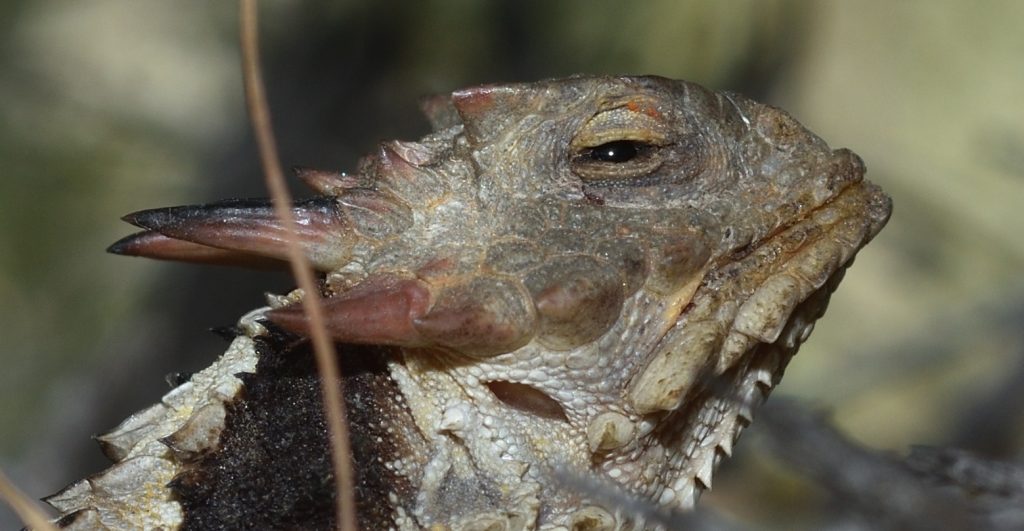
Noble Canyon, San Diego County 07/07/19
Horned toads can live in a wide variety of arid and semi-arid environments, ranging from desert to woodland, but those environments do need to meet certain requirements. They need to live in an area that has native ants (they can’t or won’t eat the invasive Argentine ants). They hunt by burying themselves in sand near ant hills and ambushing passing ants, so they need to live in an area with fine, loose sand. They also need shade for when it gets too hot. This usually means living where there’s lots of shrubbery.
I read about one exception to this last requirement in a paper about horned toads living on Table Mountain in southern California. (I’ve actually hiked this mountain a couple of times, so it was kind of cool to read a scientific paper about it.) The plateau of Table Mountain is mostly devoid of shrubbery and larger vegetation. Nevertheless, a population of P. blainvillii has managed to establish itself there by using the burrows of a species of kangaroo rat (Dipodomys californicus) as refuges from the heat. The rodents presumably receive no benefit from the lizards using their burrows, but they aren’t harmed by it either and the lizards probably could not survive in the area without the shelter of the burrows. This kind of relationship, where one partner benefits and the other is neither benefited nor harmed, is called commensalism. Here’s a link to the paper, if you’re interested.

Laguna to Cuyamaca hike, San Diego County 05/13/18
I think this is probably a juvenile, judging by the size of the horns.
Horned lizards get a lot of the water they need by extracting it from the insects they eat, but they are known to take advantage of the small amount of rain that falls in their areas using an unusual technique called rain-harvesting. When it rains, a horned lizard will raise its rear end above its head, spread it’s limbs, and flatten its back, so that the rainwater runs down its back toward its mouth. It’s evolved a network of tiny channels between its scales that channel the rainwater by capillary action. The lizard even works it jaws in a way that appears to pump the water toward its mouth! Click here to read an article about rain-harvesting. The linked article talks about research done on Texas horned lizards (Phrynosoma cornutum), but I’ve seen another paper on rain-harvesting in desert horned lizards (Phrynosoma platyrhinos) 2. I would guess that P. blainvillii exhibits similar behavior, but I don’t know if anyone’s look into it.
Horned lizards are slow moving compared to most lizards. Their main defense is their protective coloration, which allows them to blend in to their environment. They can even change their color from dark to light or vice versa to better match their surroundings. This takes them just a few minutes. If blending in doesn’t work, they’ve got some impressive armor to fall back on. The rows of spikes on their bodies are modified scales, but the horns on their heads have bony cores, which are extensions of the skull.
Horned lizards are pretty good at recognizing the type of predator they’re dealing with and reacting accordingly. When encountering a predator that swallows its prey whole, like the Greater Roadrunner, a horned lizard will puff itself up to make itself harder to swallow. Rattlesnakes are ambush predators and don’t chase their prey, so a horned lizard will actually run from them. A whip snake, on the other hand, is a fast, active hunter, so a horned toad encountering one of these snakes will hold very still and rely on its camouflage.
When a horned lizard does run, it just goes a short distance and then freezes. This is an effective strategy because most predators focus on motion. When the lizard suddenly stops moving, the predator will often lose sight of it.
The horned lizard reserves its most impressive defense mechanism — its superpower, if you will — for canids like dogs, coyotes, and foxes. If a coyote has you in its claws, you aren’t going to be running anywhere and puffing up isn’t going to do you any good either. So, what’s a horny toad to do in that predicament?
Well, you could always squirt a stream of foul-tasting blood out of your eyes… By restricting the blood flow from its head, a horned lizard increases the pressure, rupturing thin blood vessels around its eyes and sending a stream of blood shooting out, often directly into the predator’s mouth. The blood contains chemicals that make it repellent to canids. (It’s been suggested that it gets these chemicals from the harvester ants it eats, which are known for their painful stings.) Click here to watch a great National Geographic video of a horned toad squirting blood.
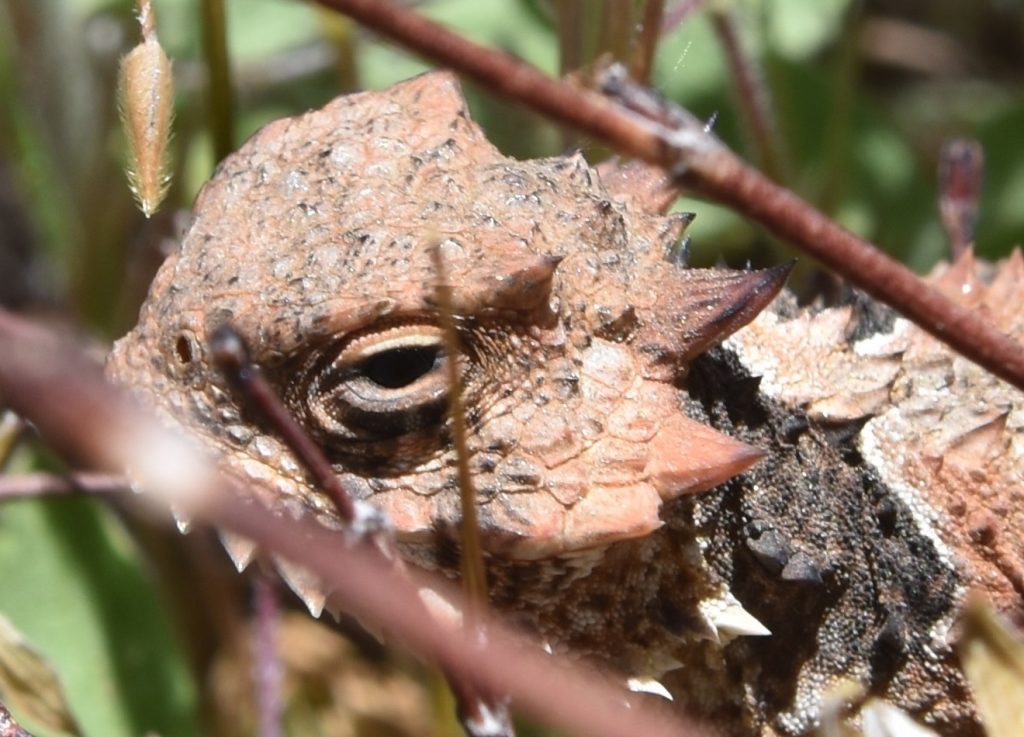
Laguna to Cuymaca hike, San Diego County 05/13/18
Blood-squirting must be a rather expensive form of self-defense, because horned lizards only use it as a last resort. They don’t normally do it with people. When a human catches them, they usually just hold still and hope for the best. Maybe they recognize humans as low-risk. (I suppose if you tried to eat one it might work, but, well… let’s just not try that.) I’d be interested to know if horned lizards have any control over the direction in which they squirt blood. If so, none of the articles I read mentioned it.
Rattlesnake BM hike, San Diego County 08/27/17
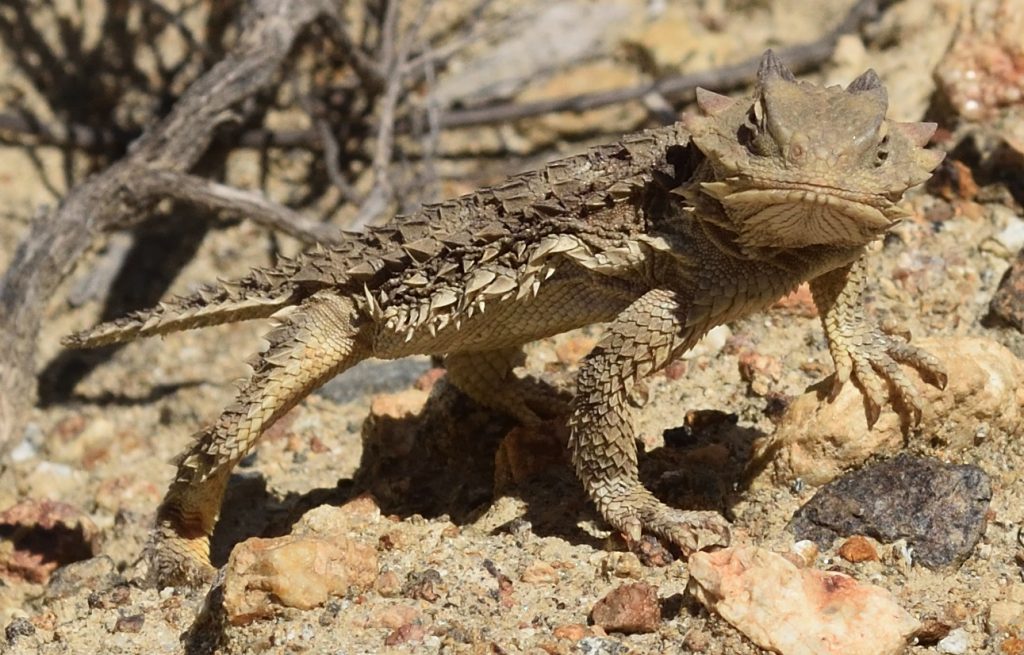
Noble Canyon, San Diego County 07/07/19