Back when we were kids, my sister gave me this book for my birthday. The title was “Creatures from the Inner Sphere” and the premise, as far as I could tell, was that the Lock Ness Monster is the Devil and flying saucers are angels. (My sister knew I liked science, so I guess she just grabbed the first book that looked “sciency” to her.)
You may be wondering if this article is of a similar nature. It’s not. It’s about the parietal eye of lizards, which is often informally referred to as the third eye. The parietal eye is located on the top of the head at the mid-line. The other two eyes are called lateral eyes to distinguish them. Not all lizards have a parietal eye, but most do. The parietal eye is sometimes called a pineal eye, because of its connection to the pineal gland. (We’ll get to that later.)
You’re probably wondering why you’ve never noticed that lizards have three eyes. That’s because the parietal eye is much smaller than the lateral eyes, so it’s easy to miss. You may also be wondering if the parietal eye is a real eye. That depends on who you ask. The parietal eye is sensitive to the intensity, wavelength, and direction of the light hitting it, but it doesn’t actually form an image. On the other hand, it does contain a cornea, a lens, and a retina, although these are less developed than in the lateral eyes. Also, it doesn’t contain rods and cones like the lateral eyes — it uses a different biochemical method of sensing light.1 So I guess it’s a matter of opinion whether or not it’s a real eye. It’s definitely “eye-like”, though.
Home Invasion
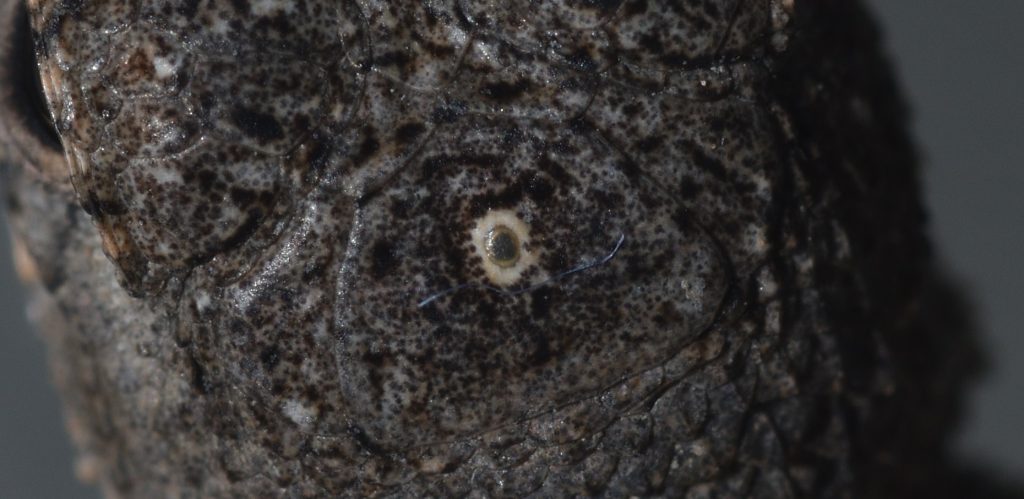
I recently came home from a camping trip only to find that my apartment had been broken into. The culprit was a baby western fence lizard (Sceloporus occidentalis). The little scamp had made herself 2 at home — eating my food, drinking my beer… (okay, I made up that last part). I caught her and put her in a Tupperware container. I figured since she snuck into my home uninvited, the least she could do was pose for a few pictures.

A baby western fence lizard (Sceloporus occidentalis)
La Mesa, CA 8/11/2019
The first thing I noticed was that she had a very prominent parietal eye. There’re some good shots of it in the photos below. This inspired me to learn a bit more about the organ and that led to this post.



So what does the third eye do? Well, when a lizard goes into a trance and drifts out of its body… sorry. The function of the third eye is not completely understood, but it’s connected to the pineal gland and is known to be involved in circadian rhythms and the regulation of body temperature. One article describes it as acting like a “dosimeter” in the sense that it keeps track of changes in light intensity and wavelength. In fact, it’s probably worth quoting the article, since I think it sums it up pretty well:
“The parietal eye is thought to play a role in both hormone production and thermoregulation, by acting as a dosimeter, with an ability to sense changes in intensity and wavelength of light then convert photic stimuli into neuroendocrine messages, allowing optimal timing for reproduction and other activities.” 3
One of the things the parietal eye controls is the length of time a lizard suns itself. Experiments have shown that if a lizard’s third eye is blocked or removed, it will stay out in the sun longer, apparently no longer being able to tell when it’s had enough exposure.4
In another experiment, researchers at the Università di Ferrara in Italy showed that at least some lizards use their parietal eyes like compasses. The lizards in the experiment were ruin lizards (Podarcis sicula). The researchers released the lizards into an outside, hexagonal pool of water and trained them to swim to a platform on the periphery of the pool. After the lizards learned to find the platform, the researchers lowered the platform to just below the surface of the water and released the lizards again. The lizards were still able to find the platform. Then the researchers removed the platform altogether. When the lizards were released into the pool, they swam to the part of the pool where the platform had been located.
In the second part of the experiment, the researchers shifted the lizards’ internal clocks either 6 hours forward or 6 hours backward. (Presumably, they did this by keeping them in artificially lit rooms where the light cycle was out of step with the sun.) This time, when the lizards were released into the pool, the ones whose internal clocks were shifted back looked for the platform further to the right, while the ones whose clocks were shifted forward looked further to the left.
In the final phase of the experiment, the researchers covered the lizards’ parietal eyes with paint. This time, the lizards swam around at random looking for the platform. The researchers also tried surgically removing the parietal eye from some of the lizards. Again, they just swam around at random. Click here to read the original article in the “Journal of Experimental Biology”.
The Long, Confusing Evolution of the Third Eye 5
Note: If you don’t feel like delving into all the messy details of third eye evolution, feel free to skip down to the Summary section at the end. I won’t blame you.
The parietal eye is an ancient structure, predating the vertebrates. Evidence for this is found in a group of living animals, the sea squirts or tunicates. The sea squirt is a chordate — a member of a group of animals, the Chordata, that possess, at some point in their lives, a notochord — a cartilaginous rod which is the precursor to the vertebral column. The adult sea squirt looks nothing like a chordate, showing no evidence of a notochord (and no third eye), however, the larval form is a recognizable chordate, possessing brain, spinal cord, gill slits, fins, a notochord, and a single eye on the top of the head.
This eye is a relatively simple structure consisting of a one-celled, pigmented cup containing a lens composed of three cells and surrounded by a layer of around 15-20 sensory cells. It’s sensitive to the presence and direction of light, but does not form an image.
All this suggests that the parietal eye evolved at least as far back as the chordate ancestors of vertebrates.
The first fossil evidence of parietal eyes is found in fish. Many fossil fish from the Devonian period (350 to 400 million years ago) display openings in their skulls where the parietal eyes would have been. In some, the openings were paired or partly subdivided, suggesting that they had a partially subdivided third eye or even two third eyes!
Actually, this isn’t too surprising because the modern lamprey also possesses two parietal eyes. Lampreys are a type of jaw-less fish. Jawed fish evolved from jaw-less fish, so the presence of paired parietal eyes in lampreys suggests that they were present in the jaw-less ancestors of modern fish more than 430 million years ago. In addition to lampreys, parietal eyes are found today in sharks and some bony fish.
The parietal eyes of the lamprey are superimposed on each other in the mid-line and “they show right (pineal) and left (parietal) connections to the brain.” 6 Apparently, even when an animal only has one parietal eye, the underlying brain structure develops as two symmetrical parts. The left part becomes the parietal eye and the right part becomes the pineal sac. In reptiles, the pineal sac secretes melatonin and the parietal eye senses light.7
In lampreys, fishes, and many other vertebrates, the parietal eye is associated with an accessory organ called the parapineal organ. I haven’t been able to find any info at all about what the parapineal organ does. Maybe not much is known about it. The parietal eye itself develops from the pineal organ in most vertebrates. However, an extinct lizard, called Saniwa, has been found that had both a pineal and a parapineal eye and, in this case, the parietal eye developed from the parapineal gland. This implies that lizards re-evolved a parietal eye. That is, they originally had a parietal eye that was evolved from the pineal gland, lost it, then re-evolved it from the parapineal gland.
Fossil amphibians also show evidence of third eyes. Even in the stem amphibians, the labyrinthodonts, the parietal foramen was almost always present. The parietal eyes of fish and amphibians are smaller than those of lizards. This makes sense in view of the fact that water absorbs much of the light, making a parietal eye less useful to aquatic animals. Apparently, fish and amphibians do get some use out of them, however, since so many still have them. The following photo shows the tiny parietal eye on the head of a bullfrog.

We’ve already noted that most lizards have parietal eyes. What about other reptiles? The tuatara (genus Sphenodon) is a reptile that lives in New Zealand. It’s the only surviving member of the order Rhynchocephalia, a group that flourished 200 million years ago. Tuataras are not lizards, but they are the closest living relatives of the squamates (lizards and snakes). As a hatchling, it has a pronounced parietal eye, although it loses it as an adult.8
Snakes are very closely related to lizards. In fact, many authors describe them as legless lizards.9 Nevertheless, snakes do not have parietal eyes. Snakes are believed to have evolved underground. This may explain why they lost their third eye.10 Many burrowing lizards still have their third eyes, though. Is it possible that they took up the burrowing lifestyle much later in evolutionary time than the snakes and have just not have time to lose the extra eye? I don’t know.
The parietal eye is absent in turtles and archosaurs, which includes birds and crocodilians. It’s also absent in the ancestors of archosaurs, which includes the non-avian dinosaurs and the pterosaurs. Reptiles evolved from amphibians, which have third eyes, so the ancestors of turtles and archosaurs must have had third eyes, too. So they lost them at some point. Why is this? All animals that have parietal eyes are cold-blooded. Presumably, once an organism evolves the ability to maintain its body temperature through metabolism, it no longer has as much use for a parietal eye. Birds are warm-blooded, so it makes sense that they would lose the third eye. Crocodilians are cold-blooded, but they evolved in the tropics, close to the equator, where the length of the day doesn’t vary much and the temperature is usually warm, so a parietal eye wouldn’t be very useful to them, either.
Turtles are more of a mystery. The evolutionary origin of turtles is not very well understood. The latest research tends to favor the view that turtles evolved their shells as an adaptation to a burying lifestyle. So, like the ancestors of snakes, the early turtles may not have had much use for a parietal eye.
And that brings us to mammals. I already mentioned that no warm-blooded animals have third eyes and mammals are warm-blooded, so it’s no surprise that mammals don’t have parietal eyes. Mammals evolved from reptiles, though. Specifically, they evolved from a group of reptiles called therapsids and fossil evidence indicates that most of these had parietal eyes.
This brings up an interesting point. It stands to reason that early mammals would have lost their parietal eyes at around the same time that they became warm-blooded. A group of researchers at the University of Witwatersrand in South Africa decided to use this to see if they could figure out when mammals evolved warm-bloodedness. The best fossils of therapsids are found in the Karoo region of South Africa, so the researches examined fossils from this region looking for the presence or absence of the parietal foramen, which is indicative of a third eye. What they found was that the shift from cold-bloodedness to warm-bloodedness must have occurred around 246 million years ago, about 10 million years before the first dinosaurs.
Finally, what remnants of the third eye are there in modern mammals, including us? Well, we still have a pineal gland. However, it’s no longer at the top of the head. Instead, it has migrated deep inside the brain to a point just behind and below the thalamus. Its primary function is to produce melatonin, which helps control sleep/wake patterns, but studies also suggest that it influences the pituitary’s production of sex hormones. The pineal gland itself also puts out many other hormones, including serotonin. It no longer contains photosensitive cells, so, presumably, it gets its info about the outside world from the lateral eyes or maybe indirectly from other parts of the brain.11
Summary
Now I’m going to attempt to summarize all of this, based on my understanding of it, which, admittedly, is not very good. If any of you readers have a better understanding, then, by all means, please enlighten me in the comments.
The pineal gland originally evolved as a sensory organ at the top of the head in chordates. It contained photosensitive cells, so it actually formed the parietal eye. It was often associated with an accessory organ called the parapineal gland. In some organisms, both glands were visible at the top of the skull, sometimes separated by a short space. Presumably, both were photosensitive. Maybe they had closely related, but different functions. In many vertebrates, the parapineal gland was eventually lost, leaving only the parietal eye (the one that was developed from the pineal gland). In mammals, the pineal gland migrated away from the top of the skull and lost its photosensitive properties. So modern mammals do not have a parietal eye.
In lizards, the pineal gland also lost its photosensitive properties, but, at some point in their evolution, these properties became useful again, so lizards re-evolved them. But this time, they used the parapineal gland instead of the pineal gland to do so.
Told you it was confusing.