There once was a small frog named the Pacific chorus frog. To scientists, it was known as Hyla regilla, and it had an impressive range, extending from southern Alaska all the way to Baja California. In 1986, the species was moved from genus Hyla to Pseudacris, and it became known as Pseudacris regilla.
There things stood until 2006, when some pesky molecular biologists came along and determined that P. regilla should be split into three species — the northern species would retain the scientific name, P. regilla, as well as the common name, Pacific chorus frog; the central California species would, henceforth, be called P. sierra or the Sierran tree frog; and the southern species, which ranges from southern California into Baja California, was to be rechristened P. hypochondriaca or the Baja California tree frog.
Actually, that’s not quite true. The authors of the 2006 paper used incorrect names for two of the species, and they had to fix their mistake in a subsequent paper. Eventually though, we did end up with those three separate species, and that remains the case to this day. (Well… except that their conclusions are still controversial and some people disagree with the whole thing. Taxonomy is hard.)1
Anyway, I’ll be using the three-species breakdown in this article. Specifically, I’ll be focusing on the southern species, Pseudacris hypochondriaca, simply because that’s the one that I see in my area.
The Baja California Tree Frog (Pseudacris hypochondriaca)2 3 4
Just to avoid confusion — well, more confusion — I should mention that the Baja California tree frog is also called the Baja California chorus frog. The latter name is actually more accurate, since P. hypochondriaca is rarely found in trees. Nevertheless, Baja California tree frog seems to be the more popular name, so I’ll go with that one for this article.
The adult frogs measure around 0.75 to 2 inches (44 to 50 mm) from snout to vent. Their color varies quite a lot, depending on the environment. Usually, they come in green, grey, tan, or brown. They can go from light to dark or vice versa in a matter of minutes, and they can change color entirely over a period of hours or weeks. Often, there are darker markings on the back and legs, which vary in intensity.

San Diego County. 4/1/21
One feature that’s pretty constant is the dark stripe that extends from their nostrils to their shoulders and sometimes beyond, passing through the eye along the way.

San Diego County. 4/1/21
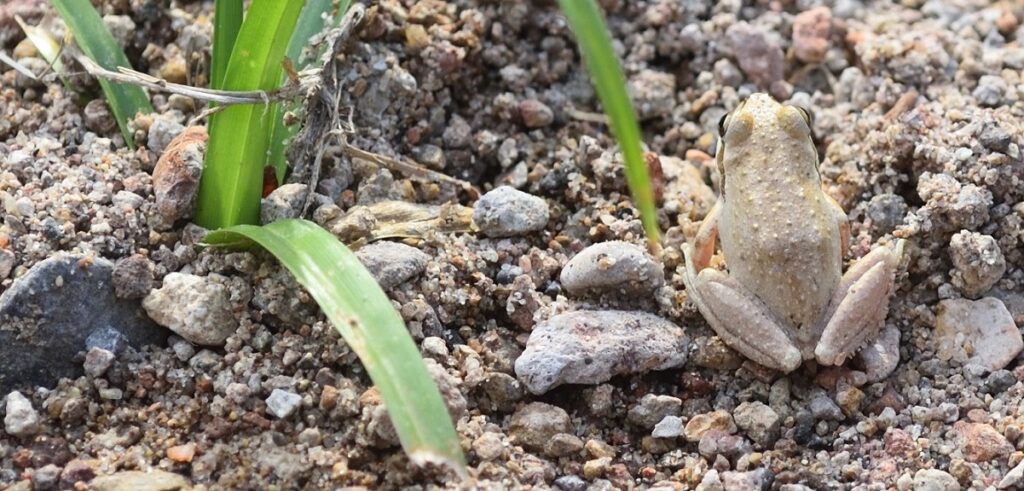
San Diego County. 4/1/21
Here’s a video of a Baja California tree frog. As you can see, this one is a darker gray color than the one in the previous photos, and it has much darker markings on the back and legs.
Here’s another specimen with similar, but not identical, markings to the one in the video.

Mission Trails Regional Park, San Diego County 11/4/17
Note the yellow-orange coloration on the bottom of the legs of the frog in the following photo. This is the usual coloration found on the ventral (bottom) surface of their bodies.

Mission Trails Regional Park, San Diego County 6/9/17
Baja California tree frogs have sticky pads on their toes, which allow them to cling to surfaces. They don’t usually climb trees, but that’s because they don’t want to, not because they can’t. I put one in a small plastic terrarium, and it was all I could do to keep it from scampering up the side of the container and escaping whenever I opened the lid. It had no trouble at all climbing the almost vertical walls of the terrarium.

Like most frogs, P. hypochondriaca is a powerful jumper. Here’s a slow-motion video of a jump. (The odd sound in the background is my voice slowed waaay down.)
And here’s the same jump at normal speed.
Baja California tree frogs eat a variety of bugs. Like other frogs, they have a sticky tongue that they use to snare their prey. Contrary to popular belief (and every cartoon frog you’ve ever seen), frogs don’t shoot out long, thin tongues to pick off bugs at a distance. In fact, their tongues are large and thick and attach near the front of the mouth, so they kind of roll out of the mouth. Click here to view a video of a tree frog eating.
The tadpoles are suspension feeders5, eating things like algae, bacteria, protozoa, and debris.
Reversible Saliva6
When a trait is vitally important to an organism’s survival, you can bet that evolution will come up with some tricks to enhance that trait. The frog’s tongue is no exception. If you watched the video of a frog eating, you might have gotten the impression that the tongue just flops out of the frog’s mouth. In fact, it whips out so fast that it hits the prey with a force of around five times the force of gravity. And it’s not just sticky — it’s coated with “reversible saliva”.
Some materials react very differently according to the type of force being applied to them. Silly Putty is the classic example. It’s soft and pliable in your hands, but when you drop a ball of it, the ball bounces as if it were made of rubber. Ketchup is another example. When you shake a bottle of ketchup, you’re actually changing the state of the ketchup, making it more watery and easier to pour.
Frog saliva reacts to shear forces in a similar way to ketchup, but in reverse. The saliva on the tongue is normally thin and watery. This allows it to seep into the cracks and crevices of the prey when the tongue strikes it. But when the tongue starts to retract, the shear forces produced change the state of the saliva so that it instantly becomes thick and sticky. In fact, it becomes more viscous than honey. It turns watery again when the tongue is back at rest inside the mouth.
A frog’s tongue is ten times softer than a human tongue, allowing it to mold itself around the prey, increasing the contact area. It’s stretchiness causes it to act like a bungee cord, pulling the captured bug toward it and “storing the intense applied forces in its stretchy tissue and dissipating them in its internal damping.”
Hollywood is in southern California, and the most common frog in southern California is, by far, the Baja California tree frog. So, when movie makers needed the sound of frogs croaking in the background, they used the first frog they found, which was, unsurprisingly, P. hypochondriaca. (Well, actually, it could have been the central species, P. sierran, whose range extends close to that area. All three species of Pseudacris seem to have identical calls.)9
It was a good choice. We expect bullfrogs to be loud — bullfrogs are big, after all — but P. hypochondriaca is less than 2 inches long. How loud could it be? Incredibly loud, as it turns out. Their croaks can be heard almost a mile away.
The croak of the Baja California tree frog has been used in so many Hollywood movies, that it’s become the “sound a frog makes” in the popular imagination all over the world. (Spoiler: when you watch Rambo running through the Vietnamese jungle, the frogs croaking in the background are not Vietnamese frogs.) Many languages have invented onomatopoetic10 words for the sound a frog makes. In English, it’s “ribbit”. If you learned as a child that “Frog says ribbit”, you have P. hypochondiaca to thank.
Here’s a video of some Baja California tree frogs ribbiting.
The frogs in the video are croaking over each other, so it might be a little hard to single any one of them out. You can click here for the sound of one frog croaking.
Only the males croak, and they do it, of course, to attract females. One way to tell a male from a female is the loose, darker-colored flap of skin under its jaw. When it’s croaking, the flap inflates with air, becoming a resonance chamber. Here’s a photo of a male in full ribbit.

Males make their calls even more noticeable by coordinating their croaks. The first male to start calling is the “chorus master”, and nearby males gradually join in, creating a “frog chorus”.
The Life Cycle11
Mating in Baja California tree frogs takes place in the water, using a behavior called amplexus. The male crawls onto the female’s back and grasps her with his front legs. Fertilization takes place externally — the female releases her eggs into the water, and the male releases his sperm to mix with them.
Females lay their eggs in small clusters of ten to eighty, which they attach to sticks, stems, or grass in shallow areas. Altogether, a female will lay between 400 and 750 eggs. The eggs hatch into tadpoles, which take two to two and a half months to metamorphose into frogs.
Here’s some photos of P. hypochondriaca tadpoles.
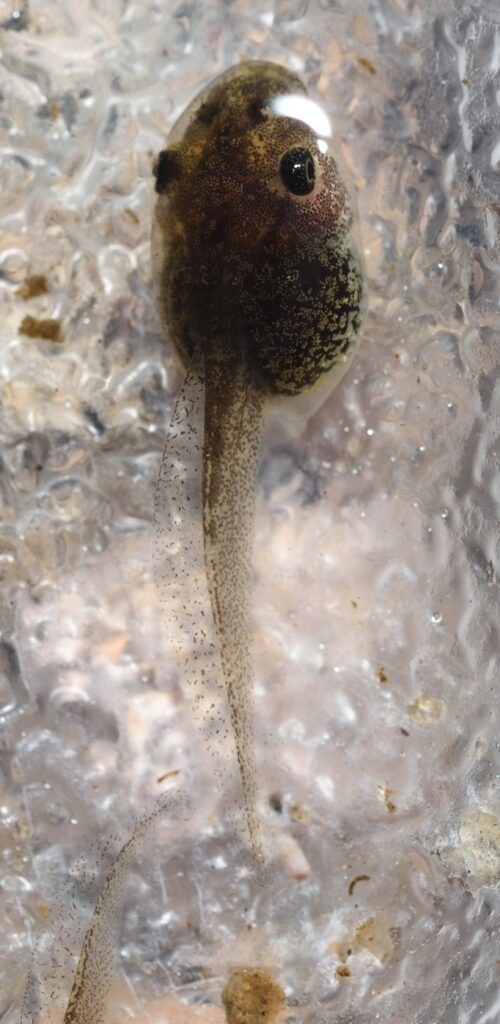
San Diego County. 4/9/21
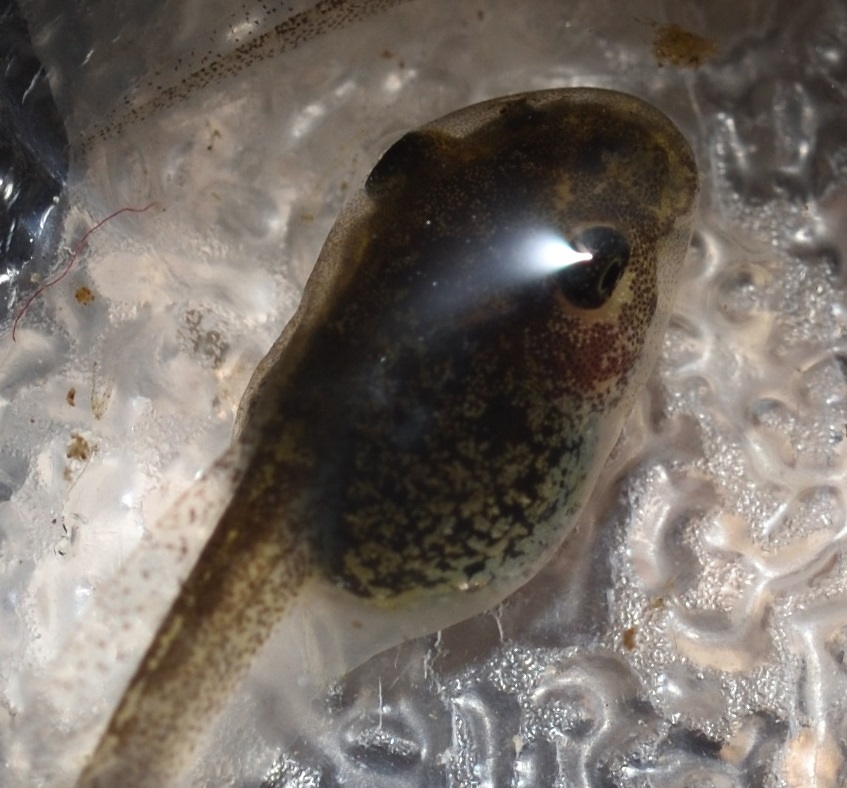
San Diego County. 4/9/21

San Diego County. 4/9/21
Here’s a view of the ventral (bottom) surface. You can see that the mouth is positioned at the bottom of the head, so it can scrape material such as algae from the substrate.

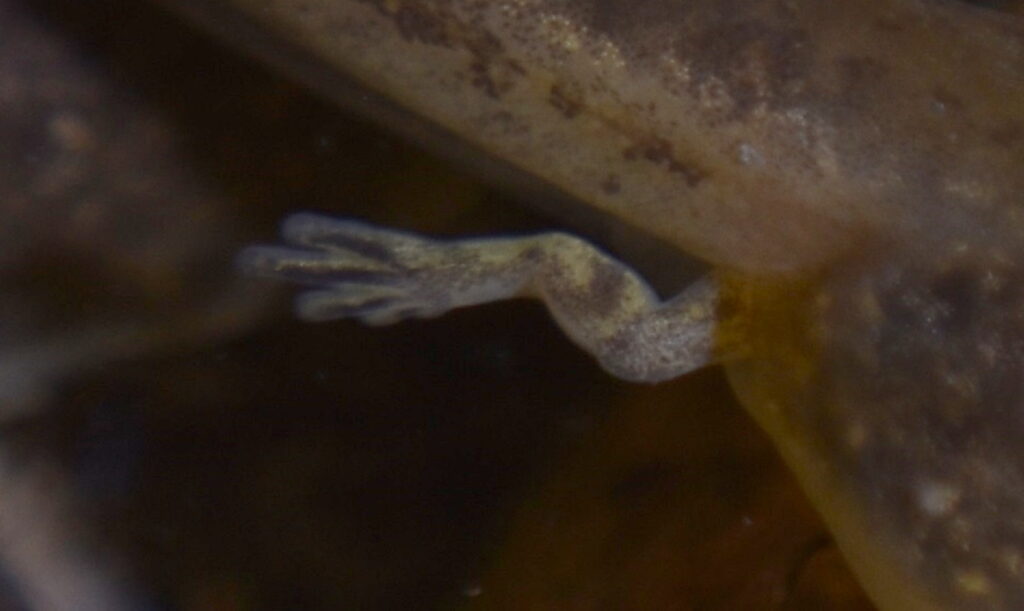
Mission Trails Regional Park, San Diego County 11/4/17
Origins12
Frogs were not the first amphibians to evolve, but they’ve been around for a very long time. Molecular studies suggest that their origins may extend as far back as the Permian, 265 million years ago, before the rise of the dinosaurs.
The oldest actual fossil we have in the frog lineage is a “proto-frog” called Triadobatrachus. It lived around 250 million years ago in what is now Madagascar, and it’s a nice example of a transitional fossil — something partway between a true frog and its earlier, less frog-like ancestors. It had a large skull consisting of thin bones, similar to modern frogs, but it couldn’t jump, and it had at least 26 vertebrae. (Modern frogs only have four to nine.) And it may have retained its tail as an adult.13 14
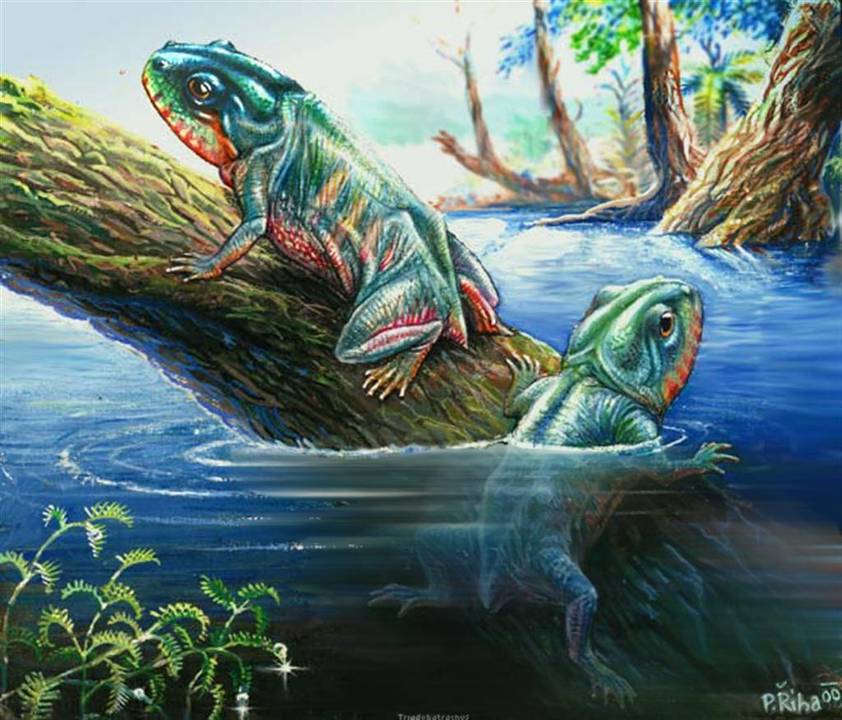
Author: Pavel.Riha.CB at English Wikipedia
Permission is granted to copy, distribute and/or modify this document under the terms of the GNU Free Documentation License, Version 1.2 or any later version published by the Free Software Foundation; with no Invariant Sections, no Front-Cover Texts, and no Back-Cover Texts. A copy of the license is included in the section entitled GNU Free Documentation License.
This file is licensed under the Creative Commons Attribution-Share Alike 3.0 Unported license.
Despite their early start, frogs don’t seem to have really come into their own until after the asteroid wiped out the non-avian dinosaurs,15 around 66 million years ago. This left lots of niches vacant, and frogs were only too happy to fill their share of them. Frogs suffered too, of course — an estimated three-quarters of life on Earth died in the aftermath of that cataclysm — but as many as ten types of frogs managed to make it through, and three of those types went on to evolve into most of the frogs we know today. So, how did frogs manage to survive an extinction event that killed off so many other groups? We don’t know for sure, but it could be that, like many modern frogs, they had the ability to spend long periods of time underground — a trait that would have been very useful when everything was going to heck above ground.
Two of those major surviving frog lineages were in what is now Africa and make up the groups Microhylidae and Natatanura. The third lineage, the superfamily Hyloidea, originated in South America, and it is from that lineage that our little Baja California tree frog eventually sprang.