What is a carnivorous plant? Seems like a simple question, right? Of course, nature is rarely simple. Suppose an animal dies next to a rosebush. Suppose also that, instead of being scavenged, its body decomposes where it fell. The rosebush will happily take up the nitrogen and other nutrients released by the decomposing body. Does that make the rosebush carnivorous? If so, that would mean that almost all plants are carnivores. So just being capable of absorbing nutrients from decomposing flesh is probably not a good definition of carnivory.
Various botanists have tried to come up with a more satisfactory definition. None of them is universally accepted, but the following, rather strict, definition is often used. According to this definition, a plant must meet the following criteria to be carnivorous: 1
- It has to do something to attract prey.
- It has to capture the prey.
- It has to digest the prey, using digestive enzymes that it secretes itself.
- It has to absorb the products of digestion. (I guess that one’s pretty obvious, but it’ll be important later.)
In this article, I’m going to go through most of the different kinds of (more or less) carnivorous plants and point out how they do or don’t meet these criteria.
Venus FlyTrap (Dionaea muscipula) 2
We may as well start with the most famous carnivorous plant, the Venus flytrap. Venus flytraps are native to the east coast of North and South Carolina. Each trap is a modified leaf, consisting of two lobes, hinged at the midrib. The interior of the lobes are a reddish color and there are small nectar-secreting glands along the rims. So any insects that happen by think they’ve found a flower and blithely crawl into the trap.
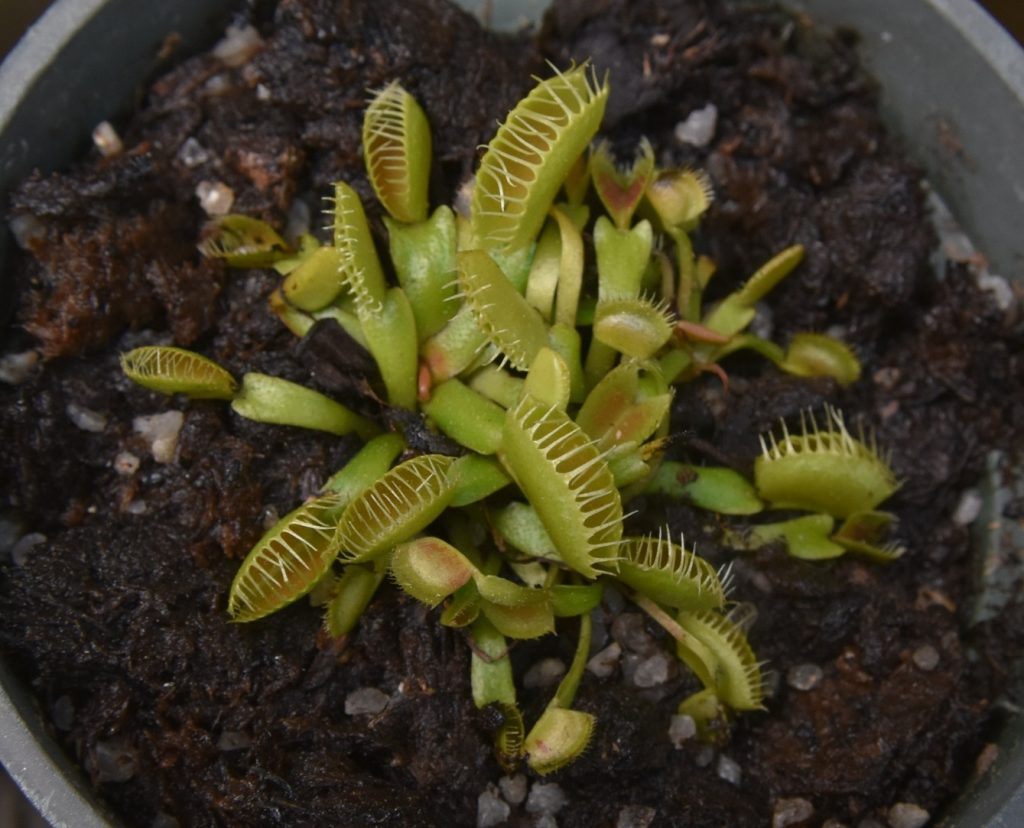
The Huntington Botanical Garden, San Marino, CA 4/22/18
Interesting that all the traps seem to be sprung. I suspect that’s because the plant is in a botanical garden. A trap probably isn’t open for long before some kid comes along…
On the upper surface of each lobe are three trigger hairs. To trigger the trap, two of these hairs much be touched within 20 seconds of each other or one of the hairs must be touched twice in quick succession. The calibration of the triggering mechanism is so finely tuned that it will not normally be triggered by non-prey stimuli, such as raindrops. After snapping shut, the trap only begins digestion if it receives at least five more triggers. This ensures that it’s caught a live bug, not just some piece of detritus.
The trap doesn’t close completely right away, though. The edges of the leaf lobes are fringed by stiff hairs called cilia. When the trap closes part-way, the cilia mesh together blocking the escape of larger prey, but very small bugs that aren’t worth eating can get out through the gaps in the cilia. If the trap fails to capture a suitable bug, it will reopen after around 12 hours.
Once the trap closes all the way, it forms a hermetic seal and essentially becomes a stomach for digesting the prey. Glands on the leaf lobes release digestive enzymes that break down the body of the prey into small components that can be absorbed through the leaf surface. Digestion takes about ten days, after which, the trap reopens, releasing the empty husk. The flytrap catches mostly crawling arthropods, such as ants, beetles and spiders.
Is it carnivorous? D. muscipula fits all the criteria listed above. By any definition, it’s a carnivore.
Waterwheel Plant (Aldrovanda vesiculosa) 3
The only extant (non-extinct) plant with a trapping mechanism similar to the Venus flytrap is the waterwheel plant, which is the only living species in the genus Aldrovanda. The waterwheel is a free-floating aquatic plant with no roots. The traps are arranged in whorls around a central stem. They’re similar to the traps of the Venus flytrap, but much smaller — the lobes are only 2-3 mm long. They trap very small prey like nematodes and Daphnia (water fleas).
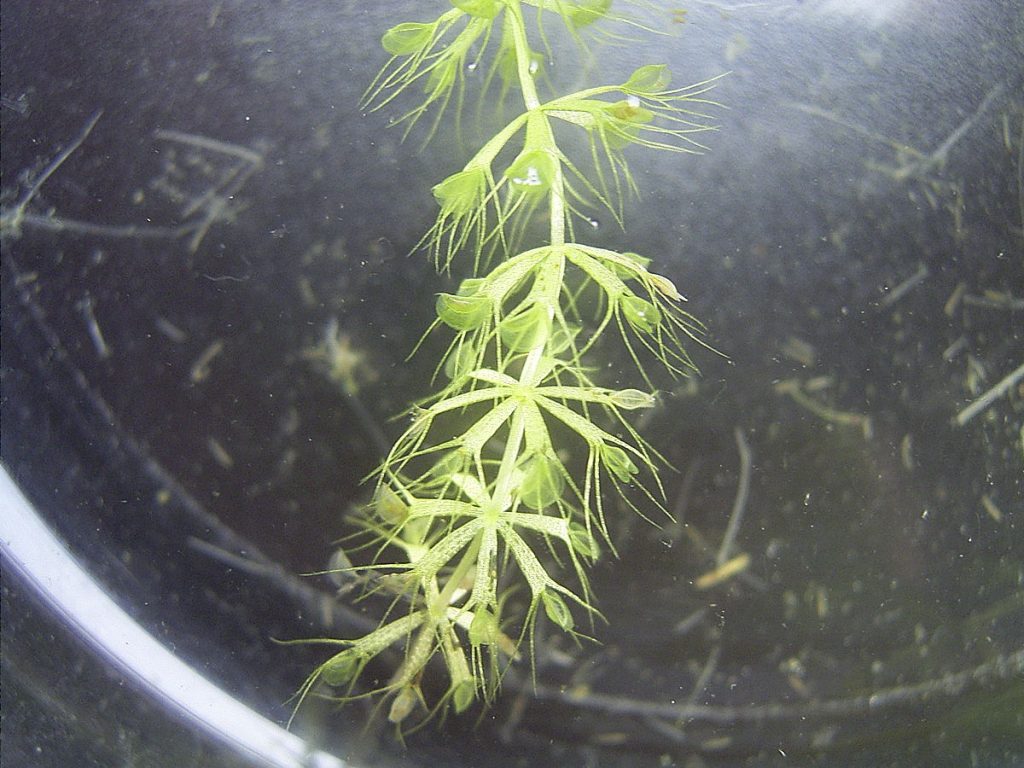
This file is licensed under the Creative Commons Attribution-Share Alike 3.0 Unported license.
A. vesiculosa is the most widely distributed of all the carnivorous plants — it’s native to Europe, Africa, Asia, and Australia. This is due to its mechanism of distribution — the small plants stick to the feet of migrating waterfowl which drop them off at their next stop. Despite its wide distribution, the waterwheel is not doing well. There are only 50 confirmed populations left in the world.
Is it carnivorous? The waterwheel fits all the criteria of carnivory except one. It doesn’t appear to do anything to attract prey. Maybe its prey is so common that it doesn’t need to. Seems like nit-picking, though. I think most botanists would still consider it a carnivorous plant.
Sundews (genus Drosera) 4
The sundews make up the genus Drosera, which contains at least 194 species, making it one of the largest genera of carnivorous plants. It’s also very widespread — there are native sundews on every continent except Antarctica. Here in California, there are at least two native species — the great sundew (D. anglica) in the central and northern part of the state and the round-leaved sundew (D. rotundifolia), which seems to have a slightly larger distribution, extending a bit farther south. There are also a number of introduced species.5

The Huntington Botanical Garden, San Marino, CA 4/22/18
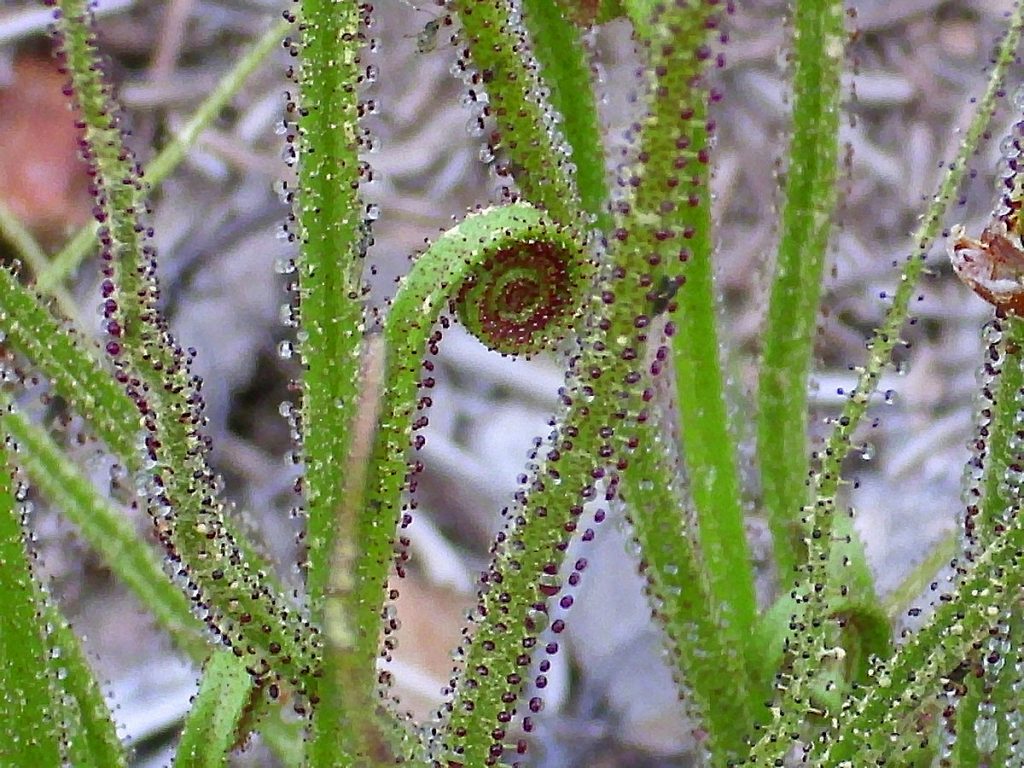
In most species of sundew, the leaves are covered with two types of glands. The first type takes the form of long tentacles, topped with sticky globs of sweet, glistening mucilage. These globs attract insects, snare them, and then secrete the enzymes that digest them. (Talk about multi-purpose!) The second type are sessile (stalkless) glands that absorb the products of digestion.

(Closeup from the last photo)
As soon as an insect is snared by the mucilage, the surrounding tentacles begin to bend toward the center of the leaf, bringing more globs of mucilage in contact with the bug. The mucilage clogs the spiracles (breathing pores) of the insect, causing it to suffocate. In some species, the leaf itself will bend around the insect to bring even more tentacles in contact with it. (You can see this behavior in the above photos.)
Are they carnivorous? Sundews easily meet the criteria for carnivory.
An Evolutionary Aside 6
The Venus flytrap (Dionaea), the waterwheel plant (Aldrovanda), and the sundews (Drosera) are grouped together into the family Droceraceae. Molecular and morphological studies suggest that Dionaea and Aldrovanda are more closely related to each other than to any other genera. Studies also suggest that Dionaea and Aldrovanda share a common ancestor with the sundews. The fossil record for carnivorous plants is far too sketchy to allow us to trace the evolution of these groups, but genetics and morphology can give us some clues. According to current thinking, Dionaea and Aldrovanda probably evolved from a sundew ancestor.
We’ve already seen that the leaves of many types of sundew will curl around a trapped insect and that this reflex is triggered by the insect touching the glandular tentacles of the leaf. The leaves of the various species of Drosera vary greatly in form. In the particular species shown above, the leaves are long and strap-like, but in many species they’re round. It’s not too hard to imagine how a round leaf with a propensity for closing around prey might have evolved into the snap-trap of a Venus flytrap or waterwheel. In this scenario, the glandular tentacles would have evolved into the trigger hairs of the trap, losing in the process their ability to secrete mucilage, which would no longer be needed.
Currently, there’s no evidence as to whether Dionaea evolved before Aldrovanda or vice versa. It could have happened either way.
Portuguese Sundew (Drosophyllum lusitanicum) 7
The Portuguese sundew is native to the Iberian Peninsula and Northern Africa. It’s not closely related to the true sundews (genus Drosera), but it does resemble them, having long glandular tentacles that trap insects. Unlike the tentacles of the sundews, however, these tentacles do not move in response to stimuli.
Author: Javier martin
Released into the public domain on Wikipedia Commons. Link to source page.

Is it carnivorous? D. lusitanicum excretes it’s own enzymes to digest trapped insects. So, although it’s traps are completely passive, it fits all the criteria for strict carnivory.
Bladderworts (genus Utricularia) 8 9 10
Bladderworts are found all over the world, except, of course, Antarctica. Quite a few species are native to California. Utricularia includes both terrestrial and aquatic species. In both cases, the main part of the plant grows beneath the surface.

Author: fischermans
This file is licensed under the Creative Commons Attribution-Share Alike 3.0 Unported license.
All bladderworts are carnivorous, trapping small prey using bladder-like traps. These traps are quite sophisticated. In fact, Utricularia may be the among the most highly developed plants in the world. Each trap has a trapdoor with trigger hairs. When a prey animal touches a trigger, the trapdoor opens and the animal is sucked into the bladder. The trapdoor quickly closes, trapping the animal inside. This process takes only ten to fifteen milliseconds. The bladder secretes digestive enzymes into the trap and the plant absorbs the products of digestion.
Water is constantly being pumped out of the trap. This creates a negative pressure inside the trap, due to the elasticity of the bladder walls. That is, the walls of the bladder are sucked inwards as water is pumped out. When the trapdoor opens, the walls spring apart, creating the suction that pulls in the prey.
Terrestrial species of bladderwort tend to feed on very small prey such as protozoa and rotifers swimming in the water-saturated soil. Aquatic species usually have larger traps and can feed on larger prey such as Daphnia, nematodes, mosquitoes, young tadpoles, and even fish fry.
Are they carnivorous? Yes.
Butterworts (genus Pinguicula) 11 12 13
Butterworts are found throughout the Northern Hemisphere, as well as Central and South America. Mexico has the most numerous species. The common name comes from the greasy feel of the plant’s leaves.
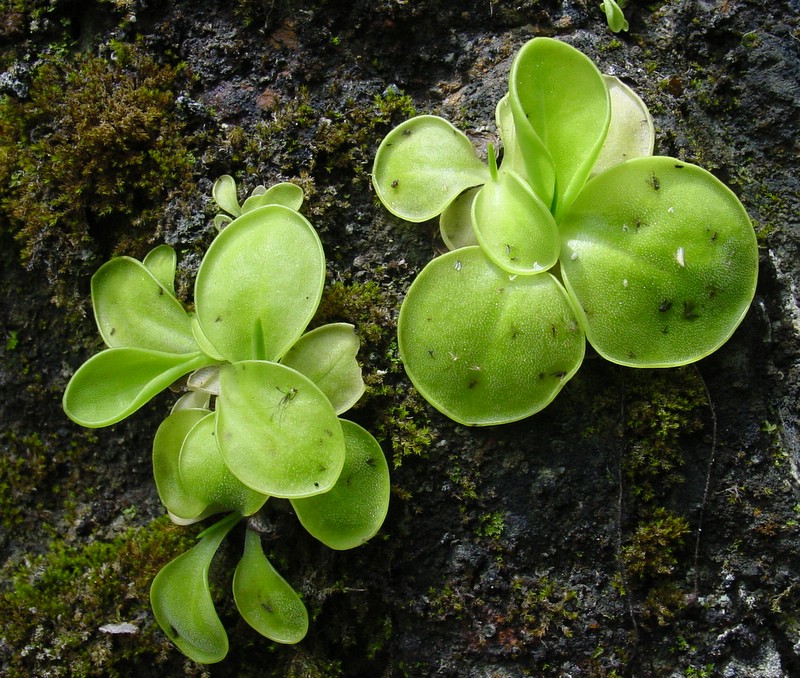
Author: NoahElhardt
This file is licensed under the Creative Commons Attribution 2.5 Generic license.
Pinquicula tend to be small plants with flat leaves. They trap prey by means of tiny glandular hairs that cover the leaves. There are two types of these glands. The peduncular glands consist a of single stalk cell with a few secretory cells at the tip. These cells produce mucilage, which forms visible droplets on the leaf surface. This gives the leaf a wet appearance, which probably helps to attract insects. The peduncular glands secrete a small amount of digestive enzymes, but are mostly used for luring and trapping small insects. Some species are able to bend the leaf edges slightly, in order to bring more of the glands into contact with the prey.
The second kind of gland found on the leaves are sessile glands, which lie flat on the leaf surface. When the peduncular glands trap a bug and start the process of digestion, the flow of nitrogen stimulates the sessile glands to release additional enzymes that complete the process. The products of digestion are absorbed through the leave surface.
Butterworts will also digest pollen grains that land on their leaves.
Are they carnivorous? Butterworts fulfill all the criteria for carnivory.
Corkscrew Plants (genus Genlisea) 14 15 16
Corkscrew plants are small plants native to Africa and Central and South America. Genlisea have no roots. Instead, they have two types of leaves — above-ground leaves that carry out photosynthesis and highly modified subterranean leaves that attract, trap, and digest tiny invertebrates, especially protozoa. Each of these underground leaves forms a hollow tube which forks into a pair of capillary tubes. Spiral grooves along the length of each capillary tube allow the prey to enter and inwardly-pointing hairs prevent them from escaping. At the fork, the prey enters the main tube, which also has inwardly-pointing hairs. Eventually, the animal reaches the digestive chamber — a vesicle containing glands which secrete digestive enzymes.

Author: Denis Barthel
This file is licensed under the Creative Commons Attribution-Share Alike 3.0 Unported license.
Besides trapping prey, the subterranean leaves of the corkscrew plant serve many of the functions of roots, including anchoring the plant and absorbing water and nutrients.
Are they carnivorous? Several of the articles I read mentioned that corkscrew plants attract prey, but I couldn’t find any that explained how they do this. So, assuming this is true, Genlisea does fit the strict definition of carnivory.
Another Evolutionary Aside 17 18
The bladderworts, butterworts, and corkscrew plants are grouped together into the family Lentibulariaceae. The corkscrews branched off first from the common ancestor of Lentibulariaceae and the other two genera branched off later. Scientists believe that the most recent common ancestor of all these plants was terrestrial and had a basal rosette of flat leaves and a primary root.
The carnivorous technique of the butterworts is pretty similar to that of the sundews, minus any movement of the glands. The bladderworts and corkscrews, on the other hand, seem to be totally unique in the carnivorous plant world. Unfortunately, I haven’t been able to find any information about the evolution of carnivory in these two genera. If I find anything in the future, I’ll update this page.
American Pitcher Plants (family Sarraceniaceae) 19 20
The pitcher plants in the Sarraceniaceae family may be the most well-known of the carnivorous plants after the Venus flytrap. The family contains three extant genera — Sarracenia, Darlingtonia, and Heliamphora.
Sarracenia composes the North American pitcher plants (excluding Darlingtonia). The pitchers are formed by long leaves that curl up to form tall, water-tight tubes. Usually, many pitchers radiate out from a central point. The tubes are partially filled with rainwater mixed with digestive enzymes.
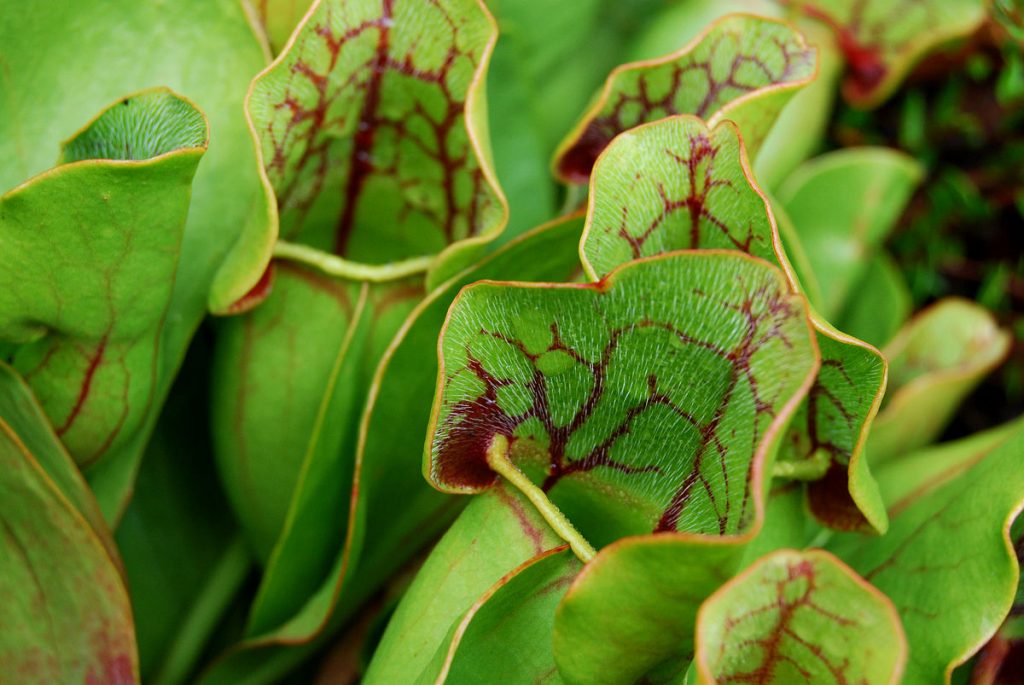
Author: Geoff Gallice from Gainesville, FL, USA
This file is licensed under the Creative Commons Attribution 2.0 Generic license.
The pitcher attracts insects with secretions from nectaries located around the lip. In most species, a waxy coating on the lip causes insects to fall in and more wax on the inside of the pitcher makes it difficult for them to climb out. Many species also have downward-pointing hairs on the inside the pitcher that make climbing out even more difficult. Further down the tube, the insects fall into the water where they drown and are digested.
At least some members of the Sarracenia genus produce their own digestive enzymes. However, most, if not all, species also use symbiotic bacteria and protozoa to supplement their supply of enzymes and some may rely on them entirely.
Members of the genus Darlingtonia are often called cobra lilies because of the their resemblance to the snake. Darlingtonia californica is the only species in the genus and it’s native to Northern California and Oregon. D. california is unusual in that it doesn’t trap rainwater in its pitchers. The water is drawn up from the roots. The hood prevents rainwater from diluting the contents of the pitcher.
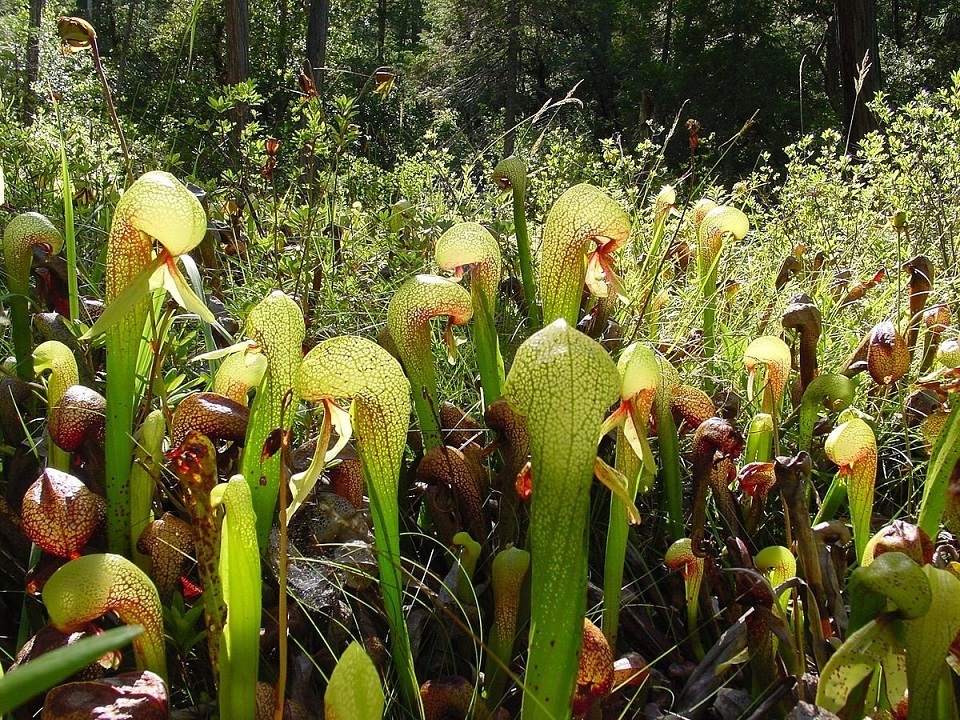
Author: NoahElhardt (talk · contribs)
This file is licensed under the Creative Commons Attribution-Share Alike 3.0 Unported license.
It used to be believed that the cobra lily did not produce any of its own digestive enzymes and, instead, relied entirely on symbiotic microorganisms to digest its prey. However, recent studies have shown that it does secrete at least one such enzyme.
Heliamphora is the genus of South American pitcher plants, which are called sun pitchers in common parlance. They’re similar to the other plants in Sarraceniaceae with the exception that most of the species in the genus do not produce their own digestive enzymes. Instead, they rely on symbiotic bacteria.
Are they carnivorous? As already mentioned, many of the species in Saraceniaceae do secrete at least some of their own digestive enzymes. Those species, at least, fit the strict definition of carnivory. Most of the members of the genus Heliamphora, however, rely entirely on symbiotic bacteria for digestion and, so, would only fit a looser definition.
Tropical Pitcher Plants (genus Nepenthes, family Nepenthaceae) 21
The pitchers of Nepenthes are remarkably similar in form to the pitchers of Sarraceniaceae, even though the the two groups are not closely related. They’re a wonderful example of convergent evolution, which is where two unrelated organisms evolve very similar features simply because they are under similar evolutionary pressures. In other words, they find similar solutions to a common problem. In this case, the common problem is how to supplement their diets. One thing all carnivorous plants have in common is that they grow in areas that are nutrient poor. Carnivory is a way of getting the nutrients that they can’t get from the soil.

Author: Attenboroughii
This file is licensed under the Creative Commons Attribution 2.0 Generic license.
Unlike the pitcher plants of the Americas, most species of Nepenthes grow as woody vines (lianas). Most of them produce two types of pitchers. The lower pitchers typically sit on the ground. The upper or aerial pitchers are usually smaller and have different features. In both cases, the pitchers grow from tendrils of the liana. The tendril of an upper pitcher will often loop around a branch to steady the pitcher. In some cases, the upper and lower pitchers are specialized to attract different types of prey.
The prey of Nepenthes usually consist of insects, but the species with the largest pitchers sometimes catch vertebrates such as lizards and even rats! A plant that eats small mammals… that may be the closest we’ll ever get to Audrey II! 22
Are they carnivorous? The members of Nepenthes are believed to secrete at least some of the digestive enzymes found in their pitchers, although these are supplemented with enzymes produced by symbiotic microorganisms. So Nepenthes seems to fit the strict definition of carnivory.
A Special Mention for Nepenthes lowii 23 24
We’re not quite finished with Nepenthes yet, because now we come to the one carnivorous plant that I absolutely had to write about. Nepenthes lowii is a tropical pitcher plant that grows in Borneo. Lower pitchers are rare, because the plant quickly enters the climbing stage in which the upper pitchers are produced. And the interesting thing about these upper pitchers is that they look a lot like toilet bowls. With lids. But the really interesting thing is that they are toilet bowls.

Author: JeremiahsCPs
This file is licensed under the Creative Commons Attribution-Share Alike 3.0 Unported license.
The underside of the lid produces a white secretion that looks a lot like snail eggs, but is actually produced by the plant itself. This secretion attracts birds, tree shrews, and the occasional rat. The opening of the pitcher and the placement of the lid have evolved in such a way that a tree shrew or rat feasting on the secretion will naturally straddle the opening of the pitcher. In fact, the pitcher appears to have evolved to be a perfect fit for tree shews. Any excrement produced by the rodent will drop into the pitcher. Poop is high in nitrogen — just what the plant is looking for. So, to put it bluntly, N. lowii eats poop.
Oh, and I almost forgot… the white secretion seems to contain a fast-acting laxative.
Is it carnivorous? Nepenthes lowii meets all the criteria for carnivory except one: it doesn’t eat the animals — just their excrement. Actually, that’s not entirely true. Insects do fall into N. lowii‘s pitchers and they do get eaten, so technically I guess it is carnivorous. However, the plant eats mostly feces and studies have shown that it is quite capable of subsisting entirely on a diet of poop. So N. lowii seems be a case of a carnivorous plant that is evolving away from carnivory.
Bromeliads (family Bromeliaceae) 25
The bromeliads are one of the few groups of monocots that includes carnivorous plants. (Monocots and dicots are two of the major groups into which the flowering plants are divided. The seeds of monocots contain only one embryonic leaf. Those of dicots contain two.) Bromeliads include both terrestrial species and epiphytes. An epiphyte is a plant that grows on another plant and gets its water and nutrients from air, rain, water (in aquatic environments) or debris that accumulates around them. Epiphytes are not parasites. They just use other plants for support.
In many bromeliads, a rosette of leaves forms a tank that catches rainwater. A pool forms in the tank and the leaves absorb water from the pool. Entire ecosystems often form in these pools, including insects and tree frogs. Animals defecate and die in the pools. Other plants, such as algae, grow in the pools and detritus collects in them. All this supplies the bromeliad with a rich source of nutrients to be absorbed by the leaves.
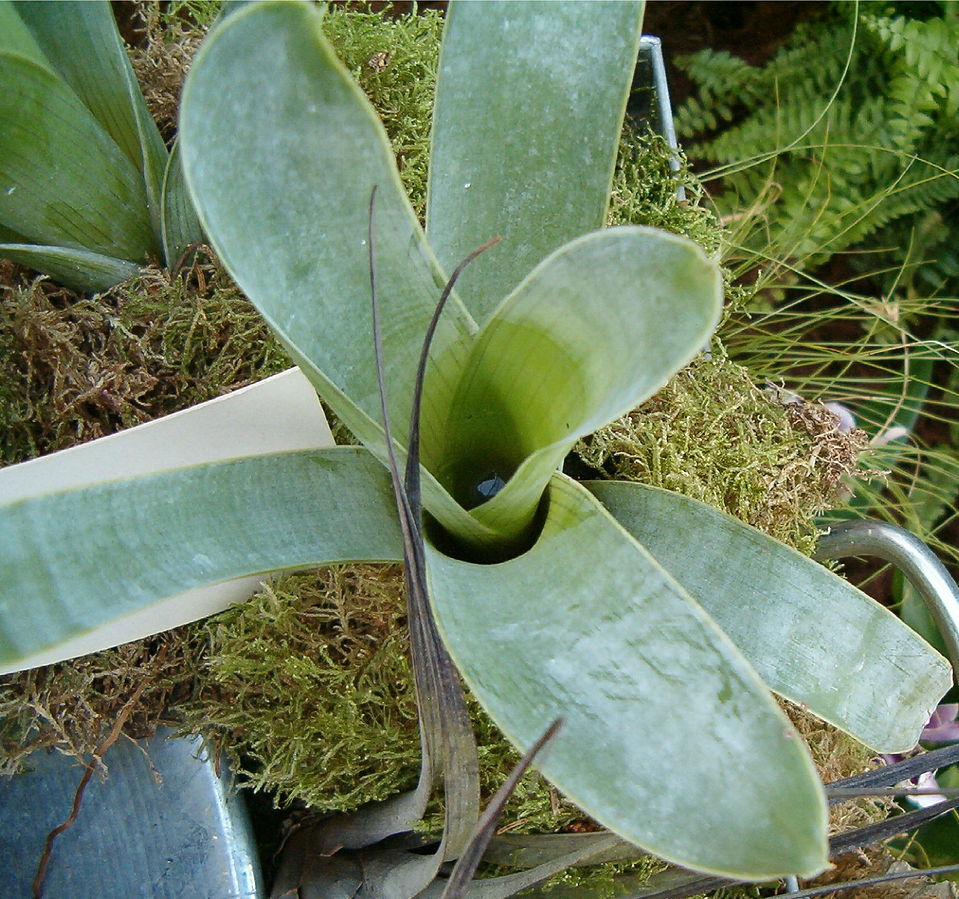
Author: BotBln
This file is licensed under the Creative Commons Attribution-Share Alike 3.0 Unported license.
A number of bromeliad species have been found to attract insects, which drown in the pools and are digested at least partly by enzymes produced by the plants.
Are they carnivorous? The bromeliads that attract, kill, and digest insects appear to fit the definition.
Another Special Mention: The Sheep-Eating Plant 26
Puya chilensis is a tree-like bromeliad that grows in the Andes. Its leaf rosettes are used by several bird species as nests. I’m not sure if P. chilensis absorbs any nutrients through its leaves, but run-off from the nests may fertilize the roots.
P. chilensis has very sharp, outwardly-pointing spines, which it probably uses to discourage predators. Birds are often trapped and killed by these spines and run-off from their decomposing bodies might also fertilize the roots of the plant. Where it gets crazy, though, is that sheep sometimes get their wool entangled by the spines of these plants and, if not rescued, they may die and decompose at the base of the plant. The roots of the plant would, of course, absorb the nutrients released by that decomposition and a rotting sheep carcass releases a lot of nutrients. For this reason, P. chilensis is sometimes called the “sheep-eating plant”.
P. chilensis does’t produce digestive enzymes, so it doesn’t fit the strict definition of a carnivorous plant. It’s still pretty amazing, though. It makes you wonder kinds of bizarre, now-extinct carnivorous plants might have existed in the past.
Click here to watch a video of some sheep caught by P. chilensis.
Dewstick or Fly Bush (genus Roridula, family Roridulaceae) 27
Roridula is a genus of shrubs native to South Africa. The leaves and sepals are covered with sticky tentacles, which trap insects. The dewstick does not digest the insects directly, however. Instead, there are two species of insect, both in the genus Pameridia, that prey on the captured bugs. These insects deposit their droppings on the leaves, which absorb nutrients from them.
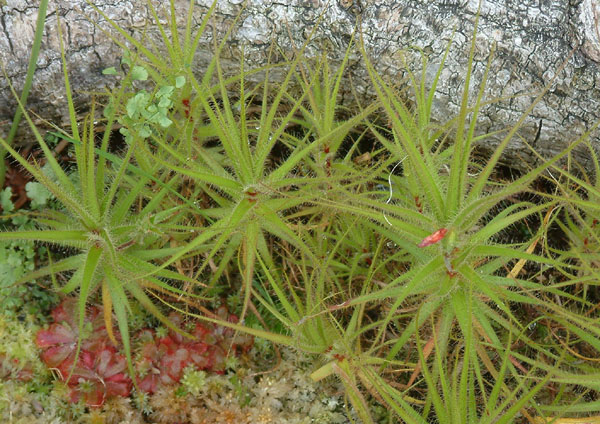
Author: Polypompholyx
This file is licensed under the Creative Commons Attribution-Share Alike 3.0 Unported license.
Are they carnivorous? The members of Roridula don’t excrete their own digestive juices. They don’t even eat the trapped insects — just the feces of the symbiotic Pameridia. So they certainly don’t fit the strict definition of carnivory. And yet, they do attract and capture insects and, eventually, the nutrients from those insects get into the plant by way of the Pameridia. So maybe the strict definition is too strict.
Occasionally, we encounter a plant that seems to meet all the criteria for carnivory except one: they don’t actually eat their prey. For instance, there are plants that attract insects, capture the insects, and even secrete digestive enzymes to digest the insects, but they don’t absorb the products of digestion. What could possibly be going on here?
In fact, the solution to this conundrum is pretty simple. Plants don’t just kill insects in order to eat them. They also kill them to protect themselves from being eaten. It’s not hard for plants to attract insects. They do it all the time without meaning to. So plants have had to evolve defenses against being eaten. Often this means producing toxic or bad-tasting chemicals to discourage the bugs. Another approach is to secrete a sticky substance that traps them and clogs up their pores.
Suppose a plant has taken this second approach and evolved sticky glands to trap insects. How could it take the next step and evolve a way to eat them? Actually, this isn’t as hard as it sounds. It turns out that regular, non-carnivorous plants are able to absorb nutrients through their leaves. They do it through their stomata (breathing pores), but also directly through the epidermis — the outer layer of the leaf. Some horticulturalists and other plant people have taken advantage of this by applying liquid fertilizer directly to the leaves — a process called foliar feeding.30
So some plants that trap and kill insects, but don’t eat them, may be on their way to becoming fully carnivorous. This kind of plant is sometimes called a protocarnivorous plant. The term is also used more broadly to refer to any plant that comes close to being fully carnivorous, but doesn’t quite fit the bill. Many of the plants discussed above could be classified as protocarnivorous. (You may also encounter terms like paracarnivorous, subcarnivorous, and borderline carnivorous. They’re all used pretty much interchangeably.)
A great many groups of plants have been examined for possible carnivory or protocarnivory — many more than I care to cover in this post. But if you’re interested, you can click here to read a paper that goes through various plant families, examining each one for evidence for carnivory. It’s actually a pretty good read and I used it as a reference for much of the information presented here. For the purposes of this article, though, I’ll just mention one of the possibly protocarnivorous plants that I’ve encountered in Southern California…
The Catchfly, a Possible Protocarnivore
Plants in the genus Silene (family Caryophylaceae) are called catchflies because many species have sticky hairs on their stems and calyxes that trap and kill insects. They don’t seem to digest the insects, though, so they’re probably doing it as a defense against predation.
I’ve seen a couple of species of Silene in San Diego County. The beautiful scarlet catchfly (Silene laciniata angustifolia) is a California native:
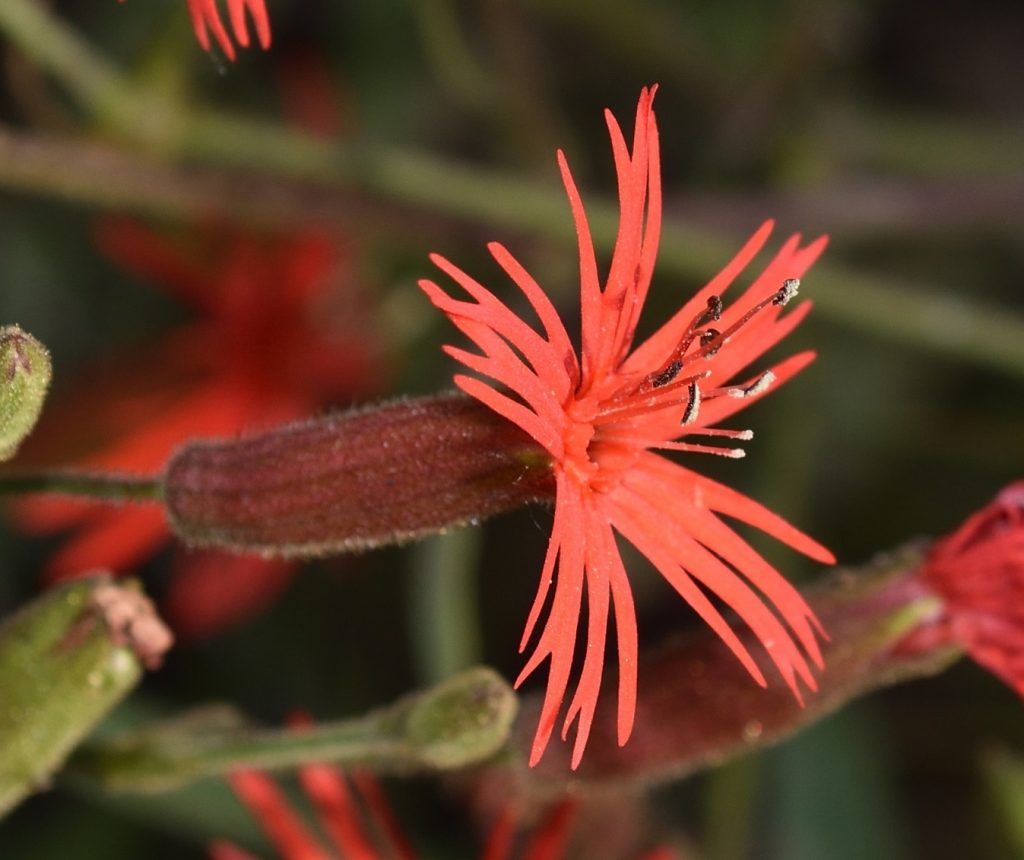
Mission Trails Regional Park, San Diego County 5/30/19
Small-flowered catchfly or common catchfly (Silene gallica) is another commonly seen catchfly in my area. A non-native, unfortunately.
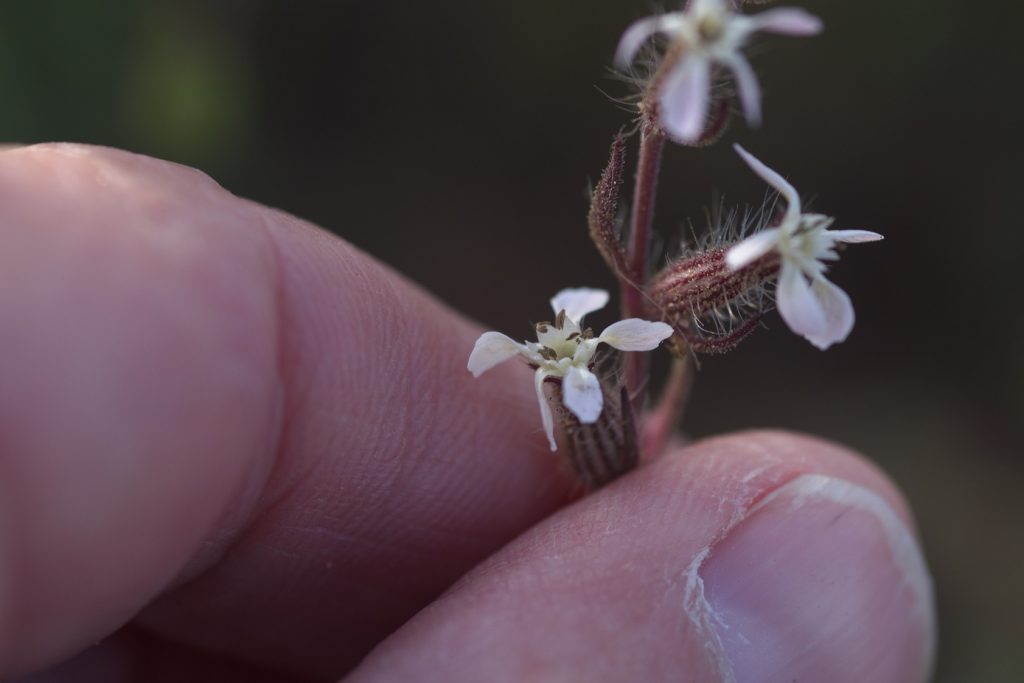
Mission Trails Regional Park, San Diego County 4/15/19
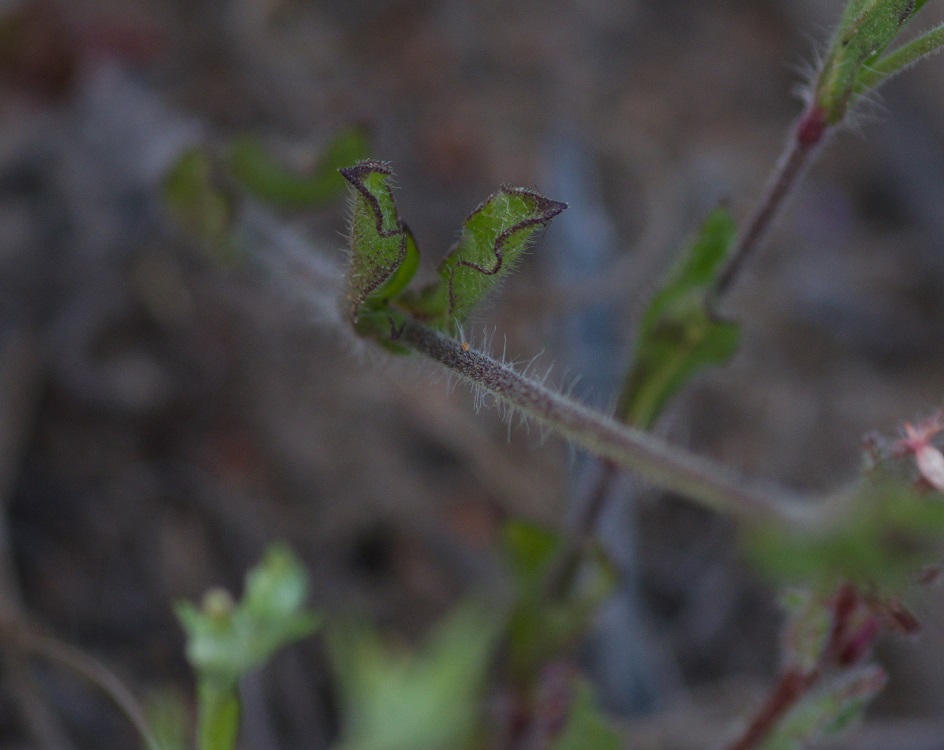
Note the hairs on the stem and leaves.
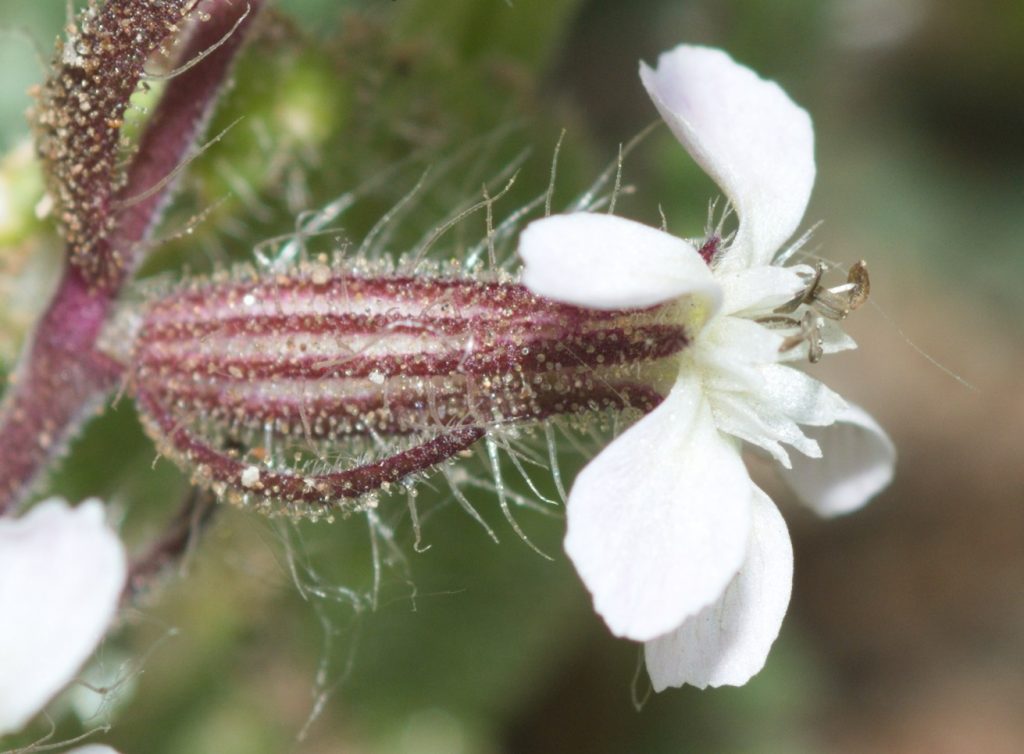
Note the glands on the calyx of the flower.
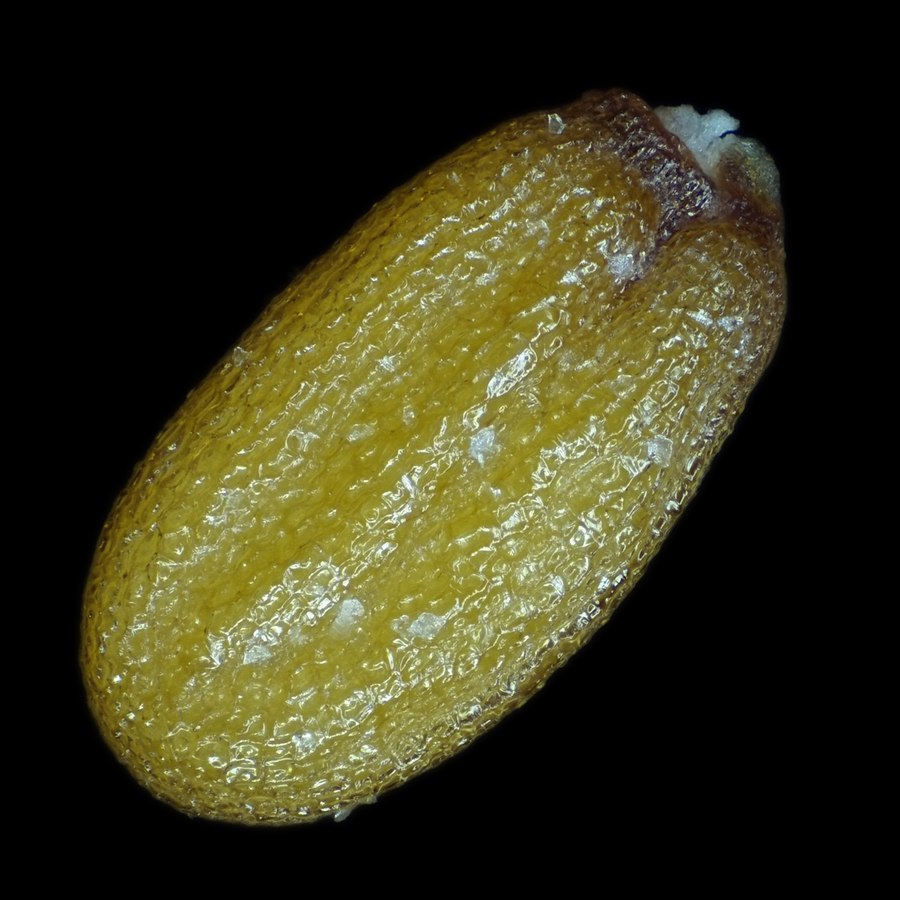
Because… why not? Shepherd’s purse (Capsella bursa-pastoris) is a small plant in the mustard family (Brassicaceae). According to findings presented in Nature,33 nematodes — very tiny roundworms that are super-abundant in soil — are attracted to the seeds of this plant, get stuck in the sticky mucilage coating the seeds, and eventually die, fertilizing the soil around the plant. The researchers found that plants germinated in soil containing nematodes did better than those germinated in soil without nematodes, especially if the soil was nutrient-deficient.
Author: Alexander Klepnev
This file is licensed under the Creative Commons Attribution 4.0 International license.
Is it carnivorous? It’s not known whether or not enzymes produced by the seeds play a role in the digestion of captured nematodes. It’s possible they may enlist the aid of symbiotic microorganisms to do the job, but there’s no conclusive evidence for that, either. So, at present, C. bursa-pastoris cannot be said to fit the strict definition of a carnivorous plant. It certainly counts as a protocarnivorous plant, though. And, in any case, a seed that eats worms is pretty freaking awesome!
- https://academic.oup.com/jxb/article/60/1/19/567619
- https://en.wikipedia.org/wiki/Venus_flytrap
- https://en.wikipedia.org/wiki/Aldrovanda_vesiculosa
- https://en.wikipedia.org/wiki/Drosera
- https://www.inaturalist.org/check_lists/7084-Carnivorous-Plants-of-California
- https://www.ncbi.nlm.nih.gov/pmc/articles/PMC3907454/
- https://academic.oup.com/botlinnean/article/161/4/329/2418471
- https://academic.oup.com/botlinnean/article/161/4/329/2418471
- https://www.californiacarnivores.com/pages/bladderworts-utricularia
- https://en.wikipedia.org/wiki/Utricularia#Distribution_and_habitat
- https://www.californiacarnivores.com/pages/butterworts-pinguicula
- https://academic.oup.com/botlinnean/article/161/4/329/2418471
- https://en.wikipedia.org/wiki/Pinguicula
- https://en.wikipedia.org/wiki/Genlisea
- http://www.honda-e.com/IPW_4_Illustrations/Illustration_Genlisea_01.htm
- https://academic.oup.com/botlinnean/article/161/4/329/2418471
- https://en.wikipedia.org/wiki/Lentibulariaceae
- https://academic.oup.com/botlinnean/article/161/4/329/2418471
- https://en.wikipedia.org/wiki/Sarraceniaceae
- https://en.wikipedia.org/wiki/Sarracenia_purpurea
- https://en.wikipedia.org/wiki/Nepenthes
- Little Shop of Horrors – https://en.wikipedia.org/wiki/Little_Shop_of_Horrors_%28film%29
- https://carnivorousplantresource.com/the-plants/nepenthes-lowii/
- https://listverse.com/2013/06/14/10-deviant-obscure-carnivorous-plants/
- https://academic.oup.com/botlinnean/article/161/4/329/2418471
- https://en.wikipedia.org/wiki/Puya_chilensis
- https://en.wikipedia.org/wiki/Roridula
- https://academic.oup.com/botlinnean/article/161/4/329/2418471
- https://en.wikipedia.org/wiki/Protocarnivorous_plant
- https://en.wikipedia.org/wiki/Foliar_feeding
- https://en.wikipedia.org/wiki/Capsella_bursa-pastoris
- https://academic.oup.com/botlinnean/article/161/4/329/2418471
- https://www.nature.com/articles/s41598-018-28564-x