…the word resonates. Beyond the look and feel of the fabric, the thought of silk conjures up images of ancient China and silkworms, of the Silk Road and Marco Polo, of beauty and eroticism. The history of silk as a textile is long and fascinating, but in this article, we look at silk, not as a textile, but as a substance — what it is and what makes it special. Commercially, silk thread is harvested from the cocoons of silkworms. But silkworms are not the only animals that produce silk. While the world of commerce may only care about the silk of silkworms, other kinds of silk play a vital role in the lives of many different animals.
You can find a list of some of the animals that produce silk by visiting the Wikipedia entry entitled, appropriately, List of animals that produce silk. The list includes a lot of insects, but also arachnids, crustaceans, and even a mollusk. Some of the animals in the list may surprise you. One that probably won’t is spiders.
All spiders produce silk. In fact, it’s fair to say that silk is central to a spider’s existence. While no insect produces more than one kind of silk, a single spider may produce many different kinds. Spiders are the undisputed masters of silk production and much of this article will be devoted to them.
But I’m getting ahead of myself. Let’s start by answering a very basic question: What is silk?
‘Protein’ is one of those words that most people know and use without giving much thought to what it actually is. Briefly, a protein is a large molecule that is made up of one or more long chains of smaller molecules called amino acids.3 There are around 500 different amino acids, but only about 20 of them occur naturally in proteins.
We all know that proteins are important for our health, but, here again, most people couldn’t tell you why. Well, here’s why… our bodies use them for just about everything! For starters, much of the stuff in our bodies is built from proteins. They are structural elements, in other words. But proteins aren’t just for building things. Most enzymes are proteins. An enzyme is a catalyst — a chemical that can greatly speed up (or make possible) a chemical reaction without being used up itself in the process. Enzymes are central to all sorts of metabolic processes. Proteins can also act as signals, making cell to cell communication possible.
How is it that proteins can serve so many different purposes? It’s because they can take an almost endless variety of forms. As noted, a protein is basically a long chain or chains of amino acids. The various amino acids in the chains are attracted to and repulsed by other atoms and molecules in their surroundings and also by each other. This often causes the protein to “ball up” into some very complicated structure. This structure may be useful as a building block or it may contain some nook or cranny that’s just the perfect size for a smaller molecule to fit into. In the latter case, the protein may be able to function as an enzyme.
While many proteins naturally curl up into balls, they don’t all do it. Some of them form fibers. Some of those fibers can be used to form silk. And that (finally) is what silk is — a natural protein fiber.
Since proteins are so readily available in every living thing, it’s not too surprising that many different kinds of animals have evolved to use proteins for making silk. Many types of insects, in particular, have gone this route. Usually, it’s just the insect larvae that produce silk. The larvae of the domestic silkworm moth (Bombyx mori) is, of course, the best known example.
A silkworm produces raw silk in its salivary glands. The silk is extruded as a liquid which quickly hardens when exposed to air. The silkworm uses its silk to spin a cocoon around itself. Each cocoon is spun from a single thread of silk that, if stretched out, would be anywhere from 300 to around 900 meters long (1,000 to 3,000 feet). When the silkworm metamorphoses into an adult moth, it releases an enzyme (yet another protein!) that eats a hole in the cocoon so that it can escape. Unfortunately, this can cause the thread to break up into shorter individual threads, which seriously reduces the value of the silk. For this reason, silkworms are not usually allowed to go through metamorphosis. Instead, they are killed by boiling the cocoons before the silk is harvested.
Many other moths and butterflies, as well as other insects, spin silk cocoons. Many insects also use silk to construct shelters. The next couple of photos show a nest of fall webworm moth caterpillars (Hyphantria cunea). Presumably, the silk covering, flimsy as it is, serves to discourage small predators, such as parasitic wasps. (In case you’re wondering, the little black balls that have collected at the bottom of the webbing are caterpillar poop.)

Lewis Ginter Botanical Garden, Richmond, VA 7/1/18

While it’s mostly the larvae that produce silk, there are a few examples of adult insects that do so. Webspinners are an entire order of insects, the Embioptera. They are all fairly similar in appearance with long bodies and short legs. Only the males have wings.
A webspinner’s silk glands are located in its “feet”. More accurately, they’re located in the last segment of the insect’s leg, which is called the tarsus (pl. tarsi). This segment is divided into subsegments called tarsomeres and it’s the first tarsomere (the one closest to the body) that contains the silk glands.6 These glands produce multiple strands of silk, which the insects use to construct the long, narrow galleries in which they live.

Mission Trails Regional Park, San Diego County 7/31/18

Mission Trails Regional Park, San Diego County 7/31/18

Webspinners are thought to be most closely related to walking sticks (order Phasmatodea), aka stick insects — the long, thin body being an obvious similarity.7
A Few Other Silk Producers
While it’s mostly insects and spiders that produce silk, there’s no law that says other animals aren’t allowed to try their hand (or foot or cerci) at it. It’s just that we don’t tend to expect it in other animals.
For instance, who would expect a mollusk to produce silk? And yet, the noble pen shell or fan mussel (Pinna nobilis) does just that. This is a huge Mediterranean clam whose shell can reach lengths of 120 centimeters or 4 feet. The clam attaches itself to the sea bed using long silk filaments called byssus that are secreted by a gland in its foot.
Up until the early 20th century, byssus was harvested to make a valuable fabric called sea silk. The cloth made from these filaments can be woven even finer than the silk from silkworms. It’s also warm and remarkably light.8 9
Peramphithoe femorata is an amphipod (a type of crustacean) that lives in the ocean. It constructs a nest-like shelter on a blade of the giant kelp Macrosystis pyrifera. It does this by using silken threads to join together the edges of the blade to form a tube. These threads are excreted by glands on its 3rd and 4th pair of periopods (legs). The amphipod manipulates the threads with its other periopods, actually weaving the silk between the sides of the blade.10
Spider mites are very tiny arthropods in the mite family. They usually live on the undersides of leaves, where they often spin silk webs to protect themselves from predators.11
Diplurans are tiny, insect-like arthropods with two long, tail-like appendages called cerci. One family of Diplura have silk glands in their cerci, but I haven’t been able to find any details about how they use it.12
Pseudoscorpions are tiny arachnids that resemble scorpions, although they are not closely related. They extrude silk from glands in their jaws, using it to weave cocoons, which they use for mating, molting, and sheltering from cold weather.13
Carp, a large freshwater fish native to Europe and Asia, uses a fibroin-like substance to attach their eggs to rocks. (Fibroin is a silk protein that’s found in insect and spider silk.) This is very interesting, as no other vertebrate that I know of has evolved the ability to make silk.14
The Structure of Silk
Silkworm silk is made up mostly of two proteins — sericin and fibroin. It consists of 70 to 80% fibroin and 20 to 30% sericin. The sericin acts as a gum sticking the fibers of fibroin together. Fibroin is what actually gives the silk its structure.15
Spider silk does not contain sericin. It’s composed almost entirely of fibroin. (At least, that’s true of all the spider silks that have been studied so far.) The particular kind of fibroin that spiders produce is given a special name: spidroin.
Fibroin consists mostly of four amino acids: glycine, alanine, tyrosine, and serine. It does contain small amounts of other amino acids, but the various kinds of silks differ mainly in the quantity and arrangement of these four.
Silks also differ in the arrangement of their protein chains. Most types of silk contain lots of tiny, microscopic regions that are highly organized. These regions are made up of “stacked sheets of protein chains that cross-polymerize into sheets. The regular organization of the protein chains suggest the organization of a crystal and hence are called ‘crystalline'”.16 These sheets are called beta sheets — usually written as β-sheets, using the Greek letter for beta. The β-sheets are connected together by loose protein chains that are free to bend and stretch. The β-sheets contribute their strength to the silk, while the loose chains contribute flexibility and stretchiness. Figure 3 illustrates this.

Author: Chen-Pan Liao
This file is licensed under the Creative Commons Attribution-Share Alike 3.0 Unported license.
Setting the Stage for Spiders
All spiders produce silk. We know this because it’s part of the definition of what makes something a spider. If it doesn’t produce silk, it’s not a spider. Of course, this is a bit disingenuous. If there were things alive today that looked like spiders and didn’t produce silk, then we would probably still call them spiders. There aren’t, so we don’t.
But what about in the distant past? Evidence suggests that silk production evolved separately in insects and spiders. Nevertheless, the chemical structures of both insect and spider silks are very similar. They both contain mostly fibroin. (See the previous section, The Structure of Silk.) This is an example of convergent evolution. The structure of fibroin must represent the easiest, most natural way to make useful threads out of proteins.
Spiders belong to the class Arachnida, which includes such animals as mites, ticks, and scorpions. Arachnids colonized the land at least as far back as the late Silurian, more than 400 million years ago (mya). Land plants in those days were at most only a few centimeters tall (a little over an inch) and, although they had spread some distance from the water by that time, most of the land was still a barren desert. Few, if any, animals had evolved the ability to digest these new plants, so most terrestrial animals would have been either detritivores, eating dead organic matter, or predators, preying on the detritivores and on each other. Many animals probably hid in burrows, both to avoid being eaten and to escape the heat of the sun and its ultraviolet rays. (The plants were too short to offer much shade.)17
Not a lot is known about the very early evolution of spiders. It’s possible that some of their earliest ancestors produced silk — it would have come in handy for lining burrows — but we don’t have any fossil evidence one way or the other. Silk was probably not a requirement for surviving on land, though, because one of the most common fossil arachnids from the late Silurian were the trigonotarbids, and they do not appear to have possessed structures for producing silk. In many other respects, however, Trigonotarbids were similar to spiders.18

Source: Dunlop, Jason A. and Garwood, Russell (2012). “Tomographic reconstruction of the exceptionally preserved trigonotarbid arachnid Eophrynus prestvicii“. Acta Palaeontologica Polonica. DOI:10.4202/app.2012.0032.
Authors:
Jason A. Dunlop and Russell J. Garwood
This file is licensed under the Creative Commons Attribution 4.0 International license.
In 1980, paleontologists excavating a site in upstate New York discovered the remains of hundreds of arthropods dating back to 380 mya. It took years to examine and prepare all these tiny fossils, but in 1988, a fragment was found that appeared to be a spider spinneret — the device a spider uses to extrude silk. Other fragments appeared to show spider legs. The fossil was named Attercopus fimbriunguis and the paleontologists announced it as the oldest fossil spider ever found.
The scientists were right about Attercopus producing silk, but they were wrong about it being a spider. Years later, in the mid-1990’s, some better preserved fossils of Attercopus were discovered eight kilometers from the first site. These revealed that the spigots this animal used to extrude silk were not located on spinnerets. Instead, they formed a double row on an abdominal plate. This is significant, because it means that Attercopus did not have nearly as much control over its silk as a real spider with real spinnerets. (Real spinnerets are part of the definition of what makes a spider a spider, which is, admittedly, somewhat arbitrary.) It turns out that in the original fossil, one of these abdominal plates had been folded up before being fossilized in such a way that it appeared to be a spinneret with a cluster of spigots on the end. Attercopus also differed from spiders in having a long, thin tail similar to that of a whip-scorpion (another member of Arachnida).
So Attercopus was not technically a spider, but it could have been an ancestor of spiders. In any case, it was certainly a close relative.19 20

Author: Apokryltaros
This file is licensed under the Creative Commons Attribution-Share Alike 4.0 International license.
As already mentioned, the first terrestrial animals were not feeding on living plants. Land plants were a new thing in the world and animals had not evolved the ability to break down their tissues into usable nutrients. Bacteria, though, were another matter. Reproducing much more rapidly than animals and routinely trading genetic material by horizontal gene transfer, bacteria quickly gained the ability to break down and digest dead plants. Animals were able to absorb nutrients from this dead plant material because it was already pre-digested by bacteria.
In taking in rotting plant matter, animals also took in the associated bacteria. Eventually, some animals formed symbiotic relationships with them. One group that formed such relationships was the insects.
Insects evolved on land. They started out as predators and detritivores, but after they gained the ability to digest plant matter, thanks to the microbes in their guts, they were able to start feeding on living plants. The insects would chew up the plant tissue (killing it and thus neutralizing its defenses) and the microbes would take it from there. This meant that insects were no longer limited to burrowing in soil and leaf litter. They could climb up the stalks of plants and chew on the leaves and other parts. Eventually, they would even develop flight — the first living things to do so.21 At the same time, plants were getting taller and more widespread.
The Rise of Spiders
While we don’t know exactly when the first spiders evolved, the earliest fossil of a spider dates to around 290 million years ago. By that time, tall forests covered much of the land and insects had taken to the air. But while insects had already conquered almost every conceivable terrestrial environment, these early spiders were stuck on the ground. We know this because that first fossil spider belonged to a lineage that is still around today.22
In 1849, the entomologist Jørgen Matthias Christian Schiødte was examining some specimens collected from an island off the Malay Peninsula. One of the specimens was of a spider that was very different from any other spider known to science. Instead of having a smooth abdomen, this spider’s abdomen was segmented!
Spiders, and arthropods in general, evolved from a wormlike ancestor with a segmented body. Over millions of years, the various lineages that descended from that distant ancestor have lost, gained, and modified segments in countless ways. They’ve also lost, gained, and modified the legs attached to those segments to form other types of appendages. In most modern spiders, the segments that form the abdomen have become entirely fused so that the abdomen appears smooth, but in the spider that Schiødte examined, the abdomen retained its ancestral segmented condition.
Eventually, scientists found more specimens of this spider and learned more about them. This spider and its close relatives have been assigned to their own suborder called Mesothelae. The 290 million year old fossil mentioned earlier belonged to this suborder. Remarkably, many of the living mesotheles are almost identical to this fossilized specimen. In fact, all mesotheles are very similar to each other.

Note the segmented abdomen.
Source: https://www.flickr.com/photos/23660854@N07/21260158468/in/photolist-yoFSqm-xJg35f-kTSF1H-nNErBR
Author: Marshal Hedin
This file is licensed under the Creative Commons Attribution-Share Alike 2.0 Generic license.
Since mesotheles have remained almost unchanged in appearance, it’s likely that their behavior has also remained largely unchanged. This is supported by the fact that much about the modern mesotheles seems primitive compared to other types of spiders. That term, “primitive”, should be taken with a grain of salt. Evolution does not inevitably work towards making organisms more advanced. It simply works to make them better adapted to whatever environments they happen to inhabit. For whatever reason, the features that the mesotheles evolved all those hundreds of millions of years ago have served them well enough to keep the lineage alive, at least in parts of Asia. So the mesotheles offer valuable clues to what early spiders were like. In the next few paragraphs, I describe some of what we know about modern mesotheles. It’s likely that their ancestors of 290 million years ago were very similar.
Like some modern spiders, adult Mesotheles have four pairs of spinnerets. But unlike any other modern spider, those spinnerets are located on the bottom of the abdomen near the center, instead of at the rear. This may sound like an awkward place for them, but spinnerets are very dexterous. They act much like fingers probing the substrate, so they work well enough in this position.
Mesotheles live in burrows which they dig themselves by shoveling out soil with their chelicerae and pedipalps (the second pair of appendages after the chelicerae). They press their bodies against the walls as they dig, compacting the soil, and use their spinnerets to line the walls with a thin film of silk. This helps to stabilize the walls. It also makes it easier for the spider to climb around in the burrow. After it finishes digging, the spider uses silk protein to glue soil and debris to the top of the entrance, fashioning a trapdoor.
Mesotheles are mostly nocturnal. When hunting, a mesothele waits just inside the entrance to its den. It keeps the trapdoor open a crack and arranges its legs around the bottom rim of the doorframe. When it detects the vibrations caused by a prey animal outside the door, it bursts out of its burrow and seizes it. Mesotheles have fangs on their chelicerae, but they don’t have venom glands. They have to kill their prey the hard way — by stabbing it with their fangs and crunching it up in their pedipalps. The spider then drags the carcass into its burrow where it can dine at leisure.
The Mesothelae have two different methods of hunting. Some species always keep at least one foot in the door when going after prey, so they have a very limited range. Other species have managed to expand their range a bit by laying down six to eight lines of silk radiating out a few centimeters from the doorframe. When an animal trips over one of these lines, it sets up vibrations that tell the spider exactly which way to go. The spider seizes its prey and follows the silk line back to its burrow.
What we can surmise from all this is that the first spiders were probably nocturnal ground dwellers with a very limited range. They lived in burrows and nabbed small prey that happened to pass close by. The many insects that inhabited vegetation above the ground and flew in the air were mostly out of their reach.23
The First Spider Silk
It’s likely that the first spiders produced a single type of silk from a single type of silk gland, but this situation probably didn’t last long (in evolutionary terms). Some species of living mesotheles have three different silk glands and each gland is divided into three regions, each producing a different kind of silk. Other species have four different glands, each of which may produce multiple types of silk.
Surprisingly, mesotheles do not use all these different silks for different purposes. Unlike most spiders, which have specialized silks for lining burrows, spinning webs, weaving egg sacs, etc., mesotheles seem to use different silks from different glands more or less at random. They may use a single type of silk or a mixture of silks for a task and later use entirely different silks for the same task.
This seems counterintuitive. What’s the point in having so many different kinds of silk if they’re all used for the same purpose? In fact, there are several advantages to this approach. Different types of silk are composed of different types of proteins, which are made up of different combinations of amino acids. Mesotheles get these amino acids from their prey. Exactly which amino acids are available to a spider and in what quantities depends on what kind of prey the spider is able to catch. So, given an abundance of certain kinds of amino acids, it may be better able to produce a certain type of silk. If the spider later begins catching a different type of prey, it may be better able to produce a different kind of silk. Thus, having the ability to produce a variety of silks increases the chances that it will always have enough resources to produce at least some kind of silk.
Being able to produce many different kinds of silk may also come in handy if food is scarce. Maybe some kinds of silk are of lower quality but are cheaper to produce. In that case, a spider that is in danger of starving may switch to the cheaper silk, thus conserving resources.
There is still another advantage to this approach. If the spider has lots of different amino acids available to it, it can produce a larger volume of silk, using some amino acids for one type and other amino acids for different types.24
Invasion of the Tarantulas (and their relatives)
By 240 million years ago, some spiders had begun to move out of their underground burrows and construct shelters aboveground. These innovators make up the infraorder Mygalomorphae, and their most famous members are the tarantulas. (See my earlier post Big, Hairy Tarantulas.) We know that mygalomorphs go back at least 240 million years, because a fossil mygalomorph of that age was found in Vosges, France.25
Spiders didn’t just abandon their burrows overnight, though. Even today, there are plenty of mygalomorphs that live in burrows and construct trapdoors, much like mesotheles.

San Diego County 10/27/16
Gradually though, the mygalomorphs began to extend their range beyond the ground just outside their dens. Some of them began surrounding their trapdoors with “tabs” — silk mixed with soil and sometimes moss that stretched out from the entrance. The tabs acted like the trip lines of the mesotheles. Prey crawling over them would set off vibrations that brought the spider running. This may not seem like that much of an advance, but tabs have one advantage over trip lines — they can slow prey down. To a bug, walking on a layer of silk may be a bit like you or I walking in thick mud — it’s harder to move around, and this obviously makes the bug easier to catch.
One group of mygalomorphs, the collar-door spiders, have dispensed with trapdoors altogether. Instead, they extend the silk lining of their burrows beyond the entrance and into the air above, forming a short “collar”. They camouflage and rigidify the collar by working soil, litter, and small pebbles into its outer surface. During the day, the spider cinches the collar closed, barring entrance to its den. At night, it opens it back up and waits for prey to wander by. The spider sits with its pedipalps and first two pairs of legs touching the inside of the collar. An insect crawling on the collar or even passing close by on the ground will set up enough vibrations to alert the burrow’s inhabitant. Again, this might seem like a very minor innovation, but research indicates that collar-door spiders do capture more prey on average than trap-door spiders.
Another group of mygalomorphs have gone collar-door spiders one better, building “turrets” that reach 7 to 10 centimeters (3 to 4 inches) above the ground. These are constructed similarly to collars but have more plant material woven onto the outside. This material extends farther into the surrounding area, including the airspace just above the ground. Besides increasing the range at which a spider can sense passing prey, the turret may attract insects whose natural inclination is to climb.
The purse-web spiders continued to expand on the “burrow extension” theme. These spiders, also known as ‘atypical tarantulas’,26 build a silken tube from the burrow entrance either along the ground or against a tree or other vertical support. This tube may be as long as 15 centimeters or 6 inches. In this case, the tube does not even need to be open at the end. When the spider senses a bug on the outside of the tube, it runs to a spot directly beneath the bug and stabs it through the silk with its fangs. The spider then slits the silk with one fang and drags the insect inside. Later it will repair the breach in preparation for its next meal.
Eventually, some mygalomorphs worked up the courage to do away with underground burrows altogether. Funnel-web mygalomorphs build their silken tubes under rocks or in crevices. They flare out the entrance of the tube into a funnel shape, suspending the edges of the funnel from nearby plants or rocks.
Finally, we come to the true tarantulas — those in the family Theraphosidae. Tarantulas are the most diverse group of mygalomorphs and they build a variety of shelters. A few may build no shelter at all. Many tarantulas do live in burrows. They don’t always do their hunting from there, though. Some species will roam around, actively seeking prey. Other types extend the silk lining of their burrow into a wide tab outside the entrance, as discussed earlier. Some tarantulas build silken shelters above ground under rocks, tree bark, plants, and so on. Some even build their shelters in trees.
Megalomorph Silk
So mygalomorphs as a group have expanded their range far beyond the entrance to their burrows (if they even have one). They’ve also extended their range vertically. Does this mean that they’ve specialized their silk production, making use of different kinds of silk for different purposes? Frankly, I’m not sure. I haven’t been able to find a definitive answer. Not much research has been done on megalomorph silk, so it’s possible that no one knows. Like modern mesotheles, they most megalomorphs produce multiple kinds of silk, but do they use them interchangeably? It’s not clear, at least not to me. The next group of spiders definitely does specialize, however.
An Unexpected Find27
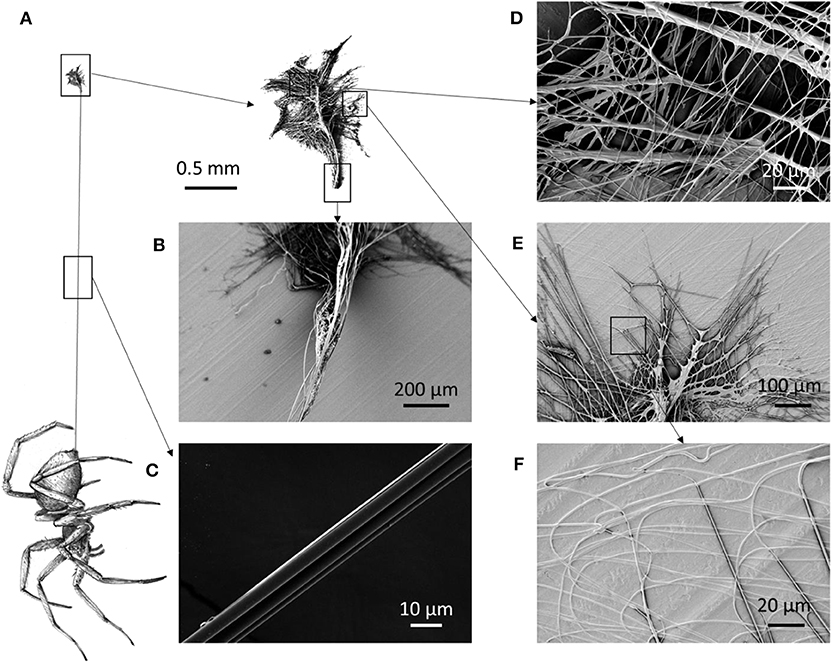
Tarantulas have silk organs in their feet! To be clear, tarantulas have the usual spinnerets and silk organs in all the regular places, but they are also able to secrete silk from their feet to help them stick to smooth surfaces.
Although tarantulas have long been popular as pets, it was not until 2006 that someone finally noticed that tarantulas were extruding silk from their feet. (Or maybe some people noticed and just didn’t believe there eyes.) In that year, Stanislav Gorb from the Max Planck Institute noticed that Costa Rican zebra tarantulas leave behind silken footprints when they climb a glass plate. Gorb published his findings, but a few years later another researcher disputed them, arguing that the spiders got the silk on their feet by wiping them on their spinnerets.
In 2011, however, Claire Rind from Newcastle University published a paper supporting Gorb’s results. She tested tarantulas by placing them on glass plates and slowly raising the plates to a vertical position. The spiders were able to cling to the glass without falling, and they always left behind tiny threads of silk.
But Rind didn’t stop there. Gathering molted skins from several tarantulas, she examined the feet with an electron microscope. She saw strands of silk emerging from the tips of some of the setae (hairs) on the feet. These setae were noticeably longer than the other setae and each one had a small hole in its tip. One even had a droplet of silk coming out of it!
As bizarre as it sounds, it’s possible that these foot spigots may actually represent the origin of spinnerets in spiders. Arthropods evolved from segmented worms that had a pair of legs on each segment. Many of the seemingly very “unleg-like” appendages of modern arthropods started out as legs that were gradually modified to serve new purposes. It’s highly likely that spinnerets also started out as legs. And if those legs already had silk glands?…
All of this is discussed in more detail in a National Geographic article, Tarantulas climb by shooting silk from their feet. The article includes some fantastic electron microscope photos. I urge you to check them out.
The Rise of the “True” Spiders28 29
The vast majority of modern spiders are in the infraorder Araneomorphae (also called Arachnomorphae). One important difference between araneomorphs and all other types of spiders can be seen in their chelicerae. To review, the chelicerae are the pair of appendages on the front of the head to which the fangs are attached. In mesotheles and megalomorphs, the fangs point more or less straight down (when unfolded) and they don’t cross each other. The spider has to raise its chelicerae in order to strike down with its fangs.

Anza Borrego State Park, San Diego County 9/4/17
In araneomorphs, the chelicerae are strikingly (ahem) different. The fangs open and close like pincers.

Author: Schtone
This file is licensed under the Creative Commons Attribution-Share Alike 3.0 Unported license.
Another important difference between araneomorphs and other spiders is in the types of silk they produce and how they use them. As I already mentioned, mesotheles produce a variety of silks, but use them interchangeably. I’m not sure whether megalomorphs use different silks for different purposes, but one thing is certain — araneomorphs have come up with some very innovative types of silk and they most definitely use them for different purposes. The most important of the these new types of silk is major ampullate silk.
A New Kind of Silk30
The success of the araneomorphs is due in no small measure to their invention of major ampullate silk. The name ‘ampullate’ comes from the shape of the gland that produces the silk, which resembles an ampoule — a type of small, sealed glass vial.31 All araneomorphs make major ampullate silk and no mesopheles or mygalomorphs do, so this is one of the defining characteristics of the group.
The thing that makes major ampullate silk special is its toughness. Toughness is not exactly the same as strength. Technically, it’s a combination of tensile strength32 and extensibility. Researchers studying the major ampullate silk of golden orb weavers (genus Nephila), have found that it’s both stronger and tougher than Kevlar. In an earlier section, I explained how silk gets its strength and flexibility from its unique microstructure. In major ampullate silk, spiders seem to have achieved a nearly perfect balance of all the factors that give silk both its strength and its stretchiness.
So what advantages did this new type of silk give the araneomorphs? First and maybe foremost, it gave them the ability to make a controlled descent. That is, they use it as a lifeline. Say you find an araneomorph spider sitting in its web, minding its own business, and you start harassing it. There’s a good chance the spider will attempt to escape your unwanted attentions by dropping from its perch and falling straight down. As it falls, it releases a thread of major ampullate silk behind it to slow its descent. It doesn’t do this to avoid injury — most spiders are small enough that they could jump from the top of a skyscraper without fear of injury — it does this so that it can stop itself from falling if it looks like it’s about end up in a worse situation than it just escaped from. The lifeline also makes it easy for the spider to crawl back up to its web after the danger has passed. Mesotheles and megalomorphs can’t do this because the silk they produce isn’t strong enough to support their weight. And the stretchiness of major ampullate silk means that, if the spider halts its descent by stopping the extrusion of silk, the lifeline will stretch in a way that brings the spider to a gentle stop.
So that’s one thing that spiders use major ampullate silk for. Another thing is for draglines. As they crawl from one place to another, all spiders (even non-araneomorphs) release a trail of silk behind them. Scientists aren’t completely sure why. It’s possible that they started doing this so that they could easily find their way back to their burrow. The silk may also be impregnated with pheromones that provide a trail for potential mates to follow. Araneomorphs use major ampullate silk for their draglines, maybe just because the resulting trail is more durable.
Major ampullate silk is also used for ballooning. If a species is to avoid extinction, it’s important for it to spread itself across as wide a geographical range as possible. That way, if conditions in one area become unfavorable to its survival, the species won’t be in danger of dying off altogether. So a species needs some way of dispersing itself far and wide. Many araneomorphs accomplish this by ballooning.
Some time after hatching and making its way out of the egg sac, a spiderling crawls to a high point in its environment and releases one or more threads of major ampullate silk. The threads (if more than one) fan out, and the spiderling is lifted from its perch. A spiderling may travel a very long distance — even thousands of miles — before touching down.
The Mechanism Behind Ballooning33 34 35
It’s natural to assume that when a spiderling releases silk threads to go ballooning, it’s the wind that provides the lift. The problem is that spiders have been observed ballooning on days when there was little or no wind, and, in any case, they often appear to be traveling faster than can be accounted for by air currents. This led some scientists to speculate that that they make use of electrostatic fields to lift themselves into the air.
On any given day, there are around 40,000 thunderstorms going on around the world. This creates a global electrical circuit called the atmospheric potential gradient. The surface of the Earth has a negative charge, while the atmosphere is positively charged, becoming more positive the higher you go. This creates a potential difference between the ground and the atmosphere. During a thunderstorm, this potential difference becomes so great that electrons jump from the ground to the clouds (where the positive charges accumulate) in a thick stream popularly known as a lightning bolt. (Yes, a lightning bolt travels from the ground to the cloud, not vice versa.)
A spiderling sitting on the ground or on pretty much anything connected to the ground, will pick up its negative charge. When it releases strands of silk, the silk, being also negatively charged, is repelled by the surface the spiderling is perched on and attracted by the positive charge of the surrounding air. This, so the theory goes, is enough to lift the spider into the air. And since the air tends to get more positive higher up, the spiderling is wafted high up into the atmosphere.
All this was only speculation until recently, when biologists from the University of Bristol put the theory to the test. They built a special box for housing spiderlings. The researchers were able to precisely control the electrical field inside the box. When little or no electrical field was present, the spiderlings didn’t try to take off. When a sufficiently strong field was applied to the box, the spiderlings displayed “tiptoeing” — raising up on their legs, lifting their abdomens, and releasing silk. In some cases, the spiderlings actually became airborne. If the field was turned off, the airborne spiderlings dropped.
Not only does this research support the theory that spiders use the electrical gradient for ballooning, it also shows that spiders can sense the strength of this gradient. They are probably able to do this because the tiny sensory hairs that cover their legs and body are moved by electrostatic forces in the same way that static electricity can lift the hairs on your head.
We’ve covered quite a number of ways spiders use major ampullate silk. Last, but not least, major ampullate silk is used for the outer rim and spokes of orb webs. But more than one kind of silk is used in building orb webs, so, before we get into the details of web construction, let’s get an overview of the different kinds of silk that modern spiders produce.
The Varieties of Araneomorph Silk
A particular kind of spider silk is not identical in every species that makes it. For instance, major ampullate silk differs slightly from species to species. But all major ampullate silks are similar enough chemically to be grouped together into the major ampullate family of silks. And the families are distinct enough in their properties that a spider rarely chooses to substitute one type of silk for another when performing a task. The families are also distinct enough that different types of glands are used to produce them. A silk gland is given the same name as the type of silk it produces. Major ampullate silk is produced by the major ampullate gland, for example.
We discussed major ampullate silk in the last section. We’ll be discussing the other types of silk that araneomorphs produce next. To make things easier, here’s a preview of what’s to come in the form of a cheat sheet:
Araneomorph Silk Cheat Sheet36
| Silk Type | Uses |
|---|---|
| Major ampullate (MaSp2 and MaSp1 proteins) | Dragline Lifeline The outer rim and spokes of a web Ballooning. |
| Minor ampullate (MiSp1 protein) | Temporary scaffolding while a web is being constructed. Also used in conjunction with major ampullate silk in draglines and lifelines and in web building. |
| Flagelliform | The capturing lines of the web |
| Tubuliform | Egg cocoon silk |
| Aciniform | Wrapping prey Male sperm webs Stabilimenta |
| Aggregate | A liquid silk that forms sticky globules |
| Piriform | Used to form bonds between separate threads and for attachment points to objects |
As a further learning aid, figure 6 shows an excellent schematic that sums up much of what we’ve discussed so far, what we will be discussing, and a lot of stuff we won’t have time to discuss. I suggest you study it a bit before proceeding.

Author: Yue Zhao
This file is licensed under the Creative Commons Attribution-Share Alike 4.0 International license.
Minor Ampullate Silk37
Minor ampullate silk is stretchable, but non-elastic. In other words, it stretches, but doesn’t bounce back. Major and minor ampulate silk are similar in composition, but major ampulate silk has many more repeating sequences of the amino acid alanine (abbreviated A in figure 6), which is probably what makes it so much stronger.
Minor ampullate glands usually look like small versions of major ampullate glands. It’s likely that the latter evolved from the former in a duplication event. That is, a mutation could have caused a spider to grow two minor ampullate glands. This may have benefited the spider, as it would have allowed it to make more silk. But having two glands performing the same function meant that evolution was free to play around with one of them, eventually leading to the evolution of the major ampullate gland.38.
Araneomorphs sometimes add minor ampullate silk to their draglines (in addition to major ampullate silk), but its main purpose seems to be to serve as a temporary scaffolding when the spider is constructing a web.
And Now for All Those Webs…
When most people think of spider webs, they think of orb webs — those classic, vertically-aligned, two-dimensional structures that have come to symbolize spiders everywhere. But most spiders — even most araneomorphs — don’t make orb webs. In fact, orb webs didn’t come about until quite late in spider evolutionary history. They evolved gradually from intermediate forms and many of those forms are still used by various groups of araneomorphs today. And spider webs didn’t stop evolving when they got to orb webs. You might be forgiven for assuming that orb webs represent the pinnacle of spider web design, but as we’ll see later, you would be wrong.
Lampshade Spiders
Lampshade spiders (family Hypochilidae) are a group of araneomorphs that, as their name suggests, spin webs shaped like lampshades. Looking at the two photos below, it’s easy to see how these webs could have evolved from the funnel webs of megalomorphs. And perhaps it’s not too hard to imagine how they might represent a first step toward orb webs.
Here’s a view of a lampshade web from the side:

Source: This file was derived from: Hypochilus web (Marshal Hedin).jpg:
Rotated 180° to show the normal orientation of Hypochilus webs.
Author: Original: Marshal Hedin
Derived: Peter coxhead
This file is licensed under the Creative Commons Attribution-Share Alike 4.0 International license.
And here’s a view looking up at a web from below with its occupant in the center:

Author: Kaldari
This file is made available under the Creative Commons CC0 1.0 Universal Public Domain Dedication.
So could the earliest araneomorphs been similar to lampshade spiders? There are some features of lampshade spiders that seem to be more similar to megalomorphs than araneomorphs or to be halfway between the two. For instance, Mesotheles and megalomorphs all have two pairs of book lungs. Most araneomorphs have only one. Lampshade spiders, however, have two pairs like the megalomorphs.
Mesotheles and megalomorphs, as noted earlier, have chelicerae that move up and down, so they have to use a downward motion to stab their prey. Araneomorphs, on the other hand, have chelicerae that open and close like tongs, allowing them to grip a prey animal even if there is no substrate supporting it. Lampshade spiders have chelicerae that appear to be intermediate between the two. They move diagonally, starting at the top of a ‘V’ and meeting at the bottom.
Lampshade spiders produce major ampullate silk, so they are definitely araneomorphs, but their two pairs of book lungs and diagonally moving chelicerae suggest that they could be similar to early araneomorphs, which would have retained many of the features of their megalomorph ancestors.
One other feature — or lack of a feature — also suggests that lampshade spiders may be similar to the early araneomorphs. They don’t wrap their prey in silk. Like non-araneomorphs, they just keep stabbing their prey with their fangs until it stops moving.39
Besides major ampullate silk, lampshade spiders produce another innovative type of silk called cribellate silk. This silk is produced by an organ called a cribellum. The cribellum is a modified spinneret that resembles a flattened plate (or two plates in some species). The surface of the plate is packed with thousands of microscopic spigots. Each of the spigots is fed by its own tiny, berry-shaped silk gland.
The silk threads produced by these spigots are unimaginably fine — it would take about a thousand of them bundled together to make a strand as thick as a human hair. As these threads are extruded from the cribellum, the spider combs them with a special set of hairs on its fourth pair of legs called a calamistrum (Latin for ‘curling iron’). The threads combine to form a wooly type of silk that, under magnification, looks like irregular waves of… well, wool.
Bugs tend to be hairy. It’s not true hair (only mammals have that), but they have lots of hair-like structures called setae that act as touch sensors, among other things. When a bug lands on cribellate silk, some of those tiny setae come into direct contact with the wooly silk. Normally, when two surfaces come into contact, there’s still lots of separation on a microscopic scale. That is, tiny bumps and irregularities on the two surfaces get in between them, preventing a really good seal. But when the two surfaces are really tiny — like the microscopic threads that make up cribellate silk and the setae of the insect — they can get into really close contact. And when that happens, various forces, including physical interlocking, capillary forces, and van der Waal’s forces, come into play. I’m not going to go down a physics rabbit hole here. Suffice it to say, the silk sticks to the insect.40
So cribellate silk is not a wet silk, but it’s still sticky. A Lampshade spider constructs its web by laying out crisscrossing lines of major ampulate silk and covering them with cribellate silk. The spider hangs upside down from a mat at the top of the lampshade, clinging to the mat with two pairs of legs and to the lampshade with the other two.
Many features of the lampshade spider’s web harken back to its megalomorph ancestors. The silken mat at the top of the web is similar to the silken mats made by megalomorphs. The lampshade itself is similar to a funnel web. The cribellum may appear to be a rather extreme innovation, but there is evidence that it may have evolved from a fusion and flattening of two spinnerets. Spider legs are already hairy. The calamistrum is just a thickening of that hair. Even the combing and spinning of the cribellate silk may have evolved from the use of the legs to manipulate trip lines and the silk used to construct shelters.41
The Next Steps
The “standard” orb web is a vertical structure, designed to catch insects as they fly from place to place. The earliest orb webs, however, were horizontal structures. Many modern araneomorphs still build such webs. They build them in enclosed, shady spaces, such as the hollows of trees or in rotting stumps. Such places often attract flying insects looking for shelter or for the water that sometimes collects in them. Spinning a horizontal orb web in such a place allows a spider to catch insects as they come in for a landing or take off. Many insects, such as mosquitos, breed in stagnant pools, so a spider may catch an unlucky bug just after it molts into its adult, non-aquatic form.42
Horizontal orb webs still use wooly cribellate silk to catch prey. This works well because insects that are landing or taking off are not flying very fast. Eventually, some spiders rotated their orb webs into the vertical position and started building them in more open spaces, allowing them to capture flying insects when they’re in cruise mode. Hackled orb weavers (family Uloboridae) build vertical orb webs using the same wooly cribellate silk used by the builders of the horizontal webs. But vertical orb webs face the problem of catching insects that may be flying quite fast. The momentum of such insects often take them right through a web that uses cribellate silk. It’s just not sticky and stretchy enough to stop a bug that’s in a hurry.
Eventually, one group of araneomorphs, the Araneoidea, solved this problem by evolving two more kinds of silk: flagelliform silk and aggregate silk protein glue. The frame and spokes of an araneoid web are constructed using major ampullate silk, but the capture spiral is made of super-stretchy flagelliform silk beaded with droplets of aggregate silk. When a rapidly flying insect barges into such a web, the aggregate silk sticks to it like glue (which it is) and the flagelliform silk stretches to absorb the impact.43
Constructing a Vertical Orb Web44
Note: The illustrations in this section are adapted from those on the webpage The contruction of a wheel web of the website Spiders of North-West Europe.
Step 1: The spider starts by releasing a strand of major ampullate silk into the breeze. The strand has a dab of sticky silk on the end. With luck, the strand will stick to a branch or other surface some distance away. If not, the spider tries again. Once the far end of a strand is successfully anchored, the spider breaks the strand loose from it’s spinnerets and anchors it nearby. It then crawls along the strand, laying down a reinforcing thread. It does this over and over until it judges the strand strong enough to support a web.

Step 2: The spider hangs a very loose strand from the first one, fastened to the first at both ends so that it hangs down in the middle.

Step 3: The spider anchors another thread to the middle of the loose strand, drops down to a lower perch and pulls the thread taught before anchoring it. It now has a Y-shaped structure beneath the original strand.

Step 4: The spider spins more anchor lines, boxing in the Y.

Step 5: The spider constructs a bunch of strands running from the center of the Y to the frame, so that it ends up with a radial pattern of threads. The frame and radial lines are made of non-sticky silk, so the spider can walk on it without getting stuck.

Step 6: The spider uses more non-sticky thread to lay down a loose construction spiral.

Step 7: Next, it uses the construction spiral as a guide as it lays down a tighter spiral of sticky silk. So as not to waste silk, it eats the construction spiral as it goes.

Often, after a night of catching insects, a web will be too worn out to use again. In that case, the spider will eat the old web in the morning, leaving only the first line. It will rest during the day and construct a new web in the evening.
To watch a video of a spider spinning a web, click here.
Aciniform Silk45
‘Aciniform’ comes from the Latin for ‘grape-like’ and refers to the shape of the glands, which resemble bunches of grapes. All araneomorphs have aciniform glands. The silk produced by these glands is used for a number of purposes. The male spider uses it for the ribbon of silk on which he deposits his sperm before he transfers it to his palpal organs.
Many orb weavers use it to weave “decorations” into their webs called stabilimenta. Scientists aren’t sure what purpose these patterns serve. One suggestion that has received recent support from research is that they serve to make the web more visible, so that larger animals, such as birds, are less likely to blunder into them. The following photo shows a couple of stabilimenta woven into the web of a silver argiope.

Source: Argiope argentata (Araneidae) . underside with stabilimenta
Author: gailhampshire from Cradley, Malvern, U.K
This file is licensed under the Creative Commons Attribution 2.0 Generic license.
Silver argiopes are quite common here in Southern California. They are usually found on prickly pear cacti. I recently saw one with four stabilimenta woven into its web. They lined up perfectly with the outstretched legs of the spider. Stupidly, I didn’t bother taking of photo of it.
Araneomorphs that wrap up their prey to subdue it use aciniform silk for the job. This isn’t too surprising, as aciniform silk is the toughest silk yet tested. This is probably also the reason that spiders use it for their egg cases.
The following three photos show a silver argiope that has captured some kind of insect. It’s hard to see any silk around it, but there must be some, because the insect appears to be tightly bound.

Mission Trails Regional Park, San Diego County 7/26/18


These next few photos show another silver argiope with a much larger and more thoroughly-trussed victim.

Mission Trails Regional Park, San Diego County 8/15/20


The next two photos show an egg sac from a silver argiope. In my experience, most spider egg sacs tend to be roughly spherical. This one’s a bit more elaborate.

San Diego County 9/29/20

Wolf spiders are unusual in that they carry their egg sacs around with them, attached to their spinnerets.

San Diego County 1/29/19

Here’s another kind of wolf spider with its egg sac. This one is a pirate wolf spider (genus Pirata). These spiders hang out near streams of water and can run around on the water’s surface. Judging by the clearly visible seams, the spider must have formed the sac in two parts, which it then joined together.

San Diego County – not sure of the date


Another unusual thing about wolf spiders is that they’re the only spiders that carry their babies around on their abdomens after they hatch. Here’s a couple of photos of a mother pirate wolf spider doing just that. (Yeah, I know, this has nothing to do with silk, but those babies are just so darn cute!)

San Diego County – not sure of the date

Tubiliform or Cylindriform Silk
The females of most types of araneomorphs possess long, tubular glands called cylindrical glands and the silk these glands produce is called tubiliform or cylindriform silk. It’s a fluffy silk used for only one purpose — it forms a protective layer around the eggs inside the egg case.
The next three photos show the contents of what I believe was a silver argiope egg sac. You can see the fluffy tubiliform silk that surrounded and cushioned the eggs in the sac. The eggs were extremely small, by the way — much smaller than the head of a pin.

San Diego County 10/7/20

One of the fun things about opening spider egg sacs is that it’s not always eggs that come out. Apparently, baby spiders tend to hang around in the sac for some time after hatching. More than once, I’ve opened an egg sac, expecting to find eggs, and had hundreds of baby spiders pour out instead. That was the case with the next photos. (These are definitely silver argiopes.)

San Diego County 10/15/20


Piriform Silk46
All araneomorphs have clusters of piriform, or pear-shaped, glands, which produce the silk that the spiders use to anchor their major ampullate draglines to the substrate. Piriform silk uses a “nano-fibril network embedded in a cement-like matrix” — to quote a paper that delves into the mechanical properties of this silk.47 I don’t recommend reading the paper unless you’re way better at math than I am, but it does include an awesome illustration. You can check it out by clicking here.
Both mesotheles and megalomorphs have glands that resemble aciniform and piriform glands. There hasn’t been much genetic research on non-araneomorph spiders, but it seems likely that there is a close relationship between these glands in araneomorphs and non-araneomorphs.
Cobwebs48
Technically, a cobweb is a tangled, three-dimensional web that doesn’t have any particular overall form. (So a lampshade web is not a cobweb, even though it is pretty tangled.) There is a whole family of spiders, Theridiidae, that are called cobweb spiders, although not all of them actually weave cobwebs.
The theridiids are araneomorphs and, in fact, there is evidence that they evolved from orb-weavers. This may come as a surprise. Why would a group of spiders that are capable of weaving such “advanced” webs revert to building such simple ones?
There are two reasons. First, evolution doesn’t care about how “advanced” an organism is. If the organism can get along just fine without it’s “advanced” traits, it’ll probably ditch them.
Second: wasps. Many, many types of wasps prey on spiders. But evidence suggests that orb weavers evolved by at least 145 million years ago and they began to diversify by 125 mya. This was before predatory wasps evolved and much earlier than birds. A vertical, two-dimensional orb web may be great at catching insects, but it leaves its occupant exposed to any hungry wasp or bird that comes along. I doubt that a cobweb is very effective against birds, but it sure comes in handy for impeding the progress of a wasp.
One of the most familiar cobweb spiders is the black widow (genus Latrodectus). Here’s a few photos of one of our local species, the western black widow (L. hesperus). It was in a very small container, so it wasn’t able to build a full-size web, but you can see how tangled even this small version is.

San Diego County 10/3/18


Many cobweb spiders, including the aforementioned black widows, build what’s known as a gum-foot line into their webs. The spider constructs the first part of its web using non-sticky major ampullate silk near some sort of ceiling — a rock overhang or the literal ceiling in the corner of a room, for instance. Then it drops down on a dragline to the ground or floor. It anchors the dragline using a dab of sticky aggregate silk. Next, it climbs back up the dragline, doubling it with a second strand of major ampullate silk. As it’s going, it coats the bottom part of the dragline with more sticky silk. When it gets back up to the web, it pulls on the gumline, stretching it like a rubber band, before reattaching it to the web. Now the gumline is spring-loaded.
The spider repeats this process, constructing more gumlines between the web and the substrate. If a bug crawling along the substrate bumps into one of these gumlines, it sticks to it. Naturally, it struggles to get free. This breaks the gumline loose from the substrate and it snaps up, launching the bug into the web above and the waiting jaws of the spider. So the gumlines catch prey on ground below while the upper part of the web catches flying insects.
More Webs
I could devote many blog posts to the different kinds of webs that araneomorphs weave. Since I don’t want this particular blog post to go on forever, I’ll just mention a few of my favorite ones.
Bolas spiders, which include several related genera of orb-weavers, don’t actually weave orb webs, or any other kind of web in the traditional sense of the word. Bolas spiders prey on moths. Moths are difficult to catch in orb webs, because they are covered in tiny, powdery scales. When a moth blunders into a web, usually only the scales stick to the silk and the moth flies free. So bolas spiders have come up with a unique hunting technique.
A typical bolas spider will dangle a single line of silk with a sticky blob of liquid silk on the end. The spider emits one or more pheromones that closely mimic the pheromones produced by female moths of the species (or small set of species) that the spider hunts. Male moths of that species are attracted to the scent. When the spider senses a moth nearby, it begins swinging the sticky blob around in a circle. The blob is large enough that, if it hits the moth, the sticky silk will soak through the scales and contact the insect’s body. Then the spider just reels it in like a fish.
Bolas spiders get their common name from the weapon called a bolas that was used by the gauchos in South America. This weapon consisted of weights on the end of interconnected cords. The gaucho would swing the weights around and throw the weapon at animals such as rheas (large, flightless birds). The cords would get tangled around the animal’s legs, bringing it down.49 50 51
I’ve only seen one bolas spider in my wanderings. It’s pictured below. I didn’t find out what it was until after I had caught and released it, so I didn’t get any photos of the bolas.

San Diego County 9/28/18

A ray spider spins a traditional orb web, then follows up by anchoring a guy line to the center of the web and pulling it into a cone shape. When a bug brushes against the web, the spider releases the guy line and the web springs back, slamming against the insect.
A net-casting spider uses cribellate silk to weave a small net, which it holds outstretched between its front legs. When it spots a prey animal close by, it lunges at it, quickly wrapping it up in the net. Net-casting spiders hunt at night. Two of their eyes are greatly enlarged, giving them excellent night vision. Members of one genus, Deinopis, are called ogre-faced spiders because their massive eyes give them such a weird look.
Harvesting Spider Silk52
Given all the amazing properties of spider silk, you might be wondering if anyone has tried using it to weave textiles. The answer, of course, is yes. Unfortunately, no one has figured out a way to harvest spider silk in the quantities needed to make it profitable. One of the reasons for researching spiders and their silk is the hope that we may one day find a way to produce spider silk in mass.
In the meantime, click here to watch a wonderful video of a researcher using a simple device made for extracting silk from a spider. The video also includes some fascinating info about the extracted silk.
People have actually succeeded in producing fabrics made of spider silk. In fact, “a complete set of bed hangings” was exhibited at the Paris Exhibition of 1898. It was the work of a French missionary, Father Paul Camboué, and his business partner, M. Nogué, who established a spider silk fabric industry on the island of Madagascar. Unfortunately, their business venture was not very successful and the bed hangings have since been lost.
More recently, in 2009, a cape made from the silk of about a million golden silk orb-weaver spiders was exhibited at the American Museum of Natural History. The cape took five years and almost $400,000 to make. For the entire story and some beautiful photos of the cape, click here.
One of the ways researchers have attempted to get around the problems of harvesting silk from spiders is by inserting spider genes into other organisms, such as bacteria. Scientists have even genetically engineered goats to produce spider silk in their milk! After milking, the silk protein is separated out, turned into a powder, and spun into a fiber. Click here to read an article about this fascinating project.