
I can tell you it’s a very disturbing experience to take a drag on your cigarette and find out you don’t have one.. Or to talk to your brother about himself thinking he’s someone else… or having your friends come round to see how you are, having a long chat with them only to realize they are not there. I cannot remember it all as it was only three days ago and I can’t operate properly (it’s taken 2 hrs so far to write this because I can’t see).
I do remember trying to smoke my belt, throwing my cat in the bathtub, thinking my mum was Spike Milligan. The list goes on.
-Mikey 1
What a long, strange trip it’s been researching this topic. I knew the plant Datura had a reputation as a psychedelic — and a dangerous one at that — but… wow. The above quote is one of the less disturbing ones I found. Many of them contained stuff that I didn’t feel comfortable including in a blog that’s supposed to be more or less family friendly. Of course, Datura didn’t evolve in order to send humans on bad trips, and there’s more to the plant than it’s psychoactive properties.
Instruments of Angels and Devils2
Datura is a small genus containing nine species, all with similar features. It’s in the family Solanaceae or the nightshades. Solanaceae is an unusual family. It contains many of our most important crops, including tomatoes, potatoes, eggplants, and peppers. Yet, it also contains many famously poisonous plants, such as nightshade, belladonna, and henbane.
It may seem counterintuitive that poisonous plants and food crops should be so closely related, but, in fact, it’s not really that strange. Just as animals tend to defend themselves when attacked, so do plants. And since plants can’t run or bite or sting, they have to rely on more passive methods of defense, such as toxins. If humans are able to eat a particular plant, it’s not necessarily because the plant doesn’t contain any toxins. Our bodies can naturally detoxify some foods, as long as we’re in good health and the toxin levels aren’t too high. Sometimes we only eat the less poisonous parts of the plant and avoid the other parts. We may also process a plant in such a way that most of the toxins are removed. Toxins in some dried beans are removed by soaking and boiling, for example.3
Some of the common names for members of Datura are raving nightshade (my personal favorite), thorn apple, stinkweed, Devil’s apple, jimsonweed, Devil’s weed, Devil’s trumpet, toloache, and moonflower. The most common species here in Southern California is Datura wrightii. This particular species is sometimes called sacred datura, due to its use in Native American religious rituals.4 5 D. wrightii is native to the Southwestern United States and northwestern Mexico. It’s also widespread in Central California, although the concentration is much higher in the south.6

Datura is one of those plants that’s easy to recognize even when it’s not in flower.
San Diego County 4/19/17

Mission Trails Regional Park, San Diego County 5/2/21
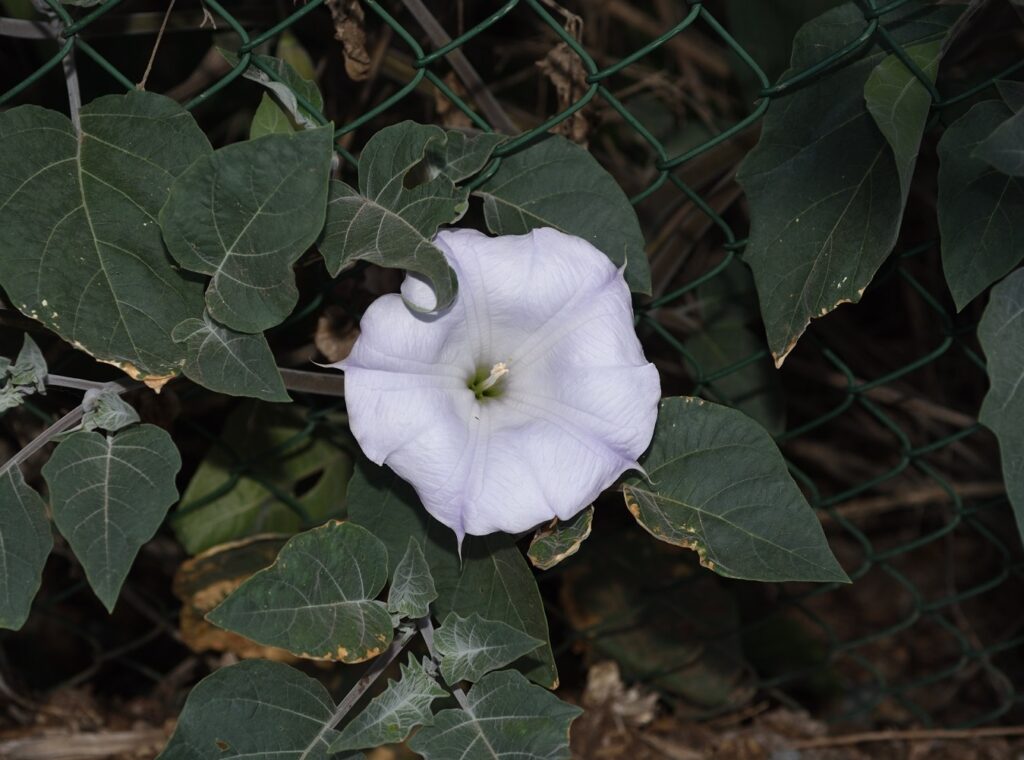
Mission Trails Regional Park, San Diego County 5/2/21
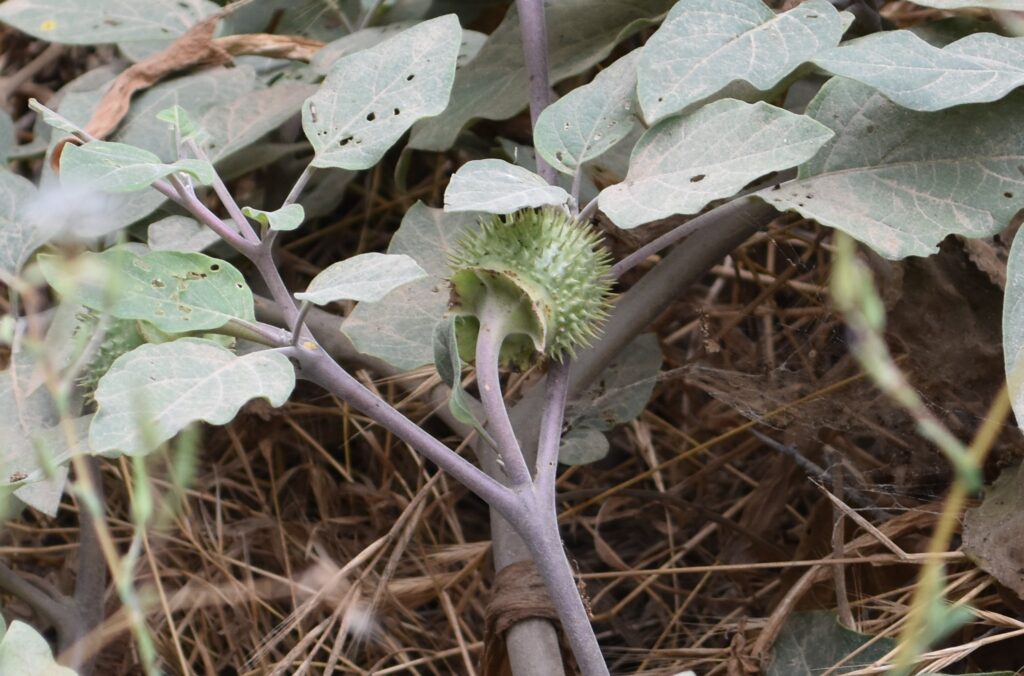
Los Peñasquitos Canyon Preserve, San Diego County 9/16/17
Another Datura species, D. stramonium, is found scattered throughout California. According to Calflora7, it’s not native to California, although a number of other sources call it a native of North America, without being more specific.8 9 10 D. stramonium is a rather important member of the genus, since it very early on managed to spread to the Old World. It now grows all over the world, wherever the climate is warm and temperate.
D. stramonium looks a lot like D. wrightii, but its leaf margins have much deeper lobes.
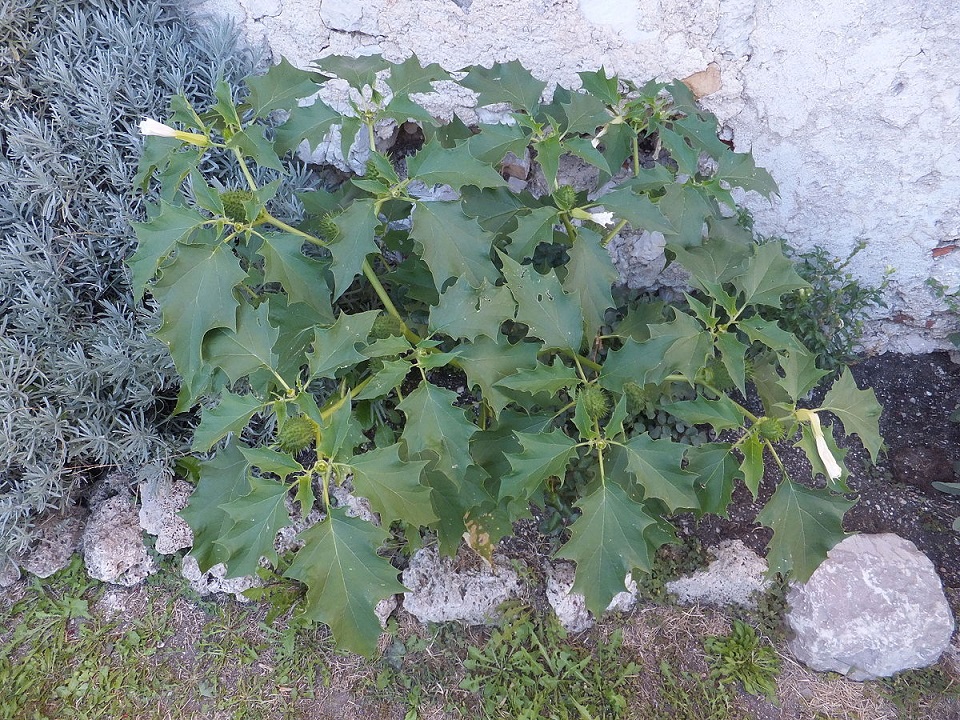
Author: Syrio
This file is licensed under the Creative Commons Attribution-Share Alike 4.0 International license.

Author: Chbaraka
This file is licensed under the Creative Commons Attribution-Share Alike 4.0 International license.
Although the name ‘jimsonweed’ or ‘jimson weed’ is often used for other members of the genus, the name originated with D. stramonium. It’s actually a corruption of the name ‘Jamestown weed’. The story goes that some English soldiers were camped out in Jamestown, Virginia while trying to suppress Bacon’s Rebellion.11 They foolishly used the leaves of the plant in a salad and spent the next eleven days tripping out. Here’s a quote from one of the people who witnessed it.12
The James-Town Weed (which resembles the Thorny Apple of Peru, and I take to be the Plant so call’d) is supposed to be one of the greatest Coolers in the World. This being an early Plant, was gather’d very young for a boil’d Salad, by some of the Soldiers sent thither, to pacific the Troubles of Bacon; and some of them eat plentifully of it, the Effect of which was a very pleasant Comedy; for they turn’d natural Fools upon it for several Days: One would blow up a Feather in the Air; another wou’d dart Straws at it with much Fury; and another stark naked was sitting up in a Corner, like a Monkey, grinning and making Mows at them; a Fourth would fondly kiss, and paw his Companions, and snear in their Faces, with a Countenance more antick, than any in a Dutch Droll. In this frantick Condition they were confined, lest they should in their Folly destroy themselves; though it was observed, that all their Actions were full of Innocence and good Nature. Indeed, they were not very cleanly; for they would have wallow’d in their own Excrements, if they had not been prevented. A Thousand such simple Tricks they play’d, and after Eleven Days, return’d to themselves again, not remembring any thing that had pass’d.13
Another genus of plants in the nightshade family is Brugmania. This genus contains seven species and is closely related to Datura. The common name for members of Brugmania is angel’s trumpets. I’m not sure why these plants deserve such a positive rating, while Datura is stuck with Devil’s trumpet and Devil’s weed. It’s certainly not due to their being any less dangerous, as the members of Brugmania are among the most toxic of ornamental plants. Maybe it’s just because angel’s trumpets are woody shrubs or small trees, and their large, trumpet-shaped flowers hang down in such a distinctive manner, making them more popular as ornamentals. Datura is very attractive in it’s own right, but it’s a much smaller plant and the flowers are displayed in a more traditional, upright manner. 14
An interesting thing about angel’s trumpets is that they are only known from cultivars. The genus appears to be extinct in the wild, and it’s suspected that its extinction may be linked to the extinction of whatever animal was responsible for the dispersal of its seeds. If this is the case, then angel’s trumpets only survive today because humans decided to grow them as ornamentals. This would make them evolutionary anachronisms. (See my earlier post Strange Fruit and Other Anachronisms.)
Soon after I moved to California, I saw an angel’s trumpet growing alongside a street in San Diego. It was a hard plant to miss, with its huge, hanging flowers. I’ve got a photo of it somewhere. Until such time as I can dig it up, here’s one I found on Wiki Commons.
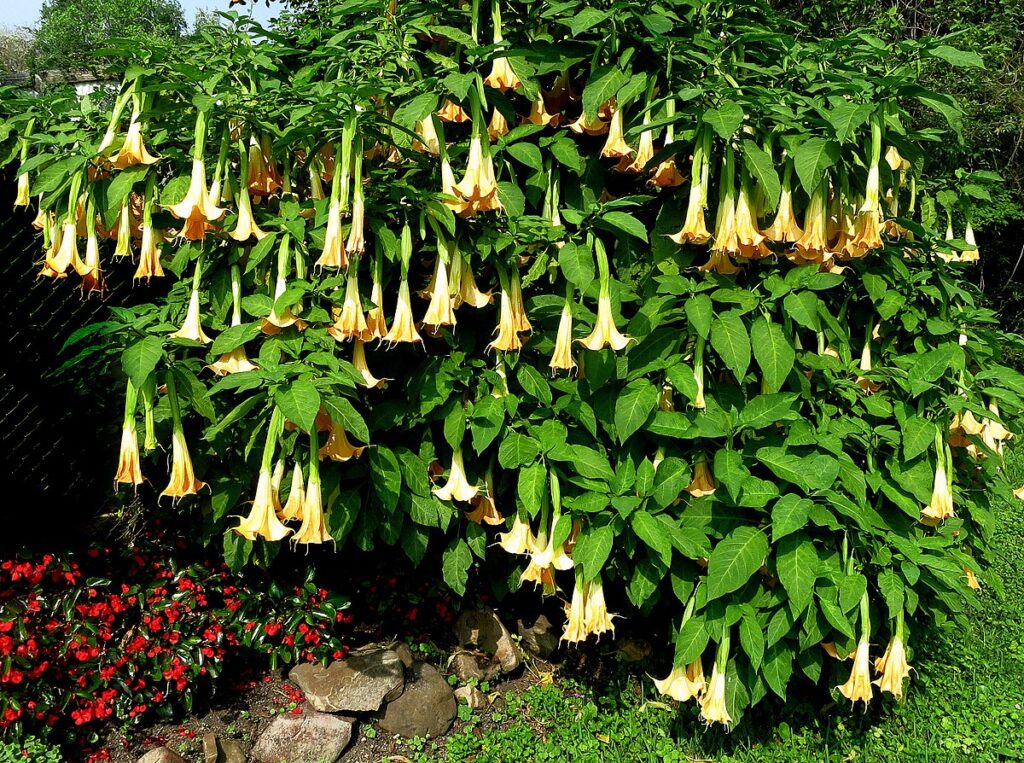
Author: Jim Evans
This file is licensed under the Creative Commons Attribution-Share Alike 4.0 International license.
A Moth Makes a Mistake
On a trip to South Korea in 2012, I visited Jeju Island, a large volcanic island just off the southern tip of the Korean Peninsula. It’s a beautiful place with lots to see, including some of the largest larva tubes in the world. A popular hiking destination is the crater and lake at the top of the central volcano, Mount Halla.15
At this period in my life, I was into oil painting, not hiking, so I wasn’t in any shape to hike all the way to the top of the mountain. Instead, I contented myself with hiking maybe a third of the way. There, I set up an easel and did a small painting. I had just squeezed out a large glob of titanium white paint onto my palette, when a large hawk moth suddenly appeared and hovered over my palette for a second before dipping its proboscis into the glob of paint. It didn’t take the moth long to realize its mistake, and it flew off with a bit of white paint stuck to the tip. It was a memorable experience, although I felt bad for the moth, which may have died as a result of the encounter — oil paint doesn’t come off easily.
So why would a moth do such a thing?
Attracting Pollinators
For millions of years, flowering plants and insects have been evolving mutualistic relationships. The plants provide insects with food in the form of pollen or nectar, and the insects pollinate the plants. When an insect visits a flower, it often gets some of the pollen stuck to its body. When it later visits the flower of another plant of the same species, some of this pollen may rub off onto the pistil of the flower, fertilizing the plant.16 This may sound like a simple, straightforward relationship, but it’s not. There are all kinds of complicating factors. Some insects want to eat other parts of the plant, such as the leaves, that the plant doesn’t want eaten, so plants have to figure out how to protect themselves from the “bad” insects while attracting the “good” ones. Some insects cheat by chewing through the petals to get to the nectar, bypassing the reproductive parts of the flower and doing nothing to pollinate the plant. And then, of course, there’s competition between plants to attract pollinators. As a result of this competition, many plants have evolved to specialize in one particular species or group of insects.
You can often make an educated guess what kind of bug or other animal pollinates a plant based on the color of its flowers. If the flowers are bright blue or violet, there’s a good chance the plant is pollinated by bees. If they’re bright red, hummingbirds may be the target pollinators. If a plant has white flowers, and, moreover, if those flowers open at night, they are probably evolved to attract moths or even bats.17
And therein lies our answer. Bright, white flowers are easier to see at night, so many plants have evolved white flowers to attract moths. And moths, in turn, have evolved to associate large, splotches of white color with a meal. That unlucky Korean moth mistook my blob of white paint for a flower! (In case you’re wondering, no, I wasn’t painting at night. Hawk moths tend to be nocturnal, but many fly during the day, as well.)
Datura flowers tend towards white, although they can also be pale yellow, pink, or pale purple. They also open at night. And they’re big. So, as you’ve probably guessed by now, they are pollinated primarily by big moths, namely hawk moths.

Mission Trails Regional Park, San Diego County 5/23/21

Mission Trails Regional Park, San Diego County 5/23/21

Mission Trails Regional Park, San Diego County 5/23/21
Moths of the Family Sphingidae18 19
Hawk or sphynx moths make up the family Sphingidae. They are also called hummingbird moths, because from a distance they look remarkably like hummingbirds. They’re about the same size, and they hover in front of flowers to feed just like hummingbirds. The moth I saw in Korea was definitely a hummingbird moth.
I see plenty of hawk moths here in San Diego County, which isn’t surprising given how much Datura we have. Of course, they feed on other flowers, too. Here’s a bad photo of one feeding from a monkey flower.
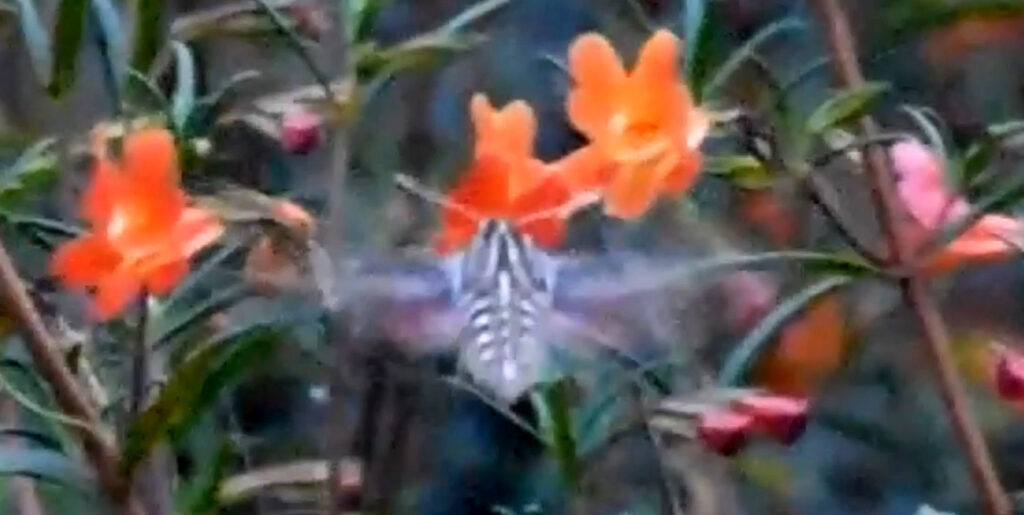
San Diego County 4/24/17
And here’s a much better photo someone took of one in Bulgaria.
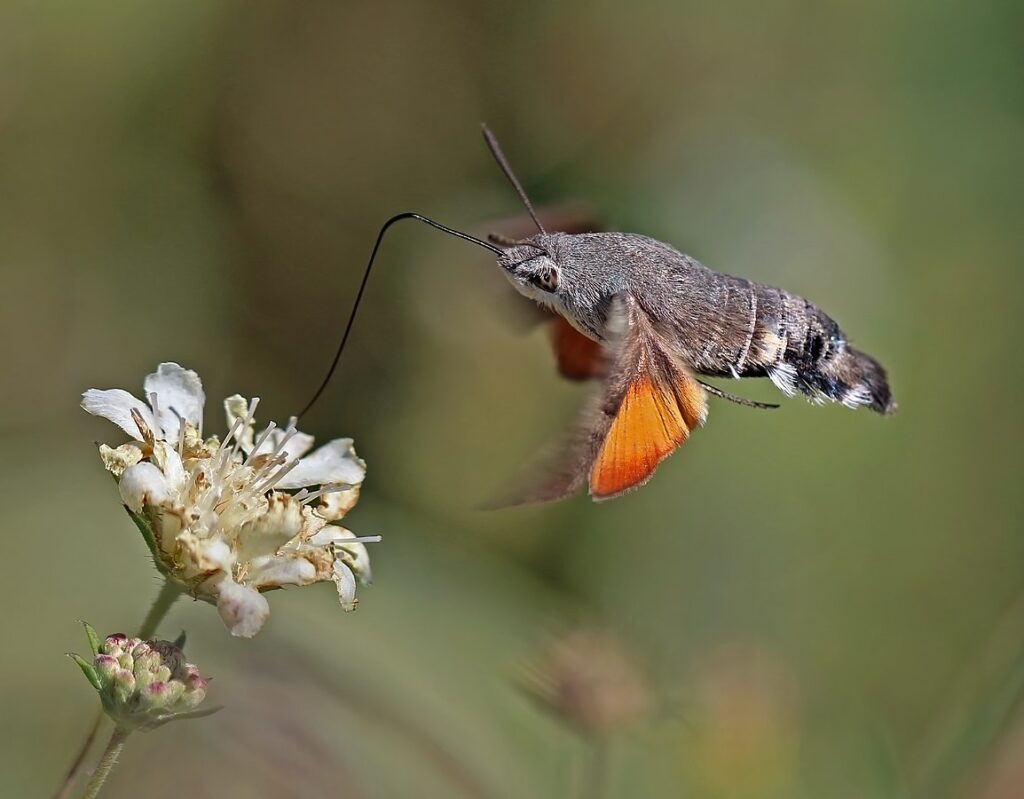
Yastrebets, Rila Mountains, Bulgaria
Author: Charles J. Sharp
This file is licensed under the Creative Commons Attribution-Share Alike 4.0 International license.
Surprisingly, hawk moths don’t seem to be immune to the psychoactive properties of Datura and are said to sometimes become intoxicated on the nectar.20 As to what form this “intoxication” takes, I read somewhere that they kind of stumble around unsteadily. Unfortunately, I haven’t been able to locate the article I read this in.
One species of hawk moth, Manduca rustica, is especially fond of sacred datura.21 I suspect that many of the moths I see in my area belong to this species.
I did have one other close encounter with a hawk moth. I was hiking at night in Mission Trails Regional Park, and one landed on the back of my wrist. Naturally, it was my right wrist, and my phone was in the right pocket of my jeans, so I had to use my left hand to fumble around in my right pocket trying to get it out. And, naturally, the moth took off the moment I was ready to shoot.
Datura in Genetics Research22
Datura has become a very important model organism for genetic research, largely due to the botanist Albert Blakeslee.23 A normal Datura plant has twelve pairs of chromosomes, but, apparently, it’s relatively easy to create mutant strains that have extra chromosomes. Blakeslee used the chemical colchicine to induce such mutations. He was able to create trisomic plants — plants with three copies of a particular chromosome, instead of a pair.
Time for some terminology. In genetics, the letter n is used as a placeholder for the number of different chromosomes in an organism’s genome. A cell is haploid if it contains only one set of n chromosomes. Most germ cells (reproductive cells) are haploid. If a cell contains 2n chromosomes or two copies of each, it is said to be diploid. In most multicellular organisms, the somatic cells — that is, anything that isn’t a germ cell — are diploid. If a cell has more than 2 sets of chromosomes — that is, 3n or greater — then it’s said to be polyploid. These terms are also applied to organisms as a whole. For instance, if an organism’s somatic cells are polypoid, then the organism is also said to be polyploid.24
Aneuploidy is when an organism’s chromosome number differs from the wild type (i.e. the unmutated type) by part of a chromosome set. For example, an organism’s cells could have two copies of most chromosomes, but three copies of one of them. Such an organism is said to have 2n + 1 chromosomes in its genome. An organism could also have two copies of most chromosomes, but only one copy of one of them. Then, it’s said to have 2n – 1 chromosomes. If an otherwise diploid organism is missing one pair of chromosomes entirely, then it has 2n – 2 chromosomes. This type of mutation is usually lethal.25
Most organisms that have nuclei in their cells (that is, organisms that aren’t bacteria or Archeae) are diploid. We humans have 23 different chromosomes, but most of our cells have two copies of each one for a total of 46 or 23 pairs. So humans have 2n chromosomes, where n = 23.
Using colchicine, Blakeslee was able to produce Datura plants with a chromosome number of 2n + 1. He was even able to produce one plant that was haploid — it only had one set of chromosomes. “This was the first haploid to be found in vascular plants and created something of a sensation. Haploid plants, one thought, should be gamophytes, but here was a little plant, rather weak and nearly sterile, that was clearly a sporophyte, but that had only one set of chromosomes in its cells.”26
Blakeslee’s results inspired a great deal of research into polypoidy. Eventually, a total of six stages in the polyploidy series of Datura were identified (1n, 2n, 3n, 4n, 6n, and 8n). It’s not clear from my reading if Blakeslee himself identified any of the polypoids or if he just produced aneuploids and a haploid, but there is no doubt that his pioneering work was of vast importance to the field of genetics. It eventually led to the concept of genetic balance: “…an organism that has complete extra sets of all of its genes is not very different from a normal organism of its type, whereas an organism that has a single extra chromosome, giving it an extra ‘dose’ of the genes carried on this chromosome and thus changing the ratio of these genes to those borne on the other chromosomes, has a profoundly changed appearance.”27
Both Poison and Hallucinogen28 29
All species of Datura contain tropane alkaloids such as scopolamine and atropine, which are both toxins and hallucinogens. These chemicals are mostly found in the flowers and seeds. In some species, such as D. wrightii, there may also be high concentrations in the roots.
Within hallucinogens, Datura is classified as a deliriant. Most deliriants, including Datura, are anticholinergic drugs, meaning they inhibit the neurotransmitter acetylcholine. The state of delirium produced is generally characterized by stupor, agitation, restlessness, confusion, and realistic visual hallucinations. Scopolamine and atropine, in particular, are known for their tendency to produce dream-like hallucinations and these hallucinations tend to be disturbing and unpleasant. People who take Datura often lose control of their actions and have little or no memory of the experience.
The real danger presented by Datura, however, is not so much its toxicity or the often disturbing nature of the hallucinations it produces. The real danger is its unpredictability. As already noted, the amount of toxin varies according to the part of the plant, but it also varies according to its stage of development and the environment in which grows. The concentration of toxins decreases during the day and increases at night. It’s also more toxic after a rainy period than a dry period. All this makes it extremely difficult to estimate what a safe dose would be.30
Despite its dangers and the often dark nature of the “trips” it produces, Datura has long been used in folk medicine and religious rituals around the world. What follows are a very few examples of such use.
The Chumash were a Native American tribe who lived in the coastal regions of Central and Southern California, a bit north of where I live.34 They enter this story because, at some point, someone among them used red-ochre to paint an image of a 5-armed pinwheel on the ceiling of a cave. The cave is called Pinwheel Cave and it’s located in the Wind Wolves Preserve of the San Emigdio Mountains. The pinwheel is believed to represent a Datura blossom as it unwinds at dusk. The photo below is one I took of a real Datura blossom unwinding. I don’t have permission to show you any of the photos of the cave painting, but you can click here to see an article that contains a couple.

Mission Trails Regional Park, San Diego County 5/23/21
The idea that the pinwheel represents a Datura blossom is bolstered by the fact that around 50 clumps of chewed Datura have been found tucked into crevices in the stone alongside the painting. This strongly suggests that the chumash people were using the plant ritually at the time the painting was done around 400 years ago. (Give or take. Radiocarbon dating indicates that the site was occupied from around A.D. 1530 to 1890. I’m not sure how, based on that, it was decided that the painting must be 400 years old. You’ll have to take that up with the authors of the referenced articles.)
Archaeologists have long speculated that some of the more abstract, “psychedelic” art found in rock paintings might have been related to the ritualistic use of hallucinogens of one type or another, but this is the first time that traces of hallucinogens have actually been found associated with cave art. One popular theory is that such caves were the haunt of individual shamans whose artwork represented images from their “vision quests”, and that the caves were avoided by other members of the tribe. However, the number of chewed “quids” of Datura found in Pinwheel Cave, as well as the number of tools and other artifacts littering the cave floor, suggest that the site may have been used communally — maybe in initiation ceremonies or in rituals conducted before a hunt.
Besides the pinwheel, a number of other, less distinct blobs and smears are painted in red-ochre on the cave ceiling. Researchers have interpreted one of the figures as an insect, possibly a hawk moth.
Huskanawing
The Algonquin Indians of Virginia used Datura stramonium in an initiation ritual called huskanawing. The following is based on a description in Beverly’s “The History and Present State of Virginia, In Four Parts”.35
The ceremony took place every fourteen or sixteen years or oftener, depending on the ages of the young men in the tribe. A group of these young men would be selected based on “treasures” they had acquired in the course of their traveling and hunting. They would be taken into the woods, where medicine men carefully fed them a plant mixture called wysoccan, which contained D. stramonium. They would be kept confined there in isolation for several months “giving them no other sustenance, but the Infusion, or Decoction”.36 (This part may sound a bit hard to believe, but I suppose whatever plant matter was in the “Infusion” could have been enough to keep them alive for a few months.)
This steady dose of wysoccan would cause the boys to become “stark, raving mad” for eighteen to twenty days. Not only that, but they would supposedly lose all memory of their lives, their parents, and even their language. The dose would then be gradually reduced, but, before the effects had worn off, they would be brought back into the village, where they were carefully observed to see if they retained any memories of their former lives. If one of them showed any sign of remembering, then he would have to undergo the entire ritual again, only this time with even more severity, and he would be unlikely to survive it.
Once back in their village, the initiates were expected to learn everything over again, even their language, so that they could begin life again as men, having forgotten their previous lives as boys. Obviously, it’s likely that the young men only pretended to have forgotten everything and were very careful not to acknowledge that they recognized anyone in the village, not wanting to have to repeat the ritual (and probably die in the process). On the other hand, given some of the stories of modern people who’ve experimented with the plant, a total, if temporary, loss of memory may not be all that farfetched.
Witches and Werewolves
The medieval belief that witches flew around on broomsticks may have been the direct result of the said witches tripping out on D. stramonium. Supposedly, “flying ointments” were compounded out of the seeds and roots of Datura and applied to the body, producing states of “extraordinary derangement and delusion”. As for the broomsticks, the handles were used to apply the ointment to the “sensitive vaginal membranes “.
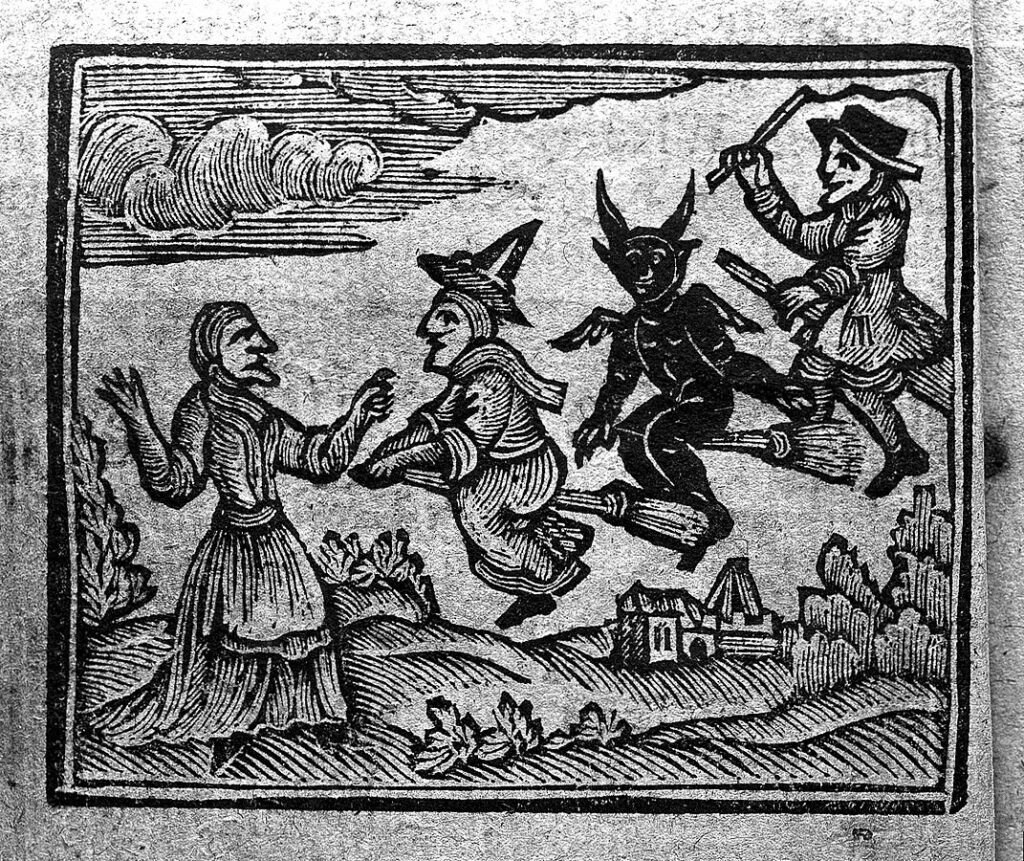
This file comes from Science Museum Group, in the United Kingdom. Refer to Wellcome blog post (archive). This tag does not indicate the copyright status of the attached work. A normal copyright tag is still required. See Commons:Licensing.
This file is licensed under the Creative Commons Attribution 4.0 International license.
Experiments on these banned religious practices were actually carried out by Andres Laguna, a physician to Pope Julius III, and Giovanni Battista Porta, a colleague of Galileo. The results showed that the potions did take the women on “journeys”, but only in their dreams. It was also reported that men would drink potions of Datura and then put on wolf skins and run about on all fours.37
So, did D. stramonium really shape our legends about witches and werewolves? I don’t know, but, given the plant’s documented effects on people, it doesn’t seem like too much of a stretch.
The “Safe” Use of Datura
If Datura is really so dangerous and unpredictable, how is it that so many cultures have apparently learned to use it safely? First, tribal cultures are much closer to nature than we are. They are in everyday contact with the plants and animals they live among, and their knowledge of the attributes and uses of various plants is formidable. Second, the use of plants like Datura would likely have been controlled by shamans (a.k.a. medicine men), who had spent much of their lives learning under what conditions to harvest the plants and how high a dosage to use. And third, in most tribal cultures, Datura was limited to rituals. It probably wasn’t used as a recreational drug.
I hope I don’t come off sounding preachy by emphasizing how dangerous Datura can be. I think some hallucinogens have great potential in medicine and therapy. Some may even be safe to use recreationally, as long as you know what you’re doing. But I don’t think Datura is one of them. It’s just too dangerous. And why would you want to knowingly take a substance that has a reputation for bad trips?