La Jolla is a beautiful seaside community within the northern city limits of San Diego, California. The beaches of La Jolla are narrow and hemmed in by rocky cliffs, so they don’t have the same sort of attraction as some of the other beaches of San Diego, such as Ocean Beach. They do have one thing those other beaches usually lack, though — seals and sea lions. Especially sea lions. And the best place to see them is La Jolla Cove.1 2
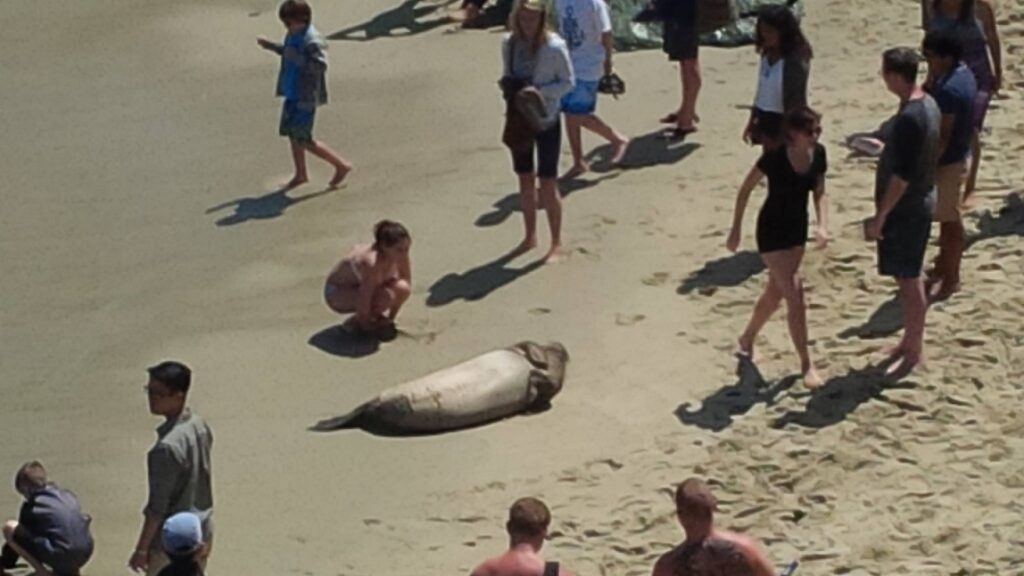
When I first moved to San Diego, back in 2015, La Jolla Cove was one of the first places I visited. There were quite a few sea lions there, but my favorite encounter was with a single elephant seal that was just lying there on the sand, trying to get some sleep, despite a crowd people ‘oohing’ and ‘aahing’ over it. I could have reached out and touched it. I didn’t — that would not have been a good idea — but I got some nice photos.
********************** Update 4/26/22 **********************
When I first posted this, I identified this animal as a harbor seal. It was only today (4/26/22) that a friend of mine, Maya Ma, who happens to be a scuba diver, pointed out that it is actually an elephant seal. A rather glaring mistake on my part! But, as I’ve mentioned more than once in these posts, I’m not an expert.
***************************************************************


Here’s a few of the sea lions I saw at the time.

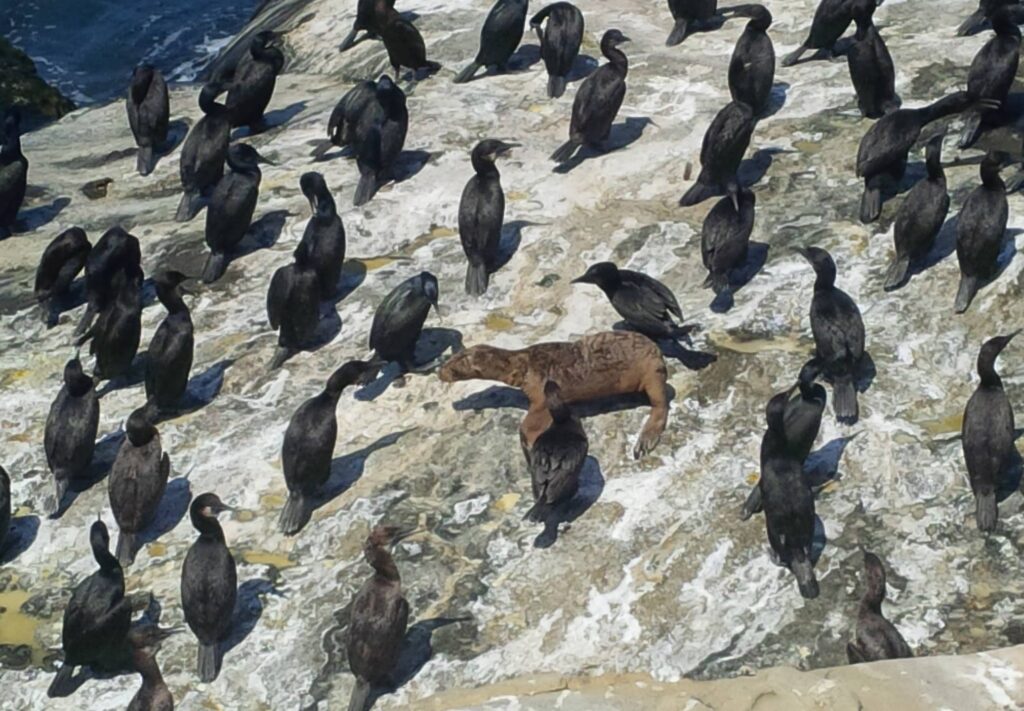
Vying with the harbor seal on the coolness scale was this baby sea lion that had somehow found itself isolated in a flock of cormorants.
Introducing the Pinnipeds3 4 5
Seals and sea lions are both pinnipeds. So are walruses. Unfortunately, we don’t have walruses in California, probably for the same reason we don’t have polar bears — the weather is far too warm and there isn’t any pack ice. We do have elephant seals, which are amazing and awesome, but they don’t come down as far south as La Jolla, so I’ll save them for a future post.
Pinniped comes from the Latin pinna “fin” and pedis “foot”, so it means “fin-footed”.6 It’s short for Pinnipedia, which is a suborder of Carnivora (the carnivores), an order of mammals that specialize in eating flesh. Carnivora includes such diverse animals as dogs, cats, bears, otters, weasels, and raccoons.7
Pinnipedia is comprised of three extant (living) families: Otariidae (sea lions and fur seals), Phocidae (the earless or true seals), and Odobenidae (walruses). In common parlance, the term ‘seal’ is often used for both seals and sea lions, but in this article, I’ll be using it only for the earless seals.
The modern walrus (Odobenus rosmarus) is the only living member of Odobenidae. The group was much more diverse in the past, however. More than a dozen extinct genera have been identified from fossils.
There are many different kinds of seals and sea lions. Nevertheless, it’s usually pretty easy to tell seals and sea lions apart. It’s especially easy at La Jolla Cove since most of the seals are harbor seals (Phoca vitulina)8 and all the sea lions are California sea lions (Zalophus californianus). Unfortunately, I don’t have any photos of my own of harbor seals, but here’s one I downloaded from Wiki Commons. I’m not sure of the location, but it’s the same species we get at La Jolla Cove.

Author: Phoca vitulina
This file is licensed under the Creative Commons Attribution 2.0 Generic license.
And here’s a couple of photos of a California sea lion. Notice the short tail. (That’s not a distinguishing feature, by the way. I just wanted to point out that they do have tails.)

La Jolla Cove. 12/26/20

La Jolla Cove. 12/26/20
One difference between seals and sea lions is that sea lions have ear flaps. You can clearly see these in the photo below.

Seals have no external ears — just tiny holes that aren’t easily seen. That’s why the true seals are also called earless seals.
Another major difference between the two families is that sea lions are able to rotate their hind flippers underneath their bodies so that they can “walk” on all fours. Actually, “walk” is probably a little too strong a word for what they do. It’s more of an awkward shuffle. They swing their heads and necks back and forth to help maintain momentum. Walruses are also able to rotate their hind flippers under their body.
Seals are not able to rotate their hind flippers. In fact, they aren’t even able to shuffle. Mostly, they just flop around on their bellies, although some species can pull themselves forward with their front flippers. Sea lions aren’t exactly graceful on land, but they get around way better than seals.
Sea lions are noisier than seals, frequently emitting loud ‘barks’. Seal vocalizations are more like soft grunts.
Seals spend more time in the water than sea lions and are generally better adapted to an aquatic lifestyle. They’re more streamlined and, while their inability to rotate their hind flippers makes them more awkward on land, those same flippers are better positioned for propelling them through the water.
Seals often lead solitary lives and only congregate on shore once a year to mate. Sea lions are much more social, congregating in herds of as many as 1,500 individuals. Dozens of them will haul out onto the sand at a time, lolling about and bickering with each other.
In general, sea lions tend to be much larger than seals and their front flippers are longer in proportion to their body. They also tend to be darker in color and their snouts are shorter. Although it may not be very helpful for identification unless you’re snorkeling or diving with them, sea lions mostly use their front flippers for swimming and their back flippers for steering. Seals are exactly the opposite — they tend to use their back flippers for swimming and steer with their front pair. (Walruses swim with all four flippers.)9
While seals may be better swimmers, sea lions are no slouches. I found that out when I went snorkeling in the cove. Here’s a couple of videos I took with a GoPro.
Sea lions get very upset if you approach them too closely on land. In the water, it’s a different story. They know they’re in their element and they exhibit no fear when swimming around humans. (At least the ones I swam with didn’t.)
There are currently four families of pinnipeds — the three extant families already mentioned: Phocidae (earless or true seals), Otariidae (sea lions), and Odobenidae (walruses), and one extinct family, Desmatophocidae. There is an extensive fossil record for all these groups. Nevertheless, there are enough gaps in the record to make the origin of pinnipeds a matter of debate.
It has been suggested that pinnipeds might be descended from two different ancestral lines. In this scenario, sea lions and walruses (otariids and odobenids) would have shared a recent common ancestor with bears, while seals (phocids) would have shared one with Musteloidea, the group that includes otters. Fossil and molecular evidence suggests that this is not the case. More likely, pinnipeds are all descended from the same recent common ancestor. What that ancestor may have been, however, is uncertain. Some studies suggest a bear-like ancestor. Others point to an ancestor that was more otter-like.
The pinniped lineage probably split from the rest of the carnivores around 50 million years ago (mya). The oldest known pinnipeds are a group called the enaliarctines. These are known from Oligocene to lower Miocene14 rocks in the North Pacific. Enaliarctines were relatively small pinnipeds, intermediate in size between a sea otter and a harbor seal.

Source: http://spinops.blogspot.com/
Author: Nobu Tamura
This file is licensed under the Creative Commons Attribution-Share Alike 4.0 International license.
In 2007, an important transitional fossil was found on Devon Island in Canada. This fossil, named Puijila darwini, is considered to be the most primitive pinniped yet found. The animal lived 20 to 24 mya, during the early Miocene. It was a little over a meter in length (three feet) and it had a long tail. Puijila did not have flippers, but the bones of its toes were a bit flattened. This is strong evidence that it had webbed feet. Although younger than some of the enaliarctines, Puijila’s primitive features suggest that it is more closely related to the earliest ancestors of the pinnipeds. For it’s time, it would have been a “living fossil”.
Its webbed feet and the robustness of its limbs and shoulders suggest that Puijila used all four of its limbs for swimming. This makes sense. As already noted, modern pinnipeds vary as to whether they use their fore- or hind-flippers or both for swimming. So it’s likely that their most recent common ancestor would have used all of its limbs, and later pinnipeds specialized.
Perhaps the most important thing about P. darwini is that its remains were found in a lake deposit. This suggests that pinnipeds started their transition to aquatic life in fresh water, only later adapting to a marine environment. It also lived in the arctic, which suggests that pinnipeds may have evolved in that region. If the ancestors of pinnipeds were hunting in streams and lakes that froze over in winter, this may have driven them to expand their hunting grounds to coastal waters, which would have been free of ice, eventually leading them to adapt to a marine environment.
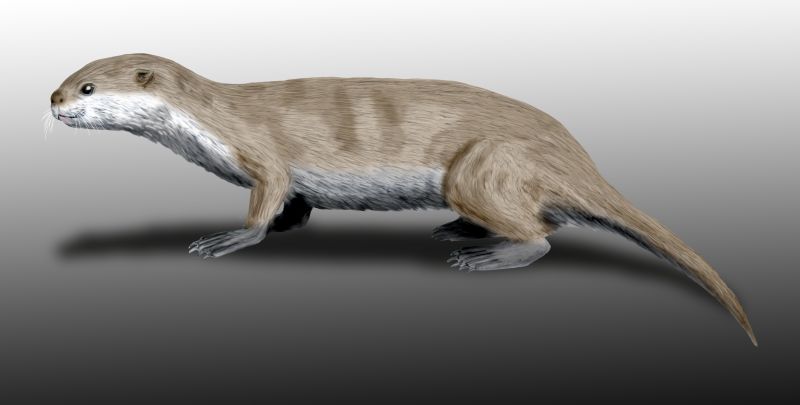
Author: Nobu Tamura (http://spinops.blogspot.com)
Permission is granted to copy, distribute and/or modify this document under the terms of the GNU Free Documentation License, Version 1.2 or any later version published by the Free Software Foundation; with no Invariant Sections, no Front-Cover Texts, and no Back-Cover Texts. A copy of the license is included in the section entitled GNU Free Documentation License.
Now, I know what you’re thinking. These two reconstructions — one of Enaliarctos mealsi and one of Puijila darwini — sure make them look a lot like otters. So does this suggest that pinnipeds evolved from otter-like ancestors, instead of bear-like ones? Not really. The transition to an aquatic environment of the ancestors of both pinnipeds and otters could have simply led to very similar adaptions. This is called convergent evolution, and it’s a very common occurrence.
Fins and a stream-lined shape are the most obvious adaptations that pinnipeds have made to life in the ocean. But they’re far from the only ones. Here’s a few more:
Blubber. Pennipeds have a thick layer of fat called blubber just beneath the skin. This serves as insulation and acts as an energy store that can be called upon when fasting. (Females typically fast while nursing and males often fast while guarding a harem during breeding season.) It also helps to stream-line the body. Blubber can make up as much as 50% of an adult pinniped’s weight.
Eyes. The eyes of pinnipeds are adapted for seeing both on land and in the water. The lens is close to spherical (like a fish’s) and all points on the retina are about the same distance from the center of the lens. The cornea is flattened in the center, so it doesn’t assist the lens in focusing, which wouldn’t work underwater, anyway. (See my earlier post The Story of Eyes: Part 1.) All these adaptations work together to give pinnipeds reasonably good vision in both aquatic and terrestrial environments.
Since they need to hunt prey in dim, underwater environments, pinnipeds have large eyes set near the front of the head for binocular vision. (The walrus is an exception. Walruses eat mollusks on the sea floor, so they don’t need good vision. Their eyes are small and located on the sides of the head.) Immediately behind the retina, pinnipeds have a layer of reflective tissue called a tapetum lucidum. Light that is not absorbed by the retina on the first pass is reflected back through the retina by this layer for a second pass. This greatly increases the sensitivity of their eyes and allows them to see better in dim light. (Cats have a similar layer. It’s what makes their eyes glow in the light of a flashlight.)
Ears. The ears of pinnipeds are adapted for hearing underwater. They can hear pretty well out of water, too, but not as well as many land mammals.
Whiskers. The technical term for whiskers is ‘vibrissae’. The vibrissae of pinnipeds are supplied with about ten times as many nerve endings as the vibrissae of terrestrial mammals. This allows them to detect vibrations in the water. Incredibly, studies have shown that harbor seals are able to follow the trail of another seal that swam ahead of them several minutes before. They can even tell the size and species of a fish by the vibrations it leaves in its wake.
Unlike land mammals, pinnipeds don’t move their whiskers over an object to examine it. They keep them extended in roughly the same position. Presumably, this allows them to better detect and analyze vibrations in the water.
Adaptations for diving. The adaptations that pinnipeds have made for diving are almost too numerous to mention. When beginning a dive, a pinniped will typically empty its lungs of half their air and close their nostrils. Their lungs are reinforced with cartilaginous rings and smooth muscles. The alveoli (tiny air sacs in the lungs) completely deflate during deep dives. Unlike most land mammals, pinnipeds can empty their lungs and re-inflate them even after complete collapse.
Whereas land mammals rely mainly on the lungs to store oxygen, pinnipeds store it mostly in the blood and muscles. For example, focid seals store only about 5% of the oxygen in the lungs. Humans store around 51%.
Pinnipeds have a higher blood volume than terrestrial mammals. On the inner wall of the chest cavity at the level of the sternum, pinnipeds have a dense complex of arteries and veins called the retia mirabilia. This structure is used for oxygen storage during deep dives. Pinnipeds have a greater concentration of red blood cells, so they have more of the oxygen storing molecule hemoglobin, which these cells contain. Oxygen is stored in the muscles by a related substance called myoglobin. Marine mammals have 3 to 10 times more myoglobin than land mammals.
Muscles produce a waste product called lactic acid. This substance is released into the blood stream, and its build up is what leads us to feel “out of breath”. In pinnipeds, vasoconstriction (the narrowing of blood vessels) blocks the muscles from releasing lactic acid into the general blood stream until the animal surfaces, allowing them to hold their breath much longer. Deep diving species reduce their heart rate and limit blood flow to just the heart, brain, and lungs.
These are only some of the adaptations that pinnipeds have made for diving. I could easily devote an entire blog post to just this topic.17
Sleep. My favorite pinniped adaptation for life in the sea is one they share with cetaceans (dolphins and whales) and, surprisingly, migrating birds. Only half of their brain sleeps at a time! In science-speak, this is called ‘unihemispheric slow-wave sleep (USWS)’. Like all higher vertebrates, the largest part of the brain, the cerebrum, is divided into two hemispheres. In placental mammals, these hemispheres are connected by a large bundle of nerves called the corpus callosum.18
Studies of so-called split-brain patients — epileptics whose corpus callosums were severed to prevent their entire brains from being taken over by seizures — have shown that the two cerebral hemispheres can act independently to a remarkable degree.19 Cetaceans, pinnipeds, and migratory birds have pushed this ability to an unexpected extreme. One of their hemispheres is able to go into deep sleep, while the other hemisphere remains awake and alert. They even close the eye that is connected to the sleeping hemisphere, while keeping the other eye open!
For pinnipeds and cetaceans, the obvious advantage to this is that one hemisphere can keep watch for predators while the other one sleeps. (For migratory birds, it allows them to fly long distances without stopping.)
Animals that rely on USWS spend shorter times in it than they would in regular sleep and get much less sleep overall. Their health does not appear to suffer from this, however. Apparently, they’re able to compensate for lack of sleep by using a variety of adaptations, including a more efficient immune system and increased brain plasticity.20
I should note that pinnipeds only engage in USWS when they’re sleeping in the water. When they’re on land, they sleep with both hemispheres.
The Future
It’s truly amazing the extent to which pinnipeds have changed their forms and physiology to enable them to live in the sea. And they’re not even fully adapted yet. For example, seals and sea lions still have to give birth on land. Given enough time — more millions of years — it’s likely that at least some pinnipeds will join the cetaceans in making the transition to living entirely in the ocean.