Category Archives: Mammals

Hearing Things

Ironically, as I write this, I have an ear infection. It’s made me partially deaf in one ear. It’s also made me appreciate what a bang-up job my ears do under more normal circumstances. We hear so much about the amazing hearing abilities of other animals that you might assume humans have a rather poor sense of hearing. In fact, humans, like most mammals, have very good hearing. But I’m getting ahead of myself. Way ahead, in fact…

Hearing in Plants1 2

No, I’m not going to tell you that if you play Mozart to your houseplants they’ll grow better. That nonsense has long since been debunked. Plants don’t care about music. They probably don’t care about anything. But there are things that are important to them, like locating water, protecting themselves from herbivores, and attracting pollinators. To achieve these goals, they’ve evolved the capacity to respond to things in their environment. They ‘know’ to grow in a direction opposite the pull of gravity; they react to light and to the position of the sun; they follow chemical gradients; they even communicate with each other and with animals through chemicals; and evidence is mounting that at least some plants can hear.3

Sound waves cause objects in their path to vibrate. That’s how we hear things—sound shakes our eardrums. Leaves and petals aren’t as good as eardrums when it comes to vibrating, but they still do it. Is it possible that some plants have evolved to respond to certain types of vibrations?

A study published in 2014 showed that Arabidopsis, a plant in the mustard family, turns up its production of chemical toxins in response to caterpillar chewing sounds. When the cabbage butterfly caterpillar munches on an Arabidopsis leaf, it makes a distinctive, high-pitched sound. Researchers recorded this sound, then played it back to one group of plants for two hours, while leaving another group in silence. The plants exposed to the sound increased their production of mustard oil, a chemical that makes their leaves distasteful to most insects. The researchers tried playing other sounds to the plants, including sounds made by non-threatening insects. The plants showed no response. This was the first study to show evidence that some plants can detect sound.

In a 2017 study, evolutionary biologist Monica Gagliano and colleagues placed pea seedlings in pots shaped like upside-down Ys. One arm of each “Y” was placed in dry soil. The other arm was placed in either a tray of water or a coiled plastic tube that had water flowing through it. The roots always grew towards the arm with the water, even when the water was inaccessible inside the plastic tubing. Gagliano believes that the only way the plants could have known the water in the tubing was there was by the gurgling noises it made. She suggests that plants use sound waves to detect water at a distance, but use moisture gradients when they get closer to the source.4

Plants produce sugary nectar to attract pollinators. Sugar production comes at a metabolic cost, though—it uses energy. So, ideally, a plant should produce the sweetest nectar only when there are pollinators around for it to attract. But how can a plant tell if that’s the case? Recent studies suggest that some plants can hear them coming! Researchers studying evening primroses (Oenothera drummondii) found that when they played the sound of bees buzzing nearby, within minutes the plants increased the concentration of sugar in their nectar by 20%.

The scientists conducted several experiments on more than 650 evening primrose flowers, measuring their nectar production in response to silence, sound at three different frequencies, and recordings of buzzing bees. The recorded buzzing (and low-frequency sounds that closely matched the recorded buzzing) resulted in the plants starting to increase sugar concentration in their nectar in just three minutes! The other sounds had no effect.

The researchers repeated the experiments on flowers that had some of their petals removed. These flowers didn’t change their nectar production in response to buzzing sounds, implying that it’s the petals that are used to detect the vibrations. This could be one reason why many flowers, including those of evening primrose, are bowl-shaped since this shape tends to concentrate sound.5

Annual evening primrose (Oenothera deltoides ssp. deltoides)
Note: This is not the species the study was done on. And its color is different—Oenothera drummondii has yellow flowers. But the flowers are a similar shape (and I don’t have any photos of Oenothera drummondii).
Anza Borrego Desert State Park, San Diego County. 1/29/23

Hearing in Insects6

Invertebrates are animals that don’t have backbones—everything from sponges to squid in other words. There are, unsurprisingly, an enormous number of invertebrate species, so it might come as a surprise to learn that the ability to hear has only evolved in two groups of them—insects and crabs—and it’s only evolved in a tiny subset of those groups.

Why is this? Well, many invertebrates are able to sense vibrations in the substrate—the ground or leaf or whatever—that they’re standing on. That’s probably good enough for most purposes. And evolution always favors good enough. It doesn’t waste time and resources on perfection.

That said, there are a lot of insect species, so even though hearing is very rare among them, their sheer numbers ensure that there are a lot of insects that can hear. Ears can be found in butterflies, moths, grasshoppers, katydids, crickets, lacewings, preying mantids, honeybees, mosquitoes, flies, true bugs, beetles, and cockroaches. And the diversity of their ears is extraordinary. Unlike vertebrates, which tend to have ears on the head, insects can have them on almost any body part—abdomen, legs, wings, mouth—some even have them on their tongues!7

One reason for this diversity is that ears didn’t just evolve once in insects. Scientists believe they evolved independently at least 20 times. In butterflies and moths alone, they evolved on six different occasions!

But there’s another reason. With a few exceptions, insect ears are modifications of chordotonal organs.8 These are sensory organs found in insects and crustaceans but not in any other type of animal. A chordotonal organ stretches between two segments of a joint. When the segments move relative to each other (that is, when the appendage bends at the joint), it increases or decreases the tension on the organ, allowing it to sense the movement. Usually, chordotonal organs are used for proprioception—that is, giving the insect a sense of how its body parts are positioned—but they are often repurposed for other functions, including hearing. They are found at almost every joint, so it follows that insects can evolve ears on almost any body part.9 10

The insect in the following photo is a katydid (a relative of grasshoppers and crickets).

Least katydid (Brachyinsara hemiptera)
Mission Trails Regional Park, San Diego County. 11/7/18

Here’s a closeup of one of its legs. The arrow points to one of its ears.

A closeup, showing the ear

The ear, in this case, takes the form of a tympanal organ. This is a membrane (the tympanum) stretched across a frame. When sound causes the membrane to vibrate, the vibrations are picked up by a chordotonal organ that’s attached to it.

So, what do insects do with all those weird ears? As diverse as their ears are, so too are their uses. Various insects use them for courtship, to establish territories, for social communication, even to locate hosts to parasitize. And, in some cases, they use them to detect bats…

Bats Go High (Frequency)

The philosopher Thomas Nagel once wrote a paper about the nature of consciousness entitled “What Is It Like to Be a Bat?” In it, Nagel asserts that “an organism has conscious mental states if and only if there is something that it is like to be that organism—something it is like for the organism.” He further asserts that we can never truly understand what it’s like to be a bat (or any other presumably-conscious organism) because we are limited to our own subjective viewpoint, which is very different from that of a bat.11

Why, we might ask, did Nagel choose a bat to illustrate his ideas? Bats are bizarre animals in many respects. For example, they are the only mammals that can fly. But I doubt Nagel was thinking about their flying ability when he chose them. More likely, he was thinking of their echolocation.

Echolocation is the ability to perceive one’s surroundings by emitting pulses of sound (aka clicks) and using the rebounding echoes to build a mental model of nearby objects. Most bats fly at night, and although they aren’t blind, they don’t need to see in order to hunt and find their way around. They can do it all with sound.

Bats echolocate using ultrasound—sound that’s at a frequency too high for humans to hear. When a bat searches for prey, it emits loud, long pulses that carry as far as possible. It also spaces the pulses out, so that the outgoing calls don’t interfere with the returning echoes. The frequency of each click typically varies from beginning to end. Different frequencies bounce off parts of an object in different ways, and this allows the bat to resolve shape and texture. In the search phase, the energy of each pulse is concentrated into a narrow range of frequencies. This improves the bat’s chances of detecting small objects at a distance, but limits its ability to identify them. (The resolution of the echoes is lower, in other words). So, the bat can tell that a small object in the distance might be an insect, but it won’t know for sure until it enters the second phase of the hunt.

In this phase, the bat homes in on the object. As it does, it broadens the frequency range of its calls to increase their resolution, and it calls more frequently to get faster updates. At the same time that it’s packing more frequencies into each click, it also shortens the click length. This is necessary to keep outgoing clicks from overlapping with incoming echoes, since it’s clicking at a faster rate. Finally, it softens the clicks. I suppose it does this because it’s getting closer to the target, so it doesn’t need to click as loudly.

All of this, mind you, is happening over a very short period of time, and the differences in wavelength of the incoming echoes are very small. And yet, the bat’s brain is able to process all this incoming information in real time, all while flitting around at high speed!

There are a lot of bat species, and not all of them do things exactly the same. For example, not all bats vary the frequency of their clicks. Most do, and those are called FM, or frequency-modulated, bats. However, around 160 species use single-note calls. These bats are called CF, or constant-frequency bats. CF bats have evolved fascinating ways of using that single note to their advantage. I won’t go into any of that here—we’ve got too much territory left to cover—but if you want the details, check out “An Immense World: How Animal Senses Reveal the Hidden World Around Us” by Ed Yong.12 It’s a great book and one of the main resources for this post.

What I’ve given you in this section is a very condensed and simplified introduction to bat echolocation. I encourage you to read Yong’s book to learn more. There are a couple of other things I’d like to mention, though. First, bat clicks are very loud. The call of a big brown bat can be 138 decibels—about as loud as a siren. Of course, since we’re talking about ultrasound, we can’t hear them—undoubtedly, a good thing! But how, you might ask, does the bat avoid going deaf from its own calls? Each time they make a call, they contract the muscles of their middle ears to muffle the sound, then relax them to listen for the echoes. Even more remarkably, bats are able to adjust the sensitivity of their ears as they get closer to an insect, so that they percieve the echoes at the same steady loudness. This probably helps to stabilize their hearing.13

The other thing I wanted to mention is something that at first glance might seem like a contradiction. Sometimes, when people have barricaded cave entrances to limit access, they’ve later found the bodies of bats that accidentally flew into the barricades. Similarly, if you see a bat flying around overhead and toss a small pebble into the air, the bat will often catch the pebble, thinking that it’s a bug. If bat echolocation is so sophisticated, why do they make such seemingly dumb mistakes?

Probably because they aren’t paying attention. Focusing takes energy. A small object sailing through the air is a lot more likely to be a bug than a pebble, so why bother checking? As for that barricaded cave entrance, when large numbers of bats enter or exit a cave at the same time, if they’re all echolocating, they’re going to have a very hard time distinguishing the echoes of their own calls from the calls and echoes of the other bats. Fortunately, they don’t need to. They’ve probably flown in and out of that cave hundreds of times. They know it like the backs of their wings. So, again, it’s not that they’re bad at echolocation, they’re just not paying attention. That barricade has never been there before, so they aren’t expecting it.

Human Echolocation

Seeing with sound is such an alien-sounding concept that it hardly seems possible. But remarkably, there are human beings who have learned to do it! As a newborn, David Kish had an aggressive form of eye cancer that left him blind by the age of 13 months. (In fact, both his eyes had to be removed.) Shortly thereafter, he started clicking with his tongue. By the age of two, he was crawling out of his crib and exploring the house, using his self-taught ability to echolocate. One night, he even crawled out of his bedroom window, dropped into a flower bed, and wandered around outside, clicking all the while. He remembers sensing the chain-link fence around his backyard and the house on the other side. He climbed that fence and others until, finally, a neighbor called the police, who took him back home.

Kish is now in his 50s. When he walks around outside his home, he uses a long cane to sense objects at ground level but uses clicks to locate everything else. And locate he does! Ed Yong, author of “An Immense World”, describes how Kish accurately narrated everything they passed as they walked around his neighborhood. He easily located houses, porches, shrubbery, and parked cars, and when they came to a place where a large tree branch had overgrown the sidewalk, Kish knew to duck under it.

Kish and people like him offer at least some push-back to Nagel’s assertion that we can never know what it’s like to be a bat, because, as Yong points out, Kish has language. So, even if he can’t explain what it’s like to be a bat, he can explain “what it’s like to be Kish”.14 According to Kish, when he clicks, “he gets a series of `’flashes’, like matches being struck in the dark, each one briefly illuminating the world around him.” Objects that return sharp echoes, like stone walls and glass panes, Kish describes as “bright”. Objects that return coarser echoes, such as foliage and rough stones, are “dark”. (Although, he has no memory of what it was like to see, he naturally uses the language of sight because that’s the language used by the sighted people around him.)15

Bugs Fight Back

For millions of years, bats have been eating bugs. Moths, being mostly nocturnal, are especially vulnerable. After reading about how good bats are at using echolocation to detect and then home in on flying insects, you might wonder how there are any moths left in the world. But millions of years of evolution have provided them with a few defenses.

First, they’re covered with scales. For some readers, this might come as a surprise. Moths certainly don’t look very scaly. However, if you look at a moth wing under a microscope, you’ll see what I mean. Their wings, and often their entire body, are covered in thousands of microscopic scales. These scales are useful in several of ways, but the one that concerns us here is their effect on a bat’s echolocation. Because the scales are so tiny and so numerous, they function as a soft, powdery, sound-absorbing coating, muffling the echoes of the calls.16

Painted tiger moth (Arachnis picta)
Jamul, CA 10/25/22
The color patterns on the moth are created by thousands of minute scales. The next couple of images show closeups of the scales.
A closeup of the wing of the moth in the last photo.
A closer view of the scales

Moths are not limited to passive defenses. More than half of moth species have evolved ears capable of hearing bat calls.17 In fact, that’s the only thing they’re used for. And they give the moths a significant advantage. When a bat emits a call, it has to wait for the sound to travel to the moth and back again. The moth, meanwhile, only has to hear the incoming sound. While the bat is still waiting for the echo, the moth can begin evasive maneuvers. Also, the sound that reaches the moth is much stronger than its echo, so the moth might have even more time to react before the bat detects it (or detects its latest dodge).18

Some moths have ears for detecting bats, but can’t be bothered with evasive maneuvers. Tiger moths in the family Arctiidae have a pair of drum-like organs on their thorax (chest area).19 When a tiger moth hears a bat, it vibrates these organs at high-speed, producing ultrasonic clicks that literally jam the bat’s sonar! Many tiger moths also contain chemicals that make them taste bad. In this case, the clicks also serve as a warning, letting the bat know that they aren’t worth eating.20

Yet another strategy moths have evolved is the ability to create illusions. Luna moths are large insects with lime-green wings that end in long streamers. I used to see them occasionally when I lived in Virginia.

Luna moth (Actias luna)
Tulsa, Oklahoma
author: woodleywonderworks
source: Luna
This file is licensed under the Creative Commons Attribution 2.0 Generic license.

Luna moths don’t have ears, and they don’t have any fancy, sonar-jamming organs. What they do have are long tails that flutter and spin behind them as they fly. Somehow, the tails produce echoes that trick bats into attacking them instead of the moth’s body. The moth might lose its tails, but it can live just fine without them (as long as it doesn’t run into another bat).21

Dolphins Go High (in Their Own Special Way)22

As far as we know, only two major groups of animals have developed echolocation. We’ve already covered one of them: bats. The other group is dolphins.

Bats and dolphins are both mammals, which means they have a lot in common, but they also have some very obvious differences. Bats are small, flying animals that live on land. Dolphins are much larger and spend their entire lives in the water. Dolphins and most bats echolocate, but they evolved that ability independently. So, it’s to be expected that they would go about it somewhat differently.

Scientists first discovered echolocation in bats. In 1947, Arthur McBride, the curator of Marine Studios (later Marineland) in Florida, noticed that bottlenose dolphins were able to avoid nets in the dark. This made him wonder if they might be using some form of echolocation. Other scientists conducted research that proved McBride’s hypothesis.23

Dolphins are technically a type of whale—they belong to the group Odontoceti or odontocetes, aka toothed whales. The other members of this group, including such fan-favorites as sperm whales, orcas, and narwhals, also echolocate. All other whales belong to the group Mysticeti or baleen whales. They don’t need to echolocate, since they’re filter feeders. (Except that maybe they do. See the section “Whales Go Long” later in this article.) 24 25

Whales evolved from land animals. As their ancestors gradually adapted to marine life, their noses migrated to the tops of their heads and became blowholes. In the nasal cavity just below the blowhole, whales have two pairs of organs called phonic lips. These evolved from what was originally the nostrils. By forcing air past the phonic lips, the dolphin sets them to vibrating. The sound travels forward through a large, fatty organ called the melon. This organ focuses the sound, producing the clicks the dolphin uses for echolocation. The melon is also what gives dolphins their bulging brows.

Note that no vocal cords are involved in the production of the clicks. In fact, dolphins no longer have functional vocal cords. All that’s left of them are structures called vocal folds, and these lost the ability to make sound millions of years ago.26 So, a dolphin’s click begins in its nose and passes out through its forehead—a very different strategy from that of a bat, whose clicks begin in the throat and exit through the mouth or nose.

Dolphins (and other toothed whales) also capture returning echoes in a novel way. Part of a dolphin’s lower jaw is hollow with very thin walls and is filled with the same fats found in the melon. When the echoes arrive at the jaw, these fats channel the sound to the inner ear. In Ed Yong’s words, “A dolphin is an echolocator that clicks with its nose and listens with its jaw.”27

This beautifully-simple animation shows how a dolphin’s ping originates in its phonic lips and is focused by the melon. The returning echo is channeled through its lower jaw toward the inner ear.
Author: Malene Thyssen
Permission is granted to copy, distribute and/or modify this document under the terms of the GNU Free Documentation License, Version 1.2 or any later version published by the Free Software Foundation; with no Invariant Sections, no Front-Cover Texts, and no Back-Cover Texts. A copy of the license is included in the section entitled GNU Free Documentation License.
This file is licensed under the Creative Commons Attribution-Share Alike 3.0 Unported license.

Despite major differences in the way they generate sounds and intercept echos, dolphins use their clicks in much the same way as bats. They manage the duration and frequency of their calls so that they don’t overlap with the returning echoes. They produce shorter clicks closer together when they need a more detailed ‘view’. They even adjust the sensitivity of their ears to avoid being deafened by their own calls and so that returning echos are all heard at the same steady volume.

But living in water allows dolphins to do things with their sonar that bats can only dream of. Sound travels faster and farther in water than in air, so dolphin echolocation has a much greater range than a bat’s. A dolphin’s large size also allows it to channel more energy into its calls. A bottlenose dolphin’s click can contain 40,000 times more energy than that of a big brown bat!

One thing that living in water allows dolphins to do is downright mind-blowing. Sound waves traveling through a substance (water, air, or whatever) tend to reflect back when they encounter another substance that has a greater density. If the new substance is dense enough, then most of the wave will be reflected. If it’s not that much denser, then only some of the sound is reflected (i.e. a weak echo is produced.) If the new substance has exactly the same density as the original substance, then the sound wave won’t be reflected at all.

Now, here comes the cool part. You’ve probably heard that your body is mostly water. The same is true of other animals. So, animal bodies have about the same density as water. Water is much denser than air, so when a ping from a bat encounters an insect, the insect’s body produces a strong echo. But dolphins live in water, so when a dolphin produces a click, it travels through the water, hits a fish whose body is not much denser than the surrounding water, and continues traveling into the fish’s body. Of course, the body of the fish is a little denser than the surrounding water, so some of the sound does get reflected back, but a large part of it continues on. And when that part hits a bone… Well, bone is quite dense, so most of the sound gets reflected back.

You can probably see where this is going. The returning echos don’t just carry information about the fish’s shape and texture. They allow the dolphin to perceive what’s inside the fish! In short, dolphin echolocation is very much akin to x-ray vision!

It’s hard to exaggerate the significance of this. If you go swimming with dolphins, they can see your lungs and skeleton. If you’re pregnant, they can probably see the fetus. Dolphins can perceive the swim bladders of the fish they eat. They can almost certainly identify the type of fish by the shape of its bladder. They can tell when a fish has a metal hook in it. In Hawaii, false killer whales will steal tuna off fishing lines, deftly avoiding being caught by the hooks themselves, presumably because they can “see” where the hooks are located in the fish.

The skulls of beaked whales (a type of toothed whale) are often decorated with crests, bumps, and ridges. These weird growths are invisible to us unless we dissect the whale—the head is perfectly smooth from the outside—but they would be easily detected by another whale’s echolocation. So, what are they for? A clue perhaps can be found in the fact that they are often only found in the males. Could they be sexual displays, used to attract mates? Normally, we would expect such displays to be on the outside of the body, but when your potential mates all have x-ray vision…

Yet another advantage to echolocating in water is something we briefly touched on earlier: greater range. Sounds travel farther in water before they dissipate too much to be useful. A flying bat typically has less than a second to decide what to do when it encounters a possible target. A swimming odontocete has more like 10 seconds. As Yong so eloquently puts it, “A bat must always react. A whale can plan.”28

This extra time also allows them to work together. At night, spinner dolphins hunt their prey in teams of up to 28 individuals. When they find a group of fish or squid, they form a tight row and plow into their prey, forcing them to crowd together. Then they surround them and take turns darting in from opposite sides to snap them up. The dolphins coordinate the sequence of their movements with precision, and they’re more likely to click when transitioning between steps in the sequence.

Spinner dolphins are obviously using echolocation to coordinate their movements, but exactly how they’re using it isn’t clear. Are they sending commands? Are they tracking each others positions? Are they able to use each other’s echoes to extend their own sense of their surroundings? We don’t yet know.

Elephants Go Low29 30 31

In 1984, zoologist Katy Payne was observing Asian elephants at the Portland Zoo, when she felt an unusual vibration in the air. This led her to suspect that the pachyderms might be using infrasound to communicate. (Infrasound is the opposite of ultrasound—its frequency is too low for us to hear.) Payne and her colleagues were able to confirm her suspicions by showing that the elephants changed their behaviors when exposed to recorded infrasonic calls, and they did so in ways that couldn’t be explained in any other way.

Payne and other researchers have gone on to spend many years studying infrasonic communication in elephants. It’s now known that elephants can produce lower-frequency sounds than any other land animal. They can also produce and detect sounds over a wider range than any other nonhuman mammal. Human hearing has a range of roughly 20Hz to 20,000Hz. In one study, a female elephant was shown to respond to frequencies from 17Hz to 10,500Hz. Other studies have found that elephants can respond to frequencies lower than 10Hz!

Scientists have shown that much of elephant communication occurs in the infrasonic. It’s possible that most of it does. But how and why did elephants evolve to communicate at such low frequencies?

Elephants evolved mostly in forested habitats. In dense forest, a relatively large animal like an elephant can’t rely on vision to keep track of other members of its group. So, early elephants evolved keen senses of smell and hearing to compensate. Hearing must have been especially important for communication.

But why favor low-frequency sounds over high-frequency? Partly, it could have been just a matter of anatomy. It’s hard to imagine a big animal making high-pitched squeaks or chirps. Deep, barrel chests are just more suited to low-pitched calls. But setting anatomy aside, low-frequency sound is just better suited to communicating in a dense forest. It passes easily through thick vegetation that would quickly dissipate higher frequencies. And the lower the frequency, the better, allowing a herd to spread out widely and still keep in touch.

Why Stop At Ears?32

When an elephant emits a low-frequency call, it doesn’t just set the air vibrating—the earth itself vibrates in response. The sound of the call travels through both air and earth. So, another elephant doesn’t just detect the sound as it passes from the air to its eardrums, it also detects the sound as it passes from the ground to its feet! That’s right, elephants hear with their feet!

What good, you might ask, does it do an elephant to hear two versions of the same call? Sound travels at different speeds through different mediums. In general, it travels faster in liquids and solids than through gases like air.33 So, the sound of the call reaches the elephant’s feet before it reaches its ears.

You might have heard that you can estimate the distance to a thunderstorm by counting the seconds between a flash of lightning and the crack of thunder that follows it. Since light travels so much faster than sound, the flash gets to you almost instantly. Sound, on the other hand, takes roughly 5 seconds to travel a mile in air.34 So, divide the time between the flash and the crack by 5 and you’ve got the approximate distance to the storm.

Similarly, when an elephant hears a call with its feet and then hears the same call with its ears a short time later, this allows it to estimate how far away the other elephant must be. Maybe this is inate or maybe it’s learned. Either way, the elephant gets an idea how far away the other elephant is.

At the same time, sound waves traveling through the air generally arrive at one of the elephant’s ears before the other one, giving the elephant an idea of the direction that the call is coming from. This isn’t anything out of the ordinary. We sense the direction of sounds the same way. However, by combining these two pieces of information—distance and direction—the elephant ends up with a pretty good idea of where the other elephant is in relation to itself!

I should mention that elephants probably don’t just detect sounds traveling through the ground by the touch sensors in their feet, although they do have a high concentration of such sensors in their foot pads. There’s also evidence that sound travels by bone conduction from their feet to their ears. So to some extent, they probably hear the sound coming from the ground with their ears, as well.

Before we move on, I want to mention one other interesting tidbit—elephants can hear clouds. Storm clouds, anyway. Apparently, storm clouds produce sounds at a frequency that’s below the range of human hearing, but not of elephant hearing. In a 2015 study, seven years’ worth of GPS data on the movements of elephants in 14 different herds was compared to weather data for the same region and period. In several instances, elephants in different areas all moved in the direction of the infrasound coming from distant storms.35 36

In 2013, I visited an elephant sanctuary in Thailand. It’s a place where they take care of elephants that have been injured or abused. Visitors can feed them (like the little girl is doing in these two pics) and “bathe” them (the elephant stood in the river, and we threw buckets of water on them.) If you go, make sure you pick a place that doesn’t let you ride the elephants. I’m sure that would be great fun, but it’s very bad for the elephant.
Another view. Somehow, sometime, I’m going to have to find a way to work elephant trunks into a blog post. Extraordinary animals!

Whales Go Long

We covered toothed whales or odontocetes in an earlier section, where we learned that they echolocate using ultrasound. The other whale group, the mysticetes or baleen whales, followed a different route. They evolved to use infrasound.

Mysticetes feed on tiny crustaceans called krill, which is a bit weird, given that mysticetes are themselves massive creatures. They include the blue whale, the largest animal on Earth. Obviously, one or two krill isn’t going to be much of a meal for such an animal. A baleen whale searches for huge swarms of krill, and when it finds one, it opens its mouth wide and engulfs as much of the swarm as it can, filtering out the krill and expelling the water. It filters the krill using baleen—bristle-like structures made of the same material as our fingernails.37

Krill are found all over the world, but they aren’t distributed evenly, so whales have to migrate long distances to find enough krill to sustain themselves. One whale, working alone, might have a hard time locating enough swarms, but what if a pod of whales could spread out over a wide area and let each other know when they find a good feeding area?

In 1971, biologist Roger Payne published two ground-breaking papers about baleen whales. The first introduced the public (and other scientists) to the haunting songs of humpback whales. These songs are low-pitched, but still within the hearing range of humans. (I suppose they could have an infrasound component, too, but I don’t know.) The second paper showed that fin whales—the second largest animals in the world—communicate using infrasound. Payne calculated how far a fin whale’s infrasonic call could travel in water. The answer he came up with was an astonishing 13,000 miles! To put this in context, the Pacific Ocean is only 12,300 miles across at its widest point!

Payne’s conclusion—that fin whales could communicate with other whales across an ocean—seemed so preposterous that other researchers scoffed at the idea. His career was almost ruined. Some people even questioned his sanity. Nevertheless, newer research supports Payne’s ideas. To be clear, we don’t know that the whales are actually communicating across that distance—it’s possible that they’re just using very loud calls to communicate with whales closer to them—but what would be the point of using louder calls than you need? Also, research has shown that blue and fin whales will repeat the same notes over and over at precise intervals. That kind of redundancy is often used by engineers when designing a system that will be used to communicate over very long distances. The Martian rovers, for example, use this strategy when sending data back to Earth.

I said earlier that baleen whales don’t use echolocation. But is that really true? A fin whale’s song can last for several seconds, and the wavelengths can be as long as a football field. If we could build a sonar system that used sound like that, we could map an entire ocean. And researchers have found evidence that whales could be doing just that. Blue whales have been observed traveling directly from polar waters to tropical Bermuda, singing as they go. Whales often swim directly from one landmark to another, even when those landmarks are hundreds of miles apart. Their movements certainly suggest that they have a mental map of the oceans—one they might have built up over their lifetimes using the echoes of their songs.

Songbirds Go Cryptic38

Bird songs are clearly audible to human ears, and we usually find them beautiful. But what does bird song sound like to a bird? The answer is a lot more complicated than you might expect.

For starters, birds seem to hear “faster” than we do. The song of a whip-poor-will, to our unaided hearing, has three notes. But if you slow it down, you’ll find that it actually has five. And when a mockingbird, which mimics the songs of other birds, mimics the song of a whip-poor-will, it mimics all five notes. So, the song sounds more complex to the mockingbird, and presumably to the whip-poor-will, than it does to us.

Researcher Robert Dooling performed a series of experiments that tested the ability of songbirds to distinquish between songs that differed only in their temporal fine structure. He presented the birds with two different buzzes. One of the buzzes consisted of chunks of sound that fell in pitch. That is, a chunk would start off high and end low, and the next chunk would repeat the pattern. The other buzz consisted of chunks that rose in pitch—each chunk started low and ended high. If the chunks were longer than three or four milliseconds, humans could detect the difference, but if the chunks were shorter than three milliseconds, they couldn’t. The birds tested performed better. Canaries and parakeets could distinguish between the buzzes until the chunks got down to one or two milliseconds, and zebra finches were able to tell the difference down to one millisecond, which was the limit of the researchers’ electronics! So, the birds could hear complexities that were too fast for human ears.

It’s interesting that songbirds are more sensitive to temporal fine structure than humans, but later experiments by some of Dooley’s colleagues and students produced more surprising results. A zebra finch always sings the same sequence of syllables, which we can represent as A-B-C-D-E. In one experiment, the researchers reversed one of the syllables: A-B-(reverse C)-D-E. Zebra finches almost always noticed the change, but humans couldn’t tell the difference. However, when the gap between two of the syllables was doubled, humans could hear the difference, but the zebra finches couldn’t.

Then things got really weird. Two of the students tried shuffling the order of the syllables: C-E-D-A-B. Unsurprisingly, the human listeners could easily tell the difference. But the zebra finches couldn’t.

Even though zebra finches always sing the same sequence of syllables for their entire life, they don’t actually care about (and apparently don’t even hear) the order of the syllables or the lengths of the gaps between them. The only thing that matters to them is the structure of the individual notes. And we humans can’t hear that structure. What does this mean? A zebra finch could be encoding all sorts of information in the fine structure of its song—sex, health, identity, who knows what—and to us it would sound like the exact same song repeated over and over again.

Owls Go Silent39 40

Owls are superbly adapted for hunting at night. In my earlier post The Story of Eyes: Part 2, I wrote briefly about the eyes of owls, which are some of the most unique eyes among vertebrates. Tubular, rather than globular, they act like telescopes, amplifying distance vision. And their huge size, taking up much of the owl’s head, allows them to collect as much light as possible.

But even on dark, moonless nights, an owl can still hunt. No, it doesn’t have echolocation. It depends on the faint sounds of its quarry—usually some luckless rodent—to tell it where to strike. Some species, like the great grey owl, can even snatch up small mammals hidden under a layer of snow.41

Let’s focus on barn owls, since they’re fairly representative of their ilk (and I happen to have pictures of one). We use the flaps of our ears to collect sound and funnel it towards our eardrums. Barn owls don’t have ear flaps. Instead, the stiff, dense feathers that make up their facial disk channel sound towards the ear holes. And the ear holes are enormous! In some owl species, if you part the feathers and look into the ear, you can see the backs of the eyeballs!

Barn owl (Tyto alba)
Dictionary Hill in Spring Valley, CA 5/13/23
A couple of rangers gave a talk about a red-tailed hawk and this barn owl that they have in captivity.

All this, plus a large eardrum and cochlea, give an owl very sensitive ears. But being able to hear the faint sounds of its prey isn’t enough. It needs to be able to pinpoint where the sounds are coming from. Since our ears are positioned on opposite sides of our skulls, a sound usually reaches one ear before the other. It’s also slight louder for that ear. This allows us to get an idea what direction the sound is coming from. This is true for owls, too. But because our ears are on the same level, sounds coming from above or below reach both ears at roughly the same time. In most owl species, the left ear is higher than the right. Having one ear positioned slightly above the other allows the owl to locate a sound’s source with much better accuracy. I couldn’t find a good, copyright-free image of an owl skull that showed the positions of the ear holes, so I’ll link you to an article with one. Click here to check it out.

Owls have one more feature that makes them formidable birds of prey: almost silent flight. I say feature, but it’s really a suite of features. First, they have large wings compared to their body mass, so they can fly very slowly with more gliding and less flapping. Second, they have comb-like serrations on the leading edge of their wing feathers. These break up the turbulance that’s responsible for much of the sound other birds make when they fly. Third, their feathers have a soft, velvety texture that further dampens the sound of their wings, as well as the sound that their body makes as it moves through the air. And fourth, they have a soft fringe on the trailing edge of the wings to break up the turbulance trailing behind. Almost silent flight has the obvious advantage of not alerting the owl’s prey, but it also makes it easier for the owl to detect faint sounds, since it doesn’t have to hear them over the sound of its own wing beats.42

The following video shows the same barn owl that was in the earlier photo. It’s in slow motion, but there is sound. You might have to turn the volume up on your computer or mobile device to tell. That’s just how quiet they are.

Journey of the Ossicles43 44 45

Terrestrial vertebrates—amphibians, reptiles, birds, and mammals—are called tetrapods because they have four legs. (Some of them, like snakes, have lost them, but that’s another story.) Tetrapods are descended from fish, so that’s where we need to start if we want to trace the evolution of their hearing. Fish have a number of ways to detect sound, including cilia (nerve hairs), swim bladders, ossicles, otoliths, and various mechanoreceptors. We’ll save all that for some future article. What we’re interested in here is their transition to land.

The first fish to make that transition probably didn’t have eardrums. Those seem to have evolved independently at least three, and maybe as many as six, times. Terrestrial vertebrates that lay their eggs on land (i.e. all of them that aren’t amphibians) are called amniotes.46 In early amniotes, the stapes bone was a large bone that was used to support the braincase. It couldn’t be used for hearing. However, there is evidence that by the Permian (298.9 to 251.9 million years ago), amniotes had evolved eardrums that connected the stapes to the inner ear. So, the stapes became the first of the three tiny bones called ossicles that modern mammals have in their inner ears. Reptiles and birds still have only the one ossicle.

The way mammals ended up with two extra ossicles is unexpected to put it mildly. When tetrapods first moved onto land, the organs that had allowed them to hear in water were useless for hearing in air. However, they could detect vibrations in the ground using the bones of their lower jaws. Those bones ended close to the ears, so when they laid their lower jaw on the ground (which those low-slung early tetrapods probably did most of the time), vibrations would pass from the ground to the ears through bone conduction. So, one could argue that they weren’t totally deaf, but they were certainly a long way off from having good hearing. As already noted, tetrapods did eventually evolve eardrums connected to the stapes bone, which was repurposed as part of the inner ear, and this gave them the ability to pick up sounds directly from the air.

At some point, the tetrapods split into two lineages—one that led to us mammals and another that led to all other amniotes. In the ancestors of mammals, the jawbones underwent some major changes. Figure 1 shows the jaw joints of an early mammal and a non-mammalian amniote.

Figure 1. Jaw joints in mammals and non-mammals
Author: Philcha
This image is in the public domain. Taken from the Wikipedia Commons page: https://commons.wikimedia.org/wiki/File:Jaw_joint_-_mammal_n_non-mammal.png

Note that the lower jaw of the non-mammalian amniote consists of three bones, the articular, angular, and dentary bones, whereas the lower jaw of the mammal consists of just the dentary. Also, the upper jaw of the non-mammalian amniote has a large bone called the quadrate that was part of the jaw joint.

As the color coding in the images shows, the quadrate, articular, and angular bones are still present in the mammalian skull, but they’ve been greatly reduced in size, disconnected from the jaws, and repositioned. In fact, two of them—the articular and quadrate—have connected up with the stapes and become part of the inner ear! We now call them the malleus and incus, respectively. ‘Malleus’, ‘incus’, and ‘stapes’ are from the Latin and translate to ‘hammer’, ‘anvil’, and ‘stirrup’, respectively, which are the other common names for the ossicles. (In case you’re wondering, the other former jaw bone, the angular, now supports the eardrum and is called the ectotympanic bone, which is rarely mentioned.)

What drove this remarkable transformation is not fully understood, but it’s been proposed that mastication (chewing) provided the selective pressure. The reconfiguration of the bones allowed mammals to move their jaws from side to side, which is what makes chewing possible. And chewing was a great advance over just tearing up one’s food and gulping it down. But decoupling the ear from the jaw had another advantage. Hearing and mastication were now able to evolve independently.47

Having three ossicles in mammalian ears gave evolution more ‘knobs’ to play around with when fine tuning mammalian hearing. One result of this tuning, is that mammals are able to detect higher frequency sounds than reptiles and birds. They can also detect a wider range of frequencies overall.

To sum up, two things—the increased complexity of their inner ears and the decoupling of their hearing and chewing ‘modules’—have increased mammals’ evolvability or capacity to evolve.48

Kangaroo rat
San Diego County, CA 3/4/23
Kangaroo rats have such sensitive, and fast, ears that they can hear the strike of a rattlesnake, jump, turn in midair, and kick the snake with their powerful hind legs before making their escape.49

In Conclusion

As usual, this has been a long one. At least I resisted the temptation to break it up into two parts, like I did with eyes. There’s so much more material I could have covered. I already mentioned Ed Yong’s excellent book “An Emmense World: How Animal Senses Reveal the Hidden Realms Around Us”. It covers, not only hearing, but many other animal senses. I can’t recommend it highly enough.

Bonus Pinnipeds

Some time ago, I wrote a blog post about pinnipeds (seals, sealions, and their relatives). See The Pinnipeds of La Jolla Cove. Recently, Maya Ma sent me some videos she took of sealions while scuba diving off the Coronados in Baja California (Mexico). These are way better than any of the videos I linked to in my earlier post, so I thought I’d create a special, bonus post just to share them. Here are the links:

Sealions off the Coronados 1
Sealions off the Coronados 2

The Pinnipeds of La Jolla Cove

La Jolla is a beautiful seaside community within the northern city limits of San Diego, California. The beaches of La Jolla are narrow and hemmed in by rocky cliffs, so they don’t have the same sort of attraction as some of the other beaches of San Diego, such as Ocean Beach. They do have one thing those other beaches usually lack, though — seals and sea lions. Especially sea lions. And the best place to see them is La Jolla Cove.9 15

When I first moved to San Diego, back in 2015, La Jolla Cove was one of the first places I visited. There were quite a few sea lions there, but my favorite encounter was with a single elephant seal that was just lying there on the sand, trying to get some sleep, despite a crowd people ‘oohing’ and ‘aahing’ over it. I could have reached out and touched it. I didn’t — that would not have been a good idea — but I got some nice photos.
********************** Update 4/26/22 **********************
When I first posted this, I identified this animal as a harbor seal. It was only today (4/26/22) that a friend of mine, Maya Ma, who happens to be a scuba diver, pointed out that it is actually an elephant seal. A rather glaring mistake on my part! But, as I’ve mentioned more than once in these posts, I’m not an expert.
***************************************************************

Yours Truly, posing with an elephant seal at La Jolla Cove. 4/5/15
Another shot
And another
I think it’s safe to say that this seal was used to people.

Here’s a few of the sea lions I saw at the time.

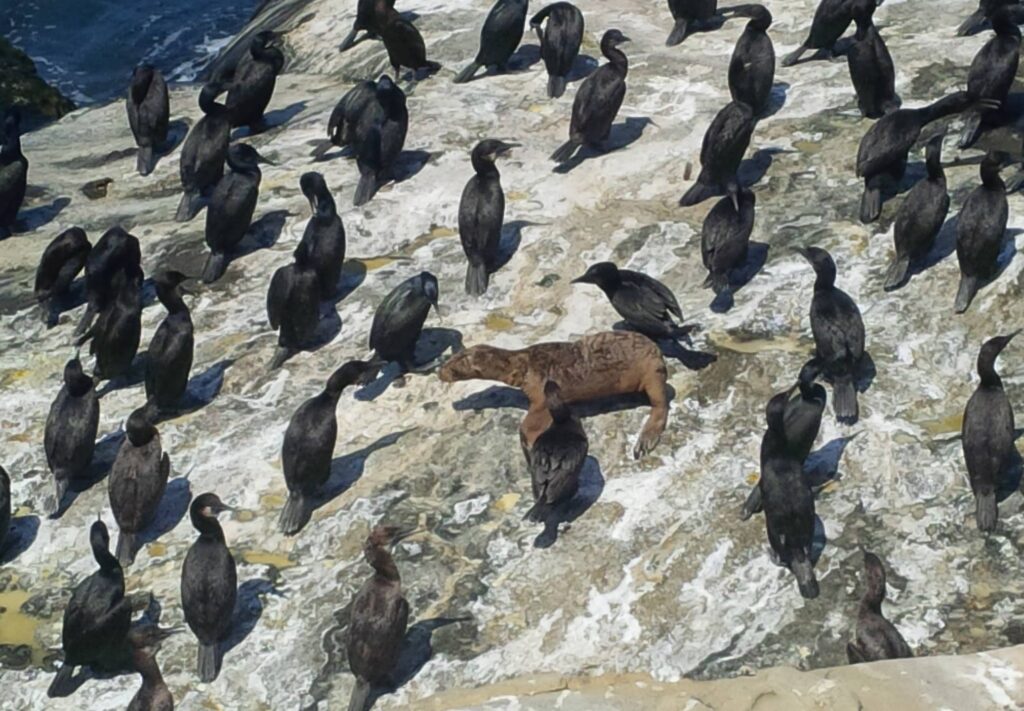
Vying with the harbor seal on the coolness scale was this baby sea lion that had somehow found itself isolated in a flock of cormorants.

A baby sea lion surrounded by cormorants

Introducing the Pinnipeds18 41 48

Seals and sea lions are both pinnipeds. So are walruses. Unfortunately, we don’t have walruses in California, probably for the same reason we don’t have polar bears — the weather is far too warm and there isn’t any pack ice. We do have elephant seals, which are amazing and awesome, but they don’t come down as far south as La Jolla, so I’ll save them for a future post.

Pinniped comes from the Latin pinna “fin” and pedis “foot”, so it means “fin-footed”.49 It’s short for Pinnipedia, which is a suborder of Carnivora (the carnivores), an order of mammals that specialize in eating flesh. Carnivora includes such diverse animals as dogs, cats, bears, otters, weasels, and raccoons.50

Pinnipedia is comprised of three extant (living) families: Otariidae (sea lions and fur seals), Phocidae (the earless or true seals), and Odobenidae (walruses). In common parlance, the term ‘seal’ is often used for both seals and sea lions, but in this article, I’ll be using it only for the earless seals.

The modern walrus (Odobenus rosmarus) is the only living member of Odobenidae. The group was much more diverse in the past, however. More than a dozen extinct genera have been identified from fossils.

There are many different kinds of seals and sea lions. Nevertheless, it’s usually pretty easy to tell seals and sea lions apart. It’s especially easy at La Jolla Cove since most of the seals are harbor seals (Phoca vitulina)51 and all the sea lions are California sea lions (Zalophus californianus). Unfortunately, I don’t have any photos of my own of harbor seals, but here’s one I downloaded from Wiki Commons. I’m not sure of the location, but it’s the same species we get at La Jolla Cove.

Harbor seals (Phoca vitulina)
Author: Phoca vitulina
This file is licensed under the Creative Commons Attribution 2.0 Generic license.

And here’s a couple of photos of a California sea lion. Notice the short tail. (That’s not a distinguishing feature, by the way. I just wanted to point out that they do have tails.)

California sea lion (Zalophus californianus)
La Jolla Cove. 12/26/20
California sea lion (Zalophus californianus)
La Jolla Cove. 12/26/20

One difference between seals and sea lions is that sea lions have ear flaps. You can clearly see these in the photo below.

Seals have no external ears — just tiny holes that aren’t easily seen. That’s why the true seals are also called earless seals.

Another major difference between the two families is that sea lions are able to rotate their hind flippers underneath their bodies so that they can “walk” on all fours. Actually, “walk” is probably a little too strong a word for what they do. It’s more of an awkward shuffle. They swing their heads and necks back and forth to help maintain momentum. Walruses are also able to rotate their hind flippers under their body.

Seals are not able to rotate their hind flippers. In fact, they aren’t even able to shuffle. Mostly, they just flop around on their bellies, although some species can pull themselves forward with their front flippers. Sea lions aren’t exactly graceful on land, but they get around way better than seals.

Sea lions are noisier than seals, frequently emitting loud ‘barks’. Seal vocalizations are more like soft grunts.

Seals spend more time in the water than sea lions and are generally better adapted to an aquatic lifestyle. They’re more streamlined and, while their inability to rotate their hind flippers makes them more awkward on land, those same flippers are better positioned for propelling them through the water.

Seals often lead solitary lives and only congregate on shore once a year to mate. Sea lions are much more social, congregating in herds of as many as 1,500 individuals. Dozens of them will haul out onto the sand at a time, lolling about and bickering with each other.

In general, sea lions tend to be much larger than seals and their front flippers are longer in proportion to their body. They also tend to be darker in color and their snouts are shorter. Although it may not be very helpful for identification unless you’re snorkeling or diving with them, sea lions mostly use their front flippers for swimming and their back flippers for steering. Seals are exactly the opposite — they tend to use their back flippers for swimming and steer with their front pair. (Walruses swim with all four flippers.)52

While seals may be better swimmers, sea lions are no slouches. I found that out when I went snorkeling in the cove. Here’s a couple of videos I took with a GoPro.

Sea lions get very upset if you approach them too closely on land. In the water, it’s a different story. They know they’re in their element and they exhibit no fear when swimming around humans. (At least the ones I swam with didn’t.)

Pinniped Evolution53 54 55 56

There are currently four families of pinnipeds — the three extant families already mentioned: Phocidae (earless or true seals), Otariidae (sea lions), and Odobenidae (walruses), and one extinct family, Desmatophocidae. There is an extensive fossil record for all these groups. Nevertheless, there are enough gaps in the record to make the origin of pinnipeds a matter of debate.

It has been suggested that pinnipeds might be descended from two different ancestral lines. In this scenario, sea lions and walruses (otariids and odobenids) would have shared a recent common ancestor with bears, while seals (phocids) would have shared one with Musteloidea, the group that includes otters. Fossil and molecular evidence suggests that this is not the case. More likely, pinnipeds are all descended from the same recent common ancestor. What that ancestor may have been, however, is uncertain. Some studies suggest a bear-like ancestor. Others point to an ancestor that was more otter-like.

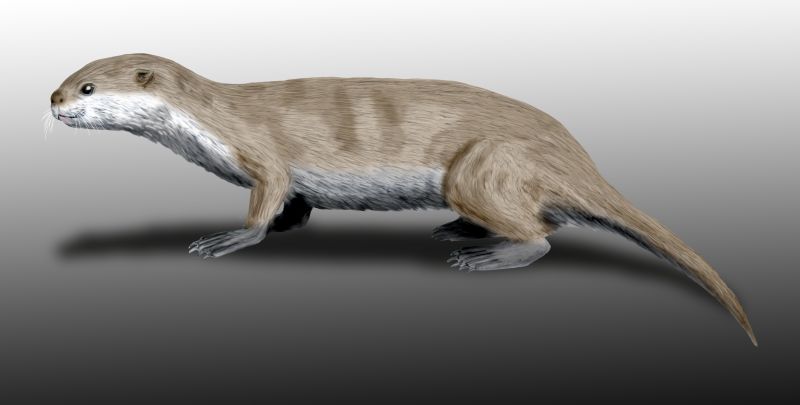
The pinniped lineage probably split from the rest of the carnivores around 50 million years ago (mya). The oldest known pinnipeds are a group called the enaliarctines. These are known from Oligocene to lower Miocene57 rocks in the North Pacific. Enaliarctines were relatively small pinnipeds, intermediate in size between a sea otter and a harbor seal.

A reconstruction of Enaliarctos mealsi.
Source: http://spinops.blogspot.com/
Author: Nobu Tamura
This file is licensed under the Creative Commons Attribution-Share Alike 4.0 International license.

In 2007, an important transitional fossil was found on Devon Island in Canada. This fossil, named Puijila darwini, is considered to be the most primitive pinniped yet found. The animal lived 20 to 24 mya, during the early Miocene. It was a little over a meter in length (three feet) and it had a long tail. Puijila did not have flippers, but the bones of its toes were a bit flattened. This is strong evidence that it had webbed feet. Although younger than some of the enaliarctines, Puijila’s primitive features suggest that it is more closely related to the earliest ancestors of the pinnipeds. For it’s time, it would have been a “living fossil”.

Its webbed feet and the robustness of its limbs and shoulders suggest that Puijila used all four of its limbs for swimming. This makes sense. As already noted, modern pinnipeds vary as to whether they use their fore- or hind-flippers or both for swimming. So it’s likely that their most recent common ancestor would have used all of its limbs, and later pinnipeds specialized.

Perhaps the most important thing about P. darwini is that its remains were found in a lake deposit. This suggests that pinnipeds started their transition to aquatic life in fresh water, only later adapting to a marine environment. It also lived in the arctic, which suggests that pinnipeds may have evolved in that region. If the ancestors of pinnipeds were hunting in streams and lakes that froze over in winter, this may have driven them to expand their hunting grounds to coastal waters, which would have been free of ice, eventually leading them to adapt to a marine environment.

A reconstruction of Puijila darwini
Author: Nobu Tamura (http://spinops.blogspot.com)
Permission is granted to copy, distribute and/or modify this document under the terms of the GNU Free Documentation License, Version 1.2 or any later version published by the Free Software Foundation; with no Invariant Sections, no Front-Cover Texts, and no Back-Cover Texts. A copy of the license is included in the section entitled GNU Free Documentation License.

Now, I know what you’re thinking. These two reconstructions — one of Enaliarctos mealsi and one of Puijila darwini — sure make them look a lot like otters. So does this suggest that pinnipeds evolved from otter-like ancestors, instead of bear-like ones? Not really. The transition to an aquatic environment of the ancestors of both pinnipeds and otters could have simply led to very similar adaptions. This is called convergent evolution, and it’s a very common occurrence.

Adaptions to Marine Life58 59

Fins and a stream-lined shape are the most obvious adaptations that pinnipeds have made to life in the ocean. But they’re far from the only ones. Here’s a few more:

Blubber. Pennipeds have a thick layer of fat called blubber just beneath the skin. This serves as insulation and acts as an energy store that can be called upon when fasting. (Females typically fast while nursing and males often fast while guarding a harem during breeding season.) It also helps to stream-line the body. Blubber can make up as much as 50% of an adult pinniped’s weight.

Eyes. The eyes of pinnipeds are adapted for seeing both on land and in the water. The lens is close to spherical (like a fish’s) and all points on the retina are about the same distance from the center of the lens. The cornea is flattened in the center, so it doesn’t assist the lens in focusing, which wouldn’t work underwater, anyway. (See my earlier post The Story of Eyes: Part 1.) All these adaptations work together to give pinnipeds reasonably good vision in both aquatic and terrestrial environments.

Since they need to hunt prey in dim, underwater environments, pinnipeds have large eyes set near the front of the head for binocular vision. (The walrus is an exception. Walruses eat mollusks on the sea floor, so they don’t need good vision. Their eyes are small and located on the sides of the head.) Immediately behind the retina, pinnipeds have a layer of reflective tissue called a tapetum lucidum. Light that is not absorbed by the retina on the first pass is reflected back through the retina by this layer for a second pass. This greatly increases the sensitivity of their eyes and allows them to see better in dim light. (Cats have a similar layer. It’s what makes their eyes glow in the light of a flashlight.)

Ears. The ears of pinnipeds are adapted for hearing underwater. They can hear pretty well out of water, too, but not as well as many land mammals.

Whiskers. The technical term for whiskers is ‘vibrissae’. The vibrissae of pinnipeds are supplied with about ten times as many nerve endings as the vibrissae of terrestrial mammals. This allows them to detect vibrations in the water. Incredibly, studies have shown that harbor seals are able to follow the trail of another seal that swam ahead of them several minutes before. They can even tell the size and species of a fish by the vibrations it leaves in its wake.

Unlike land mammals, pinnipeds don’t move their whiskers over an object to examine it. They keep them extended in roughly the same position. Presumably, this allows them to better detect and analyze vibrations in the water.

Adaptations for diving. The adaptations that pinnipeds have made for diving are almost too numerous to mention. When beginning a dive, a pinniped will typically empty its lungs of half their air and close their nostrils. Their lungs are reinforced with cartilaginous rings and smooth muscles. The alveoli (tiny air sacs in the lungs) completely deflate during deep dives. Unlike most land mammals, pinnipeds can empty their lungs and re-inflate them even after complete collapse.

Whereas land mammals rely mainly on the lungs to store oxygen, pinnipeds store it mostly in the blood and muscles. For example, focid seals store only about 5% of the oxygen in the lungs. Humans store around 51%.

Pinnipeds have a higher blood volume than terrestrial mammals. On the inner wall of the chest cavity at the level of the sternum, pinnipeds have a dense complex of arteries and veins called the retia mirabilia. This structure is used for oxygen storage during deep dives. Pinnipeds have a greater concentration of red blood cells, so they have more of the oxygen storing molecule hemoglobin, which these cells contain. Oxygen is stored in the muscles by a related substance called myoglobin. Marine mammals have 3 to 10 times more myoglobin than land mammals.

Muscles produce a waste product called lactic acid. This substance is released into the blood stream, and its build up is what leads us to feel “out of breath”. In pinnipeds, vasoconstriction (the narrowing of blood vessels) blocks the muscles from releasing lactic acid into the general blood stream until the animal surfaces, allowing them to hold their breath much longer. Deep diving species reduce their heart rate and limit blood flow to just the heart, brain, and lungs.

These are only some of the adaptations that pinnipeds have made for diving. I could easily devote an entire blog post to just this topic.60

Sleep. My favorite pinniped adaptation for life in the sea is one they share with cetaceans (dolphins and whales) and, surprisingly, migrating birds. Only half of their brain sleeps at a time! In science-speak, this is called ‘unihemispheric slow-wave sleep (USWS)’. Like all higher vertebrates, the largest part of the brain, the cerebrum, is divided into two hemispheres. In placental mammals, these hemispheres are connected by a large bundle of nerves called the corpus callosum.61

Studies of so-called split-brain patients — epileptics whose corpus callosums were severed to prevent their entire brains from being taken over by seizures — have shown that the two cerebral hemispheres can act independently to a remarkable degree.62 Cetaceans, pinnipeds, and migratory birds have pushed this ability to an unexpected extreme. One of their hemispheres is able to go into deep sleep, while the other hemisphere remains awake and alert. They even close the eye that is connected to the sleeping hemisphere, while keeping the other eye open!

For pinnipeds and cetaceans, the obvious advantage to this is that one hemisphere can keep watch for predators while the other one sleeps. (For migratory birds, it allows them to fly long distances without stopping.)

Animals that rely on USWS spend shorter times in it than they would in regular sleep and get much less sleep overall. Their health does not appear to suffer from this, however. Apparently, they’re able to compensate for lack of sleep by using a variety of adaptations, including a more efficient immune system and increased brain plasticity.63

I should note that pinnipeds only engage in USWS when they’re sleeping in the water. When they’re on land, they sleep with both hemispheres.

The Future

It’s truly amazing the extent to which pinnipeds have changed their forms and physiology to enable them to live in the sea. And they’re not even fully adapted yet. For example, seals and sea lions still have to give birth on land. Given enough time — more millions of years — it’s likely that at least some pinnipeds will join the cetaceans in making the transition to living entirely in the ocean.

From Little Man to Rocket: A Mostly Natural History of Raccoons

As a boy, I first encountered wild raccoons while on a camping trip with the Boy Scouts in the mountains of Virginia. After we’d gone to bed, a group of raccoons invaded the campsite looking for food. Their rummaging around woke some of us up and we went outside to take a look. I still remember the glow of their eyes when we shined our flashlights on them. They weren’t large animals, but they weren’t especially small either, and their seeming lack of fear was a little unnerving. We eventually went back to bed and left them to their explorations.

My first (and only) encounter with raccoons in Southern California also took place at night — not surprising, given that they are mostly nocturnal. It took place next to a stream, which is also not surprising, since a lot of a raccoon’s diet consists of aquatic prey. I heard a rustling in the bushes and, when I trained my headlamp in that direction, I spotted a large raccoon climbing in a small tree. Here’s the video:

It’s not a great video, but, unfortunately, it’s the best I’ve got. For the rest of this article, I’ll be relying on photos that are in the public domain.

The Common Raccoon

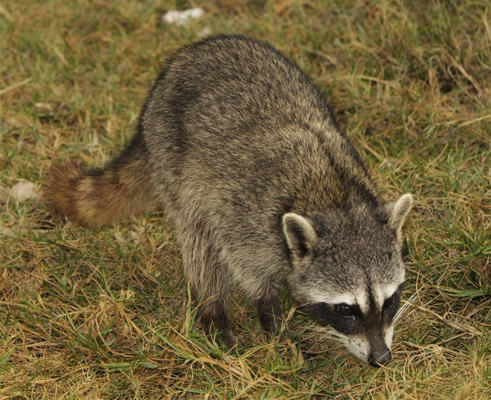
The common raccoon, Procyon lotor in science speak, is native to North America. I shouldn’t need to describe it here. Even in the unlikely event that you’ve never seen a live raccoon, you’ve certainly seen pictures. It’s one of those animals that almost any child can recognize by the age of three. Not only is it very distinctive, there’s pretty much nothing else in the United States that looks very much like it. For your reference, though, here’s a great photo of one that I found on Wiki Commons:

The common raccoon (Procyon lotor)
Author: Bernard Landgraf
This file is licensed under the Creative Commons Attribution-Share Alike 3.0 Unported license.

Species and Subspecies 50

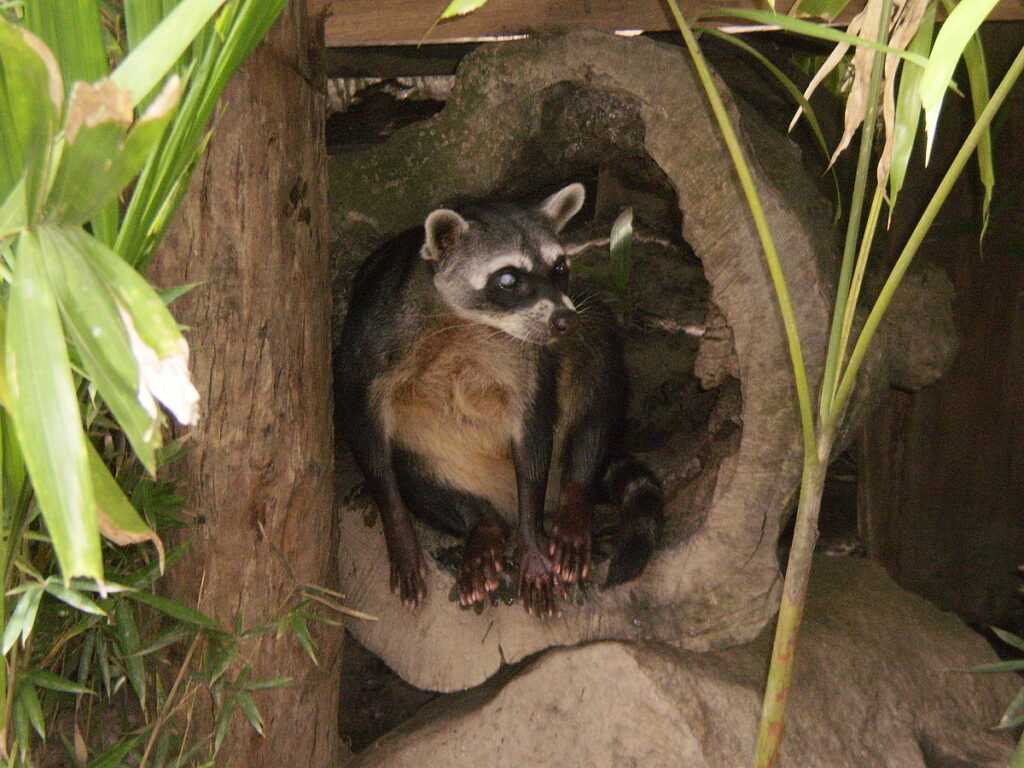
In addition to the common or North American raccoon, P. lotor, there are two other species in the genus Procyon. The crab-eating raccoon (P. cancrivorus) is found in Costa Rica and much of South America east of the Andes. As you can see from the photo, it’s quite a bit sleeker than the common raccoon and has shorter fur. P. cancrivorus and P. lotor are believed to have branched off from a common ancestor around 4.2 million years ago.

Crab-eating raccoon (P. cancrivorus)
Author: Nixón
This file is licensed under the Creative Commons Attribution-Share Alike 3.0 Unported license.

Then there is the Cozumel or pygmy raccoon (Procyon pygmaeus). It’s found only on the island of Cozumel, which is located off the eastern coast of Mexico’s Yucatán Peninsula. P. pygmaeus has a smaller head and body than the common raccoon and is probably an example of ‘island dwarfism’. This is the tendency for some animals that are confined to islands to evolve into smaller versions of themselves. There are several possible explanations for island dwarfism. The most likely is that a smaller animal has a better chance of surviving on an island where the food supply may be more limited than on the mainland.

Cozumel raccoon (Procyon pygmaeus)
Author: Camazine
This file is licensed under the Creative Commons Attribution-Share Alike 3.0 Unported license.

Insular or Island Dwarfism 59 64

There are many more extreme examples of island dwarfism. For instance, on the California Channel Islands, just a few hours from where I live, there used to live a pygmy mammoth, which was probably a dwarf version of the Columbian  mammoth. These creatures ranged from 4.5 to 7 feet high at the shoulders, as compared to 14 feet for their relatives on the mainland. Weight-wise, the difference would have been even more startling, as the pygmy and Columbian mammoths are estimated to have weighed around 2000 pounds and 20,000 pounds, respectively.

Humans are not exempt from the phenomenon of island dwarfism. In 2003, the remains of an individual in the genus Homo were uncovered on the island of Flores in Indonesia. This individual would have stood about 1.06 m or 3 ft 6 in. Remains were found of a second individual that was just slightly taller at around 1.1 m or 3 ft 7 in. Stone implements of an appropriate size were also found. Initially, there was some debate over whether the remains belonged to a new species of human or were from modern humans with congenital defects, however, the current consensus is that they do represent a new species of very small humans. The species has been named Homo floresiensis, after the island on which it was discovered. The common name is ‘Flores Man’, but the original discoverers also gave them the nickname “hobbits”, which quickly caught on in the media.

H. floresiensis is believed to have lived on Flores as recently as 50,000 years ago, which is probably around the time modern humans reached the island. So it’s likely that the two species existed side-by-side for a short time before modern humans drove them to extinction.

There are lots of subspecies of P. lotor. I won’t go over them all here, since they’re mostly just slight variations of each other. I do think the Torch Key raccoon (P. l. incautus) is worth a mention, though, just for its general cuteness, if nothing else. This is a small raccoon with an unusually pale coat. It lives in the Florida Keys.

Torch Key raccoon (Procyon lotor incautus) on Cudjoe Key, Florida, United States
Author: Mariomassone
This file is licensed under the Creative Commons Attribution 2.0 Generic license.

How the Raccoon Got Its Name(s)65 66 67

The word ‘raccoon’ is a corruption of a Native American word. It comes from the Algonquian word arakun (variously spelled aroughcun, arocoun, arakunem, and rathkone) and it means something like “he scratches with his hands.”

Of course, there were plenty of Native American tribes that were not part of the Algonquian peoples and they had their own names for the animal. The Sioux, for instance, called it wica, weé-cha, or way-atch-a, which translates to “little man”.

Although native to North America, raccoons have been introduced to many other parts of the world, including several European and Asian countries. In some cases, raccoons were introduced for hunting. In other cases, they managed to establish local populations after escaping from captivity. Naturally, non-English speakers have come up with their own names for the creatures. As you probably know, raccoons are famous for their habit of dousing their food in water and, apparently, many people think they look a bit like little bears. As a result, a surprising number of languages have combined these two characteristics in their word for the animal. In German, for instance, the word for raccoon is Waschbär (‘wash-bear’). In Italian, it’s orsetto lavatore (‘little washer bear’). And in both Chinese and Japanese it’s ‘washing-bear’ — dvivón róchetz and araiguma, respectively.

As far as the scientific name is concerned, Procyon can be translated as “before the dog” or “doglike” and lotor means “washer”. It’s not clear why Gottlieb Storr, who named the genus, chose Procyon. Maybe he just thought the animal looked doglike. It’s also possible that he was thinking of the animal’s nocturnal lifestyle and named the genus after the star Procyon, the brightest star in the constellation of Canis Minor (lesser dog). I suppose it could be both.

General Characteristics and Behaviors 68 69

Probably the most notable characteristic of the common raccoon is the black fur around its eyes, which makes the animal look as if it’s wearing a mask. This probably makes it easier for raccoons to identify each other and to recognize each others’ expressions. It may also enhance night vision by reducing glare. Similarly, the dark rings on the tail may help in recognizing individuals and in determining body posture (which would presumably aid in identifying another raccoon’s intentions.)

The raccoon’s front paws have five fingers and are shaped much like tiny human hands. Although they lack opposable thumbs, raccoons are remarkably skillful with their hands. They use them to examine their food before eating it and they are very adept at using them to open windows, doors, and trashcans. According to a post by DiVon80 on the “Backyard Chickens” website, some raccoons got into a kitchen at a campsite and “…they opened jars, turned the water on by all the sinks, opened and dug in the fridge, even [opened] pop bottles…” 70

In captivity, a raccoon can live for quite a long time, although exactly how long varies, depending on the source. Wikipedia claims they can live for over 20 years, but another source 71 gives them a maximum lifespan of only 10 to 12 years. A raccoon’s chances of reaching an advanced old age are considerably reduced in the wild, where the average lifespan is often less than 1.8 years. You might think the reason for this would be their many predators — bobcats, bears, great horned owls, mountain lions, eagles, and coyotes, to name a few. The young are especially vulnerable. However, predation is actually not a significant cause of death, since many large predators have been exterminated or reduced in population in the areas raccoons inhabit. Human hunting, traffic, and severe weather are more important factors. Disease also takes its toll. In fact, the most significant cause of raccoon death in North America is distemper.

And then there’s rabies. It’s well-known that raccoons are a reservoir for this disease. In fact, they’re the most important reservoir in the United States.72 Before you start killing raccoons on sight, though, you should know that, according to the CDC, only one person in the U.S. has died from the raccoon strain of rabies.73 This is probably because rabid raccoons do not exhibit the aggressive behavior typical of rabid dogs. In fact, they become less aggressive when infected and tend to avoid people even more than usual. 74

With such a high mortality rate, you might expect raccoons to be endangered. In fact, nothing could be further from the truth. The International Union for Conservation of Nature (IUCN) lists their status as of “least concern”. So how have raccoons managed to beat the odds? I’d have to say it’s their adaptability. The common raccoon is able to live in a wide range of habitats from as far north as Canada to as far south as Panama. Raccoons are also highly omnivorous. It’s estimated that the average raccoon’s diet consist of around 27% vertebrates, 40% invertebrates, and 33% plant material. Fish, crayfish, frogs, bird eggs (and occasionally birds), insects, worms, fruits, and nuts are some of the many foods they consume. Sometimes they even eat carrion. They are also quite happy to raid our garbage cans.

Do They Really Wash Their Food? 75 76

Not really. Raccoons often use their front paws to dabble for food in the water near the shoreline. When they find something potentially edible, they pick it up, examine it, and rub it with their paws, probably to remove inedible or unappealing parts. They usually hold the food under water while doing this because the water softens the tough layer that covers their paws, increasing their tactile sensitivity. With dry foods like nuts, a raccoon will also examine the food with its paws before eating it, but it probably won’t bother dousing it in water. According to one author,77 both dabbling and dry feeding are done “while the raccoon gazes away into space and uses its acute sense of touch to investigate its meal”. (I just reproduced that quote because I enjoy the mental image of a raccoon meditatively “gazing away into space”.)

In captivity, raccoons will often douse even dry food in water before eating it. Scientists don’t believe they do this in order to wash the food, though. Instead, it’s probably an example of a ‘fixed action pattern’ — an instinctual behavior that is characteristic of a particular species. Its water dish is right there, after all — it’s not like it has to hike over to a stream — so it just does what feels natural to it.

Raccoons prefer to make their dens in the hollows of trees, but they will make do with crevices and caves, abandoned buildings, or the abandoned burrows of other animals. In a pinch, they will even sleep in bushes or on the ground under cedars. (There’s that adaptability again.)

During the winter months in cold regions, raccoons greatly reduce their food intake and spend most of their time sleeping. They don’t technically hibernate, though, and may sometimes be found outside their dens even in the depths of winter.

Mating generally takes place between January and March, but this varies from region to region. Males take no part in caring for the young and, in fact, they will move on to try and impregnate other females. Litter size varies from 1 to 8 cubs, but 3 to 5 is the normal range. Cubs are born deaf and blind. Their ear canals open after around 18 to 23 days and their eyes open a few days later. Cubs are usually weened by around 16 weeks. In the Fall, the mother raccoon will show them dens and feeding grounds. After that, they usually go their separate ways, although in colder climates, they may share a den with their mother for the first winter.78 79

The Long Road to Raccoons 80 81 82

The first mammals were mostly tiny and mouse-like. Although they evolved toward the end of the Triassic, fairly early in the reign of the dinosaurs, they would remain small and furtive until the non-avian dinosaurs went extinct 65 million years ago (mya). Finding themselves no longer under the heels of their reptilian overlords, mammals rapidly diversified to fill the niches left vacant by them.

These ancient mammals split into five major groups, one of which, Creodonta, included the ancestors of all living carnivores. Creodonts took a wide variety of forms — some cat-like, some bear-like, and some hyena-like. During the Eocene, 55 – 37 mya, the Miacidae family of mammals appeared on the scene. The miacids were slender, five-toed, tree climbers. Changes in their teeth allowed them to exploit new kinds of food and new environments. All modern carnivores are believed to have evolved from this group.

Eventually, the order Carnivora split into two suborders, Caniformia and Feliformia, the “dog-like” and “cat-like” carnivores, respectively. Caniformia includes dogs, wolves, foxes, bears, badgers , and seals, among others. One of those “others” is raccoons. The raccoon family, Procyonidae, includes raccoons and their close relatives. The dog family (Canidae) and racoon family split off from the miacids during the Miocene. It’s not known whether the procyonids split off directly from the miacid line or were an early offshoot of the canids. Either way, the translation of ‘Procyon‘ as “before the dog” makes some sense in this context.

The Strange, Convoluted Tale of Rocket Raccoon 83 84 85

Many of you are probably familiar with the Beatles’ song “Rocky Raccoon”. The song was written mostly by Paul McCartney, although John Lennon may have contributed. Sadly, the song does not appear to be about an actual raccoon. The title character’s name was originally supposed to be “Rocky Sassoon”, but McCartney changed it to “Rocky Raccoon” because he thought it had more of a ‘cowboy’ ring to it. (The story is supposed to have taken place in the Old West.)

An interesting, quirky song, but hardly worth mentioning in an article about raccoons. But then, Marvel Comics came into the picture. Writer Bill Mantlo and artist Keith Giffen were inspired by the Beatles’ song to create a character named Rocky Raccoon for the comic book Marvel Preview #7. In this story, Rocky was an actual raccoon, albeit an anthropomorphized, talking version of one (with an English accent, no less). Rocky apparently only plays a bit part in the comic book. You can see an excerpt from it in a CBR.com article. Click here for that.

Rocky would next appear in 1982 in The Incredible Hulk #271. The story for this issue was entitled “Now Somewhere In the Black Holes of Sirius Major There Lived a Young Boy Named Rocket Raccoon” — an obvious play on on a line from the Beatles song. In this story, we learn that “Rocky” is actually short for “Rocket”. (He also loses the British accent.) You will find an excerpt in the same CBR.com article linked to previously. In 1985, the character was given his own four-issue limited series. In succeeding years, Rocket appeared in Quasar #15 and in three issues of Sensational She-Hulk, but in ten years time, he had amassed a grand total of only 10 comic book appearances. In other words, he wasn’t exactly taking the world by storm.

From 2006 on, however, Rocket appeared in a dizzying number of different comic books, including, significantly, the Guardians of the Galaxy Series. I won’t go into all the tedious details. You can read the Rocket Raccoon Wikipedia article if you’re interested.

As for Rocket’s biography, he started his career as the chief law officer on the planet Halfworld, an abandoned colony for the mentally ill. He was one of a group of animals that had been genetically modified to give them intelligence and bipedal-ism, so that they could act as caretakers for the inmates. At some point, the inmates get cured of their illness (apparently, they all had the same thing) and Rocky and friends take off into space for their own adventures. What followed was a long and, yes, convoluted, series of stories, which I also won’t go into. (Again, see the Wikipedia article.)

Rocket in these comics is a starship pilot, an expert marksman, a brilliant technician, a master military tactician and a born leader. (Well, genetically modified leader, I guess.) He also has all the abilities and attributes of a regular earth-type raccoon — sharp claws, acute senses of smell, hearing, sight, and touch, and the ability to climb trees and scale buildings with ease. (Somebody was really impressed with raccoons.) He has a sidekick named Wal Rus, who is — you guessed it — an anthropomorphic walrus; an enemy named Blackjack O’Hare, who is an anthropomorphic rabbit (get it?); and a love interest named Lylla, who is an anthropomorphic otter.

Somewhere in all this weirdness, Rocket finds out that a lot of the things he thought had happened on planet Halfworld hadn’t really happened — they were “mostly half-truths and deliberately crafted fake memories”. 86 Yeah, it gets complicated. Anyway, eventually he teams up with Star-Lord and the other Guardians of the Galaxy for a whole new series of adventures.

And then the Guardians of the Galaxy movie came out. If you haven’t seen this film and it’s two sequels, I highly recommend them. They are some of the funniest movies I’ve ever seen. One of my favorite scenes is when Peter Quill (Star-Lord) calls Rocket a trash panda. I won’t ruin it for you, though.

In the movies, Rocket’s biography is, thankfully, greatly stripped down. (He doesn’t even know he’s a raccoon or what a raccoon is.) He’s a great character and a great example of a raccoon in popular culture. And that’s how I’m justifying writing about him here. (Hey, nobody forced you to read it.)

A Model Mouse

A model organism is a non-human species that’s extensively used in research. There are many reasons why a particular species might be selected as a model organism. Usually, it’s because it’s easy to breed in the laboratory and has a short life cycle, which means a scientist doesn’t have to wait, say, twenty or thirty years to see the results of his or her experiment (always a plus). A species may also have some feature that makes it of particular interest to researchers. It might be a carrier of a disease that affects humans, for instance. Chance plays a part, too. The more an organism is studied, the more tools are developed for studying it, which increases the likelihood that other researchers will choose it for their research.

Probably the most important model species is the common fruit fly, Drosophila melanogaster. Drosophila is very easy to breed in the lab and it can go from egg to adult in as short as seven days. Non-scientists sometimes find it hard to understand why anyone would devote so much time and money to studying a fly, but natural selection is very conservative when it comes to core processes like metabolism and development. Evolution will tinker endlessly with the anatomy and behavior of an organism, but it only rarely changes the core processes. As a result, “primitive” animals like insects and even microbes share a surprising amount of their genetics and biochemistry with humans. 71

Nevertheless, scientists do sometimes need a model organism that’s more closely related to humans. For that, they often turn to mice. The house mouse, Mus musculus, is the most commonly used mammal in laboratory experiments. M. musculus originated in Asia, but it’s propensity for living with humans (and habit of stowing away on boats and other vehicles) has led to it’s being distributed worldwide in historical times. House mice have also long been kept as pets and this has led naturally to their being used in research. In fact, house mice have been used as research animals for so long that special strains have been developed for just that purpose. This makes them especially useful because these strains are more genetically uniform, which limits the number of variables a researcher has to deal with.74 76 The house mouse is not the only model mouse species, though. Here in North America, we have our own group of native mice that have proven their worth to researchers.

Enter the Deer Mouse 77

‘Deer mouse’, of course, is the just the common name. It actually refers to any member of the genus Peromyscus. The mice in this genus are the most common mammals in North America and quite a few species of Peromyscus have become model species. These include the two most common species in the United States, P. maniculatus and P. leucopus. They also include the most common deer mouse here in Southern California, P. californicus, a.k.a. the California mouse.

A California mouse (Peromyscus californicus) having a snack
Mission Trails Regional Park, San Diego County 11/13/18
Same mouse…

Like the house mouse, deer mice are easy to breed in captivity. They look very similar to house mice, but have much larger eyes (as evidenced in the above photos). They’re also more energetic and tend to jump and run around more, which makes them a bit more difficult to handle. This skittishness is what inspired their common name.

Deer mice have a number of characteristics that make them better suited for some types of research. For one thing, they tend to live longer than house mice. Peromyscus spp. have a maximum lifespan of 5-7 years, as compared to just 3 years for M. musculus. This makes them more useful in aging research. Deer mice are also the main carriers of the Sin Nombre hantavirus, a virus which can cause a fatal disease in humans. Obviously, this makes them of great interest to medical researchers.

As I mentioned earlier, deer mice are native to North America. This makes them a convenient subject for North American researchers who want to study the evolution and distribution of species. The fact that deer mice don’t normally live in close association with humans is also helpful in this regard, since it means we haven’t been spreading them all over the place like we have with M. musculus.

A House for the Mouse 79

In the 1910s and 20s, Francis B. Sumner began investigating the use of deer mice as laboratory animals. He built the first Peromyscus “mouse house” at Scripts Institute in California. When his work was discontinued, Sumner passed the torch (and his mouse stock) to Lee R Dice at the University of Michigan. In the 30s and 40s, Dice continued refining methods for maintaining deer mouse colonies. He also began cataloging mutations in the mice, which he gave names like gray, dilute, and epilepsy.

In 1985, Wallace Dawson at the University of South Carolina used Dice’s deer mouse strains to start the Peromyscus Genetic Stock Center (PGSC). PGSC maintains six Peromyscus species, as well as numerous mutant strains, which it makes available to researchers. You can click here to visit their website.

The above video shows a California mouse (P. californicus). It was filmed on 4/17/17 in Mission Trails Regional Park in San Diego County.

The Mouse Leaves Its Mark 80

In the course of his pioneering work with Peromyscus, Sumner investigated its geographic variation. At the time, this represented one of the few major studies of evolution in wild populations. Important figures in evolutionary thought like Sewall Wright, Theodosius Dobzhansky and JBS Haldane closely followed his work and drew conclusions from it. Wright, for instance, used Sumner’s observations as evidence that quantitative traits in organisms were subject to the same rules of inheritance as discrete traits. (A discrete trait is a trait that an organism either has or doesn’t have like blue eyes. A quantitative trait is one that can vary in quantity like pigmentation.)

Dobzhansky used Peromyscus data in his studies of reproductive isolation. Some subspecies of P. maniculatus live in overlapping geographical areas, but are separated by habitat. For instance, one subspecies lives only in forests, while another lives only in open habitats like prairies. These subspecies are able to mate and produce viable offspring in the lab, but because they inhabit different environments in the wild, the subspecies remain isolated from each other.

Peromyscus has been attracting the attention of these and other evolutionary biologists for about a century now. It’s become one of the best studied mammals and there are many ongoing research projects devoted to it.

Glaciation and an Ancient River Drive the Evolution of New Species81

The map below shows Northwestern Mexico and the Southwestern United States. The thin blue line is the Colorado River feeding into the Gulf of California. (The area highlighted in pink shows the distribution of the desert iguana, which has nothing to do with this article. I just needed an image that was in the public domain and this was the best I could find.)

The Colorado River shown emptying into the Gulf of California
Author: compiled by rbrausse with Quantum GIS
This file is licensed under the Creative Commons Attribution-Share Alike 3.0 Unported license.

The Gulf of California began forming around 12 million years ago as a result of the movement of the underlying tectonic plates. Before that, the Colorado emptied directly into the Pacific. Eventually, it was diverted to empty into the Gulf. The important take-away from this is that for millions of years, the Colorado River has acted as a semi-permeable boundary, isolating land-bound animals living north of the river from those living south of it.87

When a group of organisms is isolated from other members of their species for a long period of time, that group will begin to diverge from the rest of the species. If this goes on for long enough, they may form a new species. This is what has happened to deer mice living around the Colorado.

The river is not the only thing that’s been shaping the evolution of these mice, though. The Earth has experienced a number of ice ages. During an ice age, a cooling climate causes glaciers to extend farther south in the northern hemisphere (and, of course, farther north in the southern). The last ice age, which started about 2.58 million years ago,88 is technically still going on, although we’re slowly coming out of it as the Earth warms. (Well, not so slowly anymore, thanks to human activity, but that’s another story.) The Last Glacial Maximum or LGM is defined as the most recent period when glaciers were at their thickest and the seas were at their lowest (due to all that water being locked up in ice). The LGM occurred around 24,000 to 18,000 calendar years ago.

As the glaciers melted and sea level rose, new islands formed as a result of the surrounding land being flooded by sea water. Many of these islands formed in the newly opened Gulf of California. A few also formed off the western coast of Baja, as well. Deer mouse populations trapped on these islands experienced further isolation from their confreres, resulting in more speciation. The formation of deserts and arid regions as the climate grew hotter and dryer resulted in new niches and pushed speciation still more. Undoubtedly, other changes related to climate and geology have played a role, as well.

A scientific paper published in the Journal of Mammalogy (click here to read it) describes research done on this process of speciation in deer mice in the areas bordering the Colorado. This paper looks at a subgenus of Peromyscus called Haplomylomys, which includes two species groups, californicus and eremicus. The californicus group is made up of just the one species, P. californicus. Eremicus is comprised of 10 species, including the one from which it takes its name, P. eremicus. Californicus lives in habitats with moderate amounts of water, like chaparral and woodlands. The eremicus group is restricted to arid and semi-arid regions.

Haplomylomys has been studied extensively, starting in the early 20th century. This new paper extends that research, concentrating on the species that developed on the various islands around Baja California. The researchers extracted genetic data from a great many species on both the islands and the mainland. They also extracted ancient DNA from skeletal specimens of P. guardia and P. pembertoni. I won’t go into all the details of what they found. Suffice it to say that they were able to find evidence of the effects of all the previously mentioned natural forces on the development of the various species of deer mouse in the region.

Of Mice and Monogamy 89 90 91

The vast majority of mammals are promiscuous. This makes sense from an evolutionary perspective. The more females a male mates with, the better the chances that he will succeed in passing on his genes to future generations. Nevertheless, there are cases where monogamy is the better strategy. If the young of a species are slow to develop, taking a long time to become independent, then it might make sense for the male to stick around and help care for his progeny. This is why humans are at least semi-monogamous.

Monogamy has evolved independently in two species of deer mouse — P. californicus and P. polionotus — which makes them of special interest to scientists who study social behavior in mammals. P. polionotus is also called the oldfield or beach mouse.92 Oldfield mice are found in the southeastern United States.93 In a study published in the Journal Nature,94 95 researchers took oldfield mouse pups and moved them into the nests of P. maniculatus, a polygamous species of deer mouse. They also took pups from P. maniculatus and put them into oldfield mouse nests. When the oldfield mouse pups grew up, they exhibited the same monogamous behavior as other members of their species, despite being raised by polygamous parents. Likewise, the P. maniculatus pups exhibited polygamous behavior as adults, despite being raised by monogamous parents. What this tells us is that, in deer mice at least, it’s genetics that determines whether or not a mouse is monogamous.

The scientists went on to try to identify some of the genes associated with monogamous behavior. Oldfield mice exhibit a number of behaviors associated with monogamy. For example, they build more elaborate nests than their polygamous cousins. The males spend more time licking their pups, huddling with them, and handling them. The researchers mated P. polionotus mice with P. maniculatus mice and found that the offspring exhibited varying mixes of the aforementioned behaviors.

By examining the DNA of the hybrid offspring, the scientists were able to identify stretches of DNA (called loci) that were associated with certain behaviors. In a follow up study, they focused on one of the genes in one of those loci — a gene that controls the production of a hormone called vasopressin. Some of this hormone is produced in the hypothalamus of the brain. P. maniculatus, it turns out, produces three times as much vasopressin in their hypothalamus than oldfield mice. The researchers tried injecting vasopressin into the brains of oldfield mice and found that the mice started making simple nests like the nests of P. maniculatus. The injected vasopressin had no other observable effects on the parental behavior of the mice. So it’s likely that the gene controlling vasopressin is just one of a number of genes that control behaviors associated with monogamy or polygamy.

This was just a brief overview of the paper in Nature. There are a lot of details that I glossed over, so you might want to read the New York Times article for a more in-depth treatment. Click here for that article. You can view the original Nature article by clicking here.

So what about the other species of monogamous mouse? We met P. californicus, the California mouse, earlier. This mouse is found in California and Mexico, on the other side of the continent from P. poloniotus. Lots of research has been done on P. californicus and it’s social behaviors. I won’t bore you with any specifics here, except to mention one article that briefly discusses a possible reason for the evolution of monogamy in this mouse. The article, entitled Tracking the Monogamous Mouse, was published in the Baltimore Sun. (Click here to read it). The article discusses a study by Doctors David Ribble and David Gubernick.

In the article, Dr. Ribble explains that the California mouse is “about twice the size of a normal field mouse”. (Field mouse is a generic term for any mouse that commonly inhabits fields.) Having to power a larger body means that you have less energy left over to devote to other things like making babies, so, other things being equal, larger animals tend to have smaller litter sizes. Most deer mice average four pups per litter, whereas, the much larger California mice produce only two. It turns out that four pups can share enough body heat to keep themselves warm, but two pups need the additional warmth from their parents. So in California mice, the male sticks around to huddle with the pups when the female is off foraging for food.

This neatly explains why P. californicus evolved monogamy, but why did they evolve a larger size? I don’t know. I wasn’t able to find any articles that answered that question. Maybe nobody has studied it. There’s far more stuff out there on deer mice than I’ve had time to read, though, so it’s quite possible that I just haven’t found the right article.

A Note In Closing 96 97

Walt Disney is said to have been in the habit of feeding one of the field mice that would wander into his Kansas City animation studio. This mouse was likely P. leucopus. In 1925, another animator, Hugh Harman, poked fun at Disney by drawing sketches of mice around a photograph of him. This inspired Disney to direct one of his employees to sketch a new mouse character. The rest, as they say, is history. So it seems that our model mouse may have been the model for Mickey.