A model organism is a non-human species that’s extensively used in research. There are many reasons why a particular species might be selected as a model organism. Usually, it’s because it’s easy to breed in the laboratory and has a short life cycle, which means a scientist doesn’t have to wait, say, twenty or thirty years to see the results of his or her experiment (always a plus). A species may also have some feature that makes it of particular interest to researchers. It might be a carrier of a disease that affects humans, for instance. Chance plays a part, too. The more an organism is studied, the more tools are developed for studying it, which increases the likelihood that other researchers will choose it for their research.
Probably the most important model species is the common fruit fly, Drosophila melanogaster. Drosophila is very easy to breed in the lab and it can go from egg to adult in as short as seven days. Non-scientists sometimes find it hard to understand why anyone would devote so much time and money to studying a fly, but natural selection is very conservative when it comes to core processes like metabolism and development. Evolution will tinker endlessly with the anatomy and behavior of an organism, but it only rarely changes the core processes. As a result, “primitive” animals like insects and even microbes share a surprising amount of their genetics and biochemistry with humans. 2
Nevertheless, scientists do sometimes need a model organism that’s more closely related to humans. For that, they often turn to mice. The house mouse, Mus musculus, is the most commonly used mammal in laboratory experiments. M. musculus originated in Asia, but it’s propensity for living with humans (and habit of stowing away on boats and other vehicles) has led to it’s being distributed worldwide in historical times. House mice have also long been kept as pets and this has led naturally to their being used in research. In fact, house mice have been used as research animals for so long that special strains have been developed for just that purpose. This makes them especially useful because these strains are more genetically uniform, which limits the number of variables a researcher has to deal with.3 4 The house mouse is not the only model mouse species, though. Here in North America, we have our own group of native mice that have proven their worth to researchers.
Enter the Deer Mouse 5
‘Deer mouse’, of course, is the just the common name. It actually refers to any member of the genus Peromyscus. The mice in this genus are the most common mammals in North America and quite a few species of Peromyscus have become model species. These include the two most common species in the United States, P. maniculatus and P. leucopus. They also include the most common deer mouse here in Southern California, P. californicus, a.k.a. the California mouse.

Mission Trails Regional Park, San Diego County 11/13/18
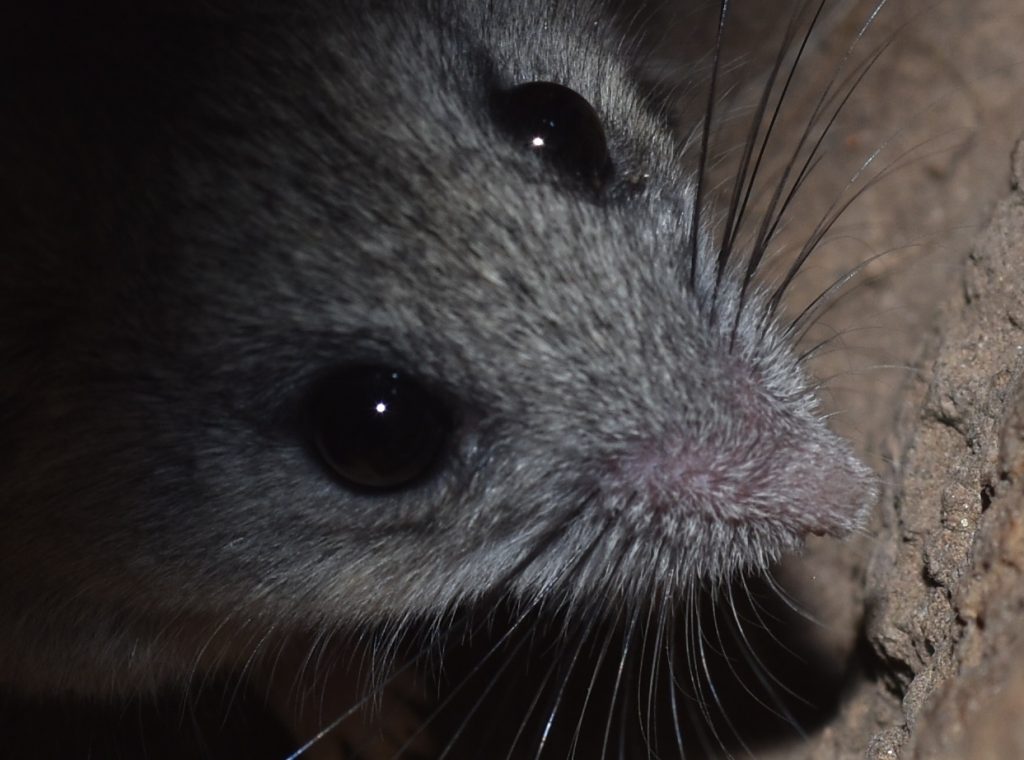
Like the house mouse, deer mice are easy to breed in captivity. They look very similar to house mice, but have much larger eyes (as evidenced in the above photos). They’re also more energetic and tend to jump and run around more, which makes them a bit more difficult to handle. This skittishness is what inspired their common name.
Deer mice have a number of characteristics that make them better suited for some types of research. For one thing, they tend to live longer than house mice. Peromyscus spp. have a maximum lifespan of 5-7 years, as compared to just 3 years for M. musculus. This makes them more useful in aging research. Deer mice are also the main carriers of the Sin Nombre hantavirus, a virus which can cause a fatal disease in humans. Obviously, this makes them of great interest to medical researchers.
As I mentioned earlier, deer mice are native to North America. This makes them a convenient subject for North American researchers who want to study the evolution and distribution of species. The fact that deer mice don’t normally live in close association with humans is also helpful in this regard, since it means we haven’t been spreading them all over the place like we have with M. musculus.
A House for the Mouse 6
In the 1910s and 20s, Francis B. Sumner began investigating the use of deer mice as laboratory animals. He built the first Peromyscus “mouse house” at Scripts Institute in California. When his work was discontinued, Sumner passed the torch (and his mouse stock) to Lee R Dice at the University of Michigan. In the 30s and 40s, Dice continued refining methods for maintaining deer mouse colonies. He also began cataloging mutations in the mice, which he gave names like gray, dilute, and epilepsy.
In 1985, Wallace Dawson at the University of South Carolina used Dice’s deer mouse strains to start the Peromyscus Genetic Stock Center (PGSC). PGSC maintains six Peromyscus species, as well as numerous mutant strains, which it makes available to researchers. You can click here to visit their website.
The above video shows a California mouse (P. californicus). It was filmed on 4/17/17 in Mission Trails Regional Park in San Diego County.
The Mouse Leaves Its Mark 7
In the course of his pioneering work with Peromyscus, Sumner investigated its geographic variation. At the time, this represented one of the few major studies of evolution in wild populations. Important figures in evolutionary thought like Sewall Wright, Theodosius Dobzhansky and JBS Haldane closely followed his work and drew conclusions from it. Wright, for instance, used Sumner’s observations as evidence that quantitative traits in organisms were subject to the same rules of inheritance as discrete traits. (A discrete trait is a trait that an organism either has or doesn’t have like blue eyes. A quantitative trait is one that can vary in quantity like pigmentation.)
Dobzhansky used Peromyscus data in his studies of reproductive isolation. Some subspecies of P. maniculatus live in overlapping geographical areas, but are separated by habitat. For instance, one subspecies lives only in forests, while another lives only in open habitats like prairies. These subspecies are able to mate and produce viable offspring in the lab, but because they inhabit different environments in the wild, the subspecies remain isolated from each other.
Peromyscus has been attracting the attention of these and other evolutionary biologists for about a century now. It’s become one of the best studied mammals and there are many ongoing research projects devoted to it.
Glaciation and an Ancient River Drive the Evolution of New Species8
The map below shows Northwestern Mexico and the Southwestern United States. The thin blue line is the Colorado River feeding into the Gulf of California. (The area highlighted in pink shows the distribution of the desert iguana, which has nothing to do with this article. I just needed an image that was in the public domain and this was the best I could find.)
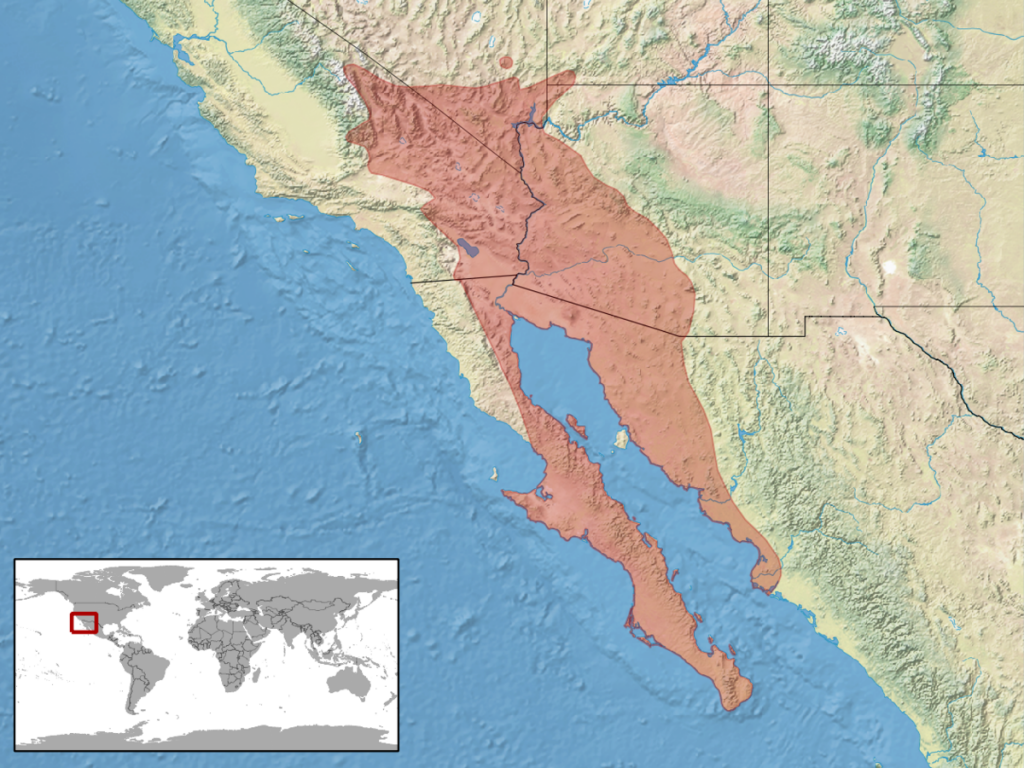
Author: compiled by rbrausse with Quantum GIS
This file is licensed under the Creative Commons Attribution-Share Alike 3.0 Unported license.
The Gulf of California began forming around 12 million years ago as a result of the movement of the underlying tectonic plates. Before that, the Colorado emptied directly into the Pacific. Eventually, it was diverted to empty into the Gulf. The important take-away from this is that for millions of years, the Colorado River has acted as a semi-permeable boundary, isolating land-bound animals living north of the river from those living south of it.9
When a group of organisms is isolated from other members of their species for a long period of time, that group will begin to diverge from the rest of the species. If this goes on for long enough, they may form a new species. This is what has happened to deer mice living around the Colorado.
The river is not the only thing that’s been shaping the evolution of these mice, though. The Earth has experienced a number of ice ages. During an ice age, a cooling climate causes glaciers to extend farther south in the northern hemisphere (and, of course, farther north in the southern). The last ice age, which started about 2.58 million years ago,10 is technically still going on, although we’re slowly coming out of it as the Earth warms. (Well, not so slowly anymore, thanks to human activity, but that’s another story.) The Last Glacial Maximum or LGM is defined as the most recent period when glaciers were at their thickest and the seas were at their lowest (due to all that water being locked up in ice). The LGM occurred around 24,000 to 18,000 calendar years ago.
As the glaciers melted and sea level rose, new islands formed as a result of the surrounding land being flooded by sea water. Many of these islands formed in the newly opened Gulf of California. A few also formed off the western coast of Baja, as well. Deer mouse populations trapped on these islands experienced further isolation from their confreres, resulting in more speciation. The formation of deserts and arid regions as the climate grew hotter and dryer resulted in new niches and pushed speciation still more. Undoubtedly, other changes related to climate and geology have played a role, as well.
A scientific paper published in the Journal of Mammalogy (click here to read it) describes research done on this process of speciation in deer mice in the areas bordering the Colorado. This paper looks at a subgenus of Peromyscus called Haplomylomys, which includes two species groups, californicus and eremicus. The californicus group is made up of just the one species, P. californicus. Eremicus is comprised of 10 species, including the one from which it takes its name, P. eremicus. Californicus lives in habitats with moderate amounts of water, like chaparral and woodlands. The eremicus group is restricted to arid and semi-arid regions.
Haplomylomys has been studied extensively, starting in the early 20th century. This new paper extends that research, concentrating on the species that developed on the various islands around Baja California. The researchers extracted genetic data from a great many species on both the islands and the mainland. They also extracted ancient DNA from skeletal specimens of P. guardia and P. pembertoni. I won’t go into all the details of what they found. Suffice it to say that they were able to find evidence of the effects of all the previously mentioned natural forces on the development of the various species of deer mouse in the region.
The vast majority of mammals are promiscuous. This makes sense from an evolutionary perspective. The more females a male mates with, the better the chances that he will succeed in passing on his genes to future generations. Nevertheless, there are cases where monogamy is the better strategy. If the young of a species are slow to develop, taking a long time to become independent, then it might make sense for the male to stick around and help care for his progeny. This is why humans are at least semi-monogamous.
Monogamy has evolved independently in two species of deer mouse — P. californicus and P. polionotus — which makes them of special interest to scientists who study social behavior in mammals. P. polionotus is also called the oldfield or beach mouse.14 Oldfield mice are found in the southeastern United States.15 In a study published in the Journal Nature,16 17 researchers took oldfield mouse pups and moved them into the nests of P. maniculatus, a polygamous species of deer mouse. They also took pups from P. maniculatus and put them into oldfield mouse nests. When the oldfield mouse pups grew up, they exhibited the same monogamous behavior as other members of their species, despite being raised by polygamous parents. Likewise, the P. maniculatus pups exhibited polygamous behavior as adults, despite being raised by monogamous parents. What this tells us is that, in deer mice at least, it’s genetics that determines whether or not a mouse is monogamous.
The scientists went on to try to identify some of the genes associated with monogamous behavior. Oldfield mice exhibit a number of behaviors associated with monogamy. For example, they build more elaborate nests than their polygamous cousins. The males spend more time licking their pups, huddling with them, and handling them. The researchers mated P. polionotus mice with P. maniculatus mice and found that the offspring exhibited varying mixes of the aforementioned behaviors.
By examining the DNA of the hybrid offspring, the scientists were able to identify stretches of DNA (called loci) that were associated with certain behaviors. In a follow up study, they focused on one of the genes in one of those loci — a gene that controls the production of a hormone called vasopressin. Some of this hormone is produced in the hypothalamus of the brain. P. maniculatus, it turns out, produces three times as much vasopressin in their hypothalamus than oldfield mice. The researchers tried injecting vasopressin into the brains of oldfield mice and found that the mice started making simple nests like the nests of P. maniculatus. The injected vasopressin had no other observable effects on the parental behavior of the mice. So it’s likely that the gene controlling vasopressin is just one of a number of genes that control behaviors associated with monogamy or polygamy.
This was just a brief overview of the paper in Nature. There are a lot of details that I glossed over, so you might want to read the New York Times article for a more in-depth treatment. Click here for that article. You can view the original Nature article by clicking here.
So what about the other species of monogamous mouse? We met P. californicus, the California mouse, earlier. This mouse is found in California and Mexico, on the other side of the continent from P. poloniotus. Lots of research has been done on P. californicus and it’s social behaviors. I won’t bore you with any specifics here, except to mention one article that briefly discusses a possible reason for the evolution of monogamy in this mouse. The article, entitled Tracking the Monogamous Mouse, was published in the Baltimore Sun. (Click here to read it). The article discusses a study by Doctors David Ribble and David Gubernick.
In the article, Dr. Ribble explains that the California mouse is “about twice the size of a normal field mouse”. (Field mouse is a generic term for any mouse that commonly inhabits fields.) Having to power a larger body means that you have less energy left over to devote to other things like making babies, so, other things being equal, larger animals tend to have smaller litter sizes. Most deer mice average four pups per litter, whereas, the much larger California mice produce only two. It turns out that four pups can share enough body heat to keep themselves warm, but two pups need the additional warmth from their parents. So in California mice, the male sticks around to huddle with the pups when the female is off foraging for food.
This neatly explains why P. californicus evolved monogamy, but why did they evolve a larger size? I don’t know. I wasn’t able to find any articles that answered that question. Maybe nobody has studied it. There’s far more stuff out there on deer mice than I’ve had time to read, though, so it’s quite possible that I just haven’t found the right article.
Walt Disney is said to have been in the habit of feeding one of the field mice that would wander into his Kansas City animation studio. This mouse was likely P. leucopus. In 1925, another animator, Hugh Harman, poked fun at Disney by drawing sketches of mice around a photograph of him. This inspired Disney to direct one of his employees to sketch a new mouse character. The rest, as they say, is history. So it seems that our model mouse may have been the model for Mickey.