Ironically, as I write this, I have an ear infection. It’s made me partially deaf in one ear. It’s also made me appreciate what a bang-up job my ears do under more normal circumstances. We hear so much about the amazing hearing abilities of other animals that you might assume humans have a rather poor sense of hearing. In fact, humans, like most mammals, have very good hearing. But I’m getting ahead of myself. Way ahead, in fact…
No, I’m not going to tell you that if you play Mozart to your houseplants they’ll grow better. That nonsense has long since been debunked. Plants don’t care about music. They probably don’t care about anything. But there are things that are important to them, like locating water, protecting themselves from herbivores, and attracting pollinators. To achieve these goals, they’ve evolved the capacity to respond to things in their environment. They ‘know’ to grow in a direction opposite the pull of gravity; they react to light and to the position of the sun; they follow chemical gradients; they even communicate with each other and with animals through chemicals; and evidence is mounting that at least some plants can hear.3
Sound waves cause objects in their path to vibrate. That’s how we hear things—sound shakes our eardrums. Leaves and petals aren’t as good as eardrums when it comes to vibrating, but they still do it. Is it possible that some plants have evolved to respond to certain types of vibrations?
A study published in 2014 showed that Arabidopsis, a plant in the mustard family, turns up its production of chemical toxins in response to caterpillar chewing sounds. When the cabbage butterfly caterpillar munches on an Arabidopsis leaf, it makes a distinctive, high-pitched sound. Researchers recorded this sound, then played it back to one group of plants for two hours, while leaving another group in silence. The plants exposed to the sound increased their production of mustard oil, a chemical that makes their leaves distasteful to most insects. The researchers tried playing other sounds to the plants, including sounds made by non-threatening insects. The plants showed no response. This was the first study to show evidence that some plants can detect sound.
In a 2017 study, evolutionary biologist Monica Gagliano and colleagues placed pea seedlings in pots shaped like upside-down Ys. One arm of each “Y” was placed in dry soil. The other arm was placed in either a tray of water or a coiled plastic tube that had water flowing through it. The roots always grew towards the arm with the water, even when the water was inaccessible inside the plastic tubing. Gagliano believes that the only way the plants could have known the water in the tubing was there was by the gurgling noises it made. She suggests that plants use sound waves to detect water at a distance, but use moisture gradients when they get closer to the source.4
Plants produce sugary nectar to attract pollinators. Sugar production comes at a metabolic cost, though—it uses energy. So, ideally, a plant should produce the sweetest nectar only when there are pollinators around for it to attract. But how can a plant tell if that’s the case? Recent studies suggest that some plants can hear them coming! Researchers studying evening primroses (Oenothera drummondii) found that when they played the sound of bees buzzing nearby, within minutes the plants increased the concentration of sugar in their nectar by 20%.
The scientists conducted several experiments on more than 650 evening primrose flowers, measuring their nectar production in response to silence, sound at three different frequencies, and recordings of buzzing bees. The recorded buzzing (and low-frequency sounds that closely matched the recorded buzzing) resulted in the plants starting to increase sugar concentration in their nectar in just three minutes! The other sounds had no effect.
The researchers repeated the experiments on flowers that had some of their petals removed. These flowers didn’t change their nectar production in response to buzzing sounds, implying that it’s the petals that are used to detect the vibrations. This could be one reason why many flowers, including those of evening primrose, are bowl-shaped since this shape tends to concentrate sound.5

Note: This is not the species the study was done on. And its color is different—Oenothera drummondii has yellow flowers. But the flowers are a similar shape (and I don’t have any photos of Oenothera drummondii).
Anza Borrego Desert State Park, San Diego County. 1/29/23
Hearing in Insects6
Invertebrates are animals that don’t have backbones—everything from sponges to squid in other words. There are, unsurprisingly, an enormous number of invertebrate species, so it might come as a surprise to learn that the ability to hear has only evolved in two groups of them—insects and crabs—and it’s only evolved in a tiny subset of those groups.
Why is this? Well, many invertebrates are able to sense vibrations in the substrate—the ground or leaf or whatever—that they’re standing on. That’s probably good enough for most purposes. And evolution always favors good enough. It doesn’t waste time and resources on perfection.
That said, there are a lot of insect species, so even though hearing is very rare among them, their sheer numbers ensure that there are a lot of insects that can hear. Ears can be found in butterflies, moths, grasshoppers, katydids, crickets, lacewings, preying mantids, honeybees, mosquitoes, flies, true bugs, beetles, and cockroaches. And the diversity of their ears is extraordinary. Unlike vertebrates, which tend to have ears on the head, insects can have them on almost any body part—abdomen, legs, wings, mouth—some even have them on their tongues!7
One reason for this diversity is that ears didn’t just evolve once in insects. Scientists believe they evolved independently at least 20 times. In butterflies and moths alone, they evolved on six different occasions!
But there’s another reason. With a few exceptions, insect ears are modifications of chordotonal organs.8 These are sensory organs found in insects and crustaceans but not in any other type of animal. A chordotonal organ stretches between two segments of a joint. When the segments move relative to each other (that is, when the appendage bends at the joint), it increases or decreases the tension on the organ, allowing it to sense the movement. Usually, chordotonal organs are used for proprioception—that is, giving the insect a sense of how its body parts are positioned—but they are often repurposed for other functions, including hearing. They are found at almost every joint, so it follows that insects can evolve ears on almost any body part.9 10
The insect in the following photo is a katydid (a relative of grasshoppers and crickets).

Mission Trails Regional Park, San Diego County. 11/7/18
Here’s a closeup of one of its legs. The arrow points to one of its ears.

The ear, in this case, takes the form of a tympanal organ. This is a membrane (the tympanum) stretched across a frame. When sound causes the membrane to vibrate, the vibrations are picked up by a chordotonal organ that’s attached to it.
So, what do insects do with all those weird ears? As diverse as their ears are, so too are their uses. Various insects use them for courtship, to establish territories, for social communication, even to locate hosts to parasitize. And, in some cases, they use them to detect bats…
Bats Go High (Frequency)
The philosopher Thomas Nagel once wrote a paper about the nature of consciousness entitled “What Is It Like to Be a Bat?” In it, Nagel asserts that “an organism has conscious mental states if and only if there is something that it is like to be that organism—something it is like for the organism.” He further asserts that we can never truly understand what it’s like to be a bat (or any other presumably-conscious organism) because we are limited to our own subjective viewpoint, which is very different from that of a bat.11
Why, we might ask, did Nagel choose a bat to illustrate his ideas? Bats are bizarre animals in many respects. For example, they are the only mammals that can fly. But I doubt Nagel was thinking about their flying ability when he chose them. More likely, he was thinking of their echolocation.
Echolocation is the ability to perceive one’s surroundings by emitting pulses of sound (aka clicks) and using the rebounding echoes to build a mental model of nearby objects. Most bats fly at night, and although they aren’t blind, they don’t need to see in order to hunt and find their way around. They can do it all with sound.
Bats echolocate using ultrasound—sound that’s at a frequency too high for humans to hear. When a bat searches for prey, it emits loud, long pulses that carry as far as possible. It also spaces the pulses out, so that the outgoing calls don’t interfere with the returning echoes. The frequency of each click typically varies from beginning to end. Different frequencies bounce off parts of an object in different ways, and this allows the bat to resolve shape and texture. In the search phase, the energy of each pulse is concentrated into a narrow range of frequencies. This improves the bat’s chances of detecting small objects at a distance, but limits its ability to identify them. (The resolution of the echoes is lower, in other words). So, the bat can tell that a small object in the distance might be an insect, but it won’t know for sure until it enters the second phase of the hunt.
In this phase, the bat homes in on the object. As it does, it broadens the frequency range of its calls to increase their resolution, and it calls more frequently to get faster updates. At the same time that it’s packing more frequencies into each click, it also shortens the click length. This is necessary to keep outgoing clicks from overlapping with incoming echoes, since it’s clicking at a faster rate. Finally, it softens the clicks. I suppose it does this because it’s getting closer to the target, so it doesn’t need to click as loudly.
All of this, mind you, is happening over a very short period of time, and the differences in wavelength of the incoming echoes are very small. And yet, the bat’s brain is able to process all this incoming information in real time, all while flitting around at high speed!
There are a lot of bat species, and not all of them do things exactly the same. For example, not all bats vary the frequency of their clicks. Most do, and those are called FM, or frequency-modulated, bats. However, around 160 species use single-note calls. These bats are called CF, or constant-frequency bats. CF bats have evolved fascinating ways of using that single note to their advantage. I won’t go into any of that here—we’ve got too much territory left to cover—but if you want the details, check out “An Immense World: How Animal Senses Reveal the Hidden World Around Us” by Ed Yong.12 It’s a great book and one of the main resources for this post.
What I’ve given you in this section is a very condensed and simplified introduction to bat echolocation. I encourage you to read Yong’s book to learn more. There are a couple of other things I’d like to mention, though. First, bat clicks are very loud. The call of a big brown bat can be 138 decibels—about as loud as a siren. Of course, since we’re talking about ultrasound, we can’t hear them—undoubtedly, a good thing! But how, you might ask, does the bat avoid going deaf from its own calls? Each time they make a call, they contract the muscles of their middle ears to muffle the sound, then relax them to listen for the echoes. Even more remarkably, bats are able to adjust the sensitivity of their ears as they get closer to an insect, so that they percieve the echoes at the same steady loudness. This probably helps to stabilize their hearing.13
The other thing I wanted to mention is something that at first glance might seem like a contradiction. Sometimes, when people have barricaded cave entrances to limit access, they’ve later found the bodies of bats that accidentally flew into the barricades. Similarly, if you see a bat flying around overhead and toss a small pebble into the air, the bat will often catch the pebble, thinking that it’s a bug. If bat echolocation is so sophisticated, why do they make such seemingly dumb mistakes?
Probably because they aren’t paying attention. Focusing takes energy. A small object sailing through the air is a lot more likely to be a bug than a pebble, so why bother checking? As for that barricaded cave entrance, when large numbers of bats enter or exit a cave at the same time, if they’re all echolocating, they’re going to have a very hard time distinguishing the echoes of their own calls from the calls and echoes of the other bats. Fortunately, they don’t need to. They’ve probably flown in and out of that cave hundreds of times. They know it like the backs of their wings. So, again, it’s not that they’re bad at echolocation, they’re just not paying attention. That barricade has never been there before, so they aren’t expecting it.
Human Echolocation
Seeing with sound is such an alien-sounding concept that it hardly seems possible. But remarkably, there are human beings who have learned to do it! As a newborn, David Kish had an aggressive form of eye cancer that left him blind by the age of 13 months. (In fact, both his eyes had to be removed.) Shortly thereafter, he started clicking with his tongue. By the age of two, he was crawling out of his crib and exploring the house, using his self-taught ability to echolocate. One night, he even crawled out of his bedroom window, dropped into a flower bed, and wandered around outside, clicking all the while. He remembers sensing the chain-link fence around his backyard and the house on the other side. He climbed that fence and others until, finally, a neighbor called the police, who took him back home.
Kish is now in his 50s. When he walks around outside his home, he uses a long cane to sense objects at ground level but uses clicks to locate everything else. And locate he does! Ed Yong, author of “An Immense World”, describes how Kish accurately narrated everything they passed as they walked around his neighborhood. He easily located houses, porches, shrubbery, and parked cars, and when they came to a place where a large tree branch had overgrown the sidewalk, Kish knew to duck under it.
Kish and people like him offer at least some push-back to Nagel’s assertion that we can never know what it’s like to be a bat, because, as Yong points out, Kish has language. So, even if he can’t explain what it’s like to be a bat, he can explain “what it’s like to be Kish”.14 According to Kish, when he clicks, “he gets a series of `’flashes’, like matches being struck in the dark, each one briefly illuminating the world around him.” Objects that return sharp echoes, like stone walls and glass panes, Kish describes as “bright”. Objects that return coarser echoes, such as foliage and rough stones, are “dark”. (Although, he has no memory of what it was like to see, he naturally uses the language of sight because that’s the language used by the sighted people around him.)15
Bugs Fight Back
For millions of years, bats have been eating bugs. Moths, being mostly nocturnal, are especially vulnerable. After reading about how good bats are at using echolocation to detect and then home in on flying insects, you might wonder how there are any moths left in the world. But millions of years of evolution have provided them with a few defenses.
First, they’re covered with scales. For some readers, this might come as a surprise. Moths certainly don’t look very scaly. However, if you look at a moth wing under a microscope, you’ll see what I mean. Their wings, and often their entire body, are covered in thousands of microscopic scales. These scales are useful in several of ways, but the one that concerns us here is their effect on a bat’s echolocation. Because the scales are so tiny and so numerous, they function as a soft, powdery, sound-absorbing coating, muffling the echoes of the calls.16

Jamul, CA 10/25/22
The color patterns on the moth are created by thousands of minute scales. The next couple of images show closeups of the scales.


Moths are not limited to passive defenses. More than half of moth species have evolved ears capable of hearing bat calls.17 In fact, that’s the only thing they’re used for. And they give the moths a significant advantage. When a bat emits a call, it has to wait for the sound to travel to the moth and back again. The moth, meanwhile, only has to hear the incoming sound. While the bat is still waiting for the echo, the moth can begin evasive maneuvers. Also, the sound that reaches the moth is much stronger than its echo, so the moth might have even more time to react before the bat detects it (or detects its latest dodge).18
Some moths have ears for detecting bats, but can’t be bothered with evasive maneuvers. Tiger moths in the family Arctiidae have a pair of drum-like organs on their thorax (chest area).19 When a tiger moth hears a bat, it vibrates these organs at high-speed, producing ultrasonic clicks that literally jam the bat’s sonar! Many tiger moths also contain chemicals that make them taste bad. In this case, the clicks also serve as a warning, letting the bat know that they aren’t worth eating.20
Yet another strategy moths have evolved is the ability to create illusions. Luna moths are large insects with lime-green wings that end in long streamers. I used to see them occasionally when I lived in Virginia.

Tulsa, Oklahoma
author: woodleywonderworks
source: Luna
This file is licensed under the Creative Commons Attribution 2.0 Generic license.
Luna moths don’t have ears, and they don’t have any fancy, sonar-jamming organs. What they do have are long tails that flutter and spin behind them as they fly. Somehow, the tails produce echoes that trick bats into attacking them instead of the moth’s body. The moth might lose its tails, but it can live just fine without them (as long as it doesn’t run into another bat).21
Dolphins Go High (in Their Own Special Way)22
As far as we know, only two major groups of animals have developed echolocation. We’ve already covered one of them: bats. The other group is dolphins.
Bats and dolphins are both mammals, which means they have a lot in common, but they also have some very obvious differences. Bats are small, flying animals that live on land. Dolphins are much larger and spend their entire lives in the water. Dolphins and most bats echolocate, but they evolved that ability independently. So, it’s to be expected that they would go about it somewhat differently.
Scientists first discovered echolocation in bats. In 1947, Arthur McBride, the curator of Marine Studios (later Marineland) in Florida, noticed that bottlenose dolphins were able to avoid nets in the dark. This made him wonder if they might be using some form of echolocation. Other scientists conducted research that proved McBride’s hypothesis.23
Dolphins are technically a type of whale—they belong to the group Odontoceti or odontocetes, aka toothed whales. The other members of this group, including such fan-favorites as sperm whales, orcas, and narwhals, also echolocate. All other whales belong to the group Mysticeti or baleen whales. They don’t need to echolocate, since they’re filter feeders. (Except that maybe they do. See the section “Whales Go Long” later in this article.) 24 25
Whales evolved from land animals. As their ancestors gradually adapted to marine life, their noses migrated to the tops of their heads and became blowholes. In the nasal cavity just below the blowhole, whales have two pairs of organs called phonic lips. These evolved from what was originally the nostrils. By forcing air past the phonic lips, the dolphin sets them to vibrating. The sound travels forward through a large, fatty organ called the melon. This organ focuses the sound, producing the clicks the dolphin uses for echolocation. The melon is also what gives dolphins their bulging brows.
Note that no vocal cords are involved in the production of the clicks. In fact, dolphins no longer have functional vocal cords. All that’s left of them are structures called vocal folds, and these lost the ability to make sound millions of years ago.26 So, a dolphin’s click begins in its nose and passes out through its forehead—a very different strategy from that of a bat, whose clicks begin in the throat and exit through the mouth or nose.
Dolphins (and other toothed whales) also capture returning echoes in a novel way. Part of a dolphin’s lower jaw is hollow with very thin walls and is filled with the same fats found in the melon. When the echoes arrive at the jaw, these fats channel the sound to the inner ear. In Ed Yong’s words, “A dolphin is an echolocator that clicks with its nose and listens with its jaw.”27

Author: Malene Thyssen
Permission is granted to copy, distribute and/or modify this document under the terms of the GNU Free Documentation License, Version 1.2 or any later version published by the Free Software Foundation; with no Invariant Sections, no Front-Cover Texts, and no Back-Cover Texts. A copy of the license is included in the section entitled GNU Free Documentation License.
This file is licensed under the Creative Commons Attribution-Share Alike 3.0 Unported license.
Despite major differences in the way they generate sounds and intercept echos, dolphins use their clicks in much the same way as bats. They manage the duration and frequency of their calls so that they don’t overlap with the returning echoes. They produce shorter clicks closer together when they need a more detailed ‘view’. They even adjust the sensitivity of their ears to avoid being deafened by their own calls and so that returning echos are all heard at the same steady volume.
But living in water allows dolphins to do things with their sonar that bats can only dream of. Sound travels faster and farther in water than in air, so dolphin echolocation has a much greater range than a bat’s. A dolphin’s large size also allows it to channel more energy into its calls. A bottlenose dolphin’s click can contain 40,000 times more energy than that of a big brown bat!
One thing that living in water allows dolphins to do is downright mind-blowing. Sound waves traveling through a substance (water, air, or whatever) tend to reflect back when they encounter another substance that has a greater density. If the new substance is dense enough, then most of the wave will be reflected. If it’s not that much denser, then only some of the sound is reflected (i.e. a weak echo is produced.) If the new substance has exactly the same density as the original substance, then the sound wave won’t be reflected at all.
Now, here comes the cool part. You’ve probably heard that your body is mostly water. The same is true of other animals. So, animal bodies have about the same density as water. Water is much denser than air, so when a ping from a bat encounters an insect, the insect’s body produces a strong echo. But dolphins live in water, so when a dolphin produces a click, it travels through the water, hits a fish whose body is not much denser than the surrounding water, and continues traveling into the fish’s body. Of course, the body of the fish is a little denser than the surrounding water, so some of the sound does get reflected back, but a large part of it continues on. And when that part hits a bone… Well, bone is quite dense, so most of the sound gets reflected back.
You can probably see where this is going. The returning echos don’t just carry information about the fish’s shape and texture. They allow the dolphin to perceive what’s inside the fish! In short, dolphin echolocation is very much akin to x-ray vision!
It’s hard to exaggerate the significance of this. If you go swimming with dolphins, they can see your lungs and skeleton. If you’re pregnant, they can probably see the fetus. Dolphins can perceive the swim bladders of the fish they eat. They can almost certainly identify the type of fish by the shape of its bladder. They can tell when a fish has a metal hook in it. In Hawaii, false killer whales will steal tuna off fishing lines, deftly avoiding being caught by the hooks themselves, presumably because they can “see” where the hooks are located in the fish.
The skulls of beaked whales (a type of toothed whale) are often decorated with crests, bumps, and ridges. These weird growths are invisible to us unless we dissect the whale—the head is perfectly smooth from the outside—but they would be easily detected by another whale’s echolocation. So, what are they for? A clue perhaps can be found in the fact that they are often only found in the males. Could they be sexual displays, used to attract mates? Normally, we would expect such displays to be on the outside of the body, but when your potential mates all have x-ray vision…
Yet another advantage to echolocating in water is something we briefly touched on earlier: greater range. Sounds travel farther in water before they dissipate too much to be useful. A flying bat typically has less than a second to decide what to do when it encounters a possible target. A swimming odontocete has more like 10 seconds. As Yong so eloquently puts it, “A bat must always react. A whale can plan.”28
This extra time also allows them to work together. At night, spinner dolphins hunt their prey in teams of up to 28 individuals. When they find a group of fish or squid, they form a tight row and plow into their prey, forcing them to crowd together. Then they surround them and take turns darting in from opposite sides to snap them up. The dolphins coordinate the sequence of their movements with precision, and they’re more likely to click when transitioning between steps in the sequence.
Spinner dolphins are obviously using echolocation to coordinate their movements, but exactly how they’re using it isn’t clear. Are they sending commands? Are they tracking each others positions? Are they able to use each other’s echoes to extend their own sense of their surroundings? We don’t yet know.
In 1984, zoologist Katy Payne was observing Asian elephants at the Portland Zoo, when she felt an unusual vibration in the air. This led her to suspect that the pachyderms might be using infrasound to communicate. (Infrasound is the opposite of ultrasound—its frequency is too low for us to hear.) Payne and her colleagues were able to confirm her suspicions by showing that the elephants changed their behaviors when exposed to recorded infrasonic calls, and they did so in ways that couldn’t be explained in any other way.
Payne and other researchers have gone on to spend many years studying infrasonic communication in elephants. It’s now known that elephants can produce lower-frequency sounds than any other land animal. They can also produce and detect sounds over a wider range than any other nonhuman mammal. Human hearing has a range of roughly 20Hz to 20,000Hz. In one study, a female elephant was shown to respond to frequencies from 17Hz to 10,500Hz. Other studies have found that elephants can respond to frequencies lower than 10Hz!
Scientists have shown that much of elephant communication occurs in the infrasonic. It’s possible that most of it does. But how and why did elephants evolve to communicate at such low frequencies?
Elephants evolved mostly in forested habitats. In dense forest, a relatively large animal like an elephant can’t rely on vision to keep track of other members of its group. So, early elephants evolved keen senses of smell and hearing to compensate. Hearing must have been especially important for communication.
But why favor low-frequency sounds over high-frequency? Partly, it could have been just a matter of anatomy. It’s hard to imagine a big animal making high-pitched squeaks or chirps. Deep, barrel chests are just more suited to low-pitched calls. But setting anatomy aside, low-frequency sound is just better suited to communicating in a dense forest. It passes easily through thick vegetation that would quickly dissipate higher frequencies. And the lower the frequency, the better, allowing a herd to spread out widely and still keep in touch.
Why Stop At Ears?32
When an elephant emits a low-frequency call, it doesn’t just set the air vibrating—the earth itself vibrates in response. The sound of the call travels through both air and earth. So, another elephant doesn’t just detect the sound as it passes from the air to its eardrums, it also detects the sound as it passes from the ground to its feet! That’s right, elephants hear with their feet!
What good, you might ask, does it do an elephant to hear two versions of the same call? Sound travels at different speeds through different mediums. In general, it travels faster in liquids and solids than through gases like air.33 So, the sound of the call reaches the elephant’s feet before it reaches its ears.
You might have heard that you can estimate the distance to a thunderstorm by counting the seconds between a flash of lightning and the crack of thunder that follows it. Since light travels so much faster than sound, the flash gets to you almost instantly. Sound, on the other hand, takes roughly 5 seconds to travel a mile in air.34 So, divide the time between the flash and the crack by 5 and you’ve got the approximate distance to the storm.
Similarly, when an elephant hears a call with its feet and then hears the same call with its ears a short time later, this allows it to estimate how far away the other elephant must be. Maybe this is inate or maybe it’s learned. Either way, the elephant gets an idea how far away the other elephant is.
At the same time, sound waves traveling through the air generally arrive at one of the elephant’s ears before the other one, giving the elephant an idea of the direction that the call is coming from. This isn’t anything out of the ordinary. We sense the direction of sounds the same way. However, by combining these two pieces of information—distance and direction—the elephant ends up with a pretty good idea of where the other elephant is in relation to itself!
I should mention that elephants probably don’t just detect sounds traveling through the ground by the touch sensors in their feet, although they do have a high concentration of such sensors in their foot pads. There’s also evidence that sound travels by bone conduction from their feet to their ears. So to some extent, they probably hear the sound coming from the ground with their ears, as well.
Before we move on, I want to mention one other interesting tidbit—elephants can hear clouds. Storm clouds, anyway. Apparently, storm clouds produce sounds at a frequency that’s below the range of human hearing, but not of elephant hearing. In a 2015 study, seven years’ worth of GPS data on the movements of elephants in 14 different herds was compared to weather data for the same region and period. In several instances, elephants in different areas all moved in the direction of the infrasound coming from distant storms.35 36


Whales Go Long
We covered toothed whales or odontocetes in an earlier section, where we learned that they echolocate using ultrasound. The other whale group, the mysticetes or baleen whales, followed a different route. They evolved to use infrasound.
Mysticetes feed on tiny crustaceans called krill, which is a bit weird, given that mysticetes are themselves massive creatures. They include the blue whale, the largest animal on Earth. Obviously, one or two krill isn’t going to be much of a meal for such an animal. A baleen whale searches for huge swarms of krill, and when it finds one, it opens its mouth wide and engulfs as much of the swarm as it can, filtering out the krill and expelling the water. It filters the krill using baleen—bristle-like structures made of the same material as our fingernails.37
Krill are found all over the world, but they aren’t distributed evenly, so whales have to migrate long distances to find enough krill to sustain themselves. One whale, working alone, might have a hard time locating enough swarms, but what if a pod of whales could spread out over a wide area and let each other know when they find a good feeding area?
In 1971, biologist Roger Payne published two ground-breaking papers about baleen whales. The first introduced the public (and other scientists) to the haunting songs of humpback whales. These songs are low-pitched, but still within the hearing range of humans. (I suppose they could have an infrasound component, too, but I don’t know.) The second paper showed that fin whales—the second largest animals in the world—communicate using infrasound. Payne calculated how far a fin whale’s infrasonic call could travel in water. The answer he came up with was an astonishing 13,000 miles! To put this in context, the Pacific Ocean is only 12,300 miles across at its widest point!
Payne’s conclusion—that fin whales could communicate with other whales across an ocean—seemed so preposterous that other researchers scoffed at the idea. His career was almost ruined. Some people even questioned his sanity. Nevertheless, newer research supports Payne’s ideas. To be clear, we don’t know that the whales are actually communicating across that distance—it’s possible that they’re just using very loud calls to communicate with whales closer to them—but what would be the point of using louder calls than you need? Also, research has shown that blue and fin whales will repeat the same notes over and over at precise intervals. That kind of redundancy is often used by engineers when designing a system that will be used to communicate over very long distances. The Martian rovers, for example, use this strategy when sending data back to Earth.
I said earlier that baleen whales don’t use echolocation. But is that really true? A fin whale’s song can last for several seconds, and the wavelengths can be as long as a football field. If we could build a sonar system that used sound like that, we could map an entire ocean. And researchers have found evidence that whales could be doing just that. Blue whales have been observed traveling directly from polar waters to tropical Bermuda, singing as they go. Whales often swim directly from one landmark to another, even when those landmarks are hundreds of miles apart. Their movements certainly suggest that they have a mental map of the oceans—one they might have built up over their lifetimes using the echoes of their songs.
Songbirds Go Cryptic38
Bird songs are clearly audible to human ears, and we usually find them beautiful. But what does bird song sound like to a bird? The answer is a lot more complicated than you might expect.
For starters, birds seem to hear “faster” than we do. The song of a whip-poor-will, to our unaided hearing, has three notes. But if you slow it down, you’ll find that it actually has five. And when a mockingbird, which mimics the songs of other birds, mimics the song of a whip-poor-will, it mimics all five notes. So, the song sounds more complex to the mockingbird, and presumably to the whip-poor-will, than it does to us.
Researcher Robert Dooling performed a series of experiments that tested the ability of songbirds to distinquish between songs that differed only in their temporal fine structure. He presented the birds with two different buzzes. One of the buzzes consisted of chunks of sound that fell in pitch. That is, a chunk would start off high and end low, and the next chunk would repeat the pattern. The other buzz consisted of chunks that rose in pitch—each chunk started low and ended high. If the chunks were longer than three or four milliseconds, humans could detect the difference, but if the chunks were shorter than three milliseconds, they couldn’t. The birds tested performed better. Canaries and parakeets could distinguish between the buzzes until the chunks got down to one or two milliseconds, and zebra finches were able to tell the difference down to one millisecond, which was the limit of the researchers’ electronics! So, the birds could hear complexities that were too fast for human ears.
It’s interesting that songbirds are more sensitive to temporal fine structure than humans, but later experiments by some of Dooley’s colleagues and students produced more surprising results. A zebra finch always sings the same sequence of syllables, which we can represent as A-B-C-D-E. In one experiment, the researchers reversed one of the syllables: A-B-(reverse C)-D-E. Zebra finches almost always noticed the change, but humans couldn’t tell the difference. However, when the gap between two of the syllables was doubled, humans could hear the difference, but the zebra finches couldn’t.
Then things got really weird. Two of the students tried shuffling the order of the syllables: C-E-D-A-B. Unsurprisingly, the human listeners could easily tell the difference. But the zebra finches couldn’t.
Even though zebra finches always sing the same sequence of syllables for their entire life, they don’t actually care about (and apparently don’t even hear) the order of the syllables or the lengths of the gaps between them. The only thing that matters to them is the structure of the individual notes. And we humans can’t hear that structure. What does this mean? A zebra finch could be encoding all sorts of information in the fine structure of its song—sex, health, identity, who knows what—and to us it would sound like the exact same song repeated over and over again.
Owls are superbly adapted for hunting at night. In my earlier post The Story of Eyes: Part 2, I wrote briefly about the eyes of owls, which are some of the most unique eyes among vertebrates. Tubular, rather than globular, they act like telescopes, amplifying distance vision. And their huge size, taking up much of the owl’s head, allows them to collect as much light as possible.
But even on dark, moonless nights, an owl can still hunt. No, it doesn’t have echolocation. It depends on the faint sounds of its quarry—usually some luckless rodent—to tell it where to strike. Some species, like the great grey owl, can even snatch up small mammals hidden under a layer of snow.41
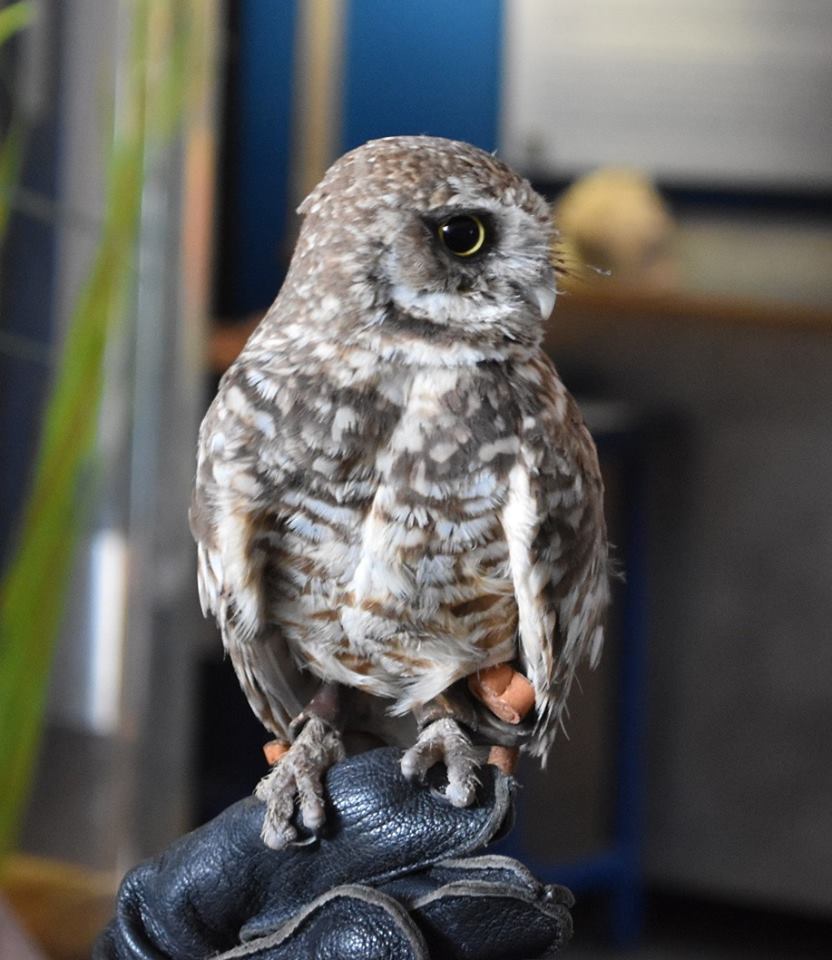
Let’s focus on barn owls, since they’re fairly representative of their ilk (and I happen to have pictures of one). We use the flaps of our ears to collect sound and funnel it towards our eardrums. Barn owls don’t have ear flaps. Instead, the stiff, dense feathers that make up their facial disk channel sound towards the ear holes. And the ear holes are enormous! In some owl species, if you part the feathers and look into the ear, you can see the backs of the eyeballs!

Dictionary Hill in Spring Valley, CA 5/13/23
A couple of rangers gave a talk about a red-tailed hawk and this barn owl that they have in captivity.
All this, plus a large eardrum and cochlea, give an owl very sensitive ears. But being able to hear the faint sounds of its prey isn’t enough. It needs to be able to pinpoint where the sounds are coming from. Since our ears are positioned on opposite sides of our skulls, a sound usually reaches one ear before the other. It’s also slight louder for that ear. This allows us to get an idea what direction the sound is coming from. This is true for owls, too. But because our ears are on the same level, sounds coming from above or below reach both ears at roughly the same time. In most owl species, the left ear is higher than the right. Having one ear positioned slightly above the other allows the owl to locate a sound’s source with much better accuracy. I couldn’t find a good, copyright-free image of an owl skull that showed the positions of the ear holes, so I’ll link you to an article with one. Click here to check it out.
Owls have one more feature that makes them formidable birds of prey: almost silent flight. I say feature, but it’s really a suite of features. First, they have large wings compared to their body mass, so they can fly very slowly with more gliding and less flapping. Second, they have comb-like serrations on the leading edge of their wing feathers. These break up the turbulance that’s responsible for much of the sound other birds make when they fly. Third, their feathers have a soft, velvety texture that further dampens the sound of their wings, as well as the sound that their body makes as it moves through the air. And fourth, they have a soft fringe on the trailing edge of the wings to break up the turbulance trailing behind. Almost silent flight has the obvious advantage of not alerting the owl’s prey, but it also makes it easier for the owl to detect faint sounds, since it doesn’t have to hear them over the sound of its own wing beats.42
The following video shows the same barn owl that was in the earlier photo. It’s in slow motion, but there is sound. You might have to turn the volume up on your computer or mobile device to tell. That’s just how quiet they are.
Journey of the Ossicles43 44 45
Terrestrial vertebrates—amphibians, reptiles, birds, and mammals—are called tetrapods because they have four legs. (Some of them, like snakes, have lost them, but that’s another story.) Tetrapods are descended from fish, so that’s where we need to start if we want to trace the evolution of their hearing. Fish have a number of ways to detect sound, including cilia (nerve hairs), swim bladders, ossicles, otoliths, and various mechanoreceptors. We’ll save all that for some future article. What we’re interested in here is their transition to land.
The first fish to make that transition probably didn’t have eardrums. Those seem to have evolved independently at least three, and maybe as many as six, times. Terrestrial vertebrates that lay their eggs on land (i.e. all of them that aren’t amphibians) are called amniotes.46 In early amniotes, the stapes bone was a large bone that was used to support the braincase. It couldn’t be used for hearing. However, there is evidence that by the Permian (298.9 to 251.9 million years ago), amniotes had evolved eardrums that connected the stapes to the inner ear. So, the stapes became the first of the three tiny bones called ossicles that modern mammals have in their inner ears. Reptiles and birds still have only the one ossicle.
The way mammals ended up with two extra ossicles is unexpected to put it mildly. When tetrapods first moved onto land, the organs that had allowed them to hear in water were useless for hearing in air. However, they could detect vibrations in the ground using the bones of their lower jaws. Those bones ended close to the ears, so when they laid their lower jaw on the ground (which those low-slung early tetrapods probably did most of the time), vibrations would pass from the ground to the ears through bone conduction. So, one could argue that they weren’t totally deaf, but they were certainly a long way off from having good hearing. As already noted, tetrapods did eventually evolve eardrums connected to the stapes bone, which was repurposed as part of the inner ear, and this gave them the ability to pick up sounds directly from the air.
At some point, the tetrapods split into two lineages—one that led to us mammals and another that led to all other amniotes. In the ancestors of mammals, the jawbones underwent some major changes. Figure 1 shows the jaw joints of an early mammal and a non-mammalian amniote.

Author: Philcha
This image is in the public domain. Taken from the Wikipedia Commons page: https://commons.wikimedia.org/wiki/File:Jaw_joint_-_mammal_n_non-mammal.png
Note that the lower jaw of the non-mammalian amniote consists of three bones, the articular, angular, and dentary bones, whereas the lower jaw of the mammal consists of just the dentary. Also, the upper jaw of the non-mammalian amniote has a large bone called the quadrate that was part of the jaw joint.
As the color coding in the images shows, the quadrate, articular, and angular bones are still present in the mammalian skull, but they’ve been greatly reduced in size, disconnected from the jaws, and repositioned. In fact, two of them—the articular and quadrate—have connected up with the stapes and become part of the inner ear! We now call them the malleus and incus, respectively. ‘Malleus’, ‘incus’, and ‘stapes’ are from the Latin and translate to ‘hammer’, ‘anvil’, and ‘stirrup’, respectively, which are the other common names for the ossicles. (In case you’re wondering, the other former jaw bone, the angular, now supports the eardrum and is called the ectotympanic bone, which is rarely mentioned.)
What drove this remarkable transformation is not fully understood, but it’s been proposed that mastication (chewing) provided the selective pressure. The reconfiguration of the bones allowed mammals to move their jaws from side to side, which is what makes chewing possible. And chewing was a great advance over just tearing up one’s food and gulping it down. But decoupling the ear from the jaw had another advantage. Hearing and mastication were now able to evolve independently.47
Having three ossicles in mammalian ears gave evolution more ‘knobs’ to play around with when fine tuning mammalian hearing. One result of this tuning, is that mammals are able to detect higher frequency sounds than reptiles and birds. They can also detect a wider range of frequencies overall.
To sum up, two things—the increased complexity of their inner ears and the decoupling of their hearing and chewing ‘modules’—have increased mammals’ evolvability or capacity to evolve.48

San Diego County, CA 3/4/23
Kangaroo rats have such sensitive, and fast, ears that they can hear the strike of a rattlesnake, jump, turn in midair, and kick the snake with their powerful hind legs before making their escape.49
In Conclusion
As usual, this has been a long one. At least I resisted the temptation to break it up into two parts, like I did with eyes. There’s so much more material I could have covered. I already mentioned Ed Yong’s excellent book “An Emmense World: How Animal Senses Reveal the Hidden Realms Around Us”. It covers, not only hearing, but many other animal senses. I can’t recommend it highly enough.