I began this article with a mission: to figure out how a woodpecker can spend its entire adult life battering its head against tree trunks without beating itself into a coma. Scientists estimate that the human brain can tolerate decelerations of up to about 100 g. In other words, you can (theoretically) beat your head against a wall with 100 times the force of gravity without experiencing brain injury.1 On the other hand, when researchers measured the force generated when a woodpecker pecks, they found that it experiences a deceleration of from 600 g to 1500 g — up to fifteen times the amount of g-force that a human being can withstand! And it doesn’t do this just now and then. Some types of woodpeckers peck up to 20 times a second and may make 8,000 to 12,000 pecks in a day!2 How did evolution engineer a bird that can take that kind of punishment day in and day out? How do you evolve a jackhammer for a head?
Before we begin our investigation, let’s get to know our test subject. The study I mentioned above, in which researchers measured the pecking force of a woodpecker, was done on Melanerpes formicivorus — the acorn woodpecker. This is fortuitous, since M. formicivorus is one of the most common woodpeckers here in Southern California. I often see them when I hike in wooded areas. Despite this, I’ve never managed to get any good photos of the bird. Fortunately, Christopher MacPherson kindly agreed to let me use his beautiful photo of one:
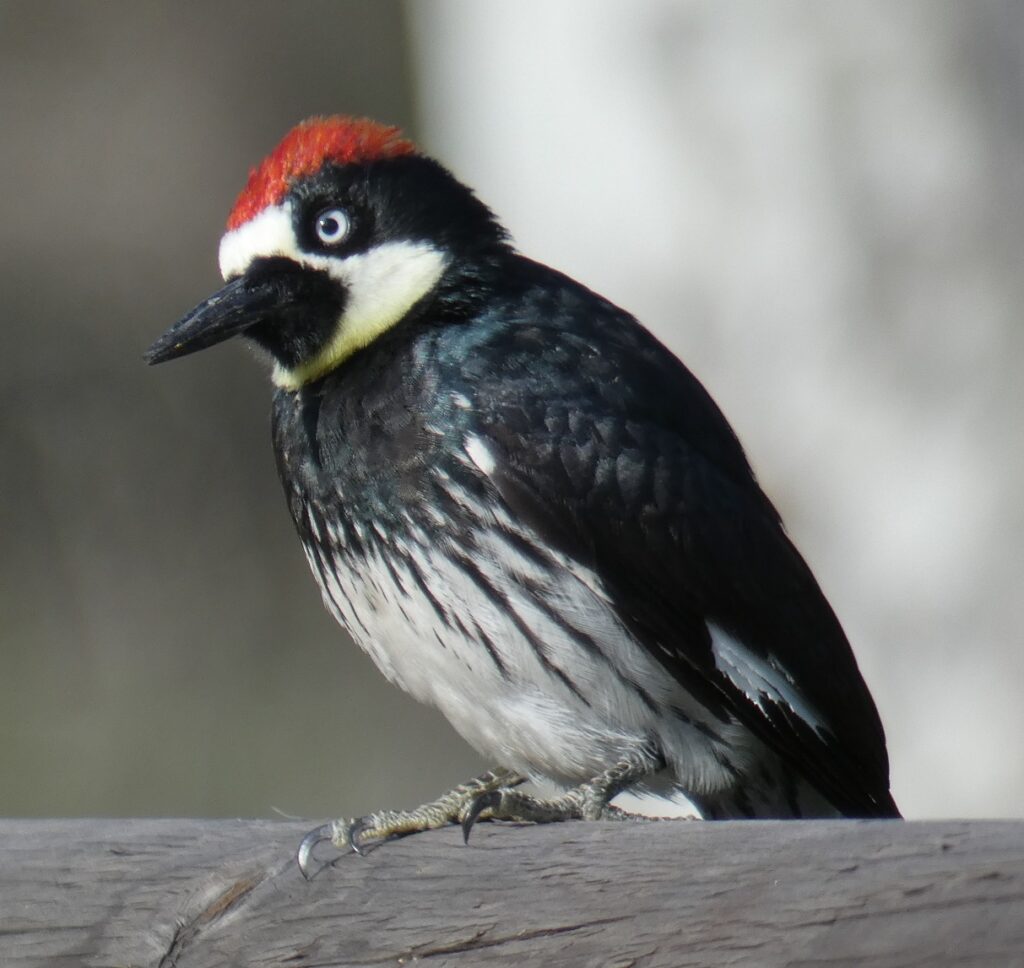
San Clemente Canyon, San Diego, CA 3/15/2019
Author: Christopher MacPherson
Used with permission
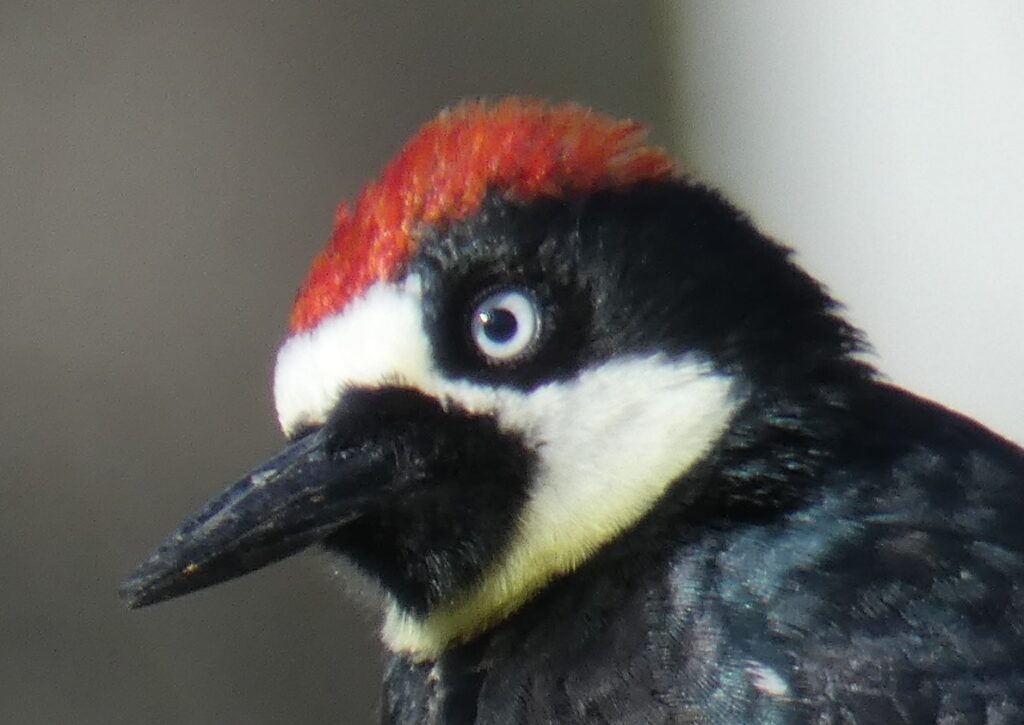
Here’s a closeup of the head from the same photo:
Author: Christopher MacPherson
Used with permission
As you can see, the acorn woodpecker is a very distinctive bird with a clown-like face and wide white eyes. Their wings are black with a single broad white stripe down the middle. This makes them easy to identify as they flit from tree to tree.3
As woodpeckers go, M. formicivorus is pretty average in most respects. It’s medium-sized — about 21 cm or 8.3 in long. The force of its peck is nothing out of the ordinary for woodpeckers. It’s probably fairly representative of the group.4
There is one thing about acorn woodpeckers that is not average, though. As you may have guessed from the name, they eat acorns. That’s not all they eat. Insects are much higher in protein than acorns and make up a large part of their diet. They also consume fruit, tree sap, and even the occasional lizard.5 Nevertheless, acorn woodpeckers cannot survive without acorns because they rely on them to make it through the winter.
Even here in Southern California, where it doesn’t get very cold, insects are rather hard to come by in winter. (I know — they’re my favorite subjects for macro shots.) You can find some by turning over rocks and rotten logs, but birds tend to be bad at that sort of thing. A lot of beetles bore into wood or underneath bark. Woodpeckers locate them by listening for the sounds they make and peck a hole to extract them. But in the winter, such insects tend to go into a dormant state and don’t make much noise, which means the woodpeckers are out of luck.
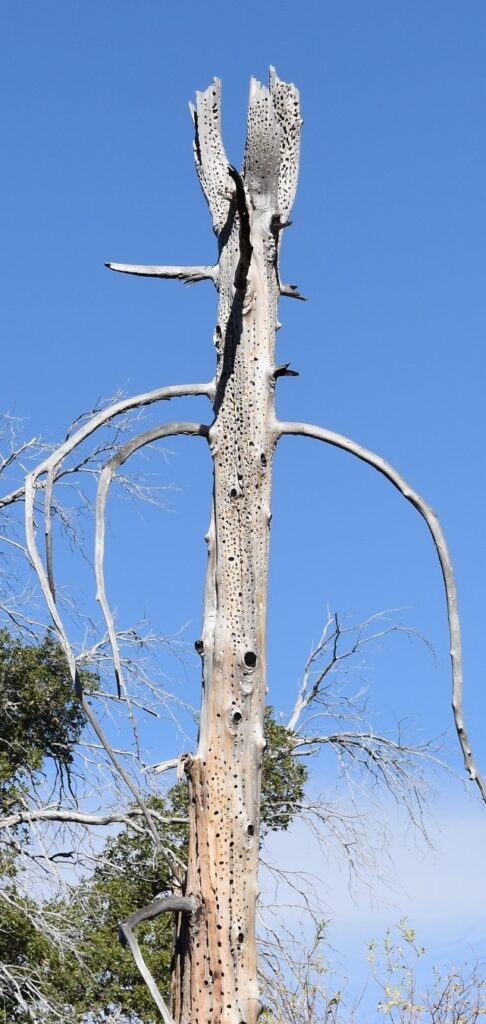
So, like squirrels, acorn woodpeckers turn to hoarding acorns to get them through the hard times. Unlike squirrels, however, they don’t bury the acorns. Instead, they pick out a tree with nice, soft bark — dead pines seem to be a favorite — and they peck thousands and thousands of holes in the trunk. They stick an acorn in each hole and hammer it in with their beak. This kind of tree is called a granary. A granary can have as many as 50,000 acorns stored in it! 6
As acorns dry, they shrink and become loose in their holes, so the woodpeckers have to move the acorns to progressively smaller holes. They also have to defend their granary from other hungry birds. As you can imagine, it’s a big job. Acorn woodpeckers spend a significant amount of their time stocking, maintaining, and defending their granaries.
I should note that not all acorn woodpeckers use trees for granaries. They sometimes use telephone poles, wooden fences, or even the wooden walls of buildings (which does not endear them to the buildings’ owners). In Arizona, some woodpeckers pecked holes through the walls of a wooden water tank and sank 220 kg (485 lbs) of acorns in it! Occasionally, they don’t bother excavating holes at all and, instead, just wedge acorns into cracks in rocks or in the bark of trees.7 But in my area, all the granaries I’ve seen have been of the more traditional variety. Here’s a picture of one:
Airplane Monument Trail, Descanso, CA 11/11/2017
And here’s a closer view:

Acorn woodpeckers are unusual in one other way — they often engage in cooperative breeding. This is when three or more birds take care of the nestlings in a single nest. This type of behavior is estimated to occur in only nine percent of bird species. Sometimes two acorn woodpeckers will form a traditional monogamous pair. In other cases, they may form a coalition of as many as seven breeding males and three nesting females. Three males and two females are more common, though. Adult offspring may also stick around to help raise the next generation. A group may contain as many as ten such non-breeding helpers.
Such a coalition or ‘breeding collective’ will stake out a territory around its granary. Breeding females all share the same nest cavity, which is generally a deep chamber excavated in the trunk of a dead tree with the entrance hole at the top of the chamber. Surprisingly, a female will usually destroy any eggs in the nest before she starts to lay. This stops once all the females have begun to lay, so eggs from more than one bird are able to hatch. Such behavior is obviously a disadvantage to the individual birds whose eggs are destroyed, however, it helps to ensure the survival of the group as a whole, since it’s easier to feed and care for fewer chicks at a time. Breeding males will mate indiscriminately with all the nesting females in a group and all members of a group take part in caring for the young.8
Some Chinese Studies
When I started looking into the “pecking problem”, the first thing I came across online was a paper published in 2012 entitled “Numerical study of the impact response of woodpecker’s head”. It’s based on a study conducted in China. The paper is written in such broken English that it would be difficult to understand even without all the scientific terminology. One sentence summed up the researchers’ conclusions pretty well, though: “The woodpecker’s head is a high [sic] effective shock absorbing system, due to the special structure and viscoelasticity of the biomaterials.” 9
The next paper I found was also about a study that took place in China. It was published in “PLOS ONE” in 2011.10 Thankfully, this one was easier to understand. In this study, the researchers used two synchronous, high-speed video systems to record pecking behavior and a force sensor was used to measure the impact of the pecks. Micro-CT scanning and a mechanical testing system were used to study the structure and mechanical properties of the woodpecker head. Finally, a 3D mathematical model of a woodpecker’s head was developed to calculate the theoretical stresses to the bird’s skull.
The woodpecker involved in the study was the great spotted woodpecker (Dendrocopus major). For comparison, the researchers also looked at the Eurasian hoopoe (Upupa epops), which is not a woodpecker. One difference the study found between the two birds was in the bones of their skulls. The woodpecker had more “plate-like spongy bones” in its cranium, while the hoopoe had more rod-like bones. The distribution was different, too. In the woodpecker, the spongy bone was concentrated in the front and back of the skull.
This makes sense if this spongy bone is acting as armor for the brain. When a human suffers a blow to the head, his or her brain first slams against the inside of the cranium on the side where the impact occurred. It then rebounds, slamming into the opposite side. Since the impact of a woodpecker’s peck is felt mostly on the front of the bird’s skull, its brain is going to press up against the inside of the forehead first and then rebound against the back of the skull — the very areas that are most heavily reinforced with spongy bone.
There was a lot more in this paper, but I’m going to move on from scientific papers to an article about a scientific paper, just because the article in question does a nice job of explaining things. The article is “Why Woodpeckers Don’t Get Concussions” by Stephanie Pappas11 and the subject is yet another Chinese study — apparently a separate one from the other two.
The author points out that scientists had previously determined that woodpeckers use their thick neck muscles to diffuse the impact of a peck. If you watch a woodpecker pecking, you’ll notice that it keeps its neck rigid and uses its whole body to peck. (In essence, it’s the bird’s whole body that’s a jackhammer, not just the head.) This means that much of the force of the peck is redirected from the head to the body.
As noted earlier, a woodpecker’s skull is reinforced with thick, plate-like, spongy bone. The mesh that makes up this bone is formed by large numbers of trabeculae, which are microscopic, beam-like projections of bone. Other birds have these trabeculae, but in the woodpecker they’re closer together.
The woodpecker’s beak is also adapted for high impact. It contains many thinner trabeculae, as well as microscopic rod structures. The upper and lower beaks of a woodpecker each consist of a bone covered in a sheath of softer material. In the study mentioned earlier, researchers found that the bone in the lower beak was slightly longer than the bone in the upper beak. On the other hand, the sheath covering the upper beak extends farther than the sheath covering the lower beak. This configuration causes the beak to deform on impact in a way that channels much of the shock into the lower beak and, from there, into the neck and body, bypassing the brain altogether.12
It’s estimated that 99.7 percent of the strain energy produced by a peck ends up being channeled into the body where it’s dissipated as heat. Only 0.3 percent is left to be converted into heat in the head. Even so, temperatures inside the skull rise so quickly that the woodpecker has to take frequent breaks just to keep its brain from overheating.13
In addition to all these adaptations, woodpeckers have evolved a thick inner eyelid (in addition to the two regular eyelids) which closes just before the beak strikes the wood. While this doesn’t do anything to protect the brain, it does keep flying wood chips from damaging the eye. It also keeps the bird’s eyeballs from popping out.14 (Seriously.)
The Strangest Tongue in the World? 15
When I first considered writing a blog post about woodpeckers, it was the mystery of how they avoided head injury that inspired me. When I read about their tongues, there was no longer any question — I had to write about these bizarre birds! There are a lot of weird tongues in the animal kingdom, but when it comes to woodpeckers… Well, click here to watch a video and see for yourself.
I hope you took the time to watch that video. It’s pretty remarkable. That woodpecker’s tongue was longer than its head. So where does it put its tongue when it’s not in use? I’ll explain that in some detail in a minute, but it will help you to understand it better if you take a couple minutes to watch one more video. Please click here for that.
All vertebrates have a complex of bone and cartilage called a hyoid apparatus. In humans, the hyoid bone is located at the top of the throat and connects by muscles to the tongue. In birds, the small hyoid bones and cartilage extend to the tip of the tongue, making it stiffer and more spear-like than our tongues.16
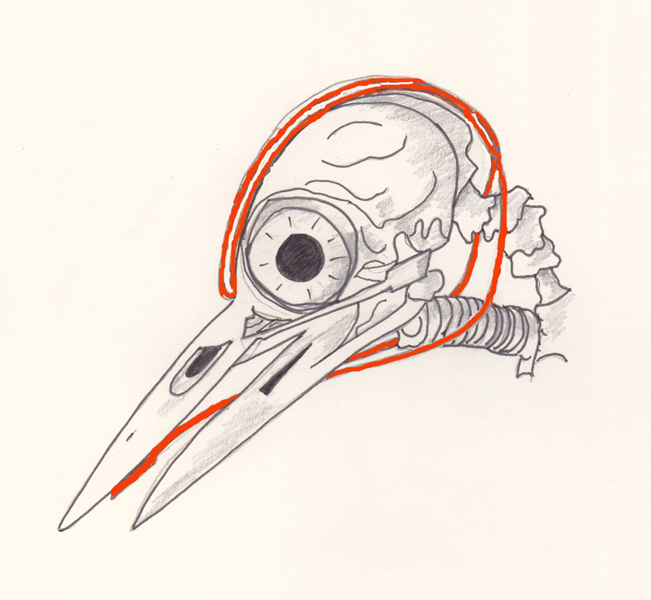
Behind the tongue, the hyoid bone divides in two like a long, thin wishbone with the two horns of the wishbone projecting toward the back of the head. In most birds, these horns are fairly short, terminating on each side of the trachea, but in woodpeckers they’re long — really long. Take a look at figure 1 below in which the tongue and hyoid bone are drawn in red. The horns of the hyoid bone snake around the back of the skull, just underneath the skin, and continue over the top of skull.
Author: Jimfbleak
This file is licensed under the Creative Commons Attribution-Share Alike 3.0 Unported license.
Muscles attached to the hyoid apparatus move it forwards and backwards. When it moves forward, the tongue is extended. The length of the horns determines how far the tongue can be extended. In some species, the tongue can be several times longer than the bill. Again, When the woodpecker retracts its tongue, the hyoid is pushed farther into the skull. When it extends its tongue, the hyoid is pulled partially out. It’s a bit creepy to imagine that thin, flexible bone slithering back and forth underneath the woodpecker’s scalp, but of course, it must feel completely natural to the woodpecker.
In some species, the ends of the horns join together and extend farther, sometimes even inserting into the right nostril (just in case you didn’t think things were weird enough), where they are anchored in place. It’s not entirely clear from the reading I’ve done, but I think that if the ends of the hyoid are not joined together, then the horns move back and forth within relatively snugly fitting sheaths. If the ends are joined together and anchored in place, this is obviously not going to work. In this case, when the tongue is retracted, the hyoid apparatus has a great deal of slack in it. When the tongue is extended, the slack is taken up.
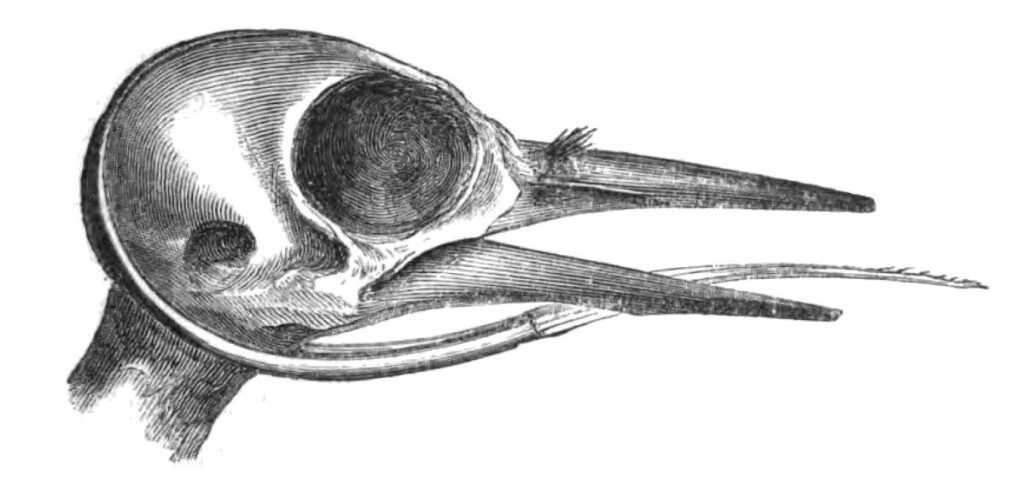
Here’s one other drawing of a woodpecker skull with the tongue and hyoid bone. It’s probably not as informative as the last one, but it’s a nice drawing:
Source: https://archive.org/details/NaturalHistoryBirds
This work is in the public domain in its country of origin and other countries and areas where the copyright term is the author’s life plus 100 years or fewer.
And here’s an old drawing of just the end of a tongue. I don’t know the species:
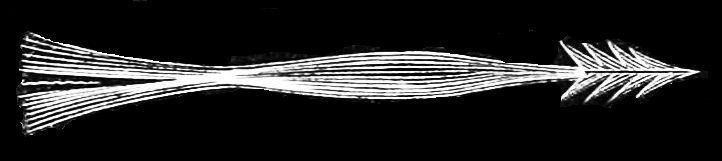
Source: Popular Science Monthly Volume 16
This work is in the public domain in its country of origin and other countries and areas where the copyright term is the author’s life plus 70 years or fewer.
I should mention that woodpecker tongues do vary quite a bit. Some are very long; some not so much. Flickers have the longest tongues, but sapsuckers have possibly the strangest. Their tongues are short and end in bristles, which suck up sap through capillary action.
Believe it or not, I haven’t quite finished listing all the freaky things about woodpecker tongues. As noted, in at least some woodpeckers, the hyoid wraps around the entire head. So, why not let it double as a seat belt? I’m not sure if this has actually been confirmed or is just speculation, but a number of sources suggest that just before a peck, a woodpecker may tighten muscles attached to the hyoid, drawing it tight against the skull and, thus, bracing the head against the impact.17
There are a few more things that contribute to protecting the woodpecker brain. In humans, the brain is loosely packed inside the skull and the space between is filled with cerebrospinal fluid (CSF). In woodpeckers, however, the brain is tightly packed inside the skull, leaving almost no space for CSF. As a result, the woodpecker brain doesn’t “slosh around” as it pecks.
Our higher order mental processes, which were the last to evolve, take place mostly in the outer layer of the brain. We’ve all seen in photos and illustrations that the human brain is covered with folds and ridges. This folding increases the area covered by that outer layer. In other words, it increases our brain power. A woodpecker’s brain, by comparison, is smooth. While this may limit the woodpecker’s mental prowess, it does have the benefit of making its brain more compact and, as a result, less susceptible to damage.18 19
The Real Secret20
In the course of this article, we’ve explored quite a few adaptations that go into making a woodpecker the pecking dynamo that it is. But maybe you’re not quite convinced. Maybe you still find it hard to believe that all these adaptations are enough to explain how a bird can spend its entire life blissfully beating its head against trees. If so, you’re absolutely right. The truth is, I haven’t yet mentioned the most important “adaptation” of all and it’s not really even an adaptation — woodpeckers are small.
The amount of deceleration that an animal’s brain can withstand without injury depends, more than anything else, on its size. If a human being were to jump off the roof of a two-story building and land on the ground, he would almost certainly be killed. If a mouse were to jump off the same building, it would walk away unscathed. And this is the main reason the woodpecker is able to handle all that hard pecking — it’s so much smaller than us.
But why exactly is this the case? Why should an animal be able to survive an impact that would kill a human just because it’s smaller? Here’s how I like to think about it. For simplicity, let’s imagine the human head as a large sphere and the woodpecker head as a much smaller sphere. I’ve represented these spheres as circles in figure 3. Now imagine stacking as many equal-size cubes in each sphere as will fit. These are represented by the cyan squares in the figure. (I just drew the ones through the center of each sphere. You’ll have to imagine the rest.)
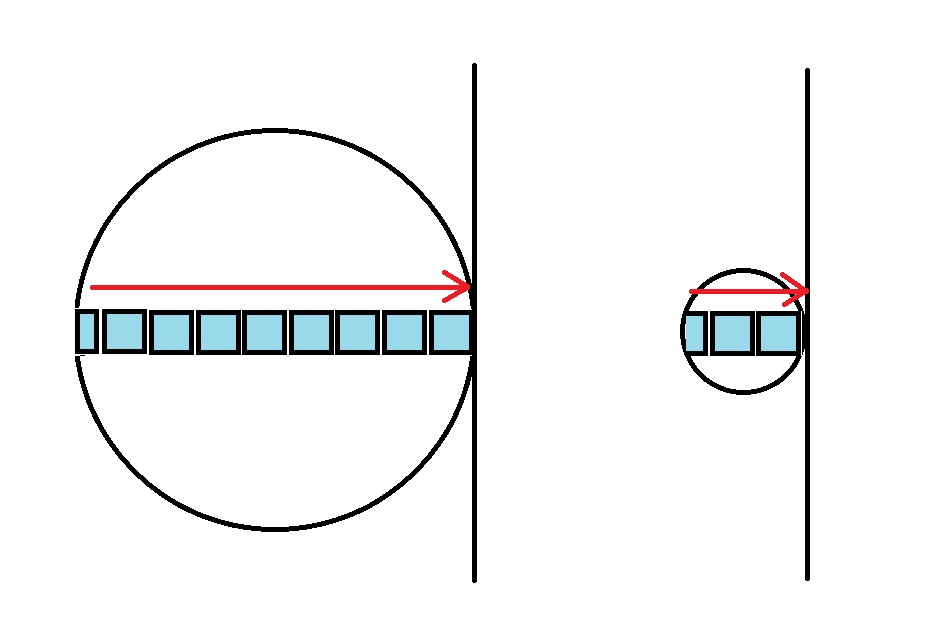
Obviously, the large sphere will hold many more cubes than the smaller one. The cubes represent chunks of brain. Basically, I’m asking you to imagine each brain as divided up into equal-size chunks. Now imagine both spheres slamming into walls (the vertical lines in the figure) at the same speed. Each cube is going to slam into the cube in front of it. So, the cube nearest the point of impact will have all the cubes behind it pushing against it.
Hopefully, you see where I’m going with this. The cubes nearest the point of impact for the human head (the left sphere) have a lot more force acting on them than the corresponding cubes in the woodpecker head. This is indicated by the red arrows in the figure. So, these cubes (chunks of brain) would be much more susceptible to damage in the human brain.
For me, this is the explanation that makes the most sense. If you prefer a more mathematical treatment, check out this short series of Cornell Lab videos: Built to Peck: How Woodpeckers Avoid Brain Injury. The sixth video in the series goes into the effects of scale, so you can skip to that one if you want. The entire series is worth watching, though.
Legacy of a Woodpecker21 22 23
In either 1940 or 1941 (my sources are a bit confused about the exact year), cartoonist Walter Lantz was honeymooning with his wife, Grace, at a cabin in June Lake, California. An acorn woodpecker made such a racket with its pecking that it kept them awake at night. Later, when it started raining heavily, they learned the hard way that the woodpecker had drilled holes in the roof of the cabin. Supposedly, Lantz wanted to shoot the bird, but Grace suggested that he should make a cartoon about it instead. And thus, Woody Woodpecker was born.
While classic cartoon characters like Bugs Bunny and Daffy Duck are still well known among young people today, Woody seems to have mostly faded into obscurity. It’s a pity. His cartoons were very popular when I was a kid and his raucous laugh was unforgettable. Although it was the acorn woodpecker that originally inspired the character, the designers seem to have modeled his appearance more on the pileated woodpecker.
As for the famous laugh, it’s not clear. According to Wikipedia, Lantz modeled it on the acorn woodpecker’s call, but at least one other source argues that it sounds more like the call of the pileated woodpecker. If you click here and scroll down a bit, you’ll see a link to audio recordings of all three woodpeckers (acorn, pileated, and fictional), so you can decide for yourself which one was the real inspiration. Voice actor extraordinaire Mel Blanc voiced the original laugh, so, who knows, he could have just made it up out of thin air.
Update 9/15/20: The Purpose of That Long Tongue
One of my readers asked an excellent question — why does a woodpecker need such a long tongue? Wood-boring beetle larvae form tunnels just underneath the outer layer of wood. These tunnels stretch up and down the trunk or along the length of a branch and can extend for several inches or even feet. The woodpecker listens for the sounds of a beetle grub chewing on wood. It will also tap on dead wood and listen for the sounds of the larva scurrying away. When it locates a potential meal, it pecks its way into the tunnel and uses its long tongue to probe the contents. The tip of the tongue is stiff and barbed, so it can spear the grub and haul it out.24