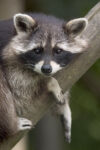
As a boy, I first encountered wild raccoons while on a camping trip with the Boy Scouts in the mountains of Virginia. After we’d gone to bed, a group of raccoons invaded the campsite looking for food. Their rummaging around woke some of us up and we went outside to take a look. I still remember the glow of their eyes when we shined our flashlights on them. They weren’t large animals, but they weren’t especially small either, and their seeming lack of fear was a little unnerving. We eventually went back to bed and left them to their explorations.
My first (and only) encounter with raccoons in Southern California also took place at night — not surprising, given that they are mostly nocturnal. It took place next to a stream, which is also not surprising, since a lot of a raccoon’s diet consists of aquatic prey. I heard a rustling in the bushes and, when I trained my headlamp in that direction, I spotted a large raccoon climbing in a small tree. Here’s the video:
It’s not a great video, but, unfortunately, it’s the best I’ve got. For the rest of this article, I’ll be relying on photos that are in the public domain.
The Common Raccoon
The common raccoon, Procyon lotor in science speak, is native to North America. I shouldn’t need to describe it here. Even in the unlikely event that you’ve never seen a live raccoon, you’ve certainly seen pictures. It’s one of those animals that almost any child can recognize by the age of three. Not only is it very distinctive, there’s pretty much nothing else in the United States that looks very much like it. For your reference, though, here’s a great photo of one that I found on Wiki Commons:

Author: Bernard Landgraf
This file is licensed under the Creative Commons Attribution-Share Alike 3.0 Unported license.
Species and Subspecies 1
In addition to the common or North American raccoon, P. lotor, there are two other species in the genus Procyon. The crab-eating raccoon (P. cancrivorus) is found in Costa Rica and much of South America east of the Andes. As you can see from the photo, it’s quite a bit sleeker than the common raccoon and has shorter fur. P. cancrivorus and P. lotor are believed to have branched off from a common ancestor around 4.2 million years ago.
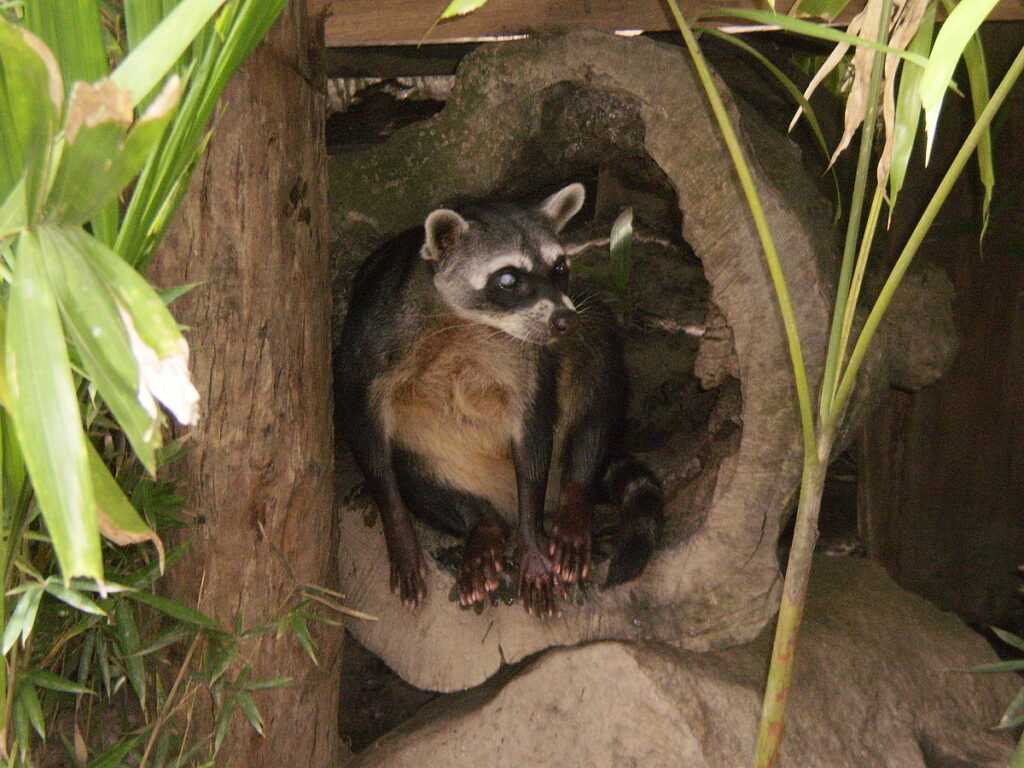
Author: Nixón
This file is licensed under the Creative Commons Attribution-Share Alike 3.0 Unported license.
Then there is the Cozumel or pygmy raccoon (Procyon pygmaeus). It’s found only on the island of Cozumel, which is located off the eastern coast of Mexico’s Yucatán Peninsula. P. pygmaeus has a smaller head and body than the common raccoon and is probably an example of ‘island dwarfism’. This is the tendency for some animals that are confined to islands to evolve into smaller versions of themselves. There are several possible explanations for island dwarfism. The most likely is that a smaller animal has a better chance of surviving on an island where the food supply may be more limited than on the mainland.
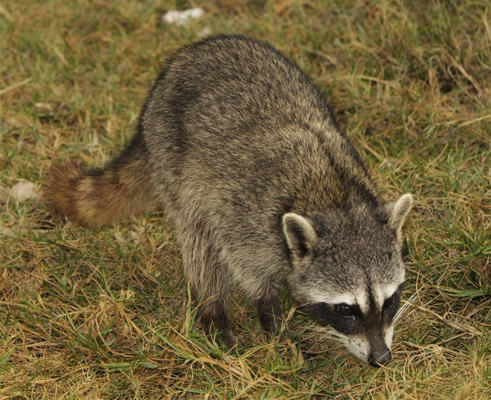
Author: Camazine
This file is licensed under the Creative Commons Attribution-Share Alike 3.0 Unported license.
Insular or Island Dwarfism 2 3
There are many more extreme examples of island dwarfism. For instance, on the California Channel Islands, just a few hours from where I live, there used to live a pygmy mammoth, which was probably a dwarf version of the Columbian mammoth. These creatures ranged from 4.5 to 7 feet high at the shoulders, as compared to 14 feet for their relatives on the mainland. Weight-wise, the difference would have been even more startling, as the pygmy and Columbian mammoths are estimated to have weighed around 2000 pounds and 20,000 pounds, respectively.
Humans are not exempt from the phenomenon of island dwarfism. In 2003, the remains of an individual in the genus Homo were uncovered on the island of Flores in Indonesia. This individual would have stood about 1.06 m or 3 ft 6 in. Remains were found of a second individual that was just slightly taller at around 1.1 m or 3 ft 7 in. Stone implements of an appropriate size were also found. Initially, there was some debate over whether the remains belonged to a new species of human or were from modern humans with congenital defects, however, the current consensus is that they do represent a new species of very small humans. The species has been named Homo floresiensis, after the island on which it was discovered. The common name is ‘Flores Man’, but the original discoverers also gave them the nickname “hobbits”, which quickly caught on in the media.
H. floresiensis is believed to have lived on Flores as recently as 50,000 years ago, which is probably around the time modern humans reached the island. So it’s likely that the two species existed side-by-side for a short time before modern humans drove them to extinction.
There are lots of subspecies of P. lotor. I won’t go over them all here, since they’re mostly just slight variations of each other. I do think the Torch Key raccoon (P. l. incautus) is worth a mention, though, just for its general cuteness, if nothing else. This is a small raccoon with an unusually pale coat. It lives in the Florida Keys.

Author: Mariomassone
This file is licensed under the Creative Commons Attribution 2.0 Generic license.
How the Raccoon Got Its Name(s)4 5 6
The word ‘raccoon’ is a corruption of a Native American word. It comes from the Algonquian word arakun (variously spelled aroughcun, arocoun, arakunem, and rathkone) and it means something like “he scratches with his hands.”
Of course, there were plenty of Native American tribes that were not part of the Algonquian peoples and they had their own names for the animal. The Sioux, for instance, called it wica, weé-cha, or way-atch-a, which translates to “little man”.
Although native to North America, raccoons have been introduced to many other parts of the world, including several European and Asian countries. In some cases, raccoons were introduced for hunting. In other cases, they managed to establish local populations after escaping from captivity. Naturally, non-English speakers have come up with their own names for the creatures. As you probably know, raccoons are famous for their habit of dousing their food in water and, apparently, many people think they look a bit like little bears. As a result, a surprising number of languages have combined these two characteristics in their word for the animal. In German, for instance, the word for raccoon is Waschbär (‘wash-bear’). In Italian, it’s orsetto lavatore (‘little washer bear’). And in both Chinese and Japanese it’s ‘washing-bear’ — dvivón róchetz and araiguma, respectively.
As far as the scientific name is concerned, Procyon can be translated as “before the dog” or “doglike” and lotor means “washer”. It’s not clear why Gottlieb Storr, who named the genus, chose Procyon. Maybe he just thought the animal looked doglike. It’s also possible that he was thinking of the animal’s nocturnal lifestyle and named the genus after the star Procyon, the brightest star in the constellation of Canis Minor (lesser dog). I suppose it could be both.
General Characteristics and Behaviors 7 8
Probably the most notable characteristic of the common raccoon is the black fur around its eyes, which makes the animal look as if it’s wearing a mask. This probably makes it easier for raccoons to identify each other and to recognize each others’ expressions. It may also enhance night vision by reducing glare. Similarly, the dark rings on the tail may help in recognizing individuals and in determining body posture (which would presumably aid in identifying another raccoon’s intentions.)
The raccoon’s front paws have five fingers and are shaped much like tiny human hands. Although they lack opposable thumbs, raccoons are remarkably skillful with their hands. They use them to examine their food before eating it and they are very adept at using them to open windows, doors, and trashcans. According to a post by DiVon80 on the “Backyard Chickens” website, some raccoons got into a kitchen at a campsite and “…they opened jars, turned the water on by all the sinks, opened and dug in the fridge, even [opened] pop bottles…” 9
In captivity, a raccoon can live for quite a long time, although exactly how long varies, depending on the source. Wikipedia claims they can live for over 20 years, but another source 10 gives them a maximum lifespan of only 10 to 12 years. A raccoon’s chances of reaching an advanced old age are considerably reduced in the wild, where the average lifespan is often less than 1.8 years. You might think the reason for this would be their many predators — bobcats, bears, great horned owls, mountain lions, eagles, and coyotes, to name a few. The young are especially vulnerable. However, predation is actually not a significant cause of death, since many large predators have been exterminated or reduced in population in the areas raccoons inhabit. Human hunting, traffic, and severe weather are more important factors. Disease also takes its toll. In fact, the most significant cause of raccoon death in North America is distemper.
And then there’s rabies. It’s well-known that raccoons are a reservoir for this disease. In fact, they’re the most important reservoir in the United States.11 Before you start killing raccoons on sight, though, you should know that, according to the CDC, only one person in the U.S. has died from the raccoon strain of rabies.12 This is probably because rabid raccoons do not exhibit the aggressive behavior typical of rabid dogs. In fact, they become less aggressive when infected and tend to avoid people even more than usual. 13
With such a high mortality rate, you might expect raccoons to be endangered. In fact, nothing could be further from the truth. The International Union for Conservation of Nature (IUCN) lists their status as of “least concern”. So how have raccoons managed to beat the odds? I’d have to say it’s their adaptability. The common raccoon is able to live in a wide range of habitats from as far north as Canada to as far south as Panama. Raccoons are also highly omnivorous. It’s estimated that the average raccoon’s diet consist of around 27% vertebrates, 40% invertebrates, and 33% plant material. Fish, crayfish, frogs, bird eggs (and occasionally birds), insects, worms, fruits, and nuts are some of the many foods they consume. Sometimes they even eat carrion. They are also quite happy to raid our garbage cans.
Do They Really Wash Their Food? 14 15
Not really. Raccoons often use their front paws to dabble for food in the water near the shoreline. When they find something potentially edible, they pick it up, examine it, and rub it with their paws, probably to remove inedible or unappealing parts. They usually hold the food under water while doing this because the water softens the tough layer that covers their paws, increasing their tactile sensitivity. With dry foods like nuts, a raccoon will also examine the food with its paws before eating it, but it probably won’t bother dousing it in water. According to one author,16 both dabbling and dry feeding are done “while the raccoon gazes away into space and uses its acute sense of touch to investigate its meal”. (I just reproduced that quote because I enjoy the mental image of a raccoon meditatively “gazing away into space”.)
In captivity, raccoons will often douse even dry food in water before eating it. Scientists don’t believe they do this in order to wash the food, though. Instead, it’s probably an example of a ‘fixed action pattern’ — an instinctual behavior that is characteristic of a particular species. Its water dish is right there, after all — it’s not like it has to hike over to a stream — so it just does what feels natural to it.
Raccoons prefer to make their dens in the hollows of trees, but they will make do with crevices and caves, abandoned buildings, or the abandoned burrows of other animals. In a pinch, they will even sleep in bushes or on the ground under cedars. (There’s that adaptability again.)
During the winter months in cold regions, raccoons greatly reduce their food intake and spend most of their time sleeping. They don’t technically hibernate, though, and may sometimes be found outside their dens even in the depths of winter.
Mating generally takes place between January and March, but this varies from region to region. Males take no part in caring for the young and, in fact, they will move on to try and impregnate other females. Litter size varies from 1 to 8 cubs, but 3 to 5 is the normal range. Cubs are born deaf and blind. Their ear canals open after around 18 to 23 days and their eyes open a few days later. Cubs are usually weened by around 16 weeks. In the Fall, the mother raccoon will show them dens and feeding grounds. After that, they usually go their separate ways, although in colder climates, they may share a den with their mother for the first winter.17 18
The Long Road to Raccoons 19 20 21
The first mammals were mostly tiny and mouse-like. Although they evolved toward the end of the Triassic, fairly early in the reign of the dinosaurs, they would remain small and furtive until the non-avian dinosaurs went extinct 65 million years ago (mya). Finding themselves no longer under the heels of their reptilian overlords, mammals rapidly diversified to fill the niches left vacant by them.
These ancient mammals split into five major groups, one of which, Creodonta, included the ancestors of all living carnivores. Creodonts took a wide variety of forms — some cat-like, some bear-like, and some hyena-like. During the Eocene, 55 – 37 mya, the Miacidae family of mammals appeared on the scene. The miacids were slender, five-toed, tree climbers. Changes in their teeth allowed them to exploit new kinds of food and new environments. All modern carnivores are believed to have evolved from this group.
Eventually, the order Carnivora split into two suborders, Caniformia and Feliformia, the “dog-like” and “cat-like” carnivores, respectively. Caniformia includes dogs, wolves, foxes, bears, badgers , and seals, among others. One of those “others” is raccoons. The raccoon family, Procyonidae, includes raccoons and their close relatives. The dog family (Canidae) and racoon family split off from the miacids during the Miocene. It’s not known whether the procyonids split off directly from the miacid line or were an early offshoot of the canids. Either way, the translation of ‘Procyon‘ as “before the dog” makes some sense in this context.
The Strange, Convoluted Tale of Rocket Raccoon 22 23 24
Many of you are probably familiar with the Beatles’ song “Rocky Raccoon”. The song was written mostly by Paul McCartney, although John Lennon may have contributed. Sadly, the song does not appear to be about an actual raccoon. The title character’s name was originally supposed to be “Rocky Sassoon”, but McCartney changed it to “Rocky Raccoon” because he thought it had more of a ‘cowboy’ ring to it. (The story is supposed to have taken place in the Old West.)
An interesting, quirky song, but hardly worth mentioning in an article about raccoons. But then, Marvel Comics came into the picture. Writer Bill Mantlo and artist Keith Giffen were inspired by the Beatles’ song to create a character named Rocky Raccoon for the comic book Marvel Preview #7. In this story, Rocky was an actual raccoon, albeit an anthropomorphized, talking version of one (with an English accent, no less). Rocky apparently only plays a bit part in the comic book. You can see an excerpt from it in a CBR.com article. Click here for that.
Rocky would next appear in 1982 in The Incredible Hulk #271. The story for this issue was entitled “Now Somewhere In the Black Holes of Sirius Major There Lived a Young Boy Named Rocket Raccoon” — an obvious play on on a line from the Beatles song. In this story, we learn that “Rocky” is actually short for “Rocket”. (He also loses the British accent.) You will find an excerpt in the same CBR.com article linked to previously. In 1985, the character was given his own four-issue limited series. In succeeding years, Rocket appeared in Quasar #15 and in three issues of Sensational She-Hulk, but in ten years time, he had amassed a grand total of only 10 comic book appearances. In other words, he wasn’t exactly taking the world by storm.
From 2006 on, however, Rocket appeared in a dizzying number of different comic books, including, significantly, the Guardians of the Galaxy Series. I won’t go into all the tedious details. You can read the Rocket Raccoon Wikipedia article if you’re interested.
As for Rocket’s biography, he started his career as the chief law officer on the planet Halfworld, an abandoned colony for the mentally ill. He was one of a group of animals that had been genetically modified to give them intelligence and bipedal-ism, so that they could act as caretakers for the inmates. At some point, the inmates get cured of their illness (apparently, they all had the same thing) and Rocky and friends take off into space for their own adventures. What followed was a long and, yes, convoluted, series of stories, which I also won’t go into. (Again, see the Wikipedia article.)
Rocket in these comics is a starship pilot, an expert marksman, a brilliant technician, a master military tactician and a born leader. (Well, genetically modified leader, I guess.) He also has all the abilities and attributes of a regular earth-type raccoon — sharp claws, acute senses of smell, hearing, sight, and touch, and the ability to climb trees and scale buildings with ease. (Somebody was really impressed with raccoons.) He has a sidekick named Wal Rus, who is — you guessed it — an anthropomorphic walrus; an enemy named Blackjack O’Hare, who is an anthropomorphic rabbit (get it?); and a love interest named Lylla, who is an anthropomorphic otter.
Somewhere in all this weirdness, Rocket finds out that a lot of the things he thought had happened on planet Halfworld hadn’t really happened — they were “mostly half-truths and deliberately crafted fake memories”. 25 Yeah, it gets complicated. Anyway, eventually he teams up with Star-Lord and the other Guardians of the Galaxy for a whole new series of adventures.
And then the Guardians of the Galaxy movie came out. If you haven’t seen this film and it’s two sequels, I highly recommend them. They are some of the funniest movies I’ve ever seen. One of my favorite scenes is when Peter Quill (Star-Lord) calls Rocket a trash panda. I won’t ruin it for you, though.
In the movies, Rocket’s biography is, thankfully, greatly stripped down. (He doesn’t even know he’s a raccoon or what a raccoon is.) He’s a great character and a great example of a raccoon in popular culture. And that’s how I’m justifying writing about him here. (Hey, nobody forced you to read it.)