Liverworts are primitive, non-vascular plants in the division Marchantiophyta. Mosses, hornworts, and liverworts, collectively, are referred to as bryophytes. Like mosses, liverworts tend to be small and green. They also often grow alongside mosses, so many people who see liverworts assume they are mosses, although the two don’t really look much alike.
“Wort” is simply a Middle English word meaning plant. So the name liverwort means “liver plant”. It got this name because, in olden times, people thought that the main body of some types of liverworts were shaped like livers. And, believe it or not, they thought that meant that the plant would be good for treating liver diseases. This was based on the doctrine of signatures, which argued that God made plants for the benefit of people and so he provided clues to their uses by making them look kind of like the organs they could be used to treat.
The earliest known fossils of land plants, which are between 471 million and 473 million years old, are liverworts, so they’re probably closely related to the first plants to colonize the land. Non-vascular just means that they don’t have a vascular system consisting of xylem and phloem. These are highly specialized tissues used to transport water and nutrients. This is not to say that liverworts don’t have any kind of transport system at all — they have to have some way to get water and nutrients to their cells — but the lack of a vascular system means that they depend more on simple diffusion, which limits the size they can attain. As a result, all liverworts are quite small. Liverworts don’t have roots. Instead, they have single-celled rhyzoids (thin filaments) that anchor them to the substrate.
Here’s some photos of liverworts I’ve seen in San Diego County. Notice that in some of the photos, the liverworts consist of very flat, blob-shaped or leafy structures. These are thalli (singular thallus). They are the main body of the plant. In other photos, each thallus has a stalk rising up from it. This is called a gametangia and it’s the reproductive part of the plant.
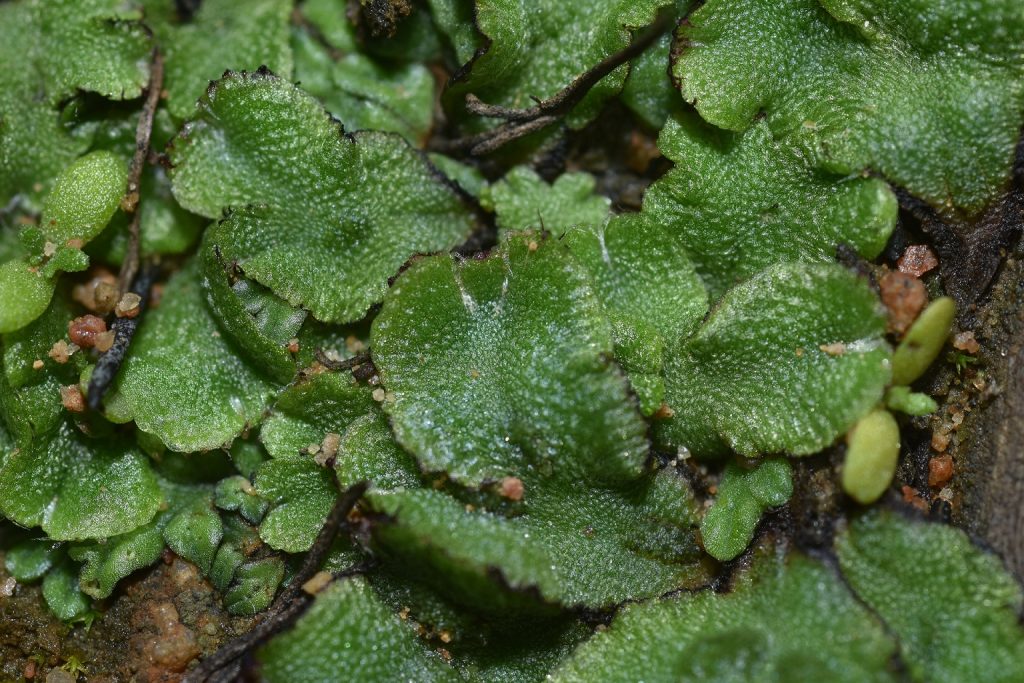
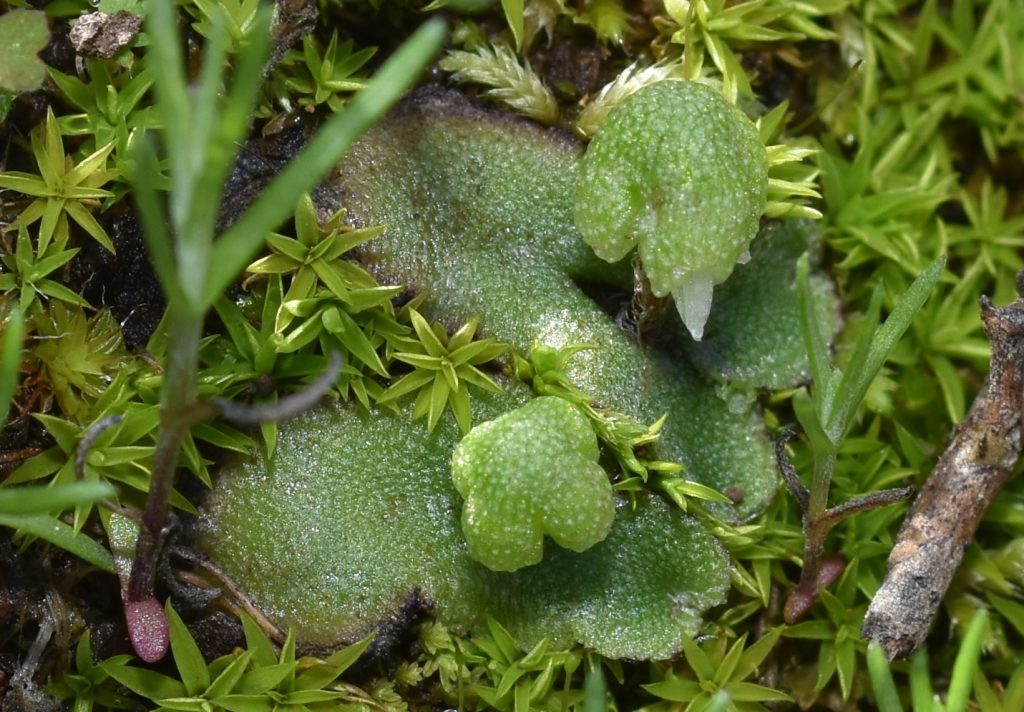
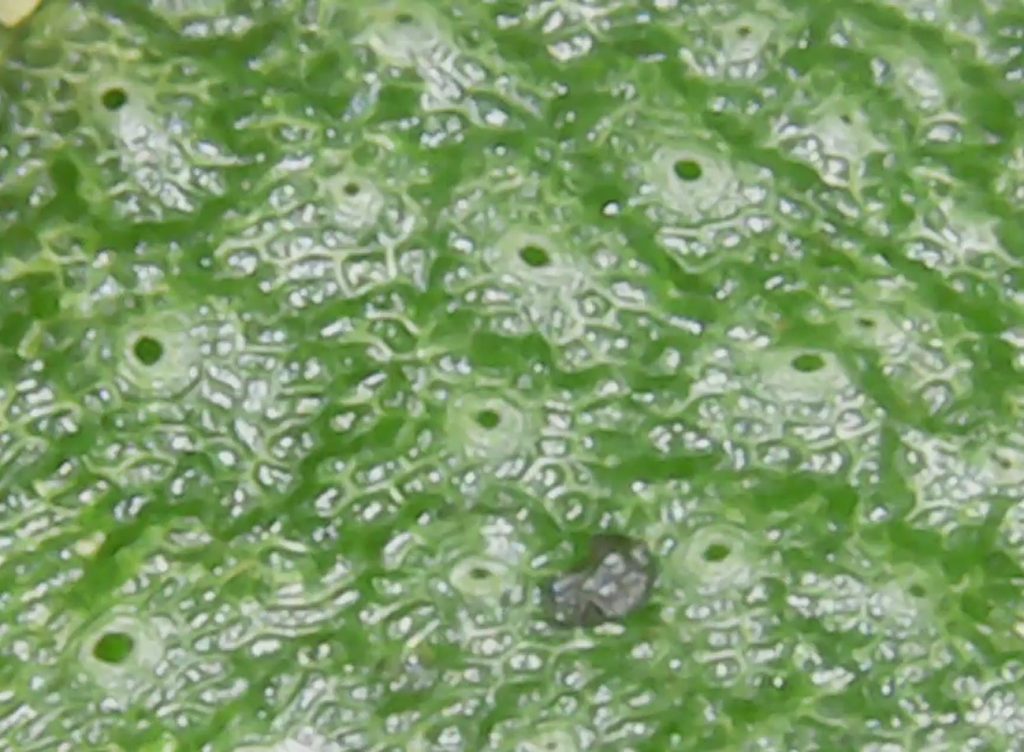
This is a microscope image of the pores on the thallus of one of the liverworts in the previous photo.
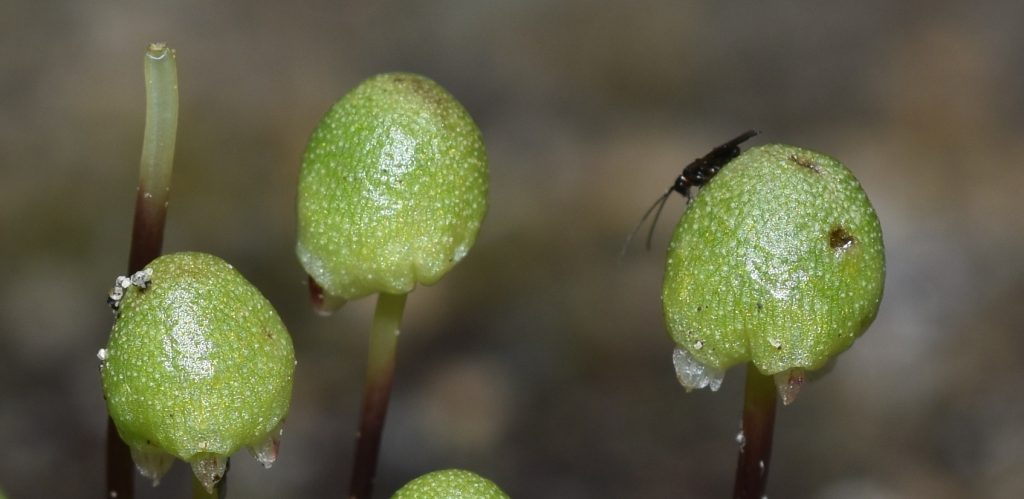
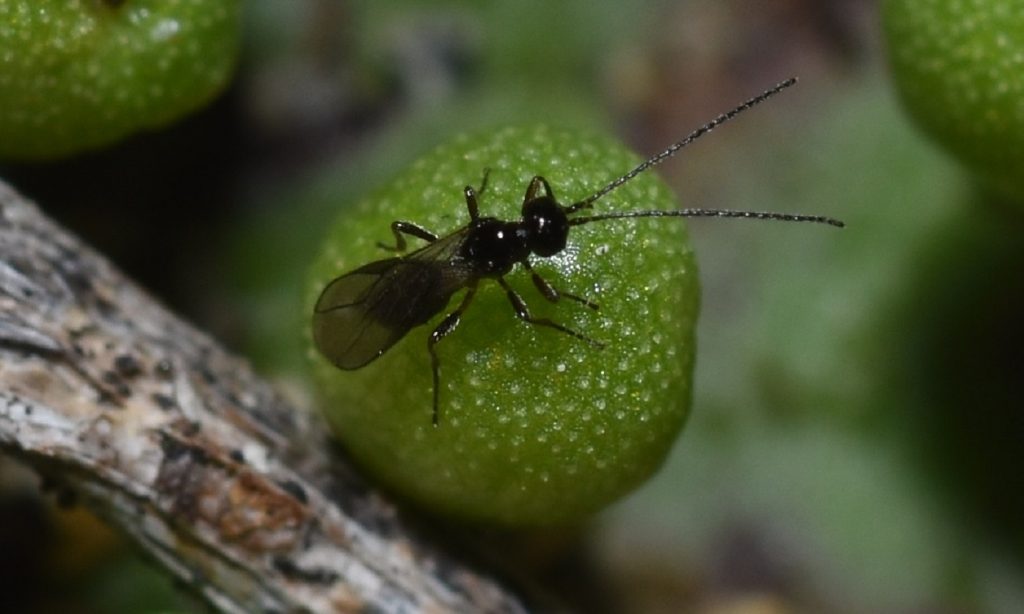
Next, we have some liverworts in the family Fossombroniaceae. The black capsules at the tops of the gametangia are smaller than the head of a pin.
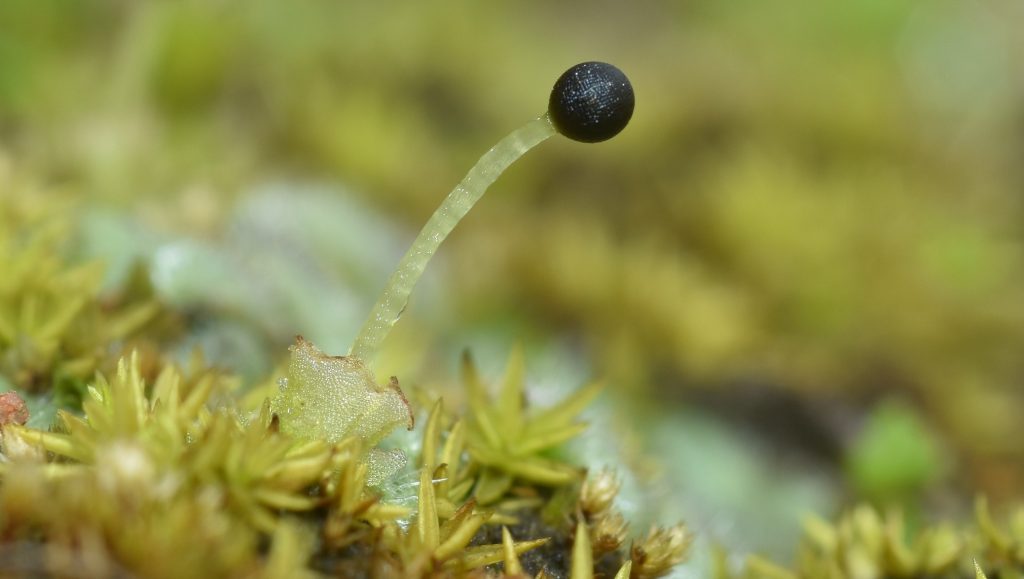
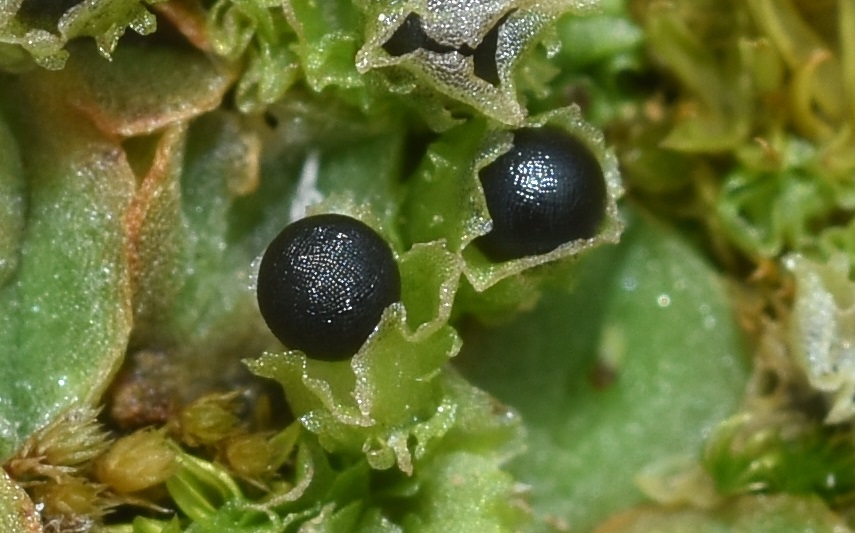
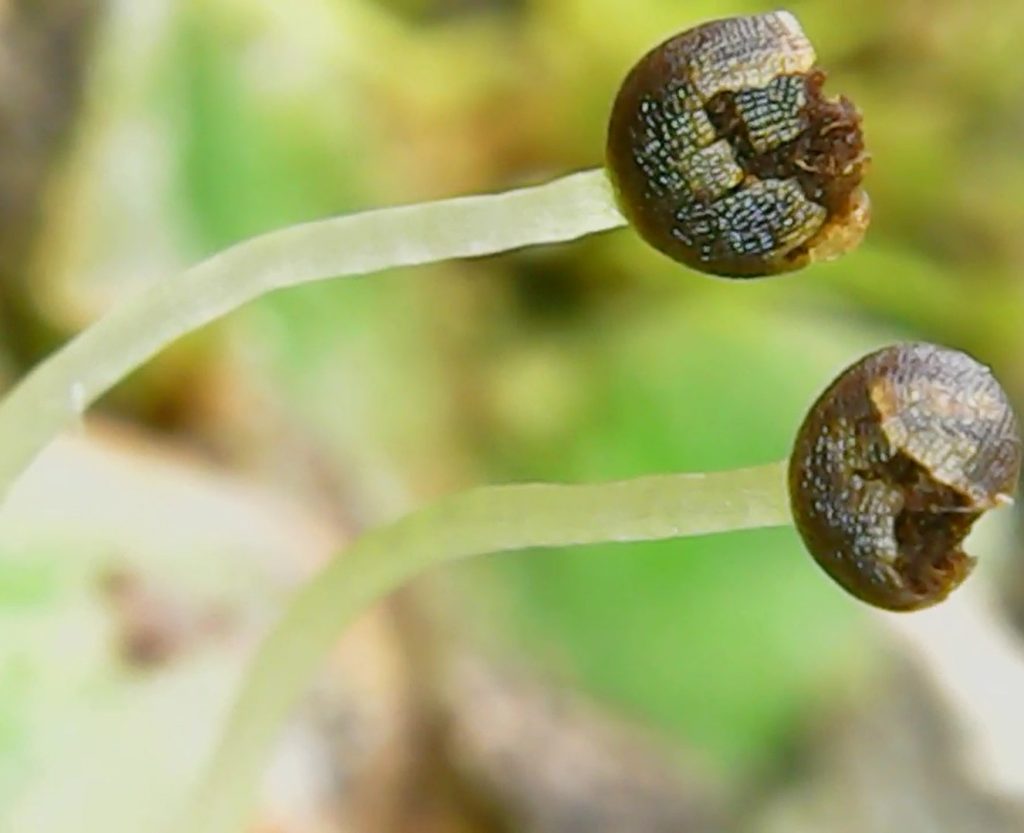
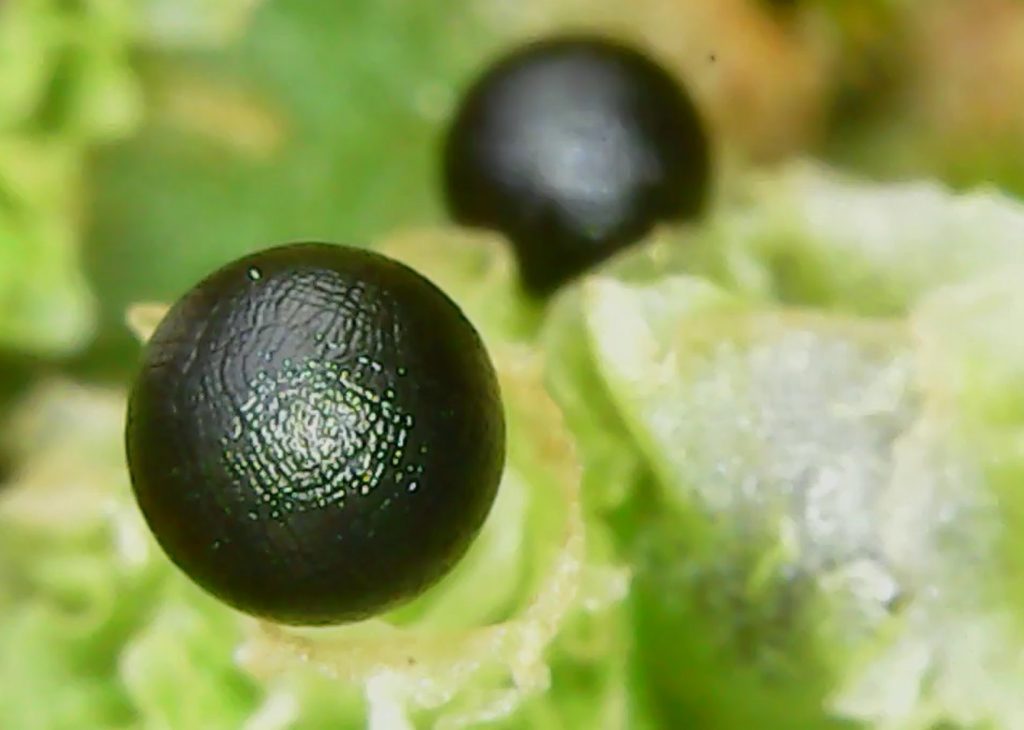
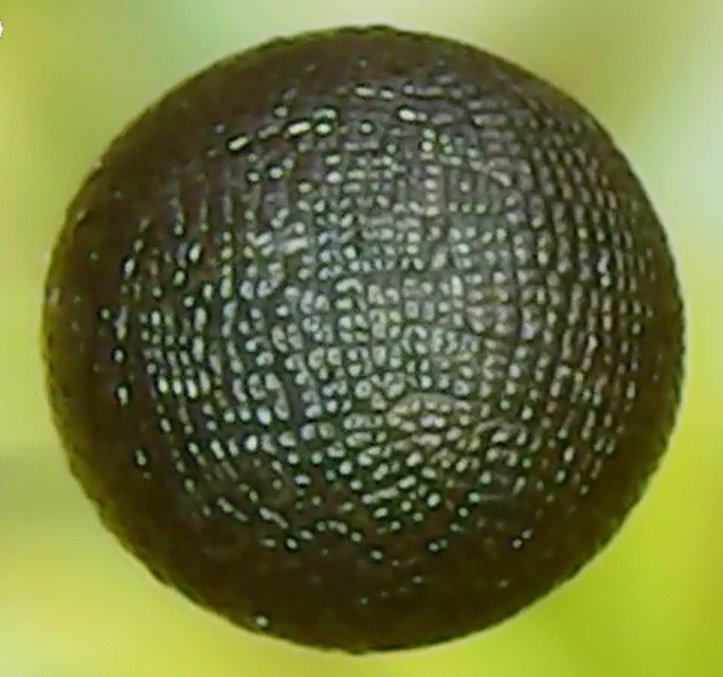
Finally, here are some bottle liverworts (Sphaerocarpos).


Most land plants breathe through stomata, which are openings, usually on the undersides of leaves, that can be closed if the plant needs to conserve water. Liverworts do not have stomata. They have pores that serve the same purpose, but which cannot be closed. So if a liverwort’s environment gets too dry, the liverwort just dries up. Like mosses, liverworts can withstand a great deal of drying. They just re-hydrate when the environment gets wet again.
Liverworts In Depth
The rest of this post gets into the life cycle of liverworts and it involves some fairly technical stuff, so I’ll forgive you if you want to skip it. But if you’re interested, we’ll start with some genetics. First, let’s talk about animals, specifically humans. A person’s appearance and, to some extent, their behavior, is determined by their genes. Most of the cells in a human body have two copies of each type of gene. One of the copies comes from the person’s mother and the other copy comes from their father. These two copies are called alleles. For example, a person’s cells may each have two alleles that code for eye color. Maybe both of them code for blue eyes. In that case, the person will actually have blue eyes. Or maybe one of the genes codes for blue eyes, but the other one codes for green eyes. In this case, one of the genes may be dominant. If the gene for green eyes is dominant, it will override the gene for blue eyes and the person’s eyes will be green. (I don’t actually know whether genes for green eyes are dominant or not, I’m just giving an example.) It gets way, way more complicated than this, but the point is that how the person turns out is determined by the interaction of the two sets of genes.
When a female human produces an egg cell, only one copy of each allele ends up in that cell. Likewise, when a male human produces a sperm cell, only one copy of each allele ends up in that sperm cell. When a sperm cell fertilizes an egg cell, it injects it’s genes into the egg cell where they combine with that cell’s genes. So the resulting fertilized egg ends up with two copies of each allele. Thus, the resulting embryo and the person it grows into will have two copies of each allele.
If you think of sperm cells and unfertilized egg cells as separate organisms from the humans that produce them (which they are), you could say that the human life cycle consists of an alternation of generations. You have a multi-cellular generation (the actual humans) consisting of cells with two copies of each allele and a single cell generation (the sperm and unfertilized eggs) in which each cell has only one copy. (Btw, a cell with two copies of each allele is called a diploid cell. A cell with only one copy is called a haploid cell. Try to remember that — it’s important.)
Now plants do things in similar, but different, ways and it varies a lot depending on what plant you’re talking about. Since we’re just concerned with liverworts here, I’ll stick to them. Liverworts that have thalli are called thallose liverworts and the following discussion applies specifically to them. Other types of liverwort probably do things in similar ways, but there’s no way I’m going to try to cover all the variations here.
The thallus and gametangia (the main body and the stalk) are together referred to as the gametophyte. They are analogous to the human body, except that they’re made up of haploid cells (i.e. each cell contains only one set of alleles). A specific gametophyte will be either male or female. If it’s female, then it will produce egg cells in the structure at the end of the gametangia. If it’s male, then the gametangia will produce sperm cells. The egg cells remain in their gametangia on the gametophyte that produced them. The sperm cells must leave their gametangia and make their way to a nearby female gametophyte. They do this by swimming, so there must be at least a film of water connecting the two gametophytes. So liverworts are limited to areas that are very wet for at least some of the time. Once the sperm cell reaches the neighboring gametophyte, it swims up the gametangia and finds an egg cell to fertilize.
The fertilized egg cell now contains two copies of each allele — the one that it started with and one from the sperm cell. So it’s a diploid cell. The egg cell divides and multiplies, forming an embryo. This embryo, which again, is made up of diploid cells, is called a sporophyte and is a separate organism from the gametophyte, even though it’s growing on it. So you have a diploid organism growing on (or in) a haploid organism. Again, alternation of generations, but this time both generations are multi-cellular.
Some of the diploid cells in the sporophyte divide in such a way as to produce haploid spores — the spores only get one copy of each allele. The spores are contained within capsules in the sporophyte. When the sporophyte matures, these capsules dry out, open up, and release the spores, which are dispersed by the wind. If a spore falls in a suitable area, it will germinate and grow into a new, haploid gametophyte, completing the cycle.
Now, will this new gametophyte be male or female? Obviously, it depends on whether the spore that produced it was male or female. But what does it mean for a spore to be male or female? Remember that a cell contains multiple chromosomes. In the case of humans, the presence or absence of a Y chromosome determines whether or not the fertilized egg will be male or female. Some such mechanism is also going on in liverworts. According to my reading, at least one liverwort — Marchantia polymorpha — does have something like a Y chromosome. I suspect that’s probably true of all liverworts, but I don’t know for sure. The point is that whether or not a liverwort gametophyte is male or female depends on what genes it ends up with and that’s determined mostly by chance.
Liverworts can also reproduce asexually. Thallose liverworts have structures called gamma cups that form on the thalli. Spores form in the gamma cups and, when it rains, water droplets splashing in the cups release the spores into the environment.