Nested within the sunflower family of flowering plants, known to botanists as the Asteraceae, is the tribe Madieae — the tarweeds and their relatives. Tarweed or tarplant is the common name for a number of different plants in this tribe. (There are a few plants outside of Madieae that are also sometimes called tarweeds, but we won’t concern ourselves with them here.)
Tarweeds are native to the Western United States.1 Two species I commonly see in Southern California are graceful tarplant (Holocarpha virgata ssp. elongata) and clustered tarweed (Deinandra fasciculata). Graceful tarweed is the more attractive of the two, in my opinion. (I suppose that’s why it’s called ‘graceful’.) Here’s a photo of a flower head of this species.
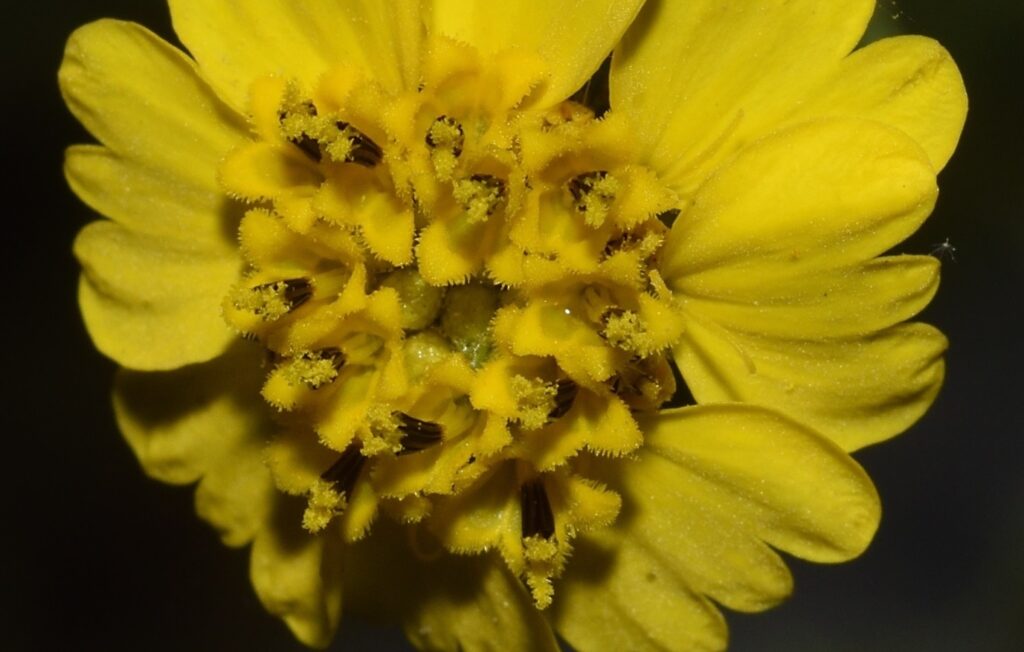
Mission Trails Regional Park, San Diego County. 7/19/19
Note the dark brown on the stamens. This is a common characteristic of the tarweeds, and it’s what initially attracted me to these plants. The flower heads are not large — maybe half an inch across — but the dark specks against a yellow background really make them stand out when you see them in the field. Here’s a view from the side.

Mission Trails Regional Park, San Diego County. 7/19/19
And, for the sake of completeness, here’s what the leaves look like.

Mission Trails Regional Park, San Diego County. 7/19/19
Clustered tarweed, as its name implies, has its flower heads in clusters.

Dictionary Hill, San Diego County. 5/18/19
Here’s a closeup of one of those flower heads.
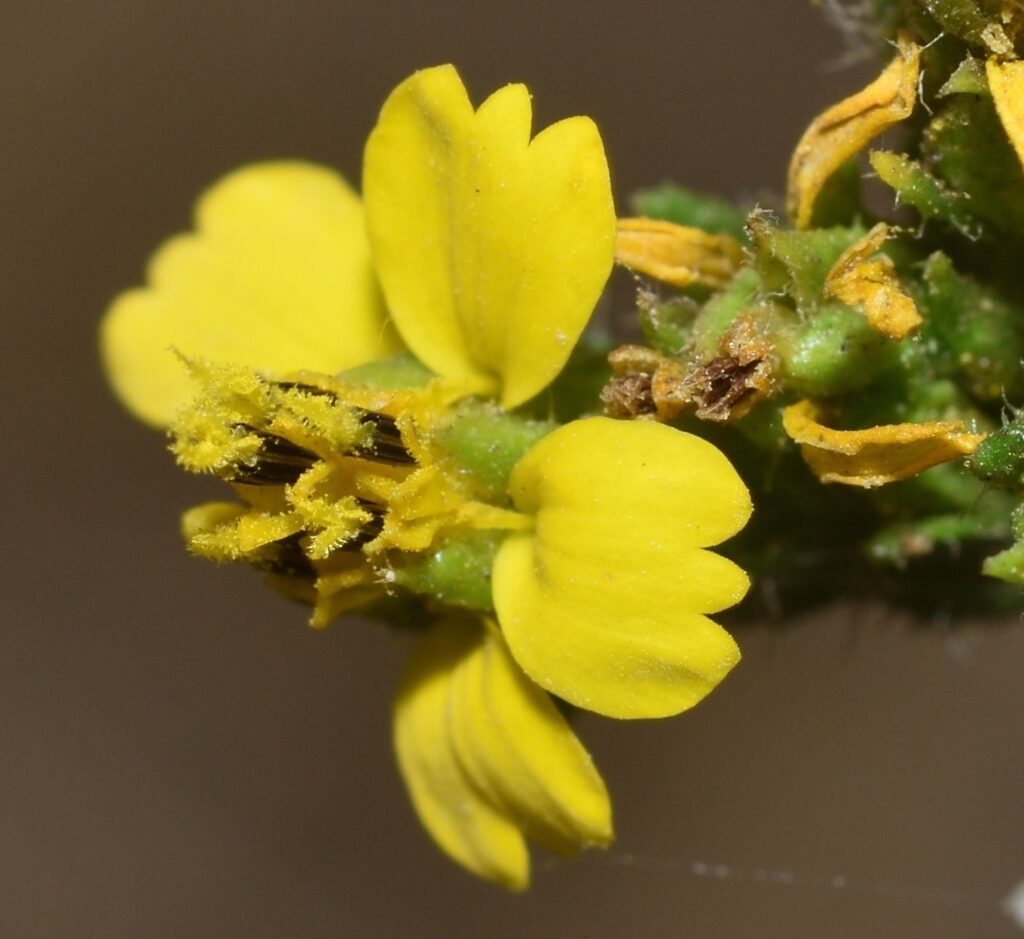
Mission Trails Regional Park, San Diego County. 7/24/19
As already mentioned, Madieae is a tribe in Asteraceae. This is the sunflower or aster family. If you know even a little bit about botany, then you probably know about the Asteraceae. If not, here’s a quick introduction.
With the possible exception of the orchids (family Orchidaceae), Asteraceae is the most diverse family of flowering plants. Their most distinctive feature is the flower head or capitulum. I say ‘flower head’, rather than flower, because what looks like a single flower is really a composite of many smaller flowers. For this reason, the family used to be called the Compositae. In fact, it’s often still called that, although it’s not technically correct. At some point, taxonomists decided that the scientific names for plant families should all end in -aceae. Hence, the name change. But Compositae has been used for so long, and it’s so (relatively) easy to pronounce, that it’s still used a lot, even in scientific papers.
In most Asteraceae, the capitulum is a composite of ray flowers and disk flowers. The disk flowers are clustered in the center. Surrounding them are the ray flowers. Each ray flower has a single petal that grows out, away from the central disk flowers. In the photo below, I’ve labeled the ray and disk flowers for a tarweed capitulum.

Mission Trails Regional Park, San Diego County. 7/19/19
In some plants, the capitulum consists of only disk flowers or only ray flowers. When it does have both, often the ray flowers will be lacking pistils and stamens, or, if they do have them, they’ll be sterile. Only the disk flowers will have functional reproductive parts. Sometimes, it’s the other way around — the disk flowers will be sterile and the ray flowers will handle the reproductive duties.
Other Tarweeds4
Wikipedia lists seven genera of plants in the Madieae tribe that are commonly called tarweeds or tarplants. I won’t repeat that list here. Check out the Wikipedia article by clicking here, if you’re interested. They all share very similar characteristics. In all but one genus, Blepharizonia, the petals are yellow. In Blepharizonia, they’re white. Another genus, Hemizonella, is distinguished by having tiny flower heads, and the leaves and stems are very hairy.
Other Madieae
There are numerous genera in Madieae that don’t usually go by the common name tarweed. I should point out, though, that botanists will sometimes refer to any member of the tarweed tribe as a tarweed. (Similarly, you’ll sometimes hear a member of the sunflower family referred to as “a sunflower”, even though it’s obviously not literally a sunflower. It’s usually clear from the context that the person just means it’s in that family.)
Anyway, the only examples of these ‘not tarweed’ tarweeds that I’m familiar with are yarrows. Here’s some photos of golden or yellow yarrow (Eriophyllum confertiflorum).
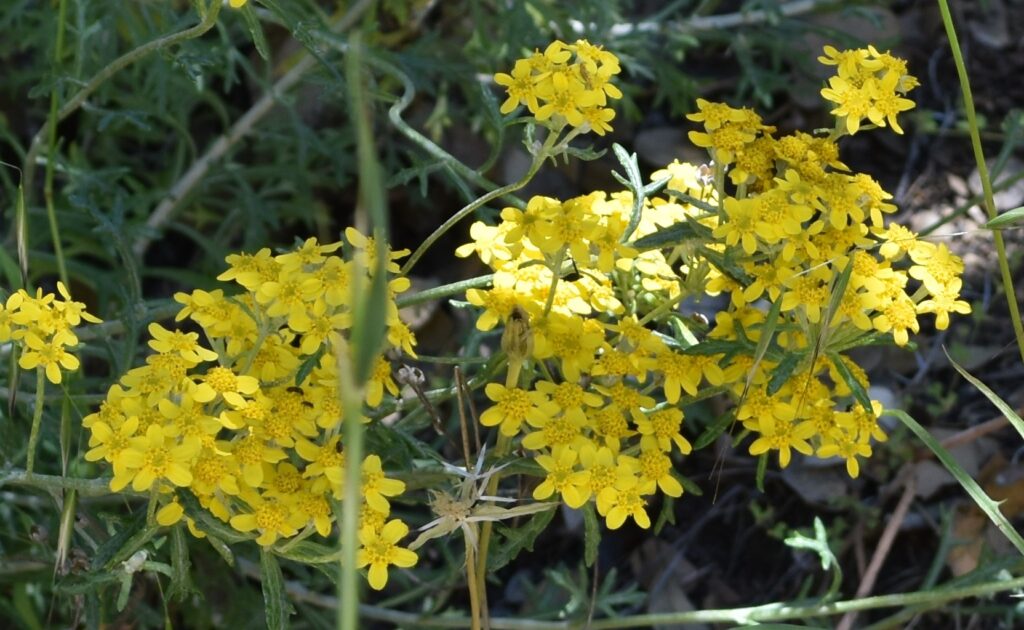
Volcan Mountain, San Diego County. 5/21/17
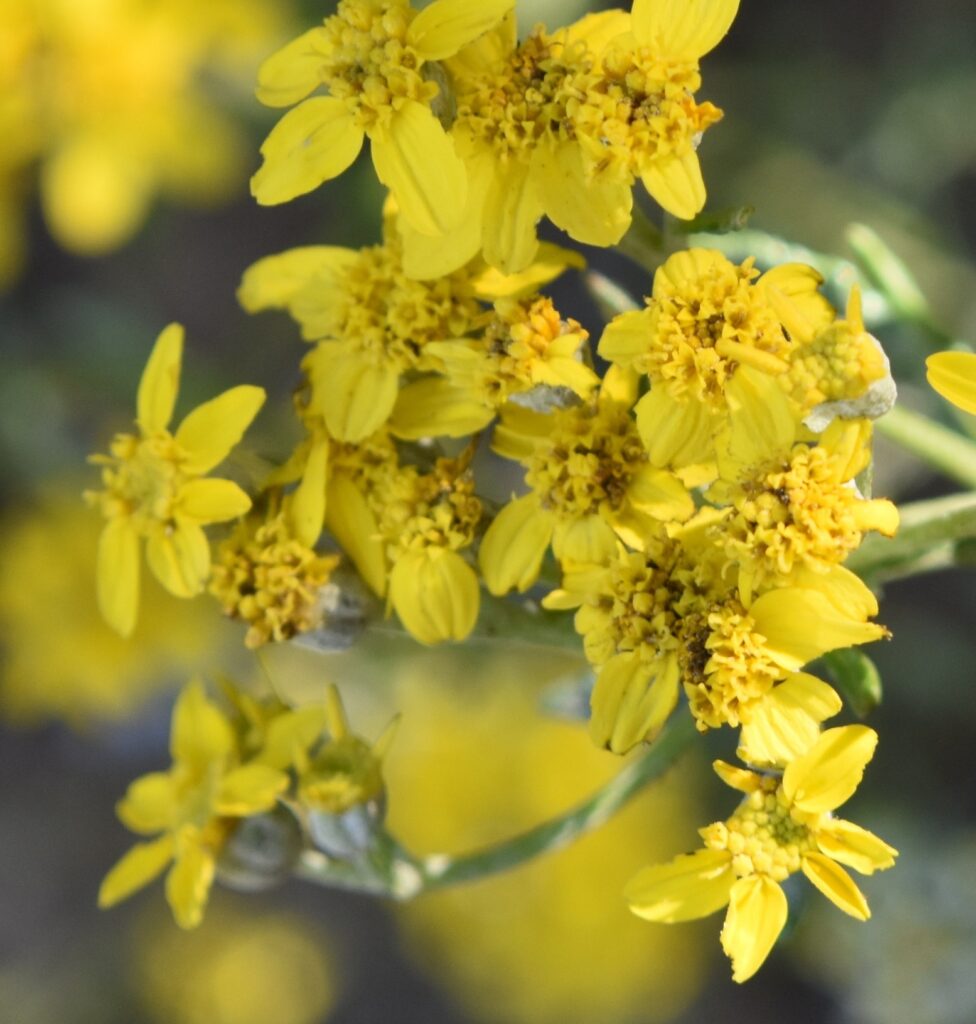
Volcan Mountain, San Diego County. 5/21/17
One example that I haven’t seen is Raillardella, although it is found in California. I mention it here because it will come up later in this article.
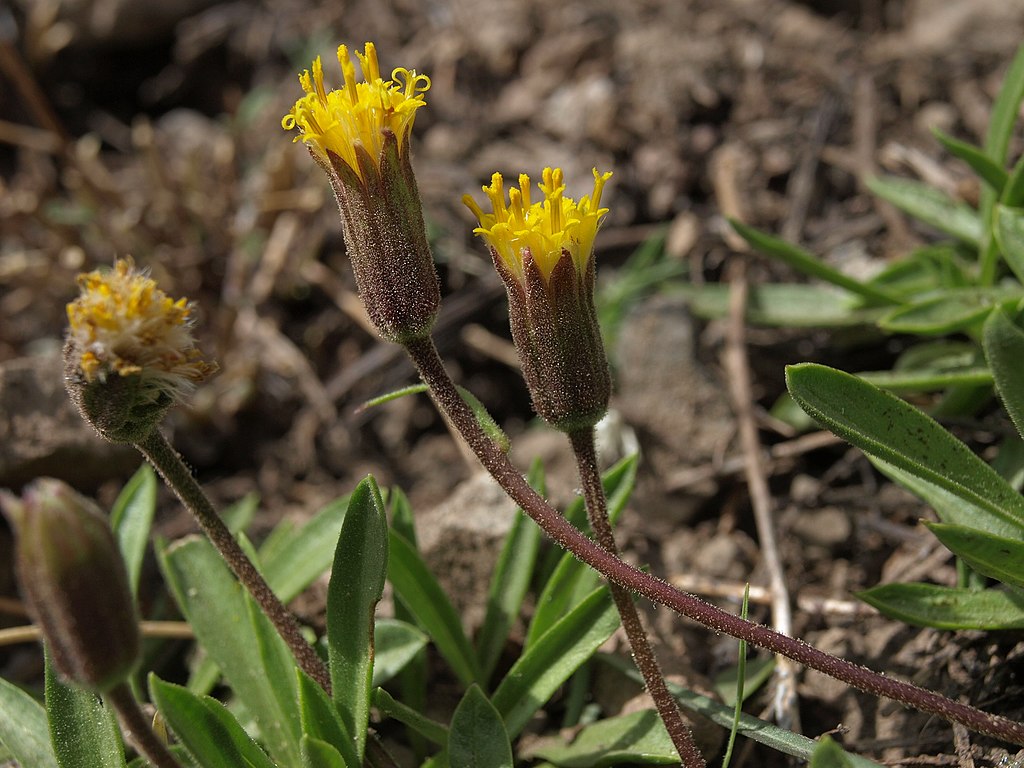
Author: Jim Morefield
This file is licensed under the Creative Commons Attribution-Share Alike 4.0 International license.
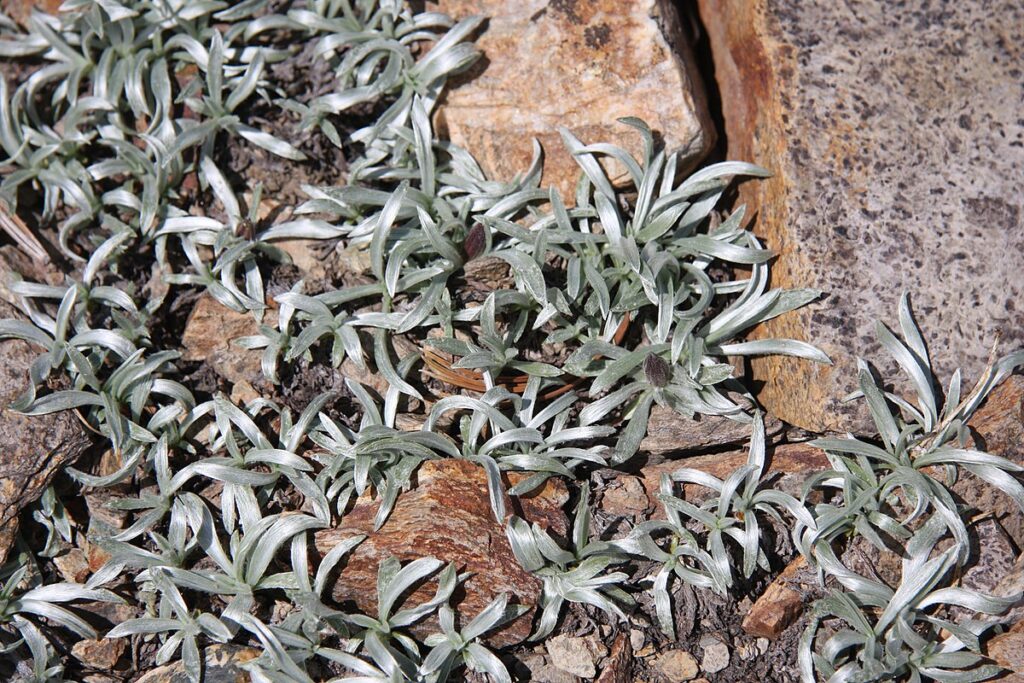
Author: Dcrjsr
This file is licensed under the Creative Commons Attribution 3.0 Unported license.
Tarweed gets its name from the sticky resin that it exudes. (It’s not really tar.) The resin probably helps prevent water loss — an adaptation to hot, dry environments. A flowering stem cut from a tarweed will remain fresh for two or three days without water.
Preventing water loss may not be the only thing the resin is good for, though. The plant’s sticky, resin-coated hairs trap a lot of bugs — bugs that might otherwise make a meal of it. The dead and dying insects attract predatory insects that feed on them and on any other herbivorous insects that happen by. Some predators seem to have evolved the ability to avoid getting stuck by the resin. These are probably nice to have around to pick off any herbivores that might have evolved the same talent.
One other way the resin could be helping the plant is that it may taste bad to herbivores. This isn’t known for certain, though.7
Note the resin oozing from glands on the back of the flower head in this photo.
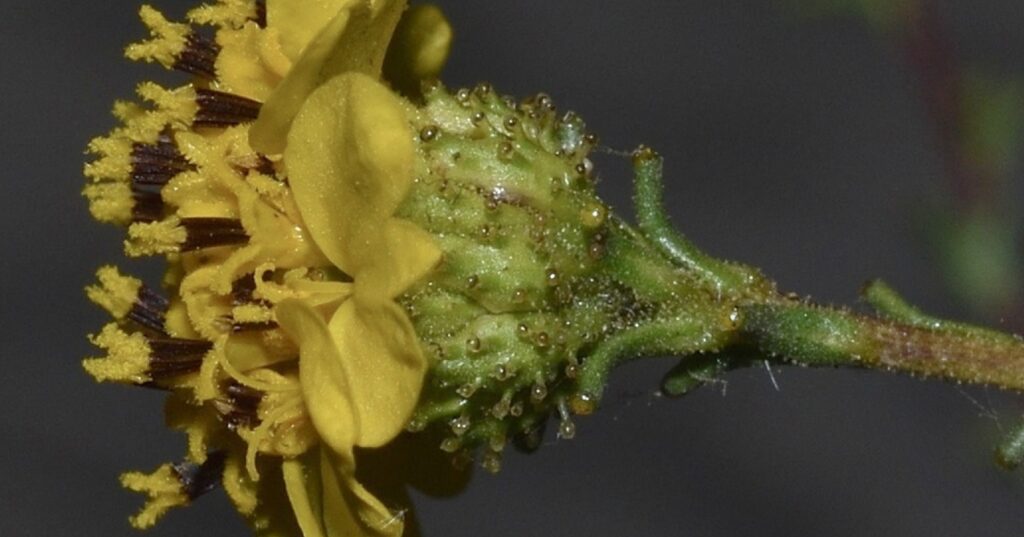
Mission Trails Regional Park, San Diego County. 7/19/19
Here’s a closer look at the resin glands on a bud.
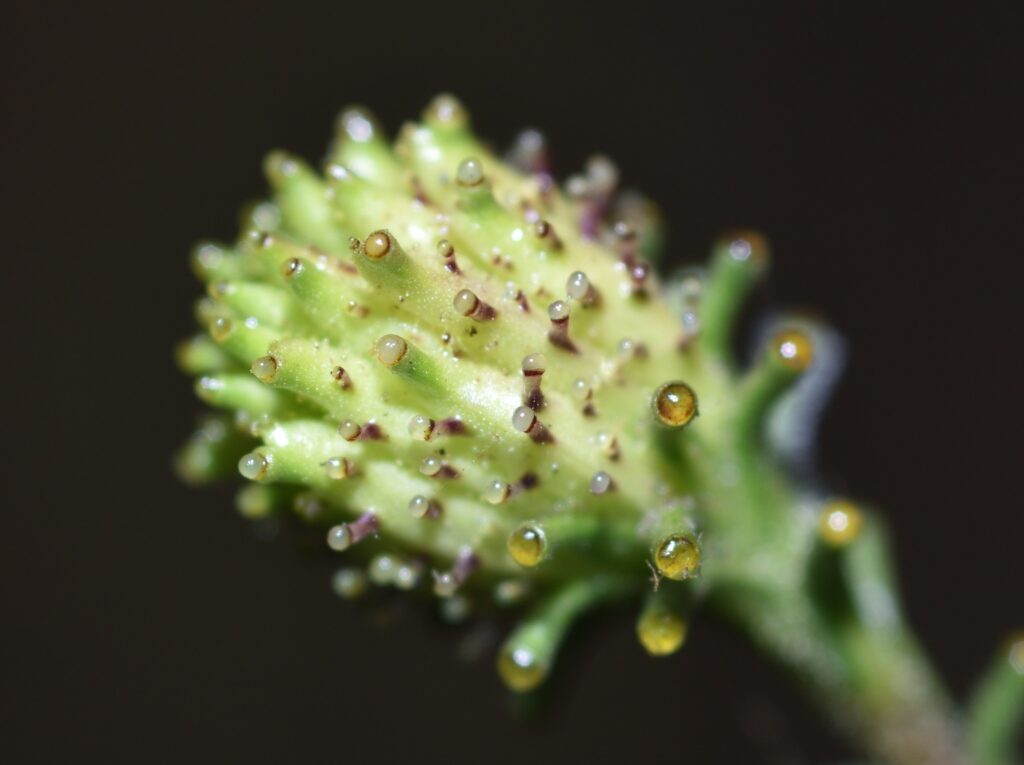
Mission Trails Regional Park, San Diego County. 7/19/19
And a still closer look.
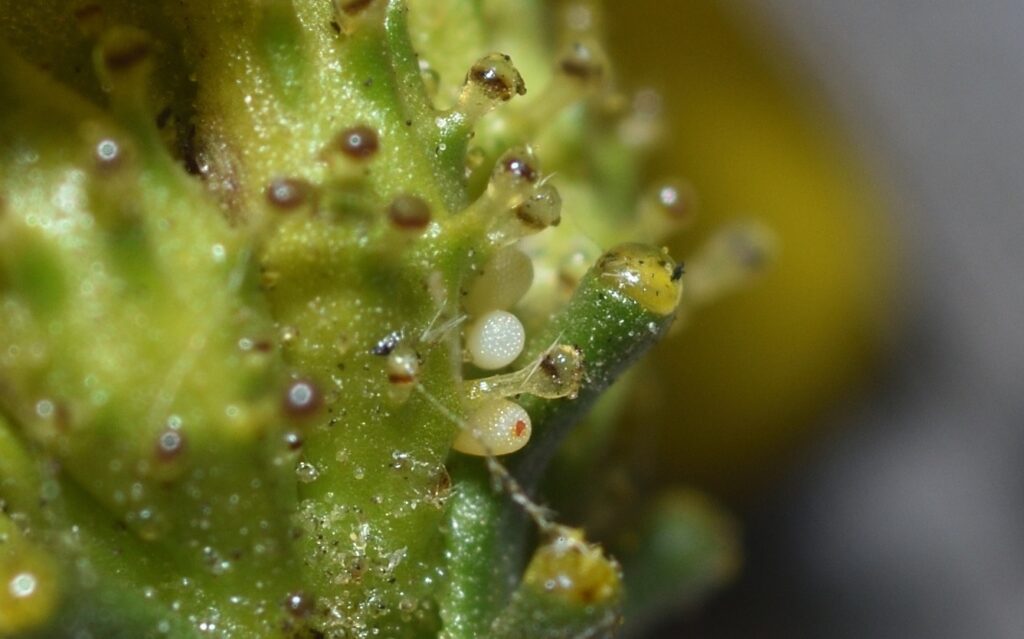
Origin8
The tarweeds evolved in California. Their common ancestor probably lived in cooler, mid-elevation environments. As California’s climate became drier and warmer, the tarweeds gradually migrated to lower elevations, diversifying into different habitats as they went. This diversification happened fairly recently in geologic time. As a result, the differences between species can be rather subtle, making them difficult to tell apart. One tarweed, however, bucked that trend in a big way. We’ll get to that in a minute, but first, we need to pay a visit to Hawai’i.
How to Grow an Island9
The Hawaiian archipelago consists of 137 islands spread across 1,500 miles (2,400 km) in the Pacific Ocean. They were formed by volcanic activity. Specifically, the islands were formed (and are being formed) by a ‘hotspot’ — a huge source of magma (liquid rock) welling up from the Earth’s mantle (the part of the Earth just beneath the crust). The Earth’s crust is broken up into many ‘tectonic plates’ which move very slowly (typically 2 or 3 inches a year) as they are pushed around by convection currents in the mantle.10 The Hawaiian islands sit on the Pacific tectonic plate. As this plate slowly moves over the underlying hotspot, magma periodically breaks through, building a new island. As the island, riding the plate, moves away from the hotspot, the source of magma is cut off. The forces of erosion begin to shrink the island. Eventually, the magma breaks through at another spot on the ocean floor and forms yet another island.
As a result of this process, the islands that make up the Hawaiian Archipelago are strung out in a slightly curved line running north and slightly west, with the youngest and largest on the southern end of the line. Moving north from there, the islands in the chain get progressively older. They also tend to get progressively smaller because they’ve been eroding longer. Of course, this depends on how big they were to begin with, so it’s not a fixed rule. Going beyond the northern end of the archipelago, there are seamounts rising up from the ocean floor. These are the remnants of even older islands that have eroded beneath the waves.
When a volcanic island first forms, it’s completely lifeless. Eventually, it will be colonized by plants and animals coming from the surrounding land masses. The Hawaiian Archipelago, however, is one of the most isolated island chains in the world. It’s about 3,000 miles (4828 km) from the closest continent (North America) and 2,000 miles (3218 km) from the nearest other island.
So how did plants and animals get all the way to Hawai’i? Some birds can cross such distances, especially if they are caught up in a gale. Flying insects are light enough to be blown there on the wind. Plants and terrestrial animals can raft there on floating mats of vegetation. Such rafts may be produced, for example, by hurricanes, cyclones, and tsunamis (tidal waves) and can sometimes be quite large. Some seeds may be able to float to islands, although in this case, the distance they would have to traverse and the length of time they would have to survive in salt water may make this less likely. Seeds can also be carried to islands stuck to the feet or feathers of birds. This last example leads to our next topic…
Silverswords and Their Relatives11 1213
The silverswords or greenswords are a small group of plants native to the Hawaiian Archipelago that make up the genus Argyroxiphium. They are found only on the islands of Maui and Hawai’i, usually at high elevations. They are adapted to areas of low-nutrient soils, such as alpine deserts and bogs. Silverswords are unusual-looking plants, as you can see from the following photos.
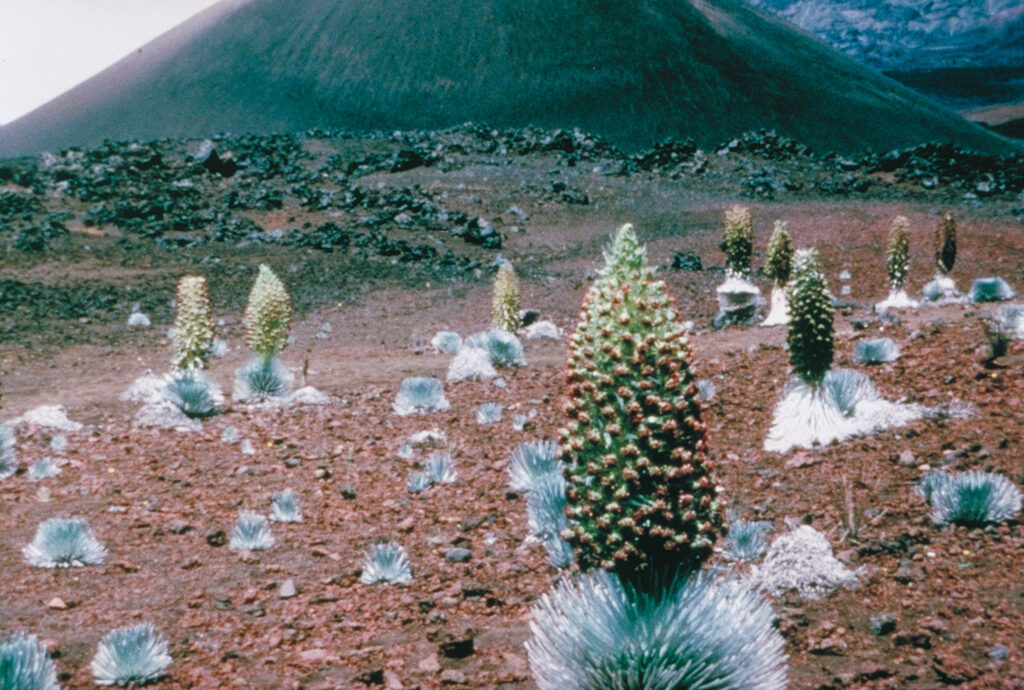
Author: Caterpillar at English Wikipedia
This file is licensed under the Creative Commons Attribution-Share Alike 3.0 Unported license. Subject to disclaimers.
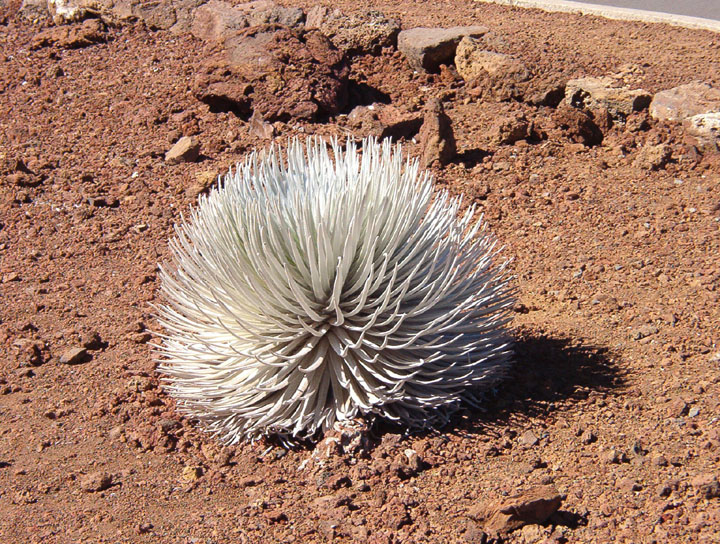
Author: Sputnikcccp at en.wikipedia
This file is licensed under the Creative Commons Attribution-Share Alike 3.0 Unported license. Subject to disclaimers.
Some more unusual plants native to the Hawaiian islands are those in the genera Dubautia and Wilkesia. Here’s some photos of a couple of species in these groups.
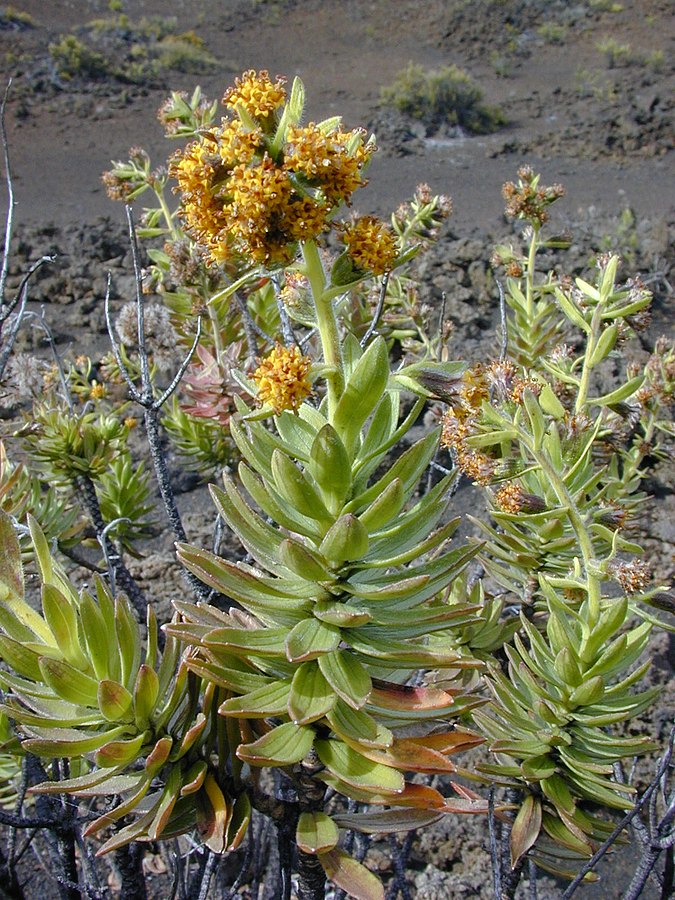
Silversword loop Haleakala National Park, Maui, Hawai’i
Source:
starr-011114-0055-Dubautia_menziesii-flowers-Silversword_loop_HNP-Maui
Author: Forest and Kim Starr
This file is licensed under the Creative Commons Attribution 3.0 United States license.
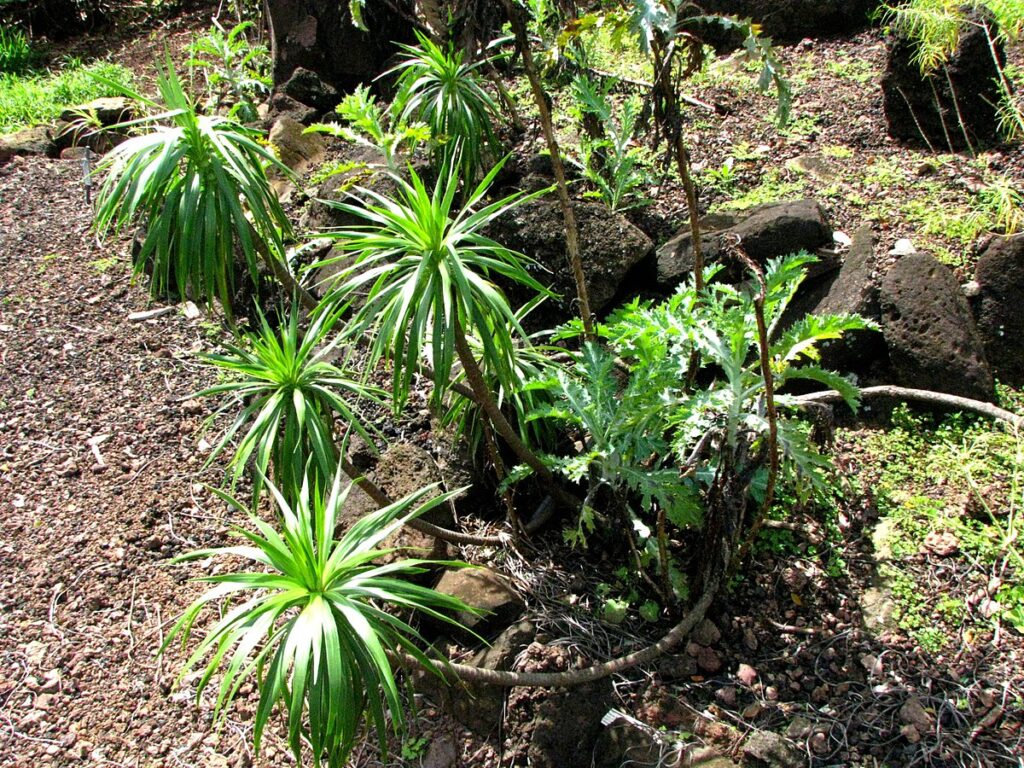
Author: David Eickhoff from Pearl City, Hawaii, USA
This file is licensed under the Creative Commons Attribution 2.0 Generic license.
These plants all look very different from each other. And they certainly don’t look much like tarweeds. In fact, despite remarkably diverse morphological, anatomical, and ecological adaptations, molecular studies have shown that Argyroxiphium, Dubautia, and Wilkesia are very closely related. Even more surprising, it has been shown that all these plants are descended from a single species of tarweed that somehow made the journey from California to the Hawaiian Islands.
As discussed in the previous section, seeds can be carried to islands stuck to the feet or feathers of a bird. If this was the case with tarweeds, and it seems likely, the entire population of Argyroxiphium, Dubautia, and Wilkesia on the islands are probably descended from one small cache of seeds — or possibly even a single seed! Molecular studies have shown that the silverswords are most closely related to either Raillardella muirii or Raillardella scabrida. (Two different studies came up with the two different species.) This does not mean that the silverswords are descended from a species of Raillardella — it just means that the tarweeds in the Raillardella genus are their closest relatives among the tarweeds that are alive today. Their actual ancestor could have been a member of a species or genus that is no longer around. The important takeaway, though, is that, at some point in time, a seed or seeds from some member of the tarweed tribe made it to the Hawaiian islands and then diversified to become the Argyroxiphium, Dubautia, and Wilkesia we see today.
Researchers have dated the radiation of the silverswords on the islands to have begun about 5.2 million years ago, plus or minus 0.8 million years. Kauai, the oldest of the Hawaiian islands, has been dated at 5.1 million years old, plus or minus 0.2 million years. This suggests that the founding tarweed made it there soon after the oldest island formed.
Arriving on the island, the tarweed would have found a land almost barren of competitors, so there would have been many unoccupied niches for its descendants to fill. The relative lack of other plant life would have also meant that the soil would not have been very fertile, so the tarweeds may have had a tough time of it for a while, until they evolved the ability to thrive on more nutrient-poor soils. But they managed it, and it makes sense that their closest descendants, the silverswords, are still found mostly in such environments.
The radiation of silverswords and their relatives from a single wayfaring species of tarweed is a fascinating example of island evolution. This radiation took place very rapidly, leading to a great diversity of species with very different adaptations, despite being closely related genetically. By comparison, the tarweeds of North America, while also being closely related to each other, show much less diversity.
The relationship of tarweeds and silverswords has attracted a great deal of research, and there is so much more I would like to tell you about them, but this is a blog post, not a book, so I’ll resist the impulse and end it here. If you would like to know more, check out this link: Adaptive Radiation and Macroevolution in the Hawaiian Silverswords. There’s also a great article by the scientist who seems to be largely responsible for discovering the relationship between the tarweeds and silverswords. You can read that article by clicking here.
I should note that Argyroxiphium, Dubautia, and Wilkesia are all now included in the Madieae tribe. In fact, another name for the tarweeds is the silversword alliance14.
Hiding in Plain Sight
One of these days, I’m going to write an entire blog post entitled “Hiding in Plain Sight”. It’s going to be a collection of images whose only common feature is that I was trying to photograph one thing and inadvertently captured another thing that I didn’t even know was there. It happens a lot in macro photography. You photograph one bug and, later, when you pull the photo up on your laptop, you realize that there’s a much more interesting bug right next to it that you hadn’t even noticed. If you’re really lucky, it might even be in focus.
Yeah, someday I’m going to write that post. In the meantime, here’s a few tarweed pics that have incidental bugs in the image. The first three photos were cropped from much larger images.
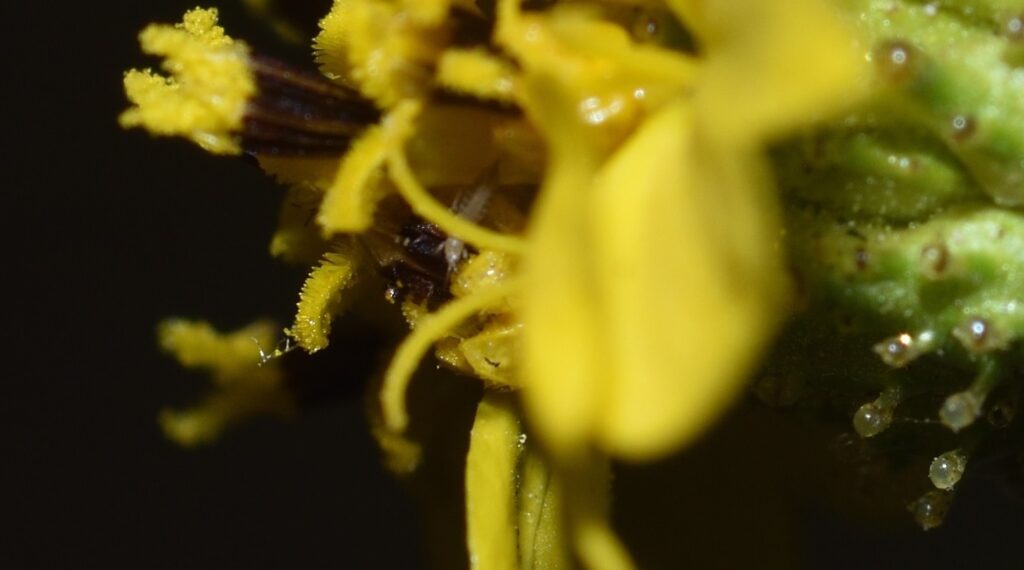
Mission Trails Regional Park, San Diego County. 7/19/19

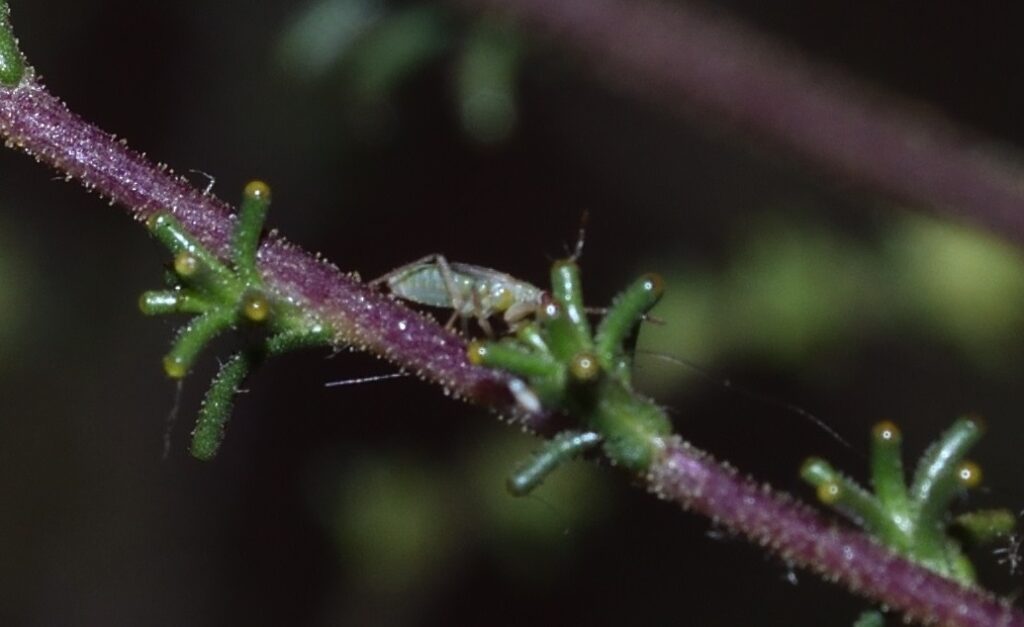
Mission Trails Regional Park, San Diego County. 7/19/19

Mission Trails Regional Park, San Diego County. 7/19/19
