Have you ever seen a baby dragonfly? Would you know it if you had? A baby dragonfly is called a naiad (rhymes with ‘my ad’). In classical Greek mythology, a naiad was a minor female deity that lived in a body of fresh water such as a lake, river, or spring. Immature dragonflies are called naiads because they also live in fresh water. Although they are similar in form to adults, they lack wings and their coloration is much more muted, so you wouldn’t immediately think ‘dragonfly’ if you saw one.
A dragonfly spends most of its life as a naiad. This can range from two months to five years, depending on the species, but also on the environment. The members of a species may take much longer to develop if they live in a cold environment. In their adult form, dragonflies live for only two to four months. So what we usually think of as a dragonfly is really just the last stage of its life cycle.1
In some insects, the adult form is so different from the immature form that the insect’s body has to go through a major restructuring to get from one to the other. To accomplish this, the insect stops eating and becomes more or less immobile. In this immobile form it’s called a pupa. In some cases, it may first spin a cocoon around itself or make some other kind of preparation, but otherwise, it just stops moving and lets the transformation begin. And what a transformation it is! In the case of a caterpillar, its body almost completely liquifies. Most of the tissues and even the cells are broken down and rebuilt into the adult butterfly or moth.
An insect that undergoes this kind of transformation is said to undergo complete metamorphosis and the immature form of the insect is called a larva.
If an insect does not go through complete metamorphosis, its immature form is called a nymph. Although dragonflies do go through some rather drastic changes in their final molt, those changes are not so drastic that the insect has to go through a pupal stage, so you will sometimes hear a baby dragonfly referred to as a nymph, rather than a naiad. Both terms are correct. A naiad is just a nymph that lives in the water.4
Dragonflies are not the only insects whose immature forms are called naiads. The term is also used for damselflies and mayflies. All these insects are closely related and their nymphs live similar lives.
Dragonfly, Damselfly, or Mayfly?5 6 7
Here’s a beautiful photo of a dragonfly by another photographer:

Photographer: Robert C
This file is licensed under the Creative Commons Attribution 3.0 Unported license.
Notice two things about the dragonfly in this photo: the wings are held more or less straight out from the body and the eyes take up most of the head. In many species, including this one, the eyes actually touch at the top of the head. The eyes of a damselfly are much farther apart — they don’t come close to touching — and when at rest, the wings fold back towards the rear. You can see this in the photo below. A dragonfly is unable to fold its wings back like this. Also note that the body of the damselfly is more slender and delicate-looking.
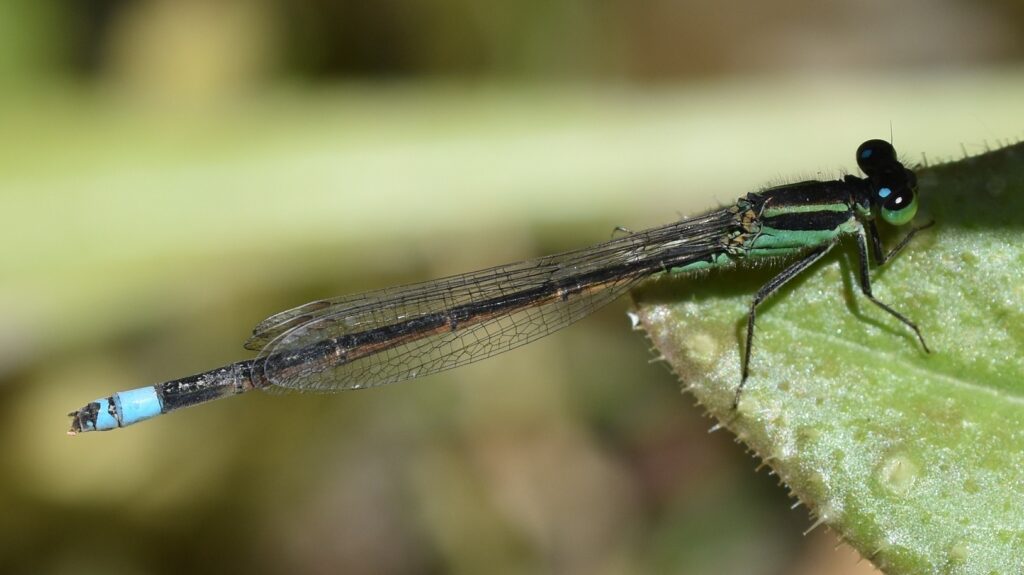
Lake Murray, San Diego County 5/28/18
Adult mayflies can be distinguished from dragonflies and damselflies by their two or three long, thread-like tails. Like a dragonfly, a mayfly is unable to fold its wings flat over its abdomen. Unlike a dragonfly, it holds them upright when at rest.

San Diego County 11/12/17
Here’s several photos of a mayfly naiad. Notice that, like the adult, it has several very long tails.

Ruffin Canyon, San Diego County 9/1/18


In the last of the photos above, notice the fan-like structures attached to the sides of the abdomen. These are gills. They’re a defining feature of mayfly naiads. As we’ll see in a minute, dragonfly and damselfly naiads also have gills, but in very different locations. Notice also the mouthparts. Here’s a couple of closeups. I know you can’t see much detail. Just keep the general look of the mouthparts in mind, so you’ll be able to contrast them to those of the damselfly and dragonfly.
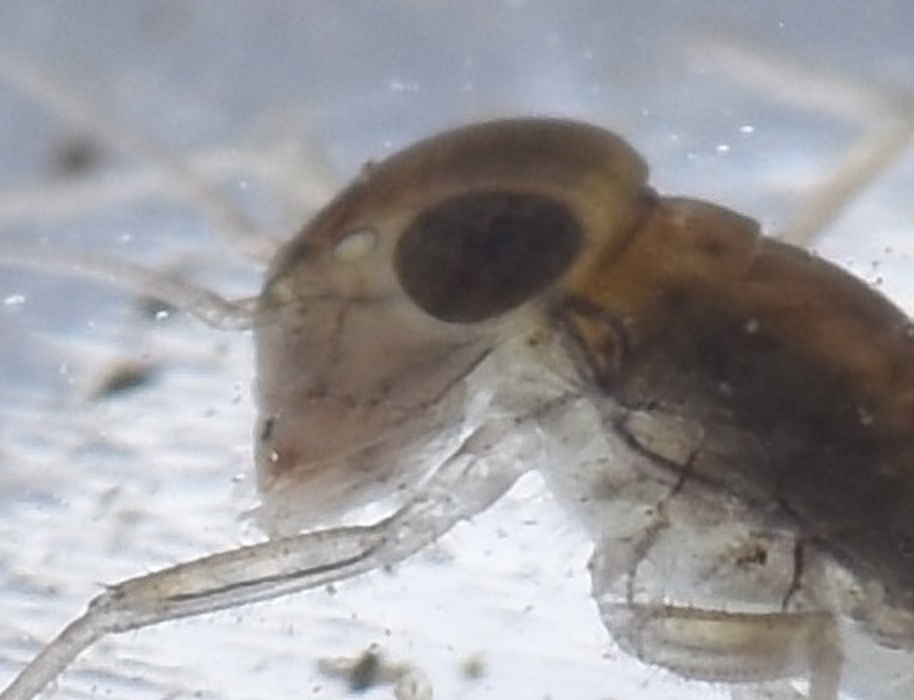

Here’s a photo of a damselfly naiad:

San Diego County 4/13/18
Right away, you can see that it doesn’t have the gills coming off the sides of the abdomen. Instead, the gills are the three long, fan-like structures attached to its rear.
The cool thing about the following photo is the almost perfect transparency of the body. I think the dark lines running through the legs and other body parts are the nerves.

San Diego County 4/13/18
The photo below (of a different naiad) also shows some amazing anatomy. Note the four wing buds attached to the thorax. This damselfly is probably getting close to maturity, as the wing buds are pretty well-developed.

San Diego County 7/16/18
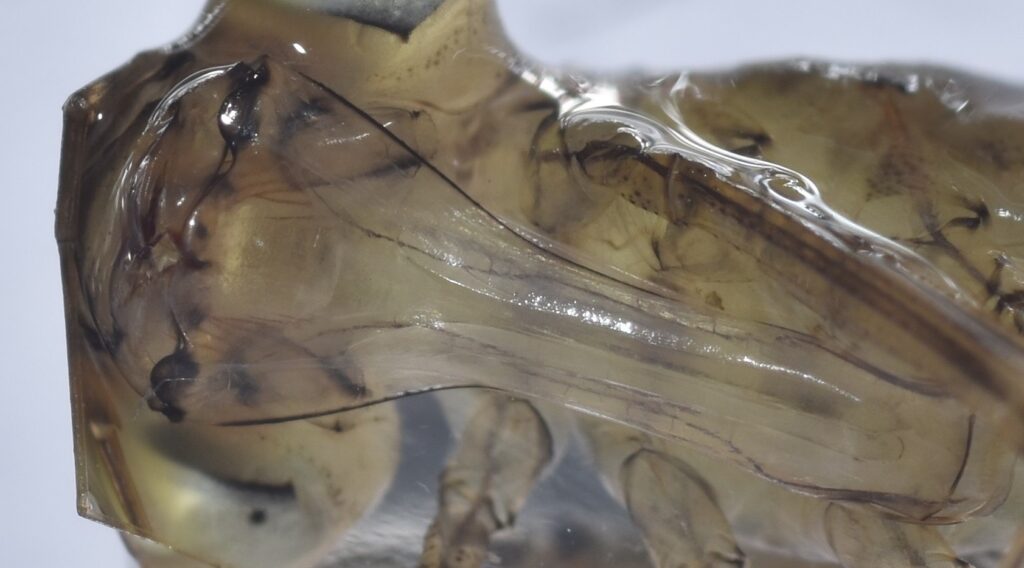
This next photo is where things start to get really freaky. Again, you can see the wing buds extending from the thorax and lots of awesome anatomy, but what’s going on with that lower jaw?
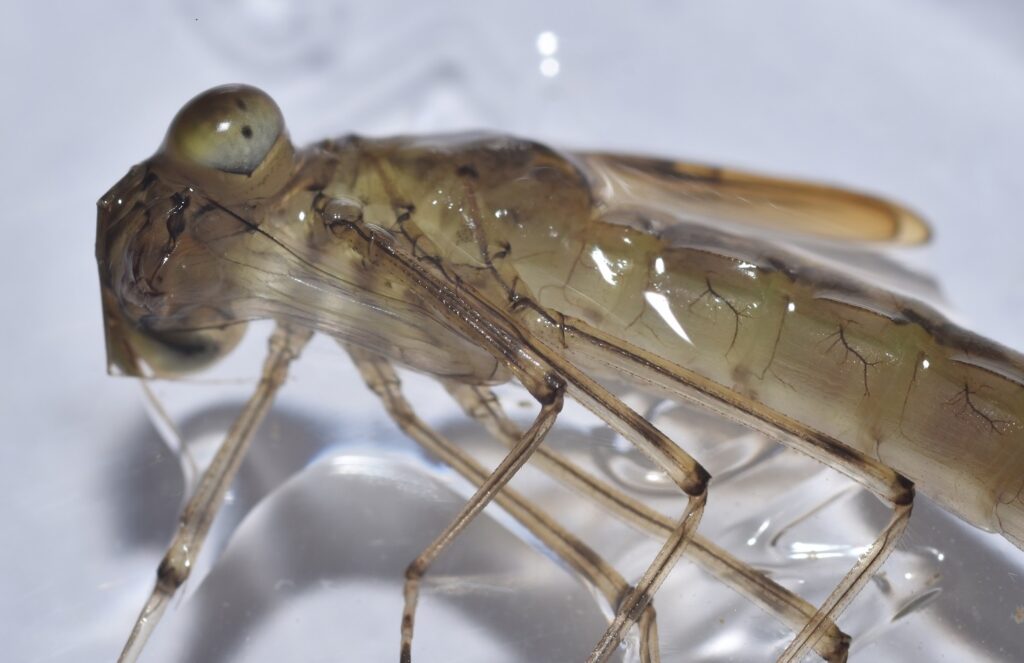
San Diego County 7/16/18
I’m using the word ‘jaw’ loosely. The technical term is ‘labium’. Most insects have a labium, although they are usually much less freakish. I’ve also seen it described as a lower lip. In fact, the word ‘labium’ comes from the Latin word for lip.12 13
Here’s a closer view of the labium. The jaw is attached to the underside of the head, as you would expect. From there, it extends backward to a joint. From the joint, it reverses direction, widens as it approaches the head, and ends in some kind of clasper.
Dragonfly naiads have very similar lower jaws. We’ll get to them in the next section, but in the meantime, I’ll use an illustration of a dragonfly naiad to show you how this lower jaw works. In figure 1 below, the labium is highlighted in red. Obviously, the labium is extended in the figure. The dragonfly can retract it by rotating the first segment backward and bending the labium at the joint. This causes the jaw to fold up underneath the head and thorax. In the retracted state, the ‘mask’ at the end of the labium fits snuggly over the dragonfly’s face. You’ll get a good view of the mask in some later photos and videos. Not all dragonflies have this mask and, as far as I know, no damselflies do.
Note: For some inane reason, entomologists have decided to call the entire labium of a dragonfly naiad the mask, regardless of whether or not it covers the face of the insect. So to be technically correct, I would have to refer to the mask-like swelling at the end of the labium as ‘the mask-like swelling at the end of the labium’. For the purposes of this article, I’m just going to call it the mask.14

Date: 1890
Source: Insecta by Alpheus Hyatt (1838-1902)
Authors: Alpheus Hyatt and J.M. Arms
This work is in the public domain in its country of origin and other countries and areas where the copyright term is the author’s life plus 70 years or fewer.
This work is in the public domain in the United States because it was published (or registered with the U.S. Copyright Office) before January 1, 1925.
Note: This image has been altered to highlight the labium in red.
The damselfly’s labium works the same way, although, as already noted, the end doesn’t form a mask like it does in some dragonflies. The labium of the mayfly naiad is not able to extend in this way.
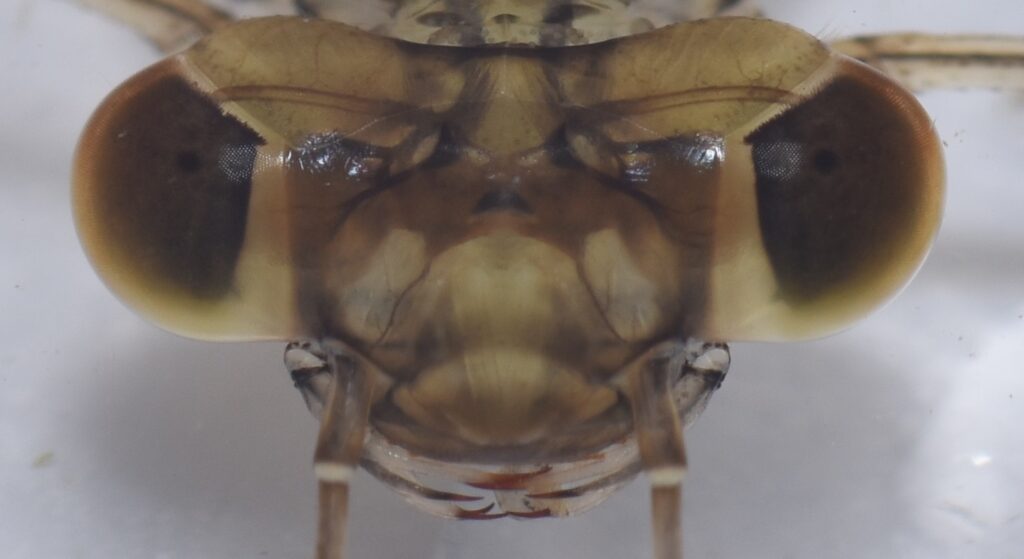
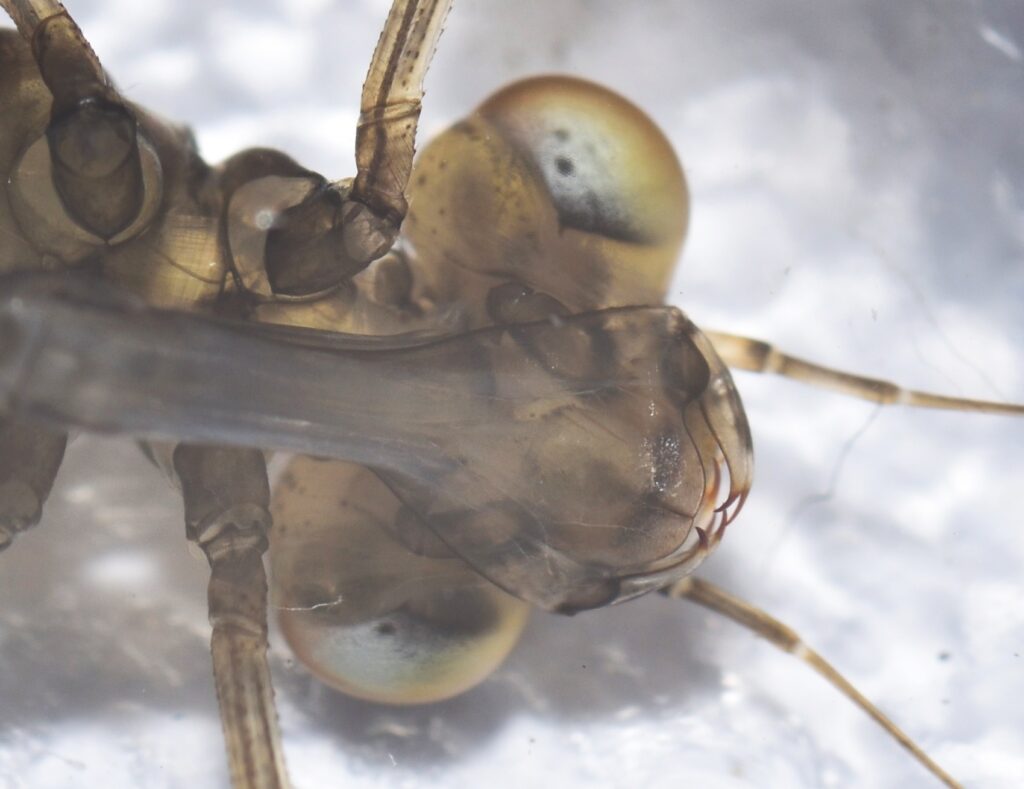
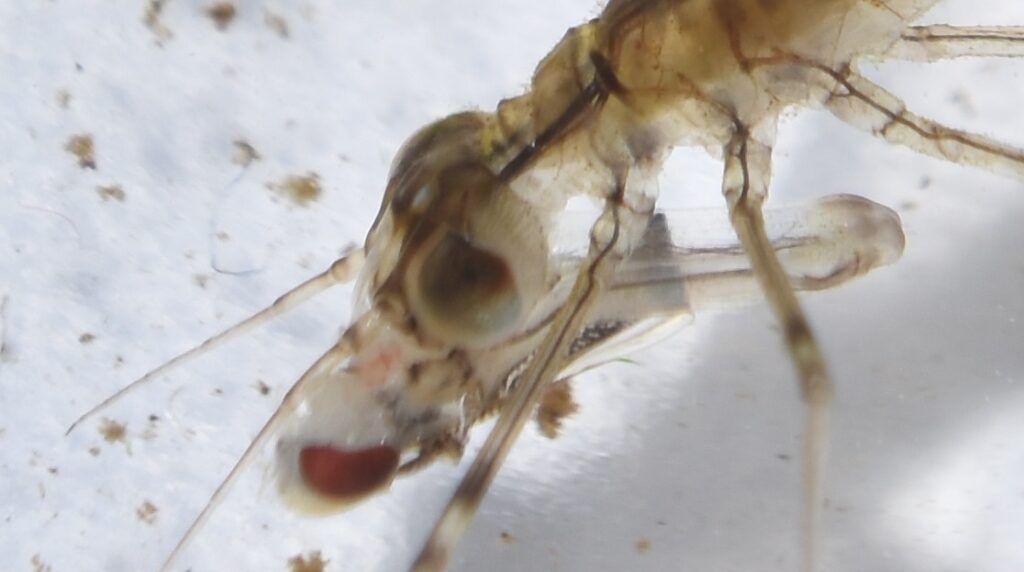
So what purpose does this bizarre jaw serve in dragonflies and damselflies? As you can probably guess, it’s for catching prey. When the naiad senses something potentially edible, the labium snaps out with incredible speed. The business end of the labium has its own set of ‘jaws’ lined with ‘teeth’. These jaws close around the prey and the naiad retracts the labium, pulling the prey against its mandibles.
The naiad doesn’t use muscles to extend the labium. Instead, it uses hydraulic pressure. The insect increases the pressure of the hemolymph (the insect equivalent of blood) feeding the labium and this causes it to unfold and shoot forward at blinding speed. Presumably, it does use muscles to close the jaws around the prey and retract the labium, although I haven’t been able to find any resources that explicitly say so.
Here’s a couple of photos that show the jaws at the end of the damselfly labium:
San Diego County 7/16/18
San Diego County 7/13/20
And because I know you want to see the labium in action, here’s a few photos of a damselfly naiad eating a bug. (Don’t worry, we’ll get to some videos later.)

San Diego County 4/20/18
San Diego County 4/20/18
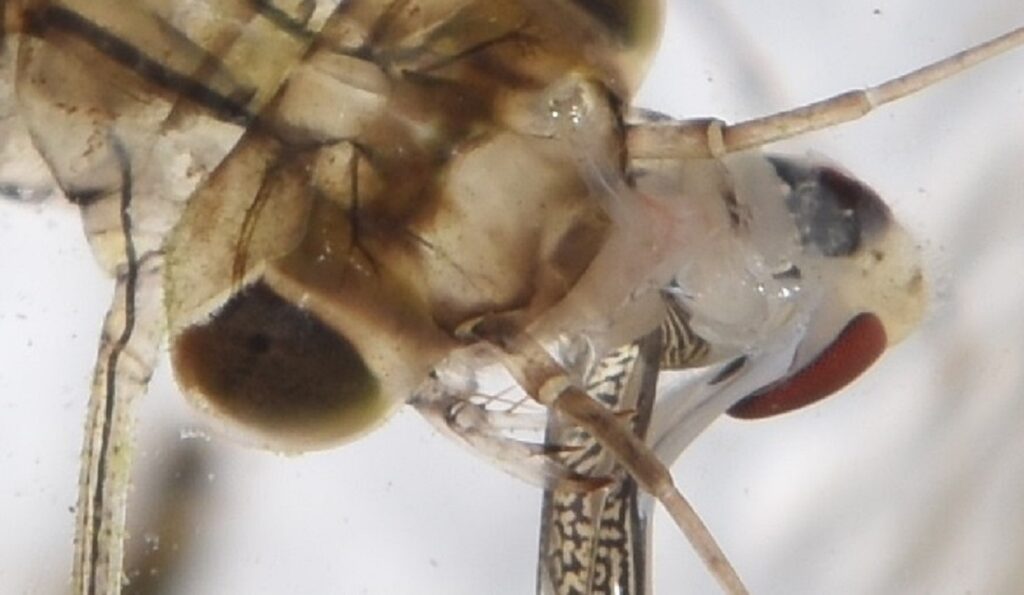
San Diego County 4/20/18
A dragonfly naiad is much more thick-bodied than that of a damselfly. The following photo shows the naiad of a common green darner dragonfly (Anax junius). It was quite large. I didn’t measure it, but I would estimate that it was about 5 cm or around 2 inches long! This was also a late-stage naiad, as it has fairly large wing buds. Notice that one of the buds is deformed. It had some kind of growth underneath it, which will be visible in some later photos.

San Diego County 7/25/20
As you can see, it doesn’t have any external gills. It’s gills are inside its rectum! The dragonfly pumps water in and out of its rectum, creating a steady flow of oxygenated water over its gills. In other words, it breathes through its butt!
When threatened, a naiad can forcefully expel water from its anus, causing the insect to shoot forward — a rather novel form of jet propulsion.
Here’s a picture of the same naiad from the side. Obviously, it’s way more robust than the damselfly naiad. In fact, from this angle, it looks downright scary. It’ll look even more scary when you see it in action.
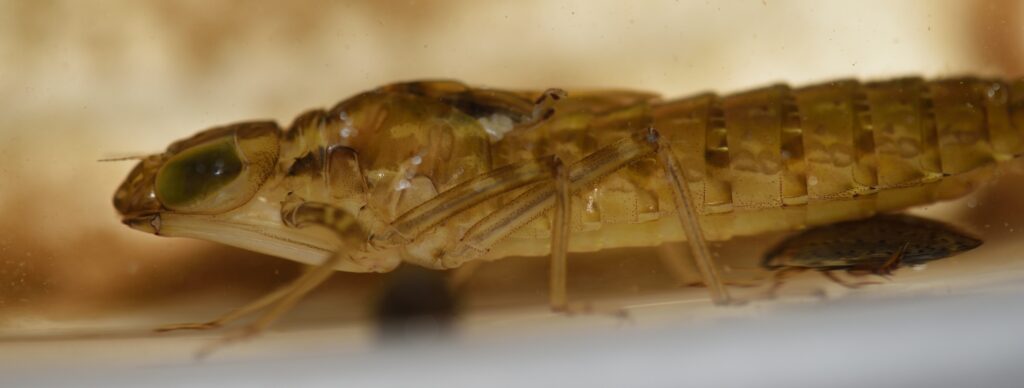
San Diego County 7/25/20
In case you’re wondering, the fuzzy dark blob between the first and second pair of legs is a snail that I’m quite sure positioned itself there just to ruin my photo. Also, you may notice what appears to be another bug wedged underneath the dragonfly’s abdomen. That’s a diving beetle. I think it was conspiring with the snail.
Here’s a closeup of the head. As you can see, it has a lower jaw very similar to that of the damselfly. This particular species of dragonfly lacks the mask at the end of the labium, making it even more similar.

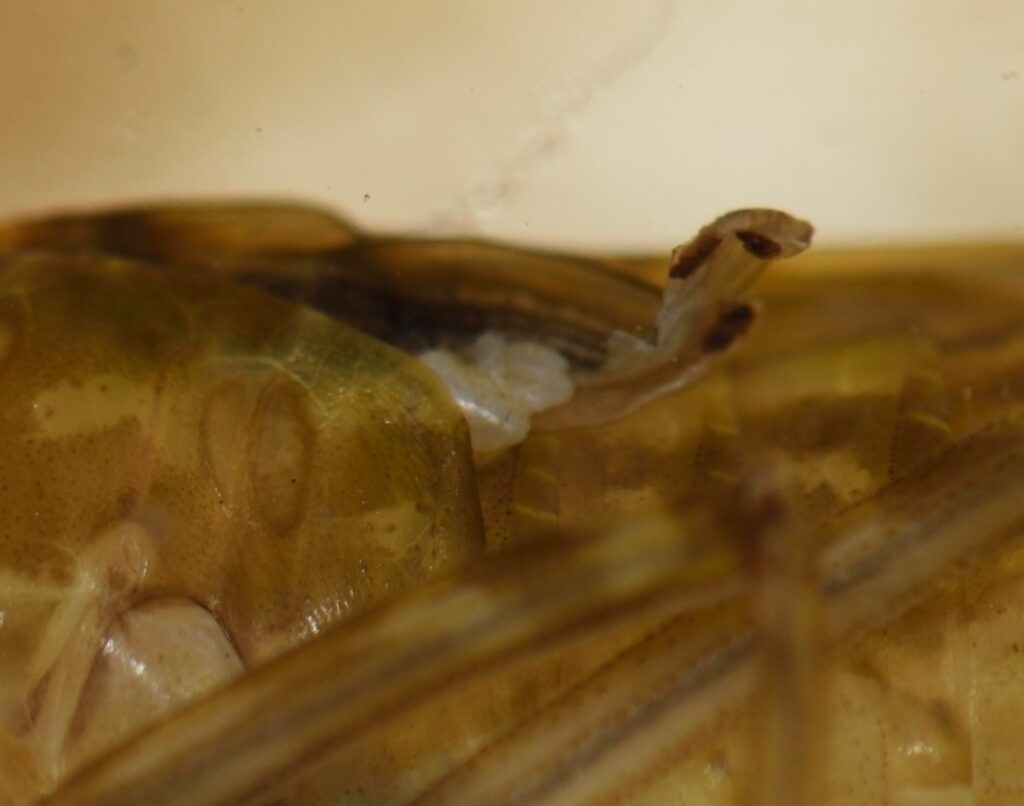
And here’s a closeup of the growth underneath the wing bud. I don’t if it’s an injury or a tumor or what. I was thinking that it might be some kind of parasite, but I haven’t been able to identify it.
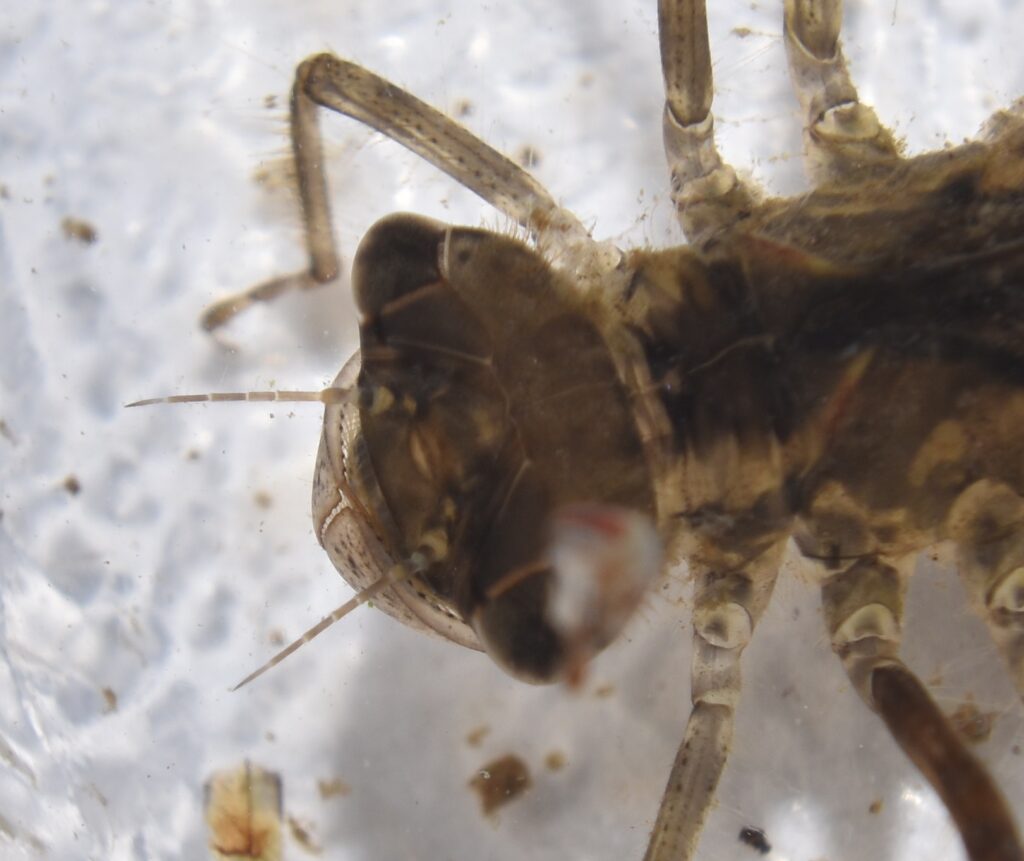
Here’s a series of photos of another kind of dragonfly nymph. I don’t know the species, but it’s more typical of the kinds that I usually see. This one does have the mask, which is very evident in the photos as it’s in the process of eating a water boatman (a type of aquatic insect). It’s also quite a bit smaller than the green darner naiad.

San Diego County 4/18/18


Here’s a couple of videos of the same nymph. The first one shows it with a water boatman caught in its mask.
And here it is “cleansing its pallet” after the meal:
Next, we have a video of the green darner dragonfly catching and eating a cricket. The strike is blurry, but it gets clearer later in the video. You can really see its labium and other mouthparts working. It consumes the entire cricket — legs and all. (You don’t want all that good protein to go to waste.)
The next video shows the same naiad trying and failing to eat a beetle. You get a better view of the strike in this one. Two strikes actually — it tries a second time. (Sorry about the red background. I had it in a god-awful ugly plastic bowl.)
Like all insects, naiads must periodically shed their exoskeletons as they grow. When the naiad of a dragonfly or damselfly is ready for its final molt — the one in which it changes into an adult — it climbs out of the water, usually by climbing up the stem of a reed or some other plant.21 The naiad will cling there while it undergoes metamorphosis. It’s not uncommon to find the shed exoskeleton of a dragonfly or damselfly still clinging to a stem or stuck to a rock face above the pool that it climbed out of.
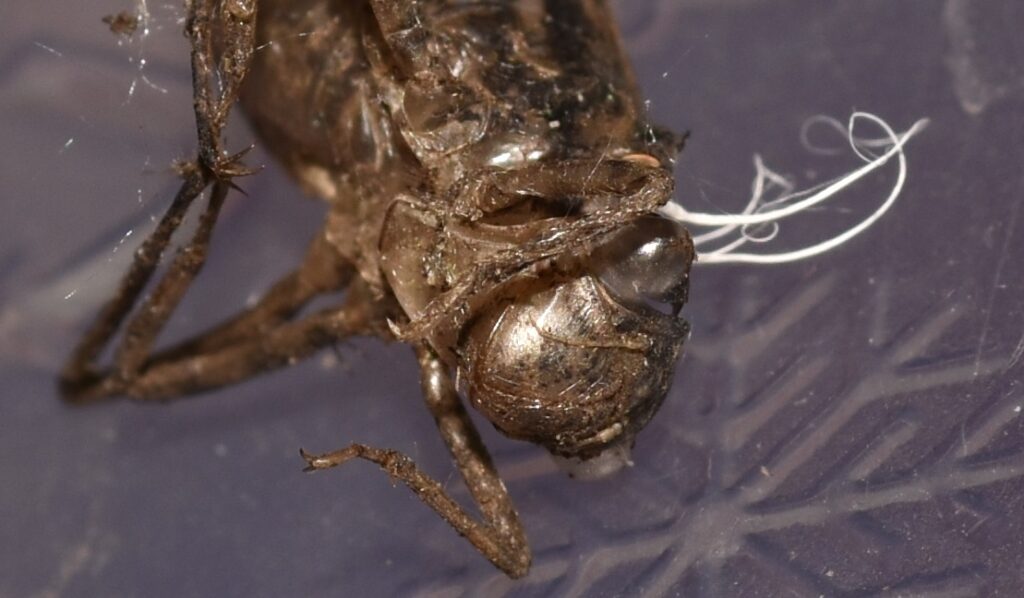
Shed exoskeletons are called exuviae. The following two photos show the nicely preserved exuviae of a dragonfly. You can clearly see the labium with its mask. Even the corneas of the eyes have been cast off.

Mission Trails Regional Park, San Diego County 5/23/18
Mission Trails Regional Park, San Diego County 5/23/18
When a naiad molts, its old exoskeleton splits just behind the head and the insect wriggles out through the opening.
You may be wondering what the white strands are in the photos. I mentioned earlier that the dragonfly has gills in its anus. The oxygen taken up by the gills has to be distributed throughout the body. Surprisingly, this is not the job of the hemolymph (insect blood), which is only responsible for distributing nutrients. Instead, it’s distributed via tubes called trachea. Much finer tubes called tracheoles branch off from the trachea. The white strands are the linings of the trachea, which are shed at the same time as the exoskeleton.23 24
Scientists believe that insects evolved about 480 million years ago — around the same time as land plants. The first insects were wingless. In fact, at the time, no animals had yet developed flight. Insects became the first to do so around 406 mya. Those insects were the ancestors of modern-day dragonflies, damselflies, and mayflies.
Mayflies form the order Ephemeroptera. The earliest fossils that have definitely been identified as mayflies are from the late Carboniferous.29 Some scientists believe they may have appeared as early as the Devonian, but this has not been confirmed. Most mayfly fossils are of nymphs, probably because the adults lived for only a few days, as is the case for modern mayflies.
The oldest known relatives of dragonflies and damselflies (order Odonata) are the extinct griffinflies, which form the order Meganisoptera. Fossil griffinflies have been found from as far back as 325 mya in the early Carboniferous. This was a time that is famous for its giant insects. In fact, the largest known insects of all time were in a genus of griffinflies, Meganeuropsis. One of the largest, Meganeuropsis permiana, had an estimated wingspan of up to 710 millimetres or 28 inches. Griffinflies look very similar to dragonflies and are sometimes called giant dragonflies in the media. This is not technically correct, since they lack some of the features that scientists use to define dragonflies. Also, they probably weren’t the direct ancestors of modern dragonflies — they just shared a common ancestor.
A few fossils of griffinfly nymphs have been found and they have mouthparts similar to dragonfly nymphs, which means they were probably also aquatic. None of the references I’ve found explicitly state that the mouthparts were extendable like modern dragonflies and damselflies, but I presume that they were, since they wouldn’t be very “similar” if they weren’t. So it’s likely that this weird lower jaw evolved very early in insect prehistory.