Southern California is not known for being wet and humid. Millipedes lose water easily, so those that live here spend most of their time hidden away in protected places. When they do come out, it’s usually at night. The one time you see a lot of them is after the first good rain of Autumn. Then they come out in droves. In one three-mile night hike in November, I counted over thirty.
The most common millipede in my neighborhood is in the genus Tylobolus. I’m not sure of the species. Tylobolus is in the family Spirobolidae and the order Spirobolida. Spirobolida are the round-backed millipedes. The reason for this moniker will be obvious from the photos below. Like all millipedes, Tylobolus adds segments with each molt, so the number of legs and segments depends on the millipede’s age, but the adults have around 40 to 54 segments.1 2

Mission Trails Regional Park, San Diego County 12/03/19

Mission Trails Regional Park, San Diego County 12/03/19
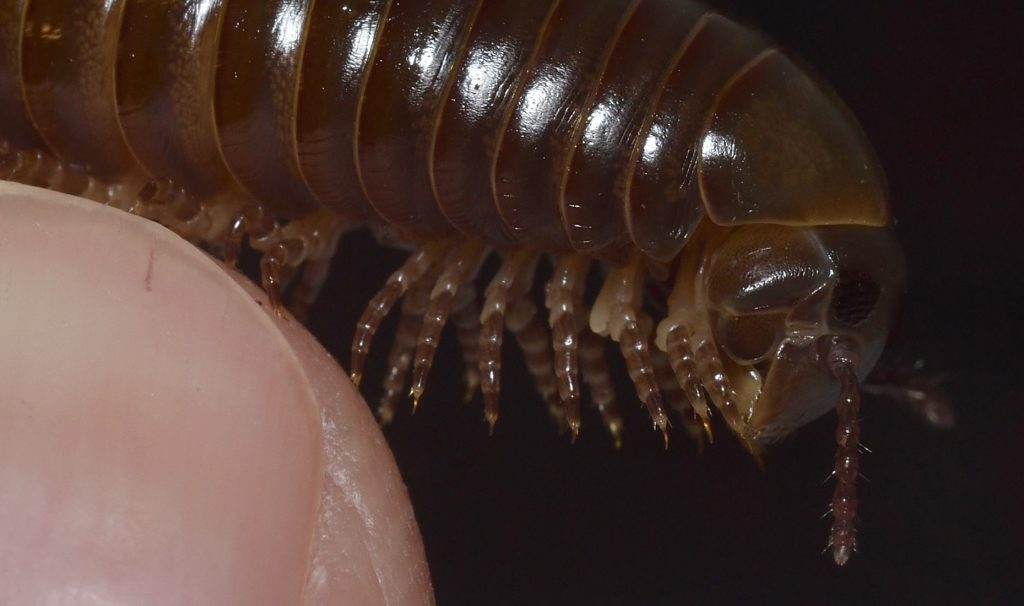
Same millipede as above perched on my thumb.
The one other species I’ve encountered here is in the genus Bollmaniulus. I don’t know the species name. The genus is in the family Parajulidae and the order Julida. As you can see from the following photo, they’re much skinnier than Tylobolus, but otherwise, the two are surprisingly similar, even though they’re in separate orders.3
I would love to know what different niches these two species occupy that would explain their extreme difference in width. Unfortunately, I haven’t been able to find much information on them. If anyone out there knows more about them, please enlighten me.
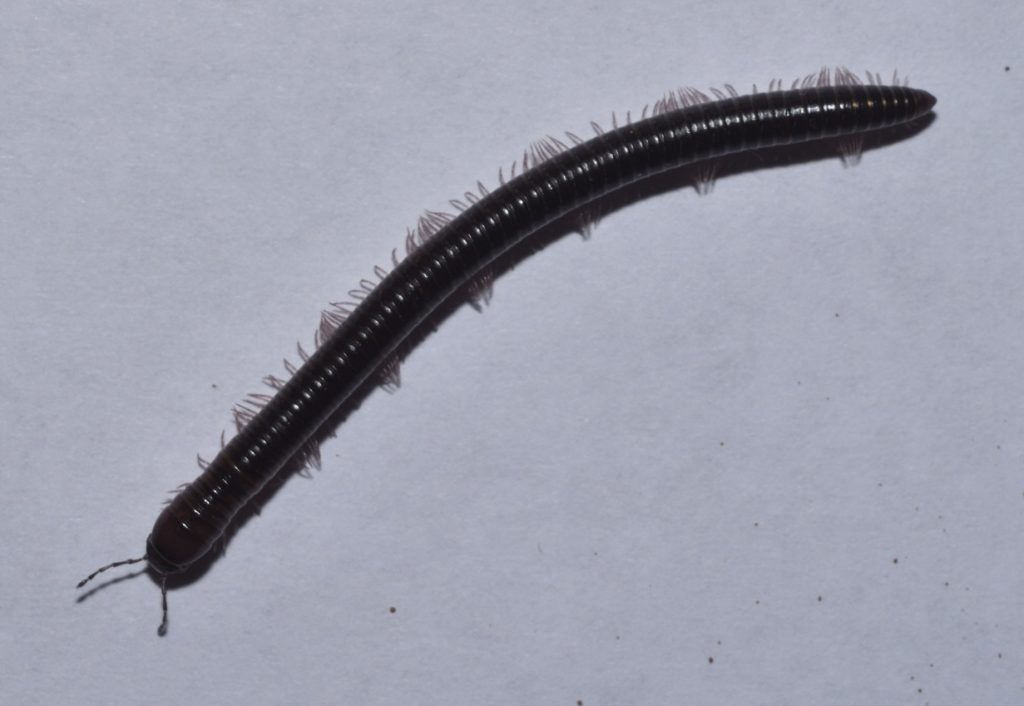
Mission Trails Regional Park, San Diego County 1/9/19
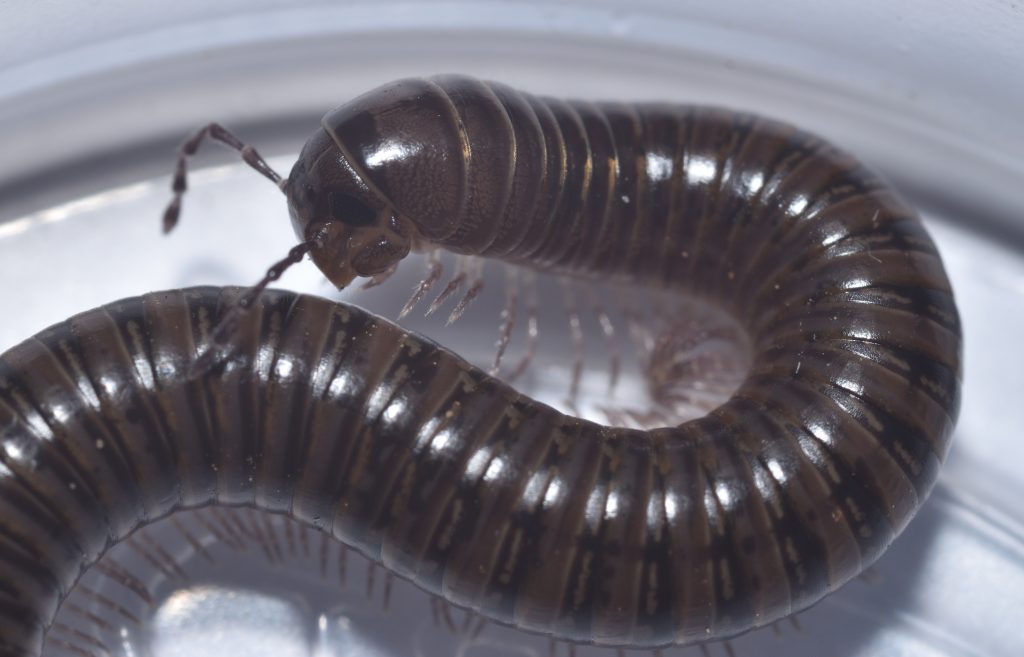
Mission Trails Regional Park, San Diego County 11/23/19

Mission Trails Regional Park, San Diego County 11/23/19
Here’s a video of Bollmaniulus in motion:
And here’s the same millipede in slow motion. This is a male — you can tell by the structure hanging down behind the fifth pair of legs, which is part of the genitalia. (Don’t worry, we’ll be covering their private parts in much greater detail later.)
The first thing everyone wants to know is how to tell the difference between a millipede and a centipede. They both tend to be long and worm-like and have lots of legs, so it’s easy to confuse them. The resemblance is superficial, though. They’re actually quite easy to tell apart if you know what to look for.
First of all, Centipedes are all carnivores and they’re all venomous. What used to be their first pair of legs has evolved into fangs, which they use to inject venom into their prey. Millipedes, on the other hand, are almost all detritivores, which means they eat rotting plant or animal matter (detritus). Mostly, they eat rotting leaves. There is a small group of millipedes that are carnivorous, but even those are not venomous. So that’s the first way to tell a millipede from a centipede — pick it up and see if it bites you.
If you prefer a less potentially painful method, you can look at the legs. Millipedes have two pairs of legs on most of their segments. (See figure 1.) Centipedes have only one pair per segment. Because of this, millipedes usually have a lot more legs than centipedes. You can’t depend on this, however, because a long centipede could have more legs than a short millipede. The legs of millipedes are also held more underneath the body, whereas centipede legs splay out to the sides.
One other difference is that centipedes, being carnivores, tend to move faster than millipedes — they’re built for speed. Millipedes, on the other hand, are built for things like burrowing and pushing their way underneath rotting leaves. This explains the two pairs of legs per segment. What better way to increase your ability to bulldoze your way through stuff than by almost doubling the number of your legs?
But why two pairs of legs per segment? Why not just double the number of segments? Actually, each of the segments with two pairs of legs started out as two segments, which have become fused. And what is the point of fusing them? If you have two pairs of legs pushing on two unfused segments, the segments are going to move in relation to each other at the joint. Maybe not much, but any amount of movement at the joint is going to consume energy. If you fuse the segments, then all of the energy goes into pushing the fused segments forward. Obviously, even more energy would go into pushing the millipede forward if you fused all the segments, but then you would lose all flexibility. As with so many things in evolution, it’s a trade-off. By fusing the segments in pairs, you significantly increase the amount of energy that goes into moving the millipede forward without sacrificing much flexibility.
What Good Is a Millipede? 6
If you catch a millipede and keep it in a small container for a while, one of the first things you’ll notice is that it poops a lot. The leaves and other detritus that millipedes consume are broken down in their guts and excreted as pellets that are more easily decomposed by microorganisms. I kept a couple of millipedes in a Tupperware container with some dead vegetation for a week or two and I was amazed at the rate at which they converted the vegetation into poop. So millipedes are important in producing new soil. They also help to aerate the soil by burying through it. In this way, they serve much the same purpose as earthworms.
Millipedes are arthropods. This means they’re in the phylum Euarthropoda, which includes myriapods, insects, arachnids, and crustaceans. (The older term, Athropoda, is now used for a proposed grouping of Euarthropoda with the phylum Onychophora, the velvet worms.) Arthropods have jointed appendages, cuticle made of chitin, and segmented bodies. They also have exoskeletons, which must be shed periodically.10
Within Euarthropoda, millipedes belong to the subphylum Myriapoda (which also includes centipedes) and, within this, they form the class Diplopoda. This word comes from the Latin for “two feet” — a reference to the two pairs of legs per segment.
When it hatches, a millipede has just three pairs of legs. As it grows, it molts repeatedly, adding legs and segments with each molt. The first segment after the head is legless. The next three segments, called haplosegments, have only one pair of legs each. (These are the pairs it’s born with.) With its first molt, it adds its first diplosegment (i.e. a segment with two pairs of legs). As mentioned earlier, each diplosegment is actually two segments fused together.
Millipedes have a single pair of antennae with seven or eight segments. Each one has a group of sensory cones at the tip. As it walks, the millipede taps the tips of its antennae on the ground — first one and then the other — sensing what’s in front of it.11
Many types of millipede are blind. If they do have eyes, they consist of small groups of ocelli (simple eyes) that form a patch on each side of the head. The individual ocelli just detect the presence and intensity of light. The input from all the ocelli in a patch is integrated by the nervous system to form a crude image. These patches are not technically compound eyes, because the ocelli in a patch are not fused together into one organ. Given time, they could potentially evolve into such organs, so they probably represent an intermediate step in the evolution of compound eyes.

Author: Janssen, Ralf; Prpic, Nikola-Michael; Damen, Wim G.M., modified by Animalparty
This file is licensed under the Creative Commons Attribution-Share Alike 3.0 Unported license.
Diplopoda is divided into two subclasses: Penicillata and Chilognatha. Penicillata consists of the tiny bristle millipedes and it’s the basal subclass. In other words, its members are more closely related to the earliest millipedes. They have soft exoskeletons and tufts of barbed bristles. When attacked by a predatory insect, these bristles come loose and become entangled in the legs and mouth-parts of the attacker.
Another characteristic of bristle millipedes is that sperm transfer is indirect. Males deposit a spermatophore (a capsule or mass containing sperm) on the ground, which the female picks up and inserts.
All other millipedes (and most of the ones you’re likely to encounter) are in the subclass Chilognatha. These millipedes have hard exoskeletons reinforced by calcium salts. Instead of bristles, members of Chilognatha have repugnatorial glands (a.k.a stink glands) that exude toxic chemicals when the animal is feeling threatened. The toxins are secreted through pores located on the sides of the animal. Some millipedes can even squirt these toxins in a stream.
Different species have different mixes of toxins. The members of the largest order of millipedes, Polydesmida, even include hydrogen cyanide as part of the mix. Fortunately, they don’t produce it in large enough quantities to be dangerous to people.12 In fact, no millipedes secrete toxins that are seriously dangerous to humans. Some of them may cause a burning sensation in people who are sensitive and they may cause stains on clothing, but, otherwise, they’re harmless. I often handle the millipedes I find and I’ve experienced no ill effects (although they do smell pretty awful).
The Chilognatha are further subdivided into pill millipedes and… well, the ones that aren’t pill millipedes. The main difference is that pill millipedes are short, with only a few segments, whereas the others are long and worm-like. Pill millipedes look a lot like pillbugs (a.k.a woodlice or roly polies), but they’re not closely related.
Spaced-out Lemurs and Other Tales of Self-Medication 13 14 15
Lemurs are a group of primates native to the island of Madagascar. Most of them are small animals with large eyes, a pointed snout, and a long tail. The group is very diverse, though. Up until shortly after humans reached the island around 2000 years ago, there were lemurs that were as large as an adult male gorilla!
Lemurs are fascinating in their own right, but I only mention them here because at least two species have a special relationship with millipedes. Red-fronted lemurs apparently self-medicate with giant millipedes (probably genus Sechelleptus). A lemur will chew on a millipede, stimulating it to secrete toxins from its stink glands. The lemur will then rub what appears to be a mixture of toxins and saliva on the fur around its genitals, anus, and tail. Often, the lemur will finish up by eating the millipede.
Scientists believe the lemurs do this because the secretions contain benzoquinone. This chemical acts as a mosquito repellent and it’s also believed to help the animals cleanse themselves of parasites in their digestive tracts. In particular, nematodes in the family Oxyuridae are known to cause irritation around the anus. Many of the lemurs have bald spots around the lower back that are probably caused by the lemurs rubbing the irritated areas. Researchers believe the lemurs may use millipede secretions both as a treatment and a preventative for this condition.16
The common black lemur also self-medicates using millipedes. Click here to watch a National Geographic video of some lemurs doing this. But in this case, the lemur doesn’t eat the millipede — it nips the millipede to get it to secrete its toxins, then it rubs the animal on its fur. Although the millipede is usually released unharmed, the lemur apparently does ingest some of the toxins, which have a soporific effect. In other words, the lemur gets high. The linked video has some amusing shots of a lemur spaced out on millipede juice.
Lemurs are not the only animals that practice self-medication. They’re not even the only ones who do it with millipedes. Some birds rub bugs — usually ants, but sometimes millipedes — on their bodies in a behavior called ‘anting’. Ants are usually used because they contain chemicals like formic acid, which probably serve purposes similar to the millipede secretions.
The mouth-parts of millipedes are fairly simple compared to many other arthropods. They basically consist of a pair of very large mandibles and a gnathochilarium, which is kind of like a lower lip. The front legs may also be used to manipulate food.
The three major parts of the mandible are labeled in the photo below. The gnathal lobe has a couple of “teeth” and some grinding parts that are not visible in the photo.

The following video shows a millipede (Tylobolus sp.) eating the glue off a strip of duct tape. I filmed it using a USB microscope attached to my laptop. See if you can identify the mouth-parts in the video.
I suppose you might be wondering how I happen to have a video of a millipede eating duct tape glue. Well, I wanted to videotape the millipede’s underparts, so I took a strip of duct tape and stuck the ends together to form a loop with the sticky part on the outside. Then I stuck the loop flat on a surface. I took the millipede, stretched it out, and stuck it on its back on the sticky strip.
Unfortunately, I had underestimated how strong millipedes are. It was able to pull its front end loose from the tape and twist its body around so that the front half was right-side up. At that point, it stopped struggling and started eating the glue! I don’t know what duct tape glue is made of, but millipedes love it.
The Sexy Bits…19
Scientists who study bugs may seem to pay an inordinate amount of attention to their genitals. (The bugs’ genitals, that is — just to be clear.) They do this for a very practical reason. Mating is a complicated business. Because of this, bug genitalia is subject to a lot of evolutionary pressure. There is often great variation between the genitalia of two species, even when they appear almost identical in every other respect. So scientists often go straight to the genitals when they’re trying to identify a specimen. Sometimes it’s the only way, short of molecular analysis.
Millipedes are no exception. Their genitals vary greatly in the details. The overall layout is pretty consistent, though. Both males and females have their main genitals on the legs of the third segment. That is, on the second pair of legs. (I know, it gets confusing.) The males have a “penis” on the first segment of each of those legs, so they have a pair of penises (or penes, if you prefer). The females have a pair of vulvae in the same location.
As I mentioned earlier, male bristle millipedes (subclass Penicillata) do not impregnate the females directly. They deposit a spermatophore, which the females pick up and insert into their vulvae.
Males in the subclass Chilognatha do impregnate the females directly, but they do so indirectly. Uh… I guess I should clarify that. In addition to the penises on his first pair of legs, the male millipede has a pair of “intromittent” organs, called gonopods, on his seventh or eighth segment. These are the organs that transfer sperm from the penises to the vulvae of the female. So the male does transfer sperm directly from his gonopods to the female, but the sperm first has to get from the penises to the gonopods and there’s no physical connection between the two.
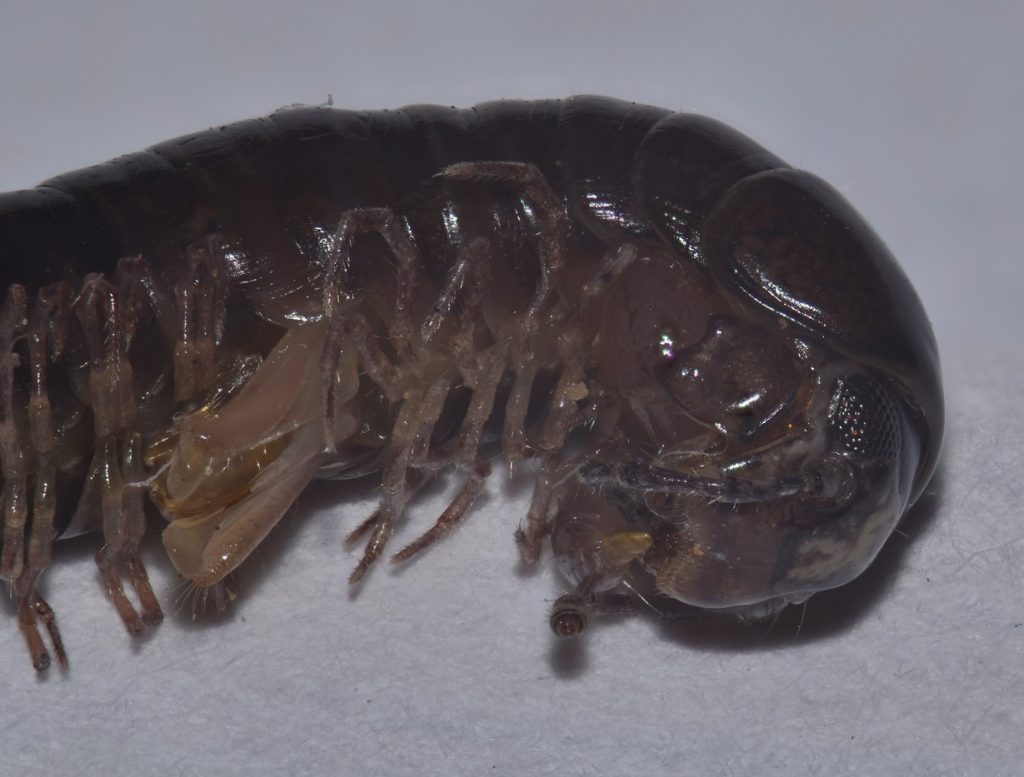
In this photo, you can see the gonopods on the seventh segment.
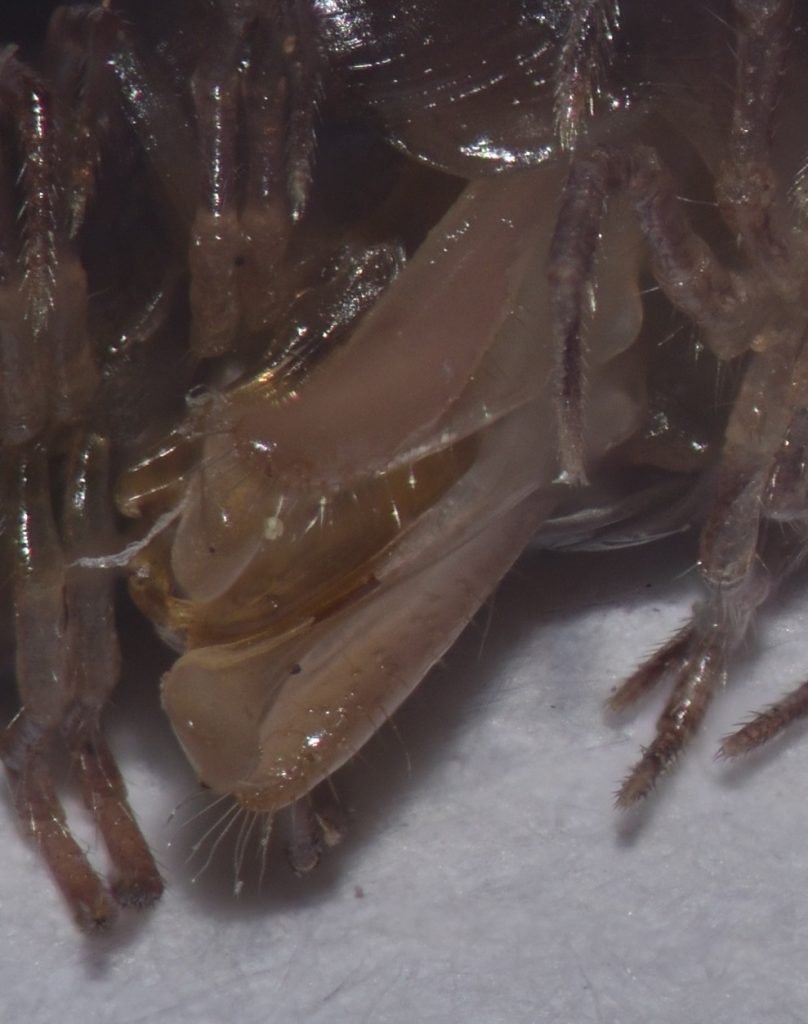
So how does that work? As you might expect, the details vary from species to species, but I found a website that gives a couple of examples. You can view the relevant page by clicking here. Both examples involved species in the order Polydesmida or flat-backed millipedes.
The first species studied was an Australian millipede, Cladethosoma clarum. Researcher Melissah Rowe observed 30 acts of copulation in 30 different pairs and offered the following description (which I’ve paraphrased).
The male lined up his ventral (bottom) surface with the female’s ventral surface so that his seventh segment (the one with the gonopods) was opposite the female’s third segment (the one with the vulvae). Holding the female’s head with his front legs, he arched his seventh segment away from the female. Presumably, this allowed sperm to be ejaculated from the penises onto the gonopods. The male then inserted his gonopods into the female’s vulvae. He partially withdrew them and inserted them several more times before letting them remain inserted for the duration of the copulation. The whole process lasted 2 to 17 minutes, averaging a little under 5.
The article goes on to describe copulation in another species, Parafontaria sp., observed by researchers in Japan. Copulation in this species was similar, but lasted a lot longer, ranging from 57 to 265 minutes.
That Certain Glow (of millipede genitalia) 22
As previously noted, one of the best ways to tell millipede species apart is to examine their private parts. Of course, this is easier said than done. Millipedes are not large animals and the anatomy of their genitals can be hard to discern. Researchers at the Chicago Field Museum have come up with a new imaging technique that can potentially make such identifications easier.
It turns out that some millipedes have genitals that glow under ultraviolet (UV) light. Stephanie Ware, one of the research assistants at the museum, rigged up UV flashlights on a camera. She then used a technique called focus stacking to create highly detailed images of the glowing gonopods. Usually, in a macro photo, only part of the subject will be in focus. In focus stacking, you take a series of photos of an object, changing the focus slightly each time. (The camera has to be on a tripod or similar device to keep it from moving and the subject has to be completely still.) The resulting images are run through a computer program that extracts just the parts that are in focus and stitches them together into a single image. (I used focus stacking to get the two photos of millipede genitalia in the last section.) Using this technique, the researchers were able to identify 8 species in the genus Pseudopolydesmus (order Polydesmida) that had previously been miscategorized as 12 species.
It’s not known if having genitals that glow under UV light provides any evolutionary advantage. The millipedes in this order are blind, so it could be that the glow is just an accidental byproduct of some chemical present in the tissues.
The consequences of all that millipede sex is, of course, a new generation of millipedes. The female lays from ten to three hundred eggs at a time, depending on the species. She fertilizes them in the process, using sperm that she’s kept in storage. Many species just lay the eggs on wet soil or detritus, but some actually construct nests. They bury into the soil and build nests, which they may line with their own feces. Most types of millipede abandon the eggs after they’re laid, but some hang around to care for them until they hatch. Some even provide parental care for the hatchlings until they’re ready to go it alone.
Millipede Evolution 25
Millipedes have a very long history, dating back to the Silurian period 443.8 to 419.2 million years ago. They were among the first animals to colonize the land.
Millipedes are slow-moving and they’re limited to wet, humid environments, so they’re not quick to spread. Nevertheless, 400 million years is a very long time. In their slow, plodding way, they’ve managed to make it to every continent except Antarctica. (They were probably there, too, before it got too cold for them.)
One consequence of being slow to spread is that it’s easy for a population to become isolated. Isolation leads to diversification. If a population is isolated long enough, it may form a new species. For this reason, millipedes have become greatly diversified. There are approximately 12,000 named species in 16 orders and around 140 families spread throughout the world.
I already mentioned that millipedes are in the phylum Euarthropoda. Within the arthropods, they belong to a subphylum called Myriapoda. This includes millipedes (Diplopoda), centipedes (Chilopoda), and a couple of less well-known classes, Pauropoda and Symphyla.
Symphyla are very small arthropods 2 to 10 mm long. They have a superficial resemblance to centipedes and are sometimes called garden centipedes or pseudocentipedes. They live in the soil, where they consume decaying vegetation. 26
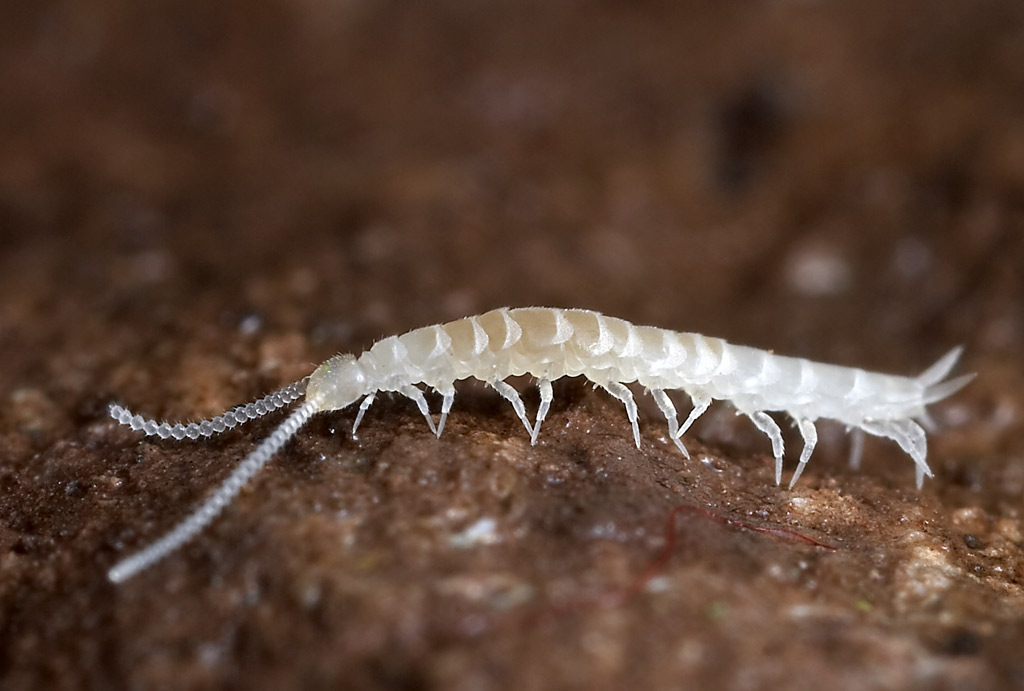
Author: Soniamartinez
This file is licensed under the Creative Commons Attribution-Share Alike 4.0 International, 3.0 Unported, 2.5 Generic, 2.0 Generic and 1.0 Generic license.
Pauropoda are a class of even smaller Arthropods, measuring only 0.5 to 2 mm long. They also live in the soil. Pauropoda have been observed eating mold, fungal hyphae (the thin filaments that make up the underground part of soil fungi), and the root hairs of plants. One of their distinguishing characteristics is their antennae, which are branching, biramous (having two main branches), and segmented. You can see this most clearly in the top two figures of the following drawing. Note that each antennae forks into two branches (before one of the branches forks again).27
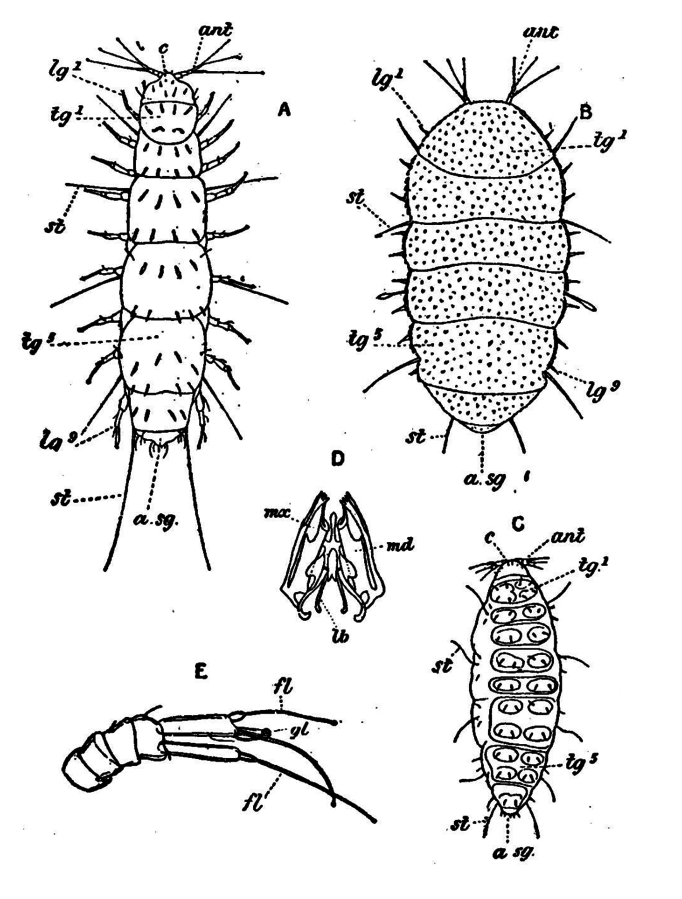
Author: unknown
This image comes from the 12th edition of the Encyclopædia Britannica or earlier. The copyrights for that book have expired in the United States because the book was first published in the US with the publication occurring before January 1, 1924. As such, this image is in the public domain in the United States.

Author: Hideyuki Miyazawa
This file is licensed under the Creative Commons Attribution 3.0 Unported license.
Scientists used to think that insects were the sister group to millipedes, meaning they branched off from a common ancestor. More recent research has shown that insects probably evolved from crustaceans and that crustaceans and myriapods share a common ancestor.
The relationships between the classes in Myriapoda have been the subject of much research and debate over the years, but advances in molecular analysis are beginning to clear things up. According to the most recent paper I was able to find on the subject, which was published in 2014 and which you can read by clicking here, Symphyla is probably the basal class, branching off first from the common ancestor of the group. Pauropoda was the next group to branch off, followed by the millipedes (Diplopoda), and finally the centipedes (Chilopoda).
One of the figures in the referenced paper shows a cladogram (tree of relationships) that illustrates this. The figure also shows the relationships of the other arthropod groups to the Myriapoda. It’s worth checking out if you’re interested in arthropod evolution. Click here to go that figure.
Perhaps the most interesting finding in this study is that Symphyla appears to have branched off before the Myriapoda colonized the land. This implies that there wasn’t a single colonization event. In other words, the ancestors of the Symphyla colonized the land in one such event and the ancestors of the rest of the Myriapoda colonized it in one or more separate events.
A Sadly Extinct Millipede
The Carboniferous Period, which lasted from 358.9 to 298.9 million years ago, is famous for two things: the formation of the coal beds (which gave the period its name) and giant insects. The latter was at least partly the result of the very high oxygen levels at the time, which allowed arthropods in general, not just the insects, to grow to much larger sizes than would be possible today. (The lack of large vertebrate predators may have also played a part.) Not surprisingly, the largest known fossil millipede was found in Carboniferous deposits. This is Arthropleura armata and it grew to 2.5 meters long — over eight feet! 28 29
What do you call a group of millipedes?
A murder of crows, a parliament of owls, a crash of rhinos… I don’t know who comes up with these terms or how they become ‘official’, but I got to wondering what a group of millipedes would be called. Googling the matter didn’t give an answer, although I did find out that a group of centipedes is called a swarm (at least according to one person somewhere on the Internet). So maybe no one has come up with a name for a group of millipedes, in which case, I guess someone needs to.
As mentioned in the previous section, millipedes belong to the group Myriapoda, so how about a “myriad of millipedes”? That has a certain ring, but it’s a little boring. Millipedes are kind of slow, so what about a “moseying of millipedes”? Better, but maybe a little hokey. In addition to being slow, they often appear to wander around at random, so how about a “meandering of millipedes”? Yeah, I like that… a meandering of millipedes it is.
Update 01/16/2020 30
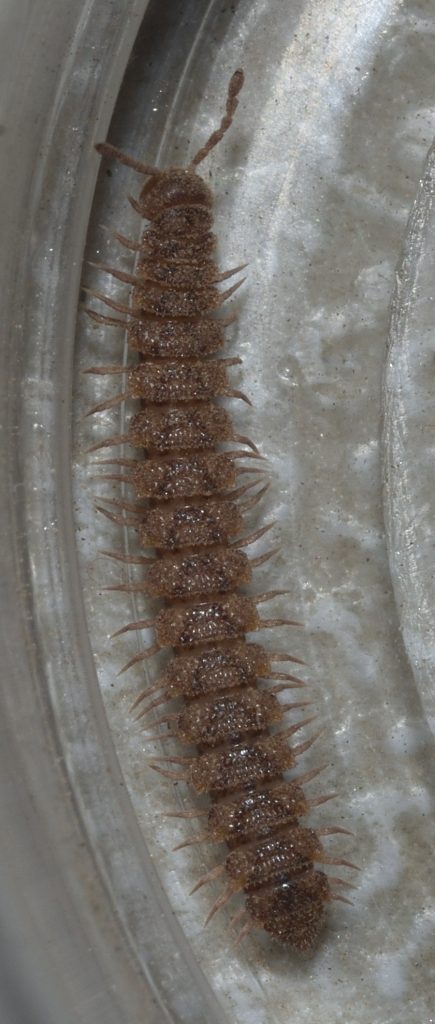
This just in… A week or two after publishing this article, I found a third species of millipede in my area. This one is in the order Polydesmida — the “flat-backed millipedes”. They are called this because most of the species, including this one, have wide lateral keels on their body segments called paranota. This gives them a more flattened appearance than the other two millipedes discussed here. Polydesmida is the largest order of millipedes, so it’s not surprising that they are found around here. They also hold the distinction of being the only millipedes that secrete hydrogen cyanide from their stink glands.
This millipede is much smaller than the other ones I’ve encountered, as you can see from the first photo below. One person online identified it as probably being in the family Macrosternodesmidae. I haven’t been able to confirm that, much less narrow it down to genus or species. I’ll update this post if more info becomes available.

San Diego County 1/14/20
San Diego County 1/14/20
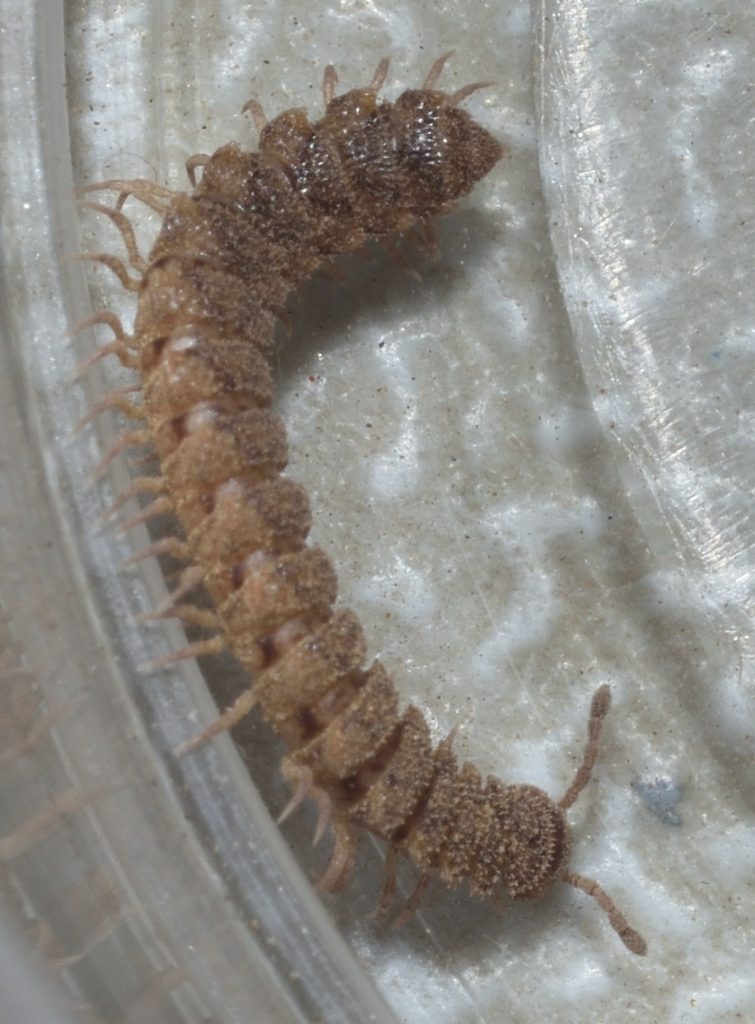
San Diego County 1/14/20
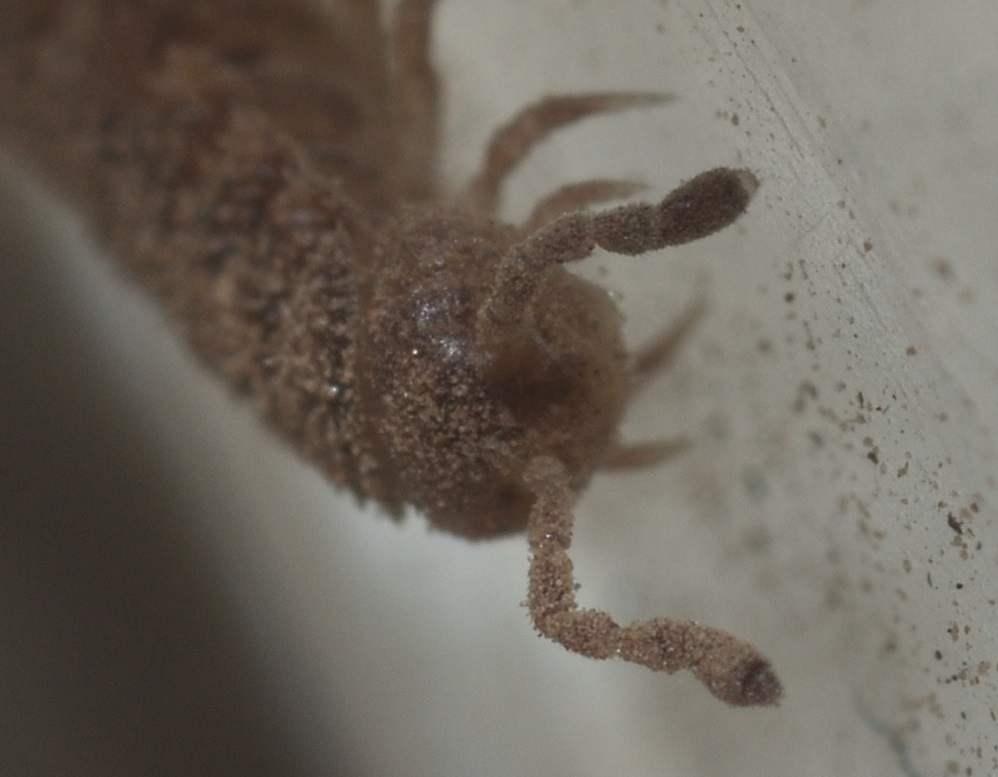
San Diego County 1/14/20