“Everybody knew that you should never provoke a rattlesnake, much less tie it into a bow. But that didn’t stop Judd. What did stop him was the rattlesnake.” -Demetri Martin
It’s easy to forget how remarkable the rattlesnake is. We all learn about rattlesnakes as kids, so we’re used to them, even if we’ve never actually seen one in the wild. And, of course, many people are too busy being terrified of rattlers to think about them in any other way. But stop for a minute and really think about it — a snake with a rattle on its tail! If it didn’t actually exist, it would be a ridiculous idea. The evolution of the rattle will be one of the things I’ll be covering in this article, but first, we need to get the basics out of the way…
Rattlesnakes are native to North and South America with the greatest concentration in the southwestern United States and northern Mexico. There are two genera of rattlesnakes, Crotalus and Sistrurus. Sistrurus is the more basal genus, which is to say, Sistrurus evolved first and Crotalus branched off from it. The larger, more well-known of the rattlers are in Crotalus. Those in Sistrurus are smaller and have smaller, higher pitched rattles. There are 33 species of rattlesnakes altogether, only 2 of which are in Sistrurus.1
Rattlers are pit vipers (subfamily Crotalinae of family Viperidae). The “pit” part of the name refers to the pit organs, small heat-sensing pits located on each side of the head. These act like eyes, allowing a rattlesnake to detect warm-blooded prey even in pitch dark.2
There are a number of Crotalus species here in southern California, but I’ve only had the uh… good fortune to encounter a couple of them. One is the red diamondback or C. ruber, which has a very pale, reddish coloration and a diamond pattern on its back. The other is the western diamondback or C. oreganus. This has a similar diamond pattern, but is usually dark gray or brown. Most of the western diamondbacks that I’ve seen have been in the subspecies C. oreganus helleri, which is also called the southern Pacific rattlesnake.3 4 5 (A third species, C. atrox, also goes by the common name western diamondback. Their range is supposed to include the southern tip of California, but, as far as I know, I haven’t encountered any.)6
I’ve run into rattlesnakes (almost literally a couple of times) in various places around San Diego County, but most of the encounters were in Mission Trails Regional Park, just west of San Diego. I don’t suppose they are any more common there than in most of the other places I hike; I just hike in Mission Trails a lot more often, since it’s close to where I live.
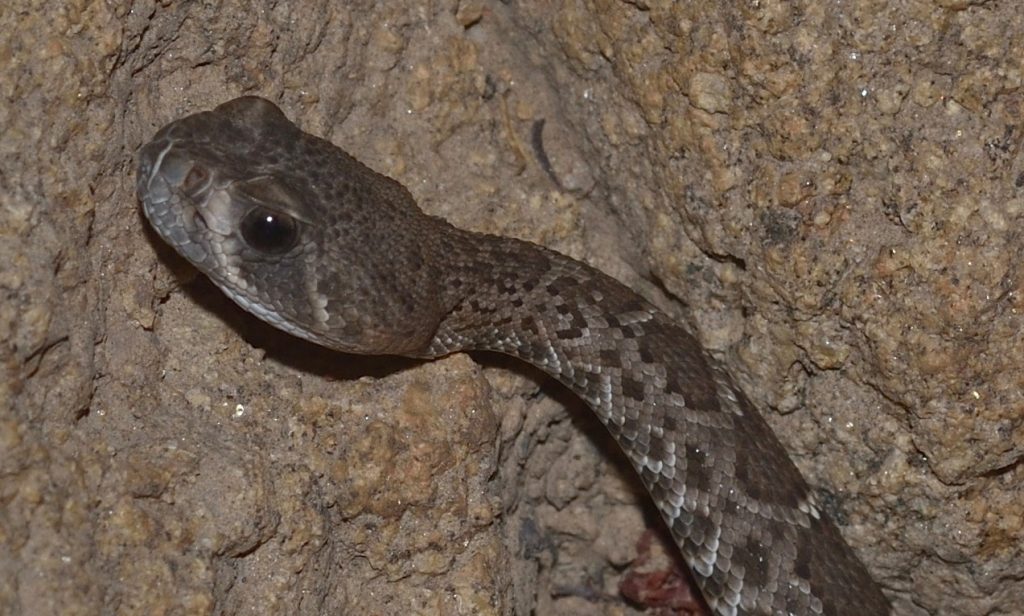
That said, I saw around 17 rattlers in 2018, almost all of them in that park. I came close to stepping on one twice. The second time was the scariest. I had just turned onto a trail. Overhanging branches of broom baccharis were blocking my view of the rattler, a huge southern Pacific. My foot landed right in front of the snake, which started rattling very loudly. Needless to say, I jumped back. I don’t know if the snake had already been coiled up when I almost stepped on it, but it was coiled up by the time I saw it. The snake partially uncoiled and, using some kind of beautiful, sinuous motion that I can’t begin to describe, propelled itself several yards away, deeper into the bushes, hissing and rattling the whole time. It stopped there and continued to rattle angrily as we took photos of it. Fortunately, there wasn’t much undergrowth, so I was able to get some great shots and a nice, long video. Those are posted below.
Mission Trails Regional Park, San Diego County 8/16/2018


In the video, you can hear one of the people I was hiking with calling to some women who were walking by on the main road, asking them if they wanted to see a rattlesnake. They declined. You can hear my friend responding “You’ll catch the movie…” Lol.
It was a fairly unnerving experience, since I’d already come close to stepping on a smaller rattler earlier that year. After that second encounter, I bought some snake chaps and started wearing them whenever I hiked in Mission Trails. I kept wearing them until the weather turned cooler, making rattlesnake encounters less likely. For whatever reason, I haven’t encountered as many rattlers this year (2019) and I haven’t felt the need to wear the chaps. You can bet I keep to the middle of the trail whenever I pass that particular overhanging bush, though.
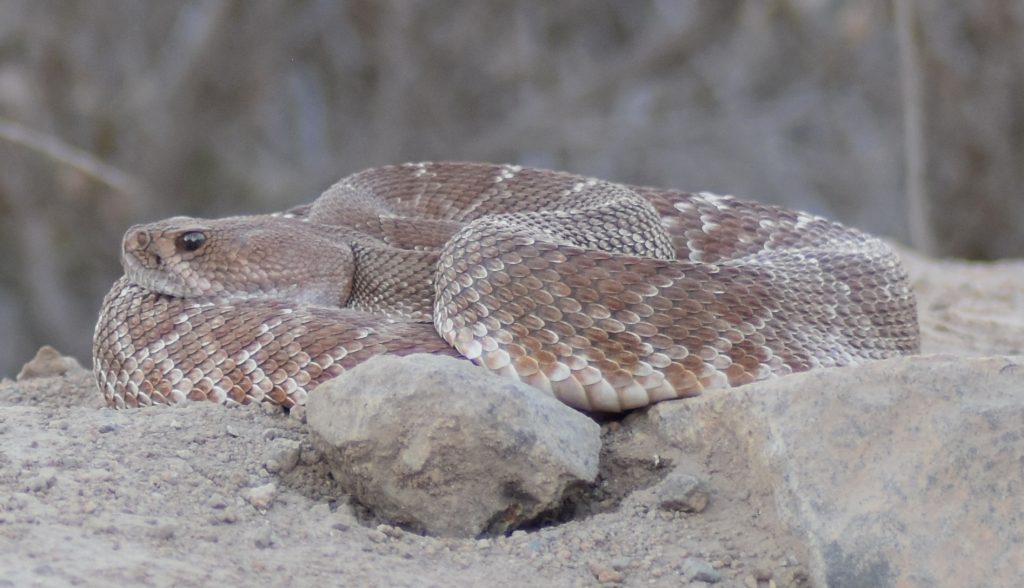
Mission Trails Regional Park, San Diego County 8/7/2018

As hair-raising as that last story may have sounded, rattlesnake bites are actually very uncommon and, when they do occur, they’re rarely fatal. On average, there are 7000 to 8,000 venomous snake bites in the U.S. per year — that’s all types of venomous snakes, not just rattlers. And, on average, only 5 of those 7000 to 8000 snakebite victims die. Rattlesnakes don’t want to bite you. They will do so only if they feel threatened. If you step on one or try to catch it, then, sure, it’s going to bite. According to Wikipedia, “A majority of victims (about 72%) are males, often young and intoxicated”.7
One reason rattlesnake bites are rarely fatal is that the snakes have voluntary control over how much venom they inject. It takes energy for a snake to make venom, so it doesn’t want to waste it on something that it can’t eat. When a rattlesnake bites a person, it will often inject a smaller amount of venom than it would if it was attacking prey. In fact, around 20% of rattlesnake bites are dry bites — no venom at all!8
I do know one person who was bitten by a rattlesnake. A woman that I often hike with had just finished a hike. She went into the bushes for a call of nature and, as she was pulling her pants up, her foot broke through the ground and into a rattlesnake den. The snake started rattling and my friend felt a light tap on her calf. She said it felt like a tap on the shoulder. She thought maybe the snake’s rattle had hit her. After pulling her foot out (and presumably putting some distance between herself and the rattler), she examined her leg. She didn’t see any marks at first, but when she squeezed her leg, two tiny beads of blood oozed up from where the fangs had penetrated.
As I mentioned, this was at the end of the hike, so one of the other hikers was able to drive her directly to a hospital. This hiker was driving a Corvette and, in his words, “I’d been waiting for this my whole life!” To make a long story short, my friend managed to survive the drive to the hospital and the bite turned out to be dry. She never felt any effects from it at all. The poor snake was probably too surprised to even think about injecting venom.
Note: As soon as my friend was bitten, they called 911 and the ambulance met them as they were driving to the hospital. The paramedics checked her over quickly, but she wasn’t exhibiting any symptoms and, since the sports car was able to handle the twists and turns in the road better than the ambulance, the paramedics let her continue the trip to the hospital in that.

copyright © 2019 Hazell Belvin
Used with permission
So, to summarize, you’re unlikely to ever get bitten by a rattlesnake and, if you are, there’s a good chance that the rattlesnake will not inject a full dose of venom. But if you do get bitten, what should you do?
What To Do If Bitten
I was going to include list of things to do in case of snake bite, but I’m not a medical professional, so it’s probably better if I just direct you to a few websites that seem trustworthy. Click here for the Mayo Clinic’s snake bite page. Click here for a site that’s specific to rattlesnake bites. And finally, click here for a link to Johns Hopkins’s page.
Now that we’ve covered the basics, let’s take a closer look at the various things that go into the making of a rattlesnake.
As mentioned earlier, the pit organs are small, heat-sensing pits on each side of the rattlesnake’s head. In the photo below, you can see one of the pits. It’s positioned between the eye and nostril, a little lower on the snout. The silvery oval inside the pit is the pit membrane. It may look like it’s swelling outward, but I think that’s an optical illusion. It’s actually curved inward, as depicted in the diagram below the photo.

The silvery oval is the pit membrane.
Mission Trails Regional Park, San Diego County 8/14/2017
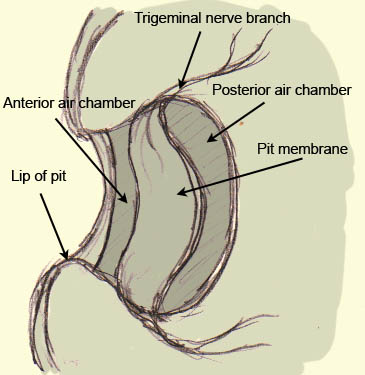
This image is in the public domain. It was downloaded from Wikipedia Commons at this url.

The pit organs function as crude eyes for detecting infrared light, a.k.a heat. For those of you who need a quick physics refresher, heat has several ways of traveling from place to place. One way is in the from of light waves in the infrared portion of the spectrum. The only difference between infrared light and red light is the wavelength. The wavelength of infrared light is longer than that of red light and cannot be detected by our eyes. As it happens, it can’t be detected by the rattlesnake’s eyes either. That’s why it needs pit organs.
In its regular eyes, the rattlesnake has special chemicals that are sensitive to light in the visible spectrum. The pit organ works a little differently. When infrared light from a warm object like a mouse hits a spot on the pit membrane, it heats up that spot. Infrared (IR) receptors in the form of heat-sensitive proteins detect the change in temperature and generate an electrical impulse that travels down nerves to the snake’s brain. The pit membrane is rich with blood vessels which quickly cool the spot back down to ambient temperature once it’s no longer being heated up.
Note that the opening that lets infrared light into the pit is smaller than the diameter of the pit. This means that the pit acts like an infrared version of a pinhole camera. The infrared light entering the pit forms a crude image in the form of a heat map on the surface of the membrane. So the pit membrane serves the same function as the retina in a regular eye.
The snake’s brain integrates the heat map from its pit organs with the visual images from its eyes. It’s kind of like how our brain integrates the 2-d images from each eye to form one 3-d image. So, what does this look like to the snake? I have no idea. I’m not a snake (despite what you may have heard). It’s like a person who’s been blind from birth trying to imagine what eyesight is like.
The heat image formed by the pits must be rather crude, but it’s good enough for the snake to detect and strike prey in total darkness. A BBC video that I found on YouTube shows some infrared images from a heat-sensitive camera developed by the military. According to the narrator, the rattlesnake’s pit organs are “30 times more powerful” than the camera. I think this probably means that the pit organs are able to detect a heat signature that is 30 times weaker; I doubt they form as sharp an image. It’s a great video, though. You can watch it here.
There is also evidence that the snake uses the pit organs for avoiding predators and for thermal regulation. In fact, it’s possible that the pit organs originally evolved for prey avoidance and/or thermal regulation and that rattlesnakes (or their ancestors) only later started using them for hunting.
So how could pit organs have evolved? I wasn’t able to find much about this, but one article mentioned that some snakes in the Boidae family have IR receptors in their labial scales (scales on the sides of the snout), without any specialized structures. Other snakes in the same family have IR receptors in the bottom of simple labial pits.12 These would seem to be examples of possible intermediate steps in the formation of a pit organ.
Those Eyes 13
Humans and many other animals have a small, central pit in the retina called a fovea consisting of tightly packed cone cells (the cells responsible for color vision). The fovea is where our vision is sharpest and it makes it possible for us to do things like reading and driving. A rattlesnake eye doesn’t have a fovea, so rattlesnakes are not able to see sharply defined images. (Never let a rattlesnake drive!) They rely mostly on the perception of movement and don’t appear to follow objects with their eyes.

Same one as in the earlier photos
Rattlesnakes are adapted for hunting at night, so they have lots of rod cells (the cells that are sensitive to dim light, but not color). They also have cone cells, though, so they have some color vision.14
Rattlesnakes have vertical pupils. That is, when the pupil is contracted, it forms a vertical slit. Not all snakes have vertical pupils. Studies have shown that it’s mostly ambush predators that have them. Computer simulations have shown that a vertical pupil allows a predator to better judge distance without moving the head — an obvious advantage, since moving the head could alert prey. (For a fascinating article about pupil shape, click here.)
Those Ears? 15
Yes, rattlesnakes have ears. They just don’t have ear openings. Or eardrums. What they do have are middle ears, but even those are not as specialized as those of mammals. In fact, mammals in general have much better hearing than reptiles because a couple of bones that form part of the jaw in reptiles (which are the ancestors of mammals) migrated into the middle ear and now form part of a mammal’s hearing apparatus — a remarkable and bizarre fact that I definitely need to do a blog post about one of these days.16
So rattlesnakes don’t have very good hearing. They do seem to be very sensitive to vibrations in the ground, though. These are transmitted to their ears through their bodies, especially their bones. So I suppose they do have pretty good hearing in that sense.
That Flicking Tongue 17
Snakes use their forked tongues for smelling. The forked tongue is not unique to rattlesnakes, of course — many reptiles have them — but it certainly adds to their mystique.
Snakes have a great sense of smell. In fact, it’s probably their most important sense. When a snake senses a change in its environment (through vibrations in the ground, for instance), it immediately starts flicking its tongue in and out, sampling the air. A groove, called a rostral groove, in the snake’s upper lip allows the tongue to move in and out without the snake having to open its mouth. When the tongue darts out, chemicals in the air stick to it. When the tongue is withdrawn into the mouth, the tines are inserted into two tubes in the roof of the mouth. These tubes form the Jacobson’s organ, also called the vomeronasal organ (VMN). This organ is stimulated by chemicals on the tongue to send nerve signals to the part of the brain that processes smell.
So why do snakes have forked tongues? This allows them to sense the direction from which a smell is coming. For instance, if more of a particular chemical sticks to the left tine than to the right, then the smell is probably wafting in from the left.
Snakes are also able to smell through their nostrils. I’m not sure how sensitive their noses are, but I get the impression that their tongues are far more sensitive. According to one article, a snake may pick up a scent through its nostrils and then start flicking its tongue to get a better sniff.18
I can’t resist mentioning that humans, as well as many other mammals, also have a Jacobson’s organ. It also consists of two tubes in the roof of the mouth. There’s a lot of debate about what purpose the Jacobson’s organ serves in humans. Some people think that it’s stimulated by sexual pheromones. Others disagree. There doesn’t seem to be any definitive evidence either way.
Those Venomous Fangs19
Rattlesnakes, in case you haven’t noticed, have two thin, curved fangs in the front of their mouths. These fangs are very much like hypodermic needles. They have a hollow core with an opening near the top where the venom enters the fang and a narrow slit on the front of the fang near the tip, through which the venom is ejected. Each fang is supplied with venom through a duct that connects to a large venom gland located near the back of the head. So there’s a separate venom gland for each fang. These glands are what give rattlesnake heads a triangular shape.20 When the snake bites, muscles on the sides of the glands squeeze the venom through the ducts into the fangs.
When the rattlesnake closes its mouth, the fangs fold back into the roof of the mouth, where they rest in a sheath of soft skin.21 Click here to see a video of a rattlesnake skull with the jaws rigged up to keep opening and closing. If you spend a little time watching this video, you can get a pretty good idea how the system works. Fangs are modified teeth, of course. They grow from the maxilla bone of the upper jaw. The other teeth, which are used for gripping the prey while the snake swallows it, grow from a separate bone, the pterygoid, that connects to the end of the maxilla and extends backwards toward the rear of the skull. The maxilla is connected at the other end to the rest of the upper jaw. The connections between all these bones are flexible, allowing them to rotate with respect to each other. When the rattlesnake opens its mouth, the pterygoid bones are pushed forward and the maxillas rotate, swinging the fangs into biting position.
Rattlesnakes shed their fangs periodically (once every 60 days or so) and they always have replacement fangs waiting in reserve. In fact, they have a series of 7 pairs of fangs in various stages of development behind their functional fangs! So even if a snake unexpectedly breaks a fang, it won’t have to wait long before it can deploy a new one.
So how did this whole remarkable system evolve? Let’s start with the venom. Venom is basically very strong saliva. This may raise a few eyebrows. How does saliva get magically transformed into venom? Well, it may surprise you to learn that ordinary human saliva injected under the skin of the hand can cause pain, redness, swelling, and partial loss of function.22
Obviously, human saliva did not evolve to be toxic. It just happens to contain some substances that don’t have very nice effects when injected under the skin. Actually, this isn’t too surprising given that the purpose of saliva is to aid in digestion by beginning to break down food in the mouth. So it makes sense that if it’s injected into the hand, it would begin to break down tissue. It’s also not hard to imagine evolution working with snake saliva to slowly increase its toxicity.
Venom — and this is true for almost all venomous creatures — is not a single substance. It’s a complex cocktail of chemicals and the different chemicals may serve very different purposes. For instance, some chemicals may act to actually kill the prey, while other chemicals only paralyze it. Still other chemicals may start the process of digestion. Different components of venom may also act on different systems. One chemical might break down muscle while another attacks the nervous system.
Different species of rattlesnake have evolved different mixtures of chemicals in their venoms to match their preferred prey. For instance, the venoms of C. ruber and C. oreganus are mostly necrotic — they break down tissue. The Mojave rattlesnake (C. scutulatus), on the other hand, has more neurotoxic components in its venom. Research has shown that the common ancestor of these three species had a more general purpose venom that contained both necrotic and neurotoxic elements. As this species differentiated into multiple species, its descendants modified the mix of chemicals in their venoms to reflect their presumably more specialized diets.23
That takes care of the venom, but how in the world did these snakes manage to evolve hypodermic needles with which to inject it? The first venomous snakes didn’t have fangs, but they did have teeth. These snakes probably caught their prey and held it in their mouths while the venom slowly seeped into the puncture marks made by the teeth. Chewing probably sped up the process. Eventually, some of the teeth evolved to be longer than the others and developed grooves that helped to channel the poison into the wounds. We still have these kinds of snakes today. These are the opisthoglyphous or “rear-fanged” snakes which make up the Colubridae family. (Technically, opisthoglyphous refers to the type of fang, not the group of snakes, but it’s often used informally to refer to the group.)
When I first read about rear-fanged snakes, I found the idea very confusing. How can a snake use fangs that are in the rear of its mouth? A picture of a snake called a boomslang on Andrew Durso’s excellent (and excellently-named) blog “Life Is Short, But Snakes Are Long” cleared things up for me. Click here to see the photo I’m talking about. It’s around the middle of the page. In this photo, you can see that the fangs aren’t actually in the rear of the mouth. They’re just at the rear of the maxilla bones. The pterygoid bones continue on beyond the fangs. (In these snakes, the maxilla and pterygoid bones are not able to rotate relative to each other.) So the fangs are really more toward the middle of the mouth. These snakes bite down on their prey and “chew” the venom into it.
The fangs of rattlesnakes — the kind that are in the front of the mouth and fold back when not in use — are called solenoglyphous fangs. These types of fangs evolved to inject large amounts of venom quickly and deeply. When a rattlesnake strikes a prey animal, it doesn’t hold on to it. After injecting venom into the prey, the snake immediately releases it. It then uses its excellent sense of smell to track the prey to where it finally collapses. This way, the snake doesn’t risk being injured by a struggling animal.
There’s another group of snakes that have what’s called proteroglyphous fangs. These fangs are also in the front of the mouth, but they don’t fold back. They tend to be about a third as long as rattlesnake fangs and they are also hollow. Snakes that have this type of fang are all in the Elapidae family and they include such infamous serpents as cobras, mambas, and death adders. Elapids bite their prey and hold on while they wait for the venom to take effect.
Scientists believe that solenoglyphous and proteroglyphous snakes both evolved from opisthoglyphous ancestors. So the distant ancestors of rattlesnakes would have had grooved fangs near the middle of the mouth. Over time, the ridges of the grooves folded over to form tubes and the fangs migrated to the front of the mouth. Evidence for this last part can be found in embryology. In the rattlesnake embryo, the developing fangs are located in the middle of the mouth in the same place as in rear-fanged snakes. As the embryo grows, the short piece the maxilla behind the fang grows much faster than the rest of the maxilla, pushing the fang forward in the mouth. You can find a nice set of photos illustrating this on the same blog page that I mentioned earlier, right under the picture of the boomslang. Click here to go back to that web page.
Those Insanely Flexible Jaws
Click here to see a video that explains how a snake swallows its prey. (It’s not a rattlesnake, but the principal is the same.) Snakes have more bones in their jaws than mammals do and these bones are not as tightly bound together. They have ligaments that stretch, allowing the bones of the jaw to spread apart, making room to swallow the prey whole.
You may be wondering how a snake goes about pulling a prey animal down its throat. I haven’t found any explicit description of this, but I’m guessing the snake clamps down harder with one side of the jaw than the other (remember how much more flexible those jaws are than ours!) and then twists its head so that the other side of the jaw moves a little farther up on the animal. It then quickly opens its mouth and snaps down again to get a new grip and repeats the process, this time clamping down with the other side of the jaw and twisting the head in the other direction.
It’s also possible, and this is entirely speculation on my part, that the pterygoid bone can be drawn back a little farther into the mouth to pull the prey a little farther in. Then the snake releases its grip long enough for the pterygoid to spring forward a little before it clamps down again. As always, if anyone out there has more info, please leave a comment. Once the prey gets down into the throat, the muscles of the throat and body can take over.
And Finally, That Rattle 24
The rattle consists of a series of hollow, interlocking segments. The segments are made of keratin — the same material that makes up our hair and fingernails and the scales of reptiles. In fact, the rattle segments are modified scales. Rattlesnakes are not born with rattles. Instead, the new-born rattler has a pre-button or first button on the end of its tail, which is a single segment of keratin. The pre-button is lost after a few days when the baby rattlesnake sheds its skin for the first time. The pre-button is replaced with the first rattle segment (labeled d in the diagram below). Obviously, this segment was developing before the snake molted, so it must have contained living tissue. By the time it’s ready to replace the pre-button, though, it has become a hollow shell of dead material and it has a second, living segment forming behind and partially within it. By the time the snake is ready to molt again, the living material in this second segment will have died, leaving a hollow keratin shell, and a third segment will have started growing behind it. In this way, the snake adds a new segment to its rattle every time it sheds its skin.

This photo is in the public domain. It was downloaded from here.

The series of segments at the bottom of the above diagram represents a disassembled rattle. Notice how each segment bulges out in two places. The front bulge of a segment fits loosely inside the rear bulge of the segment in front of it. So the segments remain connected to each other, but are loose enough to rattle against each other when the snake shakes its tail. 25
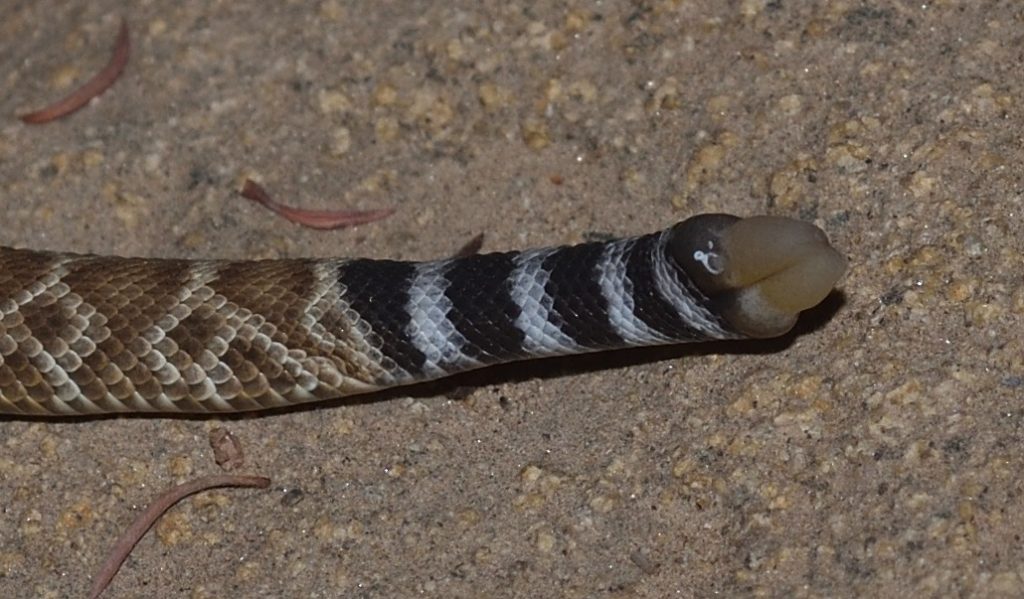
Mission Trails Regional Park, San Diego County 10/14/19
The YouTube channel What’s Inside? has an entertaining video in which the creator of the channel cuts open a rattle to see, well… what’s inside. As you can hopefully guess by now, he found that there was basically nothing inside — just the interlocking walls of the segments. You can watch that video by clicking here.
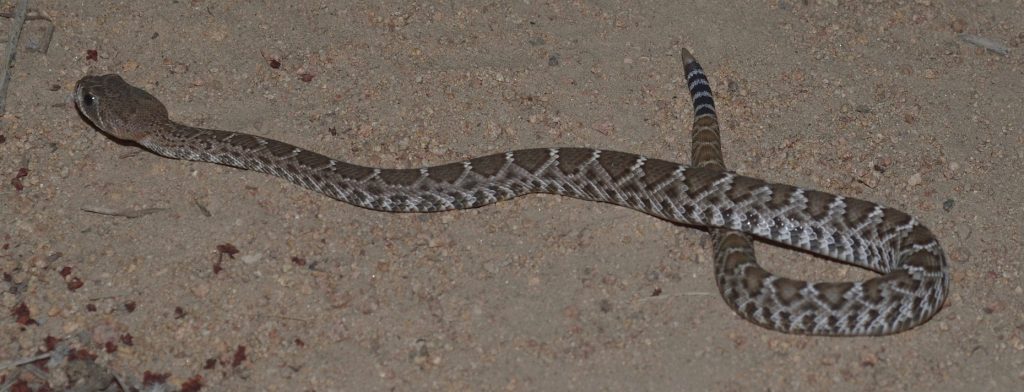
The muscles that shake the rattle are some of the fastest muscles known — comparable to those that power a hummingbird’s wings. They fire an average of 50 times per second and can keep firing for hours.
A rattlesnake sheds its skin several times a year, depending on the availability of food, so the number of segments in the rattle cannot be used to determine the age of a snake. Also, a rattlesnake will often lose segments from the end of the rattle in battles with other rattlers, when they are bitten off by predators, and just from general wear and tear. Usually, the rattle of a full-grown snake will have no more than 7 or 8 segments. (Note, the rattlesnake shown in the video near the beginning of this article — the one I almost stepped on — had a rattle with 12 segments! That was one big, healthy snake!)
So how did this amazing device evolve? Obviously, the rattle of modern rattlesnakes is a warning device (an aposematic device if you want to be technical). A rattle could not have just appeared full-blown in the rattlesnake lineage, though — it had to have evolved gradually. But it’s hard to imagine how a very early, proto-rattle could have been of much use as a warning device. So how could it have come about?
Actually, many modern snakes that don’t have rattles still shake their tails. They do this for a variety of reasons. Some snakes appear to shake their tails as a distraction. If a predator is trying to eat it, a snake may shake it’s tail to try to attract the predator to that end of its body. Obviously, the snake has a better chance of surviving the encounter if the predator is attacking its tail rather than its head.
Other snakes shake their tails to attract prey. A small, writhing tail may look like a worm or insect larva to a hungry bird. Some snakes actually have tails that have evolved to resemble specific kinds of insect larvae or other animals.26 Without a doubt, the most remarkable example of this is the Iranian spider-tailed horned viper which, as the name suggests, has evolved a structure on the end of its tail that resembles a spider!27 Click here to watch a video of this stunning creature.
Finally, a rapidly shaking tail, even without a rattle, may serve as a warning to predators that have learned to avoid such snakes.
In one study, researchers compared the tail shaking of 56 species of snake that didn’t have rattles to the tail shaking of rattlesnakes. They found that the more closely a species was related to rattlesnakes, the more similar their tail shaking was to that of rattlers.28
So the rattle probably started with a shaking tail. Over time, various modifications were added for various reasons. Eventually, in one lineage of snakes, these modifications led to the evolution of the rattles we see today.
In Conclusion
There’s so much more I could write about rattlesnakes. I should at least mention that rattlesnakes are ovoviviparous, meaning that the mother snake incubates her eggs inside her body and the babies are born live. Then there are rattlesnake roundups and the story of antivenin and dens full of hibernating rattlesnakes and on and on and on… but this is supposed to be an article, not a book, and it’s already much longer than I planned. If you made it this far, I hope you enjoyed reading it. And, as always, if you have any interesting facts or stories to add, feel free to put them in a comment. I’ll leave you with a few photos of rattlesnake skulls that I took at the San Diego Natural History Museum:
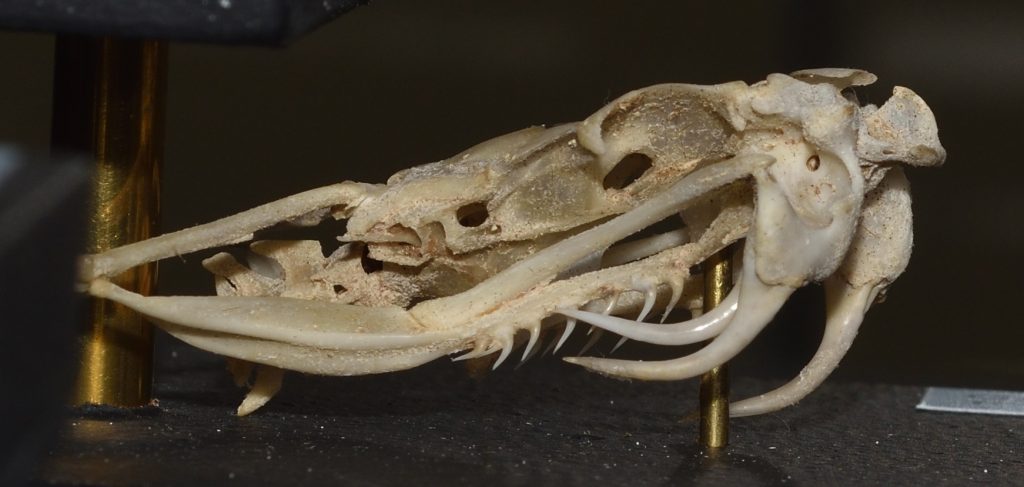
It looks like a replacement fang is coming in for the right fang. It’s not unusual for the original fang and the replacement to both be present for a time before the original finally works loose.
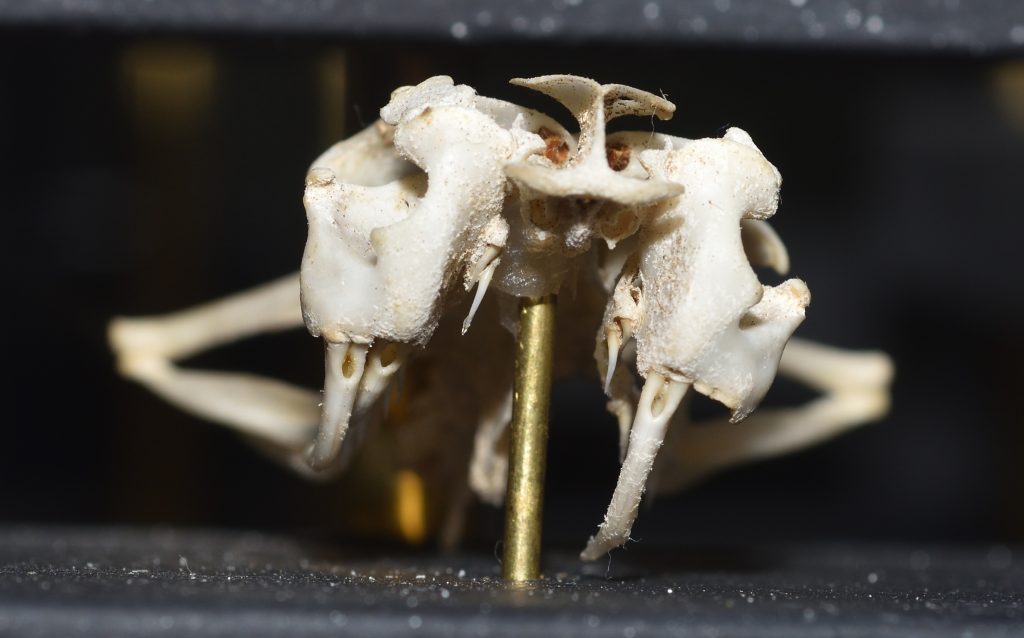
Front view of previous skull
In this photo, you can see that the replacement fang is coming in to the outside of the function fang. It will shift into the inner position, displacing the old fang.
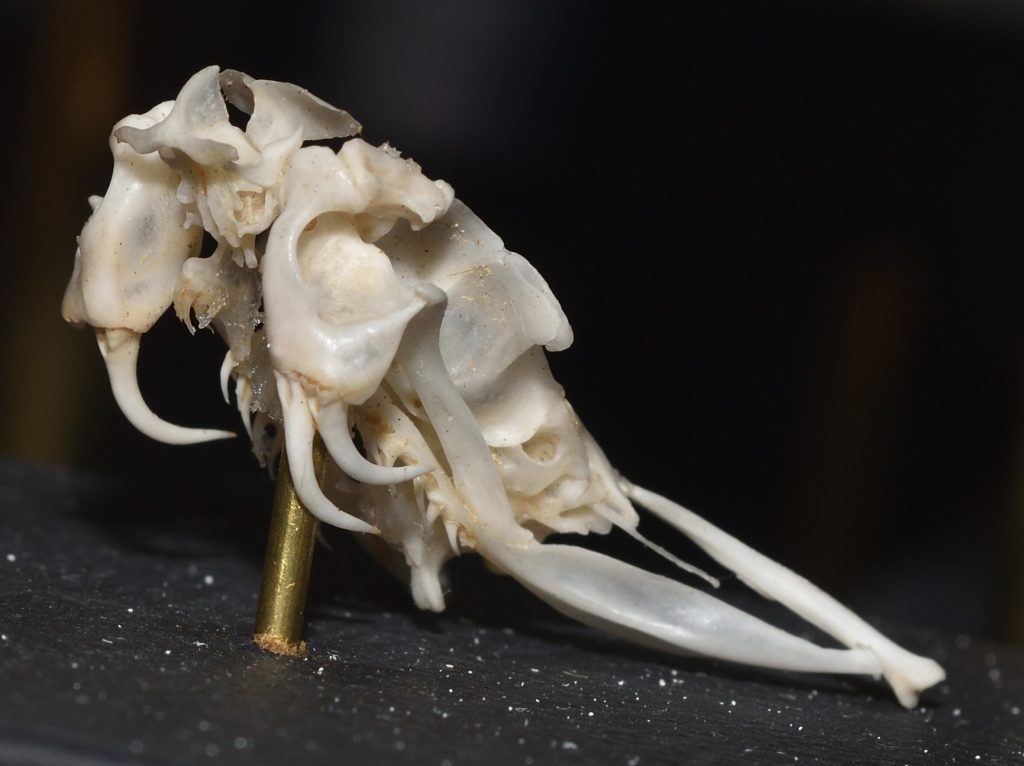
This snake also appears to have had a replacement fang coming in.
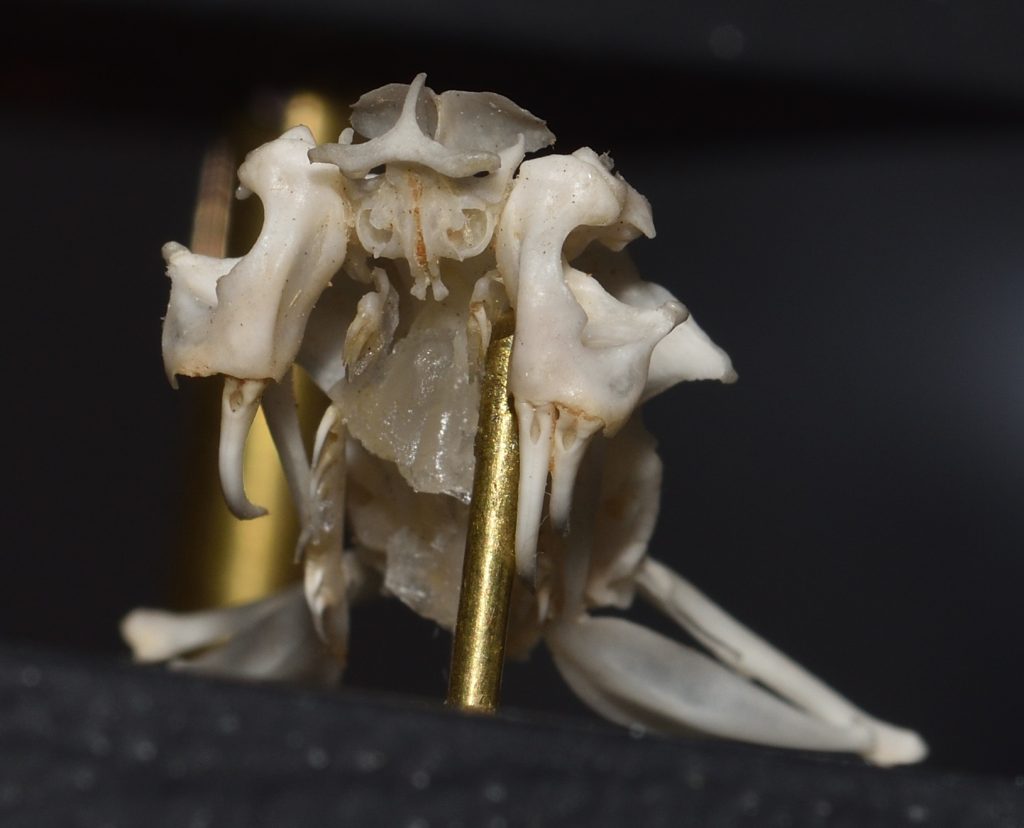
Front view of previous skull
Note the orifices in the bases of the fangs where the venom would enter them.
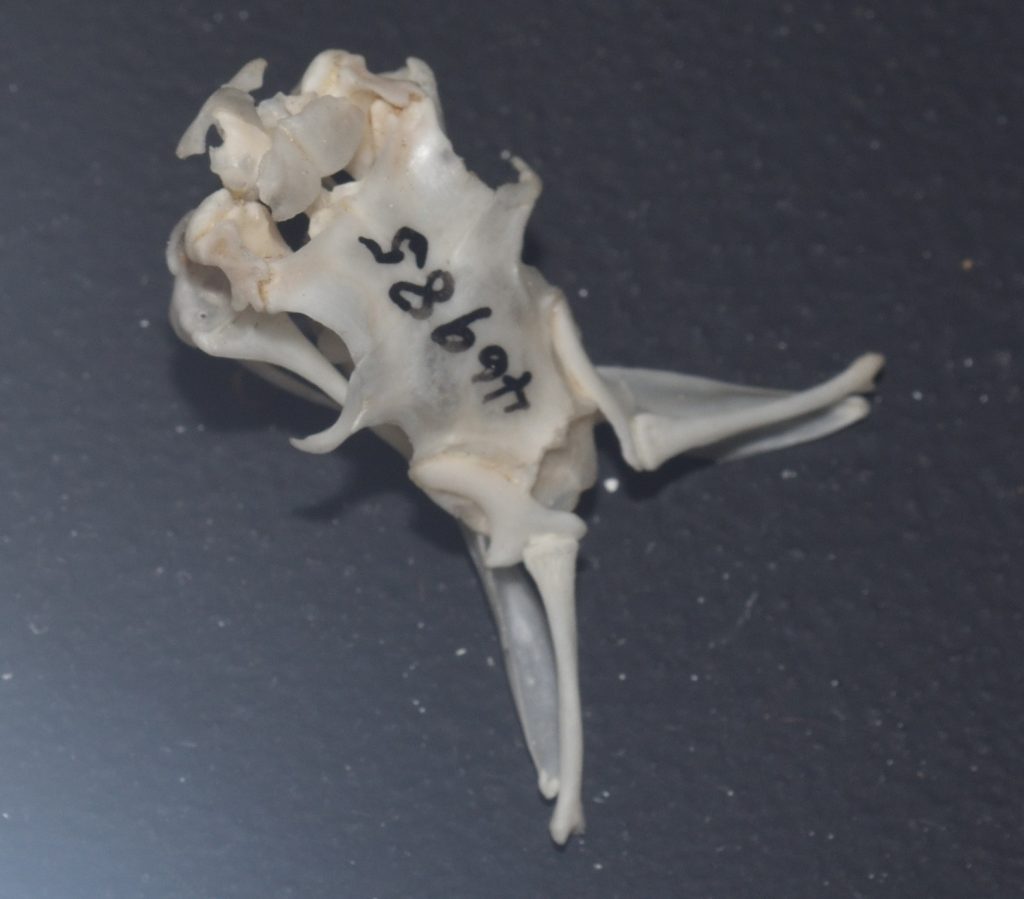
Top view of previous skull