“All you have to do is look at the plant to reliably identify it…”
-Tom Chester*
The above quote should give you some idea just how distinctive the elephant tree is. Elephant trees (Bursera microphylla) are fairly common in Mexico, especially in Baja California and the central Sonoran desert, but they’re not so easy to find north of the border. There are a few places in Anza Borrego State Park where you can see them, though. The largest collection is in Alma Wash and Alma Canyon, just south of Ocotillo Wells.**
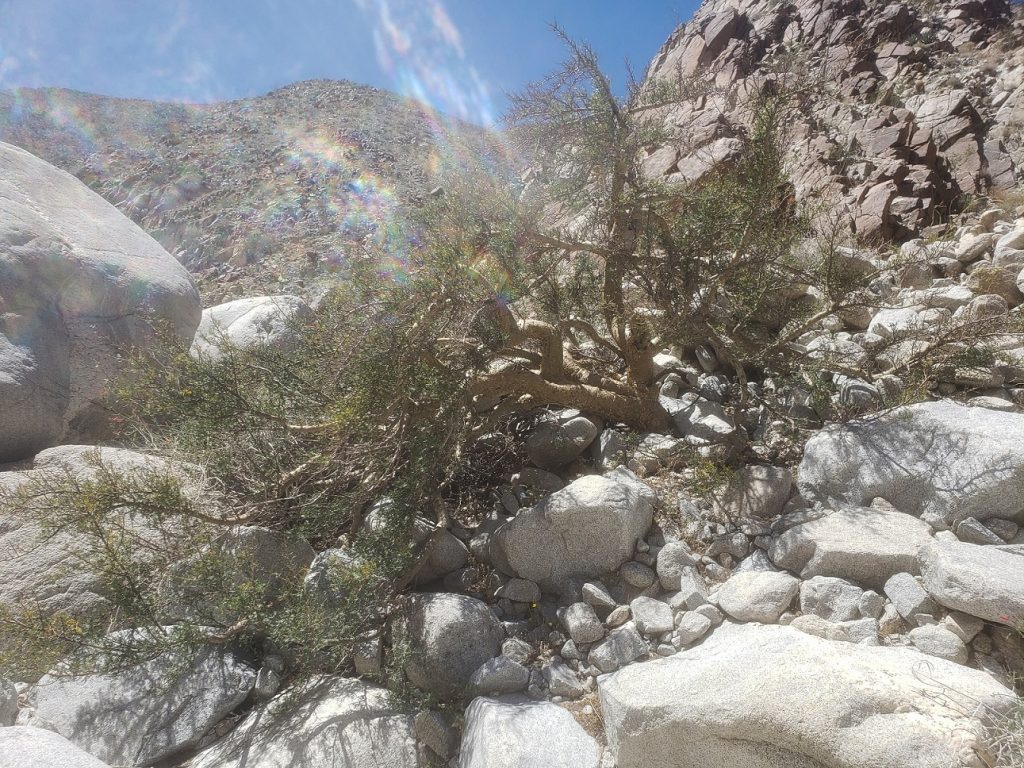
It’s not an easy place to get to. From Ocotillo Wells, you take Split Mountain Road to the beginning of Elephant Trees Nature Trail. It’s not far to the trail head, but the road is a bit rough. My car is AWD with an 8.5 inch clearance — a bit higher than the average car. So you don’t need an off-road vehicle, but high-clearance is advised. Elephant Trees Nature Trail is a fairly short loop. Unfortunately, there’s only one elephant tree left on the trail, as of this writing, and it’s not a particularly impressive specimen.

If you want the full experience, keep going up the wash, turn into Alma Canyon, and follow it to Starfish Cove. The entire hike is around 11.3 miles, give or take. It’s a long, arduous slog, much of it over broken rock and small boulders. Make sure you go during cooler weather and bring plenty of water.
So what’s so special about an elephant tree? Elephant trees are not tall — usually no more than 6 feet — but they have massive trunks for their size. The trunks are often very gnarled. Supposedly, if a boulder rolls over a young tree, it will often just keep growing, now with a new twist in its trunk. But a lot of the trees have gnarled trunks, so I doubt that rolling boulders can account for all of it. It would be interesting to know what other sorts of things cause the trunks to grow like that.
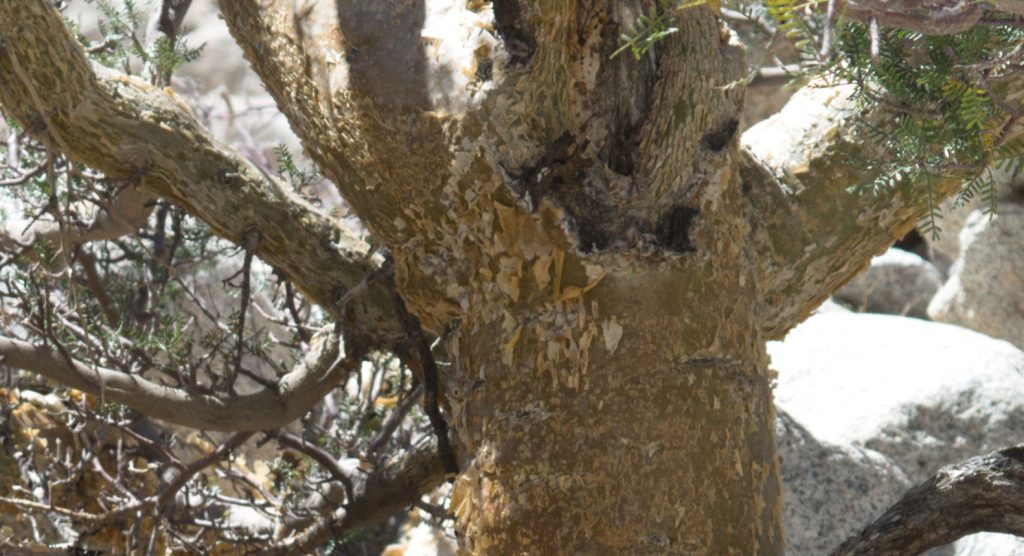
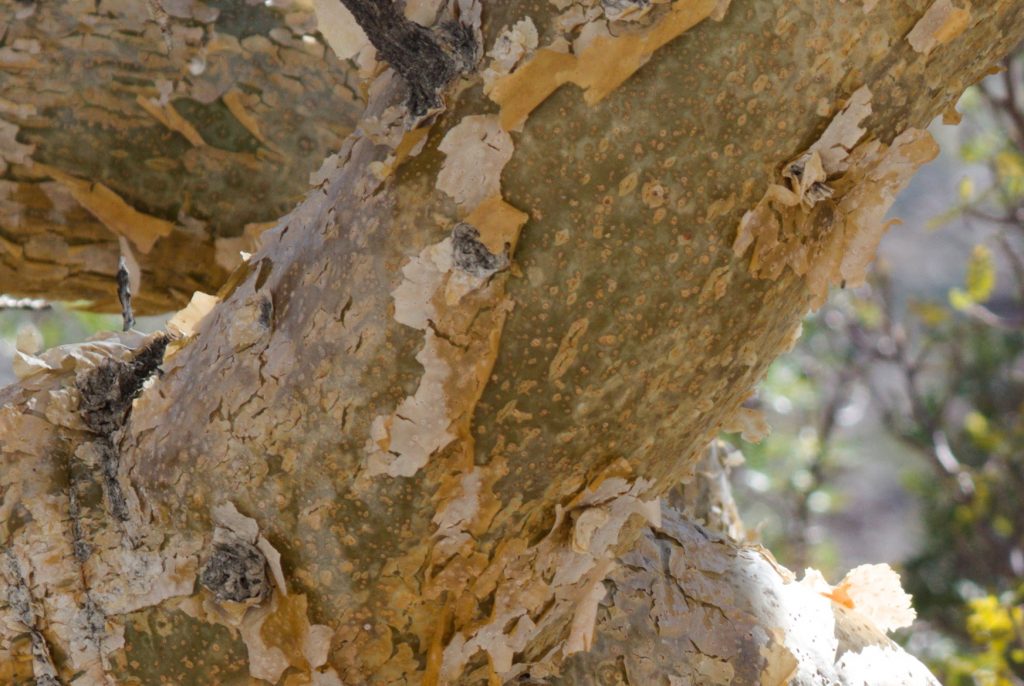
The branches and twigs tend to be of a more normal size for the height of the tree, so they kind of look like they’re too small for the trunk (or maybe it’s just that the trunk looks too large for the tree). But this just adds to the tree’s exotic look. Younger branches have a reddish color. The bark is very papery and peels away from the trunk. Some people have suggested that the rustle of this peeling bark in the wind attracts pollinating insects.

The elephant tree is a semi-succulent. It stores water in its thick trunk and lower limbs. The leaves are pinnate (compound with the leaflets arranged in a feather-like pattern) and rather small. They resemble the leaves of mesquite and cat-claw, which initially made me think they were in the pea family, but, as we’ll see in a minute, that turns out not to be the case.

The flowers are white or cream colored. They’re small, star-shaped, and not very showy, which is just as well, since the trees usually flower in June or July — not the best time to be hiking in Anza Borrego.
So how do frankincense and myrrh come into the picture? Frankincense and myrrh are aromatic resins extracted from trees in the Boswellia and Commiphora genera, respectively, which are both in the family Burseraceae. The elephant tree is also in this family. So perhaps it’s not too surprising that the sap of the elephant tree has a very pleasant aroma. In fact, the whole tree has a nice fragrance.

Frankincense and myrrh have been used for centuries in perfumes and incense. They’ve played an important role in religious ceremonies in the Middle East and Europe and they’ve been used for various medicinal purposes, as well.
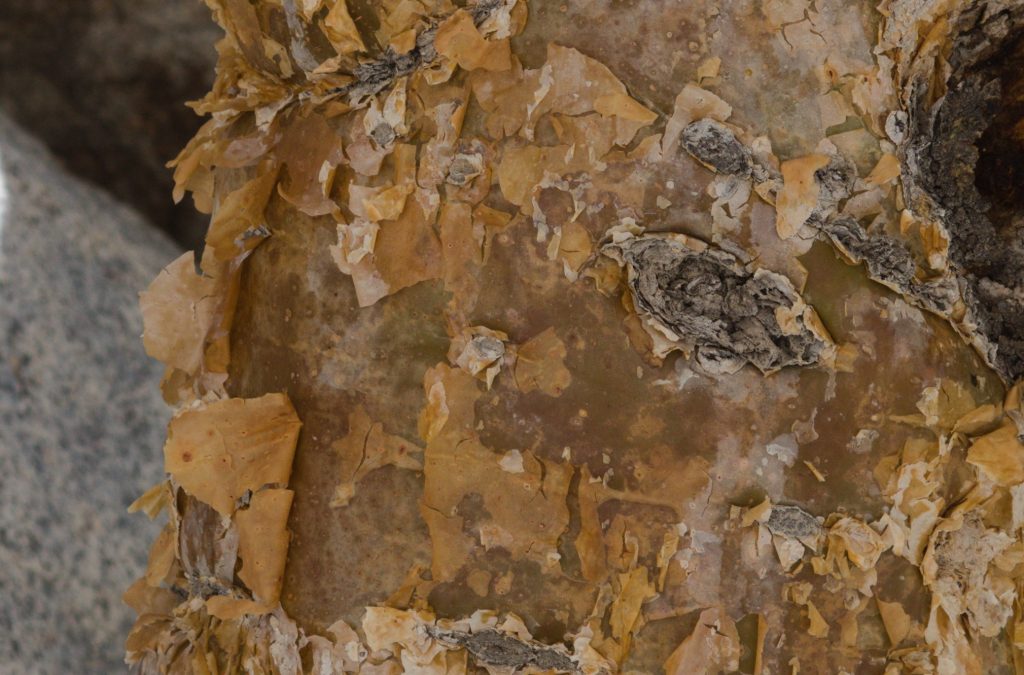
Native Americans used the red sap of the elephant tree in much the same way as frankincense and myrrh were used in the Old World. The Cahuilla treated the sap as something of a panacea, using it to treat a wide variety of illnesses. In fact, it was believed to be so powerful that it was too dangerous for ordinary people to handle. It was kept hidden away and only used by the shamans.
*From his website: http://tchester.org/bd/species/burseraceae/bursera_microphylla.html
**I’ve been told that there are other places in Anza Borrego you can go to see elephant trees that are a lot easier to get to, but by far the largest collection is in this area.