In Guildford, England, woodlice are known as ‘cheesy bobs’. I don’t live in Guildford — or in England, for that matter — but I love that name. Maybe I’ll start calling them that and see if it catches on. Anyway, here in Southern California, most people call them roly-polies or pillbugs, if they call them anything. (These names usually apply only to members of the genus Armadillidium, which can roll up into balls.)
Woodlice have a ridiculous number of common names. Wikipedia lists 25 different names and this is just a small sampling. I clicked at random on one of the footnotes in the list and it brought up a reference to a paper (yes, an actual scientific paper) entitled “Vernacular Names of Woodlice with Particular Reference to Devonshire”, which went on to list many more names. This is kind of surprising, given that most people know jack-all about woodlice. Many people don’t even know what they are, which brings me to my next topic: 1
Since there are so many great common names, I thought it would be fun to sprinkle some of them throughout this article. Just to anchor us, I’ll also frequently refer to them as ‘woodlice’ (singular ‘woodlouse’). Whenever I use one of the other common names, I’ll put it in single quotes and note the source in a footnote. For instance:
‘Chucky pigs’ 4 are crustaceans (like crabs, lobsters, shrimp, etc.) They form the suborder Oniscidea within the order Isopoda. One interesting thing about woodlice is that they’re the only terrestrial crustaceans. That is, they’re the only ones that have managed to adapt completely to living on land. Not all species live on land and not all of them live on land all the time, but most do.
Actually, there is some ambiguity in the literature about whether or not woodlice really are the only terrestrial crustaceans. Some articles state this as fact. Others point to a few other types of crustaceans, such as some species of amphipods, that may also qualify as fully terrestrial. This discrepancy may be due to the difficulty of defining ‘fully terrestrial’.

San Diego County, CA 6/15/17
As I already mentioned, ‘hog-lice’ 5 are in the order Isopoda. Woodlice, and Isopods in general, have seven pairs of equal-sized legs. This is the reason for the name ‘Isopoda‘, which is Latin for ‘equal feet’. Isopods also have segmented exoskeletons, two pairs of antennae, and five pairs of appendages on the abdomen that are used for respiration. In woodlice, only one of the pairs of antennae is easily seen. The other pair are very small and may be vestigial (no longer used). (See figure 2.)
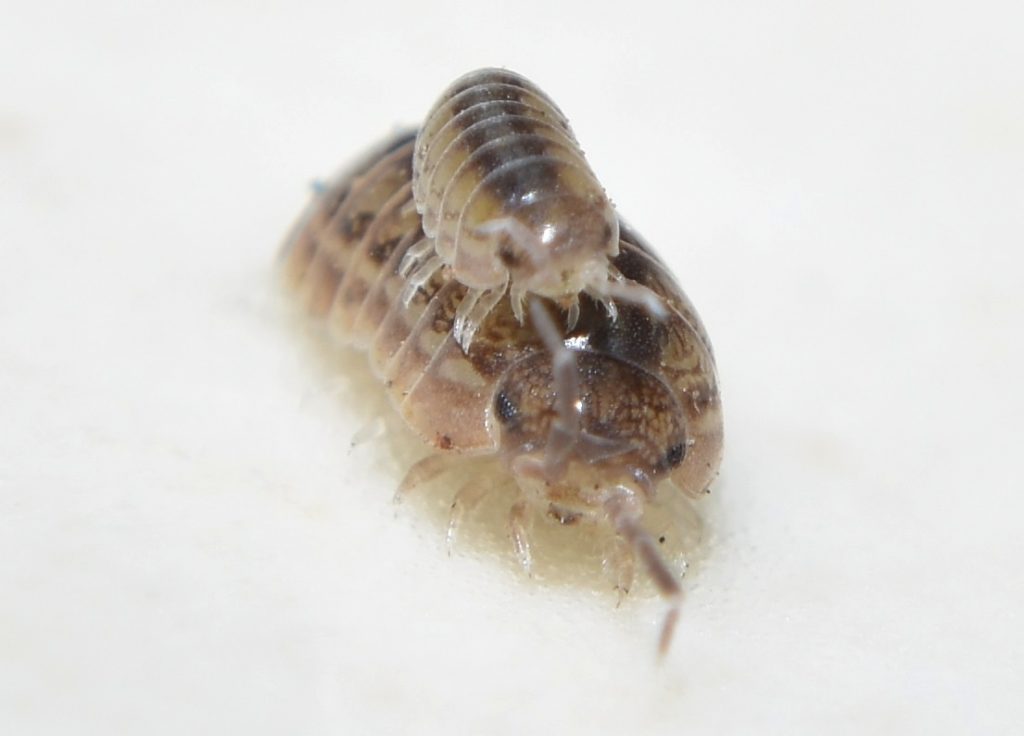
San Diego County, CA 6/15/17
The smaller woodlouse is not riding on the older one for any particular reason. It just happened to crawl on top of it.
Female isopods carry their young in a pouch underneath their bodies. This pouch is called a ‘marsupium’. The marsupium starts off full of water. After the young have developed to the point where they are capable of breathing outside water, air is injected into the marsupium and the young continue to develop for a time before leaving the brood pouch. This is one of the nice adaptions the woodlouse has made to living on land.
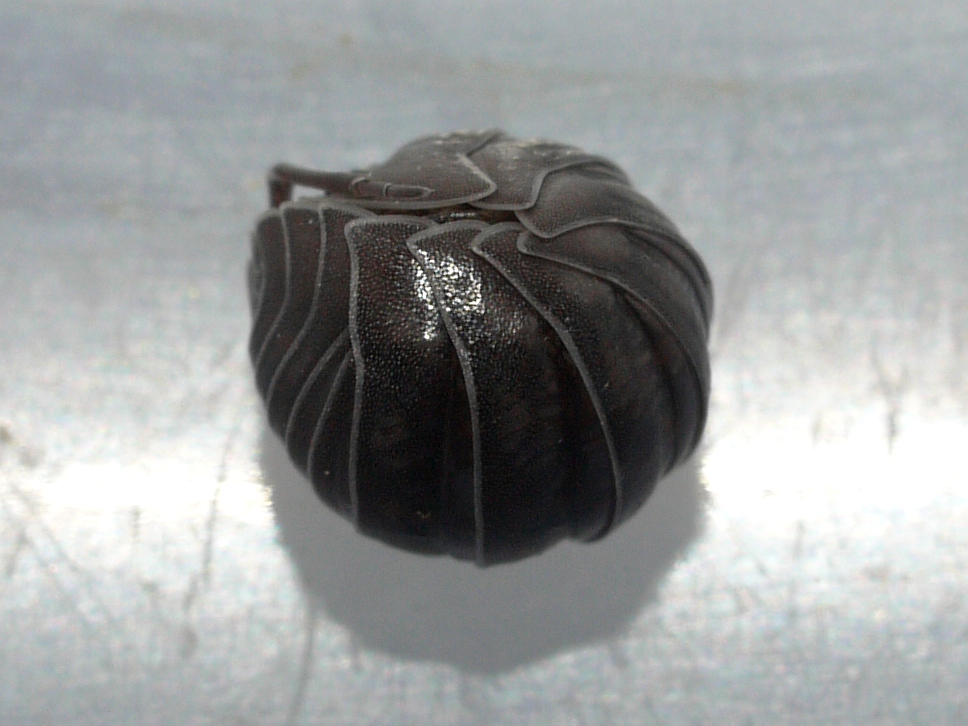
Woodlice in the genus Armadillidium are famous for their ability to roll up into balls. They are often called pillbugs or roly-polies.
Author: Ilona Loser
This file is licensed under the Creative Commons Attribution-Share Alike 4.0 International license.
More on Anatomy
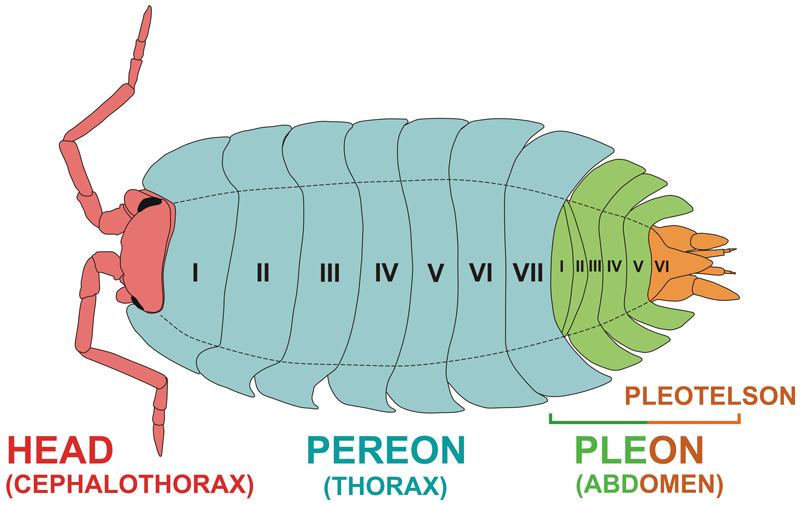
The ‘ sow bug’ 6 body is divided into three major parts: the cephalothorax (which is technically the head fused with the first segment of the thorax), the pereon (the remaining segments of the thorax), and the pleon (the abdomen). (See Figure 1.)
Author: Darekk2
This file is licensed under the Creative Commons Attribution-Share Alike 4.0 International license.
Figure 2 shows a ventral (bottom) view of the head of a woodlouse. A number of important features are visible in this figure. The maxillipeds were originally legs, but they have evolved to serve as sort of a lower lip. You can see how they’ve fused together. Above these, you can see the mandibles and, above them, the upper lip. Note the large main antennae and the very tiny pair of antennae between them. The eyes are also visible.
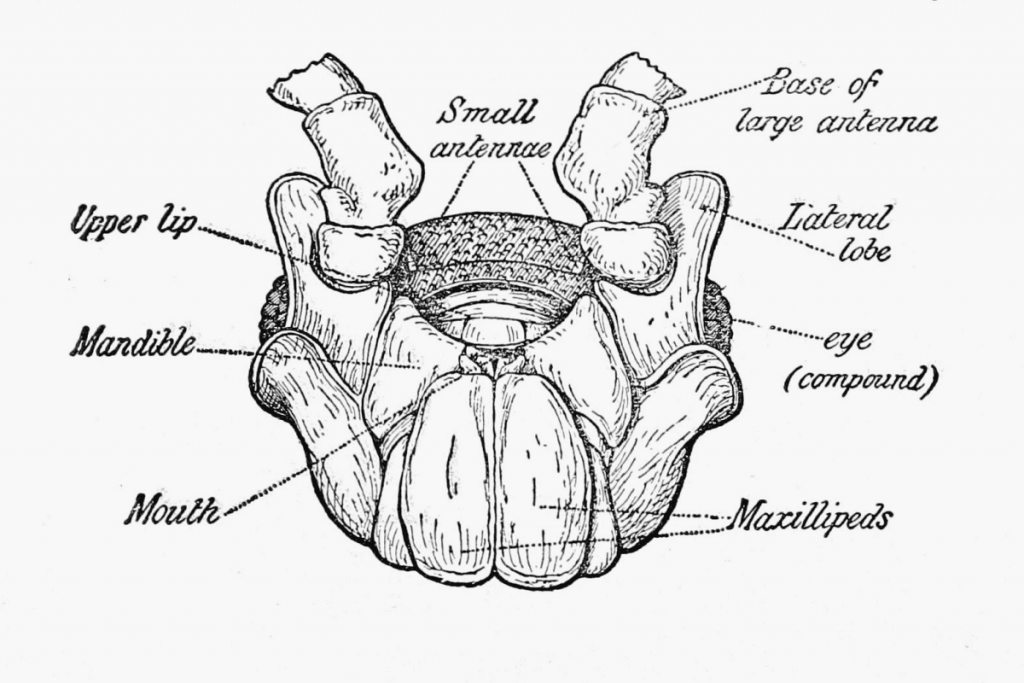
This media file is in the public domain in the United States. This applies to U.S. works where the copyright has expired, often because its first publication occurred prior to January 1, 1925, and if not then due to lack of notice or renewal. See this page for further explanation.
The following photos show a woodlouse in the genus Porcellionides (according to bugguide.net).
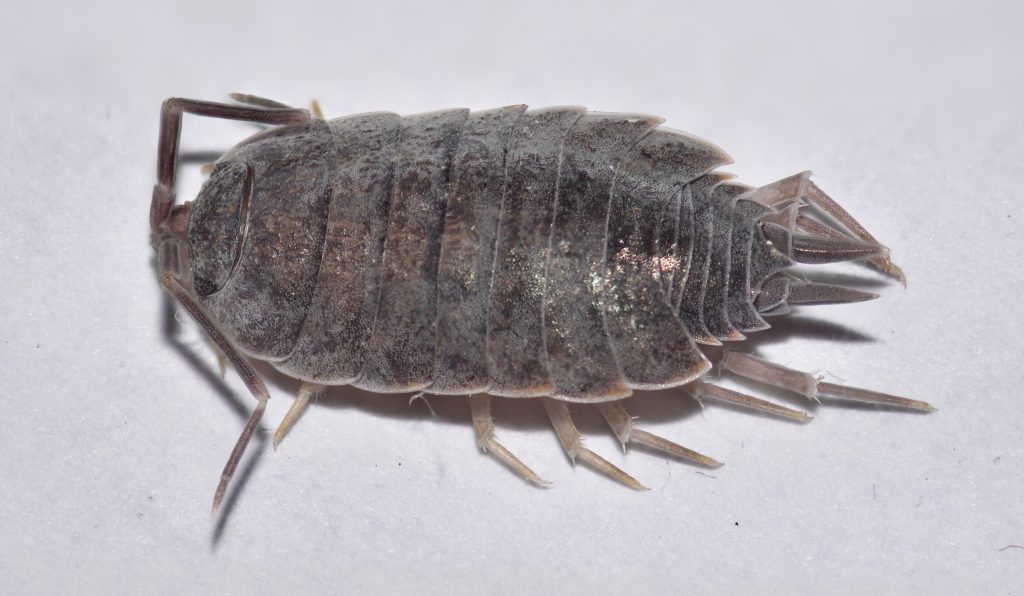
Ruffin Canyon, San Diego County 11/1/19
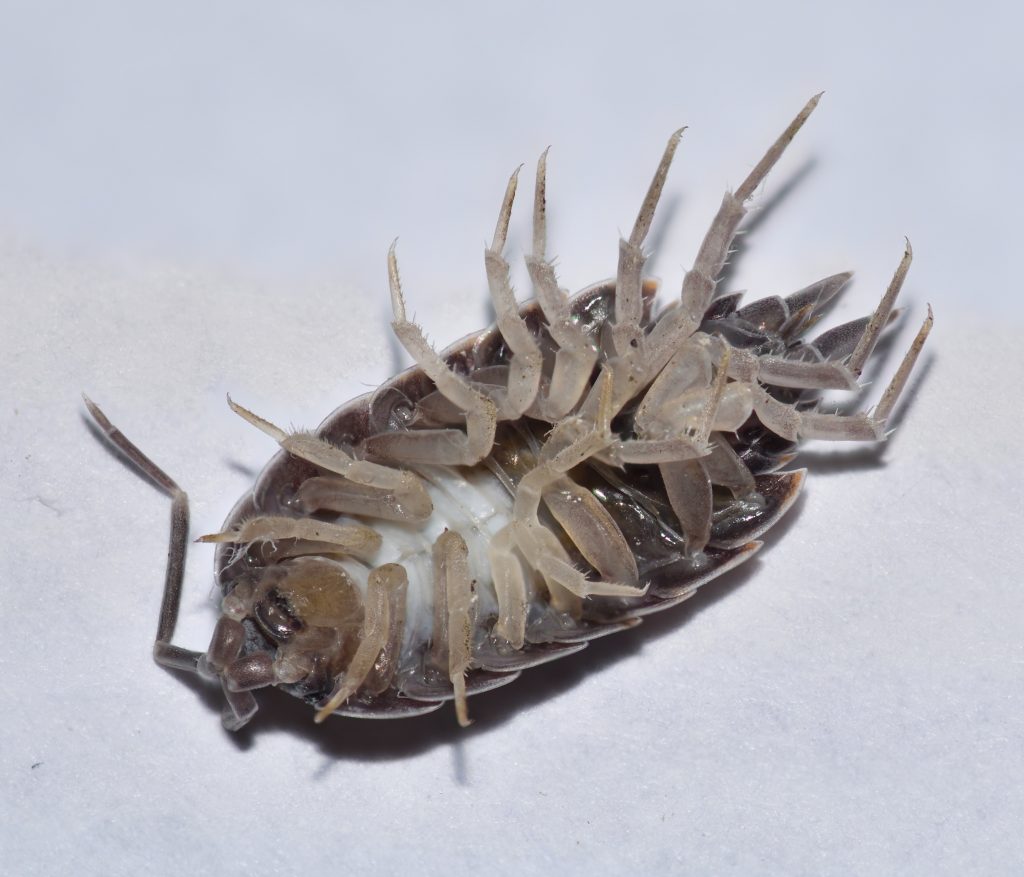
In the next photo, you get a pretty good view of one of the eyes. Although Figure 2 describes them as compound eyes, they may not technically fit that definition if they haven’t been integrated into a single organ. (See my previous article on millipedes.) However, according to one article,7 the eyes can vary from small groups of ocelli (simple eyes) to compound eyes, according to the species. So maybe some of them do have true compound eyes.
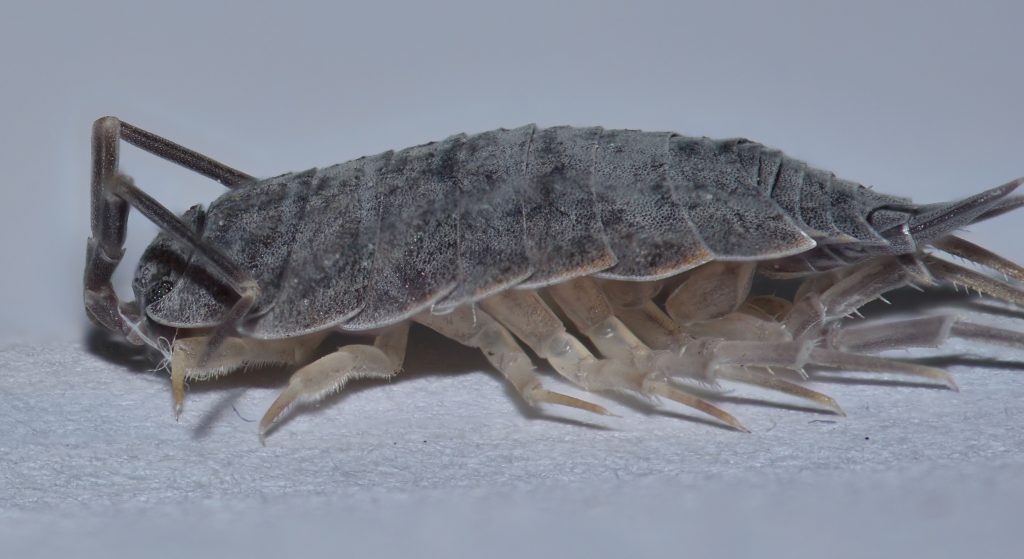
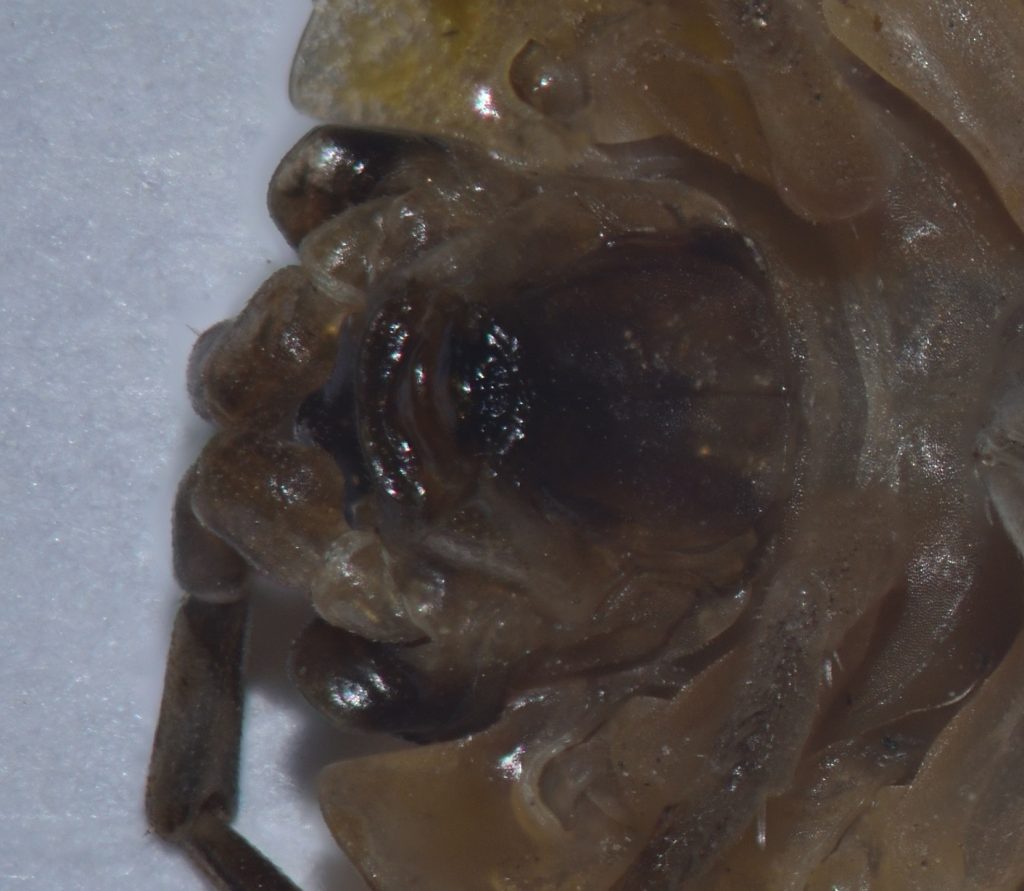
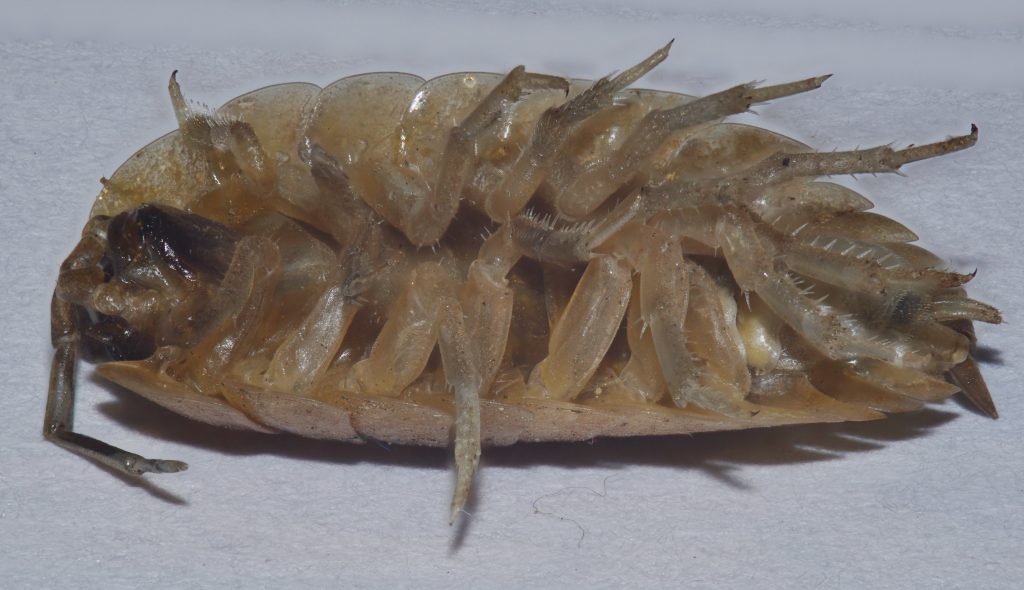
Here’s some photos of another species of ‘butcher boy’ 8 It’s been identified as two completely different genus/species on two different forums, so I’m not sure what it really is, other than some kind of woodlouse.

San Diego County 12/14/19
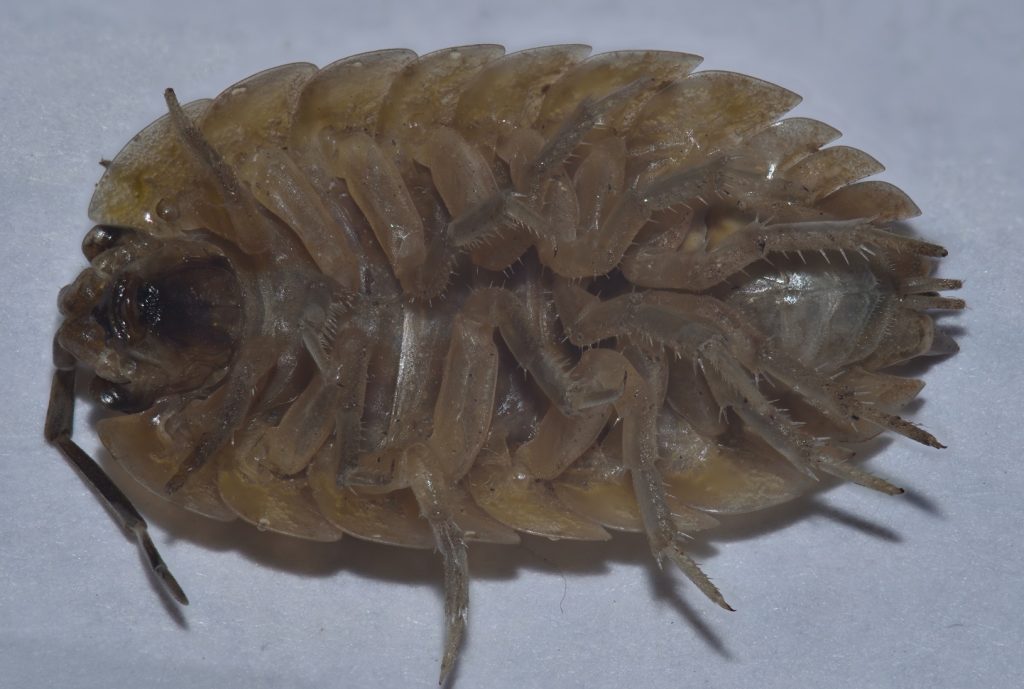
See if you can match up the mouth-parts in the following photo with those in figure 2.
At the beginning of this section, I referred to woodlice as ‘sow bugs’. This is actually one of the more common names. As a side note, someone on the Internet mentioned that she once met a kid who insisted on calling them ‘sour bugs’. When she tried to correct him, he said “Have you ever tasted them?”, which effectively ended the argument. (I wish I could give this person credit, but, unfortunately, I don’t remember where I read the story.)
Eating and Being Eaten
‘Boat-builders’ 9 eat mostly decomposing plant material (detritus). They love compost. As such, they are very beneficial bugs, helping to recycle organic material.10 Woodlice are not usually carnivorous, but they will occasionally eat dead and decaying animals. They are also cannibalistic — they will happily eat dead woodlice or even live woodlice that are vulnerable because they’re in the process of molting.11
Of course, in addition to eating, they often get eaten. Some of their many predators include toads, lizards, snails, newts, foxes, and small owls.12 ‘Chucky pigs’ 13 also have to contend with the woodlouse spider (Dysdera crocata). This spider has large chelicerae (fangs) that are able to pierce the woodlouse’s exoskeleton. Laboratory studies have shown that D. crocata doesn’t actually have any preference for ‘monkey-peas’.14 — they just hang out in the same habitats (in leaf litter, under logs and rocks, etc.) 15
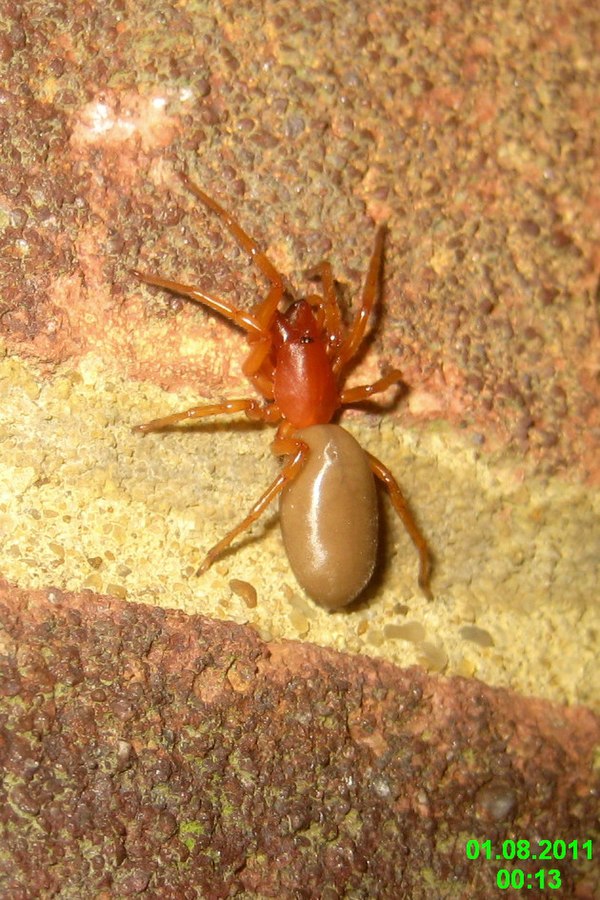
Author: David Short from Windsor, UK
This file is licensed under the Creative Commons Attribution 2.0 Generic license.
Woodlice are sometimes eaten by humans, although it’s probably not a widespread practice. According to one article, they taste a like shrimp. This isn’t too surprising — they are closely related, after all.16 Other authors are less complementary. Wikipedia references an article from Discover that describes them as tasting like “strong urine”.17 I’m not sure how the author knows what strong urine tastes like, but, there you go.
‘Cheese Log’ 18 Reproduction
Woodlouse genitalia are on their abdomens. Females have two genital openings, one on each side. When a male woodlouse finds a receptive female, he crawls onto her back and, according to the source referenced in the footnote for this section, “spends a few minutes licking her head and tapping on her back with his front legs”. (The source doesn’t bother explaining how he goes about licking her without the benefit of a tongue. Your guess is as good as mine.) The male then moves to one side, bends his body under the female, and inserts his genitalia into the genital opening on the opposite side. After transferring sperm, which takes about 5 minutes, he moves to the opposite side of the female and repeats the process with her other genital opening.
Gills or Lungs?
According to Wikipedia, ‘Grammersows’ 19 “breathe through trachea-like lungs in their paddle-shaped hind legs (pleopods), called pleopodal lungs.” 20 Other articles describe woodlice as breathing through gills. The confusion may be due to the difficulty of telling where gills leave off and lungs begin. Here’s a link to a very interesting video that refers to them as gills: Click here. The video goes on to explain that “folds in the pleopod gills developed into hollow, branched structures — almost like tiny lungs.”
Another source of confusion could be that different species of woodlouse vary in the extent to which the ancestral gills have been modified. In any case, woodlice and their relatives tell a fascinating story of how a group of aquatic animals evolved to conquer the land. As such, they’re of great interest to evolutionary biologists.
The Strange Case of Wolbachia 21 22
Wolbachia is a genus of bacteria that infects arthropods (including woodlice) and some nematodes. It’s remarkably widespread. One study estimated that 25 to 70 percent of all insect species were potential hosts for this microbe.23 In some arthropod species, the relationship has evolved to be mutualistic, so that the host actually benefits in some way from the infection. There are even examples of species that cannot reproduce, or even survive, without the bacteria.
The most remarkable thing, though, is what the bacteria does to its hosts. Wolbachia is passed from mother to offspring through the egg cells. It doesn’t pass from father to offspring, because the bacteria are too big for the sperm cells. What this means is that Wolbachia benefits if there are more female hosts than males. It also benefits if there are fewer uninfected hosts to compete with the infected ones. Various strains of Wolbachia have evolved different ways to take advantage of this:
1. The bacteria may kill the males during larval development, so that only infected females live to reproduce.
2. Feminization of the males. In some cases, Wolbachia actually overrules a host’s genes, causing genetic males to develop as functional females. In other cases, the males may develop as infertile ‘pseudofemales’, which, from the bacteria’s point of view, is just as good as killing them.
3. Parthenogenesis, a.k.a. asexual reproduction. The bacteria modifies the female host so that she is able to reproduce without the help of males. In other words, she lays unfertilized eggs that hatch into new females. Remarkably, some researchers have suggested that asexual reproduction is always due to Wolbachia.24
4. Cytoplasmic incompatibility. Wolbachia alters the chromosomes of the infected hosts in such a way that infected males can only successfully reproduce with infected females.
As far as I can tell, Wolbachia infection in woodlice hasn’t been widely studied. I did find one paper from 2001 that described a study done on the species Oniscus asellus.25 I won’t bore you with the details — you can check out the link in the footnote, if you’re interested — but, in general, Wolbachia seems to exhibit a wide variety of strategies in woodlice, just as it does in other arthropods.
‘Granny Grey’ Gets the Blues 26 27
Invertebrate iridescent virus 31 (IIV-31), a.k.a. ‘isopod iridescent virus’, is a virus that infects and eventually kills isopods. But before it kills them, it turns them blue. In the advanced stages of an infection, the crystalline arrangement of the virus particles that have built up in the bug’s exoskeleton cause it to turn a bright, iridescent blue or sometimes a bluish-purple. If you ever encounter a woodlouse of this color, you may be sure that it’s been infected with IIV-31 and, moreover, that it’s not long for this world.
A fossil isopod has been found preserved in Myanmar amber that actually displays iridescent blue patches, suggestive of an IIV-31 infection. While it’s not known for certain that this is a result of the virus, it seems likely. Here’s a photo:
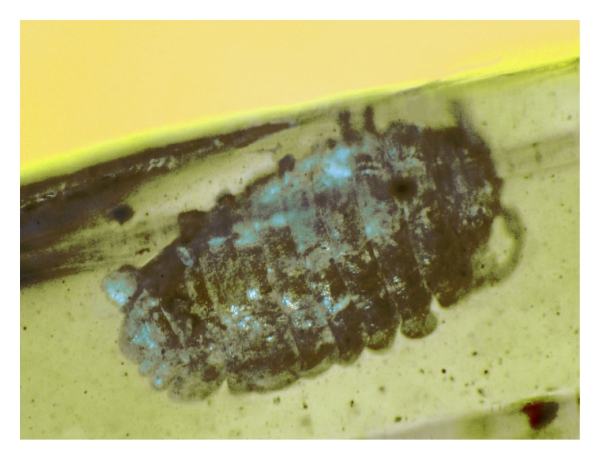
Author: George Poinar Jr.
Source: George Poinar Jr., “Evolutionary History of Terrestrial Pathogens and Endoparasites as Revealed in Fossils and Subfossils,” Advances in Biology, vol. 2014, Article ID 181353, 29 pages, 2014. doi:10.1155/2014/181353
This file is licensed under the Creative Commons Attribution 3.0 Unported license.
More Random Weirdness
Honestly, there are so many weird facts about ‘chucky pigs’ 28 that it’s hard to figure out how to discuss them in any kind of logical order. So here’s a few of them listed at random: 29
Like all arthropods, a woodlouse has to periodically shed its exoskeleton as it grows. Unlike most arthropods, it does this in two stages. First, it molts the back half of the exoskeleton, then it molts the front half a few days later. If you see a woodlouse whose front and back halves are different colors, it’s probably in the process of molting. Molting in two stages may make the woodlouse less vulnerable to predators. It probably also reduces water loss.
‘Granfer-grigs’ 30 can drink water through their anus. Woodlice have tube-like structures called uropods on their back ends. They press the uropods together and touch them against a moist surface. Capillary action sucks water up through the uropods and into the anus. They can also drink water the usual way through their mouths and they even seem to be able to absorb water vapor directly through their exoskeletons when the humidity is high enough. If the humidity remains high for too long, they may become water-logged and have to seek out an area of lower humidity. In summary, woodlice are very well adapted to extracting water from the environment.
Building on that last point, a few species of woodlice have even managed to adapt to living in the desert. Hemilepistus reaumuri lives in the deserts of North Africa and the Middle East in what is probably the driest environment colonized by any species of crustacean. It occurs there in great numbers and is an important part of the desert ecosystem.31 32
Woodlice do not pee. The main purpose of urination is to get rid of nitrogenous waste. This usually occurs in the form of ammonia. Ammonia is too toxic for most animals to deal with directly, so they convert it into urea or uric acid before excreting it. Woodlice, however, have developed a high tolerance for ammonia and are able to excrete it directly as a gas. This means they don’t have to waste energy converting it to another form.
‘Grammer sows’ 33, like all crustaceans and many other arthropods, have blue blood. This is due to the presence of the compound hemocyanin34, which is copper-based and serves the same purpose as the iron-based hemoglobin in our blood. The blood is colorless when it’s not carrying oxygen, but turns pale blue in the presence of oxygen. Unfortunately, woodlouse blood only contains small amounts of hemocyanin, so the blue color is not visible to the unaided eye.
As a young child, the science fiction writer Isaac Asimov decided it would be a great idea to put a number of woodlice in his mouth. His reasoning was that the woodlice would “tickle his tongue” as they walked around on it. Apparently, he was right about this, but his mother noticed the strange expression on his face and asked him if everything was all right. He replied by spitting out a mouthful of woodlice.
Woodlouse Evolution 35
Fossils of aquatic isopods have been found from the Carboniferous, around 300 million years ago. All isopods that live in water are benthic — that is, they crawl around on the bottom — so it’s likely that woodlice evolved from such bottom-dwellers. Isopods would have begun the evolution into woodlice by developing forms that could survive outside water for longer and longer periods. Such intermediate forms still exist today. The sea slater (Ligia oceanica), for instance, lives on the seashore in rocky areas, coming out at night to dine on seaweed, diatoms and debris.36
The earliest fossils we have of actual woodlice only go back to the Eocene, about 50 million years ago. It’s likely that they evolved much earlier than that, though. ‘Tiddy-hogs’ 37 are widely distributed throughout the world and, since they don’t have any means of crossing the ocean, this implies that they must have evolved before the continents split up, around 160 million years ago.
Scientists used to believe that Oniscidea (the woodlouse suborder) was monophyletic; that is, they believed that all of them were descended from a common ancestor. This would have implied that they underwent a single transition from water to land. Molecular studies, however, have called this into question. One such study, published in Nature in 2019 38 suggests at least two, and possibly more, such transitions onto land.
Some Thoughts on All Those Names
You may have noticed that many of the common names for woodlice are related to pigs. In fact, an article on the “Country Life” website39 claims that 94% of the common names relate to pigs! The article goes on to explain that the reason for this is that “Woodlice look like feeding piglets or pigs huddled in a pen.” However, another website (which I haven’t been able to relocate) suggests that it’s just because they smell bad.
Either way, what interests me more is why there are so many common names. I mean, millipedes, by comparison, seem to have very few common names. Maybe it’s because woodlice look so different from other animals. Millipedes are worm-like, so people may just think of them as a kind of worm, despite all the legs. But woodlice are just plain weird. Also, you rarely see them unless you turn over a log or brick or move a bucket or something. Then, suddenly, there they are!
Another thing to keep in mind is that up until recent times, most people lived in the country. So, while they wouldn’t have been encountering woodlice on a daily basis, unexpected encounters with them would have been much more common than for the average person today. You see something weird; you have no idea what it’s related to; so you make up a weird name for it.
That’s the best explanation I can come up with. It does seem like it would be an interesting, if rather eclectic, research subject.