When Charles Darwin published On the Origin of Species in 1859, he argued the case for evolution by presenting what he hoped would be an overwhelming amount of evidence. I think most scientists would agree that he succeeded admirably. Nevertheless, Darwin had to contend with the fact that much of the scientific knowledge we take for granted today didn’t exist at the time. Obviously, he knew nothing about the genetic code. Even the basics of heredity were almost unknown. (Gregor Mendel had made a great start, but his work was pretty much ignored until decades later.) So the mechanism underlying natural selection was a black box to him. This was a problem, but not an insurmountable one. Darwin simply had to present evidence that there must be some such mechanism; he didn’t actually need to find it.
A more serious problem was continental drift, a.k.a plate tectonics. There were many cases of identical fossils found on widely separated bodies of land with no obvious way that the organisms could have gotten from one body to the other. For instance, there were fossils of animals found on the west coast of Africa that were identical to fossils found on the east coast of South America. Today the explanation is obvious. We know that all the continents used to be joined together into one vast super-continent called Pangaea. Pangaea eventually broke up and the fragments drifted apart to form separate land masses. The animals found in both South America and Africa evolved there when the two continents were connected.
Darwin knew nothing about continental drift. He didn’t even know about radioactive elements (whose decay heats up the Earth’s mantle and produces the massive convection currents that move the continents.) No one at the time seriously believed that the continents could be moving. So Darwin was forced to come up with alternative explanations for such fossils. When I read On the Origin of Species as a young man, I remember thinking that the suggestions he put forth were not very convincing.1 2
So what does all this have to do with crayfish? Crayfish are basically small, freshwater lobsters, but, unlike their marine relatives, they can’t survive in the open ocean. Nevertheless, there are native crayfish found on all the continents except Africa and Antarctica. So crayfish are a textbook example of a population of organisms that evolved when all the continents were joined together and were broken up into separate populations when Pangaea broke up. Those populations continued to evolve after the breakup. I’ll be discussing this in more detail later, but, first, let’s get to know our subject a little better.
Sweetwater River near Jamul, CA 8/19/2017

Sweetwater River near Jamul, CA 8/19/2017
Crayfish, Crawfish, or Crawdad?
The word crayfish probably comes from the Frankish word krebitja, which is a diminutive of the word for crab.3 This evolved into the Old French word for crayfish — “escreviss” — and eventually into our version of the word. Crayfish are also called crawfish or crawdads in some localities. “Crawfish” is obviously just a variation on the pronunciation. The origin of “Crawdad” is a bit more mysterious. It could be related to the use of “dad” in “doodad”, but no one seems to know for sure.
Crayfish are crustaceans, which means that they are related to such animals as crabs, shrimps, prawns, and woodlice. Crustaceans are, in turn, a subgroup of Arthropods. Like other arthropods, such as insects and spiders, crustaceans have exoskeletons. Unlike other arthropods, they have biramous limbs. A biramous limb is an apendage that branches into two parts. The bottom part is often (but not always) used for locomotion, while the upper part is used for other purposes — gills, for instance.
Crayfish evolved from lobsters. Some authors treat them as a type of lobster; some don’t. It’s not important from a scientific point of view, since “crayfish” and “lobster” are both common names. Historically, crayfish have generally been classified as belonging to three families — Astacidae, Cambaridae, and Parastacidae. Together, these three families can be referred to as Astacida. So Astacida is the scientific name for crayfish as a group.4 The study of crayfish is called Astacology. 5
Crayfish in California
There is only one extant (not extinct) species of crayfish that’s native to California. That’s the Shasta crayfish (Pacifastacus fortis). It lives only in Shasta County in northeast California. It’s threatened by habitat loss and also by competition from an invasive species, the signal crayfish (Pacifastacus leniusculus).6 7
Another invasive species that’s found in California, including here in San Diego County, is the red swamp crayfish (Procambarus clarkii), which is in the Cambaridae family. P. clarkii is native to the southern and southeastern United States and northern Mexico. Its native range doesn’t extend much farther west than Texas, but it’s been introduced to many other places in the U.S. and around the world. In some places, it’s become a serious pest.8
The red swamp crayfish is the most widely farmed species of crayfish in the world. It’s used as food, as bait for fishermen, in the aquarium trade, and as research animals in schools and laboratories. All this accounts for its wide dispersal. In some cases, P. clarkii has been deliberately introduced into an area in hopes of an economic return. In other cases, schools or individuals have released them into the wild just because they didn’t know any better.
P. clarkii is the only crayfish that I’ve encountered in southern California. All the photos that I’m including with this post, unless otherwise noted, are photos of this species and all were taken of individuals that I found in the Sweetwater River near Jamul, CA.
Crayfish Anatomy9
Crayfish are a popular subject for dissection in high school and college biology classes. As a result, there are some excellent resource videos online. The easiest way to learn crayfish anatomy is to watch some of these videos. Click here for a good anatomy video. And here’s a couple of links to videos that actually show the dissection process: Crayfish Dissection 1, Crayfish Dissection 2
Just in case you don’t feel like watching a bunch of videos, I’ll give you a quick lesson. Figure 1 shows the basics of crayfish external anatomy.


For the internal anatomy, refer to figure 2 below:


Figure 1 shows a female crayfish in the genus Cambarus. Other crayfish species should have similar anatomies. I don’t know what species was used for Figure 2.
Crayfish are decapods, a word which means “ten-footed”.10 In the case of crayfish, this refers to the five pairs of walking legs or pereiopods. The first pair — the pair with the big claws — are also called chelipeds.
On the sides of the thorax, hidden by the carapace, are the gills. Each gill looks like a feathery appendage, but it’s actually the upper branch of one of the walking legs. Unfortunately, the gills are not shown in the illustrations, but if you watch the dissection videos, you’ll get a good look at them.
The head and thorax are joined and together make up the cephalothorax. This is covered on the top and sides by a shell called the carapace. The carapace includes the rostrum — the pointed “nose” or beak at the front of the head.
Crayfish have two pairs of antennae — one long pair and another much shorter pair. The shorter pair are called antennules. Each antennule is branched. That is, they are biramous appendages like the walking legs. Arthropods are believed to have evolved from annelids — segmented worms with non-branched (uniramous) appendages on each segment. As new species evolved from this ancestor, segments were added, lost, or fused, and became specialized in various ways. The appendages went on to differentiate into new forms that served different purposes. Some, for instance, evolved into mouth-parts and others became antennae.
In the crustaceans (or maybe in an earlier ancestor), the appendages evolved to be biramous. It’s likely that two segments were fused into one segment with two pairs of appendages and, later, the two pairs of appendages fused to become one biramous pair.11
Note the “pleopods” on the “tail” (really the abdomen) of the crayfish. These are also called swimmerets. These are thin, flimsy-looking, biramous appendages that are used by the female to hold her eggs to the bottom of her abdomen after she lays them. Despite the name, they’re not actually used for swimming, although they may help to keep water flowing over the gills. They may also help in steering.
In the male crayfish, the first pair of pleopods are enlarged and are used for transferring sperm during copulation. These more specialized pleopods are called gonopods.
The tail is made up of the telson (which is actually the last segment of the body) and four paddle-like structures called uropods, two on each side of the telson. When frightened, a crayfish will often propel itself rapidly backwards by flipping its tail in an arc underneath its body.
On the underside of the head, just a little farther back than the eyes, are the openings to the nephridia. The nephridia (there are two of them) are glands that are present in many invertebrates that function like kidneys — they eliminate toxic substances and waste products from the urinary and circulatory systems.12 In crustaceans, the nephridia are also called green glands, antennal glands, or maxillary glands. The following two photos clearly show the openings of the green glands. The actual glands are not visible in the above illustrations, but one of the openings is labeled in each figure.
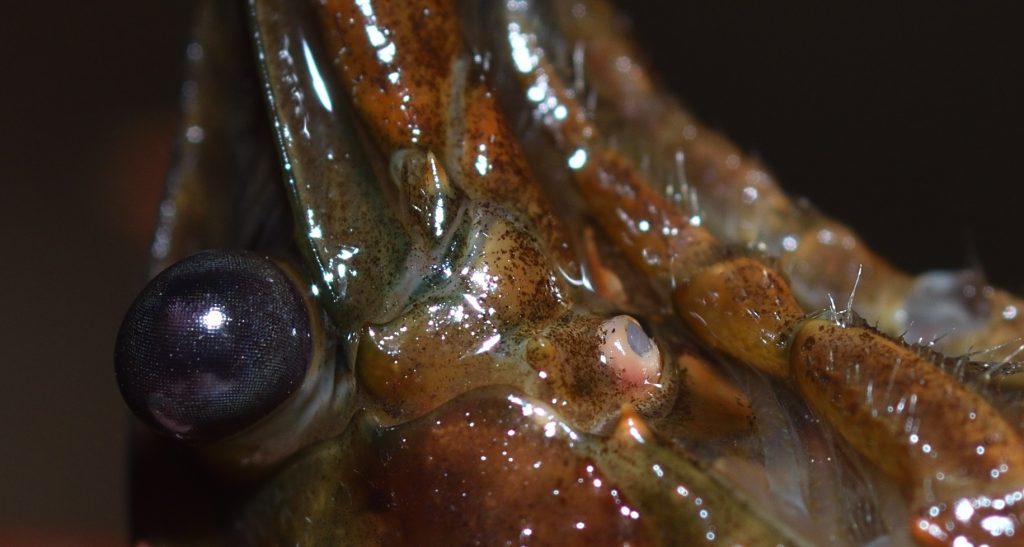
The pink oriface is the opening of the green gland.
Sweetwater River near Jamul, CA 10/4/2019
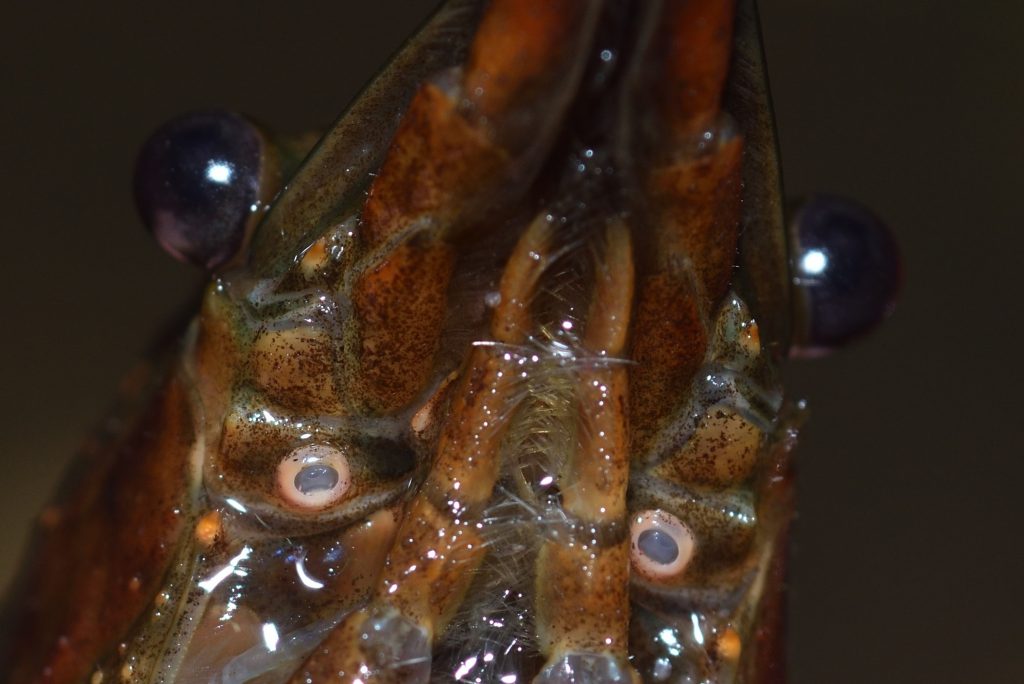
Showing the openings of the green glands.
In the above photos, you can see the largest of the three pairs of maxillipeds. These are appendages used to manipulate food. They’re also labeled in figures 1 and 2. The photo below gives you a more complete view.
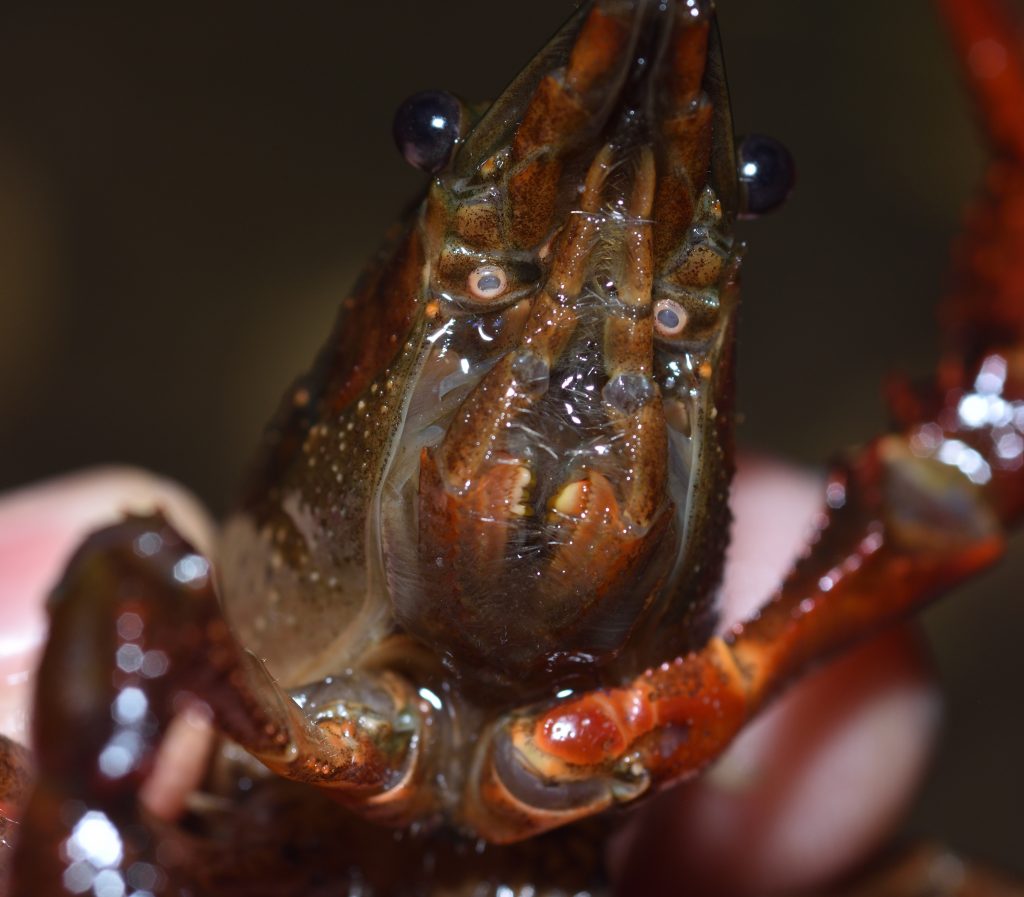
Also visible in the above photo are the mandibles. Those are the small, light tan structures between the maxillipeds. The mandibles are used for grinding up food.13 Here’s a better view of them:
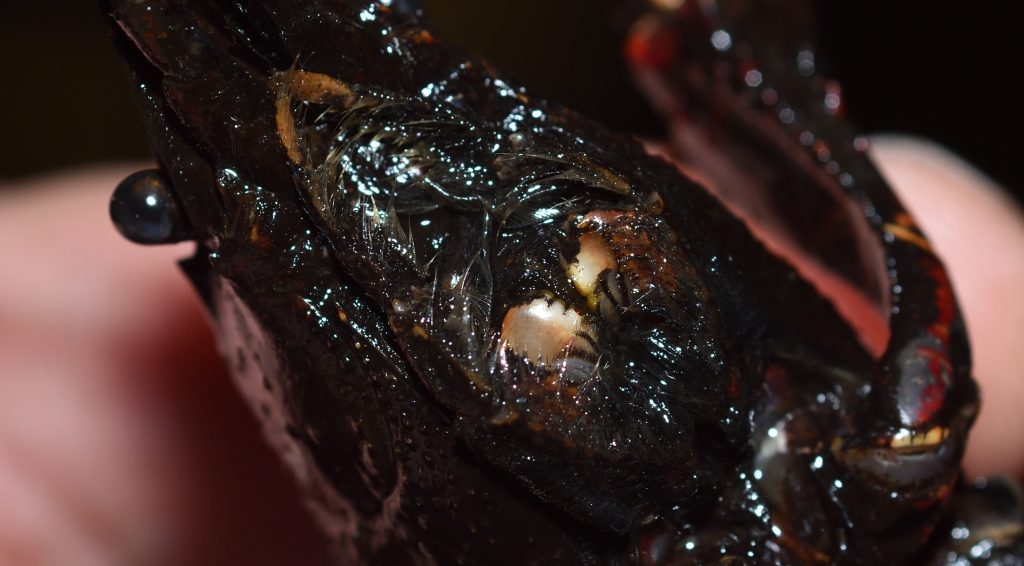
In the following shot, you can see two of the pairs of maxillipeds from the side. (The third pair is hidden underneath the body.)

The following video shows a crayfish using its maxillipeds to search the sediment for food.
In the next photo, you can see the rostrum, the antennae, the antennules, and the compound eyes. The eyes are mounted on short stalks called pedicels.

Like the compound eyes of many insects (which probably evolved from crustaceans), a crayfish eye consists of thousands of ommatidia — thin, columnar structures that run from the surface of the eye to the retina. The ommatidium of a crayfish consists of a cornea, a lens, and photoreceptor cells. (Figure 3 shows a generic drawing of an ommatidium.) Each of the tiny, individual facets visible in the following photos is the cornea of an ommatidium. When excited by incoming light, the photoreceptor cells produce electrical impulses representing the intensity and color of the light. These impulses are processed by the nervous system and brain of the crayfish to form an image.


A and B represent the cornea and lens, respectively.
This image is in the public domain. It was downloaded from Wiki Commons at this url.

I mentioned earlier that arthropods are believed to have descended from a segmented worm with a pair of appendages on each segment. Originally, all the segments were probably identical externally, except for the head and tail, where the orifices for the mouth and anus would have been located. The body of the crayfish is still divided into segments, although these segments have been greatly modified, and each of the segments still has a pair of appendages.
To summarize, here’s a chart that lists the segments of the crayfish body and their associated appendages:
Head: 5 segments
Segment 1: Antennas
Segment 2: Antennules
Segments 3-5: Mouth-parts, consisting of 3 pairs of modified appendages (Only the mandibles are visible in the photos.)
Thorax: 8 segments
Segments 1-3: Three pairs of maxillipeds used for manipulating food
Segment 4: Chelipeds (the 1st pair of walking legs with the large claws)
Segments 5-8: The other 3 pairs of walking legs
Abdomen: 5 segments
Segments 1-5: Pleopods or swimmerets
Tail: 1 segment
Segment 1: Telson and uropods
Daily Life
Most crayfish live in bodies of freshwater, such as lakes, rivers, streams and ponds, although a few species can live in brackish water. They are mostly nocturnal, hiding under rocks or logs or in burrows during the day and coming out to forage at night. There are cave-dwelling species that have lost eyes and pigmentation. Most crayfish are omnivores, eating a variety of plants and small animals, both living and dead.
Many, but not all, species of crayfish dig burrows. Those that do often dig them all the way down to the water table, which insures that they will have access to water even if the surface water body dries up. Some species spend their entire lives in their burrows, some come out to forage at night and return to their burrows during the day, and some spend most of their time outside their burrows, returning to them only for certain activities, such as mating or egg laying or for protection when environmental factors become a threat.14
The exact details of the crayfish life cycle varies greatly from species to species and genus to genus. The following description focuses on the red swamp crayfish (P. clarkii).
P. clarkii becomes sexually mature in as little as two months. The male crayfish comes in two forms, officially named form 1 and form 2. Form 1 is the mating form. In form 2, the male is not capable of mating and may attack a female if it comes near. The crayfish changes from one form to the other by molting. Mating usually takes place in the fall, but there may be a second period of mating in the spring in warmer, wetter climates.
After the female lays her eggs, she gathers them up and glues them in a mass to the underside of her abdomen and tail. An adhesive called glair is used to glue the eggs. The swimmerets also help to hold the egg mass to the body. A crayfish lays hundreds of eggs at a time, but only 20 to 40% of them produce young. Many fail to hatch because they didn’t get fertilized. Others come loose from the egg mass and, without the mother’s protection, will almost certainly get eaten. P. clarkii females carrying eggs or young can be found year-round, which certainly contributes to the invasive capacity of the species.
The exoskeleton of a crayfish doesn’t grow, so the crayfish has to shed it periodically. After a molt, it takes a couple of days for the new exoskeleton to harden. During that time, the crayfish is very soft and vulnerable, so it will stay hidden (usually in a burrow). You can click here to see a sped up video of a crayfish molting. Click here for another video that shows the process at normal speed.
P. clarkii has a life span of around 2 to 5 years in the wild. The life span of other crayfish species varies widely. It’s usually from 1 to 20 years, but there’s a genus of spiny crayfish (Euasticus) in Australia that can live for 50 years or more.20
One of the crayfish that I caught in the Sweetwater River had babies. The following photo shows the underside of the tail with a bunch of babies still clinging to it (and falling off onto my palm).
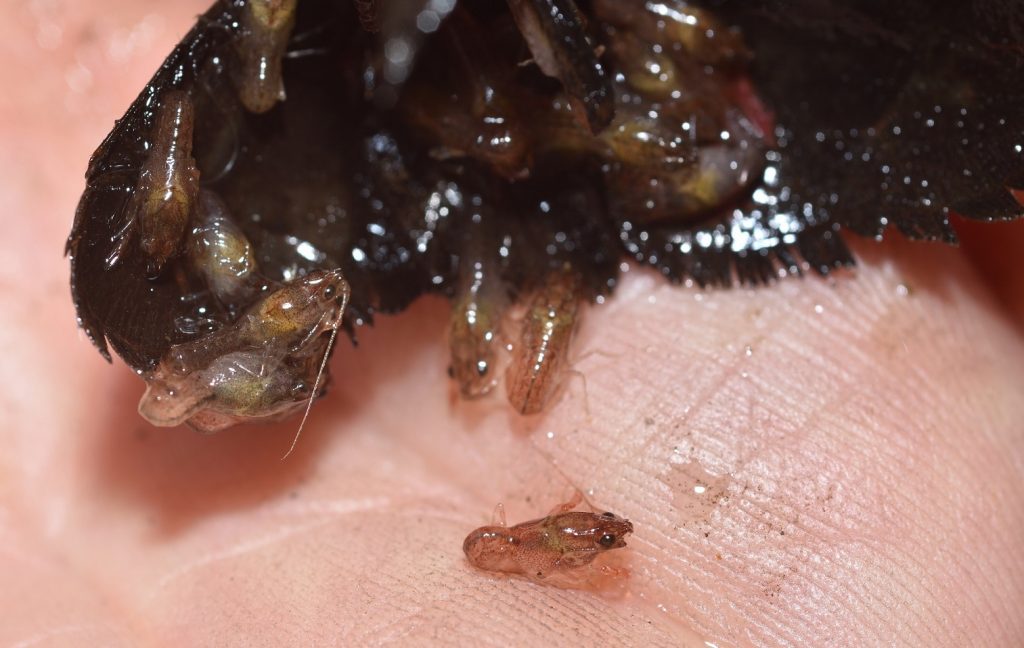
Sweetwater River near Jamul, CA 10/4/2019


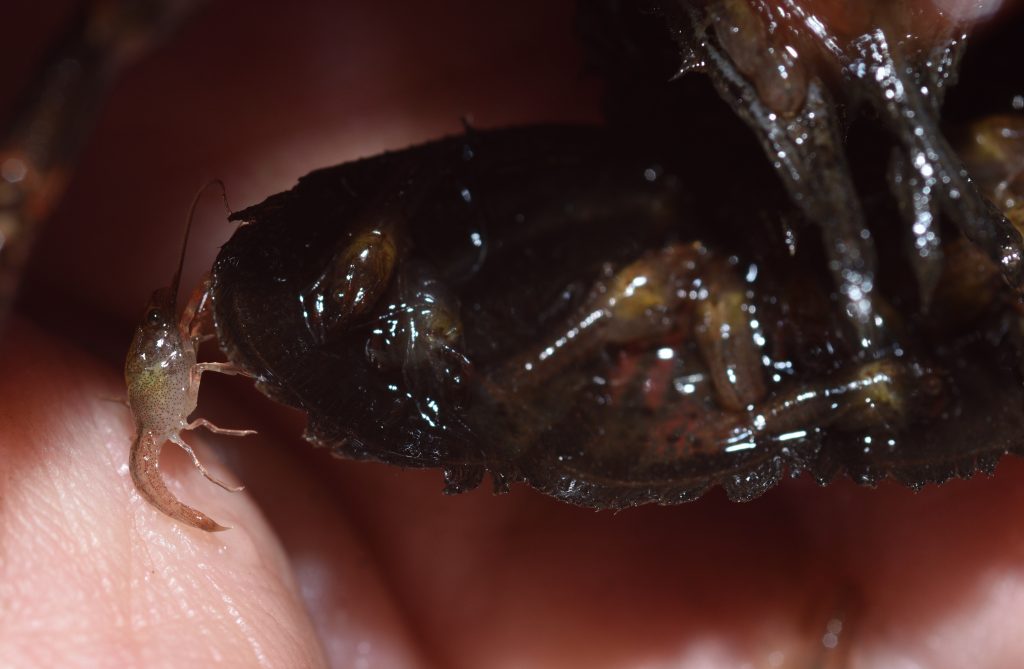

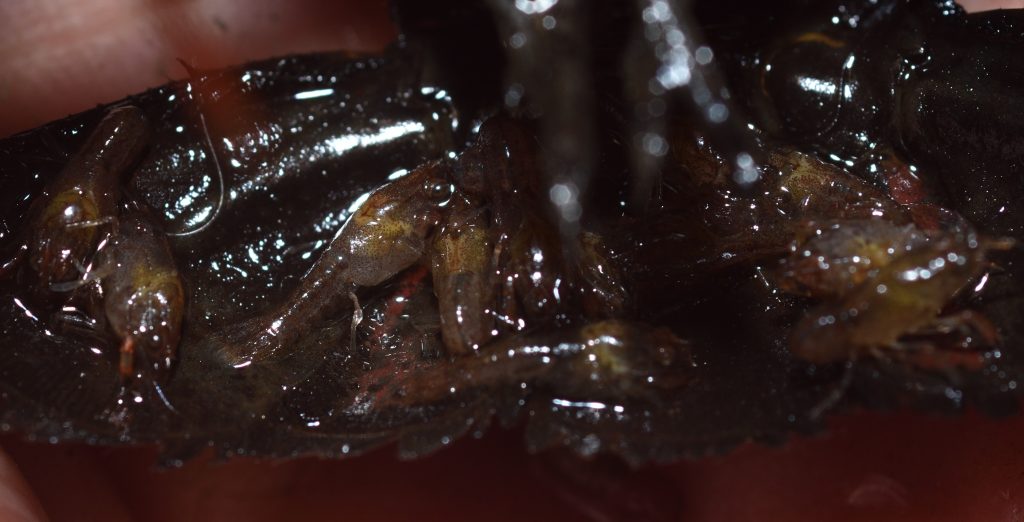
The next two photos show a few babies clinging to the underside of the abdomen. The pleopods or swimmerets help hold them to the mother.

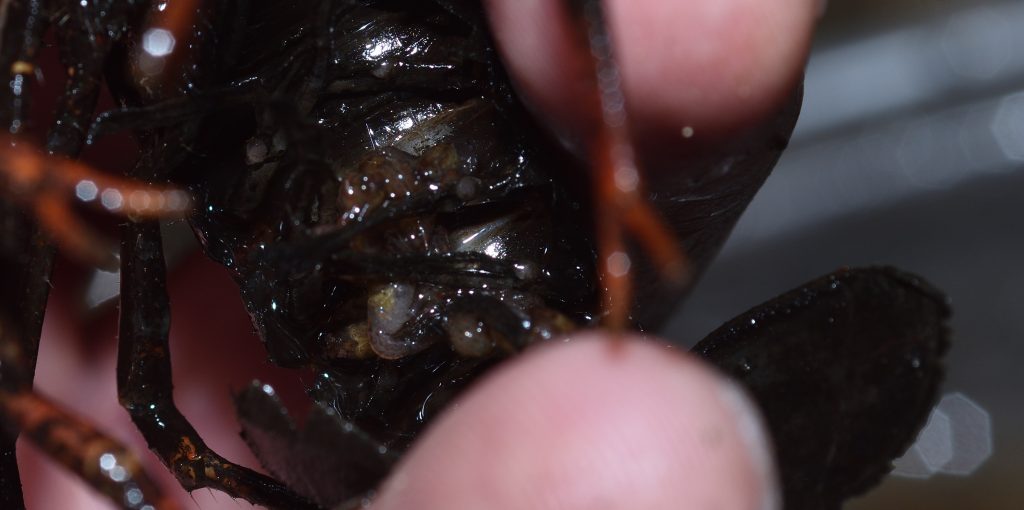
I released the mother and babies back into the river next to the rock where I found them. Hopefully, all the babies found their way back to the mother, but, honestly, most of them aren’t going to make it to adulthood anyway. Young crayfish are much more susceptible to predation than the adults.
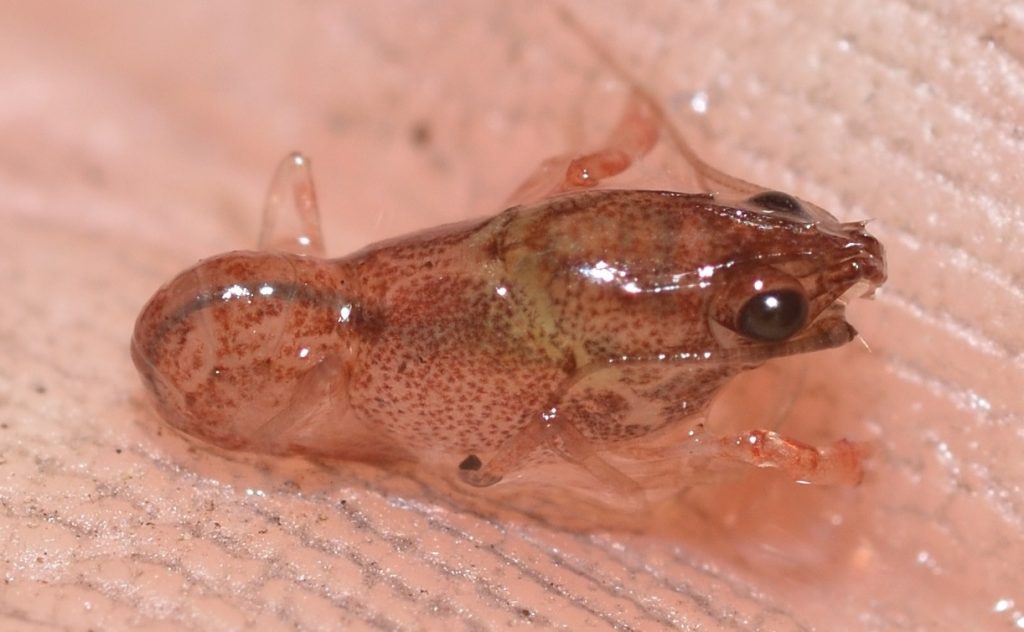
The next few photographs show a very young crayfish. I’m not sure how old it was, but it was no longer with its mother.
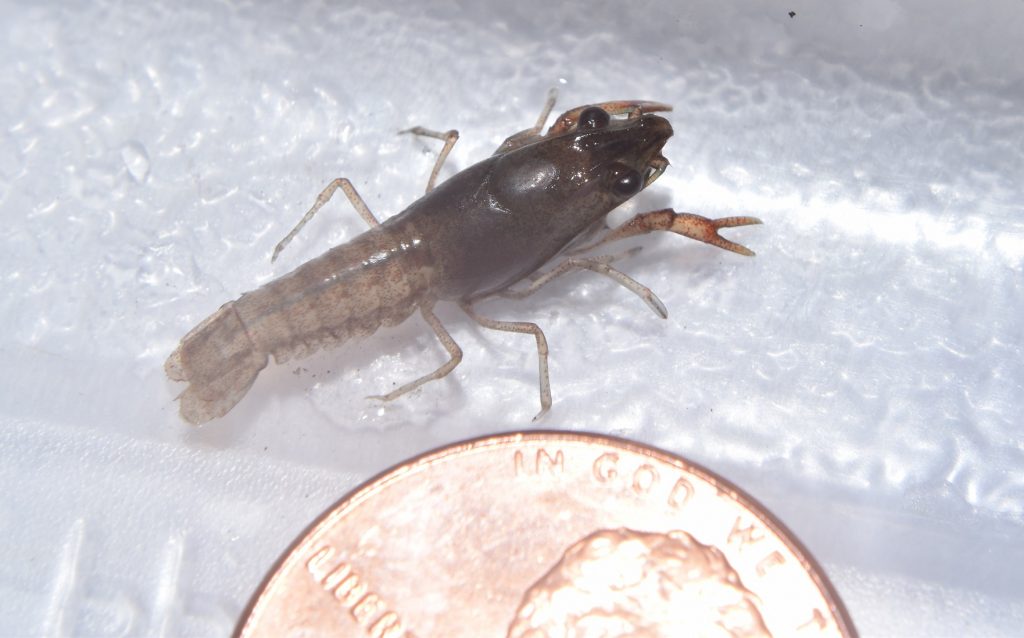
Sweetwater River near Jamul, CA 9/9/2017
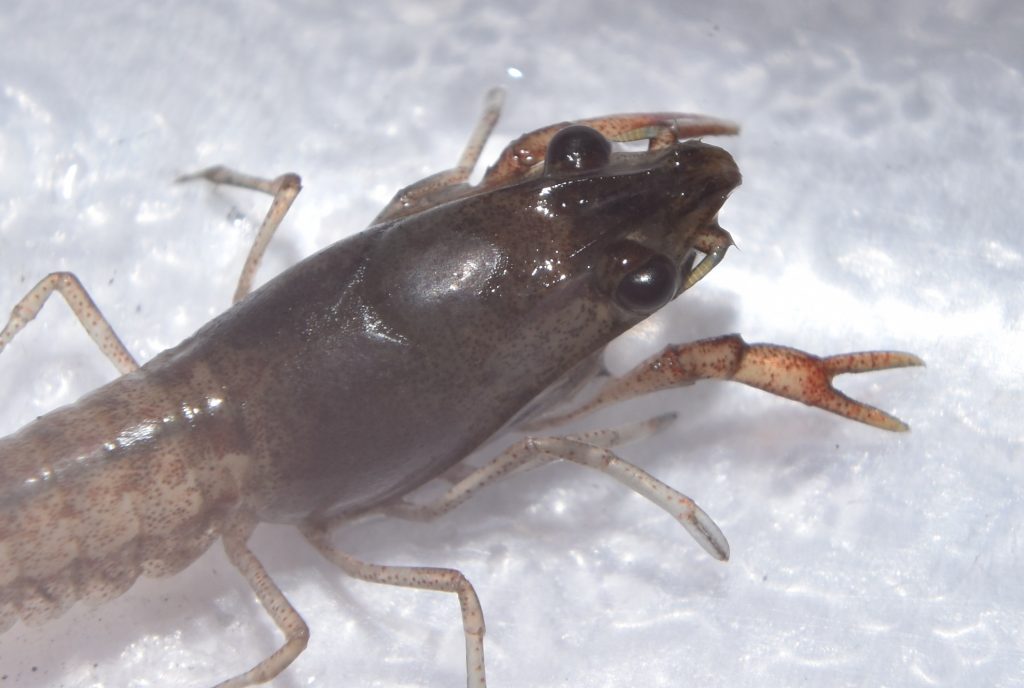
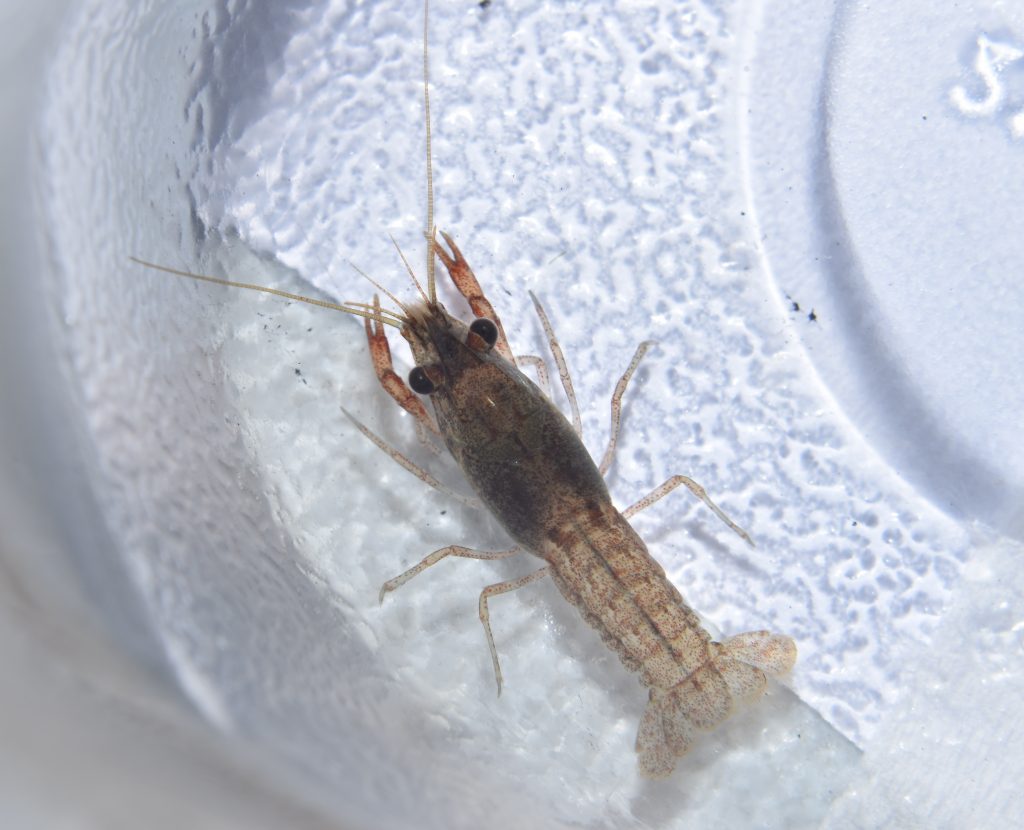
And finally, here’s some shots of a juvenile. Crayfish don’t go through extensive metamorphosis. Aside from their chelae (main claws) being much smaller, the juveniles and even the babies look very much like the adults. This is one thing that differentiates them from lobsters, which have a distinct larval stage. It would be interesting to know why this is. My guess is that it’s because lobster larvae are part of the plankton, drifting near the surface. When they grow too large for this, they sink to the bottom and become benthic (bottom-dwelling) organisms. It probably makes more sense for freshwater crayfish, which often live in small streams, to start out living on the bottom.


A Personal Anecdote
Before I moved to California, I lived in Virginia. One day I was walking through the woods and, as I crossed a small stream, I caught sight of a crayfish in the water. I reached down and scooped it up. It immediately pinched my hand with one of its claws. It was quite painful, but I managed to hold on to it and pry its claw loose. I took it home and put it in an aquarium.
After a week or two, the crayfish molted. In nature, the empty exoskeleton usually gets broken up by rocks and currents. In this case, however, since there were no currents in the aquarium, the exoskeleton was almost perfectly intact. It was missing a few legs, but otherwise, it was in pristine condition. Even the remarkably long antennae were still attached.
I took the exoskeleton out of the aquarium and let it dry. Then I bent a paperclip into a mount for it. I glued one end of the mount to the bottom of the exoskeleton and the other to the bottom of a small plastic display case. The result was a cool little display of a crayfish exoskeleton. Sadly, a couple of years later, I dropped the case and the fragile exoskeleton broke apart. I haven’t been able to find any photos of the exoskeleton in its display case, but I was able to find a drawing that I did of the exoskeleton. That’s posted below.

Meanwhile, Back in Pangaea…
I mentioned at the beginning of this article that crayfish are an example of an organism that evolved when all the continents were joined together into one super-continent called Pangaea. When that continent broke up into separate land masses, the population of crayfish was broken up into various isolated pockets, which then went on their separate evolutionary ways. Now, I’m going to try to describe that population breakup and subsequent differentiation in a little more detail. Most of the following is taken from a paper in the Journal of Crustacean Biology entitled Phylogeny of Fossil and Extant Freshwater Crayfish and Some Closely Related Nephropid Lobsters.21
In this paper, the authors examined both modern and fossil crayfish, applying molecular and morphological analyses to determine the relationships and likely evolutionary history of crayfish groups.
The paper concludes that “The freshwater crayfish are a monophyletic group consisting of three families (and possibly a fourth grouping to include only [the genus] Gramastacus, pending further investigation).” What this means, first of all, is that the traditional division of crayfish into three families is probably correct. The “monophyletic” part means that crayfish are all evolved from one common ancestor. This may seem obvious, but there have been many cases where organisms that seemed very similar turned out to be only distantly related. This is not the case with crayfish.
The authors also found evidence of a single freshwater invasion by crayfish. It could have been possible that crayfish evolved in saltwater and that two or more subgroups in different locations independently adapted to freshwater. Again, this does not seem to be the case. This is important because it means that crayfish radiated from a single freshwater location in Pangaea.
The reference paper contains a map showing the current distribution of the three extant crayfish families. Click here to go directly to that map. (The legend will appear at the bottom of the page.) You can see from the map that the family Parastacidae is limited to the Southern Hemisphere, including South America, Australia, Madagascar, New Zealand, and New Guinea. All these land masses were originally part of Gondwana, the southern-most of the two super-continents that formed when Pangaea broke up.
Pangaea began its breakup about 175 mya during the Triassic. It initially broke up into the southern super-continent of Gondwana and a northern super-continent called Laurentia. Gondwana would go on to break up into the land masses of the Southern Hemisphere, while Laurentia would break up into North America and Eurasia. (South America was initially part of Gondwana. North and South America would not come together and be joined by the Isthmus of Panama until many millions of years later.)
So the members of Parastacidae are descended from the crayfish that were isolated on Gondwana after the initial breakup of Pangaea. The other two families are both limited to the Northern Hemisphere, so these were the crayfish that were isolated in Laurentia. As Laurentia and Gondwana proceeded to break apart in their turn, further populations of crayfish found themselves isolated from one another; however, the breakup of these two super-continents didn’t happen all at once. There were a series of breakups over a long span of time. So the populations within families are more closely related than the families are to each other.
The paper came to a number of other conclusions. For instance, crayfish appear to have evolved from the Chilenophoberidae family of lobsters, rather than the Erymid lobsters, as it was previously thought. A minor detail, perhaps of interest only to specialists, but it’s another small piece in the great puzzle of evolution.