Tag Archives: mushroom

The Diabolical Ironclad Beetle

Sam Wells, in his blog post about the diabolical ironclad beetle, states: “How the species got its name is a mystery to me.” Personally, I don’t find it all that mysterious. To me, it looks exactly like it’s encased in cast iron. And, imho, any beetle that looks like it’s encased in cast iron also looks pretty friggin’ diabolical.

In any case, the diabolical ironclad beetle, Phloeodes diabolicus1 is very well-armored. Reportly, you can step on it and it will just get up and walk away. There have even been reports of them being run over by cars without incurring any damage. An insect collector, wanting to mount a specimen. will often resort to using a drill to make a hole in the beetle’s carapace for the pin. It’s just too hard to force a pin through manually. This is one tough bug.

An ironclad beetle is any member of the beetle subfamily Zopherinae, so there are lots of different kinds. P. diabolicus is the only one I’ve seen in San Diego County, though. I haven’t been able to dig up much information about the beetle. Supposedly, they are found in woodlands under the loose bark of oak trees or cottonwoods. According to Charles Hogue in Insects of the Los Angeles Basin, “They are thought to feed on punky fungus-ridden wood.” I can add to this that they also feed on large mushrooms, as evidenced by the following video and photo. The ironclad is, of course, the roughly textured one. The other beetle is a species of Eleodes — a desert stink beetle.

Diabolical ironclad beetle (Nosoderma diabolicum) in the front and a desert stink beetle (genus Eleodes) in back

What Makes a Beetle a Beetle?

Beetles are insects in the order Coleoptera. Coleoptera comes from the Greek words koleos, which means sheath, and pteron, which means wing. Most modern insects have two pairs of wings. In beetles, the front pair have evolved to form thickened, protective shields for the membraneous hind wings. Only the hind wings are actually used for flight. The protective front pair are called the elytra.

Having only one pair of functional wings, plus the extra weight of the elytra, makes beetles less efficient flyers than many other insects. As a result, beetles tend to fly less often and they’re generally slower to resort to flight to escape threats. On the other hand, a hardened elytra is excellent armor. Also, being able to tuck the delicate wings inside the elytra allows the beetle to crawl into narrow spaces or burrow into things without having to worry about damaging its wings.

The following photo shows a blister beetle with its elytra open, exposing the thin hind wings.

Gnathium sp.
Gnathium sp.
Anza Borrego State Park near East Butte 02/03/19

Update: 9/11/20

In the original version of this post, I gave Nosoderma diabolicum as the scientific name for this beetle and Phloeodes diabolicus as a former name. According to Hisserdude on BeetleForum.net, this is incorrect. Phloeodes diabolicus is the correct name. I’ve updated this post accordingly. I’ve also deleted a bit about the number of species in Nosoderma and replaced it with a blurb about the beetle subfamily that the ironclads make up. You can read Hisserdude‘s argument by clicking on this link: Diabolical Ironclad Beetle (Phloeodes diabolicus) PSA.
Zooming in on Fungi

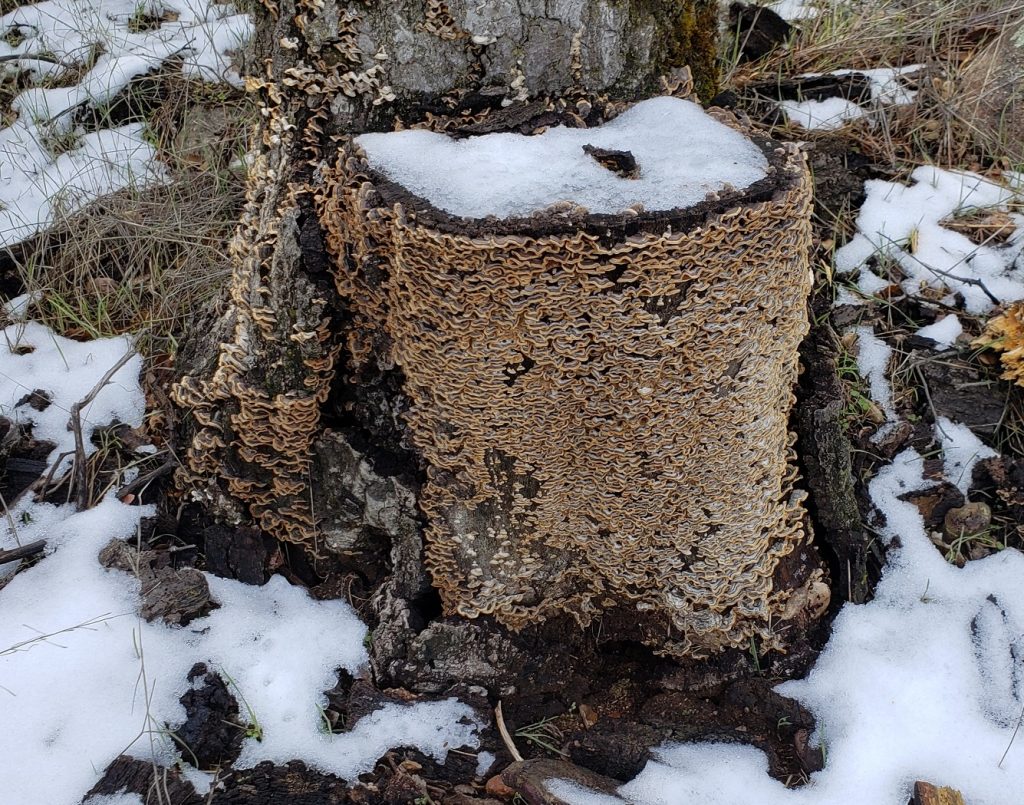
I absolutely refuse to make any jokes about fungi being “fun guys”. People who do that should be shot. Really. Fungi is the plural of fungus. The fungi are a separate kingdom of life — like the animal kingdom or the plant kingdom. They include yeasts, molds, and mushrooms.

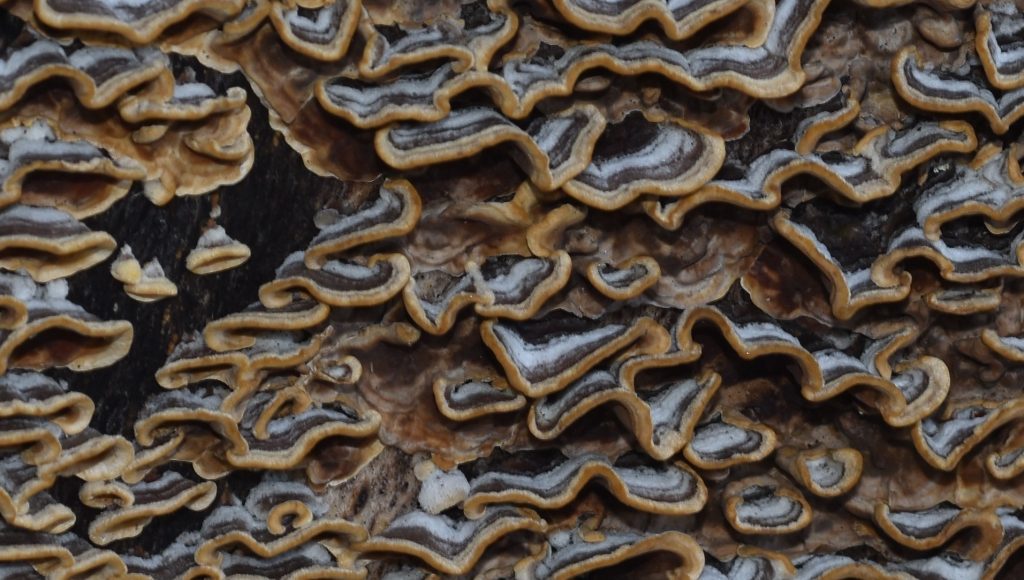
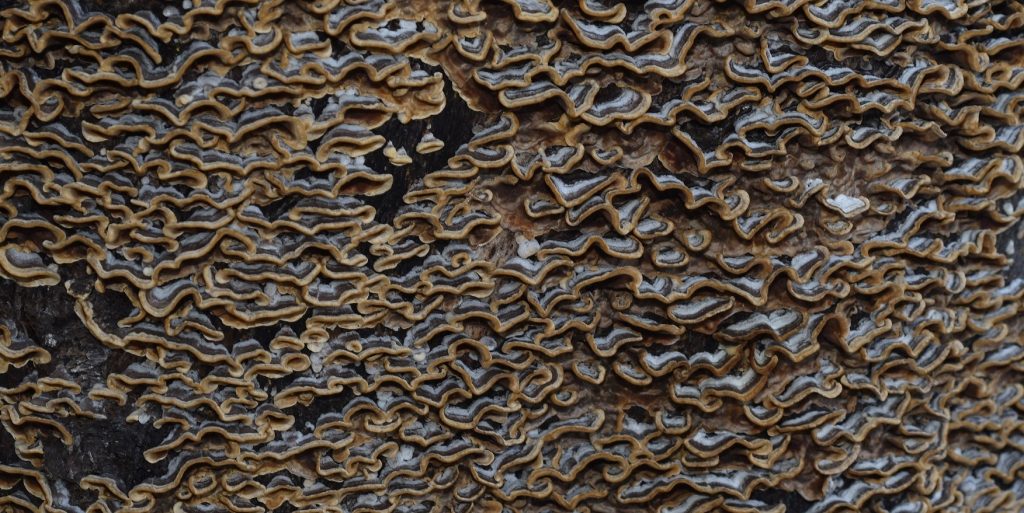
Hairy Curtain Crust (Stereum hirsutum)
Near Lake Morena, Campo, CA 2/24/2019

Actually, a mushroom is just the fruiting body (reproductive part) of the associated fungus. The main body consists of very thin filaments called hyphae (singular hypha). These hyphae are hidden in the substrate — that is, in the soil or inside the wood or whatever — that the mushroom is growing on. Collectively, the hyphae form an extensive network called a mycelium (plural mycelia).

Hairy Curtain Crust (Stereum hirsutum)
Gills of the hairy curtain crust mushroom (Stereum hirsutum)

Because fungi don’t move around like animals, most people assume they’re closely related to plants. In fact, geneticists have found that fungi are more closely related to animals! This makes sense when you consider that fungi don’t use photosynthesis to make their own food like most plants do. Like animals, they feed off detritus (rotting organic matter) or off other organisms. The difference is, instead of ingesting their food and then digesting it inside their bodies, fungi secrete digestive juices into the surrounding environment. Their food gets broken down by these secretions and the fungi absorb the resulting nutrients.

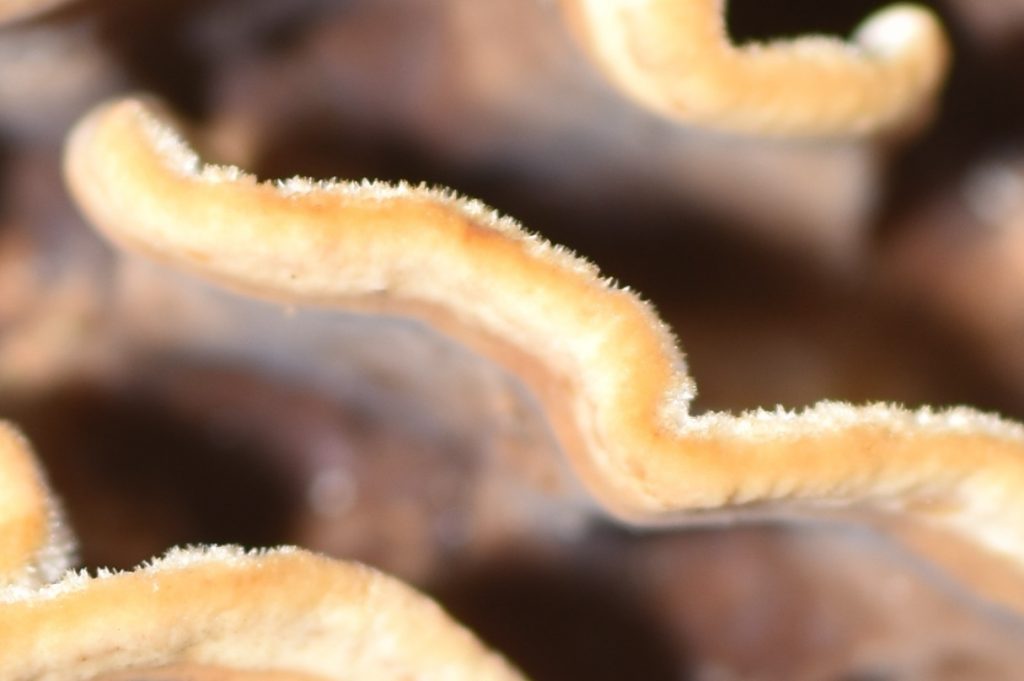
Hairy Curtain Crust (Stereum hirsutum)
Closeup

It’s long been known that fungi serve an important role in ecosystems as decomposers and recyclers, but, in recent years, scientists have uncovered other roles that are nothing short of mind-blowing. It turns out that most plants form mutualistic relationships with certain types of fungi. These fungi, called mycorrhyzal fungi, grow around and often into the roots of their host plant. The fungal network (mycelium) then acts as an extension of the plant’s root system, greatly increasing the plant’s ability to absorb water and minerals from the soil. In return, the plant supplies the fungus with carbohydrates, such as glucose and sucrose. If a plant is forced to grow without its usual fungal symbionts, it will be much smaller and less healthy, if it survives at all. Similarly, some mycorrhizal fungi will not survive unless a host plant is present.

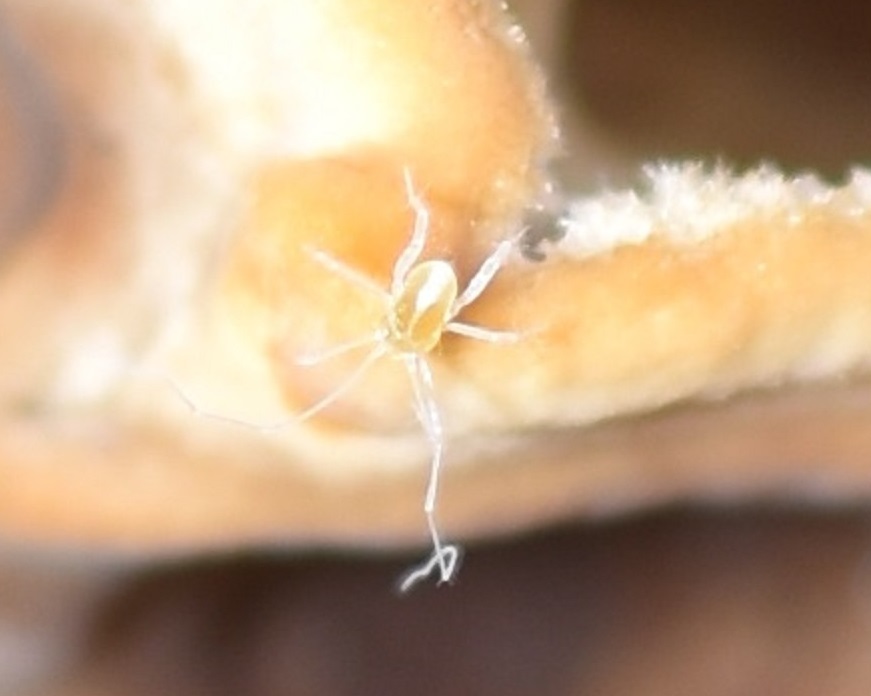
Hairy Curtain Crust (Stereum hirsutum)
Extreme closeup

That’s pretty interesting, but it gets better. It turns out that mycelia form a kind of communication and transportation network between plants. If a tree is not getting enough sunlight because it’s being shaded by larger trees, the fungal network may actually transfer food from the larger trees to the smaller one to supplement its diet. Remarkably, the fungi sometimes even transport food between different species of tree! All this is not meant to suggest that plants or fungi are actually intelligent; although, some people have suggested that there may be a kind of intelligence or even consciousness involved. That seems unlikely to me, but, either way, the relationship between plants and fungi is certainly much more complicated than anyone expected and we’re still learning more.

Mite
Mite

One final note… As I just mentioned, many fungi send their hyphae into the roots of their host plants. There is some evidence that the vascular systems of plants evolved from such a relationship. In this scenario, fungal hyphae would have formed a relationship with some non-vascular plant, living inside the plant just as fungal hyphae often do today. Eventually, these hyphae became a part of the plant, evolving into the vessels of the plant’s vascular system!

This isn’t quite as far-fetched as it might sound. It’s been shown that many of the organelles in plants and animals, such as chloroplasts, protoplasts, and mitochondria started out as free-living microbes that were ingested by a larger microbe. Instead of being digested, they somehow managed to survive inside the larger cell, eventually forming a symbiotic relationship with it. This “dual” cell eventually evolved into a multi-cell organism. This would be a nice subject for a future post, but, for now, suffice it to say that such relationships lend credence to the idea that the vascular system in plants could have started off as a network of invading fungal hyphae.

I’ve been talking mostly about the fungi that form mushrooms. I shouldn’t end this post without a brief mention of the other two types of fungus. Molds are similar to the mushroom fungi, but they have much smaller and, presumably, simpler reproductive structures. Yeasts are single-cell fungi. Some yeasts do form chains of cells, but they don’t form mycelial networks.

This post has been about an entire kingdom of living things, so, obviously, we’ve barely scratched the surface. I’m sure there’ll be many more posts to come about this fascinating group of organisms!

.