“In spring, the ivory flowers bloom on the sunny hill or in sheltered glade, in summer its fine green leaves contrast refreshingly with dried and tawny grassland, in autumn its colors flame more brilliantly than in any other native, but one great fault, its poisonous juice, nullifies its every other virtue and renders this beautiful shrub the most disparaged of all within our region.” – John Howell1
Most of the people I hike with aren’t especially cognizant of the botanical life around them. If a flower is unusually pretty they might notice. They might even comment on it. For the most part, though, they hike for the scenery, the exercise, and the companionship.
One plant that does get a lot of attention, however, is poison oak. Whenever a patch is spotted, someone is sure to deliver a warning to the rest of the group. “Watch out, poison oak!” is a common refrain. I can’t really blame them. A poison oak rash is no fun. I have a habit of lying down on the ground in order to get a better shot of whatever small creature I’m photographing. I also have a habit of focusing so intently on my subject that I don’t pay attention to what I’m lying in. After one such ill-considered photo session, I came down with the worst case of poison oak in my life. It was on both arms and both legs. (A couple of people asked me why I didn’t have it on the rest of my body. I explained that I don’t normally hike naked.) It itched like crazy, and it lasted for three or four weeks. Calamine lotion, for all its sterling reputation, didn’t make much of a dent in my suffering. It was a long few weeks.
It’s a pity poison oak and its close relative, poison ivy, have such a “great fault”, because they’re actually very interesting and attractive plants. The poison ivy on the east coast of the United States is especially beautiful in the Autumn, when the leaves turn a bright red. As one floral designer put it, “It would be a great fall accent—if you could use it. The trouble is, you couldn’t count on re-orders.”2
The Genus
Both poison oak and poison ivy are in the genus Toxicodendron, which includes a number of other “poisonous” plants such as poison sumac (T. vernix) and the lacquer tree (T. vernicifluum), which grows in Asia.
There are a number of species of poison oak and poison ivy:3
- Western poison oak (Toxicodendron diversilobum) – very common in western North America. This is the one I normally see in Southern California. In fact, it’s the most common woody shrub in California.
- Atlantic poison oak (Toxicodendron pubescens) – grows in eastern parts of the U.S., mostly in sandy soils.
- Poison ivy (Toxicodendron radicans) – grows in all states east of the Rockies. It’s very common in my home state of Virginia. It also grows in Central America.
- Western poison ivy (Toxicodendron rydbergii) – grows in northern parts of the eastern United States. It can also be found in the western U.S. and Canada, but it’s much less common than western poison oak.
- Asian poison ivy (Toxicodendron orientale) – grows throughout east Asia. It could be a variety of western poison ivy (T. rydbergii), rather than a separate species.
The other member of the genus that most Americans will have heard of is poison sumac. The only species in North America is Toxicodendron vernix. It has leaves with 7 to 13 leaflets, as opposed to the usual three leaflets characteristic of poison oak and poison ivy. It grows as a small tree or a tall shrub. When I lived in Virginia, I often used to see what I thought was poison sumac, but, according to my reading, it’s not nearly as common as most people think, and what is often identified as poison sumac really isn’t. So maybe it was some other type of sumac I was seeing. According to one source, the best way to find true poison sumac is to find a bog, trip, and catch yourself. The plant you catch yourself on will be poison sumac.4 5
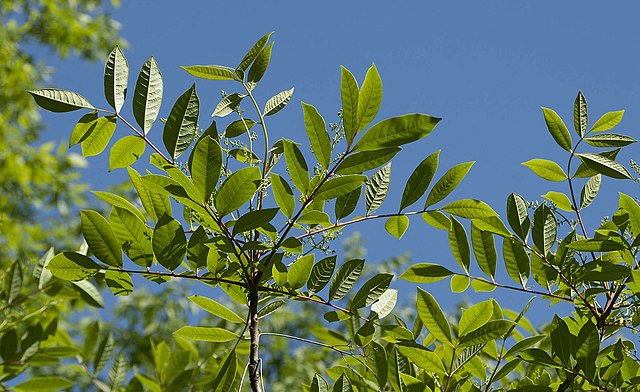
Cedarburg Bog State Natural Area in Ozaukee County, Wisconsin 6/16/2013
Author: Freekee
This file is made available under the Creative Commons CC0 1.0 Universal Public Domain Dedication.
The lacquer tree (Toxicodendron vernicifluum), as the name suggests, is a tree. I’ll have more to say about it in a later section.
Leaves of Three
What English speaker hasn’t heard the rhyme “Leaves of three, let it be?” Unlike many such popular bits of folklore, this one is pretty accurate. Both poison oak and poison ivy tend to have their leaves (technically leaflets) arranged in groups of three. Certainly, there are other plants that have this characteristic, but not as many as you might think, so if you avoid all plants with “leaves of three”, you’ll probably be safe.
So how can you tell if what you’re looking at is poison oak or poison ivy? Well, where you’re at is your first clue. If you’re on the east coast of the U.S., chances are it’s poison ivy. If you’re here in the west, it’s probably poison oak. This isn’t always the case, though. A more reliable clue is the shape of the leaves. Poison ivy leaves are pointed at the tip. The leaves of poison oak have scalloped, toothed, or lobed edges and have blunt tips.
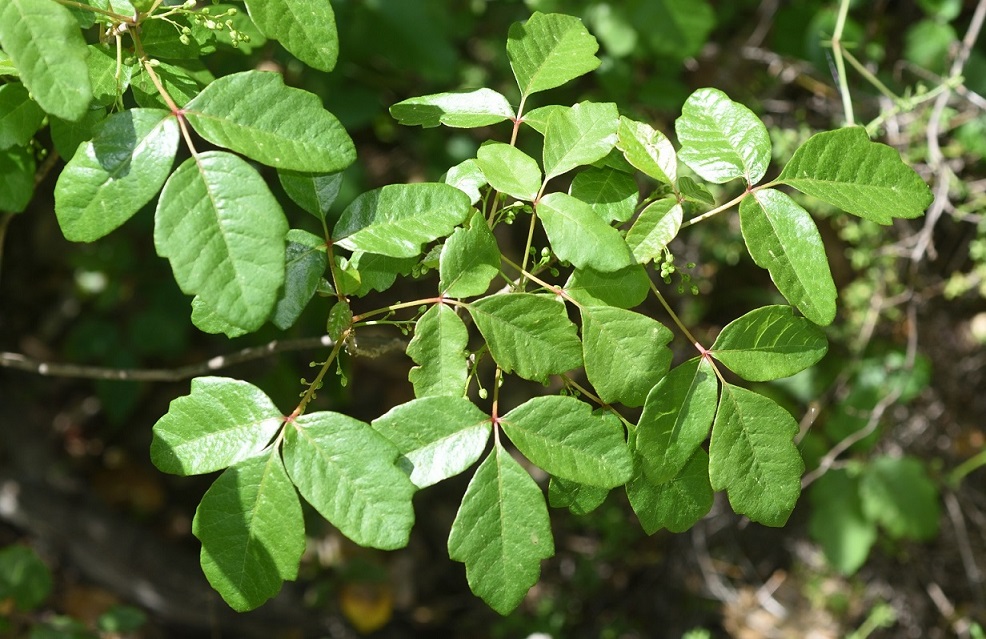
San Diego County 4/4/21
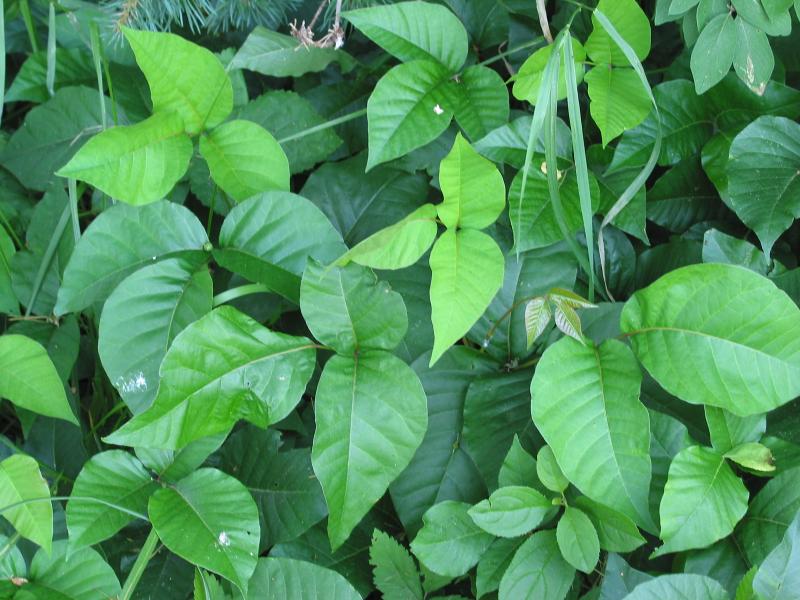
Author: Esculapio
This work has been released into the public domain by its author, Esculapio. This applies worldwide. In some countries this may not be legally possible; if so: Esculapio grants anyone the right to use this work for any purpose, without any conditions, unless such conditions are required by law.
I should mention that both poison oak and poison ivy drop their leaves for part of the year. So how do you identify one of these plants if they don’t have any leaves? Well, you could try rubbing one of the sticks on your arm, and see if you get a rash. Otherwise, I’m not sure. Probably, you should just try to remember where you’ve seen the plants growing in the past and avoid that area. (And, yes, you can definitely get a rash from the leafless twigs.)
Flowers and Fruit6
As noted in the quote from John Howell at the beginning of the post, T. diversilobum blooms in the spring with ivory or greenish-white flowers. The flowers of T. radicans are similar.
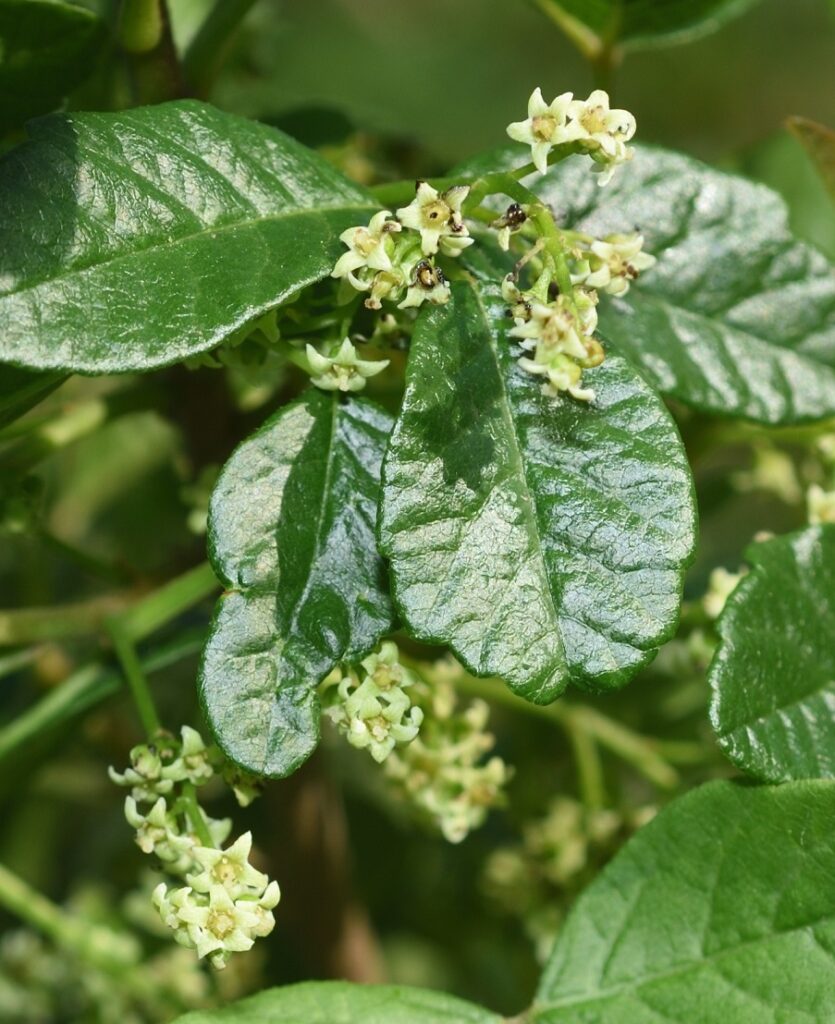
Mission Trails Regional Park, San Diego County 4/1/21
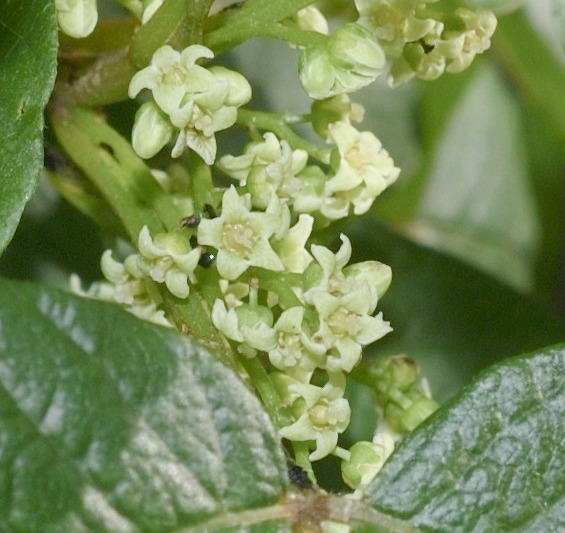
Mission Trails Regional Park, San Diego County 4/1/21
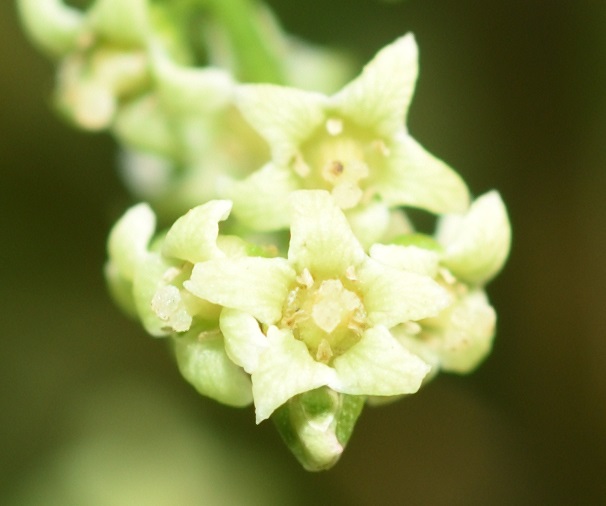
When fertilized, they develop into greenish-white or tan berries. Technically, the berries are drupes. A drupe is a fruit that consists of a fleshy outer part surrounding a hard pit, which contains the seed. Poison oak, by the way, is one of the few plants in California with white (or nearly white) berries. Another one is snowberry (genus Symphoricarpos), whose berries are very white and are considered poisonous to humans.7 So another good rule to follow, at least in California, is to not mess with anything that has white berries.
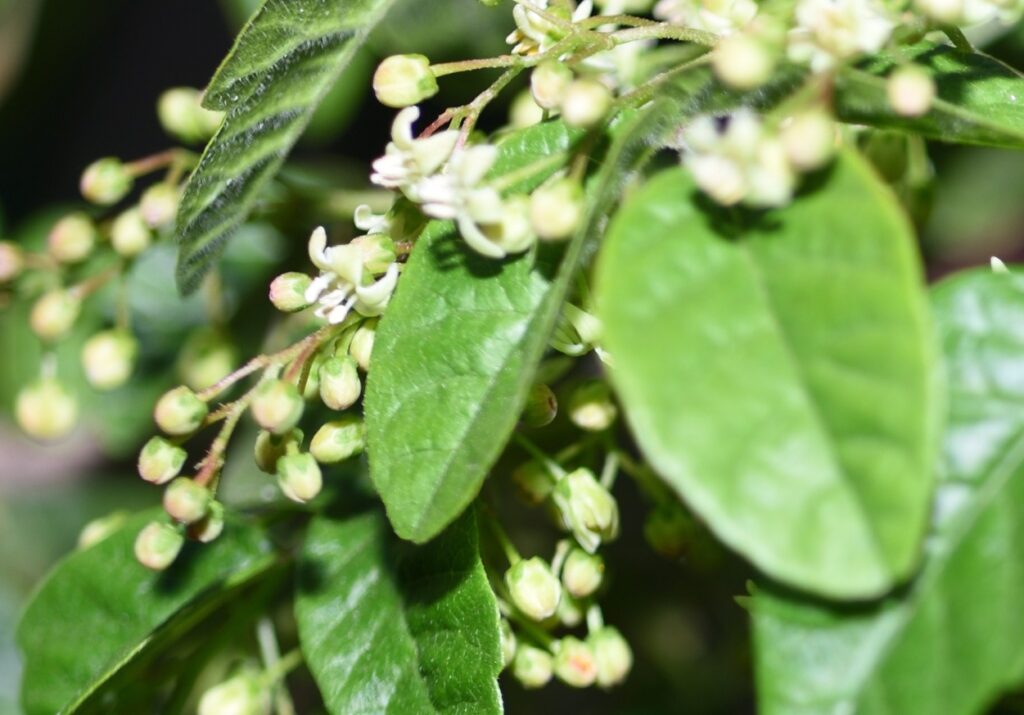
San Diego County 4/16/21
The Cashew Family8
Surprisingly, the genus Toxicodendron, with all its not-so-popular plants, is in a very popular family: Anacardiaceae or the cashew family. Besides cashews (Anacardium occidentale), Anacardiaceae also includes the pistachio tree (Pistacia vera) and the mango tree (Mangifera indica). So, that’s kind of weird, but cashews, pistachios, and mangos obviously don’t contain whatever substance is found in poison oak that causes rashes, right? Well, actually, they do. The substance is an oil called urushiol. In the case of mangos, it’s found in the skin of the fruit, not the meat. If you eat a mango, make sure you peel it first. Also, wash it after you peel it. Your knife can transfer some of the urushiol from the skin to the fruit. Apparently, some people are able to eat mangos with the skin intact without suffering any negative consequences. Presumably, those people would also be immune to the effects of poison oak. But immunity to the effects of urushiol often wears off with repeated exposure. You can be immune to it for years, and then suddenly find yourself reacting. Many people who unwisely eat the skin of a mango will find themselves with a painful rash on their lips. This is known as ‘mango mouth’.9 10
So, what about cashews and pistachios? Most people seem to be able to eat these without any problem, but, yes, some people are allergic to them. Often, if you’re allergic to one of the three (cashews, pistachios, or mangos), you’ll be allergic to all three, although that’s not always the case.11 12 Just as most of the urushiol found in a mango is in the skin and not the meat of the fruit, most of the urushiol in cashews and pistachios is in the shell. Even so, cashews and pistachios are not eaten raw. (If you buy these nuts, they may be described as raw on the packaging, but they’ve probably been roasted at least enough to break down the urushiol.)13
More on Urushiol
I guess it’s a bit late in the game to be mentioning this, but poison oak and its relatives aren’t technically poisonous. Urushiol is an allergen, not a toxin. In other words, it doesn’t directly attack your body. Instead, it causes an immune reaction. This is why you can be seemingly immune to poison oak for years and then suddenly develop an allergy to it. Repeated exposure sensitizes your immune system to the substance, until it finally starts reacting to it.
It’s also worth noting that if you’re already sensitive to urushiol, you can’t build up an immunity to it by repeatedly exposing yourself to it in small amounts. It doesn’t work that way. In fact, you would just be increasing your sensitivity to it.
Why does our immune system react to urushiol? No one knows for sure. I could describe how urushiol “attaches to certain proteins of the skin, where it acts as a hapten, leading to a type IV hypersensitive reaction”, blah, blah, blah, but the fact is, in most animals, this doesn’t happen.14 Remarkably, humans and maybe a few other primates seem to be the only animals that have an immune reaction to the compound! Your dog can wallow in poison oak or poison ivy all day, and it’ll be just fine. You, not so much. The oil dries on the dog’s fur, and it can be transferred to you — over and over again — until you get around to giving the dog a bath.
The name ‘urushiol’ comes from ‘urushi’ — the Japanese word for the Chinese lacquer tree (Toxicodendron vernicifluum). The sap of this tree is tapped to produce lacquer. The sap is filtered, heat-treated, or colored before it’s applied, and the applied sap must then be cured by drying it in a warm, humid environment for 12 to 24 hours. Curing causes the urushiol to polymerize, forming a clear, hard surface. In its liquid state, the sap can cause extreme rashes, even from the fumes. Once cured, it may still cause rashes in some people, but this is uncommon.15
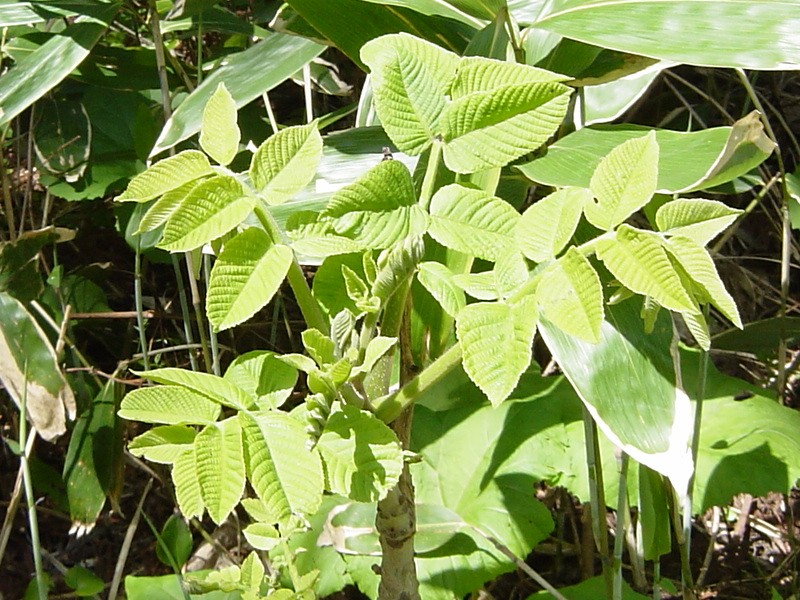
Author: Aomorikuma
This file is licensed under the Creative Commons Attribution-Share Alike 3.0 Unported license.
Exposure and Treatment
It can be a bit difficult to figure out what to believe when it comes to poison oak and poison ivy, since there’s a lot of misinformation out there. One thing I’ve read is that if you think you’ve been exposed to it, there’s no rush. It takes hours for the oil to penetrate the skin and, as long as you scrub the affected area thoroughly with soap and water when you get home, you should be okay. This doesn’t seem to be correct. The oil actually penetrates very quickly, and if you want to avoid a reaction, you need to scrub it off pretty quickly after coming into contact.
In theory, simply coming into contact with the plant is not enough to get a rash. The oil is contained within the tissues, not on the surface, so, in order to be exposed to it, you have to rupture the tissue containing it. Of course, you have no way of knowing if a plant you come in contact with has already been bruised or injured, in which case, the oil will be there waiting for you. Plus, some people are very sensitive to exposure, so better safe than sorry.
Urushiol is very sticky and, once released, it will dry onto surfaces and can take a very long time to degrade. (According to one account, the oil may stay active for one to five years!16) So if you’ve come down with a rash, it’s best to thoroughly wash everything that might still have some of the oil on it, such as the clothes you were wearing at the time.
Another misconception is that scratching the rash will spread it. The blisters do not contain urushiol, so breaking them doesn’t make the rash worse. You also can’t get it from someone else, unless they still have some of the oil on their skin or clothes.17
A popular belief that is correct is that you can get a rash from burning poison ivy, oak, or sumac and breathing in the smoke. Inhaling the fumes can cause a systemic reaction, as opposed to the usual contact reaction, and a systemic reaction can be much more serious. Symptoms may include headache, nausea, vomiting, fever, swollen lymph nodes, and difficulty breathing. Swelling in the respiratory system may even lead to death.
Calamine lotion can help make the symptoms of a rash more endurable, but it doesn’t make the rash go away any faster. It also won’t do anything for a systemic reaction. In that case, you should go to the doctor as soon as possible.18
Why Urushiol?
So why would a plant produce all that allergenic oil? Usually, when a plant produces a toxic substance, it’s to protect against herbivores. But, as I’ve already mentioned, urushiol is neither toxic nor allergenic to most animals. In fact, birds, deer, goats, and many other creatures happily dine on the urushiol-laden berries of poison oak and its relatives.
We don’t really know why some plants produce urushiol. It’s been suggested that it may protect from bacterial or fungal infection when the plant is injured, and the stickiness of the resin may help to seal wounds. This is all just speculation, though.19 20
What of the Pollen?
Some sources will tell you that every part of a poison ivy or poison oak plant contains urushiol. Apparently, this isn’t entirely true, because much of the honey produced in the U.S. contains pollen from one or the other of these plants. Honey bees are quite happy to visit the flowers of poison ivy and poison oak, and a study of honey produced in East Texas found that poison ivy pollen occurred in 83% of the samples. Granted, it wasn’t found in large amounts, so I suppose it could be that the low concentration makes it safe to eat.21 On the other hand, the book “Nectar and Pollen Plants of Oregon and the Pacific Northwest” (Burgett et al. 1989) describes poison oak as a “producer of light honey in areas where it grows in sufficient abundance”. In fact, you can buy “poison oak honey” online.22 (Click here if you want to order some.) So maybe the pollen really is free of urushiol.
Poisonous Honey23
“In the summer, in the College garden, the woolly foxglove, Digitalis lanata, is visited by little bees which become stuporose and lie upside down in the flowers, seeming unable to fly away when disturbed.” – Dr Henry Oakeley, Garden Fellow at the Royal College of Physicians (RCP) Medicinal Garden.
As long as we’re on the subject, I would be remiss if I didn’t mention that, although pollen from poison oak and poison ivy seem to occur fairly regularly in honey without causing any ill effects, there is such thing as poisonous honey. Some plants produce nectar or pollen that is poisonous to humans and sometimes even to bees! If enough of this is incorporated into a batch of honey, then it could become toxic.
So why don’t we ever hear of people getting sick or dying from eating bad honey? Two reasons: First, bees usually visit a variety of flowers, so that no one plant species contributes the bulk of the pollen or nectar. When a problem does occur, it’s usually because of a lack of species diversity, forcing the bees to visit flowers that they might normally avoid. Second, when honey does become tainted, it often has a strong, unpleasant taste, so most people would naturally avoid it.
That said, there have been cases of poisoning by honey. Most often, the plant responsible is rhododendron. Rhododendron and other plants in the family Ericaceae produce chemicals called grayanotoxins, which are toxic to both bees and humans. Honey that becomes tainted with these chemicals can cause a reaction called ‘rhododendron poisoning’ or ‘honey intoxication’. I want to emphasize again that this happens very rarely, but it does happen. And sometimes it’s even changed the course of history.
Rhododendron poisoning is said to have caused Xenophon’s Greek army to have retreated from Persia in 399 bc. Later, during the Third Mithridatic War in 65 bc, the Roman general Pompey’s soldiers reportedly suffered casualties, some of them lethal, from eating rhododendron-tainted honey deliberately left behind by the enemy forces. According to historical accounts, consuming such honey would lead to a “feeling of drunkeness, to vomiting and purging, and madness that lasted for days” (Collins).24 25
The botanist Frank Kingdon-Ward and his companions experienced rhododendron poisoning while traveling towards Tibet through northern Burma. He describes the symptoms as similar to acute alcohol poisoning. The local Tibetans had apparently built up a tolerance for the toxins, as they were able to eat the honey without suffering any ill effects. (Collins) 26
In 2005, the British writer, Piers Moore Ede, published a travel book, “Honey and Dust: Travels in Search of Sweetness”, in which he describes traveling the world in search of the last of the tribes that still hunt wild honey. In the book, Ede tells of eating the “wondrous toxic honey” collected by the honey hunters of Nepal. This honey, too, was tainted by rhododendron. According to Ede, the effects of honey intoxication “resembled drunkenness at first, but then became visual, like a magic mushroom trip I remembered from university. Painted dots were dripping across my irises like technicolor rain. My body felt light and tingly, filled with warm rushes and heat-bursts. It was wild and strangely wonderful.”27 28
“The poisonous weed, being in shape but little different from our English ivie; but being touched causeth reddness, itchings, and lastly blysters, the which howsoever, after a while they pass away of themselves without further harme; yet because for the time they are somewhat painefull, and in aspect dangerous, it hath gotten itselfe an ill name, although questionless of noe very ill nature.” — Captain John Smith31
The term ‘poison ivy’ was coined by none other than our own Captain John Smith of Jamestown fame. Poison ivy is a native of North America, and its first mention in the literature is the above-mentioned quote from Smith. (Poison oak, of course, is so-named because of the resemblance of its leaves to those of oak trees, although the two plants are not closely related.)
European collectors were always looking to buy “exotic” new plants from the New World, and they were willing to overlook whatever disagreeable aspects some of those plants might have presented. In fact, some of those disagreeable aspects might have been regarded as a plus. What uses might medicine make of new substances that had such strong effects on the body? In those days, most medicines were plant-based, so it’s not surprising that physicians would have looked to poison ivy and its relatives for potential new treatments. Throughout the 18th and 19th centuries, scientists experimented with poison ivy as a medicine.
One physician-botanist, André-Ignace-Joseph Dufresnoy, was in the habit of giving botany lectures that were open to the public. During one such lecture, he displayed some leaves of poison ivy and described the ill effects of the plant. A young florist in the audience was skeptical. After the lecture, he approached Dufresnoy and proceeded to test the truth of his assertions by rubbing the leaves on his hands. No doubt the florist came to regret his impulsiveness, but when the rash finally cleared, he discovered that an old sore that he had had on his wrist had completely healed!
When Dufresnoy learned of this miraculous cure, he quickly concluded that poison ivy offered great potential as a medicine. He boiled some leaves in hopes of making an infusion that was safe for internal use. Apparently, this mostly worked, because Dufresnoy tested the concoction on himself and reported only mild side effects. Sweating and urination increased, and he experienced some slight stomach upset. He went on to prescribe such extracts to patients with various skin maladies and to at least one patient with paralysis of the legs. Reportedly, he had some positive results.
Dufresnoy, by the way, nearly went to the guillotine because of his infatuation with poison ivy. During the French Revolution, he sent some young plants to a physician friend. At the time, poison ivy was in the genus Rhus, instead of Toxicodendron, so Dufresnoy later wrote to his friend, asking “How are our dear Rhus? How I long to see them!” The word for Russians in French is ‘Russes’, and the Russians were threatening to join the wartime coalition against France. Dufresnoy’s letter was intercepted, and the revolutionaries interpreted ‘Rhus‘ as Russians (Russes). (People weren’t particularly consistent with their spelling back then.) Fortunately, the harsh judge who was originally due to hear the case was deposed, and Dufresnoy was able to explain to the authorities that he was just writing about plants.
In the 20th Century, botanists moved the “poisonous” members of the Rhus genus into a separate genus, Toxicodendron, which means “poison tree”. The chemist who identified urushiol as the allergen in poison ivy and figured out its chemical structure was a Japanese scientist named Rikō Majima. Japanese scientists at the time had a hard time competing with Western scientists, who were far ahead of them technologically, so Majima decided to focus on local natural products that western scientists were unlikely to spend much time on. He studied the lacquer tree from 1907 to 1922, eventually extracting the allergen and identifying it as a mixture of closely related products called alkyl catechols.
Poison Ivy in Popular Culture
For whatever reason, poison oak doesn’t receive a lot of attention in popular culture. Poison ivy is another matter. Something about the plant just seems to capture the public’s imagination. Here’s a few examples.
In 1959, the Coasters were the first group to record the song “Poison Ivy”, which was written and composed by Jerry Leiber and Mike Stoller, respectively. Ostensibly, the song is about a woman who “comes on like a rose” and is “pretty as a daisy,” but will “really do you in if you let her get under your skin.” In reality, it’s about the clap (gonorrhea), a subject that didn’t normally get a lot of air time in 1959.
Another example, of course, is the Batman supervillain Poison Ivy. Dr. Pamela Lillian Isley is a botanist and biochemist, who survives a poisoning attempt, only to find that she has acquired an immunity to plant poisons and (perhaps more remarkably) the ability to control plants.32
Poison Ivy is also the name of a popular movie starring Drew Barrymore as a psychopathic teenager. The movie tagline is “What Ivy wants, Ivy gets”. It spawned several sequels.
Finally, Toxicodendron species have played starring roles in many a “poison garden”. As I’ve noted in other blog posts, plants routinely produce toxins to protect themselves from animals that would like to eat them. Animals, such as us, that do eat them, find or evolve ways to reduce the toxicity to a safe level. As a result, the line between toxic and non-toxic is blurred. Nevertheless, some botanical gardens have leveraged our natural proclivity towards sensationalism by fencing off an area which they designate as their “poison garden” and, of course, charging extra to see it. It’s silly, but mostly harmless, fun. If you’re ever in Northumberland, England, you can visit the “Deadliest Garden in the World” at Alnwick Castle;33 Ireland has a poison garden at Blarney Castle;34 and then there was the Medici Poison Garden in Florence, Italy, which I’m not sure ever actually existed, but was supposed to have supplied Catherine de Medici with the poisons that went into her various potions. (She had something of a reputation as a sorceress.)35
The Future is Looking Itchy36
Plants breathe carbon dioxide. This means that, in the short term, some plants will actually benefit from the increased CO2 levels associated with global warming. In a six-year study conducted by researchers in North Carolina, an experimental forest was subjected to increased levels of carbon dioxide. The researchers found that the greater availability of CO2 improved poison ivy’s ability to conduct photosynthesis and manage water usage, allowing it to grow larger and more abundant. Not only that, but the increase was greater for poison ivy than it was for similar woody plant species, meaning that, in the future, poison ivy could out-compete other plants and become even more common than it already is. And the bad news doesn’t end there. A higher carbon dioxide level also influences the production of urushiol, leading to a more potent form of the compound.
So, yeah, the future is looking very hot and very itchy.