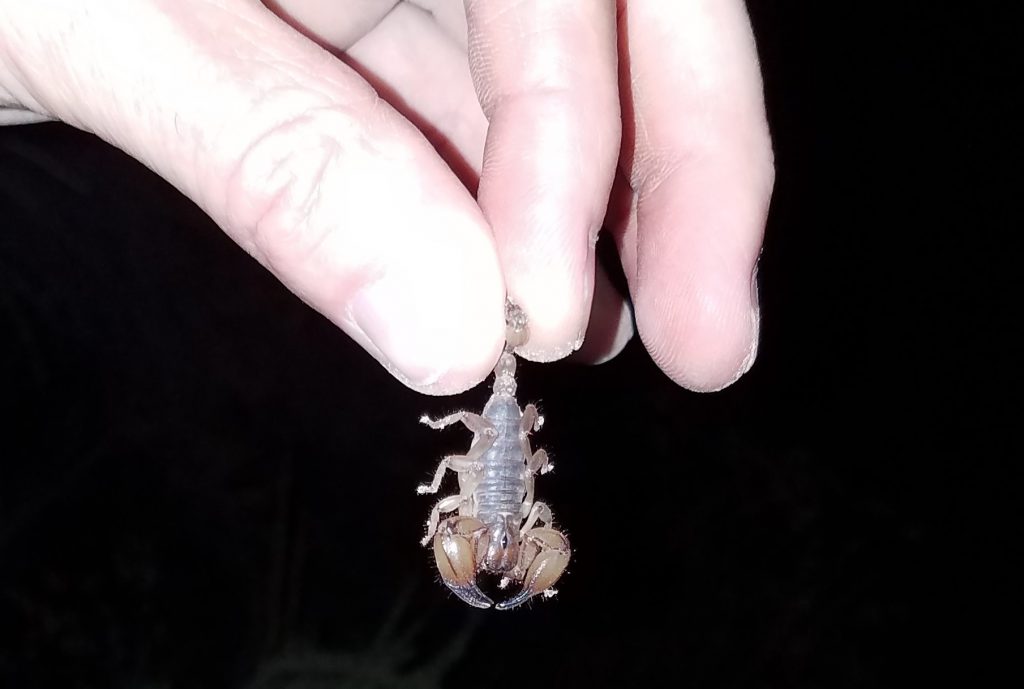
Alongside rattlesnakes and tarantulas, scorpions are one of the most iconic animals of the American Southwest. That’s not to say they’re limited to that area — far from it — scorpions are found in tropical and temperate regions all over the globe and in just about every sort of terrestrial environment from deserts and high mountains to inter-tidal zones. They’ve also been around for a very long time. Scorpions date back at least as far as the Silurian period, around 435 million years ago.

Mission Trails Regional Park, San Diego County, CA 7/1/17
Despite their long evolutionary history and wide distribution, their basic form hasn’t changed much. Like spiders, they have eight legs. At the front of the body are another pair of appendages called pedipalps, which end in large claws or pincers.
Perhaps their most distinctive feature is their long “tail” — really just a narrowing of the abdomen — ending in a large, bulbous stinger. The fact that this tail is really an extension of the abdomen can be seen by the location of the anus, which is on the last segment, just before the stinger. A scorpion will often hold its tail curved over its body with the stinger pointing forwards. It may forgo using its stinger on small prey, but when it needs to subdue a larger animal, the stinger stabs forward with blinding speed.
Although all scorpions are venomous, most are not dangerous to people. In some cases, the sting is said to be less painful than a bee sting. (This is not the case with the two most common scorpions in my area. More on that later.) Of the approximately 1750 described species of extant (living) scorpions, only around 25 have venom that is dangerous to humans. Most of these are in the family Buthidae. This includes the deadliest species in the United States, the Arizona bark scorpion (Centruroides sculpturatus). As you might expect, C. sculpturatus is found mostly in Arizona, but there’s also a small population in the southeastern corner of California.
The venom of the Arizona bark scorpion causes severe pain, usually lasting between 24 and 72 hours. If the sting is in a hand or arm, the victim may experience temporary loss of use of the appendage. In especially bad cases, the victim may experience numbness, paralysis, convulsions in the affected limb, and frothing at the mouth.
Despite the severity of these symptoms, death is extremely rare. Every year, thousands of people in Arizona are stung by C. sculpturatus, yet only 2 fatalities have been recorded in the state since 1968. This is not to say that stings should be treated lightly. Part of the reason for the low fatality rate has been the development of antivenin. If you think you’ve been stung by C. sculturatus, you should seek medical attention as soon as possible. Children, the elderly, and immuno-compromised people are most at risk.
While we’re on the subject of stings, I know you’ll want to see a scorpion in action, so here’s a video of a California common scorpion trying to sting my hiking pole. (No, I don’t regularly harass scorpions. I just wanted to see one in action, too.) 1 2
The general term for envenomation by scorpion, by the way, is ‘scorpionism’. Why we need a general term for this, I don’t know.
Milking Scorpions for Fun and Profit 3 4
No, scorpions do not produce milk. They are ‘milked’ for their venom. Why, you ask? Scorpion venom is a mixture of many different biochemical substances that have all sorts of physiological effects. It’s very possible that some of these substances will find a use in medicine. Researchers are actively exploring the use of scorpion venom for such things as treating multiple sclerosis and cancer and to help with heart transplants. It may also be useful in pain management.
One thing researchers are concerned about, though, is the possibility of addiction to scorpion venom. Yes, you read that right. It’s no secret that many of the medications currently used for pain management are extremely addictive. There’s no guarantee that medications derived from scorpion venom will be any different.
And there’s cause for concern. There is currently a craze in India of people deliberately letting themselves be stung by scorpions. Apparently, the pain is followed by a feeling of euphoria. There are even dealers on the side of the road between Delhi and Bombay that you can go to if you want to pay to be stung. Many clients seem to get addicted to the stings.
So, danger of addiction aside, how do you go about milking a scorpion? It’s actually not that hard. You cover the mouth of a container with some sort of membrane, position the membrane in front of the stinger, and give the scorpion a tap on the back. When the scorpion strikes, the stinger penetrates the membrane and leaves a tiny drop of venom clinging to the inside.
Of course, you’re not going to collect massive amounts of venom this way. Neither is it particularly safe. People who collect venom professionally (for sale or research) usually use electrical stimulation of the venom bulb to get it to release venom. Click here to watch a video of someone using this method. A robot has even been developed to speed up the process of collecting venom for cancer research.5
Despite the advent of scorpion-milking robots, scorpion venom is produced in such tiny quantities that it supposedly holds the record for being the most expensive liquid in world. A single liter will set you back over ten million dollars!6
A Very Laid-Back Predator 7 8 9
Scorpions are nocturnal predators. They usually hide in burrows during the day and come out at night to hunt. Their prey typically includes insects, spiders, and other arthropods. Some species also feed on grubs and earthworms. Really large scorpions have even been known to eat lizards and small rodents. Most species are generalists, feeding on many different things, but some specialize in one type of prey, such as burrowing spiders.
They will also eat each other. Because of this, it’s perhaps not surprising that the vast majority of scorpions are nonsocial. There are a few species that overwinter in groups, however. Presumably, those types are less inclined to cannibalism.
Scorpions are not active hunters. Mostly, they sit and wait. Their eyesight is poor, but the sensory hairs on their legs and pedipalps allow them to sense the vibrations of approaching prey.
No, Really, They Are Seriously Laid-back 10
Scorpions tend to be very abundant in arid regions — more so than is possible for most predators. They’re able to pull this off because they have unusually low metabolic rates. According to a study published in the “Journal of Experimental Biology”,11 the metabolic rates of scorpions from two genera were measured to be less than 24% that of typical terrestrial arthropods such as spiders and insects (measured at 25° C). This means they don’t require nearly as much energy and don’t have to eat as often. According to one website,12 scorpions can go up to a year without food and require less than a tenth as much oxygen as most insects.13
Another fascinating thing about scorpion metabolism is that they seem to have the ability to slow it down and quickly speed it back up when the situation demands. Click here to watch a “National Geographic” video that discusses this. While many animals slow their metabolism when hibernating or estivating, it typically takes a while for them to raise it back up to normal speed. A scorpion, however, can be resting in a lowered metabolic state and still be ready to strike at full speed if a tasty morsel wanders by.
This slow metabolism undoubtedly plays a part in their ability to survive in a wide range of environments. Although they usually live in hot, arid places, researchers have frozen scorpions overnight and then watched them thaw out and walk away!14
Where Baby Scorpions Come From 15 16
While most scorpions reproduce sexually, there are a few species that have decided to skip all the mess and fuss of exchanging genetic material. These species reproduce through a process called parthenogenesis in which embryos develop from unfertilized eggs. All the scorpions in these species are female and all the babies are clones of their mother.
In species that do reproduce sexually, the courtship starts with a dance. The male grasps the female’s claws in his own and starts leading her around. Depending on the species, the dance may involve other behaviors such as the male grasping the female’s chelicerae (mouth-parts) with his own — almost like a kiss. In fact, the behavior is sometimes called a cheliceral kiss. There may also be some juddering and, in some species, the male even injects a small amount of venom into the female to keep her calm.
The dance, which is called a “promenade à deux” (French for a “walk in twos”), is not particularly romantic. Its main purpose is probably to keep the male from being eaten while he searches for a nice, smooth place to deposit his spermatophore. This is just a capsule that contains his sperm. Once he finds a good place, he extrudes a glandular secretion that forms a stalk to which the spermatophore is attached. He then positions the female over it. Physical contact with the spermatophore causes the sperm to be ejected into her genital opening. (See the section on anatomy.) The sperm, of course, then make their way to the eggs and fertilize them.
Unusually for non-mammalian animals, scorpions give birth to live young. The eggs are retained inside the mother and the embryos are nourished in utero for a period of several months to a year, according to species. Litter sizes range from 1 to 100, but average about 25. Immediately after birth, the young scorpions (or scorplings) climb up onto their mother’s back, where they will remain for 1 to 50 days. During this time, they absorb water through their mother’s cuticle. At birth, the scorpling’s cuticle is soft. It won’t harden until after the first molt, at which time the scorpling will leave its mother and assume its mostly solitary life.
Scorpions I Have Known
Here in Southern California, we have a number of species, but, so far, I’ve only encountered three of them. The most common one seems to be the California common scorpion (Paruroctonus silvestrii).17 The adults tend to be around 7 cm (2.5 inches) long. There’s a photo of one near the beginning of the article. Here’s another one:

Mission Trails Regional Park, San Diego County, CA 8/13/18
The body of this individual appears to be a bit thicker than the one in the earlier photo. This may indicate that it’s a female, as they’re supposed to have thicker bodies. I’m not an expert, though, so I don’t know for sure. The scorpion in the next two photos, however, is almost certainly female. In fact, I wouldn’t be surprised if it was pregnant. (But again, I’m not an expert.)

San Diego County, CA 7/18/17

San Diego County, CA 7/18/17
P. silvestrii is found throughout California and in a great variety of habitats. I usually see them in chaparral country, but I’ve seen them in the desert, as well. They can even be found on sandy coastlines and forested mountains.18
As noted earlier, the newborn or young of scorpions are called scorplings. The next few photos show a very young scorpling of P. silvestrii. I don’t know how young, but it was tiny compared to the adults — maybe a quarter of an inch or around one centimeter.

Mission Trails Regional Park, San Diego County, CA 8/21/17
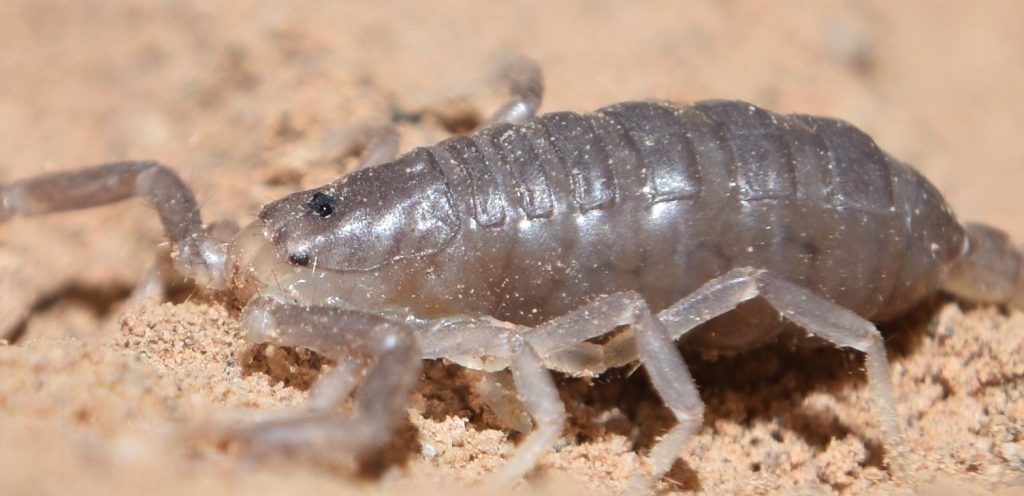
Mission Trails Regional Park, San Diego County, CA 8/21/17

Mission Trails Regional Park, San Diego County, CA 8/21/17
The sting of P. silvestrii, by the way, is reportedly quite painful. According to enonumus, writing on the website “BugGuide” 19, when he got stung on the bottom of the foot by one of them, “It just felt like someone stuck an ice pick straight through my foot!!!”
The second most common scorpion I’ve seen in Southern California is the California swollen stinger scorpion (Anuroctonus pococki).20 Here’s a few pics.

San Diego County 8/11/17

San Diego County 8/11/17
This scorpion is about the same length as P. silvestrii, but its more robust body and much larger claws make it look a bit more fearsome. This may be misleading. As a general rule, the larger the claws, the less potent the venom. This is because having large claws is an indication that the scorpion relies more on its claws to subdue prey than on its sting.21 So, despite its appearance, A. pococki could have a less painful sting than P. silvestrii. This is not a hard and fast rule, however, and anecdotal evidence says that it’s sting is still plenty painful.22
The next photo shows a closeup of A. pococki’s stinger. Note the swelling just before the business end. This structure is what inspired the scorpion’s common name. The scorpion mating process can be hazardous to males, since females sometimes have difficulty distinguishing between a potential suitor and a potential meal. Males of some species get around this problem by stinging the female to calm her down. Of course, it wouldn’t do to inject a full load of venom into the female as killing her would tend to defeat the whole purpose of mating. Supposedly, the swelling is there to keep the male from overdoing things — maybe by preventing him from stabbing too deeply? I’m not quite sure how it’s supposed to work.23
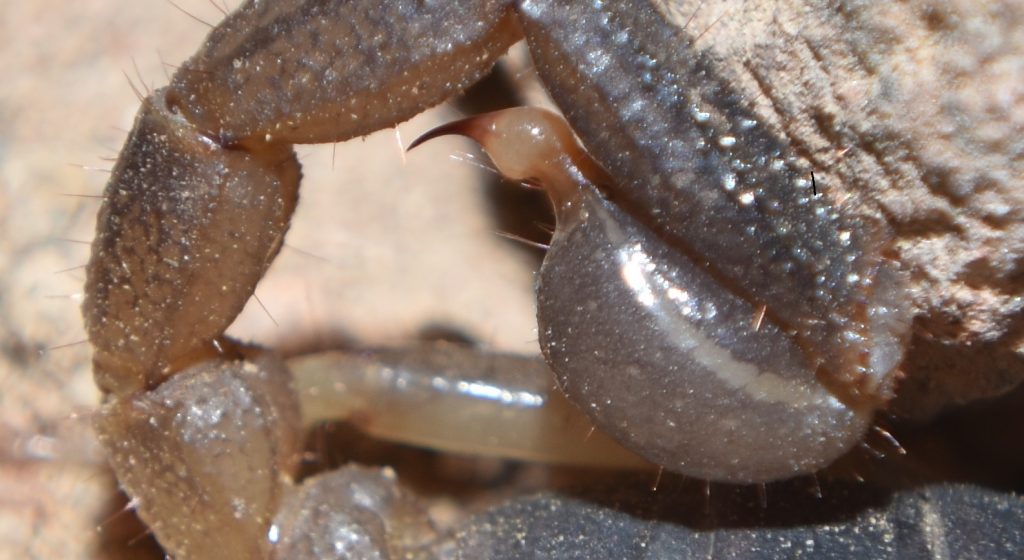
San Diego County 8/11/17
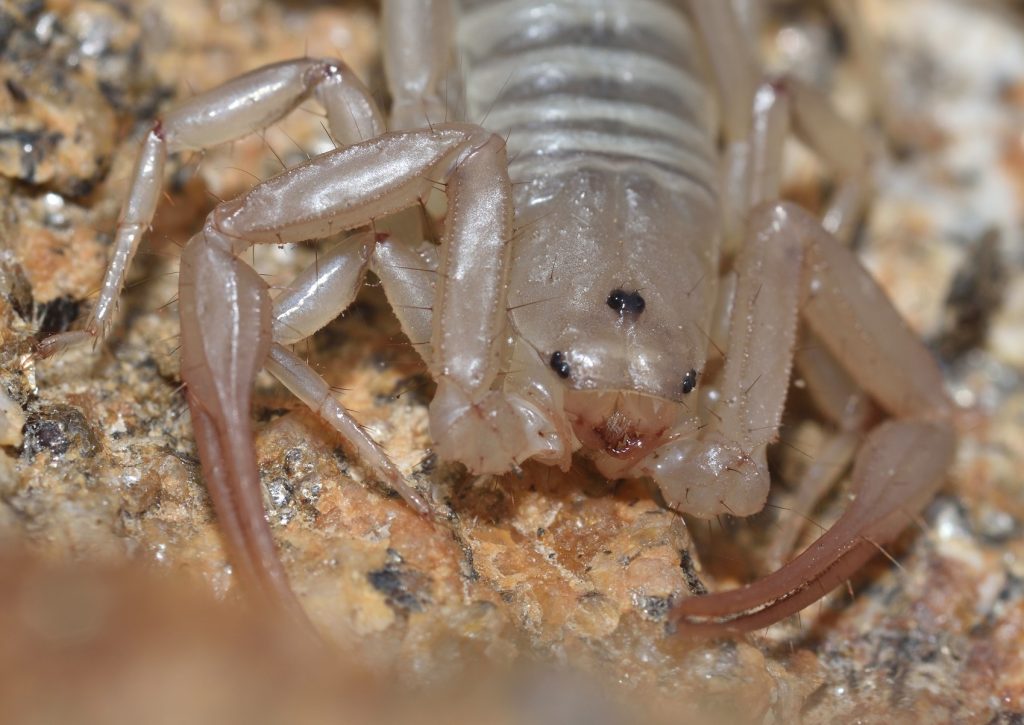
The third and final scorpion species that I’ve encountered in Southern California is Stahnkeus subtilimanus.24 25 If it has a common name, I haven’t been able to find it. I’ve only seen this scorpion once. I was hiking in the desert in winter and I turned over a rock, hoping to find something interesting to photograph. I was successful. It’s around the same length as the other two.
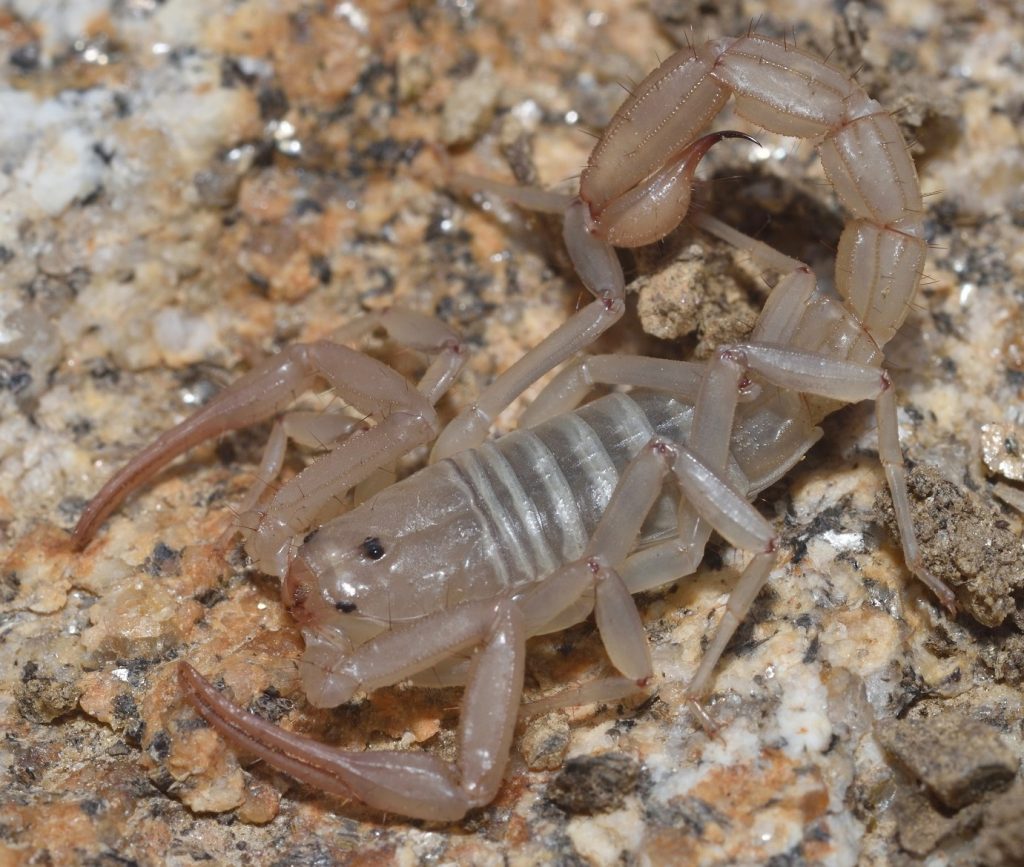
Jojoba Wash in Anza Borrego State Park, San Diego County, CA 1/19/20
The easiest way to find a scorpion is: (a) look for them when they’re most likely to be out and about — namely, at night in the middle of summer — and: (b) use a black light. Black light or UV radiation makes scorpions glow a blue-green color.
Just in case you’re too young to remember all the black light paraphernalia of the 60’s and 70’s, a black light is just a light bulb (or, more likely these days, a grid of LEDs) that emits light in the ultraviolet or UV range of wavelengths, which is invisible to the human eye. When certain materials are exposed to UV light, they absorb some of it and re-emit it at lower wavelengths that are visible to us. Various creatures have bits that glow when exposed to UV light, but scorpions are unusual in that their entire bodies glow.
Black light flashlights are relatively cheap and can easily be ordered online. It’s worth the small investment if want to experience the thrill of seeing a scorpion in the wild. And they’re quite effective. It’s possible that you may find yourself standing around at night under the light of an ordinary flashlight with nary a scorpion in sight. You turn off your regular flashlight and turn on your black light and, suddenly, they’re all over the place! Scorpions are not uncommon in the American Southwest and they’re not hard to find if you know where (and when) to look for them. A black light certainly helps with that endeavor.
That said, it’s perfectly possible to spot a scorpion without using a UV flashlight. In fact, to be honest, I’ve never found one that way. I spotted my first scorpion while hiking at night with a regular headlight for illumination. After I saw my first one, I had no problem spotting more. Your eyes just learn what to look for. Note: Unless you’re willing to look under rocks for them, you will need to hike at night to find them. I have seen one or two in daylight, but it’s rare. And it has to be pretty warm. Scorpions, at least the ones in Southern California, only come out when it’s toasty.

Mission Trails Regional Park, San Diego County, CA 7/1/17

How and Why They Light Up 28 29
You may be wondering what causes a scorpion to glow under a black light. The exoskeleton or cuticle of a scorpion contains several chemicals that fluoresce when exposed to UV radiation. These chemicals are present in the hard, thin out layer of the cuticle called the hyalin layer. Interestingly, a scorpion is not able to fluoresce immediately after molting. It starts to fluoresce again only after the new cuticle hardens. This could mean that the substance that causes the glow is produced as a byproduct of the hardening or it could mean the substance is not secreted until shortly after the molt.
So what are these chemicals you ask? Well, if you really want to know, they are β-carboline, 7-hydroxy-4-methylcoumarin, and some kind of phthalate ester that was only recently isolated from scorpion cuticle. You probably know about as much about these chemicals as I do, but I can tell you that at least one of them must be powerful and long-lasting. When a scorpion is preserved in alcohol, the alcohol itself will eventually begin to fluoresce. More remarkably, cuticle preserved in fossil scorpions hundreds of millions of years old still fluoresces under UV light!
Perhaps more interesting than how a scorpion fluoresces is why do they bother? I mean, what’s the point of all that glowing? The answer to that is still up in the air. There are a number of theories, but the one that seems to be backed up by the most experimental evidence is that it helps them hide from the moon.
Perhaps I should explain. It turns out that some UV light is present in moonlight and scorpions glow dimly when exposed to it. The theory is that converting the UV light to visible light allows the scorpion to detect it. In other words, it’s able to tell when it’s being illuminated by the light of the moon. Since scorpions have many predators, they prefer to avoid this. So a scorpion may remain in its burrow or keep to the shadows when the moon is visible.
One really odd thing about scorpions is that they have photosensitive elements in their tails. These elements are most sensitive to green light. The theory seems to be that the tail is used to detect the blue-green glow emitted by the cuticle. The brighter the glow, the brighter the moon. So the hyalin layer in combination with the photosensitive elements in the tail form a whole-body UV detector that helps the scorpion hide more effectively.
The Various Parts and How They Work (Scorpion Anatomy) 30 31 32
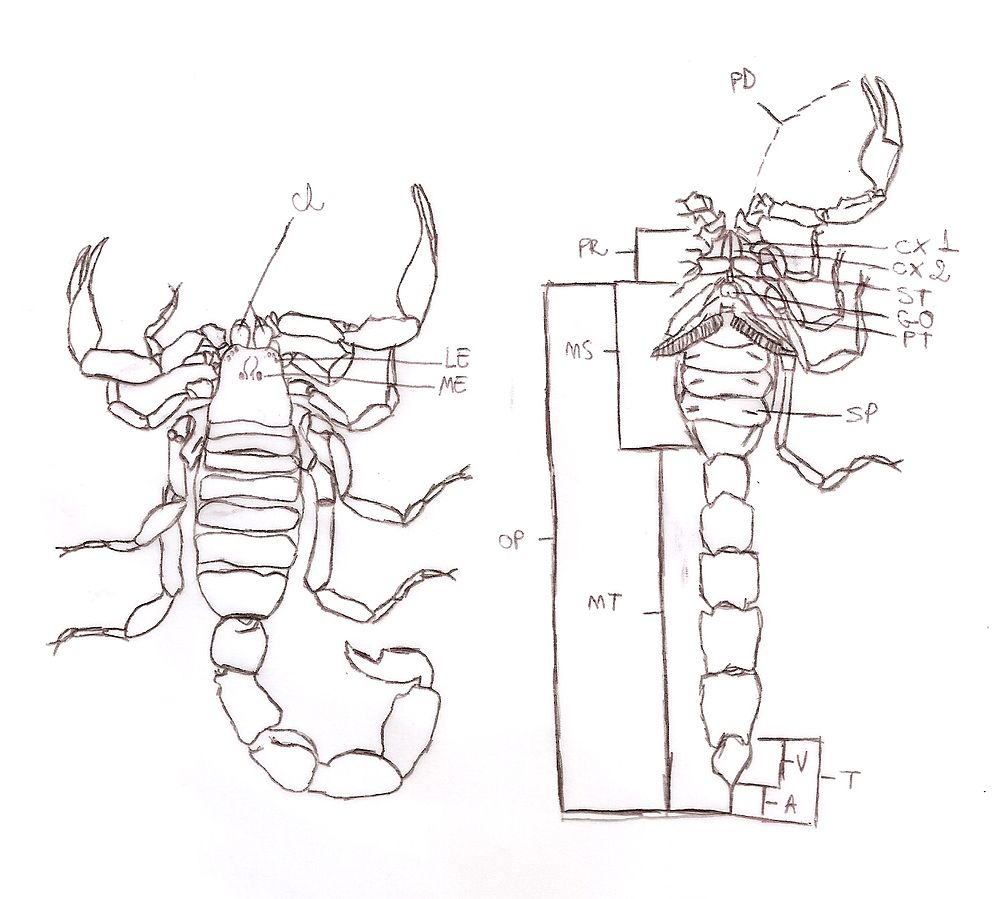
The body of a scorpion is divided into three main parts — the prosoma, the mesosoma, and the metasoma. The prosoma (colored green in figure 1) is also called the cephalothorax. This term may be inappropriate, however, since in other arthropods it’s generally used for a body part that forms from a fusion of the head segment (the cephalon) with the following segment (the thorax) and there is no evidence that scorpions or their ancestors ever had a body part corresponding to a thorax. So prosoma may be the more correct term. The mesosoma and metasoma together are called the opisthosoma.

This work has been released into the public domain by its author, Pearson Scott Foresman. This applies worldwide.
In some countries this may not be legally possible; if so:
Pearson Scott Foresman grants anyone the right to use this work for any purpose, without any conditions, unless such conditions are required by law.
Legend for Figure 1:
- Cephalothorax or prosoma – The area in green
- 1 to 7 – Segments of mesosoma (abdomen) in tan
- M1 to M5 – Segments of metasoma (tail) in pink
- Opisthosoma – The abdomen and tail together. Includes the mesosoma (in tan) and metasoma (in pink).
- P – Pedipalps
- T – Telson (venom bulb and stinger)
- C – Chelicerae (mouthparts)
Author: Pietrovicari
This file is licensed under the Creative Commons Attribution-Share Alike 3.0 Unported license.
Legend for Figure 2:
- Ch – Chelicerae (mouthparts)
- LE – Left eyes
- ME – Median eyes
- PD – Pedipalps
- PR – Prosoma or cephalothorax
- MS – Mesosoma
- MT- Metasoma
- OP – Opisthosoma
- GO – Genetal opercula (covers the gonopore or genital opening)
- PT – Pectins or pectines
The prosoma usually has one central pair of eyes on top. Often, there will also be two or three pairs of lateral eyes near the front edge. None of these eyes form sharp images, but the central pair is among the most light-sensitive of any animal. Scorpions are believed to use the shadows cast by starlight to navigate at night! The lateral eyes or ocelli are only used to detect changes in light intensity. They help the scorpion maintain its daily cycles.
In the photo below, you get a good view of the pair of central eyes. There is a cluster of lateral eyes visible, as well.
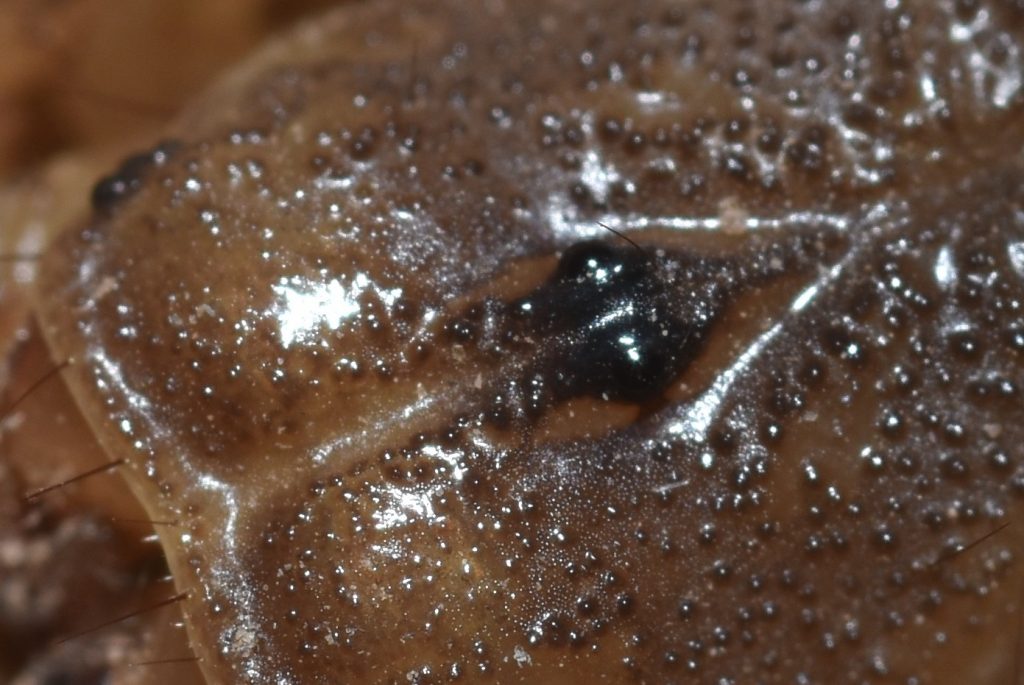
San Diego County 8/12/18
Here’s a better view of the lateral eyes. It looks like this species has three pairs grouped very closely together.

San Diego County 8/12/18
Four pairs of walking legs are attached to the underside (or ventral surface) of the prosoma. Extending from the front of the prosoma are a pair of appendages called pedipalps, which end in large claws. And between the pedipalps are a pair of pincer-like appendages called chelicerae that function as mouthparts, tearing up food. Prey is caught with the claws, passed to the chelicerae, and, from there, the shredded parts are passed into the preoral cavity. Digestive juices secreted into the preoral cavity partially digest and liquefy the food. Only liquefied food is passed on to the rest of the digestive tract. Parts that cannot be liquefied are filtered out and expelled from the preoral cavity.
The next photo shows the chelicerae of a California common scorpion. Its lateral eyes are also visible.
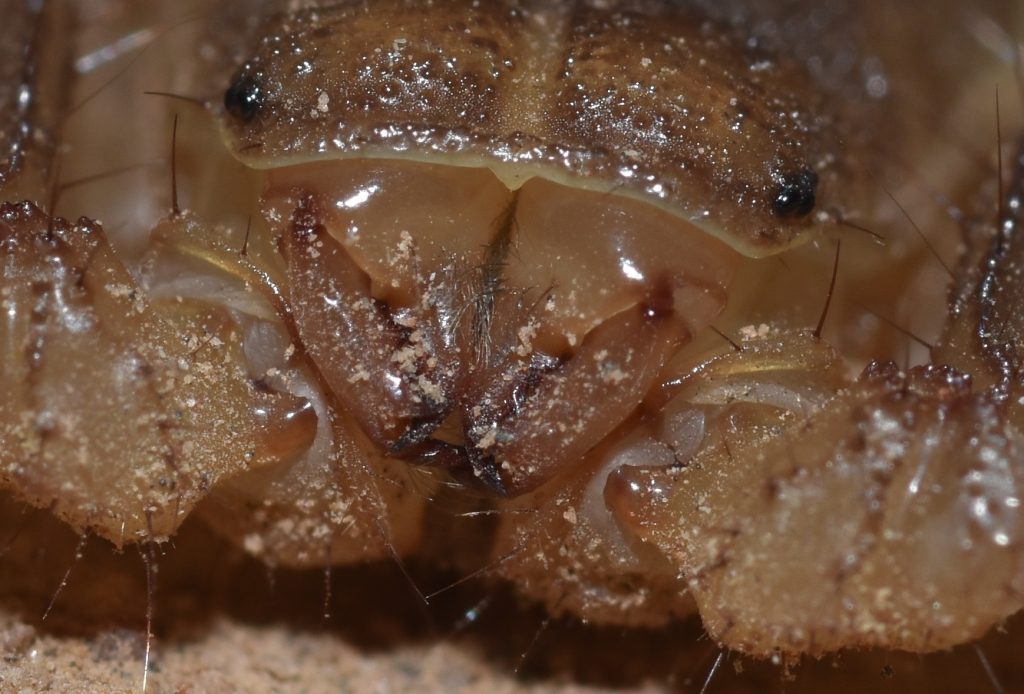
San Diego County 8/12/18
In the photo below, we can see the rather vicious-looking mouth-parts of a California swollen stinger scorpion. The central and lateral eyes are visible on the prosoma.

San Diego County 8/11/17
Behind the legs on the bottom of the prosoma are the genital opercula (GO in figure 2), which cover the openings to the genitals. Behind those are a pair of pectens (or pectines). These are comb-like appendages that serve as sense organs. Some species use them to locate prey. Males also use them to detect pheromones released by females. One way to tell males from females is that male pectines are larger and have more and larger teeth.
As noted earlier, the tail or metasoma is really an extension of the abdomen. The anus is located on the last segment of the metasoma, right before the telson. The telson is a venom bulb with a wicked stinger attached. This bulb contains two venom sacs which inject venom through a pair of openings on each side of the stinger, just before the tip.
On the ventral (bottom) side of mesosomal segments three through six are three pairs of book lungs. The ancestors of scorpions were aquatic and book lungs are evolved from gills. If you think of them as gills that have been enclosed inside the body to keep them from drying out, you probably won’t be far wrong.
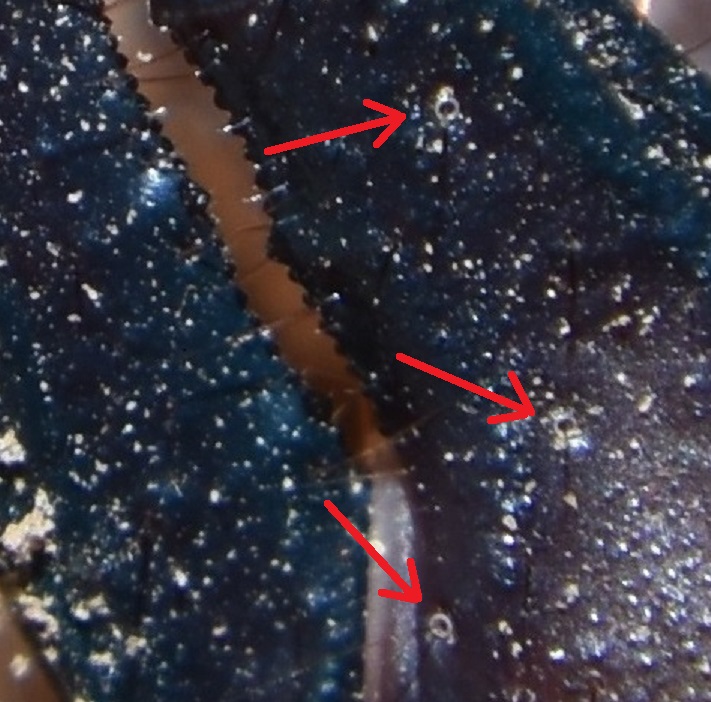
And finally, the following photo shows a claw of a California swollen stinger scorpion. You can see that there are a great many “hairs” or setae sprouting from it. Setae are sensory hairs. Most of them are probably used to feel things that come in contact with the claw, but some of them are a special type of setae called trichobothria. These sprout from the centers of tiny circular openings. The second photo below shows a blowup of a section of the claw with several trichobothria indicated with red arrows. The trichobothria are used to detect airborne vibrations and currents.33
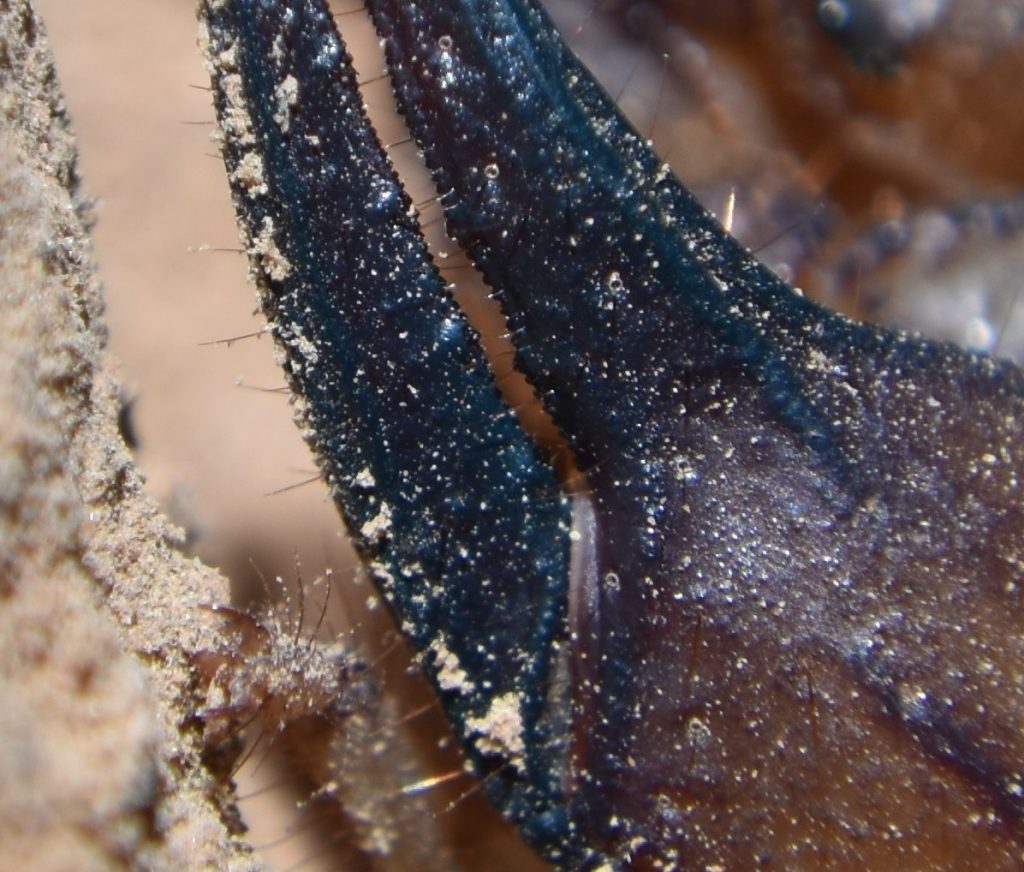
San Diego County 8/11/17
The Grasshopper Mouse: A Mouse That Eats Scorpions 34 35 36
Most mice are vegetarians. Grasshopper mice in the genus Onychomys are an exception. They feed on a wide range of animals including insects (such as the eponymous grasshopper), spiders, snakes, centipedes, and even other species of mice. They also feed on scorpions. The southern grasshopper mouse (Onycomys torridus), in particular, routinely kills and eats Arizona bark scorpions (Centruroides sculpturatus). This is especially impressive given that, as already mentioned, this is the most venomous scorpion in the United States.
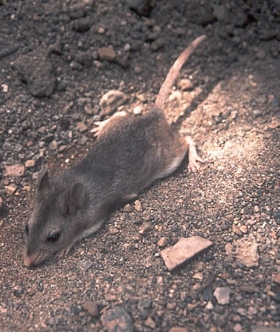
Author: National Park Service
Source: Rodents – Tonto National Monument
So how does this rather unassuming-looking mouse manage this? A scorpion’s venom is a cocktail of chemicals that have various usually not very good effects on the animals it stings. One of these toxins has the job of causing intense pain. Researchers have found that the southern grasshopper mouse has a single mutation that changes the way this toxin interacts with pain neurons in such a way that, instead of exciting the neurons, it shuts them down, essentially anesthetizing the mouse. When it’s first stung, the mouse feels a quick stab of pain, but then it goes numb and is able to continue to feed with impunity.
Of course, this doesn’t explain how the mouse is able to handle all the other toxins in the venom. (There seems to be around 6 in total). Apparently, the grasshopper mouse has evolved resistance to those, as well, but researchers haven’t figured out the details yet.
There’s lots more I could write about this fascinating rodent, but this is a post about scorpions, so that will have to wait for a future article.
Scorpion Evolution 37 38 39 40 41
First, a quick bit of taxonomy. Scorpions are arthropods (phylum Arthropoda), which includes all animals with a segmented body, jointed legs, and an exoskeleton. Within Arthropoda, they are included in the subphylum Chelicerata, which groups together all animals that have chelicerae. Within Chelicerata, they are usually included in the class Arachnida, along with spiders, mites, ticks, and the like. (There is some debate about whether scorpions are really arachnids. We’ll get into that later.) Finally, scorpions themselves form the order Scorpiones.
To sum up, here’s the last paragraph in heirarchical form:
Arthropoda –> Chelicerata –> Arachnida –> Scorpiones
Arthropods were among the earliest animals and were part of the famous Cambrian explosion around 541 million years ago, which marks the beginning of the Cambrian period. All the major animal forms appear in the fossil record during this period. The last common ancestor of arthropods has not been found, but it’s been reconstructed as a modular organism in which each module or segment had a single pair of legs and an armor plate. It would have evolved during the period immediately preceding the Cambrian, the Ediacaran.
The Chelicerata evolved around 445 mya from marine arthropods. (All animal life was aquatic at this time.) Scorpions were among the earliest Chelicerata to evolve. Fossil scorpions as old as 430 million years have been found.
Scorpions are closely related to the extinct eurypterids (order Eurypterida) or sea scorpions, but the exact relationship is not known. Some scientists believe that scorpions evolved from eurypterids. Other scientists believe they both evolved from a common ancestor. Either way, the eurypterids are a fascinating group of animals and deserve a section of their own…
The Eurypterids
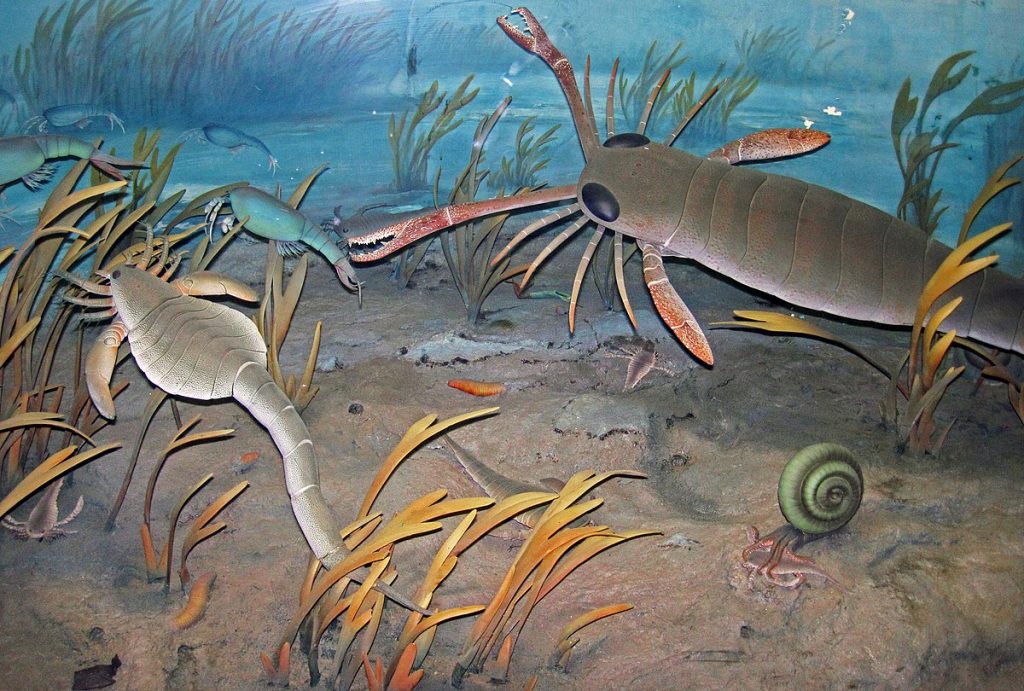
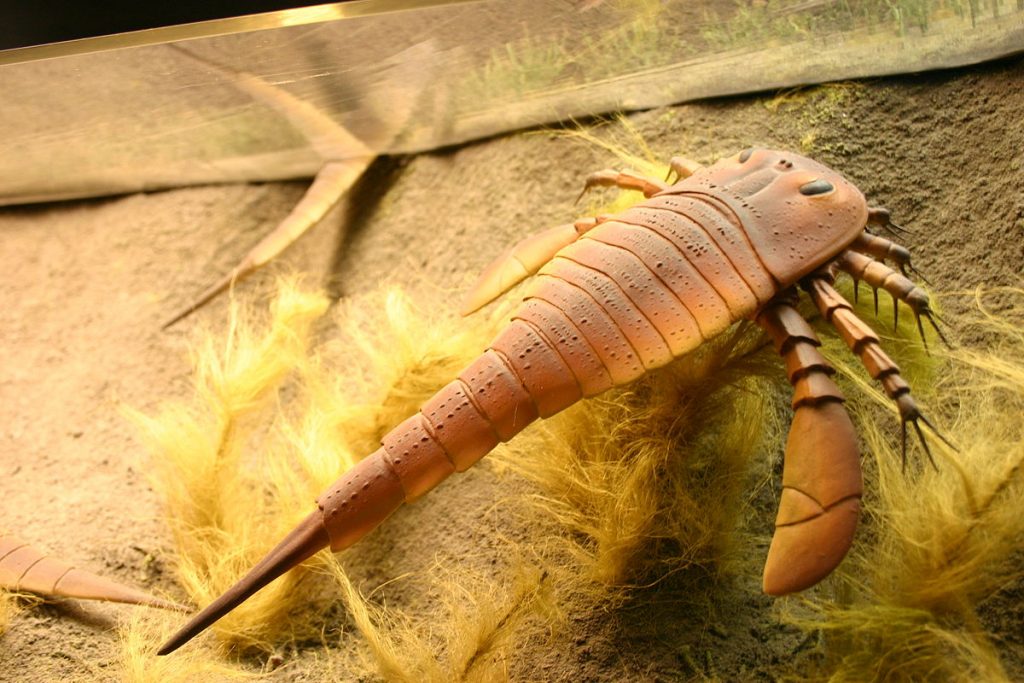
Sea scorpions go back at least to the Ordovician period around 467.3 mya. They may have evolved as early as the late Cambrian. The photos below attest to their obvious similarities to the true scorpions.

Author: James St. John
This file is licensed under the Creative Commons Attribution 2.0 Generic license.
Author: James St. John
This file is licensed under the Creative Commons Attribution 2.0 Generic license.
Author: Ryan Somma
This file is licensed under the Creative Commons Attribution-Share Alike 2.0 Generic license.
The earliest eurypterids lived in marine environments, but many later species inhabited brackish or fresh water. It’s possible they may have even invaded the land, although this is not known for certain. Some studies suggest that a dual respiratory system was present in some species, which would have allowed them to breathe both in water and air. But this, too, is not certain.
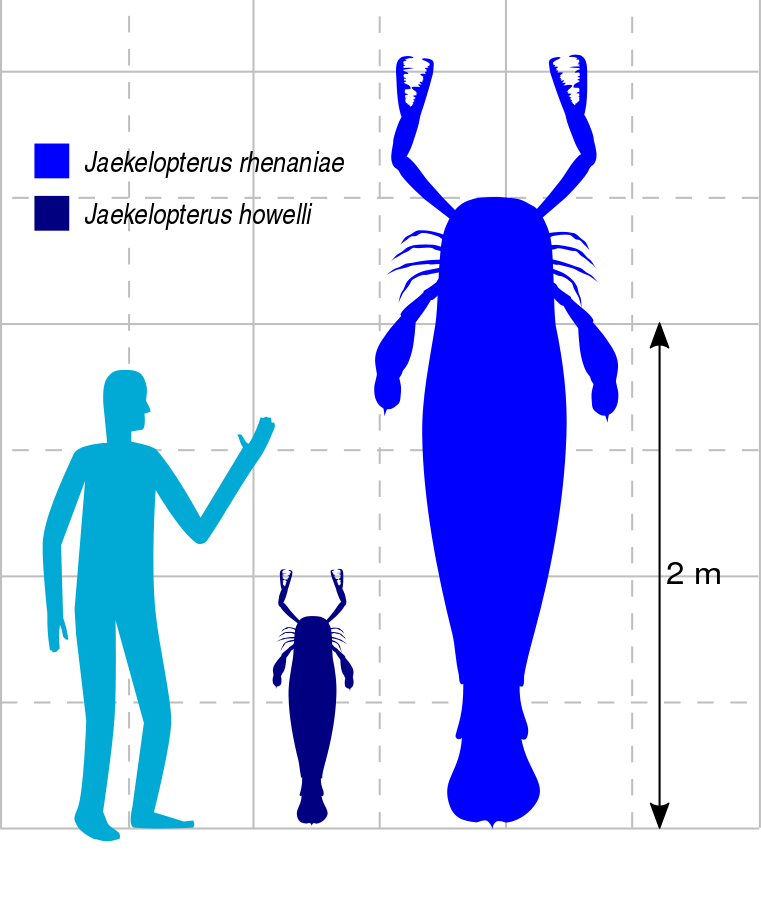
Eurypterids were very successful in their time and diversified to fill many niches. The smallest were less than an inch long. The largest known eurypterid, Jaekelopterus, may have reached 2.3–2.6 metres (7.5–8.5 ft)! It would have been the apex predator of the Early Devonian (roughly 419 to 393 mya).
Author: User:Slate Weasel
This image is in the public domain.
Despite their similarities, it’s important to re-emphasize that scorpions may not have evolved from eurypterids. It’s quite possible that the two groups split from a common, unknown ancestor. There just isn’t enough fossil evidence to settle the matter one way or the other.
Scorpion Evolution Continued…42
The first scorpions were either marine or amphibious. The earliest fossils are associated with other marine organisms, so it’s likely they were entirely marine. They appear to have had gills and their legs appear to have been adapted to a bottom-dwelling lifestyle. The first fossils of scorpions that were definitely terrestrial are from the Upper Devonian or Lower Carboniferous between 370 and 323 mya. The transition from external book gills to internal book lungs is what made their colonization of land possible.
Early scorpions (as well as eurypterids) had compound eyes. These evolved into the simple eyes and ocelli of modern scorpions. (See my earlier blog post The Story of Eyes: Part 1.)
Ancient scorpions included some impressively large specimens. The current record holder, Brontoscorpio anglicus, apparently grew to around a meter long! (The only fossil we have of B. anglicus is an “incomplete single free finger of a pedipalp, almost 10 centimetres (3.9 in) long”,43 so this is necessarily an estimate.)

Author: Tim Bertelink
This file is licensed under the Creative Commons Attribution-Share Alike 4.0 International license.
I mentioned earlier that there is some debate over whether or not scorpions should be classified as arachnids. The fossil record of scorpions is not terribly good and embryological and morphological studies have not been able to establish a clear relationship between the two groups. Some scientists believe that scorpions do belong in Arachnida and may even be the ancestors of other members of the group. Others believe that they don’t belong in Arachnida and instead are members of the class Merestomata. In this view, their closest living relatives would be the horseshoe crabs.
Living Fossils? Not So Much
It used to be very common for certain plants and animals to be described as “living fossils” — generally because their outward appearance hasn’t changed much from their distant ancestors. Although you’ll still hear the term used occasionally, modern scientists prefer to avoid it. The fact is, all organisms change over time, even if the changes aren’t immediately obvious.
Scorpions are a good example. A paper in “Nature” 44 describes a study of the genome of the scorpion Mesobuthus martensii. According to this paper, “Although M. martensii appears to evolve conservatively, it has a greater gene family turnover than the insects that have undergone diverse morphological and physiological changes, suggesting the decoupling of the molecular and morphological evolution in scorpions.” In other words, while the scorpion’s overall form has been conserved, physiological features, such as basic metabolic pathways, signalling pathways, and venom makeup, have evolved at a remarkable pace. So much for scorpions being living fossils!
It’s interesting to note that the concept of “decoupling” is also used in modern computer programming, especially object oriented programming. I won’t go into a lot of detail, but the idea is that programmers try to design the various “entities” — usually classes — in a program in such a way that any given entity can be redesigned without having to modify other entities that use it or depend on it. More and more, biologists are finding that evolution also uses decoupling to improve the “evolvability” of organisms. The decoupling of morphology and physiology in scorpions is a nice example. Evolvability is an important concept in modern evolutionary theory, but that’s a topic for another time.