When a bird eats a berry, it digests the pulp and poops out the seed. But not right away. It takes a while for the seed to work its way through the bird’s digestive tract, and by the time it reaches the exit, it’s likely to have traveled a long way from the plant that produced it. In this way, the plant is dispersed.
Every species must have some means of dispersal. Animals can walk or swim or fly to new locations, but plants don’t have that luxury. They have to find more indirect methods of dispersal, and one of the most common is reliance on animals. Usually, this means enclosing the seed in a tough coating that can withstand acidic digestive juices, grinding gizzards, and mashing molars, then wrapping the whole thing in tasty, nutritious pulp that some animal will find irresistible. If the resulting fruit is a small berry, it’ll probably be a bird that’s recruited to disperse it. But many fruits are much larger than your typical berry,1 and larger fruit likely evolved to attract larger, more earth-bound animals.
This leads to a mystery. Some plants produce very large fruit that have very tough rinds. And sometimes the seed or seeds inside are also intimidatingly large. Think of an avocado. I’ll help you out — here’s a photo of one.

And here’s a photo showing the pit inside.2
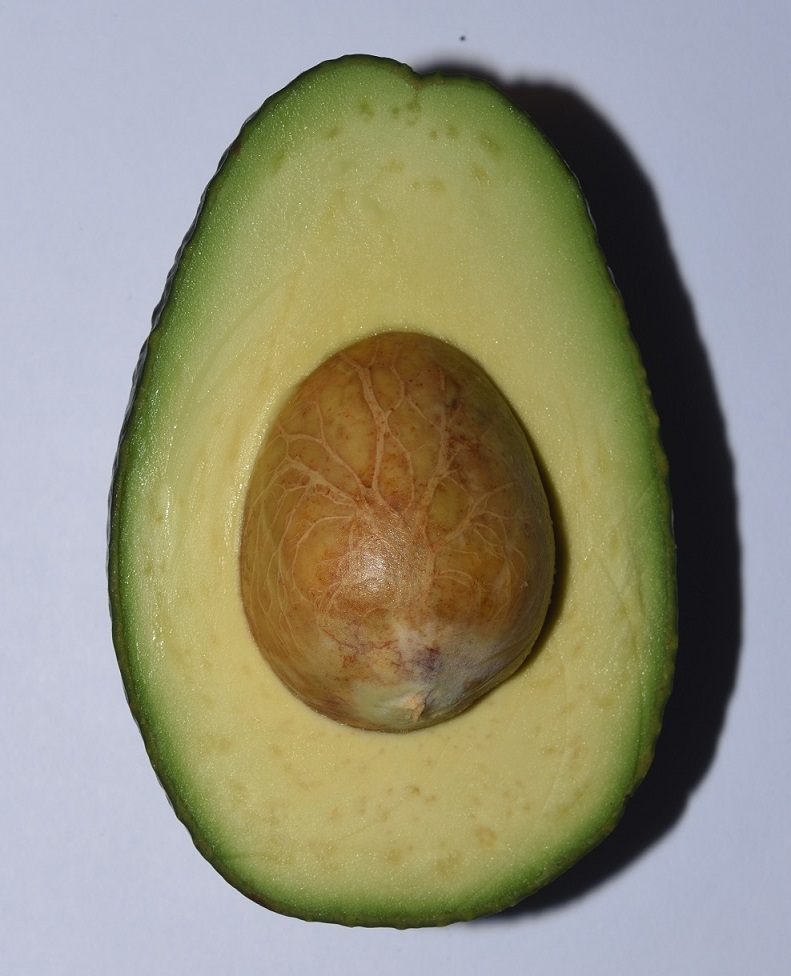
That is a big pit. What kind of animal could possibly swallow an avocado pit whole? Sure, lot’s of small animals could just eat around it, but that doesn’t help the plant disperse its seed.
Now, I’ll grant you, the avocados of today are the result of thousands of years of domestication, so it’s quite possible that larger fruit have been selected for. But why would the seed also increase in size? In fact, there is evidence that the original version of the fruit had less flesh than today’s avocado. But the pit was actually larger. A larger pit and less pulp — the mystery deepens.
Avocado plants are native to South America, and there is one South American animal that may sometimes eat avocados whole. Surprisingly, that animal is the jaguar! Yes, jaguars are carnivores. Nevertheless, they do occasionally eat avocados, but probably not that often. Also, being carnivores, jaguars are very uncommon. Why? Simple math. A carnivore has to eat lots of other animals during its lifetime, so its prey animals have to greatly outnumber it. For this reason, it’s unlikely that avocados evolved to be dispersed by jaguars — there just aren’t enough of them.3
Maybe you’ve already guessed where I’m going with this. If not, I won’t keep you in suspense any longer. The reason you won’t find any animals in South America large enough to be the dispersal agents for avocados is that they’re all extinct, and they went extinct thousands of years ago!4
The Americas in the Pleistocene
According to current estimates, humans first colonized the Americas around 15,000 years ago. This was toward the end of the Pleistocene epoch, which lasted from 2,580,000 to 11,700 years ago.5 The Americas in the Pleistocene were very, very different from the Americas we know today. And I don’t just mean no cars or roads or white picket fences. I mean, there were some seriously large animals roaming the landscape. 15,000 years ago, North America was home to mammoths, mastodons, giant ground sloths, lions, camels, wild horses, short-faced bears, saber-toothed cats, a beaver the size of a bear, and lots of other beasts you’ve probably never heard of.
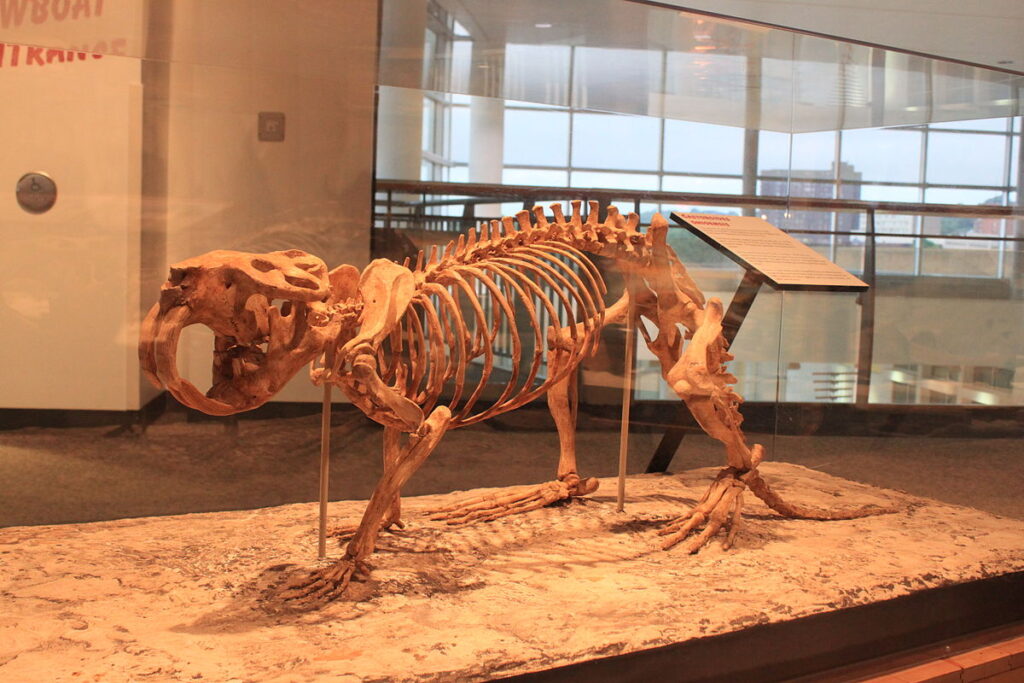
Minnesota Science Museum: Mississippi River Gallery
Author: Ryan Somma from Occoquan, USA
This file is licensed under the Creative Commons Attribution 2.0 Generic license.
In South America, the situation was much the same, although the selection of large mammals was different. North and South America were separated until around 2.8 million years ago when the Isthmus of Panama formed, so the southern continent evolved its own set of mammals.6 Giant ground sloths actually evolved in South America before crossing the isthmus into the north, so South America did have them.
If you’re not familiar with giant ground sloths, you should look them up. The largest one, Megatherium americanum, was around 20 feet long, 4 tons, and about the size of a modern elephant. On its hind legs, M. americanum would have stood around 12 feet (3.5 meters) tall!7 8
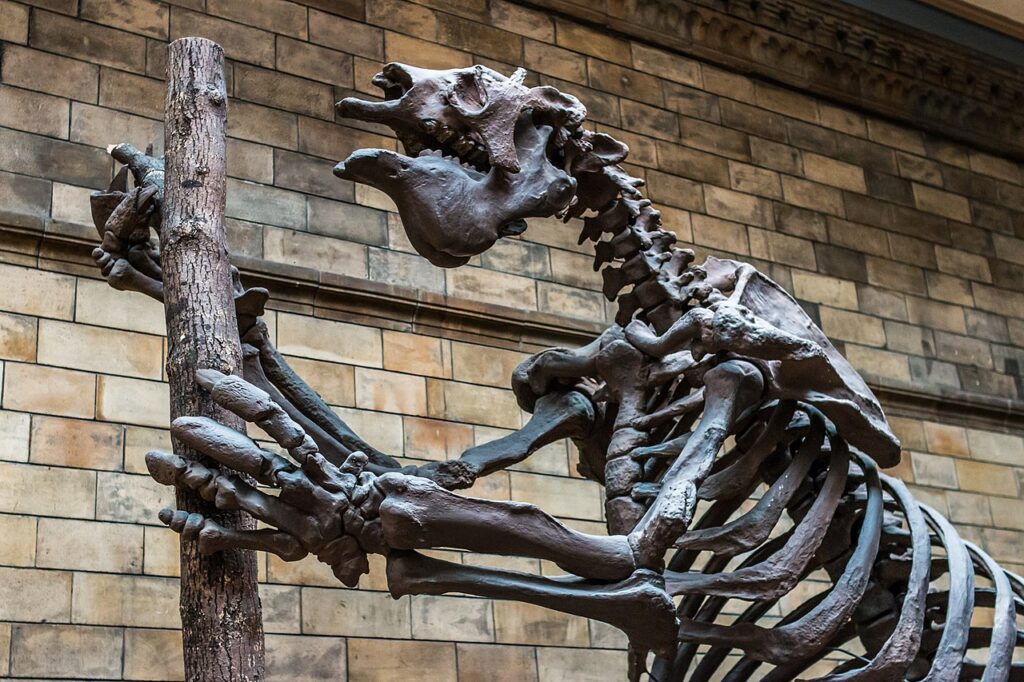
Natural History Museum, London
Author: Markus Trienke
This file is licensed under the Creative Commons Attribution-Share Alike 2.0 Generic license.
South America didn’t have any mammoths or mastodons, but it had gomphotheres, a family of elephant-relatives, many of which easily held their own in the behemoth department.9
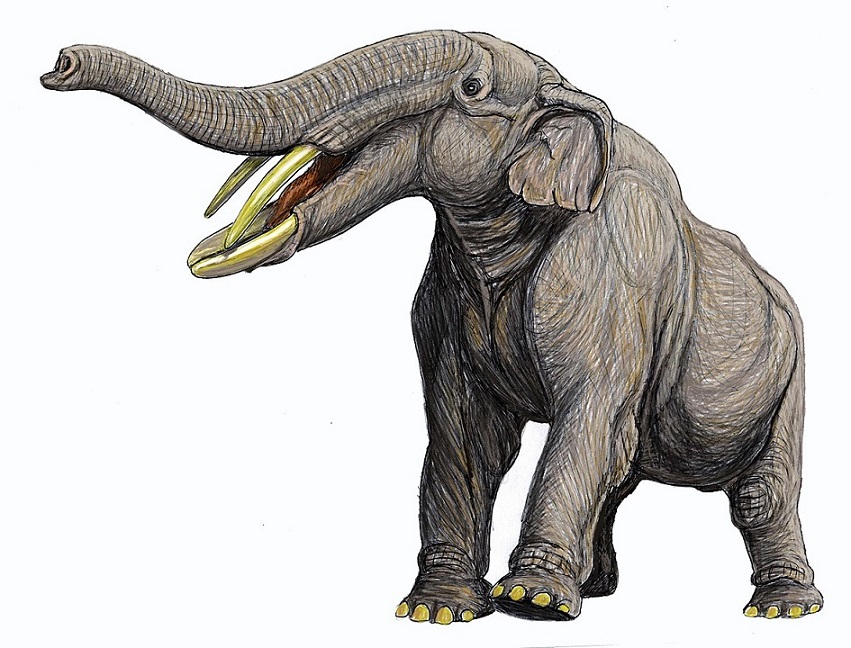
Author: DiBgd
This file is licensed under the Creative Commons Attribution-Share Alike 4.0 International license.
Another large South American mammal of the Pleistocene was the toxodon. Actually, Toxodon is an entire genus nested within an order of extinct hoofed animals called Notoungulata. The most well-known species of toxodon is Toxodon platensis. It’s estimated to have weighed over a ton and was around the size of an American bison or an African black rhino.10
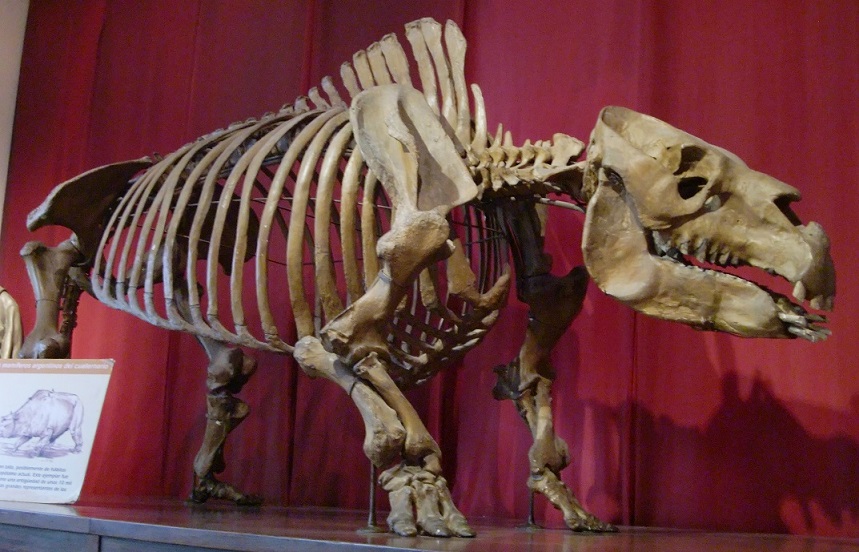
Author: WereSpielChequers
This file is licensed under the Creative Commons Attribution-Share Alike 3.0 Unported license.
Yet another group of large extinct mammals from South America are the glyptodonts, members of the suborder Glyptodontinae. They were closely related to modern armadillos and had a similar armored body plan. In fact, molecular studies have found that the glyptodonts actually were armadillos — Glyptodontinae is nested within the family Chlamyphoridae, which includes most modern armadillos.
The best-known of the glyptodonts belong to the genus Glyptodon. These were about the size and weight of a Volkswagon Beetle.11 12 13 Here’s a very old (probably 1920) drawing of a glyptodon.
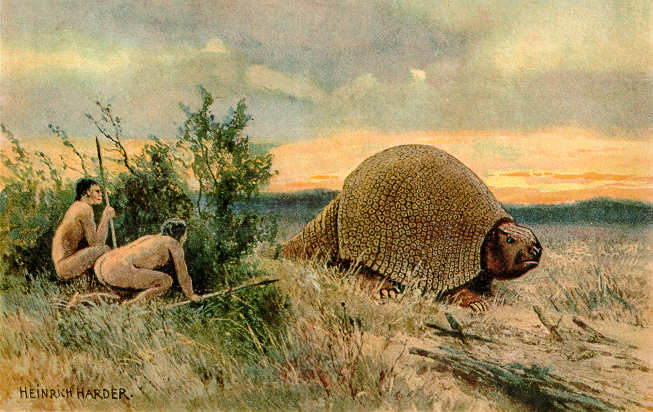
Source: The Wonderful Paleo Art of Heinrich Harder
Author: Heinrich Harder
This work is in the public domain in the United States because it was published (or registered with the U.S. Copyright Office) before January 1, 1926.
This is just a small sampling of the large mammals that inhabited the Americas of the Pleistocene epoch. Note that all the mammals mentioned here are actually genera or even families. In other words, there wasn’t just one type of gomphothere or one type of glyptodont. These were groups of animals that contained many, many variations. The New World had an incredibly diverse collection of very large mammals .
Scientists use the term megafauna to mean very large animals. How large varies somewhat — the term is a bit loose. Some people define megafauna as including any animal with a mass as great or greater than a human being. Others apply the term only to really big animals — those weighing in over a ton. For the purposes of this article, I’ll stick with the first definition.14
Today, most of the megafauna are gone from North and South America. In fact, most of the megafauna are gone from everywhere except Africa (and we’re working on that). As mentioned, the megafauna were mostly extinct in the New World by 13,000 years ago. (A few literal die-hards, like the giant sloth, managed to hold on until about 11,000 years ago). So what happened to them? Well, humans showed up in North America around 15,000 years ago. 2,000 years later, most of the big mammals were extinct. Seems like a no-brainer.
Actually, some pretty good arguments have been made that humans couldn’t have driven all those animals to extinction in such a short period of time just by over-hunting. It’s possible that other factors, such as climate change, were involved. Still, it’s highly suspicious that most of the megafauna went extinct so soon after humans appeared. Maybe it was a combination of human over-hunting and some other factors. I don’t know. The important thing is, by about 13,000 years ago, most of the really big mammals were gone.
The Concept of Evolutionary Anachronisms15
In modern Africa, large herbivores such as elephants routinely take large fruit into their mouths whole, mash the soft pulp, and swallow the seeds whole, along with the pulp. Later, they poop out the seeds in another location, along with a generous helping of natural fertilizer. Many African plants have evolved large fruit specifically in response to the presence of large megafauna such as elephants, rhinos, giraffes, and so on.16 17
There’s no reason to think that things were any different in the Pleistocene of North and South America. Many plants, including the avocado, must have evolved to rely on the large megafauna for dispersal. When these animals went extinct, the plants were left without their primary dispersal agents, which means it suddenly became much harder for them to spread their seeds. Now, 13,000 years later, these plants are still producing ridiculously large fruit — as if they were still expecting a giant sloth or gomphothere to show up. And, in a sense, they are. 13,000 years is a blip in evolutionary time, especially for plants, which tend to evolve more slowly than animals. It’s as if the plants haven’t yet “noticed” that the megafauna are gone!
When a fruit evolved to be eaten by an animal or group of animals that are no longer around, botanists refer to such a fruit as an evolutionary anachronism. An anachronism, in the general sense, is something that is out of place in time. If you’re reading a story that’s supposed to be taking place in the Middle Ages, and one of the characters uses a slang term from the 21st Century, that’s an example of a literary anachronism. Botanists and evolutionary scientists have adopted the term to describe these strangely out of step fruit.
But strange fruit are not the only examples of evolutionary anachronisms. In general, anytime a species preserves intact a physical or behavioral trait that evolved in response to evolutionary pressures that no longer exist, the trait is said to be an example of an evolutionary anachronism.
So, maybe you’d like to see an example of an evolutionary anachronism that doesn’t involve fruit…
The American pronghorn is sometimes called the American antelope. It’s not a true antelope, although it does resemble one. In scientific terms, it’s a member of the order Artiodactyla, the even-toed ungulates. This is a large order, which includes deer, pigs, true antelopes, giraffes, and (surprisingly) hippos.
The pronghorn is the fastest land mammal in the New World. It’s been clocked at 55 mph for 0.5 mi (88.5 km/h for 0.8 km). The interesting thing about that figure is that it’s too fast! Nothing alive today in North America is anywhere near fast enough to catch a pronghorn. Why would an animal evolve to be so much faster than it needs to be?
The answer, of course, is that it wouldn’t. There’s nothing alive in North America today that can catch a pronghorn, but what about back in the Pleistocene? When I was listing the various megafauna that lived in North America during the Pleistocene, I forgot to mention cheetahs. That’s right, cheetahs used to live in what’s now the United States! Other predators, such as hyenas, short-faced bears, and lions, might also have posed a threat to pronghorns.
So the American pronghorn is likely an example of an evolutionary anachronism — a prey animal that’s still ready to run super-fast at the first glimpse of a cheetah or whatever other scarily-fast predator might have been around all those years ago.
Anachronistic vs. Vestigial20
When I defined the term ‘evolutionary anachronism’, I specified that it had to be an ‘intact’ trait. In other words, the trait cannot have noticeably devolved. Let me give you an example of what I mean.
Many animals that live their entire lives in caves have lost their eyesight. In some cases, they’ve lost their eyes entirely. In other cases, they still have eyes, but those eyes no longer function. In other words, they’re vestigial. If, for whatever reason, a species with vestigial eyes were to migrate out of its cave and re-colonize the surrounding area, the environmental condition that caused animals to evolve eyes in the first place — namely, the presence of light — would reappear. But its vestigial eyes would not start functioning again. By this time, the species has presumably been blind for many thousands of years. So, it’s too late — its eyes are permanently broken.
On the other hand, the pulp and seed of an avocado are still functional. If an animal were to come along tomorrow that liked the taste of the pulp and was big enough to swallow the fruit whole, it could easily fill the role of disperser for the plant. Ergo, the avocado is an anachronistic fruit, not a vestigial one.
Holding On21
So, it’s likely that the fruit of avocados evolved to be swallowed whole by animals like gomphotheres and giant sloths. Such animals were very common for most of the Pleistocene, and, sure enough, avocados had a much larger natural range back then than they do today. But, if the animals that were responsible for dispersing them have been extinct for all this time, why haven’t avocados also gone extinct?
Well, note my use of the phrase ‘natural range’ in the last paragraph. Most of the avocado’s megafaunal dispersers went extinct towards the end of the Pleistocene, but not quite all of them. There was one survivor: humans. Fortunately for the avocado, people like how they taste. And people can be very good dispersers when they want to be. So, it may be that the avocados would have gone extinct if humans hadn’t decided to fill in for the sloths and gomphotheres.
Then again, maybe avocados could have held on for a long time without humans. Just because their primary dispersers went extinct, that doesn’t mean that nothing would ever disperse them. I already mentioned the possibility that jaguars might occasionally disperse an avocado seed. It’s very unlikely that jaguars could have kept the avocados going indefinitely, but they might have enabled them to hold on for a little while, if only by the skin of their non-existent teeth.
Most fruits float. They didn’t evolve for floating. It’s merely a side-effect of the way they’re constructed — most fruits are light enough and waterproof enough to float for a while. For that reason, many plants that appear to be anachronistic can still be found alongside rivers. When the river floods, some of the fruit get washed downstream, and, with luck, some of them may come to rest in a place where they can take root.
Even animals that don’t routinely disperse a plant’s seeds may occasionally disperse them. For example, an animal may be in the habit of eating the pulp of a fruit and spitting out the seeds or eating around them. This doesn’t help the plant because it doesn’t disperse the seeds. Unless, of course, the animal decides to carry the fruit someplace else before it eats it. In that case, the discarded seeds may still be able to find a suitable new location in which to germinate.
If a seed has evolved to survive passage through the digestive tract of an animal, it has necessarily evolved a thick coating. This could make it very hard for the seed to absorb water and germinate. For this reason, many plants have evolved seed coatings that are just barely tough enough to make it through the target animal’s guts. In fact, many won’t make it through, but those that do should be scarified enough by the passage that water will be able to penetrate the coating. The seed absorbs the water, swells up, and germinates. Thus, many plants have evolved seeds that almost have to pass through an animal’s gut if they are ever to germinate.
It’s a tricky balancing act. A seed that hasn’t passed through a digestive tract may eventually germinate, but it may take months or even years. So, if a plant’s primary dispersers are gone, it may still be able to hold on for a long time thanks to that very occasional seed that doesn’t pass though an animal’s gut, but manages to germinate anyway.
But many plants may not be able to hold on without their primary dispersers. Plants rarely fossilize, so we have no way of knowing how many plants went extinct along with their megafaunal dispersers. It seems likely that at least some did, especially the ones for which humans didn’t have any use.
More Strange Fruit
I’d like to spend the rest of the article showcasing a few interesting, and very strange, fruit that are likely anachronistic. It turns out that grocery stores are great places to go hunting for the “ghosts” of extinct megafauna.
“…the most delicious fruit known to men”22
That’s what Mark Twain called the fruit of cherimoya (Annona cherimola), a plant that grows from central Mexico, through Central America, and down the west coast of South America, almost to its very tip. I won’t argue with Twain’s assessment. The one I tried was exquisite, delectable, scrumptious… just seriously good. Its taste is complemented by the texture of the flesh, which is similar to custard and gives it the other common name it goes by — custard apple.
My only complaint is that the seeds are numerous and evenly distributed throughout the pulp, so that you have to spit them out with every mouthful. This makes eating one a bit of a hassle. If someone could come up with a seedless variety, I expect it would take the world by storm.
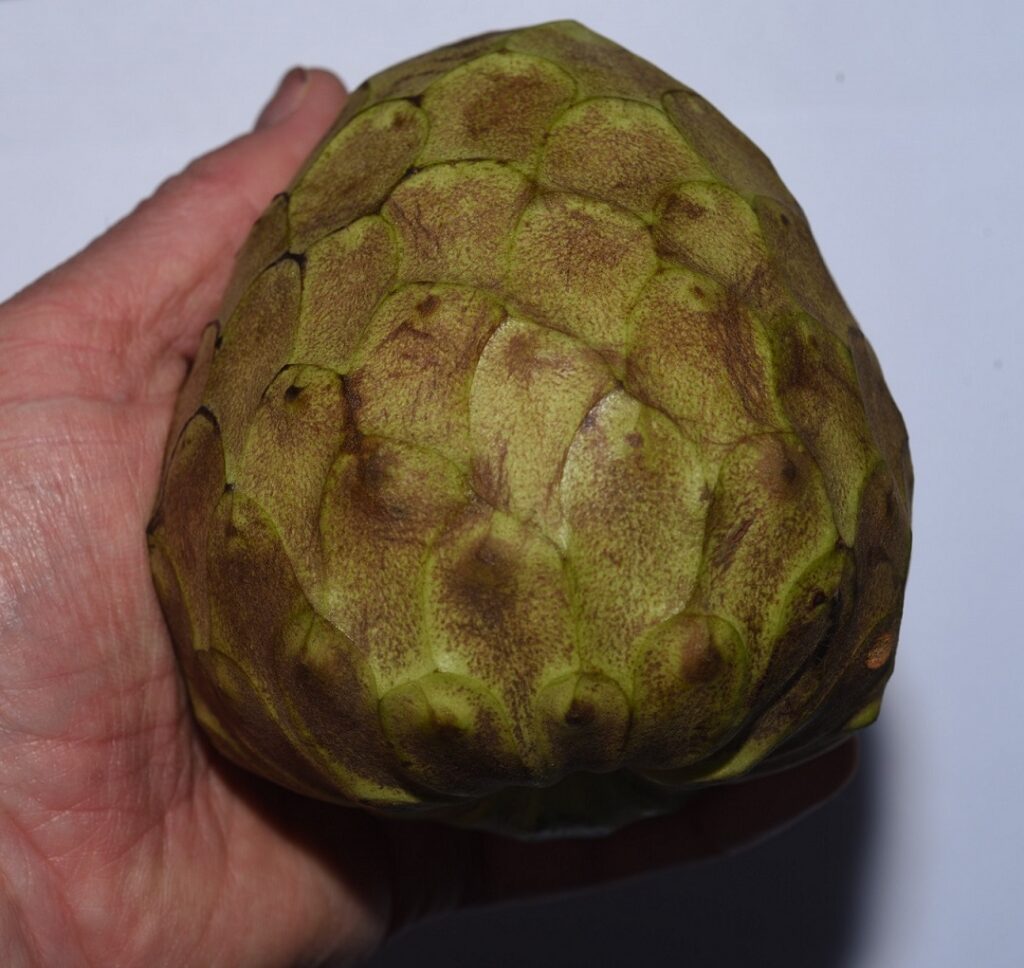
I googled “seedless cherimoya” just to see if, by chance, anyone had come up with one. I found a number of articles referencing work done at UC Davis that isolated a mutant gene in a closely related fruit — the sugar apple — that caused it to be seedless. It seems like it would be a simple matter to knock out the same gene in cherimoya, thereby producing a seedless variety. But the articles I saw were from 2011, and I haven’t found any follow up articles, so I guess it’s not that easy.23
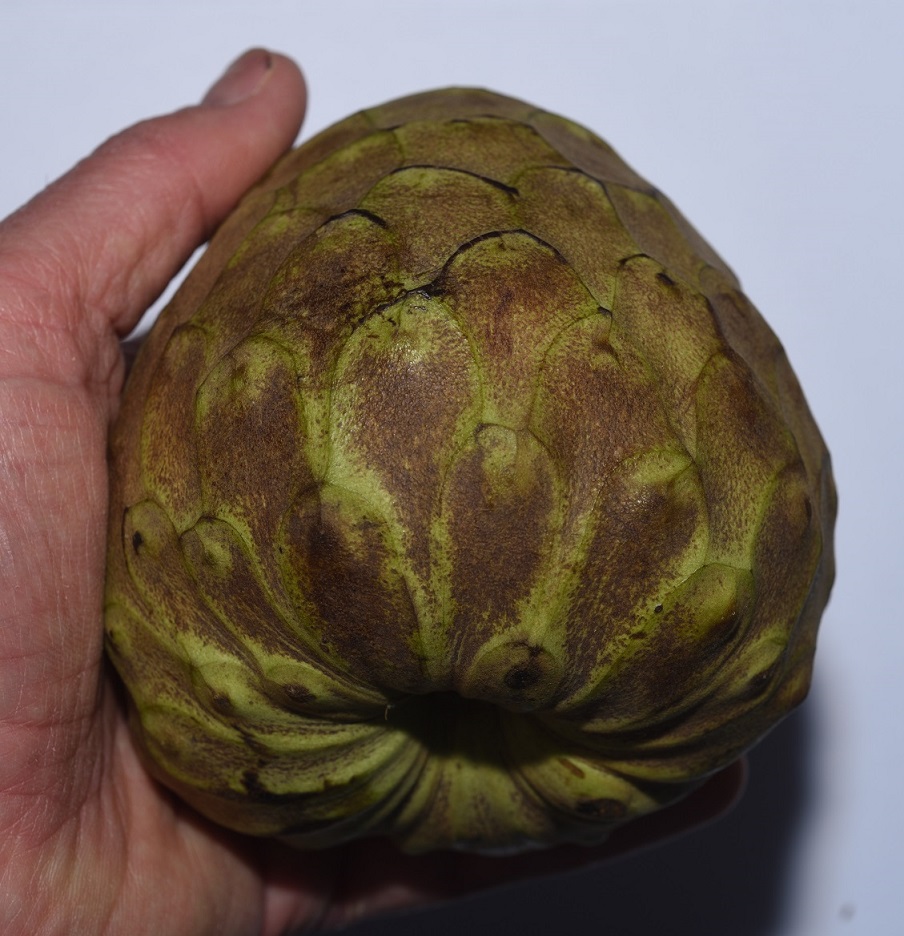
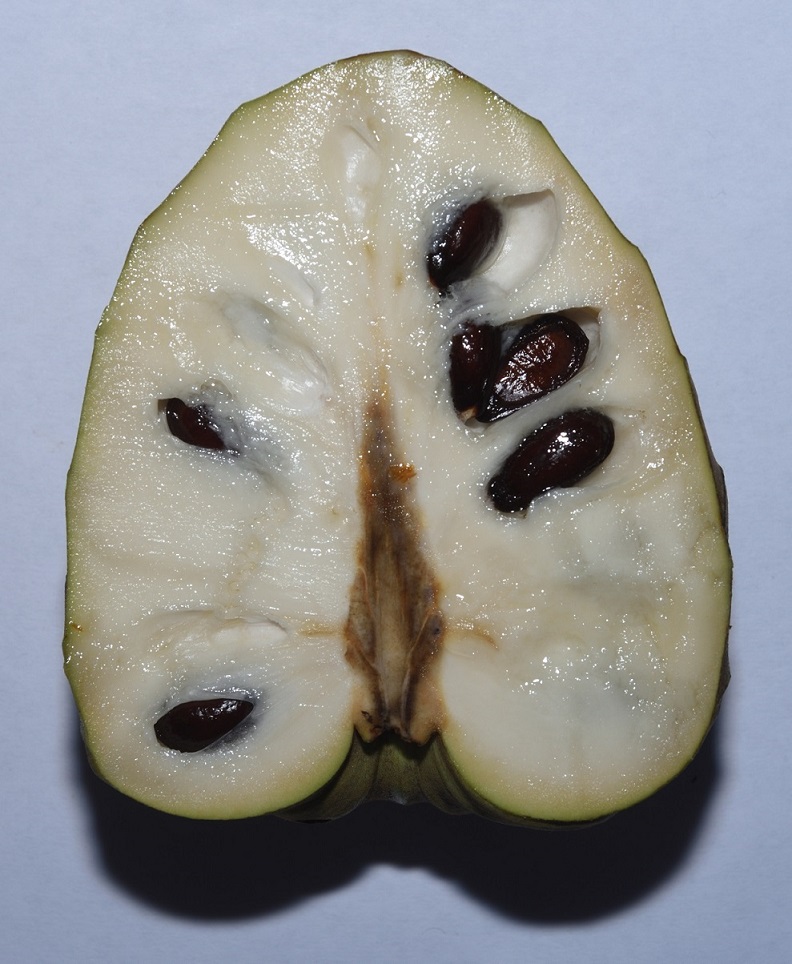
The best evidence that cherimoya is anachronistic is its large size. The seeds are also fairly large and not super easy to separate from the pulp, so it seems likely that the fruit evolved to be eaten by large mammals that would mash the fruit and swallow the pulp along with the seeds.

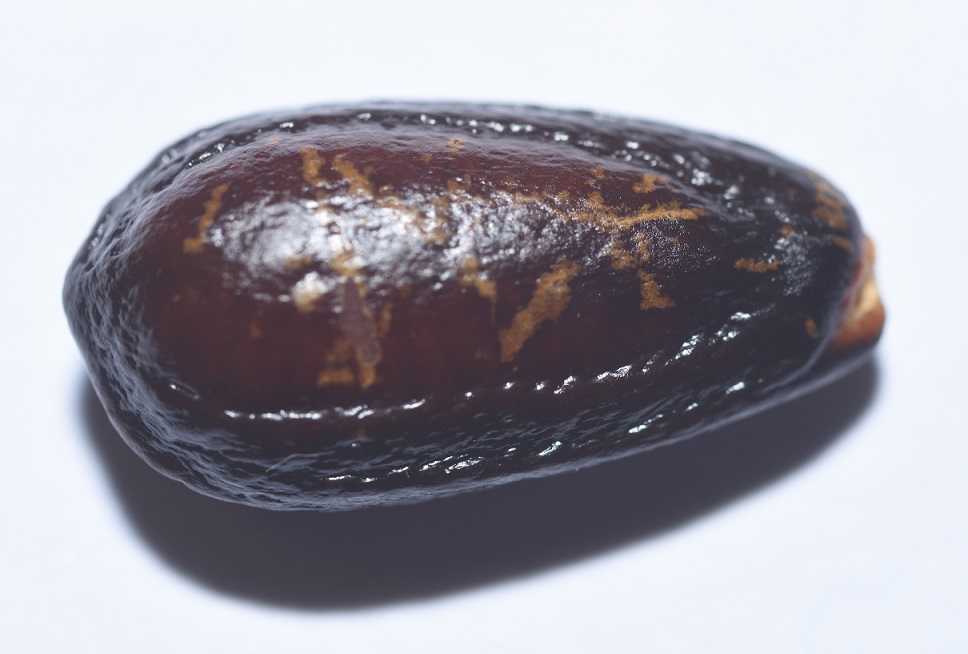
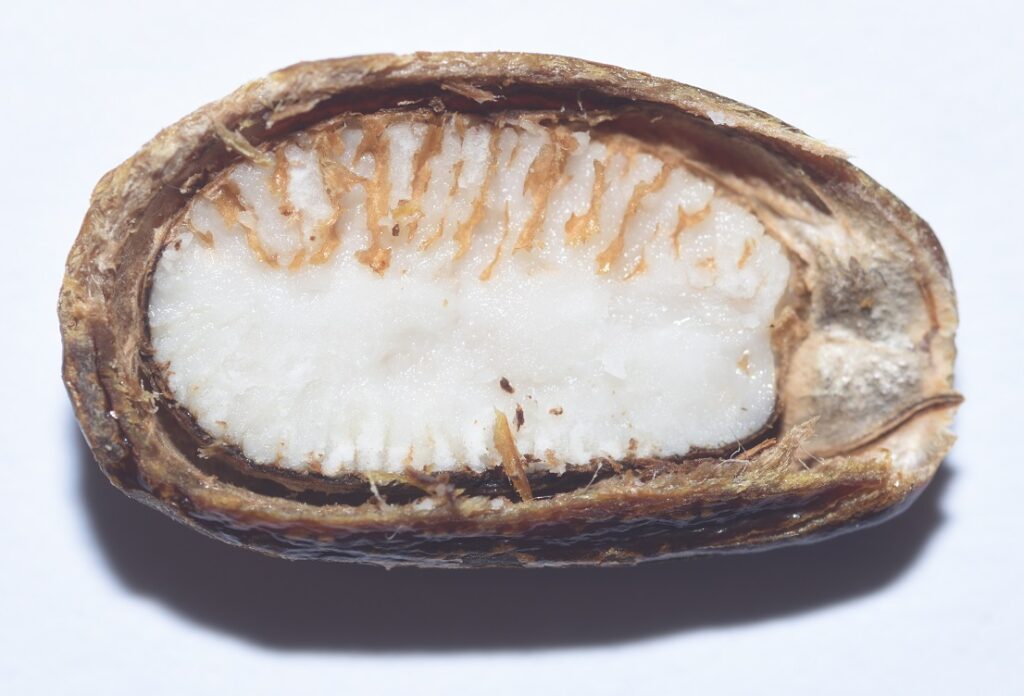
There are at least two other edible fruits produced by plants in the Annona genus that may be anachronistic: soursop (Annona muricata)24 and sweetsop or sugar apple (Annona squamosa).25. Both are similar in appearance to cherimoya, but I haven’t tried them, so I don’t know how they compare taste-wise.
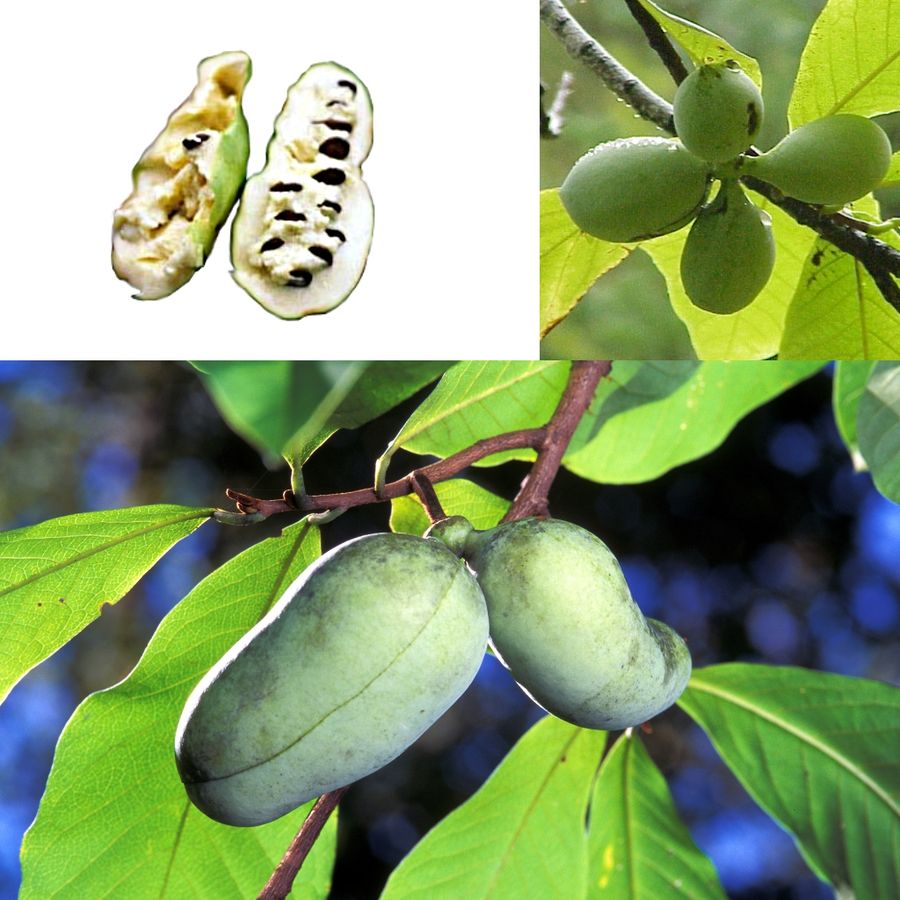
Way down yonder in the pawpaw patch26 27
I’ve never eaten a pawpaw (Asimina triloba). Chances are, you haven’t either. In fact, it’s possible your only clue to the existence of this fruit is the lyrics of that old folksong. (If you’re not familiar with the song, well now… you should just click here and have a listen.)
The plant is a small deciduous tree that’s native to the eastern United States and Canada. It’s in the same family, Annonaceae, as the aforementioned cherimoya, and is quite closely related. Supposedly, the fruit has a “sweet, custardish flavor somewhat similar to banana, mango, and pineapple”.28 The fruit has a shelf life of only about three days, which explains why you don’t find them in supermarkets. If you’re lucky, you might find some in a roadside stand. Otherwise, unless you happen to live way down yonder near a pawpaw patch, you probably won’t run across them.
Author: Agnieszka Kwiecień (Nova)
Permission is granted to copy, distribute and/or modify this document under the terms of the GNU Free Documentation License, Version 1.2 or any later version published by the Free Software Foundation; with no Invariant Sections, no Front-Cover Texts, and no Back-Cover Texts. A copy of the license is included in the section entitled GNU Free Documentation License.
Several things point to pawpaws being anachronistic. First, of course, is their large size. The seeds are also fairly large, although not ridiculously so. Second, the fruits tend to fall from the tree within a day of ripening, and then they rot very quickly. This suggests that they are targeted towards animals large enough to pick them directly from the tree.
Third, pawpaw patches are rare, except where indigenous people routinely eat them. This suggests that their only remaining primary dispersers may be humans. Finally, wild pawpaw trees usually only grow in floodplains, and yet, they grow just fine when they’re planted in uplands. This, again, suggests that people are their only remaining primary dispersers.
…the largest fruit of all trees29 30
The jackfruit (Artocarpus heterophyllus) has the distinction of being the largest fruit of all trees. Here’s a photo of a jackfruit that was found in Kerala, India.

Author: Suniltg at English Wikipedia
Permission is granted to copy, distribute and/or modify this document under the terms of the GNU Free Documentation License, Version 1.2 or any later version published by the Free Software Foundation; with no Invariant Sections, no Front-Cover Texts, and no Back-Cover Texts. A copy of the license is included in the section entitled GNU Free Documentation License. Subject to disclaimers.
The one I bought in an Asian market wasn’t quite that big, but it wasn’t exactly small, either. Here it is on the cutting board.
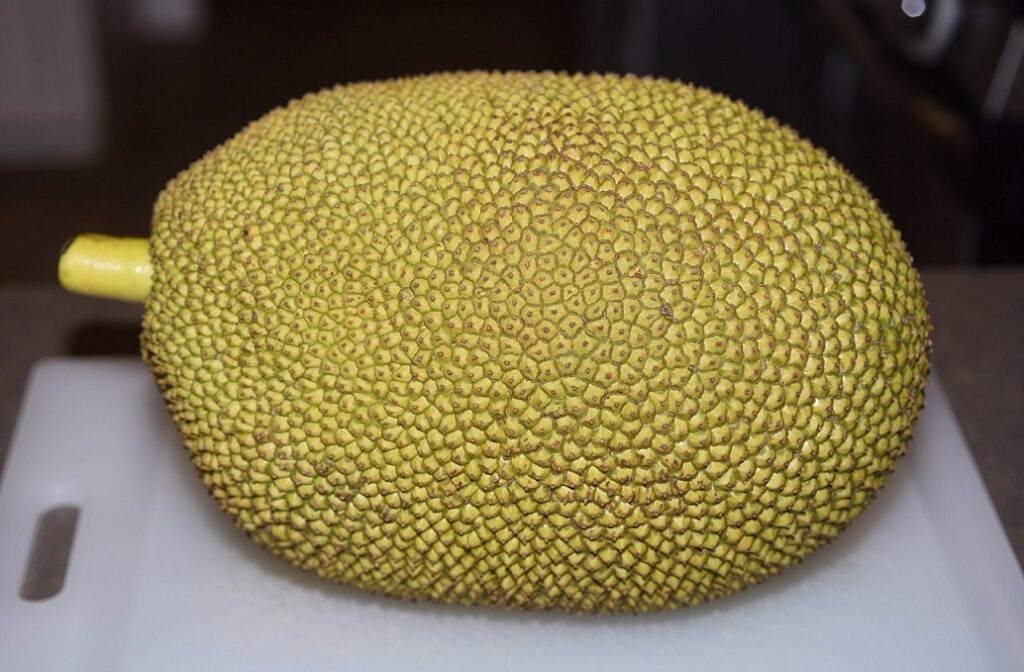
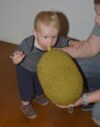
And here’s one of my grandnephews for scale.

I don’t know if anyone has ever been killed by a jackfruit falling from a tree, but it wouldn’t surprise me. Then again, maybe people just instinctively avoid walking under something that looks like this.
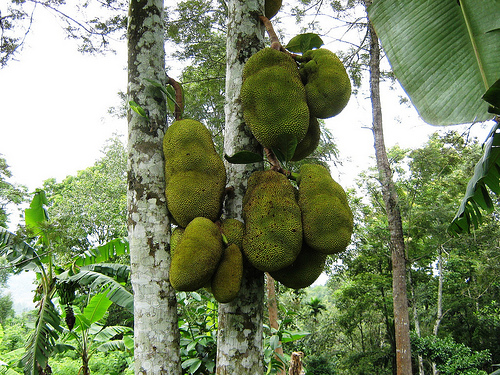
Kerala Agricultural University, Ambalavayal, Kerala, India
Author: Prof. Mohamed Shareef from Mysore
This file is licensed under the Creative Commons Attribution-Share Alike 2.0 Generic license.
When I cut my specimen open, I was surprised how tough the rind was. It took some effort to cut through it. I was also surprised by how sticky the insides were. The pulp stuck to my hands like glue. It took a lot of soap and water to get it off. It was also kind of slimy. My grandnephew (the older one, who’s four) refused to eat it because it was “too slimy”. (This is the same kid who routinely handles earthworms and thinks they’re “cute”!)

The fruit is very good. According to Wikipedia, it has a “subtle pineapple- or banana-like flavor”.31 Personally, I thought it tasted more like cantaloupe.
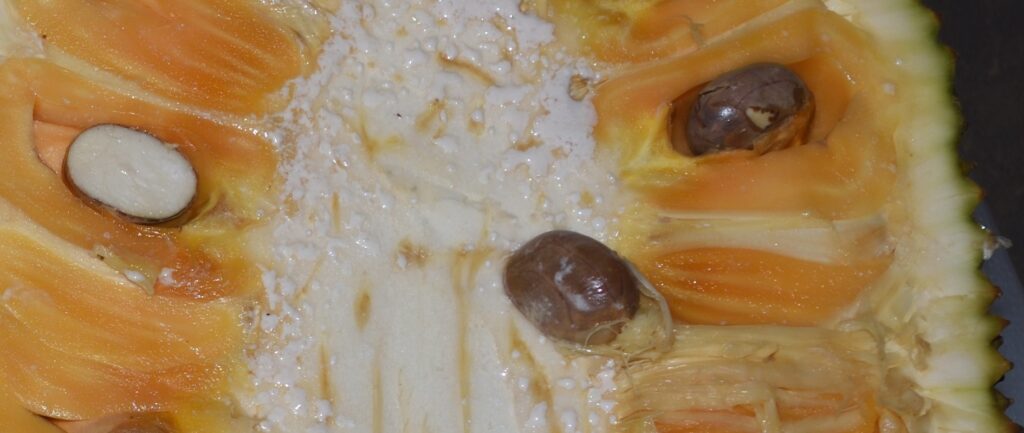
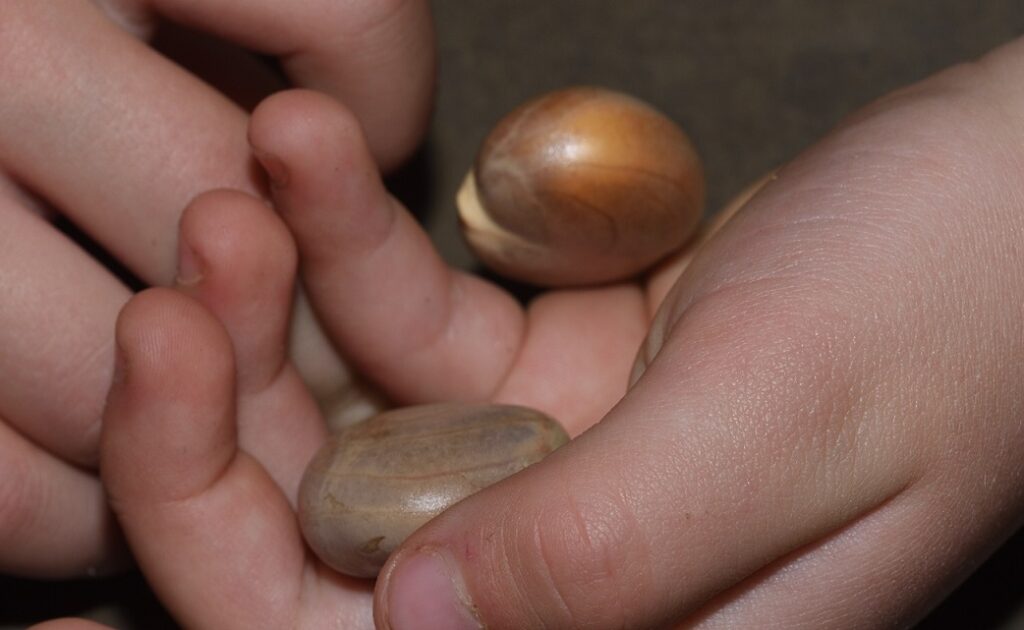
The seeds can also be eaten. I boiled and ate a bunch of them. After 10 minutes of boiling, the water was stained a dark reddish-brown from all the tannins. After boiling, the seeds have to be peeled, which is no fun, but they do have a nice, sweet taste to them.

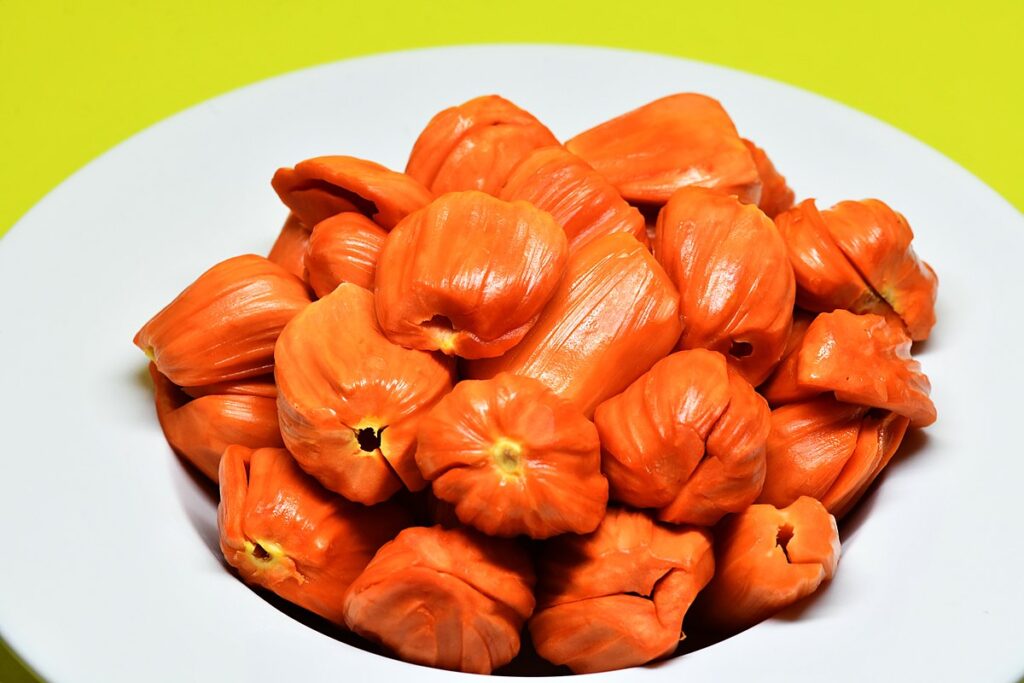
Thailand
Author: Tris T7
This file is licensed under the Creative Commons Attribution-Share Alike 4.0 International license.
So is jackfruit anachronistic? It’s important to realize that, like the avocado, and like most fruit consumed by people, the jackfruit has been domesticated. It’s probably quite a bit larger than the original, wild variety. But also like the avocado, the original fruit was probably still pretty big, and the seeds likely haven’t changed significantly.
So the huge size, tough rind, and large seeds strongly suggest a fruit that evolved to be mashed in the mouths of megafauna and the seeds swallowed whole without grinding. The presence of high levels of tannins in the seeds would be a deterrent to insects, but it would also make them distasteful to any large animal that bit into them or ground them between its molars.
So what kind of megafauna are we talking about? It’s not known exactly where jackfruit originated, but they’re believed to be indigenous to the rainforests of the Western Ghats in southern India. This area is a hotspot of biodiversity. Among the many large animals found there is the Indian elephant (Elephas maximus indicus) — an obvious candidate seed disperser for the ancestral jackfruit. Turn the clock back around 50,000 years, and India was home to, not one, but two giant elephants — Palaeoloxodon namadicus and Stegodon namadicus. P. namadicus, in particular, may have been the largest land mammal that ever lived. According to one estimate, it weighed around 24 tons (21,772 kg) and stood 16 feet (4.8 m) tall at the shoulder.32 The largest mammal and the largest fruit? Seems like a good match.33
Mango
The mango (Mangifera sp.) is another fruit that probably originated on the Indian subcontinent. The most common variety, appropriately named the common mango, is Mangifera indica. I’m not sure what variety I got when I visited the local grocery, but here it is.

And here it is cut in half. Notice how the pulp clings to the pit.
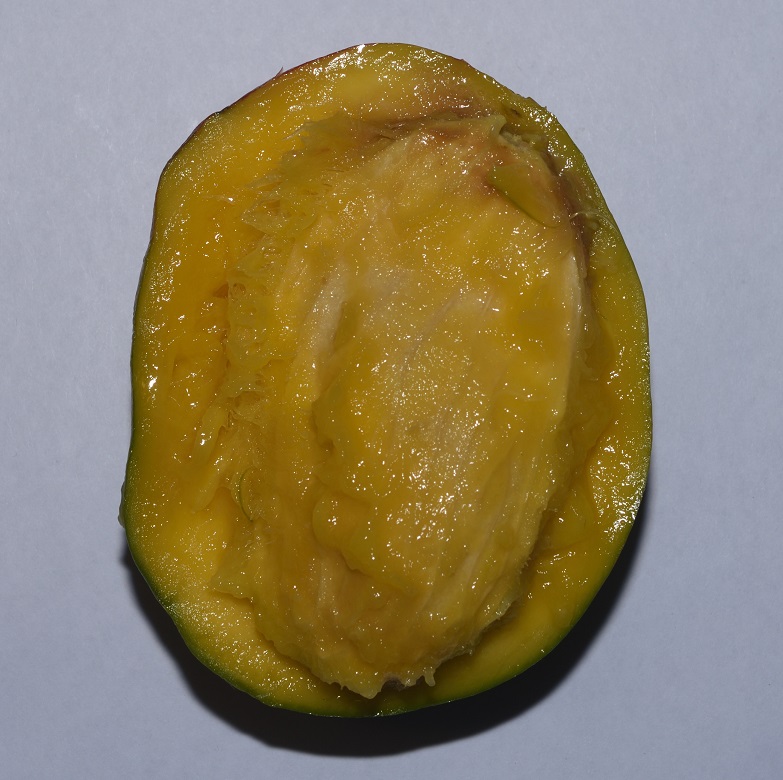
In the next photo, I’ve extracted the pit. Notice how large it is compared to the fruit as a whole. I actually used a scouring pad to remove most of the pulp from the pit and I still couldn’t get it all off — that’s how tightly the pulp is bound to it. This is no accident. A large animal eating the fruit isn’t going to spit out the pit — that would be a waste of pulp — it’s going to mash the fruit and swallow both pulp and pit.

I continued my dissection, extracting the seed from the pit.
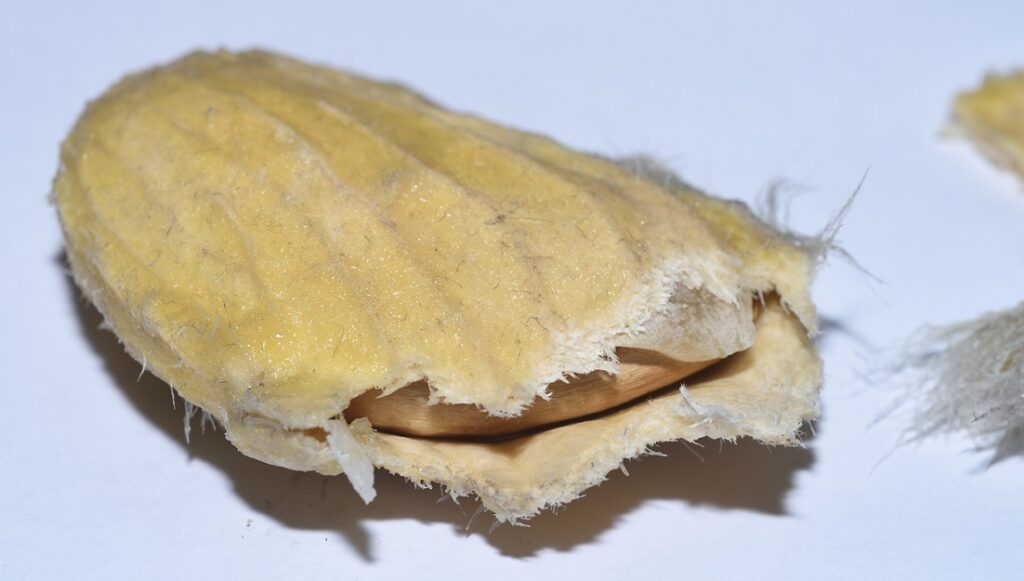

Papaya34
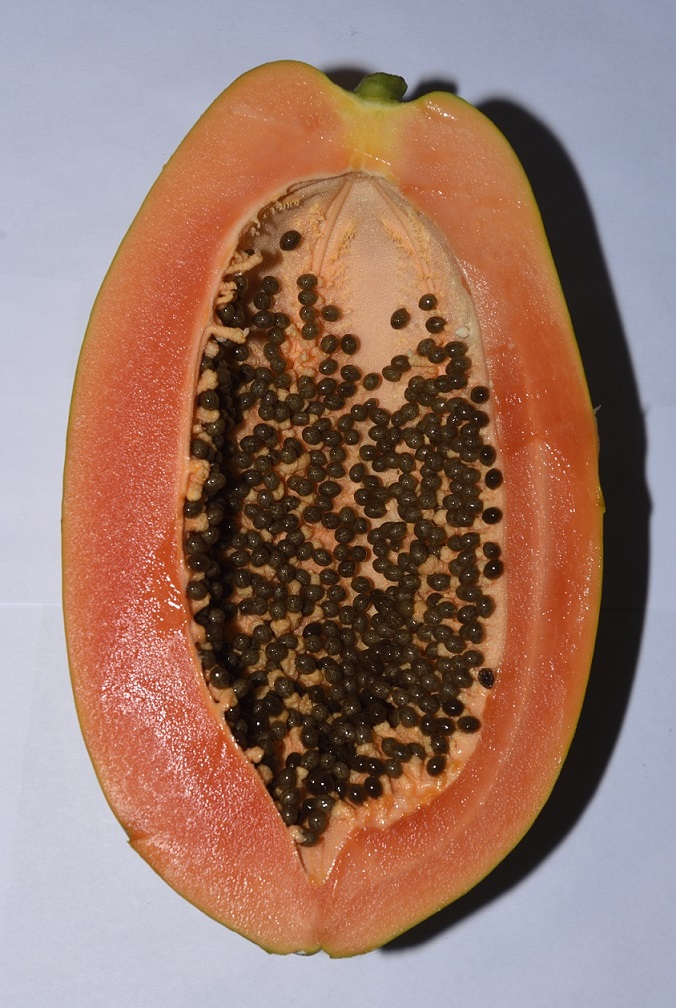
Papayas (Carica papaya) are sometimes called pawpaws, but they are unrelated to the pawpaw (Asimina triloba) discussed earlier. They have the usual large size, suggestive of an affinity for megafauna, but the seeds are a surprise.
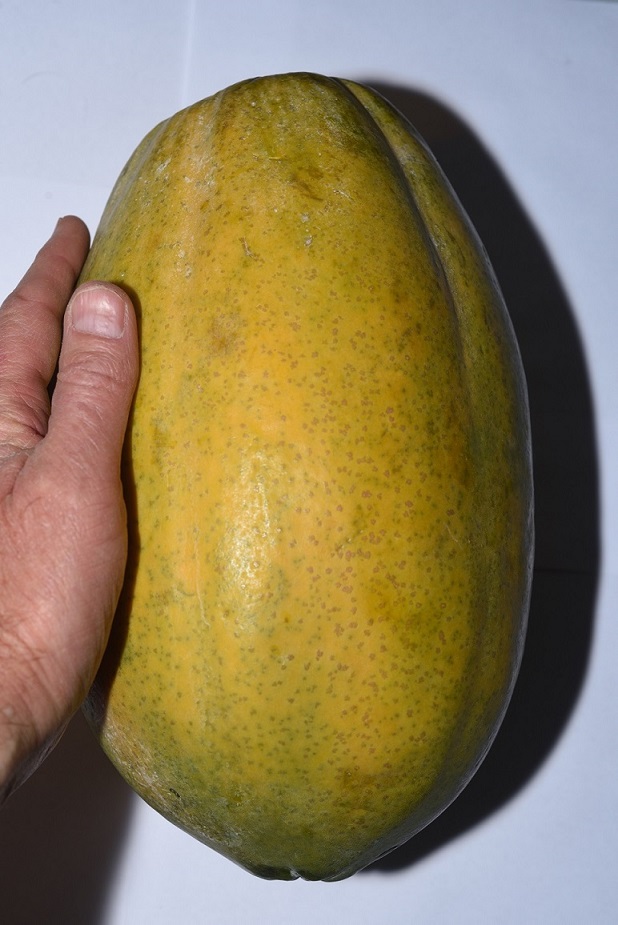
Instead of one huge seed or a few dozen moderately large ones, the papaya has lots of very small seeds concentrated in a large central cavity. This is an interesting variation. The large cavity reduces the weight of the fruit, so the stalk attaching it to the tree doesn’t have to be quite as thick. The large number of seeds increases the chances that one of them will successfully germinate and grow to maturity.
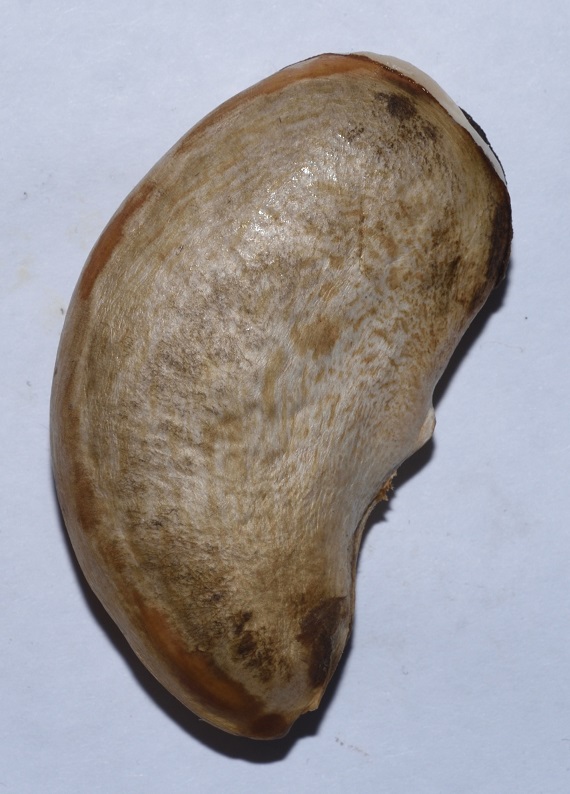
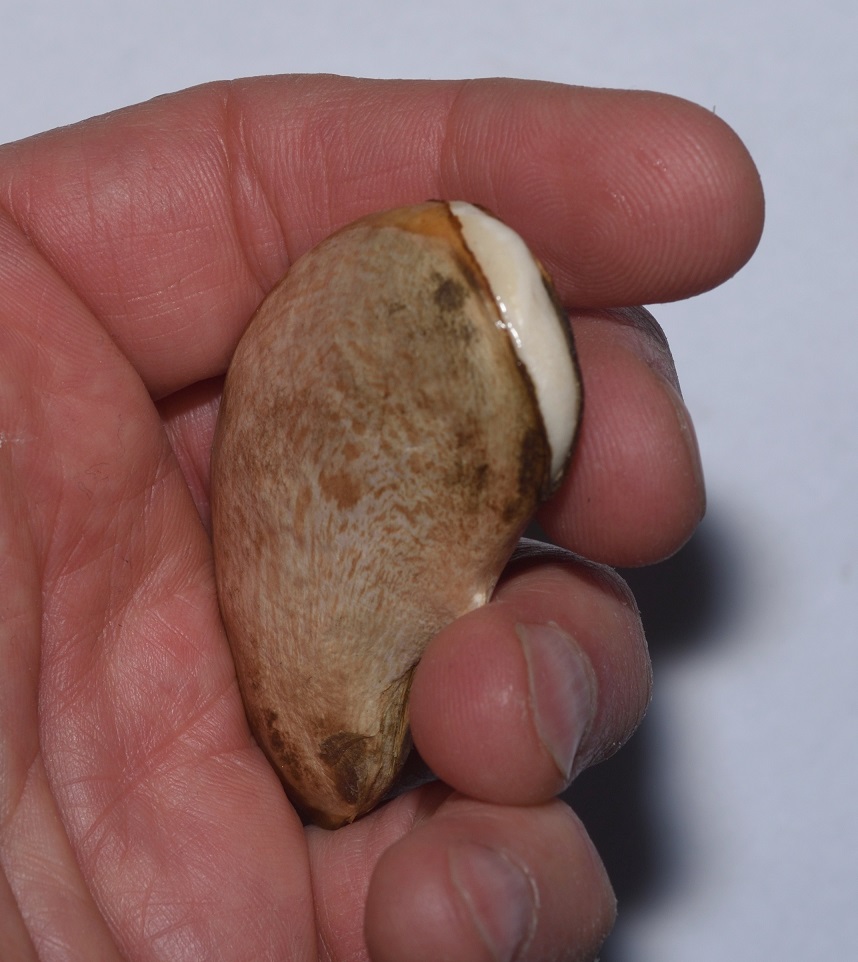
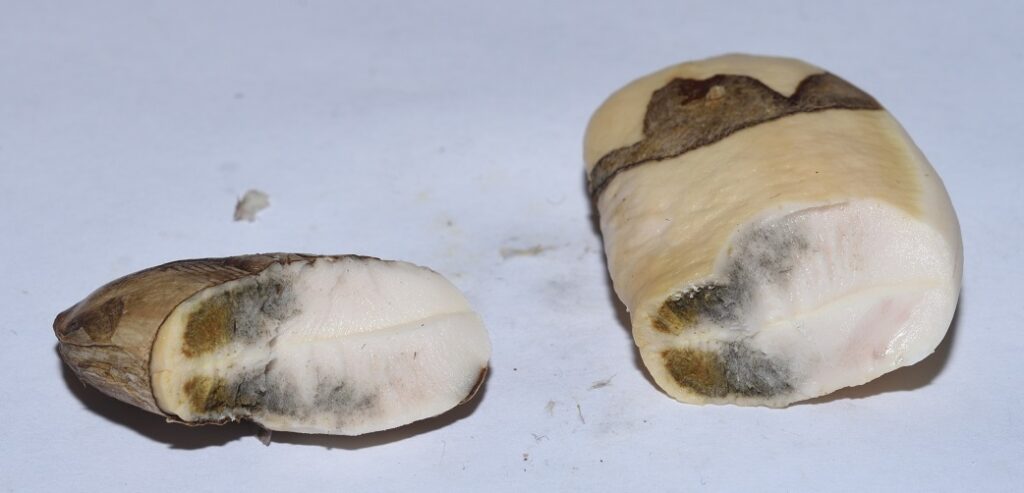
The seeds themselves are fascinating. They’re wrapped in some sort of gelatinous pouch. Here’s a photo of a whole seed (right) and a seed with its pouch removed (left).
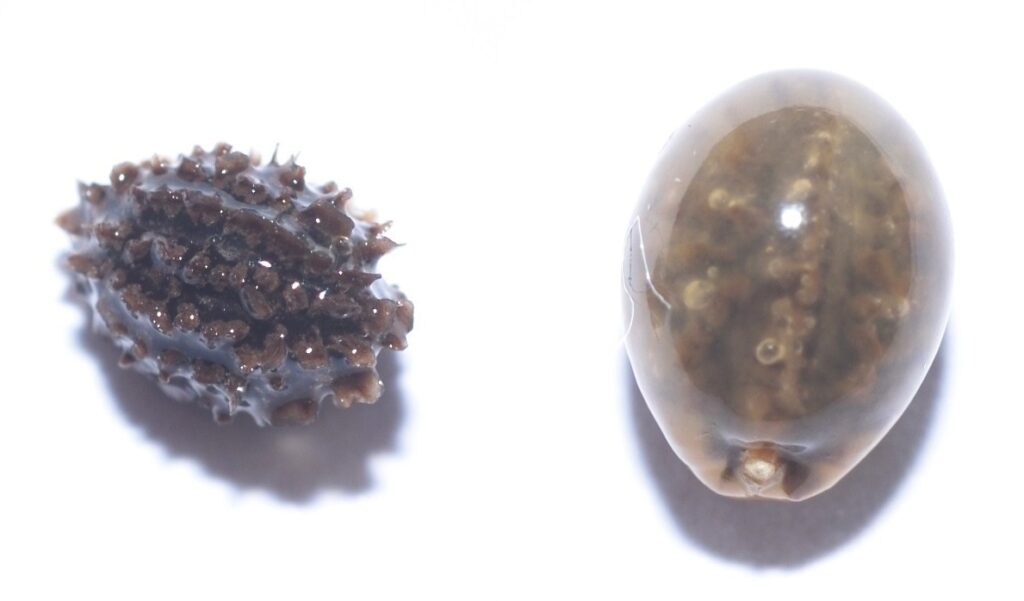

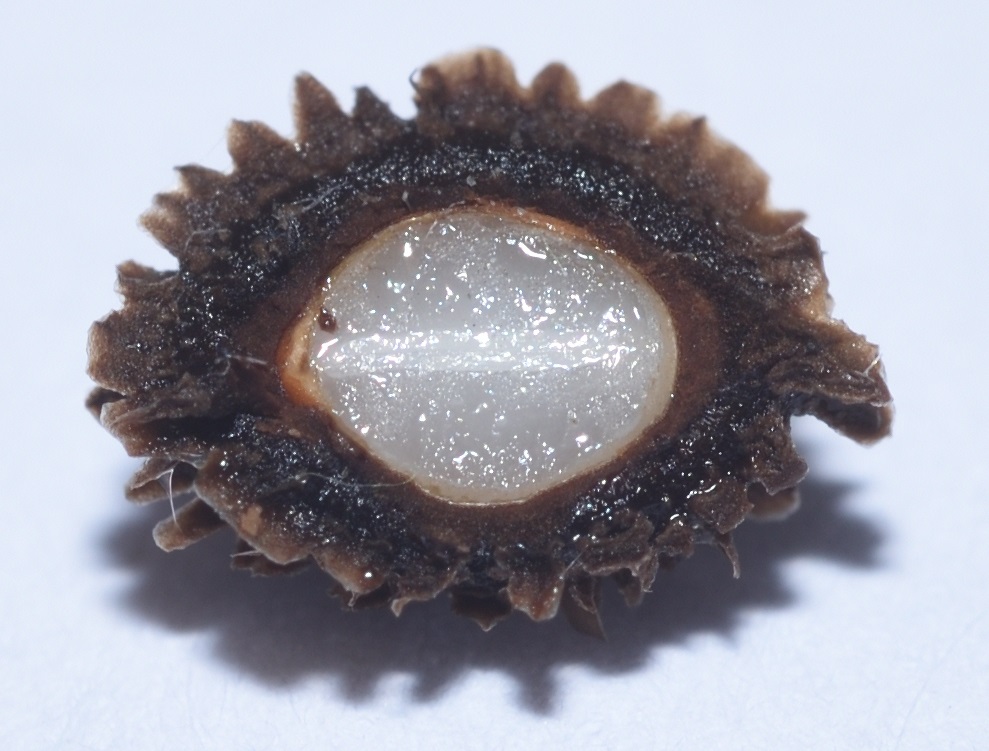
Papaya seeds are edible and taste a bit like horseradish. I would love to know more about that gelatinous pouch. I’m not familiar with any other type of seed that has such a covering. I’ve been searching for more info online, but all I’ve found so far is some stuff about papaya seeds’ reputed health benefits and a lot of rather dubious articles extoling their value for detoxing and parasite cleansing.
Papaya is thought to be native to Mexico, Central America, and northern South America. Several members of the papaya family can be found growing wild in the tropical valleys of the Andes. If papaya originated in South America, then, like the avocado, it was probably dispersed by South American giants such as ground sloths, gomphotheres, and toxodons.
The osage-orange or hedge-apple (Maclura pomifera) is a small tree or large shrub, which has a small natural range in parts of Texas, Oklahoma, and Arkansas. The fruit is neither an orange nor an apple. It’s technically edible, but no humans actually eat it, because it contains an unpalatable milky latex. Even horses don’t much care for it, although one of its many names is horse-apple.
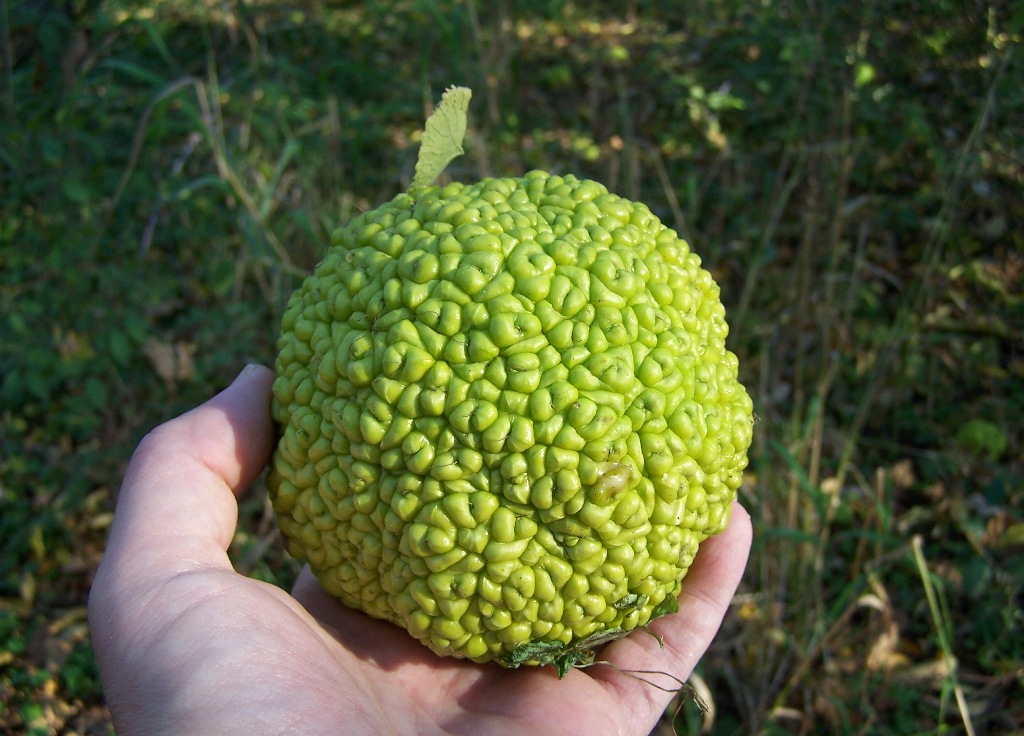
Winfield, IL USA
Author: Bruce Marlin
This file is licensed under the Creative Commons Attribution-Share Alike 2.5 Generic license.
In fact, nothing much eats it. When the fruits ripen, they drop to the ground. There, unless they roll downhill or get dispersed by a flood, they rot underneath the tree that produced them. This is, itself, a clear sign of anachronism. Nothing today eats them, but something must have eaten them at one time — something that’s no longer around. Molecular analysis indicates that M. pomifera probably diverged from other members of Maclura during the Oligocene, around the same time that some groups of mammoths, mastodons, and ground sloths first appear in the evolutionary record. This suggests that these mammals could have been the original seed dispersers for the plant.
You might be wondering, if the latex contained in the osage-orange is distasteful to horses and people, why would these larger mammals be any different? The fact is, many plants that people do eat produce chemicals that are toxic to some degree. Peppers, for instance, are eaten by no other animal other than humans. Large mammals, such as us, are able to handle limited amounts of mild toxins, and much larger mammals, such as elephants, are able to eat some fruits that would be toxic or unpalatable to us. Partly, this is because their slower digestion gives them more time to break down the toxins. Bad-taste is often an indication that something is not safe to eat. If something is safe for an animal to eat, chances are it won’t taste bad to that animal. So, to a mammoth or ground sloth, an osage-orange might have tasted pretty good.
Although we don’t eat the fruit, people have managed to find other uses for osage-orange. The wood was prized by Native Americans as the best wood for making bows (from which it gets another one of its common names, bois d’arc, which is French for bow wood.) They prized it so much, in fact, that they would travel hundreds of miles to get it.
The common name ‘hedge-apple’ refers to its use by European settlers as living fences or hedges around their fields to keep out free-range livestock. Pruning the plants would cause them to sprout adventitious roots from their bases. These would interweave, forming a dense, thorny barrier.
The use of osage-orange as hedges allowed it to become naturalized far beyond its limited natural range. The invention of barbed wire eventually ended its use by farmers, but, by that time, it had become well-established in much of the U.S. It’s still occasionally used as an ornamental.
More Anachronisms and More Theory38
I’ve concentrated on fruits in this article because they represent the most obvious examples of anachronisms, and because most of the research has been focused on them. This is probably only scratching the surface of the subject, though. One thing I haven’t mentioned is the presence on some plants of ridiculously large thorns — thorns that seem unnecessarily large to fend off the tiny herbivores the plants have to deal with in their modern environment. In the case of trees, these thorns often go far up the trunk — far beyond the reach of any modern animal — and then stop. Plants don’t waste resources any more than they have to. If nothing can reach beyond a certain height, then there’s no point in growing thorns beyond that height.39 There are many more examples of evolutionary anachronisms that I haven’t covered here, and as more research is done on the subject, many more examples will undoubtedly be found.
One final thing I should point out is that whether or not a particular trait is anachronistic rarely, if ever, has a simple yes or no answer. The person responsible for originating the concept of evolutionary anachronisms is a scientist named Dan Janzen, and as Janzen points out “…each trait is to some degree anachronistic.” The reason for this is simple. Evolution is slow. When the environment changes, it takes time for poorly adapted organisms to die out, leaving better adapted ones to carry on. This means that organisms are not really adapted to their current environment — they are adapted to their past environment.
Another important point is that the fruits I’ve been discussing are probably not adapted to a particular species of megafauna, or even a particular genus or family. As has already been pointed out, plants tend to evolve more slowly than animals. If most of a plant’s original dispersers have gone extinct, chances are, another set of dispersers will have evolved to take their place. (At least, that was the case until humans came along and upset the apple cart.)
All this leads to the concept of degrees of anachronism. Some organisms represent extreme anachronisms and are probably on their way to extinction (unless, of course, humans have stepped in and taken the place of their former dispersers.) Other organisms may have evolved traits in response to environmental conditions that have long since changed, but they still manage to get by pretty well, and they will probably have time to adapt to the new conditions. As in all things biological, it’s complicated.