“An ant of velvet
On a dusty hiking trail
A wasp chirps softly” – Haiku1
Velvet ants are not really ants. They’re wasps. They’re called velvet ants because the females are wingless and look a bit like large, hairy ants. They’re also called cow killers. They earn this moniker by having excruciatingly painful stings.
You might be forgiven for thinking that the more painful a sting is, the more dangerous it is. In fact, the toxicity of a venom is unrelated to the level of pain it produces. The sting from a velvet ant is less toxic than that of a honey bee, but hurts way more. On the Schmidt sting pain index2, the velvet ant scores a 3. (The index only goes up to 4.) One of the few insects in Southern California with a more painful sting is the tarantula hawk wasp, which I covered in an earlier post. (See The Stuff of Nightmares.)
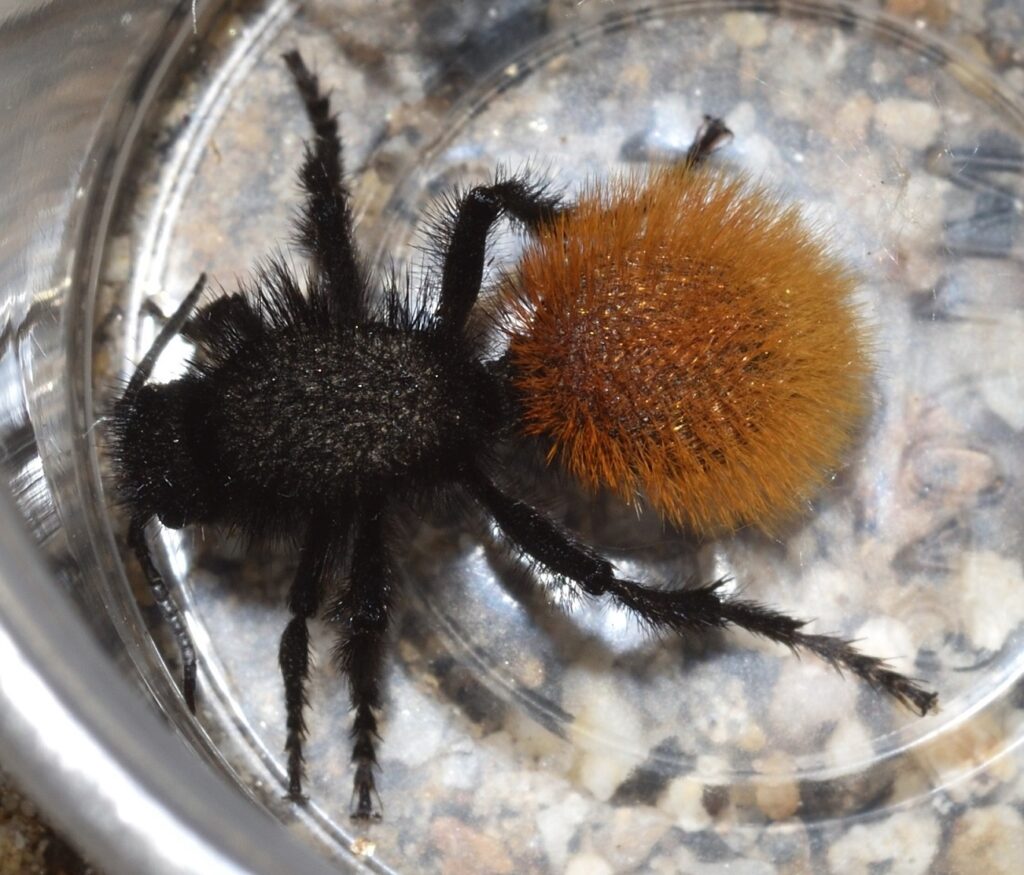
Anza Borrego State Park, San Diego County, CA 6/22/19
I’ve actually been stung by a velvet ant. While hiking near where I live, I saw a Sacken’s velvet ant, a species whose long white fur makes it look kind of like the seed-head of a plant — if a seed-head had long black legs. I wanted to show it to my grandnephew, who’s a huge fan of bugs (can’t imagine where he gets that from), so I caught it in a small plastic container. The young woman I was hiking with was worried that it wouldn’t have enough air, so, to make her happy, I decided to transfer it to a larger container that I happened to have with me. When I got home, I discovered that the container had gotten squeezed in my pack and the lid had popped loose …and it was empty. It seemed unlikely that the velvet ant would be able to find its way out of the pack, so it stood to reason that it was still in there. Somewhere…
I started very gingerly pulling things out. Finally, I upended the pack and dumped out the remaining items. No velvet ant. I had just about concluded that it had escaped altogether, when I detected movement out of the corner of my eye. I jerked my hand back just as the wasp struck. I must have reacted just in time to prevent the insect from injecting more than a tiny amount of venom, because the sting was very mild — much less painful than a typical spider bite — and the pain faded completely in a few minutes. Obviously, I was very lucky.
Here’s a couple of photos of a velvet ant like the one that stung me (but not the same individual):

Cuyamaca Rancho State Park, San Diego County, CA 8/8/20

Wasps are in the order Hymenoptera, which also includes bees, ants, and sawflies. All these insects are in many ways closely related. Bees have been described as vegan wasps (see my earlier blog post Vegan Wasps and Flying Mice) and ants could be thought of as wingless, social wasps.
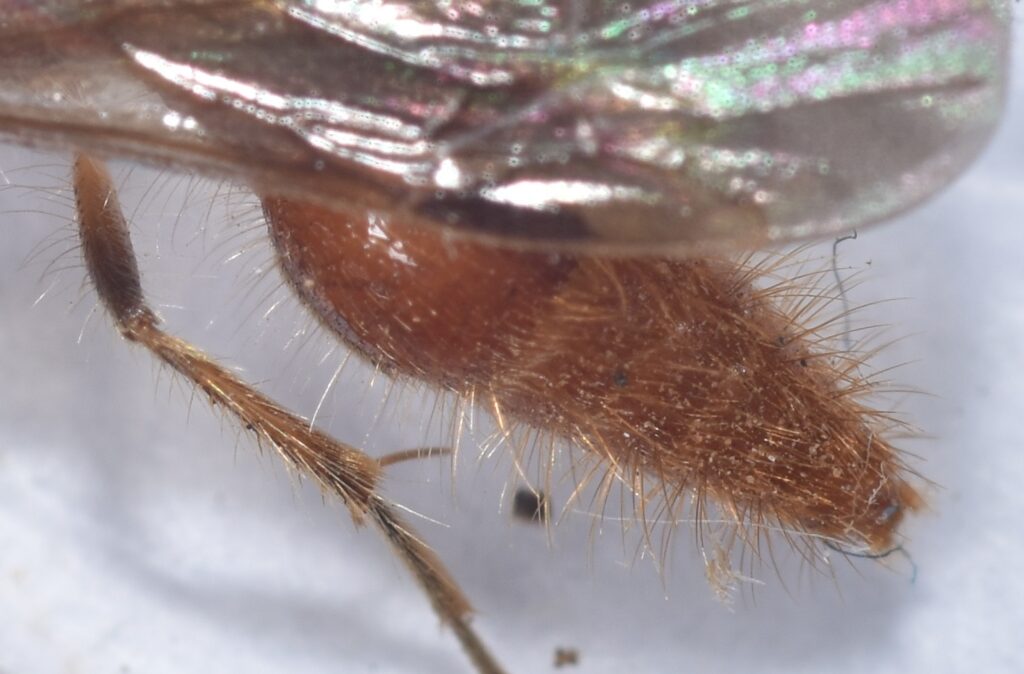
Within the Hymenoptera, wasps form the suborder Apocrita and, within that, velvet ants make up the family Mutillidae. As noted, female mutillids are wingless. The males do have wings and often differ markedly in size, form, and coloration from the females. This presents a problem for entomologists. Velvet ants are solitary insects. The only time males and females hang out together are when they are actually in the process of mating. So, given any two velvet ants — one male and one female — how can you tell if they are the same species? Often the only way to know for sure is if you manage to catch them in flagrante. One entomologist who specializes in the group writes that, although he has frequently seen males in the vicinity of females (and actively searching for them), he’s only once seen them actually doing the deed. It seems that they prefer to conduct their affairs in private.
Obviously, this makes it very difficult for scientists to sort out the different species. Many times males and females of the same species have been given different species names. When the mistake is finally caught, one name (the first one given) becomes the official species name while the other becomes a synonym.5 Currently, there are around 150 species of velvet ant listed for North America. Of these, about a third are known from both males and females; another third are known only from males; and the final third are known only from females.

Mission Trails Regional Park, San Diego County, CA 8/13/18

Note the three large ocelli on the top of the head. (See The Story of Eyes for an explanation of ocelli.)
Dietary Habits
Adult velvet ants feed on nectar. I mentioned earlier that I caught a female to show to my grandnephew. Since hummingbirds also feed on nectar, but will accept sugar water as a substitute, I figured mutillids might do the same. So, we mixed up some sugar water, added a little red food coloring (this was more for the kid’s benefit than the bug’s — he thoroughly enjoyed making “nectar”), and put a few drops into the container with the wasp. The insect didn’t immediately go for it — she was probably distracted by all the unwanted attention — but later I saw her grazing on the sticky, drying droplets.
What the larvae of velvet ants eat is a bit more gruesome. Mutillid larvae are parasitoids — parasites that kill their hosts. With a few exceptions, they prey on the young of solitary, ground-nesting bees or wasps. After mating, the female velvet ant goes in search of a host nest. When she finds one, she invades the nest and lays an egg next to each larva or pupa. When an egg hatches, the mutillid larva begins feeding on the host larva/pupa. It takes only a week or two for the wasp to consume its host, after which, it metamorphoses into an adult and leaves the nest.
Naturally, a bee or wasp whose nest is invaded by a velvet ant defends it vigorously. And since the hosts are usually solitary, the nests tend to be scattered far and wide, so the female velvet ant has to spend a lot of time wandering around in the open searching for them. This means exposing herself to an increased risk of predation. As a result of these selection pressures, velvet ants have evolved a remarkable array of defenses. One of these is their extremely painful sting, which we’ve already discussed. I’ll cover the other defenses in the following sections.

Mission Trails Regional Park, San Diego County 9/16/19
Body Armor6
The velvet ant’s exoskeleton is heavily reinforced. So much so, that collectors often resort to using tiny drill bits to drill holes for the pins, instead of trying to force the pins through the bug’s carapace. If an entomologist does try to push a pin through by brute force, when it finally breaks through, it will often continue on through the bottom of the carapace and into the collector’s finger. So, a drill bit is probably the way to go.
The top and sides of a velvet ant’s exoskeleton are covered with pits and ridges. This serves to strengthen the exoskeleton without adding a lot of weight. The ridges may also serve to redirect attacks. When a mandible or stinger catches on a ridge, it tends to slide along it towards an even thicker part of the armor.
An aposematic signal is a warning directed toward potential predators. It’s a way of saying, “you really don’t want to mess with me”. Such signals often take the form of colorful, eye-catching patterns. Most velvet ants are covered in brightly colored fur. If a predator tries to eat one, it’s probably going to get a bad sting and, while the wasp in question may or may not survive the attack, the predator will quickly learn to avoid any similar-looking insects in the future. So, aposematic coloration helps to reduce predation on a species as a whole.
A defensive strategy often allied with aposematic coloration is Müllerian mimicry. This is when two or more species that share the same predators evolve very similar warning signals. If a predator learns to avoid members of one of the species, it will likely avoid members of all of the species, so sharing the same aposematic signals is mutually beneficial. There are many cases of velvet ants forming ‘Müllerian mimicry rings’ consisting of dozens of species. A study in “Current Biology” found that North American velvet ants form one of the largest known Müllerian mimicry complexes on the planet, consisting of eight extensive and distinct mimicry rings.9
A Chemical Alarm10
Aposematic coloration is a pretty good warning signal, but what if your attacker is color blind? Perhaps to fill that gap in its defenses, the velvet ant has evolved the ability to secrete an alarm chemical from a gland in its mandible. This chemical serves as an olfactory alarm signal. A predator quickly learns to avoid any insects that smell like it.
Ok, but what if your attacker is color blind and has a head cold? Better to give him an auditory warning, too, just to be safe. Insects don’t have vocal cords, but many of them are able to produce sounds by rubbing together various body parts. This is called stridulation. Crickets, for example, are famous for their chirping, which they make by rubbing together their wings.13 When disturbed, a velvet ant emits a sound that has also been described as “chirping” or sometimes “squeaking”. It does this by rubbing together two of the segments of its abdomen.
When I showed that velvet ant to my grandnephew, we found that we could get it to stridulate by gently stroking its back with the cap from an ink pen. The sound was soft and difficult to hear, but then, it’s probably tuned to non-human ears. The vibration of the abdomen may also serve as a deterrent by provoking a startle response. In one experiment, a shrew was observed to drop a velvet ant as soon as it started stridulating, even though it hadn’t been stung.
I should note that stridulation may not be used exclusively for defense. According to one article, the female also uses it to attract males.14
In the following video, I’ve increased the volume to make the stridulation easier to hear. You can also clearly see the movement of the abdomen. Note: the velvet ant in the video looks a bit bedraggled. This is probably because of the time it spent loose in my backpack. It was not otherwise harmed and I later released it near where I found it. (It even got a nice meal of sugar water for its trouble. That’s the red splotches in the video.)
Scientists have actually studied the susceptibility of female mutillids to predation. In one study, entitled “The indestructible insect: Velvet ants from across the United States avoid predation by representatives from all major tetrapod clades”15, velvet ants from both the Eastern and Western United States were exposed to various potential predators that they would be likely to encounter in their native habitats. These included birds, shrews, lizards, toads, and one mole. (Apparently, moles were in short supply.) The results of the study can be summed up by the following excerpt from the paper: “…out of over 100 interactions between potential predators and various species of velvet ant, there were only 16 occasions where feeding strikes occurred. Only four velvet ants were eaten and three of the four were immediately regurgitated. Only one velvet ant was consumed and retained by a predator.”
The Mile High Club, Velvet Ant Style16 17 18
Female mutillids probably lost their wings as an adaptation to entering the burrows of their hosts. Wings would be easily damaged by attacking insects, so better to just do away with them. This presents a problem, though — it limits species dispersal — and this puts them at an evolutionary disadvantage, because if a species is only found in a small area, it will tend to adapt itself to the specific environment found in that area. If that environment changes drastically, the species could be wiped out.
Some mutillids have overcome this handicap by evolving phoretic copulation. Phoresy is a type of behaviour in which one animal hitches a ride on another animal. Some types of mites, for instance, will hitch rides on beetles or other larger animals. This way, they get more widely dispersed than would be possible if they just walked. In phoretic copulation, the male of a species carries a female to a new location either before or during mating. In the case of velvet ants, the male transports the female by flying. He actually carries her attached to his genitalia, so mating is done in mid-air. To facilitate this behavior, males of these species have evolved to be significantly larger than the females.
- First haiku I ever wrote voluntarily. (I think one of my teachers made us write one in grade school.)
- The Schmidt sting pain index was developed by entomologist Justin Schmidt who voluntarily left himself be stung by many different kinds of insects in order to rate the pain produced. According to Dr. Schmidt, the most painful sting he ever experienced was that of the bullet ant, an insect which, I’m relieved to say, does not live in the U.S.
- https://en.wikipedia.org/wiki/Wasp
- https://en.wikipedia.org/wiki/Mutillidae
- https://scholar.valpo.edu/cgi/viewcontent.cgi?article=1623&context=tgle
- https://www.desertusa.com/insects/velvet-ants.html
- https://en.wikipedia.org/wiki/Mutillidae#Defense_mechanisms
- https://en.wikipedia.org/wiki/Aposematism
- https://www.cell.com/current-biology/fulltext/S0960-9822(15)00747-2?_returnURL=https%3A%2F%2Flinkinghub.elsevier.com%2Fretrieve%2Fpii%2FS0960982215007472%3Fshowall%3Dtrue
- https://www.ncbi.nlm.nih.gov/pmc/articles/PMC6010712/
- https://www.ncbi.nlm.nih.gov/pmc/articles/PMC6010712/
- https://www.ncbi.nlm.nih.gov/pmc/articles/PMC6010712/
- https://en.wikipedia.org/wiki/Cricket_%28insect%29#Chirping
- https://extensionentomology.tamu.edu/publications/velvet-ants/
- https://www.ncbi.nlm.nih.gov/pmc/articles/PMC6010712/
- “Review of Adaptations of Velvet Ants (Hymenoptera: Mutillidae)” in The Great Lakes Entomologist, pgs 2-3
- https://www.scilit.net/article/2136a196717c74bbbfa820134dd259ba
- https://en.wikipedia.org/wiki/Phoresis