Lots of animals and even some plants can sting. In this post, I’m going to limit myself to one specific group of stinging animals — the insects. All stinging insects are in the order Hymenoptera, which includes sawflies, wasps, ants, and bees, so I’ll be further limiting myself to that order. As we’ll see, it won’t be much of a limitation.
A lot of things about stinging insects may surprise you. For starters, they’re all female. That’s right, no male insect can sting. The reason is simple — stingers evolved from ovipositors. And what’s an ovipositor, you ask? Well, consider the word. ‘Ovipositor’ comes from the Latin ōvum (“egg”) and positor (“one who deposits”).1 An ovipositor is a tube through which an insect lays eggs.
A Few Examples
Ovipositors come in all sizes and a surprising variety of shapes. Some are short and fat; some are so long and thin that you wonder how they can possibly work; some are serrated so that their wielders can saw into a leaf or stem and deposit their eggs inside.
Jumping bristletails — One of my favorite examples is the jumping bristletail. These are insects in the order Archaeognatha,2 an ancient group first appearing in the fossil record in the Devonian, well over 358 million years ago.3 They’re called jumping bristletails because when a bristletail is threatened, it snaps its abdomen against the ground, causing the insect to jump up to four inches (10 cm). Modern bristletails have no wings, and none of their ancestors did, either. The group actually predates the evolution of wings in insects.4

Mission Trails Regional Park, San Diego County. 7/31/17
The reason bristletails are one of my favorite examples of ovipositing insects is simply that I have some cool videos of them laying eggs. Here’s one of them.
Parasitoids — A parasitoid is a parasite that kills its host. Many, many species of wasp are parasitoids. One example is shown below. It’s a carrot wasp in the genus Gasteruption, family Gasteruptiidae. Wasps in this family are called carrot wasps because the adults often feed on pollen and nectar from plants in the carrot family.

Chimoio, Mozambique April 2010
Author: Ton Rulkens from Mozambique
This file is licensed under the Creative Commons Attribution-Share Alike 2.0 Generic license.
The larvae of carrot wasps prey on other wasps or bees. When an adult female wasp finds a bee or wasp nest, she will tap the cells in the nest with her antennae, trying to detect the presence of a larva by the vibrations. When she finds an occupied cell, she punctures the seal with her ovipositor and deposits an egg. When the egg hatches, the wasp larva eats the food left for the original inhabitant, or the original inhabitant, or both.5 6
The photo below shows a wasp in the genus Apocrypta. These are parasitoids of certain species of fig wasps. The larvae of fig wasps develop inside figs. The parasitoid has to drill through the thick outer wall of the fig and root around inside the fruit to find the larva it wants to parasitize. Hence, the absurdly long ovipositor.7

Author: Nikhil More
This file is licensed under the Creative Commons Attribution-Share Alike 4.0 International license.
Katydid — The insect in the next couple of photos is a least katydid (Brachyinsara hemiptera)8. This insect’s ovipositor has serrations for sawing. Katydids deposit their eggs in a variety of substrates, depending on the species. Since the one pictured here has serrations on its ovipositor, I would guess that it deposits its eggs inside a leaf or stem. I know this is true of another species of katydid, Scudderia furcata. This katydid curls its abdomen underneath itself and uses its ovipositor to saw into the edge of a leaf between the inner and outer layers and deposits its eggs inside. If you’re having trouble visualizing how this would work, click here to visit a website that has a nice photo of a Scudderia furcata in the process of laying eggs. The leaf in the photo is very thin, which means that the eggs the katydid is inserting must also be very thin. In fact, they’re so thin as to be almost transparent — one more example of a mind-blowing evolutionary adaption.9

Mission Trails Regional Park, San Diego County 11/7/18

Cricket — The ovipositor of this tropical house cricket (Gryllodes sigillatus) wins the prize for simple elegance and refinement. It looks remarkably like a hypodermic needle.

La Mesa 12/12/20
This was an escapee from a box of crickets that I got from a pet food store, so who knows where it originated.

The cricket simply inserts her ovipositor into soft ground and injects an egg. Click here to watch a video of some crickets ovipositing.
The Evolution of Ovipositors10 11 12
Earlier, I described the ovipositor as a tube. This is true enough, however, it’s not a simple, one-piece tube like a straw. It consists of a number of separate parts that come together to form a tube-like structure. Often, when an insect dies, those parts will separate, splaying out behind the body.
The reason ovipositors are not simple tubes can be traced back to their evolutionary origins. Insects (and, ultimately, most other animals, with a few exceptions like sponges and jellyfish) are descended from annelid-like ancestors. Annelids are segmented worms. Some annelids, like earthworms, have no legs, but many annelids have a pair of legs attached to most of their body segments. The photo below shows a fairly typical annelid — a type of polychaete worm.

North Inlet – Winyah Bay National Estuarine Research Reserve.
Author: Unknown
Source:
http://www.photolib.noaa.gov/htmls/nerr0328.htm
This image is in the public domain because it contains materials that originally came from the U.S. National Oceanic and Atmospheric Administration, taken or made as part of an employee’s official duties.
Most of the segments in an annelid’s body have the same sets of internal organs and are essentially identical. (Of course, there are some organs, like parts of the digestive tract, that necessarily span multiple segments.) This basic body plan is easily modified by natural selection. Segments can be added or dropped, and legs can be modified to form other types of appendages, such as antennae, mouthparts, and genitalia.
In the case of ovipositors, some of the appendages evolved to work together to form mechanisms for guiding the eggs as they leave the body. Sometimes additional appendages evolved to form a sheath around the ovipositor to protect it when not in use. This sheath will part to expose the ovipositor when the insect is ready to lay eggs.
I was able to find one scientific paper that describes in detail the stingers of a honeybee and a paper wasp. You can click here to access the entire paper. The images in the article (mostly electron microscope images) show the structure of the stingers. In both species, the stinger consists of a wide ‘stylet’ and two ‘lancets’. The lancets ride on two ‘rails’ that run along the stylet. When the insect stings, it moves the lancets rapidly back and forth in opposite directions for a short distance along the rails. This helps the stinger penetrate the substrate. The venom is pumped down the trough formed by the stylet and lancets. In the case of the honeybee, the venom exits the stinger through the space between the ends of the lancets and stylet. In the wasp stinger, the venom exits through an opening in the stinger much nearer the base. (I don’t know why this opening is so far from the tip in the case of the wasp. It seems like this would make it harder for it to inject venom, since it would have to almost completely bury the stinger first. But that’s apparently how they do it.)13
The images in the paper are a bit difficult to interpret. Another paper that it references has some images that are easier to understand. Click here to see one of the photos from it. You can see click here to see an abstract of the paper (and some more photos).
Insects have evolved endless varieties of ovipositors. To mention just one more example, according to Wikipedia, “In some species [of wasps], such as Apocrypta westwoodi, the ovipositor has zinc-hardened drill bits”.14 ‘Endless varieties’ really isn’t much of an exaggeration.
The Rise of Wasps
As we have seen, an ovipositor can be used to inject an egg into a substrate. Often that substrate is the ground, a leaf, or the stem of a plant. But it could also be another insect or even a mammal. Over the course of time, many insects have evolved to be parasitoids, laying their eggs near, on, or inside a host.
Many different kinds of insects, including flies and even some beetles,15 have produced parasitic species, but the undisputed masters of parasitism are the wasps. Most people would be astonished to learn just how many different kinds of wasps there are. And most of them are parasites. Many entomologists believe there are more species of parasitoid wasps — just parasitoid wasps — than there are beetle species. This seems hard to believe, since we see a lot more beetles than we do wasps. The reason for this seeming paradox is that the vast majority of wasps are very tiny, so they don’t get noticed very often. For a long time, scientists believed that beetles (order Coleoptera) were the most diverse of the insects, but as time passed, more and more minute species of wasp were discovered. Eventually, it become clear that for just about every species of beetle there was probably at least one species of wasp that was evolved to parasitize it. In fact, according to entomologist Lynn Kimsey, “…for each beetle species there are probably at least two wasp parasitoids: One [that targets] the eggs and one [that targets] the larvae.”16
Before we get too much further along, I should take a moment to explain just what I mean by ‘wasp’. As mentioned at the beginning of this article, the order Hymenoptera includes sawflies, bees, wasps, and ants. The order is further divided into two groups or clades17 — Symphyta and Apocrita. The members of Symphyta are called sawflies. Their main defining characteristic is the lack of a ‘wasp waist’ — instead, the junction between the thorax and abdomen of a sawfly is thick and relatively inflexible. Apocrita, on the other hand, includes all the members of Hymenoptera that do have wasp waists, namely ants, wasps, and bees. The point of having a wasp waist it that it allows the insect to move its abdomen independently of the rest of its body, which can be useful in all sorts of ways, such finding a vulnerable spot to sting an animal.
Now, you may be wondering why I’m covering all the Hymenoptera here, instead of just focusing on the subset of the Apocrita that make up the wasps. Well, it’s because things aren’t quite that clear cut. ‘Wasp’ is not a scientific term. It’s a popular name that’s used for a lot of different members of Hymenoptera, including some of those in Symphyta. Wood wasps (family Xiphydriidae), for example, are technically sawflies.18 I’m not a professional entomologist, but from my reading, I get the impression that the professionals tend to use the term ‘wasp’ rather flexibly — sometimes using it to refer to anything in Hymenoptera, other times using it in a more conventional sense. Both ants and bees, by the way, evolved from wasps (in the narrower sense of the word), so from a scientific perspective, I suppose they are just special types of wasps.19 20
The Bizarre World of Parasitoid Wasps
Let’s take a look at a few more examples of parasitoid wasps.
Darwin or ichneumon wasps21 22 — These are wasps in the family Ichneumonidae — one of the most diverse of all animal families. Almost all ichneumon wasps parasitize spiders or the immature stages of holometabolous23 insects. Typically, an ichneumonid wasp will sting a caterpillar, injecting an egg in the process. When the egg hatches, the wasp larva proceeds to dine on the caterpillar’s organs. Apparently, it does this very selectively, however, because the caterpillar continues to go about its development and eventually constructs a chrysalis in which it pupates. The wasp larva also pupates, still inside the caterpillar’s body. Eventually, an adult ichneumonid wasp emerges from the chrysalis. (The caterpillar does not.)
The term ‘ichneumon wasp’ is sometimes used to refer specifically to members of the genus Ichneumon within the Ichneumonidae, so it can cause a bit of confusion. For this reason, some entomologists have suggested that ‘Darwin wasps’ would be a better common name for the group. The reason they picked this name is because of a quote from Charles Darwin in which he expressed the profound horror that the ichneumonid lifestyle engendered in him:
“I cannot persuade myself that a beneficent and omnipotent God would have designedly created the Ichneumonidae with the express intention of their feeding within the living bodies of Caterpillars…” – Charles Darwin in a letter to a friend, 1860
Seems a bit perverse to name a group of insects after a guy who was horrified by them, but he’s not around to argue.
Here’s a couple of photos of a Darwin wasp in the subfamily Pimplinae. Note the very long antennae. This is one of the defining features of the family.

San Diego County 8/18/19

Braconid wasps24 — The family Braconidae is the second largest family in the order Hymenoptera. Braconids are mostly internal or external parasitoids of a wide variety of insects — usually beetles, flies, moths, or butterflies.
Here’s some photos of a braconid wasp in the subfamily Braconinae.

San Diego County 3/31/18

San Diego County 3/31/18
The next couple of photos show a jaw wasp (subfamily Alysiinae, also in family Brachonidae).25 The wasps in this genus are internal parasitoids of flies, ovipositing either into the fly larva or its egg. Yes, you read that right, some wasps lay their eggs inside the eggs of other insects! Not surprisingly, jaw wasps tend to be very small, usually less than 5 mm long. The wasp in these photos is sitting on a liverwort, so, if you happen to be familiar with liverworts, this should give you some idea just how tiny these wasps are.

Mission Trails Regional Park, San Diego County 2/12/19

Mission Trails Regional Park, San Diego County 2/12/19
Hyperparasitoids — Parasitoids, as we’ve seen, have rather gruesome lifestyles. But parasitoids have their own problems, such as other parasitoids. Believe it or not, quite a few wasps are parasitoids of parasitoids. In other words, they are hyperparasitoids!26
The following photo shows some cocoons of an unidentified braconid wasp. Braconid wasps, as we have seen, are parasitoids. But it wasn’t braconid wasps that came out of these cocoons. Instead, tiny conuran wasps emerged, having devoured the original occupants.

San Diego County 062817
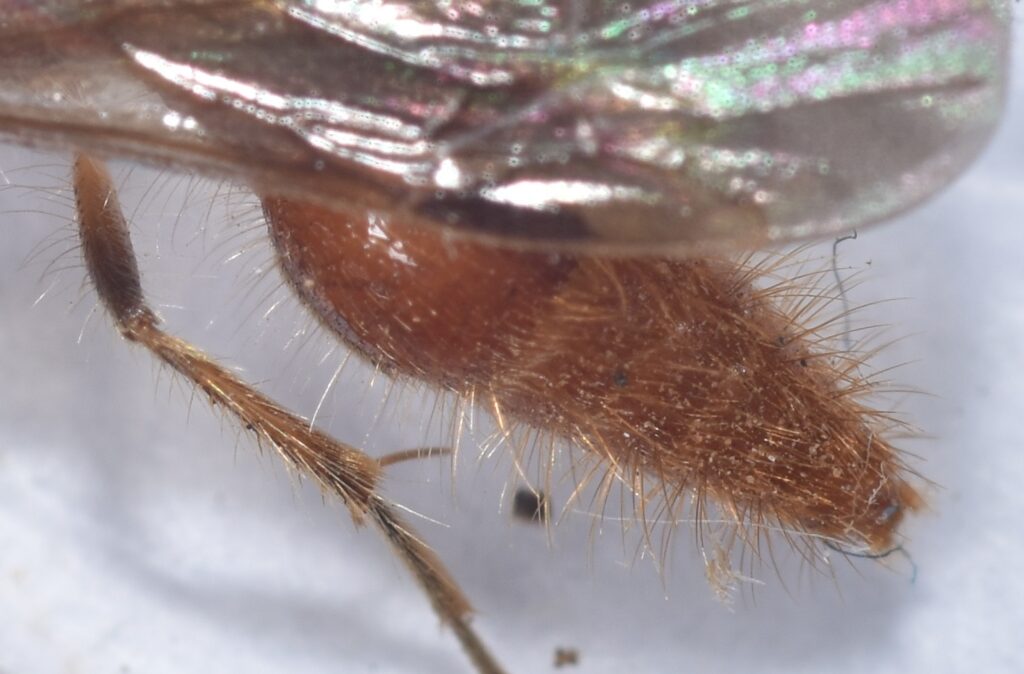
Conura is a genus in the family Chalcididae. Chalcididae is itself in the superfamily Chalcidoidea. Wasps in this superfamily are called chalcid wasps, and they often have a greatly enlarged hind femora (one of the leg segments), with a row of teeth on the lower margin. You can see this in the next photo, which shows one of the wasps that emerged from the cocoons.27

Most of you are probably familiar with aphids — those tiny, sedentary insects that spend their lives sucking sap from plants. Aphids have many enemies, but some of the most unsettling are the parasitoids. These wasps lay their eggs inside aphids. The larva develops inside and eventually pupates, usually still inside. At this point, the aphid is, mercifully, dead, and its body has been turned into a “mummy”. The body of a mummified aphid is swollen, papery, and brown, tan, or blackish in color, depending on the species of wasp that parasitized it. After the wasp metamorphoses into an adult, it chews its way out of the aphid, leaving a gaping hole in the aphid’s body.28

San Diego County 5/18/18

San Diego County 5/18/18
The wasp that parasitized these aphids was probably a braconid, but it wasn’t a braconid that came out. Instead, the parasite was itself parasitized by a wasp of the genus Pachyneuron in the family Pteromalidae.

San Diego County 5/18/18

While we’re on the subject of parasitoids, I should mention what’s probably the weirdest type: adelphoparasitoids. These are tiny parasitic wasps in the family Aphelinidae. The females are parasitoids of whiteflies or scale insects, but the males of some species are hyperparasitoids of the females of their own species and sometimes even of other males!29
Fairyflies or fairy wasps (family Mymaridae) — Fairyflies are some of the most common wasps, but you’ve probably never seen one. They are unbelievably tiny. Most of them are between 0.5 and 1.0 mm (0.020 to 0.039 inches) long. All known fairyflies lay their eggs inside the eggs of other insects, which accounts for their small size. As you can see in the following photo, they have very strange, feathery wings.30

New Zealand
Author: S.E. Thorpe
License (as per the author): I, the copyright holder of this work, release this work into the public domain. This applies worldwide.
In some countries this may not be legally possible; if so:
I grant anyone the right to use this work for any purpose, without any conditions, unless such conditions are required by law.
Included within the fairyflies is the smallest known insect, Dicopomorpha echmepterygis. The males are blind and wingless and are about 40% smaller than the females (so it’s the male that’s the smallest insect). Their body length measures 186 μm, based on eight specimens. This makes them smaller than some species of Paramecium and amoeba. In other words, they are smaller than some single cells! 31

Source: e
Huber J, Noyes J (2013). “A new genus and species of fairyfly, Tinkerbella nana (Hymenoptera, Mymaridae), with comments on its sister genus Kikiki , and discussion on small size limits in arthropods“. Journal of Hymenoptera Research 32: 17–44. Pensoft Publishers. DOI:10.3897/JHR.32.4663.
Authors: John T. Huber, John S. Noyes, J. Read
This file is licensed under the Creative Commons Attribution 3.0 Unported license.
The fairyflies also include the smallest known flying animals. These are wasps in the genus Kikiki. The genus includes a single species, K. huna, which is found in Costa Rica, the Hawaiian Islands, Trinidad and Tobago, Argentina, and India. It’s very likely that they’ve been spread by humans, probably by stowing away on boats. The females range from 158 to 190 μm. Very few males of the species have been studied. The one measurement of a male put it at 235 μm. It’s believed that the females of K. huna represent the smallest that an insect can get and still retain the ability to fly.32 33

Source: Huber J, Noyes J (2013). “A new genus and species of fairyfly, Tinkerbella nana (Hymenoptera, Mymaridae), with comments on its sister genus Kikiki , and discussion on small size limits in arthropods“. Journal of Hymenoptera Research 32: 17–44. Pensoft Publishers. DOI:10.3897/JHR.32.4663.
Authors: Huber J, Noyes J
This file is licensed under the Creative Commons Attribution 3.0 Unported license.
Hyperhyperparasitoids? — If you’re like me, when you first learned about hyperparasitoids, your natural reaction was “So are there any hyperhyperparasitoids?” — that is, parasitoids of parasitoids of parasitoids? Apparently, the answer is yes. I don’t know if there are any parasitoids that parasitize only hyperparasitoids, but if the larvae of two hyperparasitoids happen to meet up within the body of a parasitoid host (which probably happens more often than you might expect), it’s quite possible that one will end up parasitizing the other.34
So are there any hyperhyperhyperparasitoids? Let’s just not go there.
Back to Stingers
So now we’ve got some insects stabbing their ovipositors into other animals. That seems like a good first step towards a stinger. But a yellowjacket doesn’t sting us in order to deposit an egg under our skin (which would presumably go on to hatch into a larva that would feed off our tissues and bodily fluids before bursting forth, xenomorph-style, from our body as a fully-formed adult.) Instead, it injects venom, whose sole purpose is to send us screaming. This seems like a bit of a leap evolution-wise. How do we get from injecting eggs to injecting venom?
I read one paper that described how a hypothetical enzyme could be transformed into a venom. The paper was focused more on snake venoms, but I think it still applies here. It pointed out that some venoms are related to immune system proteins that attack bodily invaders such as bacteria, and others are related to digestive enzymes. A subject that I’ve mentioned often in my blog posts is gene duplication. This is a common type of mutation in which the section of DNA that codes for a gene gets duplicated. At first, this just means that twice as much of an enzyme or other protein encoded by the gene may get produced. But having an extra copy of a gene means that one of the copies can evolve to perform a different function without the organism losing the ability to produce the original protein. So evolution is free to adapt the extra copy for a different purpose. Another type of mutation can change the signal that tells a gene where to become active. So, in the case of a snake, a mutation may tell a gene to make its protein in the mouth instead of the pancreas.35 In the case of an insect, a digestive enzyme could be redirected to the ovipositor.
So what would happen if such an enzyme were injected into another species? Hard to say. It could do nothing; it could make the target sick or even kill it; it could produce pain with or without actual damage or damage with or without pain. It could even have an effect on the target’s behavior (besides scaring it away or making it sick, I mean). After all, the substances manufactured by insects include hormones and neurotransmitters. In any event, a random foreign chemical injected into an organism will have a much better chance of having a negative effect on that organism than a positive one, especially if the chemical is, for example, a digestive enzyme. So it’s pretty easy to see how evolution could select for venoms that produce pain and/or damage.36
Some parasitoid wasps represent an intermediate step in the evolution from ovipositor to stinger. They use their stinger to inject an egg into the body of a host, but also inject venom along with it. The venom may paralyze the host or prepare it in some other way for consumption by the wasp larva. Eventually, some parasitoids developed a separate opening at the base of the stinger for depositing the egg, freeing up the stinger to became specialized for injecting venom.37
Some Stinging Wasps
In this section, we’ll cover some of the wasps that have full-fledged stingers. One thing you’ll notice when looking at the photos of these wasps is that, in most cases, the stingers are not visible. This is because they’re retractable — they are withdrawn inside the abdomen when not in use.
Umbrella wasp (Polistes dorsalis californicus) — Umbrella wasps are a type of paper wasp, which is a common name referring to any type of wasp that makes its nest out of chewed up wood fiber — paper, in other words.
It’s not surprising that paper wasps can sting. They have a nest to defend, after all. Surprisingly, though, the sting is generally described as only moderately painful.

Mission Trails Regional Park, San Diego California 6/27/20
The use of wood pulp in paper making was probably inspired by paper wasps. The first paper was made out of recycled rags of hemp, linen, cotton, or other plant fibers. When Europe suffered a shortage of cotton and linen in the sixteenth century, manufacturers started looking for alternatives. The French naturalist René Antoine Ferchault de Réaumur is credited with introducing the use of wood fiber in 1719. One of Réaumur’s most important works is the Mémoires pour servir à l’histoire des insectes in 6 volumes. My French is not exactly fluent, but I think this means something like “Reports on the History of Insects”. And, again, it was in six volumes! I think it’s safe to say that Réaumur would have been familiar with the way paper wasps make their nests.38
Milde’s tarantula hawk wasp (Pepsis mildei) — If you haven’t read my earlier post on tarantula hawks, The Stuff of Nightmares, please do so. These are some beautiful, fascinating, and gruesome insects. A female tarantula hawk hunts tarantulas. When she locates one, she paralyzes it with a sting and drags the still living tarantula into a burrow. She then lays a single egg on the abdomen of the spider and seals the burrow. When the egg hatches, the wasp larva proceeds to feed off the tarantula, eating the non-vital organs first to keep it alive and fresh for as long as possible.
I’ve had the good fortune to see a tarantula hawk dragging a paralyzed tarantula on two occasions. Here’s a couple of photos from one of those encounters.

Sweetwater River Trail 9/8/17

Sweetwater River Trail 9/8/17
And here’s a video of the wasp dragging its prey.
When it comes to stings, tarantula hawks are something special. According to the Schmidt sting pain index (which I’ll be discussing later in the article), the tarantula hawk has the second most painful sting of any insect!39 And we have them right here in Southern California! Fortunately, since they don’t have nests to defend, tarantula hawk wasps will not normally attack humans. In other words, don’t bother them, and they won’t bother you.
Eastern cicada-killer wasp (Sphecius speciosus) — I recently spent a week in Virginia on the east coast of the U.S. As luck would have it, the 17-year periodic cicadas (Magicicada cassinii) were emerging.40 Cicadas are extraordinary insects. There are many different species, but M. cassinii is one of the most remarkable. It spends most of its life as a larva, living underground, where it feeds on the roots of plants. At the end of 17 years, all the cicadas emerge from the ground at the same time41 and molt one last time, metamorphosing into their adult forms.
As if this weren’t incredible enough, once they finish molting, the males all start calling to attract females. They do this by vibrating a couple of membranes on their abdomens, and the sound this makes is difficult to describe. It’s a loud buzzing — really loud. Collectively, the sound can reach 100 decibels. How loud is that, you ask? One website compares it to the sound of an “ambulance siren, inside driver window down”. It can actually cause hearing damage.42

Richmond, Virginia 7/27/21
17-year cicadas are large, meaty insects, so naturally, they have a lot of predators. One of those predators is the eastern cicada-killer wasp (Sphecius speciosus). As the name suggests, this wasp specializes in hunting cicadas. Just as a tarantula hawk wasp stings a tarantula to paralyze it and uses it to provision a burrow with food for its offspring, a cicada-killer wasp does the same thing with cicadas. Now, you might be wondering, how can it specialize in cicadas if they only emerge once every 17-years? I wondered this, too, and I haven’t found a definitive answer. My guess is that it hunts more than one type of cicada. (Most species of cicada are not ‘periodic’ — they spend much less time as larvae and emerge at random.) If you know the answer, please share your knowledge in the comments.
Once it stings a cicada, the wasp holds it underneath her as she flies off to a previously prepared nest cell. As already noted, 17-year cicadas are big insects, so the cicada-killer has to be big, too. It’s a large, scary-looking wasp with a wicked-looking stinger. Surprisingly though, its sting is actually quite mild — less painful than that of a honeybee.45
While in Virginia, I was fortunate enough to come across a dead cicada-killer wasp lying next to the path I was walking, so I was able to get some nice closeups.

Maymont Park, Richmond, Virginia 7/25/21


Notice how the sting protrudes from an opening in the abdomen. I would guess that, in life, it would be kept retracted inside.
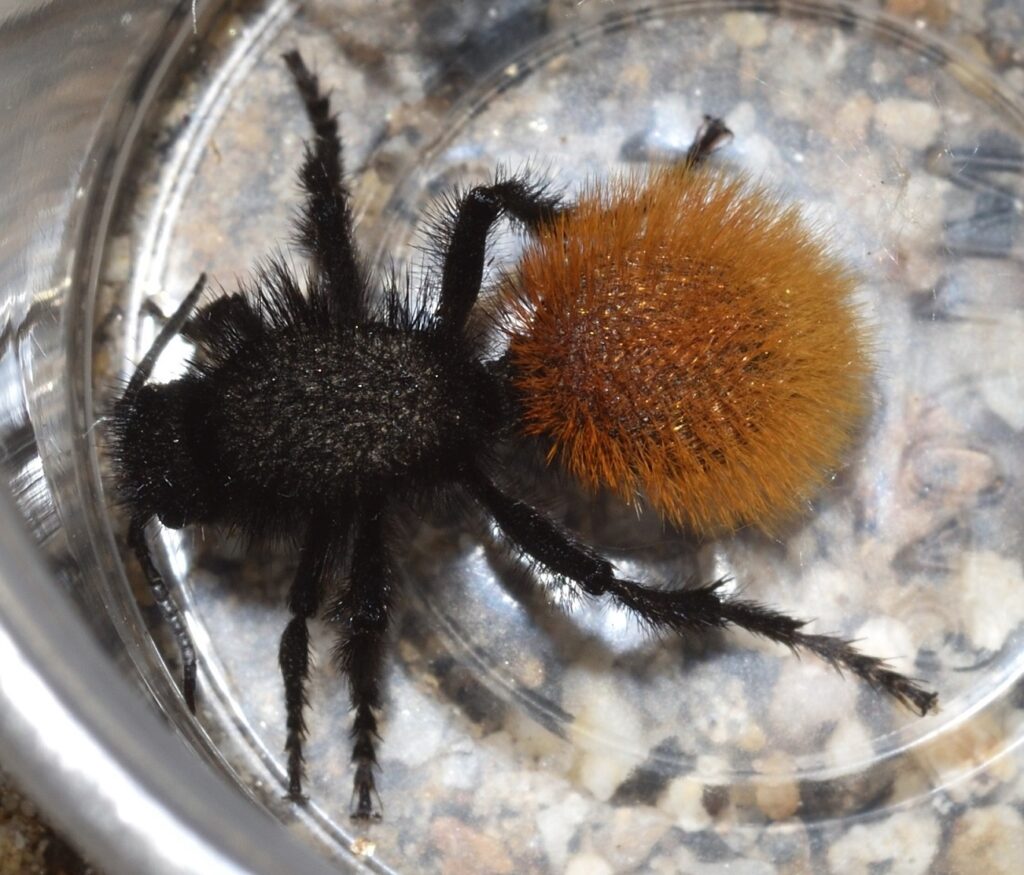
Velvet ant (family Mutilidae)46 — Velvet ants are actually wasps. The females are wingless and look a bit like large ants. Female velvet ants are parasitoids, usually of ground-dwelling bees or wasps. Because they have to spend a lot of time crawling around out in the open looking for the nests of their prey, they’ve had to evolve some serious defenses, one of which is an extremely painful sting. The sting of one species, Dasymutilla klugii, is rated three out of four on the Schmidt sting pain index. It also lasts up to 30 minutes.47 Check out my earlier blog post, Cow Killer, for more about velvet ants.

Mission Trails Regional Park, San Diego County 9/16/19
Other Stinging Insects
While wasps (in the common, more restrictive, sense of the word) make up the vast majority of stinging insects, there are plenty of others among the ants and bees.
Harvester ants48 — Harvester ant is the common name for any kind of ant that collects seeds. This covers a lot of species and genera, so you might expect their stings to vary a great deal. But the following passage from Wikipedia seems to imply that they all have similar stings: “Harvester ants for their size have a rather potent venom. They inject it to [sic] their victim via sting by biting down and following up with a rapid sting from their abdomen, this causes 4-8 hours of sharp pain with effects similar to neurotoxicity such as piloerection49 and localized sweating around the area of the sting. ” If true, I suppose this is an example of similar lifestyles leading to convergent evolution.

Anza Borrego Desert State Park, San Diego County 3/17/19

Anza Borrego Desert State Park, San Diego County 3/17/19
Western or European honeybee (Apis mellifera) — Western honeybees are what most people think of when they think honeybee. They are, of course, highly social insects, and, since they have a hive to defend, one would expect them to have a fairly painful sting, and they do. On the Schmidt sting pain index, they rate a 2, which is moderately painful.50
Although I often got stung by wasps when I was a kid, as far as I can remember, I was never stung by a bee. That all changed on one of my recent hikes. A swarm of honeybees had built a hive inside the hollow of a tree. I used a friend’s phone to take a video of the swarm and was able to get quite close without being stung, resulting in a very nice video. Unfortunately, my friend’s phone malfunctioned shortly after this, and she lost the video. So the next time my hiking took me past the hive, I decided to try to get some more photos and videos.
I’m not sure why, but this time the bees seemed more aggressive. Maybe the first time, they were in the process of constructing the hive and didn’t have any eggs or young to defend, or maybe I was just too close for too long, but in any case, this time they were a lot more upset with me, and I got stung on the neck. Of course, my first thought was “What a great photo opportunity!”
I should explain. Honeybee stingers are barbed, which means that when they embed their stinger in your skin, they usually can’t pull it out again. When they fly away, the stinger is ripped out of their abdomen along with some of their guts. The bee, of course, dies from the injury. This may seem rather counterproductive, but it actually makes perfect sense from the point of view of evolution. The worker bees in a hive are all daughters of the same queen, so they share most of the same genes. As long as the hive survives, most of their genes will get passed down to future generations, regardless of the fate of any individual worker.
When the stinger is ripped out of a honeybee, the venom sac and the muscles connected to it are usually ripped out along with it. The muscles keep pumping for a while, insuring that a full dose of venom is injected into the target! So even if you swat the bee as soon as it starts to sting you, you’re still likely to suffer the full effect of its sting. Honeybees, by the way, are fairly unusual in only being able to sting once. Most stinging insects don’t leave their stingers behind and, thus, are able to sting repeatedly.51 52
So, anyway, back to the story. I left the stinger in my neck, venom muscles presumably still pumping away. (It actually didn’t hurt very much, so it wasn’t that much of a sacrifice.) When I got home, I awkwardly managed to take a few pics of the embedded stinger using my bathroom mirror to aim the camera. Here’s a couple of them. A nice photographic touch for an article on insect stings, if I do say so myself!

Mission Trails Regional Park, San Diego County 4/4/21

I didn’t think about it at the time, but I should have gotten one of the other hikers to take a video of it with their phone. Maybe it would have been possible to see the movements of the stinger as the muscles continued to pump venom. I also should have taken some photos of it after I scraped it off my neck. (I don’t know what I was thinking!) Here’s a photo someone else took of a honeybee stinger torn out of the insect’s body.

Author:
Dejan Kreculj
This file is licensed under the Creative Commons Attribution-Share Alike 4.0 International license.
Finally (because I can’t seem to get enough of these ripped-out stingers), click here to view an amazing scanning electron microscope (SEM) image of a honeybee stinger.
Pseudo-stings
I mentioned at the beginning of the article that no male insects have stingers. That does not, however, prevent some of them from faking it. Many male insects have even evolved structures that look like stings and can be jabbed into an attacker, but that don’t inject venom. It’s an effective ruse. A quick jab from a pseudo-sting is often enough to startle even an experienced entomologist, giving the devious insect a chance to escape.53 54
The Schmidt Sting Pain Index55 56 57
No article about insect stings would be complete without discussing the Schmidt sting pain index. The toxicity of a sting can be determined experimentally, but toxicity is not closely related to pain. In fact, there are plenty of insect stings that are excruciatingly painful, but not at all toxic. Tarantula hawk wasps and velvet ants are two examples. The only way we currently have of finding out how painful an insect’s sting is is for someone to get stung by that insect and tell us. The entomologist Justin O. Schmidt set out to develop a sting pain index based on his personal experiences. The index he came up with rates stings from 0 to 4, with 0 being no pain at all and 4 being the most painful.
Many popular articles about Schmidt’s index suggest that Schmidt developed it by deliberately letting himself be stung. Schmidt himself denies this. His ratings are based on a lifetime of work in the field of entomology, during the course of which he estimates that he has (inadvertently) been stung by the majority of stinging hymenopterans. Whenever he got stung in the course of his work, he would make a note of how painful the sting was and how long the pain lasted. Obviously, the assignment of scores to stings is very subjective. That’s one reason the index only goes from 0 to 4. That way, different stings are only very broadly differentiated. If a species of wasp and a species of bee both have stings rated as 2, it doesn’t mean they’re the same or even very similar — it just means they produce roughly similar levels of pain.
Let’s take a look at some examples of Schmidt’s ratings.
Level 0. No pain in humans.
Level 1. Slight pain. Generally lasts five minutes or less. According to Schmidt, “almost pleasant, a lover just bit your earlobe a little too hard.” Examples of insects with level 1 stings are Western paper wasps, Southern fire ants, and most small bees.
Level 2. Average. Generally lasting between five and ten minutes. The majority of stinging insects have stings at this pain level. Western honeybees, yellowjackets, and bald-faced hornets have level 2 stings. Schmidt describes a yellowjacket sting as “hot and smoky, almost irreverent. Imagine W. C. Fields58 extinguishing a cigar on your tongue.”
Level 3. Significantly more painful than level 2. Lasting anywhere from one minute to half an hour. Klug’s velvet ant and the Maricopa harvester ant have stings in this category. Schmidt describes the latter’s sting as “After eight unrelenting hours of drilling into that ingrown toenail, you find the drill wedged into the toe.”
Level 4. The highest level in the index. A species of tarantula hawk wasp, Pepsis grossa, has a level 4 sting, which Schmidt deems to be “blinding, fierce [and] shockingly electric”. Another insect that gets a level 4 rating is the bullet ant (Paraponera clavata), found in Central and South America. According to Schmidt, this ant has the most painful sting of all insects. He describes it as “pure, intense, brilliant pain…like walking over flaming charcoal with a three-inch nail embedded in your heel.”
Schmidt’s descriptions of the various stings might give you the impression that his pain index isn’t meant to be taken seriously, but he actually did have a serious purpose in developing it. He wanted to collect evidence to either prove or disprove the hypothesis that the evolution of sociality in hymenopterans required the evolution of venoms that were both painful and toxic.
Pain is meant to act as a warning to an organism that it’s in danger of suffering damage — the pain of a burn lets you know that you need to take your hand off the hot plate. But since pain and toxicity aren’t closely related when it comes to stings, a painful sting can signal a danger that isn’t really there. Early hymenopterans were solitary, so just causing pain in an attacker would usually give the insect a chance to escape. Plus, solitary insects don’t provide large predators with much of a reward, so a little pain is usually enough to discourage them.
The evolution of sociality changed the equation. A large number of insects grouped together in a colony, along with their eggs and offspring, is a target much more worthy of predation. If a sting is painful, but causes no real damage, an intelligent predator will quickly realize that the meal is worth a little pain and learn to ignore the stings. So insects, the hypothesis goes, had to develop stings that were toxic, as well as painful. To study this hypothesis, Schmidt needed a way to relate the level of pain to the levels of toxicity and sociality. Thus, the Schmidt sting pain index was born.
Grad Students Are Nuts59
Another reason the Schmidt sting pain index has only four levels is that the figures represent an average over different locations on the body. For example, a honeybee sting to the back of the hand may only rate a 1.5, but a sting to the tongue from the same insect might be worthy of a 3. So, when assigning a level, Schmidt tried to estimate the average pain across a number of different body parts.
Michael Smith, a graduate student at Cornell University, decided to collect a bit more data. He proceeded to systematically test the pain levels of honeybee stings inflicted in random order to 25 different locations on his body. For six weeks, he received three test stings and two calibration stings a day until he had accumulated three stings to each location. The stings were rated on a scale from 1 to 10. The body locations chosen included “traditional” locations such as the upper arm, forearm, middle finger, thigh, upper lip, etc. Some of the more “non-traditional” locations included were the nipple, scrotum, and penis.
I would give you his results for all the various locations, but I know the only ones you really care about are the scrotum and penis. Unsurprisingly, both were “right up there near the top”.