One of the frustrations of macro photography is that, no matter how powerful your lens, it’s never powerful enough. There’s always some tiny bug that you can almost make out, but not quite. Mites are a case in point. Some mites are completely invisible to the unaided eye. Many others are visible, but just barely. Mites are super common, so I’ve photographed a lot of them, but usually with very poor results.
So I bought a microscope. It’s not a great microscope. It was manufactured in China; as far as I can tell, it doesn’t have any brand name; and it took about a month for it to get here. On the other hand, it was cheap, it’s portable, and, because it plugs into the usb port of my smartphone or laptop, it doesn’t require batteries. It also magnifies up to 1000x, which is not bad. It can take both videos and still shots. Oddly enough, the videos have better resolution, so I always take videos and make screenshots of the frames that I like.
As soon as I began using my new microscope, I started seeing mites all over the place. They were in moss and lichens. They were crawling around on mushrooms. A strange new world was revealed. In this article, I’ll try to give you a quick introduction to that world.
So what are mites? Mites are arachnids, which means they’re related to spiders. Like spiders, they have eight legs in their adult form. They’re also related to ticks, although maybe not as closely related as their appearance would suggest. More on that later. Here’s a photo of a fairly typical mite:

The bodies of mites and ticks are divided into two segments — the cephalothorax and the opisthosoma. The cephalothorax is a fusion of the head and thorax. The opisthosoma is the rear part of the body. It’s similar to the abdomen of insects, but has a few different internal organs. Sometimes the division between the two segments is easily discernible. Most times, like in the above photo, there’s no clear separation.
Mites and ticks are grouped together for convenience into the suborder Acari. I say “for convenience” because this is not a natural grouping. Some types of mites are more closely related to other types of arachnids like Solifugidae (sun scorpions) than they are to other mites. Some research even suggests that ticks are more closely related to spiders than to mites. Nevertheless, historically, they’ve tended to get lumped together, so I’m going to follow that tradition by covering them both in this article.
Mites have a very long evolutionary history. The oldest fossil mite dates back to the early Ordovician about 480 million years ago. So they’ve had plenty of time to diversify and they haven’t wasted it. It’s a hugely diverse group.
Ticks are quite a bit younger, but they do go back at least 145 million years, which puts them right in the middle of the age of dinosaurs. Lumps of 99 million-year-old amber found at a fossil site in Myanmar contain material from a dinosaur nest, including a number of ticks, bits of beetles, and at least one feather from a dinosaur. (Yes, many dinosaurs did have feathers. See my earlier post The Coolest Thing about Birds.) The feather couldn’t have been from a bird because they hadn’t evolved yet. This is the strongest evidence we have to date that ticks parasitised dinosaurs. This isn’t surprising, but it’s always nice to have hard evidence.
Among he ticks preserved in this amber was a previously unknown species, which the researchers named Deinocroton draculi or “Dracula’s terrible tick”, because one of the ticks was still bloated with blood. You can check out an article about this discovery in The Guardian. It even includes a nice interactive 3D model of Deinocroton draculi.
Another bit of amber found in Myanmar, also from about 99 million years ago, contains a tick wrapped in spider silk. One paleontologist speculated that the tick may have been trying to feed on small, tree-climbing rapter dinosaurs when it got caught by the spider. You can read about this find on National Geographic‘s website.
While all ticks are parasitic, mites have a variety of lifestyles. Some eat plants; some are detrivores, living off decaying material; some are predators; and some are parasites. A mite might be parasitic as a larva or nymph and switch to another way of making a living as an adult. Or it might be parasitic as an adult, as well.
Some More Visuals
The following series of photos shows the nymphal form of a mite of the genus Leptus (family Erythaeidae) parasitizing a harvestman (aka daddy-long-legs). This is an unusually large mite, so I was able to get some pretty good photos with my macro lens.
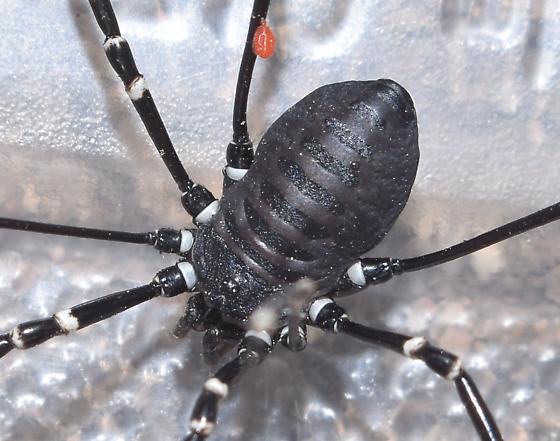
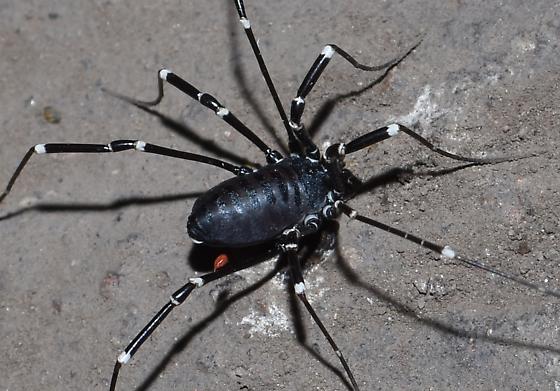
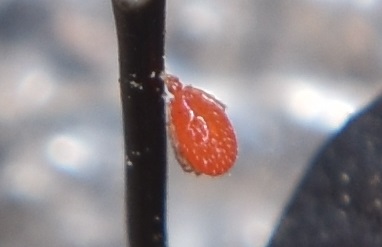
Leptus uses its mouth-parts to pierce the skin. It then injects saliva into the opening. The saliva contains digestive juices which break down cells and cause the surrounding tissue to harden. The mite sucks up the digested cells. The saliva gradually seeps lower into the body of the host, breaking down cells and hardening the surrounding tissue as it goes. The resulting tube is called a stylosome and acts like a drinking straw for the mite. (Note: What looks like the head in the above photo is actually the mouth-parts. As noted earlier, the head and thorax in mites are fused together.) In its adult form, Leptus is predatory.
Speaking of predatory, the next series of photos shows a whirligig mite (family Anystidae) eating a thrips. Thrips are very tiny insects that are often found on flowers. (“Thrips” is both the singular and plural form.)
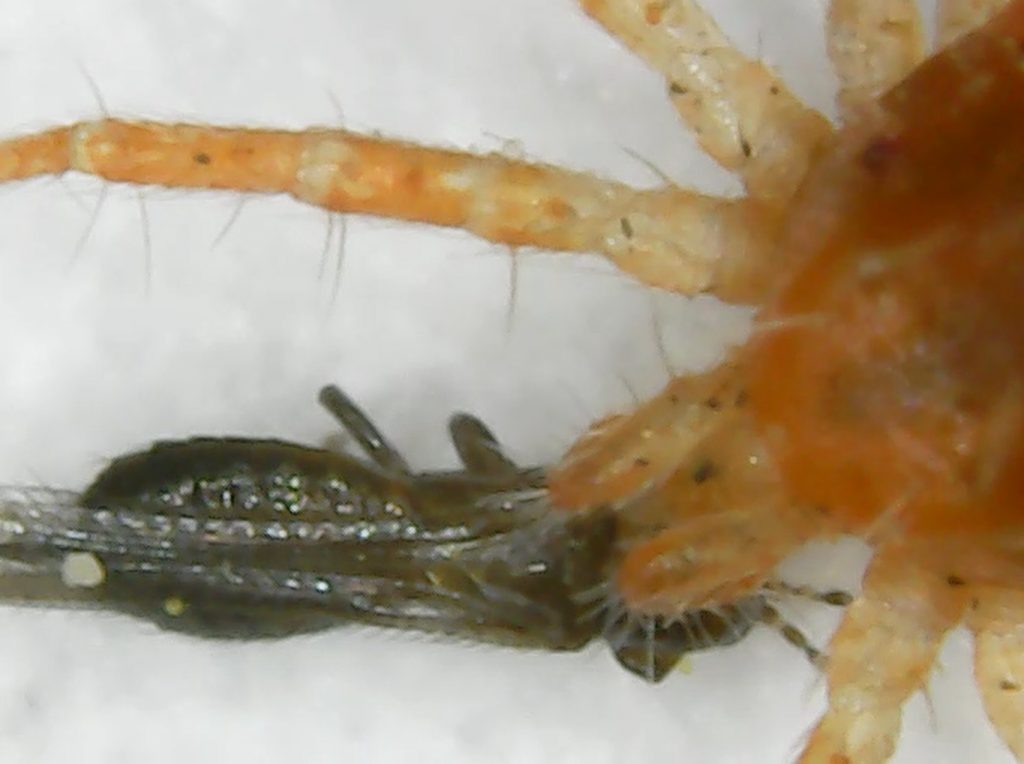
I collected this mite in a small plastic container. Later, I came across some thrips and caught a few of them, too. When I got home, I shook out the contents of the container onto a sheet of typing paper and started using my microscope to try to videotape the mite. I wasn’t having much luck because the mite was moving around too quickly. Then it suddenly stopped. When I finally got it in focus, I found out why. It had latched onto one of the thrips and was busily sucking it dry.
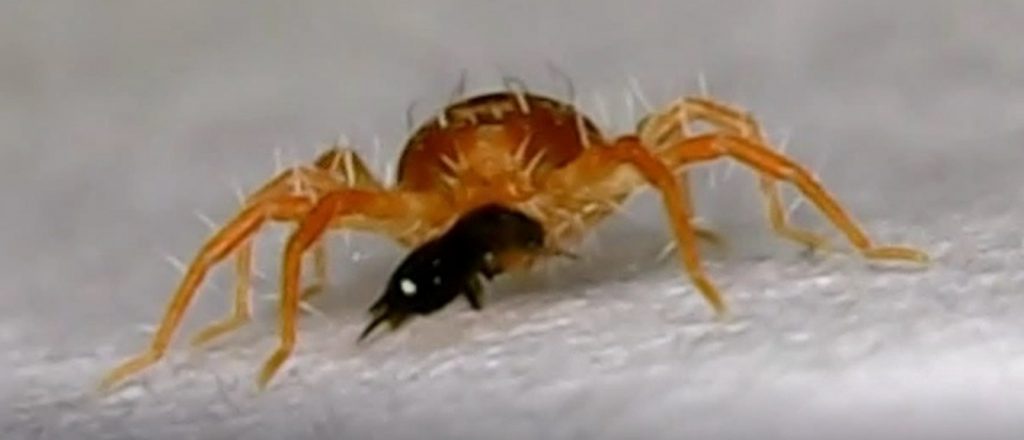
Here’s a couple of videos. Notice that you can see the mite’s internal organs working in the first video.
The next video is a little less violent. It shows a winter grain mite (Penthaleus major) crawling around on some lichen. I think I probably brushed it with the microscope, which is why it’s flailing around so much. I doubt that it’s that clumsy ordinarily.
One of the first things I looked at when I got my microscope was this huge mushroom:
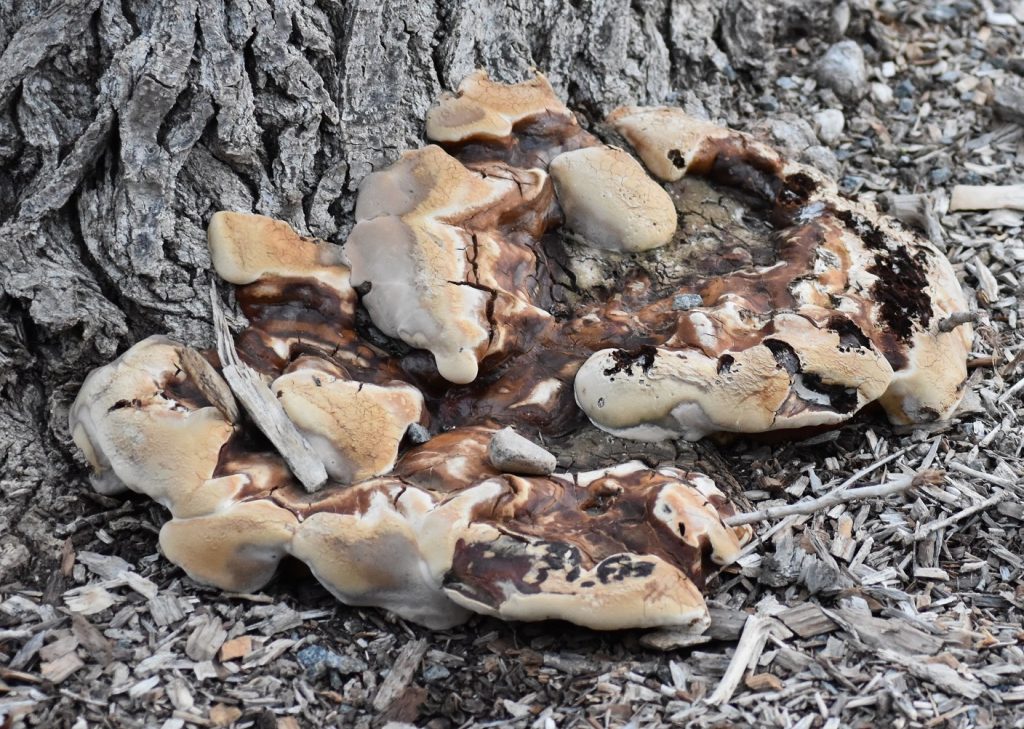
And this is the mite I saw on it. It’s in the order Mesostigmata. I love the way it looks like it’s crawling around in a snowfield. Oh, and you get a couple of quick glimpses of an ant, which should give you some idea how of just how tiny this mite is.
The next video shows some mites on a lichen. It looks like there may be a couple of different species here. Notice that some of them appear to have glued bits of rock onto their backs as camouflage. (You can see it a lot better if you view the video full screen.) According to Matthew Shepherd (see comments), these mites are probably in the genus Bryobia, which is in the spider mite family Tetranychidae.1
Phoresis
I know this next part is going to gross some people out. I found this beetle under the bark of a rotting log (which is a great place to find beetles, btw). This is a clown beetle (Hololepta populnea). As you can see, it was covered in mites. In the original version of this article, I said that the larger mites were probably orbatid mites. This was incorrect. Matthew Shepherd (see the comments) correctly identified them as turtle mites (family Uropodidae). They are in the order Mesostigmata.

Mites in this order are free-living and predatory — they’re not parasitic.2 So what, you may ask, are they doing on this beetle if they aren’t parasitising it? This is an example of phoresis. Phoresis is when one organism hitches a ride on another organism. It’s a means of dispersal. The most obvious example is when a seed clings to the fur of an animal, but it’s common among other organisms, as well, including mites.
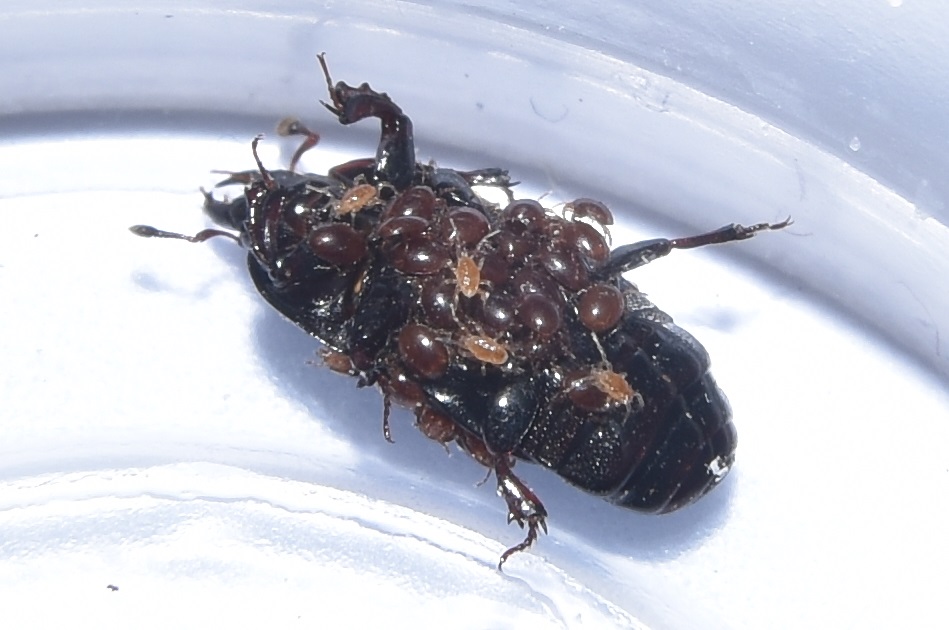
There are many advantages to phoresis. If an organism is limited to one small area and the environment in that area changes drastically, it could easily be wiped out. Dispersal over a wide area also helps to prevent inbreeding. Phoresis can even be used as a method of seasonal migration (although I doubt that’s relevant to mites).
According to Matthew, “The name ‘uropoda’ means tail-foot and relates to the unusual phoretic adaptations of the deutonymphs [second larval stage] in this family. When the nymphs crawl onto a beetle, they exude a tough stalk called an ‘anal pedicel’ out of their anus which they glue onto the beetle’s back, which then dries, sometimes lifting the animal up and holding it like a lollypop on a stick, while the beetle-transport heads off on its way to pastures new.”
More on Ticks
Getting back to ticks, most of them belong to one of two families — the hard ticks (Ixodidae) and the soft ticks (Argasidae). The hard ticks are so-called because they have a hard shield or scutum on the top of their cephalothorax. The mouth-parts project forward from the body and are easily visible from above. Soft ticks lack a scutum and their mouth-parts are underneath the body.
As noted earlier, all ticks are parasitic. Various species feed on the blood of mammals, birds, reptiles, and amphibians. Ticks go through a series of stages in their lifecyle from egg to larva to nymph to adult. Hard ticks feed from three different hosts during their lifetimes. Soft ticks may have as many as seven nymphal stages, each one requiring a blood meal.
Sadly, I don’t have any photos of ticks in my personal collection. Fortunately, my friend Meridith (of spittlebug fame) sent me this awesome photo of male and female American dog ticks (Dermacentor variabilis). The female is the one with the white patch at the front of the body:

© Meridith Erickson. 2019
Of Dust and Dander
We have mites in our homes and mites on our bodies. Most of you have probably heard of dust mites. Also called house dust mites (or HDM), dust mites include a number of different species commonly found in homes. They eat mostly dead skin shed by humans and their pets, which is known as dander. It’s been estimated that about 80 percent of the dust that you see floating in sunbeams consists of dander, so they find plenty to eat. Dust mites don’t carry diseases and they aren’t normally harmful to humans, but some people can have allergic reactions to their feces and shed exoskeletons.
Two species of mite are known to live on our bodies — Demodex folliculorum and Demodex brevis. D. folliculorum reproduces in hair follicles and D. brevis reproduces in the sebaceous glands near the base of hairs. Otherwise, the two species are very similar. Unlike typical mites, they are long and worm-like with very short legs. These mites are usually harmless; although, D. folliculorum can cause a disease called Demodicosis. It’s believed that all people have mites living on them, but, since it’s not easy to collect them, this hasn’t been confirmed. Click here to read an article about body mites that includes some interesting photos.
Update 07/03/2019
While hiking with a meetup group over the weekend, one of the people in the group found a tick crawling on her. Quickly admonishing her not to brush it off (and ignoring the exaggerated eye-rolls of my companions), I collected the tick in a small plastic container. So I was finally able to get some photos to supplement the one Meridith sent me.
It appears to be another female American dog tick. In the following photos, I’ve highlighted a bit of the anatomy. The first photo shows the scutum — the hard “shield” on the tick’s back. On the male, this would cover the entire back, but, on the female, it leaves room for the body to expand when the tick drinks blood.

It’s difficult to tell in these photos, but the hypostome is separate from the chelicerae on either side of it. The chelicerae are similar to jaws. The tick uses them to cut or scrape through the skin. The hypostome is a combination harpoon and drinking tube. If you’re interested, you can read a rather technical scientific article about these mouthparts here.

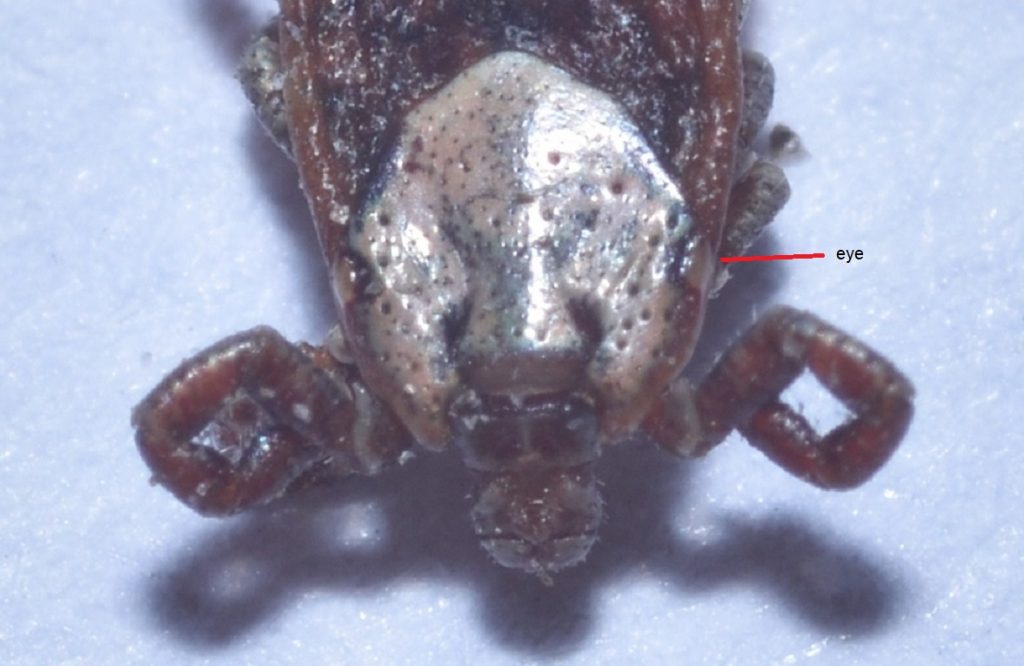
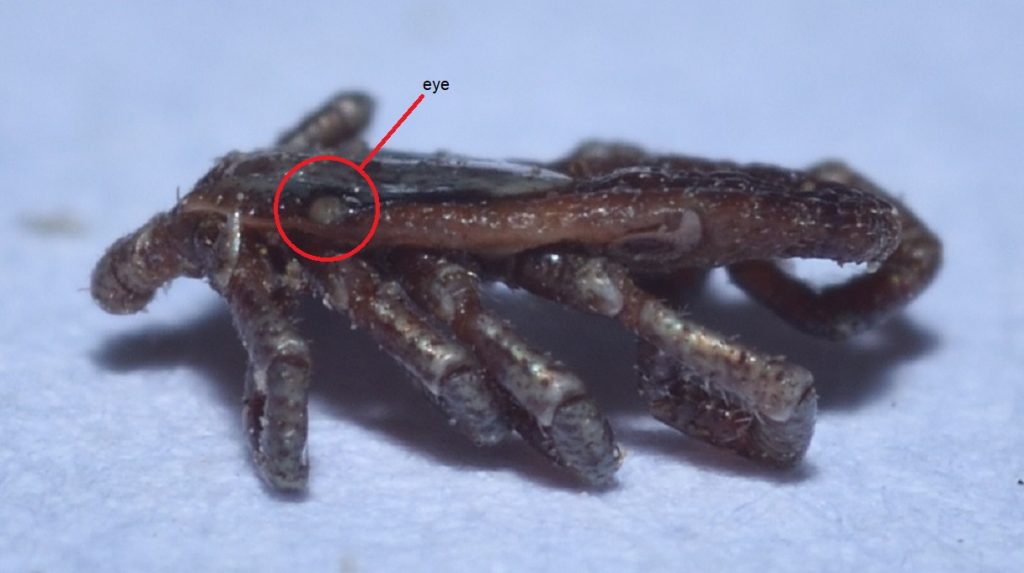
As noted previously, the tick doesn’t have a head separate from the rest of the body. The eyes are actually on the side of the body.
And just because you were wondering…
