There is a family of wasps, the Sphecidae or thread-waisted wasps, that practice mass-provisioning. These wasps construct brood chambers which they fill with dead or paralysed insects or spiders. Different species of wasp specialize in different prey. Some collect mostly spiders, some collect mostly beetles, and so on. Once a chamber is fully-provisioned, the wasp lays a single egg in it, seals it, and begins work on the next chamber. Adult wasps feed on pollen and nectar from flowers, so it’s likely that pollen sometimes gets brushed off and falls into the brooding chamber. A lot would be stuck to the bodies of prey insects, as well. Pollen is an excellent source of protein, so it’s likely that the wasp larvae often eat the pollen.
At some point, around 130 million years ago, some unidentified species of Sphecid wasp must have started routinely supplementing its prey collection with pollen. Perhaps this came in handy when prey was in short supply. Over time, this wasp evolved to rely more and more on pollen and less and less on insects until, eventually, it was collecting only pollen. The first bee was born.
“[Bees] are simply wasps that have gone vegan” 1
Sphecid wasps are almost exclusively solitary, so the first bees would also have been solitary. Most of them still are. The average person can recognize only two types of bee — honey bees and bumblebees. This is a bit surprising, since there are about 20,000 bee species worldwide. Just in San Diego County, where I live, we have several hundred native species. To be honest, though, I’ve only seen a tiny fraction of those and I only recognize a few of them on sight. So maybe I’ll learn as much writing this post as you’ll learn reading it.
We may as well start with honey bees. Honey bees are members of the genus Apis. Currently, Apis includes seven species, only two of which — Apis mellifera and Apis cerana indica — have been domesticated. Apis mellifera, the western or European honey bee, is the only one of the two that has been spread widely beyond it’s native range. This is the honey bee most people are familiar with. Some people may be surprised to learn that honey bees are not native to North America. In fact, they’re believed to have originated in either Africa or Asia. It’s hard to tell for sure because humans have been spreading them around for thousands of years.
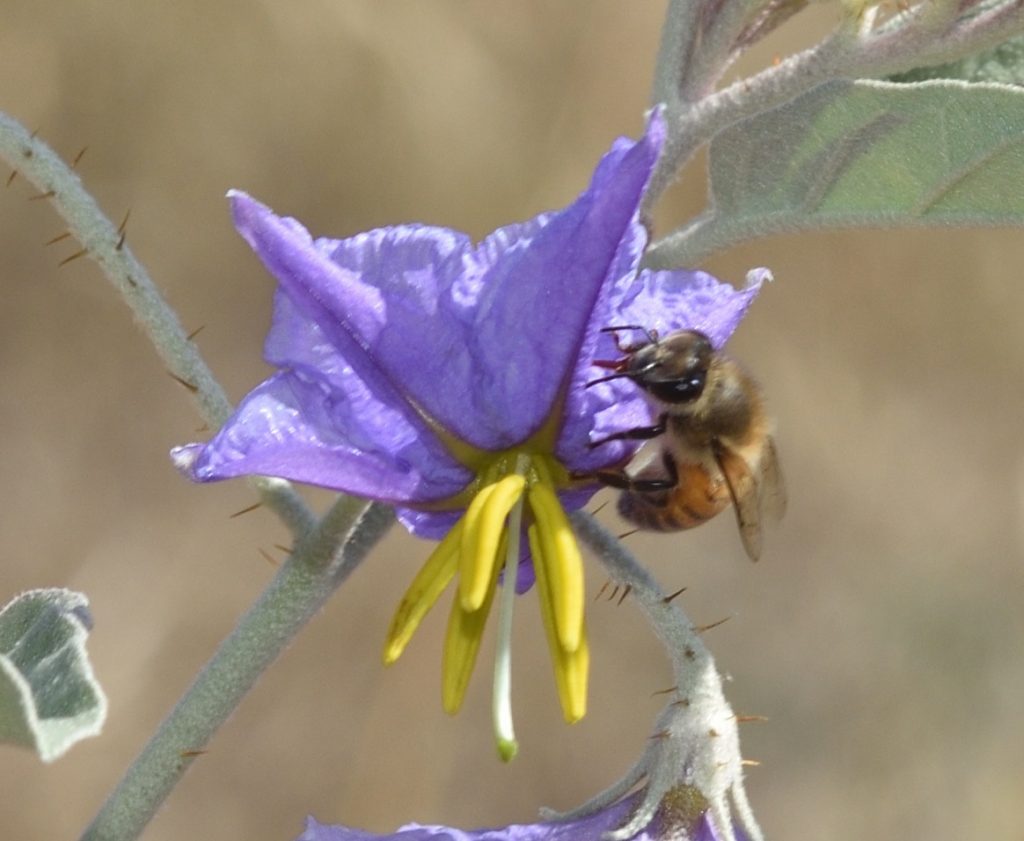
Los Penasquitos Canyon, San Diego County. 06/09/19
Honey bees are famously social insects. Technically, they are eusocial. Eusociality is the highest level of sociality. To be classified as eusocial, a species must meet the following criteria:
- Cooperative brood care. Members of a colony care for offspring that are not their own.
- Overlapping of generations within colonies. Multiple generations live within a colony at the same time.
- Division of labor into reproductive and non-reproductive castes. Only one or a few individuals reproduce. The rest perform brood care and other tasks.
San Diego County. June 2017
Honey bees and other eusocial creatures are sometimes thought of as superorganisms. This is the idea that the entire colony functions as a single organism in which the individual members act more like cells than independent beings. Experiments have shown that in some ants — another eusocial organism — the colony as a whole exhibits more intelligence than the individual ants.
San Diego County. June 2017
An Very Close Look at a Honey Bee
I found this honey bee clinging to a rock. It was very sluggish and barely responded at all as I filmed it with my usb microscope. I’ve seen this sort of thing before in bees. Sometimes you’ll find one that’s so slow and unresponsive that you can pick it up in your hand without it reacting. Bees have very short lifespans. I suspect that bees get like this when they’re nearing the end of their days.
At any rate, this video gives us a chance to really examine the anatomy of the bee. Notice the “simple” eye on the top of the head between the two compound eyes. This is called an ocellus (plural ocelli). An ocellus has a single lens and just a few sensory cells. It’s used to detect movement.
I could easily devote the rest of this article to honey bees. (Heck, I could devote a whole blog to them.) But we’ve got a lot more bees I want to get to, so let’s move on to bumblebees…
Bumblebees are members of the genus Bombus. Prior to World War II, they were sometimes called “humblebees”, but that term has pretty much disappeared, except in some of the older literature. (Darwin called them that.) And, in times past, “dumbledor” was sometimes used to refer to bumblebees and other buzzing insects. (Now where have I heard that name before?)
San Diego County
Do bumblebees really pee? Click here to learn the answer.
Most bumblebee species are also eusocial; however, they have not taken it quite as far as the honey bees. For one thing, bumblebee colonies are much smaller — usually between 50 and 400 bees. Honey bee colonies, by comparison, generally consist of around 50,000 individuals! Also, in temperate regions, bumblebee nests last for only one season. When the weather turns cold, they die off. The young queens go into hibernation for the winter and search for a place to start a new colony the following spring. Honey bee colonies, on the other hand, are perennial — they can last for many years.
There are many other ways in which bumblebees fall short of the level of social organization that honey bees have achieved. They don’t make combs of hexagonal cells — their brood cells are much more roughly made; they don’t make honey (honey bees make it to use during the winter when they can’t forage); their workers are not as specialized — a single bee will perform many different tasks; and they don’t do a “dance” to tell other bees where to find the good flowers.
One distinctive thing about bumblebees is that they do tend to be rather large insects. The largest is believed to be a South American species named Bombus dahlbomii. Adult queens of this species are about 1.6 inches (40 mm) long. They’re also quite fluffy, which has led to the popular name “flying mice”. Author Dave Goulson, perhaps most memorably, described the insect as “a monstrous fluffy ginger beast”. 2
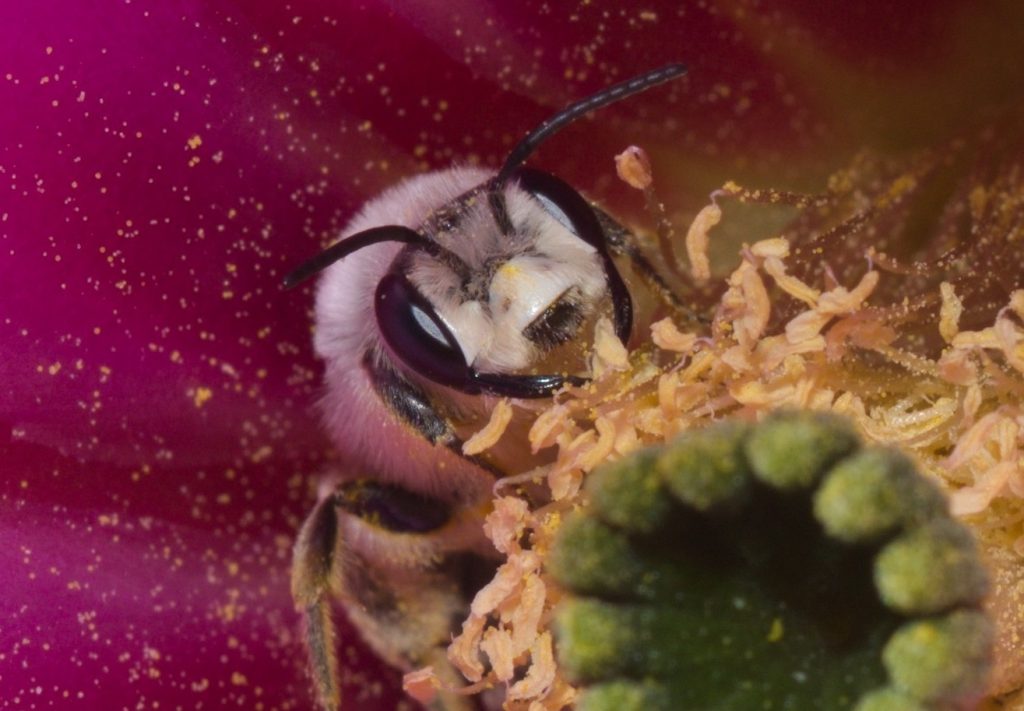
A solitary bee that I often see in San Diego County is the mining bee or digger bee (genus Andrena). There are hundreds of species in the genus, but the ones I’ve seen are medium- sized, hairy bees with a tan or golden color. They’re called mining bees because the female digs a tunnel in the ground with branches leading off to individual brooding cells.
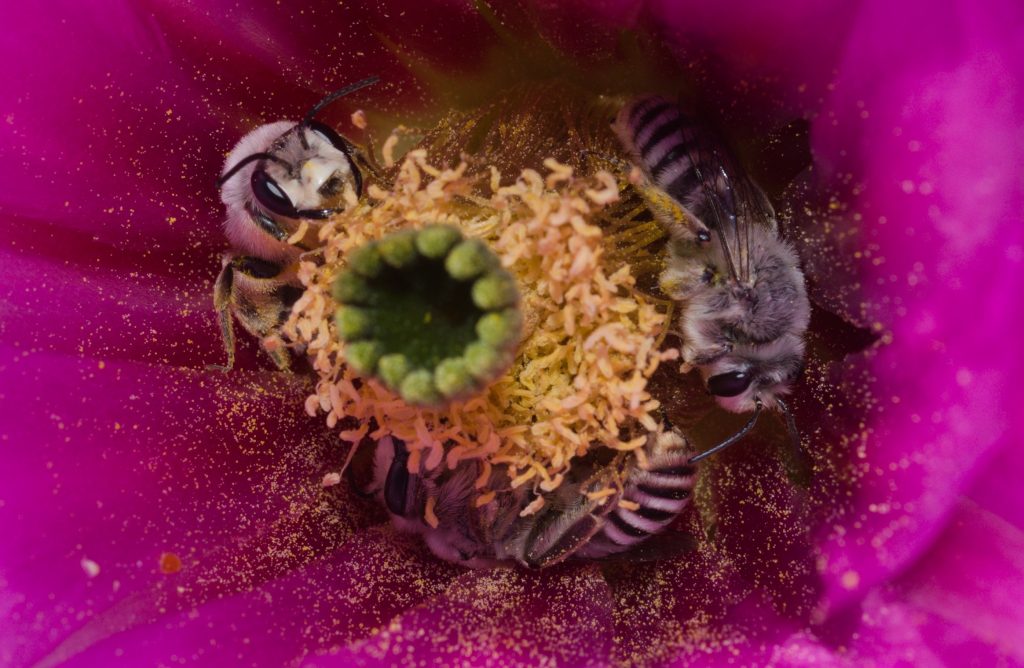
Anza Borrego State Park, San Diego County. 03/30/19
Note: This video is not sped up — it’s actual speed.
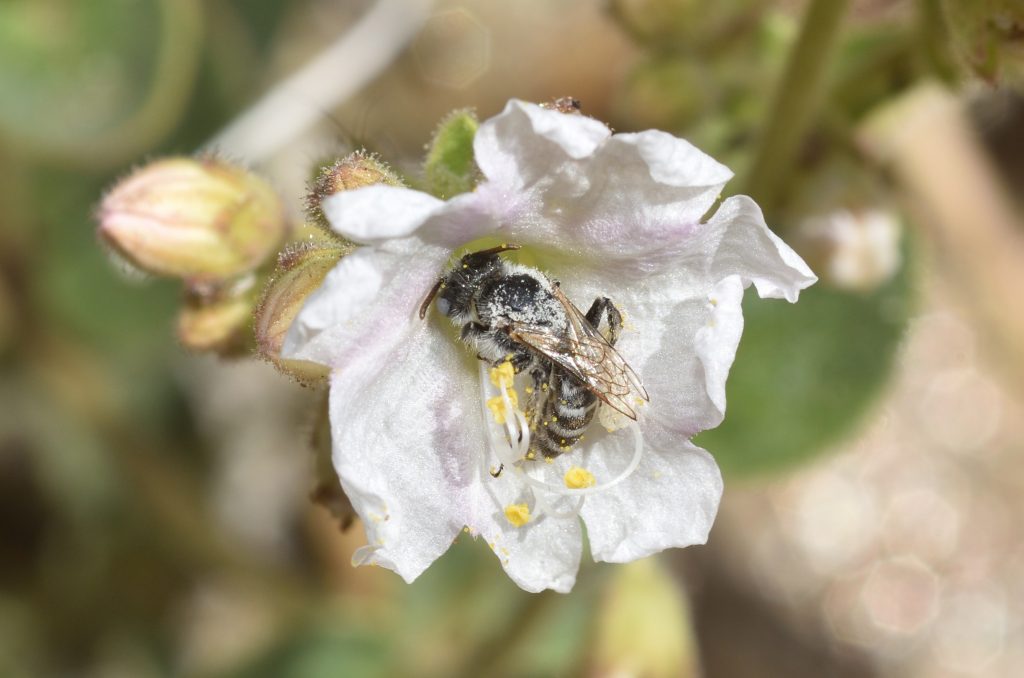
Another group of bees that are sometimes called mining bees are bees in the genus Perdita. These bees are small and often brightly colored. As you can see, the specimen in the photos below has a metallic sheen to the head and thorax. Perdita is one of the few types of bees that don’t have stingers.
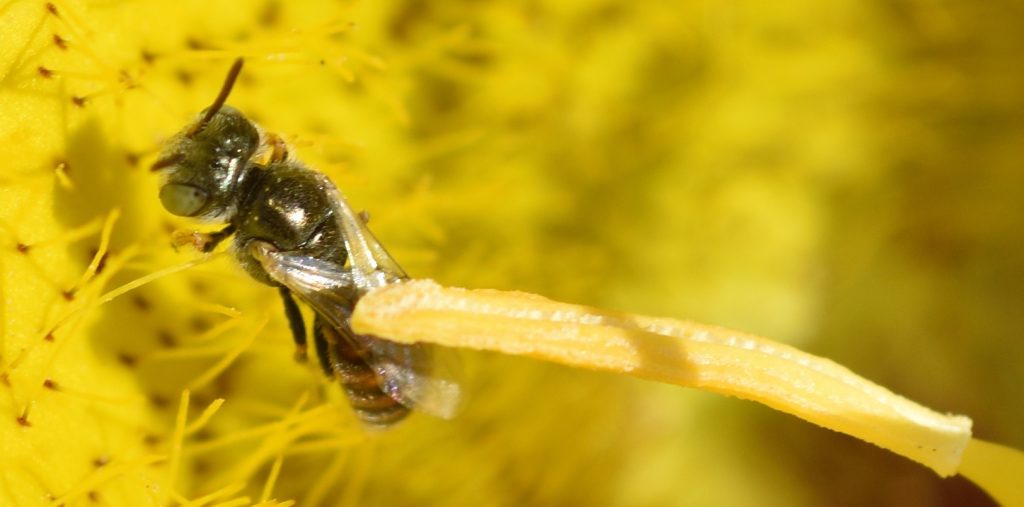
Mission Trails Regional Park, San Diego County. 06/04/19
Another group of solitary bees found in southern California is the long-horned bees (tribe Eucerini, family Apidae). These are small, hairy bees. The males in most species have unusually long antennae; hence, the “long-horned” in the common name. Presumably, this helps them locate potential mates. Although technically solitary, many of them nest in large groups and males are sometimes found in large aggregations. All long-horned bees nest in the ground.

Los Penansquitos Canyon, San Diego County. 06/09/19
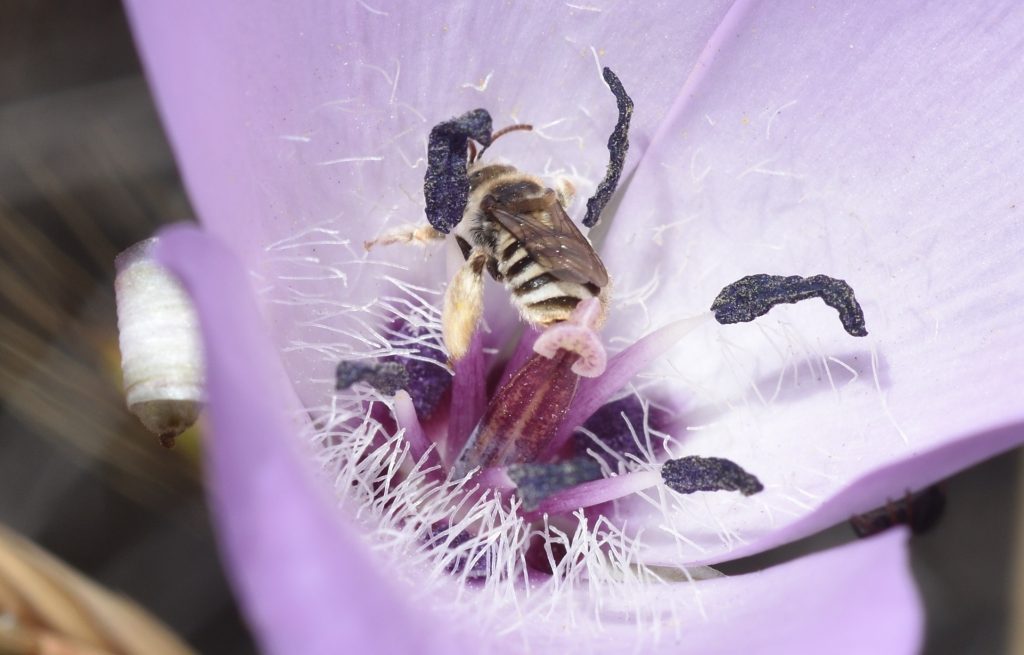
I think the bee in the following photo may also be in Eucerini, but I haven’t been able to confirm that.
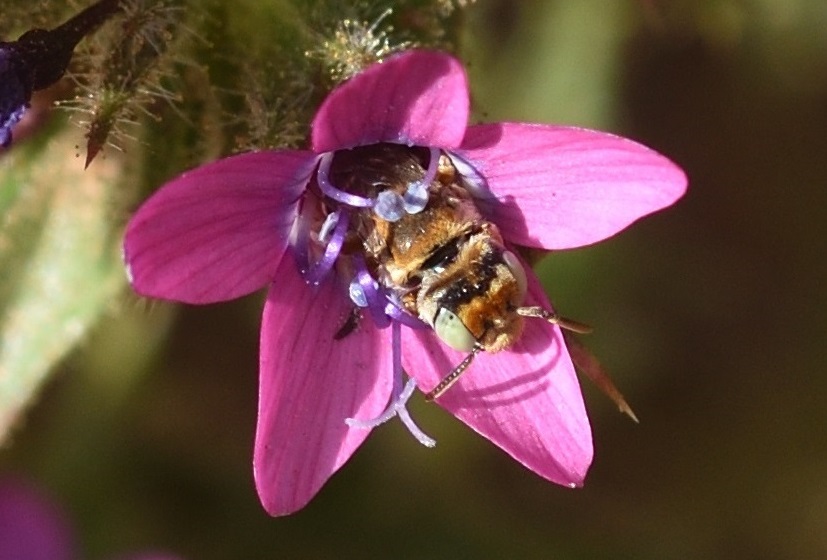
San Diego County. 06/04/19
The following series of photos are of an evening bee in the genus Hesperapis, family Mellitidae. I haven’t been able to find out much else about it. One of the species in this genus, H. regularis, which is native to California, constructs its brooding chambers underground. I would guess the other species in the genus do this, too, but I don’t know for sure. I saw this bee in the Sonoran Desert near East Butte.

Sonoran Desert. 02/03/19

Sonoran Desert. 02/03/19
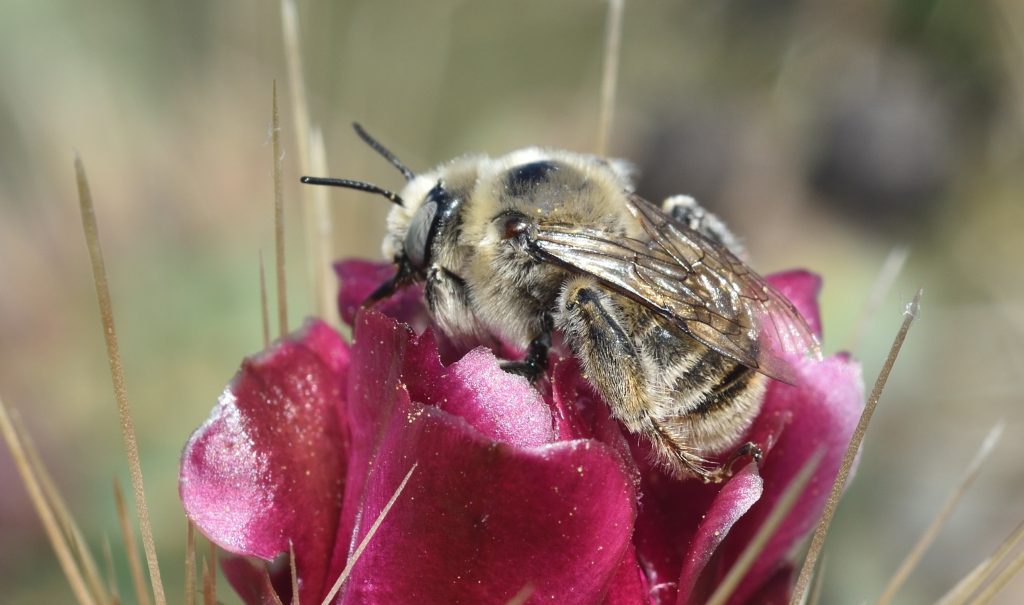
Yet another solitary bee is the chimney bee or sunflower bee (genus Diadasia). Its host plants include asters, bindweeds, willowherbs, cacti, and mallows. Species that frequent cacti are sometimes called cactus bees. The most common host plants are mallows, which suggests that this was likely the ancestral host plant for the genus.
Diadasia constructs its brood chambers underground. The common name “chimney bee” comes from the fact that they built small turrets above the entrances to their tunnels. It’s not known what purpose these turrets serve. It’s been suggested that they help to prevent flooding, keep debris from falling into the tunnels, and/or protect the nest from predatory insects. At least sometimes, after egg-laying, a bee will disassemble the turret and use the mud to plug the tunnel entrance.
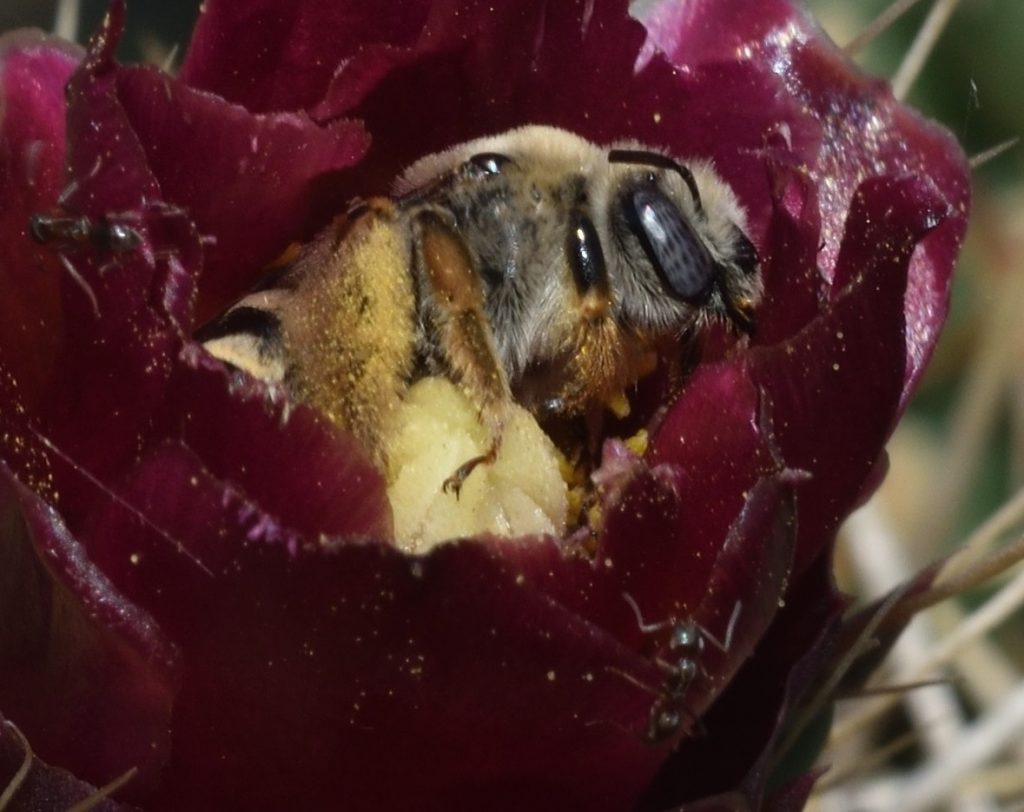
Los Penasquitos Canyon, San Diego County. 06/09/19
One last bee I want to talk about is the carpenter bee (genus Xylocopa). Unfortunately, I don’t have any good photos of them, but they’re so common and distinctive that I felt I should mention them anyway. These are large bees that look a lot like bumblebees, but they’re mostly black. Some species are entirely black. One way to tell for sure whether a bee is a bumblebee or a carpenter bee is to examine its abdomen. Carpenter bees generally have shiny abdomens; whereas, bumblebee abdomens are extremely hairy. They’re called carpenter bees because most species construct their nests by burrowing into wood or other hard plant material like bamboo.
Bee Impostors
Many harmless insects have evolved to resemble bees or other harmful insects (harmful as in stinging or biting or just tasting really bad), thus decreasing the chances that a predator will try to eat them. This is called Batesian mimicry. What looks like a bee in the following photos is actually a type of hoverfly or Syrphid fly.
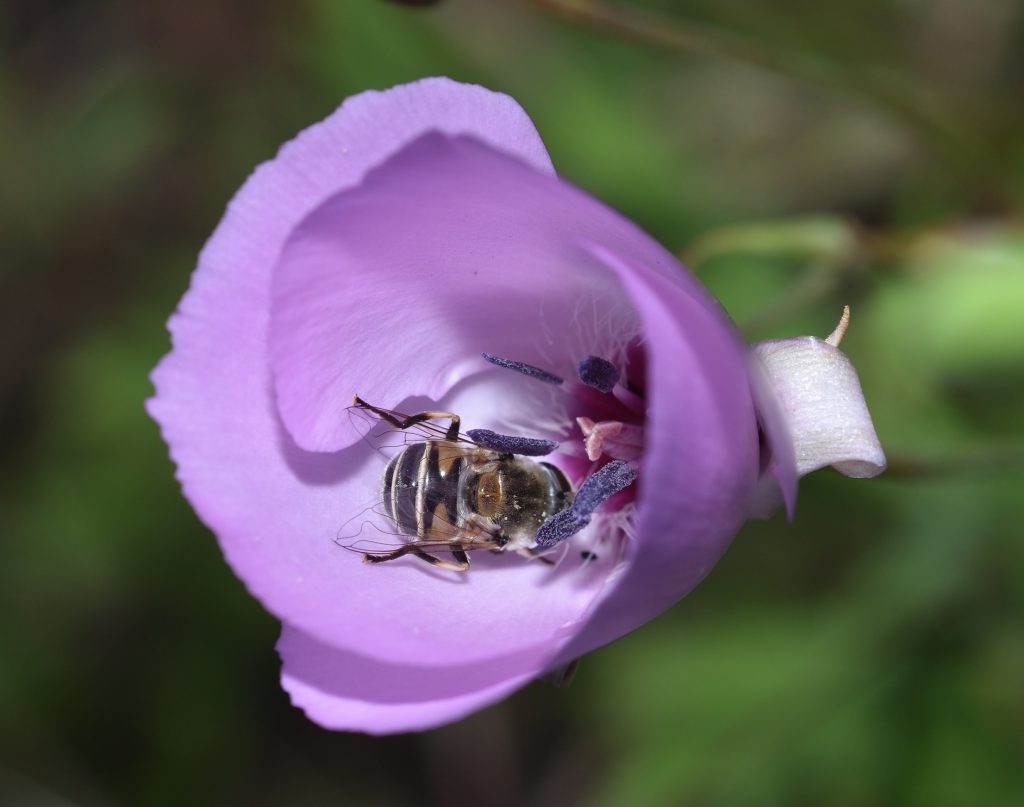
San Diego County. 06/02/19
