We expect plants to be green. Sure, flowers come in pretty much every color of the rainbow and even leaves may contain pigments that mask the underlying green, but, because plants contain chlorophyll and chlorophyll is green, we know the green must be there somewhere.
Except when it isn’t. About 1% of angiosperms (flowering plants) have either partly or wholly given up photosynthesizing in favor of becoming parasites. If you’re no longer using sunlight to make your own food, you no longer need chlorophyll. If you no longer need chlorophyll, then, over the course of millions of generations, you’re going to slowly lose the genes that allow you to make it. And so, you slowly lose the green.
A plant that is just trying out the parasitic lifestyle will still be green. Maybe the only difference you’ll notice is that its leaves are unusually small. Eventually, though, as it commits more and more to the life of a thief, its leaves will be reduced to scales or disappear altogether and its stems will turn a pasty yellow or a ghostly white. The stems may even disappear altogether as the parasite moves underground or into the body of its host. In that case, you’ll never see it at all until it flowers.
I said that 1% of flowering plants are parasites. So what about non-flowering plants? For some reason, parasitism is much rarer outside the angiosperms, but there are a few examples. Some people argue that, in bryophytes (mosses, liverworts, and hornworts), the sporophyte is parasitic on the gametophyte. (See my earlier post, In Among the Mosses – An Introduction to Liverworts.) That seems like a bit of a stretch to me, since the gametophyte depends on the sporophyte to reproduce itself and vice versa, but I guess that’s just quibbling over terminology.
There’s only one known parasitic species of conifer — a plant named Parasitaxus usta, which grows in New Caledonia. (Or maybe two. We’ll get to that later.) Other than that, the only non-flowering parasitic plants that I know of are some types of algae. Helicosporidium is a genus of algae that parasitizes the guts of insects1. As a general rule, parasitic plants tend to have greatly reduced genomes2, simply because they rely on their host to perform many of the functions that they would otherwise have to handle themselves. Interestingly, scientists have found that Helicosporium has retained most of its functions that are not directly related to photosynthesis. This suggests that Helicosporium may be fairly new to the parasite game. Given time, the species in this genus will probably lose many more genes that they no longer use or use very little. Another genus of algae, Cephaleuros, is parasitic on higher plants3. There are probably many others.
Getting back to angiosperms, parasitic flowering plants can be broadly divided into stem parasites and root parasites. In both cases, the plants have evolved thin, root-like filaments called haustoria (singular haustorium) that penetrate into the tissues of their host plants (stems, in the case of stem parasites, or roots, in the case of root parasites) and steal resources from them. Parasitic plants can also be classified by the degree of parasitism. A holoparasite is a parasite that has completely lost the ability to photosynthesize and relies entirely on its host to survive. A hemiparasite, on the other hand, still retains some ability to photosynthesize and only gets some of its resources from its host. In many cases, a hemiparasite may be on its way to becoming a holoparasite. It just hasn’t gotten there yet.
There are about 4,500 known species of parasitic flowering plants in approximately 20 families. Most of these families contain both parasites and non-parasites. The last common ancestor of the plants in such a family must have been photosynthetic (since it’s very unlikely that a plant will re-evolve photosynthesis once it has lost it.) It follows that plants have independently evolved parasitism many times. It also follows that haustoria (the thin, root-like organs) have evolved independently many times.
Now that we’ve gone over a few of the general characteristics of parasitic plants, let’s take a closer look at some of them. Each of the groups of parasitic plants that I discuss here is certainly deserving of its own article and I plan to devote future articles to some of them. For the moment, though, I’ll just give each of them a brief mention.
The one parasitic plant that most people have heard of is mistletoe. Mistletoe is actually the common name for a great many hemiparasites in the order Santalales. In fact, molecular studies have shown that plants in this order evolved parasitism independently five different times. So the different kinds of plant that we call mistletoe are not necessarily very closely related. As such, they have widely varied lifestyles.
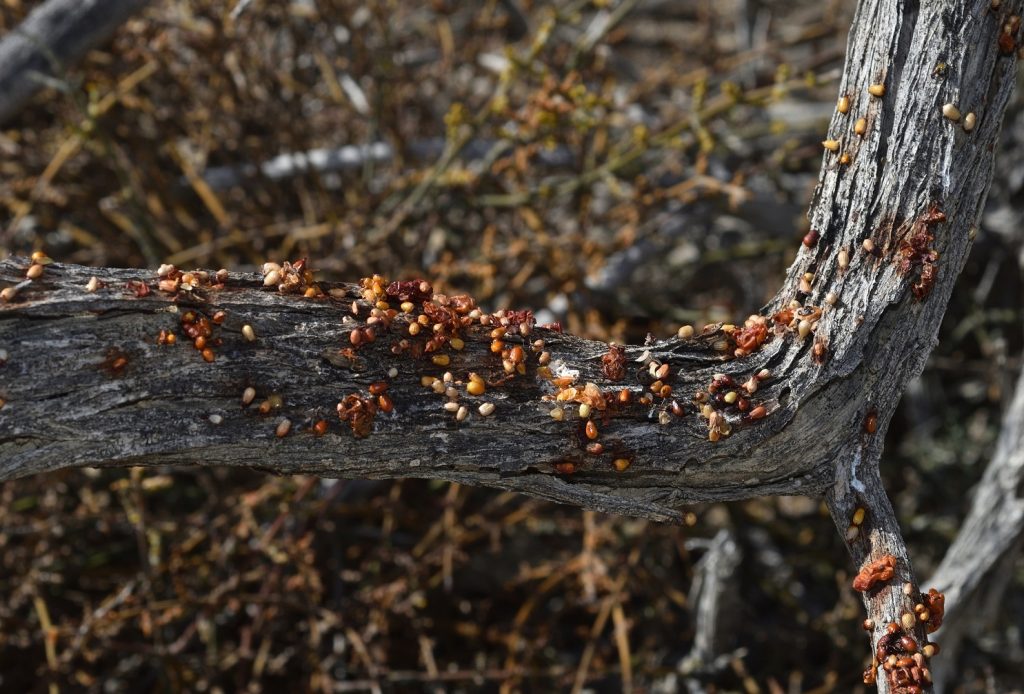
Lyceum Wash in Anza Borrego State Park 03/24/19
The mistletoe that I see most commonly in southern California is desert mistletoe (Phoradendron californicum), also known as mesquite mistletoe. It’s found in the Sonoron and Mojave Deserts, where it grows as a stem parasite mostly on trees in the pea family, such as mesquite and catclaw. P. californicum extracts water and nutrients from its host plant through its haustoria, but it does its own photosynthesis. (This despite having no leaves — I guess it has enough chlorophyll in its stems.) Mistletoe is spread by birds that eat the berries and poop out the indigestible seeds. A song bird called the Phainopepla is the main disperser of mistletoe seeds in western North American. It’s not uncommon when hiking in the Sonoron Desert to see a limb of a mesquite tree covered in seed-ridden droppings from this bird.

Cowles Mountain, San Diego County 05/31/19
Another common parasitic plant in southern California is dodder. Dodder is any member of the genus Cuscuta. The most common dodder in my area is Cuscuta californica, but there are a number of other species found here. All of them take the form of huge masses of stringy, orange-yellow tangles of thin stems and tendrils draping host plants such as buckwheat and laurel sumac. Dodders still retain traces of chlorophyll and may photosynthesize to varying degrees, so they should probably be classified as a hemiparasites. They are well on their way to being holoparasites, however, extracting water, nutrients, secondary metabolites, proteins, and even mRNAs4 from their hosts.
Update 8/25/19: Actually, the articles I’ve been reading can’t seem to agree on whether Cuscuta is a hemi- or holoparasite. Some of them say it’s totally parasitic, others say it still does a bit of photosynthesis. Maybe it varies according to the species. I would guess that most species are pretty close to being holoparasitic, but, hey, I’m not even a professional botanist.

Cowles Mountain, San Diego County 05/31/19
Dodders are stem parasites. When a dodder first germinates from a seed, it has a small, rudimentary root that serves to anchor it, but it absorbs no nutrients from the soil and this root starts to degenerate once the plant acquires a host. The plant soon becomes entirely rootless. Dodder produces tiny white or cream flowers in abundance, but they usually go unnoticed by the casual observer, since they are only a few millimeters wide.

Cowles Mountain, San Diego County 05/31/19
The broomrape family, Orobanchaceae, is a large family of mostly root parasites. It includes both hemi- and holoparasites. Of the hemiparasites, some are obligate parasites (i.e. they can’t survive without a host). Others are facultative parasites — they can get along on their own, if necessary.
A common genus of broomrapes found in southern California is Castilleja. This includes coast Indian paintbrush (C. affinis), a perennial herb with beautiful red flowers that is well-known to hikers. Indian paintbrush is a hemiparasite. It can still photosynthesize, but its leaves are noticeably reduced. C. affinis is never found in nature without a host plant. It can survive and reproduce in a greenhouse without a host, but the plants will be less vigorous than they would be with a host. So does this make C. affinis an obligate or a facultative parasite? It’s not clear. This is another case where it’s just a matter of how you define your terms.
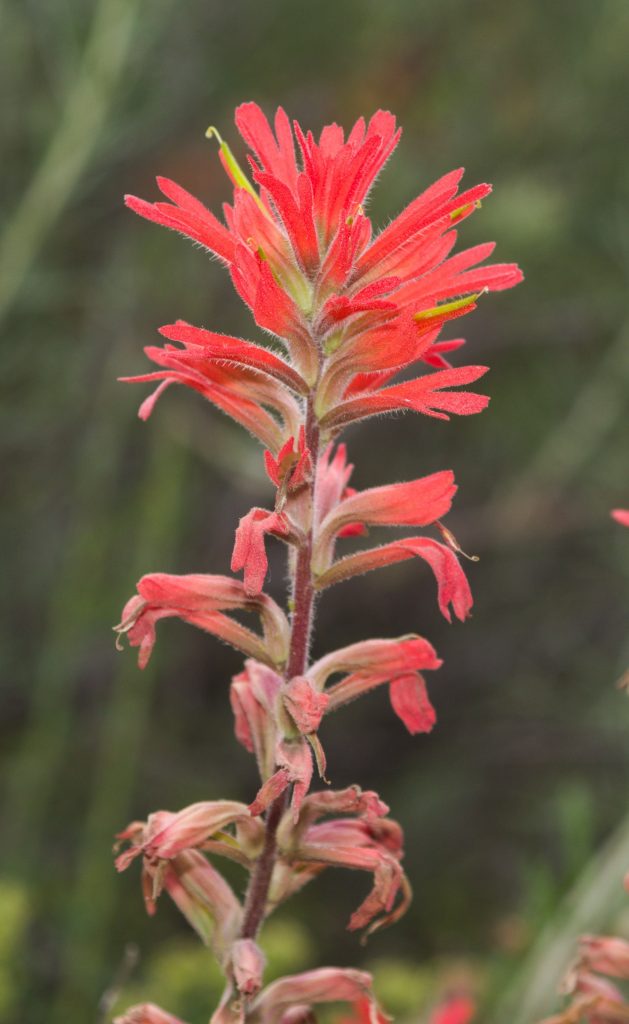
A root hemiparasite in the broomrape family
Mission Trails Regional Park, San Diego County 04/16/19
Another very common member of the genus Catilleja is the oddly named purple owl’s clover, Catilleja exserta. (Apparently, it’s also called exserted Indian paintbrush, although not by anyone I know.) C. exserta is also a hemiparasite. It’s somewhat similar in form to coast Indian paintbrush, growing in erect stems with small, thin leaves, but its flowers are a striking purple or lavender color with large spots of white. Purple owl’s clover is an annual plant. It seems to be much pickier about when it blooms than its relative, C. affinis, but, in the Spring, when the time is right, it can be seen blooming in profusion.

Other common names include escobita and exserted Indian paintbrush.
Mission Trails Regional Park, San Diego County 04/16/19
Yet another hemiparasitic broomrape in my area — one that I just recently learned about — is bird’s beak, specifically stiffbranch bird’s beak (Cordylanthus rigidus). It’s an odd-looking plant, again with small, much reduced leaves on thin stems. The flowers are strange white blossoms that apparently remind some people of bird’s beaks. The dark-tipped bracts5 that surround the blossoms are what really give the plant its weirdness.

A root hemiparasite in the broomrape family
Otay Mountain, San Diego County 06/22/19
Two more species of broomrape found in southern California are chaparral broomrape (Orobranche bulbosa), which I saw on Otay Mountain near the Mexican border, and Parish’s broomrape (Orobanche parishii), which I encountered a bit farther North near Pine Valley, CA. Both are holoparasites, depending entirely on resources extracted from the roots of their host plants. Lacking both leaves and chlorophyll, the only parts of these plants visible above ground are the thick clusters of flowers growing from single stems.
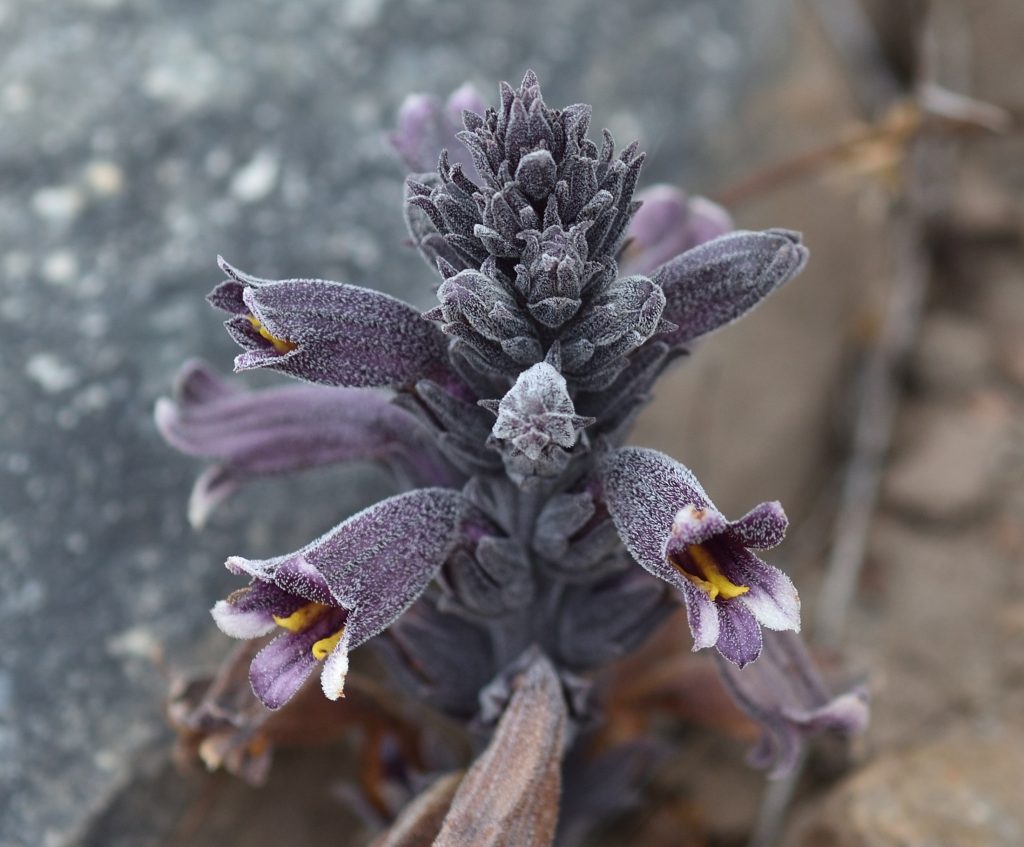
A weird, root holoparasite in the broomrape family
Otay Mountain, San Diego County 06/22/19
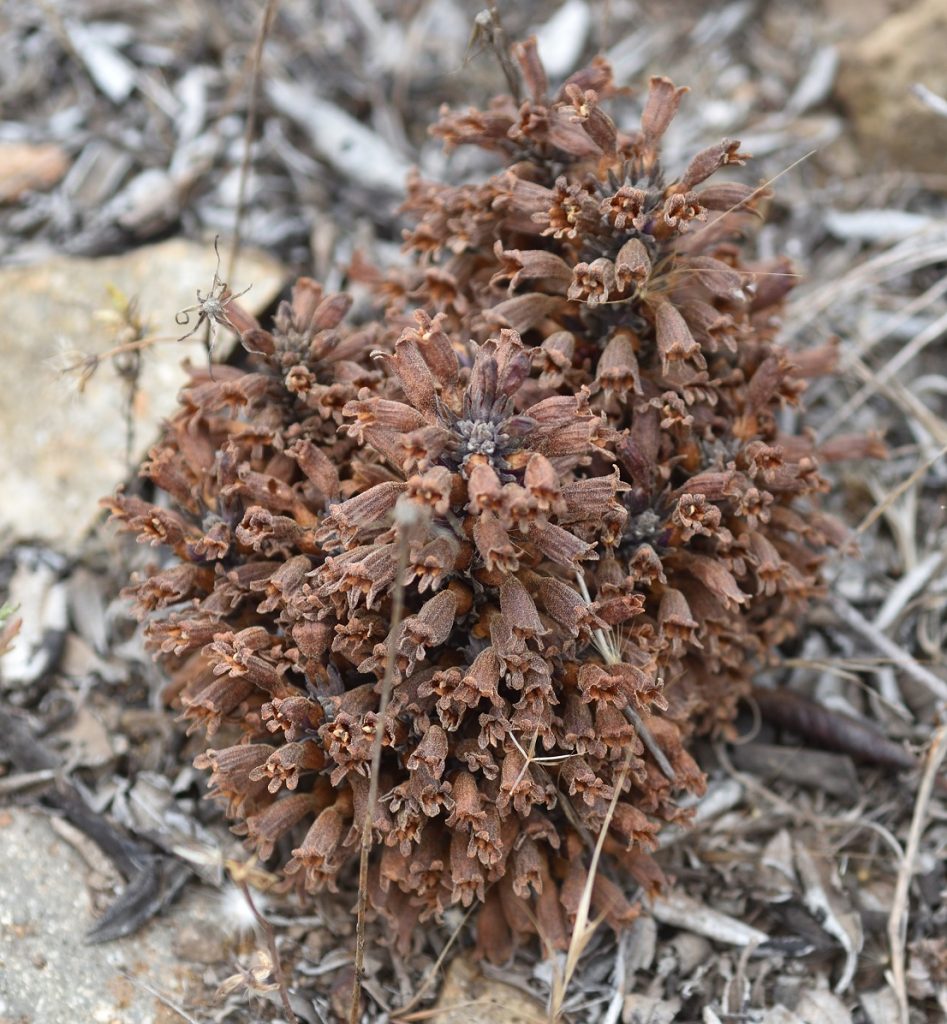
Otay Mountain, San Diego County 06/22/19
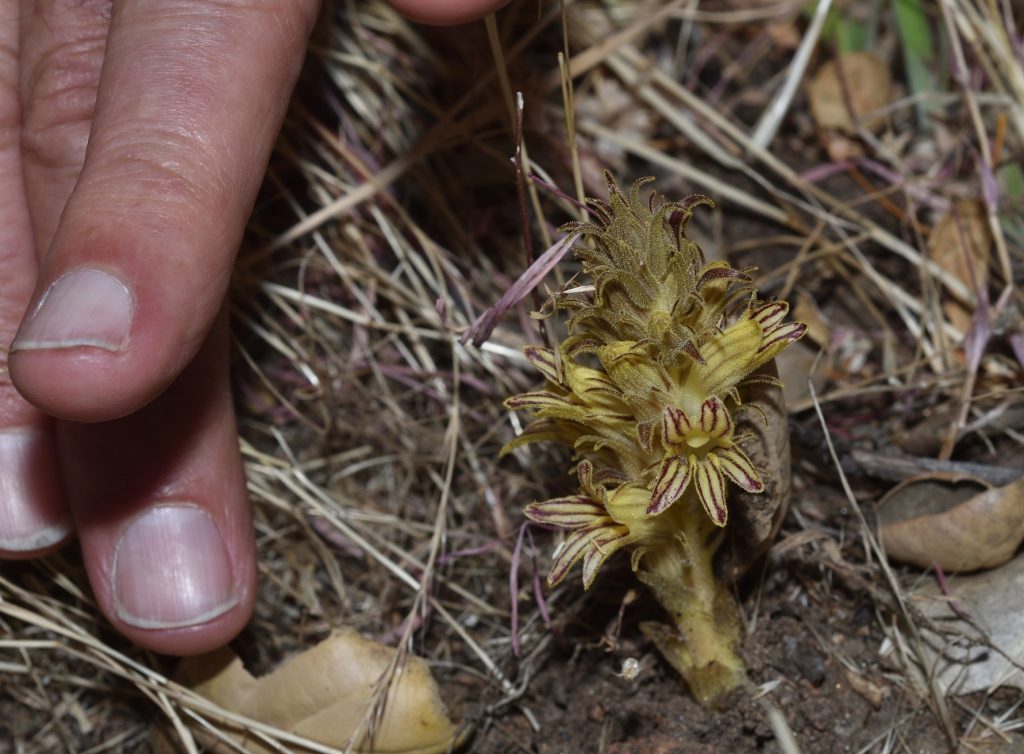
Another weird, beautiful member of the genus Orobanche
Noble Canyon, Pine Valley, CA 07/07/19
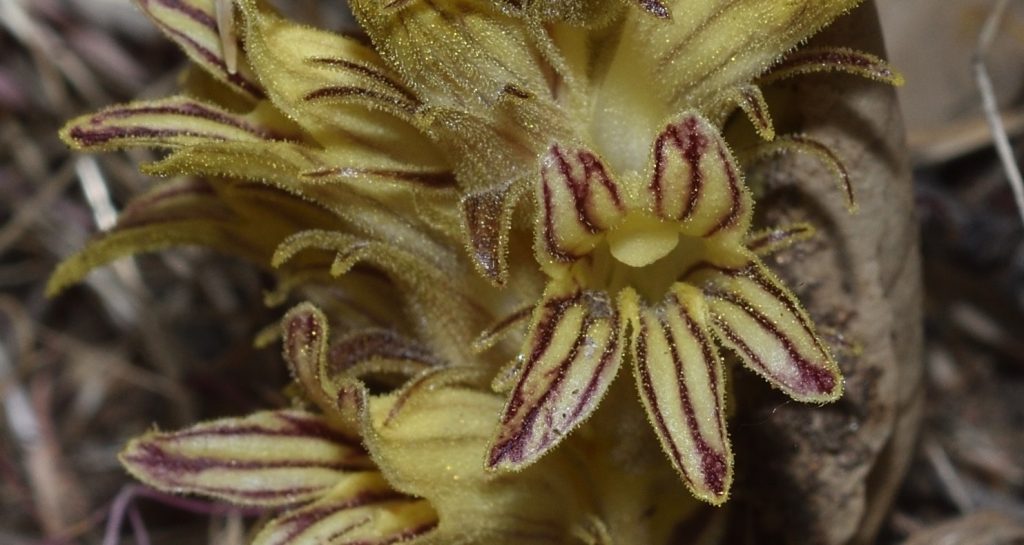
Noble Canyon, Pine Valley, CA 07/07/19
That about covers the parasitic plants I’ve come across on my hikes, but there are a few others I want to mention. One plant that I’ve looked for unsuccessfully for years is Thurber’s stemsucker (Pilostyles thurberi). P. thurberi is only a few millimeters long. It has no roots or leaves and lives entirely inside the stem of its host plant. The only time the plant is visible is when it blooms, sending out a tiny flower that protrudes from the stem of the host.
P. thurberi parasitizes shrubs in the pea family, especially Emory’s indigo bush or dyebush (Psorothamnus emoryi). This plant is very common in parts of the Sonoran Desert. Every time I see dyebush, I look for the flowers of the parasite, but, so far, I haven’t had any luck.
I mentioned earlier that there was only one known species of parasitic conifer — Parasitaxus usta, which grows in New Caledonia. This plant always grows attached to the roots of another conifer, Falcatifolium taxoides. It has no roots of its own, but also, no haustoria, so it’s not entirely clear how it gets its sustenance. Scientists think P. usta is a myco-heterotrope — a parasite on the mycorrhizal fungi that form symbiotic relationships with many plants. Studies have shown that it gets carbohydrates from the fungus. However, it also appears to get nitrogen and water directly from the host tree. (I’m not sure how it does this without haustoria. None of the articles I read were clear about it.) Click here to read an interesting article about this unique parasite.
This would not be the first time a plant evolved to parasitize fungi. Ghost plant or ghost pipe (Monotropa uniflora), which grows in a small part of northern California (and other parts of the world), is a known parasite of mycorrhizal fungi. Lacking chlorophyll, it sprouts a single stem that looks like a frilly white candy cane without the stripes.
I hinted earlier that there may be one more example of a parasitic conifer. I say may be, because this one’s a little different. Ever heard of an albino redwood? I hadn’t either until I started researching this article. An albino redwood is a mutant coast redwood (Sequoia sempervirens) that grows from the base of a normal redwood and lives on sugars extracted (usually) from the parent tree. It has no chlorophyll and so, its needles are a ghostly white. It’s also much smaller than a normal redwood, which makes sense, considering that it has to live off what it can get from its parent. Although it’s usually regarded as a parasite, in 2016 one scientist suggested that normal redwoods may actually support the albinos because they store toxic heavy metals. The albinos have defective stomata (breathing pores) that cause them to accumulate the metals in their tissues. If this is the case, then, far from being a parasite, the albino redwood could be benefiting the surrounding trees by absorbing poisons from the soil. There are only around 400 albino redwoods known and their locations are secret.
I’ll end this post with another plant that I’ve never seen in the wild (and probably never will, since it’s native to Sumatra and, possibly, Borneo). The corpse lily or corpse flower (Rafflesia arnoldii) is a parasite of a few species of vines in Tetrastigma, a genus in the grape family. R. arnoldii is most famous for producing the largest single flower in the world. This flower grows to a diameter of around one meter (3.3 feet), which is even more remarkable considering that, as with Pilostyles thurberi, the rest of the plant grows entirely inside its host. The name corpse flower comes from its scent, which mimics the smell of rotting flesh to attract its pollinators, carrion flies.