Tag Archives: parasite

A Gallery of Galls

If you’re a hiker, you might be familiar with oak apples. These aren’t really apples, of course. They’re plant galls, and they’re caused by a tiny wasp.

A large “oak apple” on a scrub oak. Caused by the oak gall wasp or California gall wasp (Andricus quercuscalifornicus). This type of gall forms a hard, dry “shell” when it’s fully formed.
Harvey Moore Trail near Descanso, CA. San Diego County 7/3/22

A gall is a plant growth that’s caused by, and serves as home to, some other type of organism. Most gall-formers are insects, but they can also be mites, nematodes1, fungi, bacteria, viruses, rotifers,2 or phytoplasmas.3 4 The gall occupant or its parent initiates the growth of the gall, usually by injecting a substance into the plant that mimics the plant’s hormones, hijacking its cellular machinery. Once started, a gall might grow into its final form on its own, or it might need additional stimulation from its occupant(s).5

A gall can be very simple or highly-structured, and galls of many different shapes, sizes, textures, and colors can grow on the same species of plant. Somehow, the gall-former forces the plant to grow the gall to its own specifications!

Many types of galls are found on oak trees, and most of them are caused by wasps. The gall in the previous photo was caused by a California gall wasp (Andricus quercuscalifornicus).6 Here’s a photo of the wasp. It’s only 5 mm long.

The oak gall wasp (Andricus quercuscalifornicus)
Author: USGS Bee Inventory and Monitoring Lab from Beltsville, Maryland, USA
Source:
Andricus quercuscalifornicus usda buffington

This image is in the public domain in the United States because it only contains materials that originally came from the United States Geological Survey, an agency of the United States Department of the Interior. For more information, see the official USGS copyright policy.

Here’s a photo of another oak gall of the same type. This one was still soft, so I cut it open.

An oak apple caused by the California gall wasp (Andricus quercuscalifornicus).
San Diego County 7/9/22

Inside, I found a wasp larva.

A cross-section of the gall in the previous photo, showing a tiny wasp larva.
A closeup of the larva

How an Insect Causes a Gall

There are two ways an insect can initiate a gall. It can injure the plant’s cells, causing an unorganized mass of protective tissue called plant callus to grow at the site of the wound, 7 8 or it can inject some substance into the plant that “instructs” it to form a gall. This substance is most likely a cocktail of chemicals that mimic the hormones the plant uses to control its growth.

Sometimes an adult insect uses its ovipositor9 to inject a substance that stimulates the growth of the gall. It then lays one or more eggs at or near the site. When the eggs hatch, the larvae find their way into the growing gall (or the gall simply grows around them). Sometimes the adult insect uses its ovipositor to inject both the larvae and the gall-stimulating substance at the same time.

In other cases, it’s the larva itself that initiates the growth of the gall. Often, its saliva contains a gall-stimulating substance. Even if the adult insect initiates the gall, the chewing of the larvae might be necessary to keep it growing. In more complex galls, the gall’s structure changes as it grows. Presumably, this means that the chemicals in the gall-former’s saliva are also changing as the larva develops.

For an amazing timelapse video of an aphid gall forming, check out this link.

Galls can take on some very strange shapes. Take, for example, the gall of the crystalline gall wasp in the following photos.

Gall of a crystalline gall wasp (Andricus crystallinus) on a California scrub oak (Quercus berberidifolia)
San Diego County 10/15/17
A closeup

There were some more galls on the same plant that were probably crystalline galls in earlier stages of development.

Some more galls on the same plant

Here are some more examples of crystalline galls.

Galls formed by the crystalline gall wasp (Andricus crystallinus) on a California scrub oak (Quercus berberidifolia)
San Diego County 10/6/22
A closer look at the galls from the last photo

In case you’re wondering, the two white, flower-shaped objects on the bottom leaf are not galls. They’re the pupal cases of a whitefly.

There is another type of gall in the photo, however. It’s in the fold of one of the leaves. I haven’t been able to identify it, but here are some closeups.

A closeup of the tiny, unidentified gall hidden among the crystalline galls in the last photo.
Closer still

What Counts as a Gall?10

I already defined galls earlier in the article, but to reiterate, galls are “growths on plants formed of plant tissue but caused by other organisms”.11 Of course, like most things in biology, it’s not quite that simple.

For starters, the host isn’t always a plant. It usually is, but it could also be a fungus, a lichen, or an alga. I won’t be covering any of those other, rarer, types of hosts, though. For the purposes of this blog post, gallers gall plants.

Also, the above definition isn’t complete. It’s not enough for an organism to cause a growth on a plant. It must also benefit in some way from that growth. It isn’t always easy to tell if this is the case. When an herbivore feeds on a plant, the damage alone is often enough to induce the plant to grow a different kind of tissue around the site of the injury ─ the plant callus I mentioned earlier. Usually, a galler or its parent injects substances into the plant to control the grow of new tissue, but not always. Sometimes the galler simply benefits from feeding on the callus, and that’s enough to classify the callus tissue as a gall.

On the opposite end of the spectrum, some galls can be quite complex, consisting of multiple layers, some nutritive, others protective. Often, the substances injected by the organism cause the plant to divert extra resources to the gall, making it (or a layer within it) more nutritious than other parts of the plant.

The fuzzy, little round gall in the next photo was formed by the aptly-named round-gall wasp, Burnettweldia washingtonensis.12

Burnettweldia washingtonensis gall on an oak
Oakoasis County Preserve, San Diego County 7/2/22
A closeup

Looking back at some of my pics on bugguide.net, I found a series of photos from 2018 of what looks like an older Burnettweldia washingtonensis gall. It was on a scrub oak, and it was definitely caused by some kind of gall wasp. I know this because when I cut it open, I found the wasp pupating inside! This was in February, so this species of wasp probably overwinters as a pupa inside the gall and exits as an adult in Spring.

A gall wasp gall on a scrub oak. This may be a Burnettweldia washingtonensis gall ─ the same kind shown in the earlier series of photos, but from later in the year.
Encinitas, CA 2/24/28

When I first cut the gall open, I was perplexed to find what appeared to be a loose nut inside. When I cut the “nut” open, I found the pupa.

The same gall cut open

The nut was actually a hardened inner layer of material ─ an “inner gall” ─ that formed around the pupa to protect it. This layer probably formed after the larva consumed all the tissue in the nutritive layer and decided it was time to pupate. The inner gall forms loose inside the outer gall because this makes it more difficult for a parasitoid13 to attack the pupa. The parasitoid uses its long, thin ovipositor to bore through the outer gall without too much problem, but when it tries to get a purchase on the inner gall, it’s like trying to spear a grape with a fork.

Here are several photos showing the wasp pupa from different angles.

The inner gall and the wasp pupa
Another view
And another

A spined turban gall wasp (Cynips douglasii) formed this next gall on the underside of an oak leaf.

Gall of a spined turban gall wasp (Cynips douglasii)
San Diego County 7/2/22
Another view

Types of Galls

Many kinds of plants are galled by many kinds of organisms. And, as we’ve seen, those galls can be very simple or very complex. There are several other ways that galls differ from each other.

First, different types of gall form on different parts of the plant. Some galls only grow on roots, for example. Others only grow on stems, leaves, buds, or flowers.14

Second, galls vary in size. They can be almost microscopic or bigger than your head.

Finally, and perhaps most obviously, they vary in form ─ from a simple swelling to a round ball to weird grows like the crystalline galls we saw earlier.

A particular organism doesn’t necessarily cause only one type of gall. Many insects, for example, have alternate generations ─ usually, a sexual one and an asexual one (where the insect reproduces without mating). Sometimes one of the generations forms galls and the other doesn’t. In other cases, both generations form galls, but on different types of plants, or on different parts of the same type of plant, or even on different parts of different types of plant.

Scientists who study galls (and who are called cecidologists) have come up with many descriptive terms for them. What follows is a list of some of the most common ones. I’m not going to show you examples of each one ─ that would make this post way too long. If you’re interested, check out “Plant Galls” by Margaret Redfern. Much of the info in this article comes from that book.

Fasciations, phyllathies, phyllodies, and virescences ─ Plants sometimes exhibit weird growth patterns called fasciations, which are caused by errors in their development. These can be genetic errors or they can result from environmental factors. If they aren’t caused by other organisms, then they don’t count as galls.15 A few organisms, however, cause fasciations and feed on them. These do count as galls.

A phyllody, to quote Wikipedia, is “the abnormal development of floral parts into leafy structures. It is generally caused by phytoplasma or virus infections, though it may also be because of environmental factors that result in an imbalance in plant hormones.”16

Phyllathy seems to be just another word for phyllody.

Virescences are “oddly shaped parts of plants, where shoots, roots, leaves, or flower parts are distorted, multiplied or bunched together.”17 When they occur on trees, virescenses are sometimes called witches’ brooms. Phyllodies are a type of virescence.

Solid swellings ─ These can be single enlarged cells in algae. In plants, they can be much larger ─ up to a meter or more on trees.18 Crown gall is a plant disease caused by the bacterium Agrobacterium tumefaciens. It results in tumor-like growths up to a foot in diameter on more than 600 different plant species, including both woody and herbacious plants.19 This is one way in which bacterial gallers differ from most other types of gall-formers. Most gallers gall only one or a few types of plants.

Erinea galls ─ Simple, hairy galls caused by eriophyid mites. The mites live among the hairs. Erinea galls often look like patches of velvet on the undersides of leaves. Sometimes they are reddish in color.20

Folds and rolls ─ These are simple leaf galls. The galler causes the edge of the leaf to fold over or roll up. It does this by stimulating cells on one side of the leaf to proliferate more than those on the other side.21 The galler benefits from the protection that the fold or roll provides, so, simple as they are, these do count as galls. Many types of mites and insects cause fold or roll galls.22

Pits, blisters, and pouches ─ These, like folds, rolls, and erinea galls, are open galls. And, like folds and rolls, they are fairly simple distortions of the leaf. Various mites and insects cause these types of galls.23

Big buds, cigars, pineapples, and rosettes24 ─ These types are lumped together because they all develop in buds, and they all form from young modified leaves that bunch together because their petioles (leaf stems) fail to develop. These are open galls. The mites or insects that cause them escape through openings between the leaves. Pineapple galls are sort of an exception. These are temporarily sealed, but changes in the gall tissue eventually provide openings for the insects to escape.

Closed chambered galls ─ These galls, as the name suggests, contain one or more closed chambers in which the gall-former(s) reside. These tend to be the most highly-structured types of galls.25

Burro-weed (Ambrosia dumosa), aka white bursage, is a type of ragweed that grows in the desert.26 The next two photos show an interesting gall that I found on a burro-weed. I think the gall-former is Procecidochares kristineae, a type of tephritid fly.27

A gall on burro-weed (Ambrosia dumosa), probably caused by Procecidochares kristineae.
Sonoran Desert, San Diego County 11/26/22
Another view

Cutting it open, I found that the occupant had already pupated and left, leaving behind its pupal skin.

Inside the gall. The dark object in the left section is the pupal skin. It was just a dry husk.

The Australian eucalyptus leafgall wasp (Ophelimus maskelli) galls the leaves of eucalytus trees. The galls are tiny red swellings.28

A eucalyptus leaf almost covered with galls of the Australian eucalyptus leafgall wasp (Ophelimus maskelli)
San Diego County, California, USA 11/5/22

Let’s zoom in on a few of those galls.

A closeup
Closer still

I used an x-acto knife to slice one of the galls open, and to my surpise, I managed to do it without injuring the baby wasp inside.

This isn’t the first time I’ve seen these particular galls. Back in May of 2020, I collected some eucalyptus leaves with galls, most of which had exit holes.

Empty O. maskelli galls on a eucalyptus leaf
San Diego County 5/4/20

A few still had the insect inside, though. I managed to capture this adult wasp after it exited one of the galls.

Australian eucalyptus leafgall wasp (Ophelimus maskelli)
San Diego County 5/4/20

Manzanita (genus Arctostaphylos) is a very common plant in the chaparral of Southern California. Occasionally, you’ll come across one that’s absolutely covered in bright red fold galls. These are caused by Manzanita leaf gall aphids (Tamalia coweni). They mostly form on the edges of leaves, but they can also form on midribs and on the inflorescenses (flower clusters).29

Fold galls formed by Manzanita leaf gall aphids (Tamalia coweni)
San Diego County 7/10/16
A closeup of a couple of galls on the same leaf
A small fly on one of the galls. I don’t know of any association between the fly and the gall, I just like the photo.

Here are some more aphid galls on a manzanita. I saw these in Tulare County in central California.

Aphid galls on manzanita
Tulare County, CA 7/10/16
A cross-section of one of the galls
A slightly closer look
One of the aphids
Another aphid

I found the next gall on a cottonwood tree. It was formed by poplar leaf-petiole gall aphids (Pemphigus populicaulis)30

Gall of poplar leaf-petiole gall aphid (Pemphigus populicaulis)
San Diego County 11/29/17

Aphids in various stages of development were inside. The winged one is an adult.

The same gall cut open

Here’s a gall I found on a California sagebrush (Artemisia californica). The gall-former is probably a gall midge31 in the genus Rhopalomyia.

Gall on California sagebrush (Artemisia californica), probably caused by Rhopalomyia sp., a gall midge.
San Diego County 2/24/19
Another view
A closeup

This next gall was on a Great Basin sagebrush (Artemisia tridentata). It was caused by a sponge gall midge (Rhopalomyia pomum). The gall was, indeed, soft and spongy.

Gall caused by a sponge gall midge (Rhopalomyia pomum) on Great Basin sagebrush (Artemisia tridentata)
San Diego County 4/28/18

One of the most common plants in the Sonoran Desert is the creosote bush (Larrea tridentata).32 It’s not uncommon to see these unusual-looking galls on them. They are caused by creosote gall midges in the genus Asphondylia.

Gall on a creosote bush (Larrea tridentata). Caused by a gall midge, Asphondylia sp.
Sonoran Desert, San Diego County 12/16/17
A closeup

This next gall was formed by a wasp on a wild rose.

Diplolepis sp. gall on a wild rose
Northern San Diego County 4/28/18

Nancy Asquith on bugguide.net identified the gall-former as “definitely Diplolepis“. She thinks it was probably a spiny leaf gall wasp (Diplolepis polita), which is very common in California. This type of gall would normally have many long spikes instead of one short one. Ms. Asquith thinks that it could have been a D. polita gall altered by inquilines.

And what’s an inquiline, you ask…

Gall Ecosystems

According to Wikipedia, an inquiline is “an animal that lives commensally in the nest, burrow, or dwelling place of an animal of another species.”33 So, in the context of galls, an inquiline is an animal that moves into the gall after the gall-former forms it. The “commensally” part of the definiton means that the inquiline neither benefits nor harms the gall-former.

In fact, entire ecosystems of organisms often form inside a gall. In addition to inquilines, there are parasites, parasitoids, and predators. A parasite feeds on the gall-former (or one of the other occupants) without killing it; a parasitoid feeds on the gall-former (or one of the other occupants) and eventually kills it; a predator feeds on the gall-former (or one of the other occupants), kills it, and then moves on to prey on another occupant (or an occupant of another gall, or something else entirely). Some predators eat one or more of the occupants and then feed on the gall itself.

Of course, gall occupants are not just fed on by other occupants. Birds and mice will break open galls to get to the insects inside. Herbivores like caterpillars will feed on a gall and unintentionally eat the occupants in the process.

Even if the gall-formers make it to adulthood and exit the gall, other organisms might move in later. If nothing else, empty galls eventually serve as food for bacteria and fungi.

Some species of sawfly are gallers of willows. The next series of photos show galls of the willow apple gall sawfly (Pontania californica).

Galls of willow apple gall sawflies (Pontania californica)
San Diego County 8/20/22
The same galled leaf showing the top (dorsal) surface.
The bottom (ventral) surface.
A section through one of the galls. You can see that it has cavities for multiple larvae. One of the larvae is visible.

And here’s a live oak apple gallfly gall on a live oak.

Gall of live oak apple gallfly (Callirhytis quercuspomiformis)
San Diego County 9/24/17

The beaked twig gall wasp (Disholcaspis plumbella) makes brightly-colored galls. This one is a bit out-of-focus, sadly. It has three exit holes, so it looks like at least some of the occupants have already left.

Gall of a beaked twig gall wasp (Disholcaspis plumbella) on a scrub oak
San Diego County 9/24/17

This gall on coyote brush (Baccharis pilularis) was caused by a gall midge ─ probably a coyote brush bud gall midge (Rhopalomyia californica).

Gall midge gall on coyote brush
San Diego County 7/16/22
Another view. Lots of exit holes, so it must have had multiple occupants.

I think that what looks like long, whitish husks protruding from a few of the holes are the exuviae (discarded exoskeletons) left behind by adult midges emerging from the gall.34

This is a bud gall, meaning that it formed from tissue that would have formed into a bud if the galler hadn’t gotten there first. You can see in the cross-section below that it has a structure similar to a bud. I didn’t find any larvae or pupae inside, but a small larval cavity is visible in the right half.

A very common plant in my area is another species of baccharis ─ broom baccharis (Baccharis sarothroides).35 It’s also frequently galled by midges. I see them very often on my local hikes.

Unidentified gall midge galls on broom baccharis (Baccharis sarothroides).
San Diego County 7/6/22

I don’t know what caused the galls on this leaf. Possibly mites.

Unidentified galls. I think the plant is called basket bush.
San Diego County 10/7/17

The vast majority of gallers are parasites. In other words, the galler benefits from the relationship, but the host plant is harmed by it. Sometimes the damage is severe. A galled plant might be stunted or produce fewer seeds. If the infestation is bad enough, it might even die. In other cases, the plant hardly seems to notice.36

It’s very rare for gallers to form mutualistic relationships with a host, but it does happen. One well-known example is the fig wasp.

Fig Wasps37 38

Fig wasps are wasps that spend their larval stage in figs. There are many different kinds of fig wasps, but the ones we’re interested in are in the family Agaonidae. These are the ones that act as pollinators for fig trees. The trees cannot reproduce without the wasps and the wasps cannot reproduce without the trees, so this is a clear case of mutualism.

A fig is not actually a fruit. It’s a syconium. An article on the Britannica website describes it as an “urn-shaped inflorescence”. The article goes on to explain that the syconium probably originated from the “invagination of a flat flower-bearing capitulum”.39 Maybe you’re having trouble making sense of this explanation, so let’s dissect it a bit.

An inflorescense is a cluster of flowers on a stem.

A capitulum is “An inflorescence that consists of closely packed flowers or florets which have no stalks and arise on a flattened axis, all at the same level.”40

An invagination is a surface that has folded into itself to form a cavity, pouch, or tube.41

So, Britannica seems to be saying figs evolved from an inflorescense of small, tightly-packed flowers that folded in on itself to form a pouch with the flowers inside. This makes sense because unripe figs actually do have flowers inside them! So, where do the wasps come in?

A female wasp enters a fig through a small opening. She has to force her way through this opening, and, in the process, she usually loses her wings and most of her antennae. In other words, she won’t be leaving. A female fig wasp only gets to pollinate one fig.

Once inside, the wasp lays eggs on some of the flowers. A flower that has an egg deposited on it develops a gall instead of a seed. The wasp deposits pollen that she picked up from her “home” fig (the one she hatched out in) on some of the other flowers.

When a male fig wasp hatches out of a gall, it searches in the same fig for galls containing females. When he finds one, he chews a hole in it and mates with the unhatched female. That’s right… the unhatched female. The female emerges from her gall already pregnant. The male dies inside the fig, but before he does (in many species, at least) he chews an escape hole for the female. When females emerge from their galls, they crawl over ungalled flowers on their way to the exit holes, picking up pollen as they go. Once outside the fig, they waste no time looking for a new, unripe fig in which to lay their eggs and die. What a life!

There are many kinds of fig wasps in the family Agaonidae. The description that I just gave of the fig wasp life cycle is somewhat generalised. Details vary from species to species. If you want to do some further reading, a good place to start is the Britannica article that I referenced earlier. It’s short, but it has a nice illustration of the life cycle. Click here to read it.

The Evolution of Gall-forming

Unsurprisingly, we don’t know a lot about how gall-forming evolved. One thing that’s certain is that it arose independently many times.42 Despite this, gall-forming is not all that common an adaptation. Apparently, it’s a successful enough strategy to have evolved many times, but not successful enough to be the “go-to” strategy for any large group like mites or insects.43

Although we don’t know many details, it’s not hard to imagine how an organism might evolve to form galls. At least, this is how I imagine it…

When an insect larva feeds on plant tissue, the plant typically responds by growing callus tissue44 to cover the wound. This might be a better source of nutrients than the regular tissue, so the insect proceeds to feed on it. Maybe some chemical in the larva’s saliva happens to stimulate the plant to change something about the way it grows this tissue. If the change is beneficial, the insect’s descendants are more likely to survive and more likely to keep secreting that substance in their saliva. Then, maybe a mutation occurs that causes a new chemical to be included in their saliva. If it also proves beneficial, the new mutation might be retained. And so on. Insects use many chemicals that are simular to plant hormones (they probably have similar evolutionary origins), so it’s not as unlikely as it might sound.

Similarly, if an insect lays an egg by injecting it into plant tissue, various substances get injected along with it. Some of these substances are probably meant to protect the egg from the plant’s defences, for example. A side effect of some of the substances might be to alter the way the plant grows tissue in the vicinity of the egg. Maybe this altered tissue benefits the larva in some way. And so on.

This just my take on how gall-forming might have evolved.

Evolution of gall morphology is affected by the pressure put on the gall-formers by their enemies. For example, an insect deep inside a large gall is often safer than an insect in a small gall or one farther from the center, simply because it’s harder for parasites, parasitoids, and small predaters to get to them. On the other hand, a large gall is more conspicuous, so there’s more chance that a large predator, such as a bird, will notice it.45 So, it’s a give and take. The gall-former will evolve in whichever direction gives the best results.46

Addendum

In the short time that’s passed since I published this article, I’ve already found a number of new galls. Also, my friend, Meridith Erickson, sent me a great photo that she took of a large, old oak apple. So, I figured I’d add a section at the end of the post for new photos.

I’ll start with Meridith’s photo.

Meridith photographed this gall while hiking in Daley Ranch ─ a preserve in Escondido, California (San Diego County). 12/3/22
Lots of exit holes in this one.
Photograph © Meridith Erickson. Used with permission.
Here, I’ve zoomed in on the top of the gall, where it looks like something tried to chew its way in.
Photograph © Meridith Erickson. Used with permission.

This next gall was on the stem of a grass called big galleta (Hilaria rigida). I haven’t been able to identify it, yet. It was a large gall ─ around an inch long.

Unidentified gall on Hilaria rigida.
Colorado Desert, San Diego County 1/29/23
Another view
The same gall cut open

I found this gall on a California sagebrush (Artemisia californica). It was about a quarter of an inch long.

Unidentified gall on California sagebrush (Artemisia californica)
San Diego County 2/7/23
Another view

When I cut it open, I found the larva still inside. I think it’s probably some kind of gall midge larva, but I’m not sure.

Cut open
A closeup of the larva

Diving Deep Into Dodder

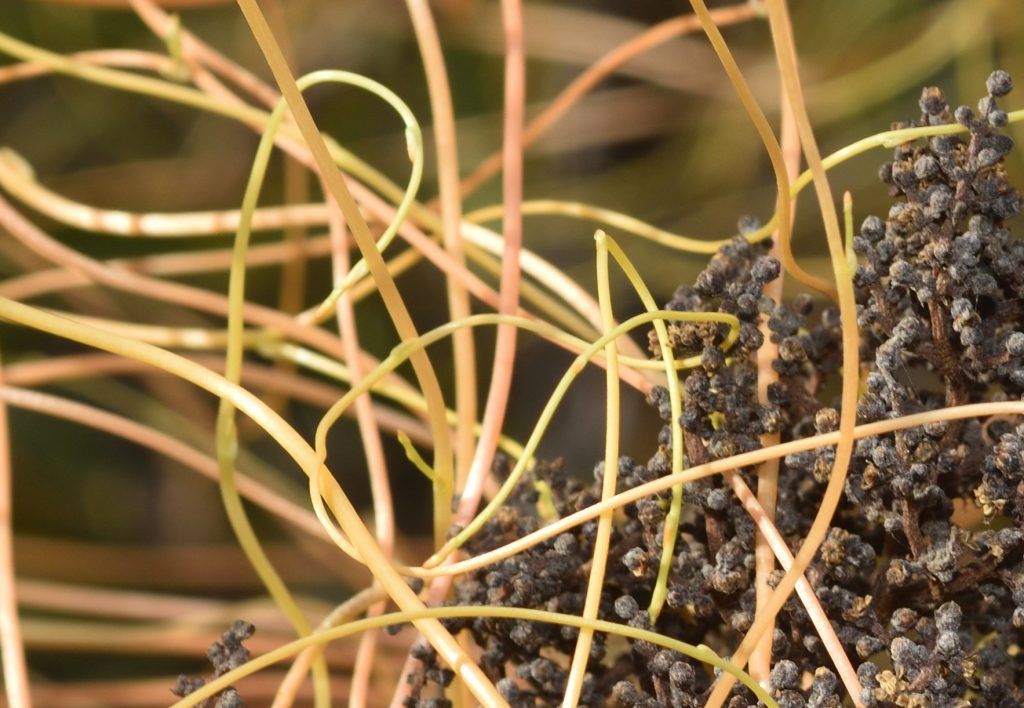
It’s been called witch’s hair, devil’s hair, devil’s guts, devil’s ringlets, scaldweed, beggarweed, fireweed, strangleweed, strangle tare, hairweed, pull-down, hailweed, and hellbine — the parasitic plant dodder doesn’t get a whole lot of love.39 If you do much hiking in southern California, you’re probably used to seeing huge, yellow-orange masses of dodder draping vegetation. Many people assume it’s invasive, but it’s actually native to California.

A buckwheat plant almost completely smothered in dodder
Noble Canyon, Pine Valley, CA 07/07/19

Dodder is in the genus Cuscuta, which contains between 100 and 170 species, all of them parasites. It has a world-wide distribution. Cuscuta used to be treated as the only genus in the family Cuscutaceae, but it’s now been incorporated into the morning glory family (Convolvulaceae). The various species can be yellow, orange, or red. At least one species, Cuscuta reflexa or giant dodder, is green. (That one’s found in India, so I probably won’t be posting any photos of it here.)

Dodder (Cuscuta sp.)
Cowles Mountain, San Diego County 05/31/19

Cuscuta is classified as a stem parasite, because it invades the stems of other plants (as opposed to their roots). Like all parasitic plants, dodder evolved from photosynthetic ancestors. At least some species still retain traces of chlorophyll, although not nearly enough to survive without a host. Generally, if a plant is parasitic, but still does some of its own photosynthesis, it’s called a hemiparasite. If, on the other hand, it has totally lost the ability to photosynthesize, it’s called a holoparasite. Dodder seems to be an edge case. Some of the articles I’ve read confidently state that it’s a hemiparasite. Others just as confidently call it a holoparasite. To some extent, it probably depends on the species. As mentioned earlier, the Indian species — C. reflexa, is green, so it retains more chlorophyll than the other species and probably photosynthesizes at least slightly. When it comes to the other dodders, the various articles can’t seem to agree on whether they photosynthesize just a little bit or none at all.

C. subinclusa growing on laurel sumac. The leaves have been reduced to tiny scales.
Cowles Mountain, San Diego County 07/23/19

When a dodder stem contacts a plant, it wraps itself around the plant. (It even wraps itself around itself, as you can see from the photos in this post). If the plant is a potential host, the dodder will produce very thin, modified roots called haustoria (singular haustorium), which burrow into the stems of the host plant and invade its vascular system, tapping into both xylem and phloem.44 The dodder then proceeds to extract all the water, sugar, and nutrients it needs from the other plant.

A Closer Look at Haustoria

The following description is based on an article published in the online journal “Frontiers of Plant Science“. You can read that article here.

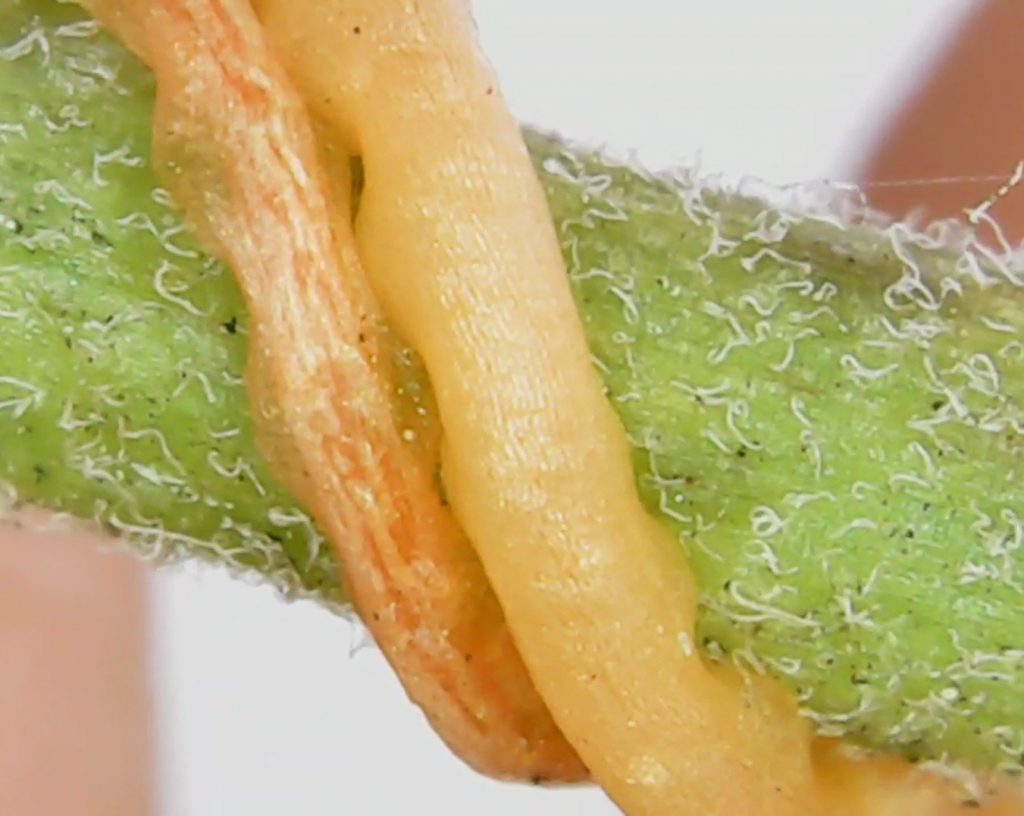
When a dodder stem comes into contact with an appropriate host, it goes into an “attachment phase”, in which the cells at the contact point develop into a secondary meristem.47 This secondary meristem forms an adhesive disk or “prehaustorium”, which adheres to the stem of the host plant. Cuscuta even induces the host plant to produce sticky substances of its own to reinforce the connection.

This photo shows a couple of dodder stems wrapped around the green stem of a buckwheat plant. The swellings where the dodder contacts the host stem are the prehaustoria or adhesive disks.
San Diego County 05/31/19

Next comes the “penetration phase”, in which a haustorium grows from the adhesive disk and penetrates the stem of the host. Cuscuta secretes enzymes that work to degrade the cell walls of the host and the developing haustorium forces its way through the weakened or ruptured walls. Meanwhile, the dodder stem continues to grow longer, attaching a second prehaustorium, then a third, and so on.

Cells at the tips of the haustoria form “searching hyphae”, which search for xylem and phloem. When hyphae come into contact with one of the sieve cells of the phloem, they grow around the cell “like the fingers of a hand”. The hyphae then fuse with the cell so completely that it’s hard to tell where the parasitic hyphae end and the host cell begins.

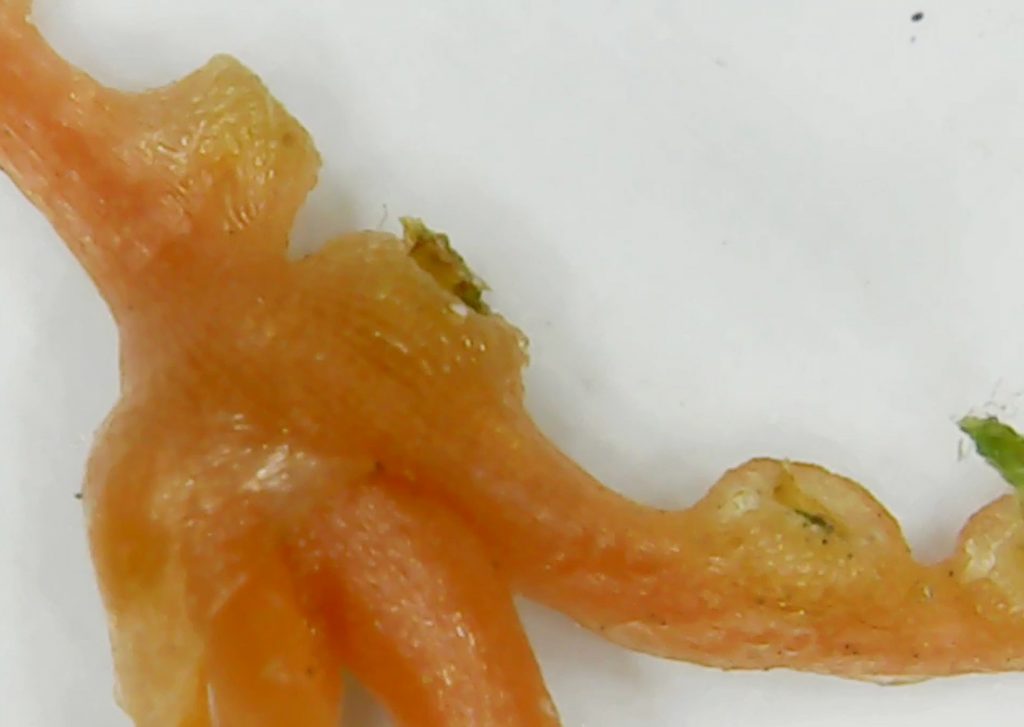
This is a section of dodder stem that I pulled loose from the host plant. You can see the undersides of the prehaustoria. Haustoria would have been growing from the prehaustoria into the stem of the host plant. They were too integrated with the host tissue to be pulled free.

Similarly, when the searching hyphae find xylem tissue, the dodder stimulates the host xylem to develop synchronously with its own xylem tissue (formed within the hyphae), resulting in a continuous tube of xylem connecting the two plants.

Another view of adhesive disks pulled loose from a host stem
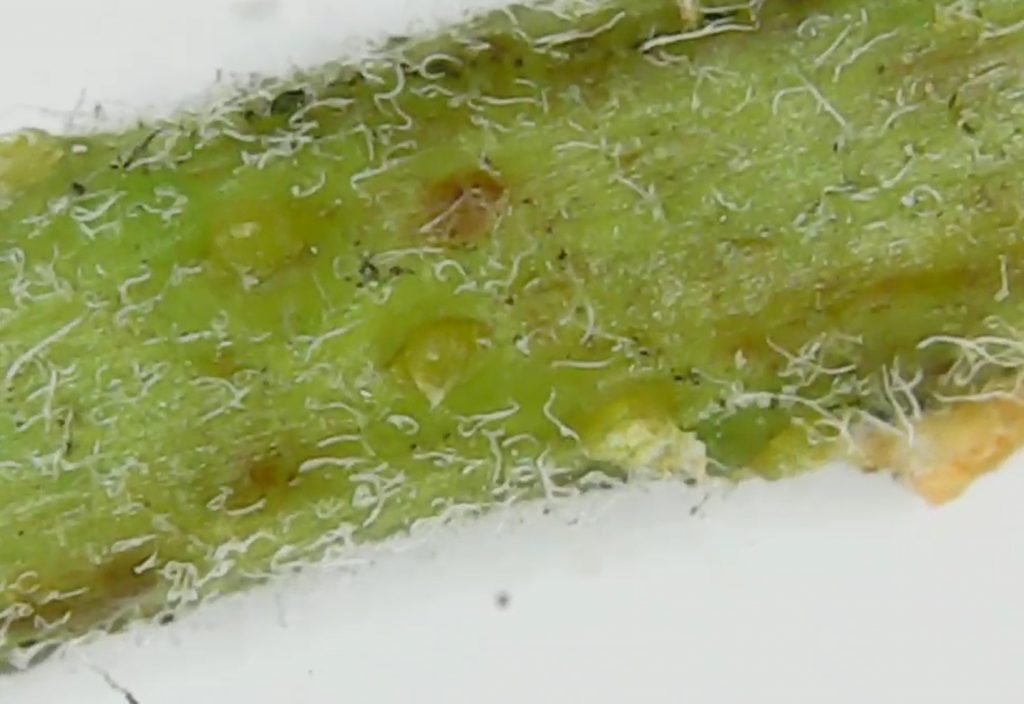
Here you can see the wounds left by the prehaustoria ripping loose from the buckwheat stem. The haustoria are still imbedded in the host stem.

To quote from the referenced article:

“The haustorium […] is the defining feature of all parasitic plants, representing the interface where nutrients, solutes, and carbohydrates are exchanged between host and parasite. […] This interface also allows the exchange of macromolecules between the host plant and the parasite.”

And:

“… the impressive extent of exchanged macromolecules such as RNAs confirms the haustorium as an ‘open door’ between host and parasite that seems not especially guarded.”

Cuscuta can reproduce asexually from bits of stem spread by birds or other animals. Dodder is a flowering plant, however, so it can also grow from seed. Most, if not all, species are annuals, so I suppose it has to regrow from seeds each year. A newly germinated seedling has roots, but little or no chlorophyll, so it has to reach a host as soon as possible. The endosperm of the seed, which is much like the yolk of an egg, contains enough food to keep the young plant alive for 5 to 10 days after germination, but if it fails to find a host within that time period, it dies. Experiments have shown that dodder locates potential hosts by sensing airborne chemicals released by the plants. In other words, it smells them. Dodder has been shown to be sensitive to a number of different volatile compounds and to be repelled by others. Once a seedling attaches itself to a host, its roots are no longer needed, so they wither away.

Dodder seeds don’t have any obvious dispersal mechanism — they simply drop to the ground. The plants probably rely on the dispersal of bits of stem by animals to spread to new areas.

The white flowers belong to California buckwheat. Remarkably, even loaded down with dodder, buckwheat still manages to produce flowers.
Cowles Mountain, San Diego County 05/31/19
Cuscuta flowers (C. californica)
Cowles Mountain, San Diego County 07/12/19

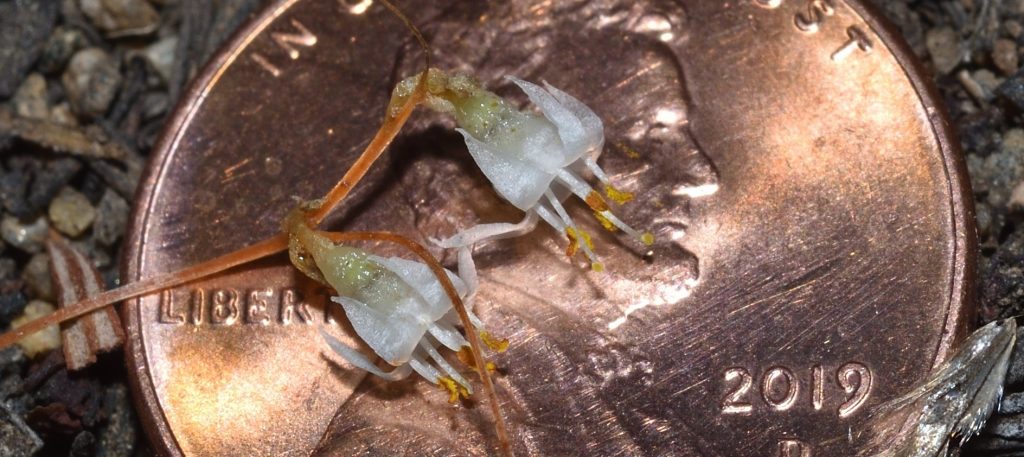
Many people who are familiar with dodder don’t realize that it’s a flowering plant. That’s probably because they’ve never bothered to take a close look. Dodder produces flowers in abundance, but they’re very tiny — around 3 mm wide. In most species, they’re white or cream-colored, so they don’t stand out against the pale yellow-orange of the stems.

There are a number of species of dodder in southern California, but the two most common ones are Chaparral or California dodder (C. californica) and canyon dodder (C. subinclusa). I’ve seen both species growing on Cowles Mountain in Mission Trails Regional Park, just west of San Diego. California dodder grows at or near the bottom of the mountain. It infests mostly buckwheat. The flowers are short, white, and urn-shaped.

The canyon dodder in the park grows mostly on laurel sumac. Its stems are noticeably thicker than those of California dodder. The flowers are also white, but longer and more tube-shaped. The petals are joined for maybe two-thirds of their length.

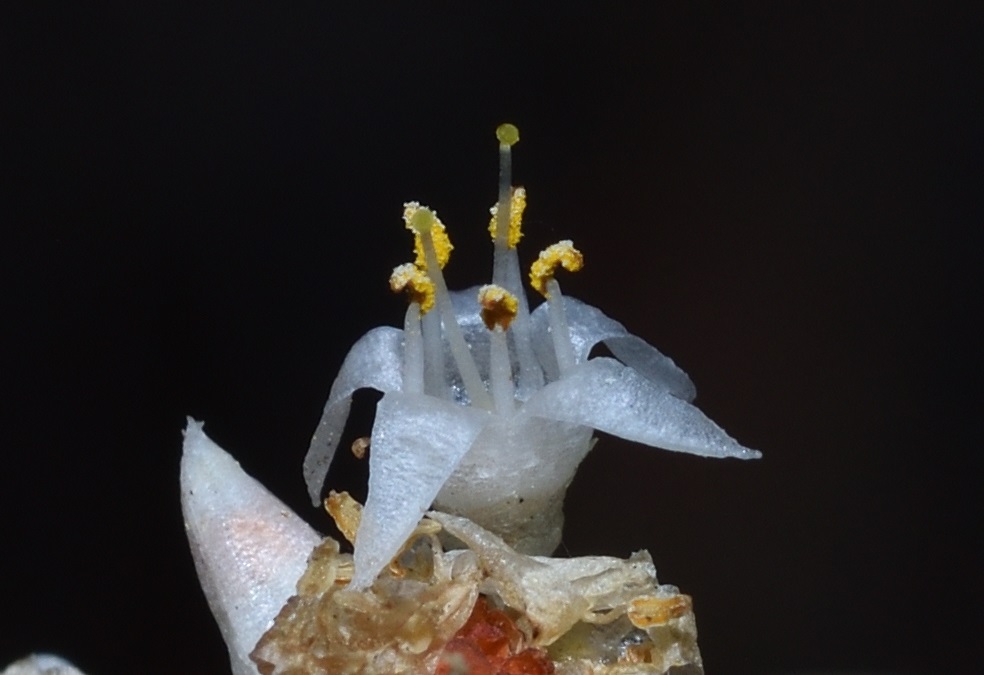
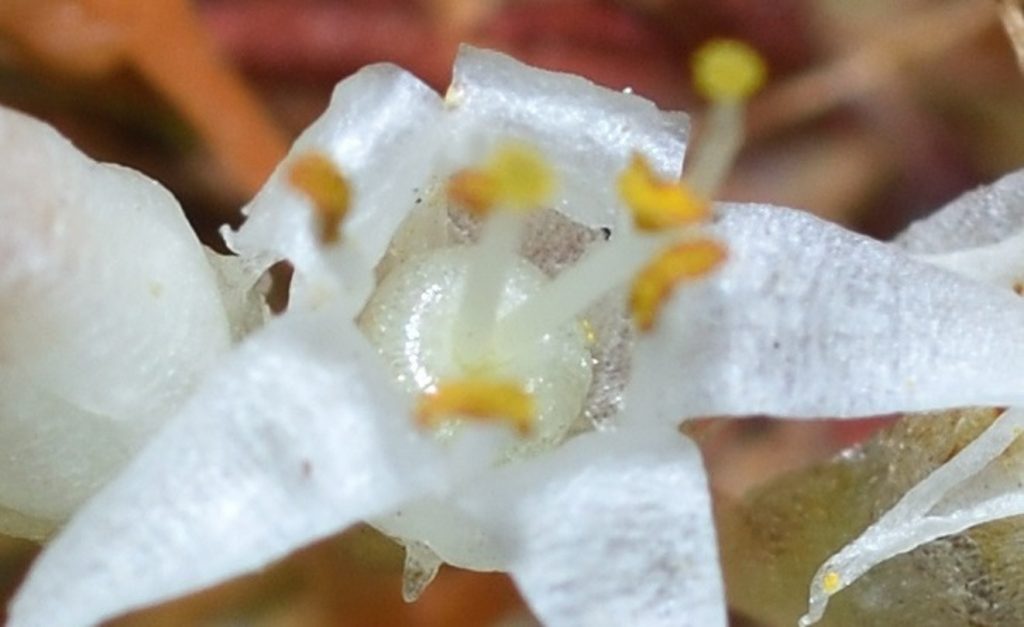
A dodder flower has five petals. The petals are joined together near the base, but peel back at the ends to expose five stamens48 and two pistils.49 The pistil of a dodder consists mostly of a style — a long, thin stalk — sporting a very small, round stigma on the end. When a pollen grain sticks to a style, it grows a thin tube that penetrates the style and follows it down to the ovary, which it fertilizes. As a flower matures, the styles grow longer. They may not grow equally, though. In many species, one style will grow noticeably longer than the other.

Cuscuta flower (C. californica)
Cowles Mountain, San Diego County 07/12/19
Cuscuta flower (C. californica). Note the unequal length of the styles.
The reddish plant matter to the left of the flower is part of the buckwheat host.
Cowles Mountain, San Diego County 07/12/19
Cuscuta flower (C. californica)
Cowles Mountain, San Diego County 07/12/19

Why would a flower have two unequal styles? This represents two different methods of assuring reproductive success. An insect flying from flower to flower will pick up pollen from one flower and transport it to the next. The long pistil stands a better chance of getting pollen from the visiting insect stuck to it, so it has a better chance of picking up pollen from a different plant. The short pistil, on the other hand, has a better chance of receiving pollen from the stamen growing next to it. In other words, one pistil favors cross-pollination and the other favors self-pollination.

The whole point of sexual reproduction is to give a species a better chance of coping with changes in the environment by producing offspring with many different characteristics. If the environment changes in such a way that one individual has less chance of survival, maybe another individual with different characteristics will stand a better chance. So, all things being equal, cross-pollination is better than self-pollination. On the other hand, what if the pollinators that a flower usually relies on are in short supply? In that case, the plant can still reproduce by self-pollination.

Which is better — cross-pollination or self-pollination — can vary with circumstances. For instance, many plants have evolved to take advantage of disturbed ground. When a large tree falls, clearing a space in the forest, or a fire kills all the vegetation in an area, some plants have evolved to quickly colonize the newly vacated plot of ground, squeezing in a few generations before other plants crowd them out. For this kind of plant, self-pollination may be the more successful strategy, simply because it’s quicker — the plant doesn’t have to wait for a bug to come by or for the wind to blow a few pollen grains of the right sort in its direction. Believe it or not, some flowers have evolved to grow flower buds that never open! They still have stamens and styles, but the pollen from the stamens always ends up on the styles in the same bud.

As a plant species encounters different environments, it will often evolve different pollination strategies that allow it to adapt to those environments. If some members of a species evolve a new strategy that is so different from the old strategy that they are no longer able to breed with the plants that use the old strategy, then those members have formed a new species.

In his Master’s thesis, which you can read online here, Michael Wright discusses the evolution of sexual reproduction in Cuscuta. He comes to the conclusion that the evolution of two styles of unequal length was crucial to the success of the genus. To quote Dr. Wright, “The more flexible floral design enabled Cuscuta to evolve different mechanisms of reproductive assurance in coordination with their exploitation of novel host species and new pollination environments.”

Some of the examples he gives are fascinating. In one subspecies, a style tends to collect pollen from it’s own flower near its tip, but, as it grows longer and the stamens begin to wither and die, the style bends over, so that its lower part is exposed to any visiting insects. In this way, if it collects a pollen grain from an insect, that grain will likely be closer to the bottom of the style than any pollen that it picked up from its own stamens. So the tube that grows from the foreign pollen may be able to reach the ovule first. Thus, preference is given to the potentially more beneficial foreign pollen.

This springtail (order Collembola) was crawling around inside the flower of a California dodder. I don’t know if springtails are an effective pollinator of dodders, though. Just because an animal visits a flower, it doesn’t follow that it acts as a pollinator. For this reason, pollination studies

The Consequences of Intimacy

A single Cuscuta plant will routinely infect multiple host plants and multiple Cuscuta plants will routinely infect the same host. And, as already noted, the haustoria of Cuscuta form a very intimate connection with the vascular tissue of the host plant, allowing all sorts of things to pass between them. These several facts have some important consequences:

The transfer of viruses. Viruses seem to pass freely from an infected host plant to Cuscuta and from there to an uninfected host. Sometimes a virus is able to infect the dodder, as well as the host plant. In this situation, the dodder can go on to pass on the virus to other host plants even if all the original hosts have died. In other cases, Cuscuta may be immune to infection by the virus. This does not prevent it from transferring the virus between hosts, however.

Horizontal gene transfer (HGT). HGT is most familiar in microbes. Bacteria, for instance, routinely exchange DNA. This is one reason they are able to evolve resistance to antibiotics so quickly. What scientists have only recently begun to appreciate is that HGT can also occur in plants and animals. The mechanisms are not fully understood and it probably doesn’t happen very often, but there is good evidence that parasitic plants, such as Cuscuta, can exchange genes with their hosts. It’s likely that much of Cuscuta‘s success as a parasite is a result of its ability to incorporate useful genes from host plants and express them in its haustoria.

Communication between hosts. The fact that Cuscuta steals resources from its host plant is obviously detrimental to the host. There’s no getting around that. However, it doesn’t benefit a parasite if its host dies. So, perhaps it’s not so surprising that a parasite will sometimes do things that actually benefit the host. There is experimental evidence that when a dodder connects multiple host plants, it forms a communication network between them, passing useful info from plant to plant. See the section below for more details.

How Dodder Helps Its Hosts

A study published in PNAS50 showed that when two host plants are connected by a Cuscuta bridge and one of the hosts is attacked by an insect, the dodder will pass signals to the other host that cause that host to react in a way that makes it more resistant to attack. (Click here to read the original paper.)

Multiple buckwheat plants connected by dodder bridges

The study was done on Cuscuta australis. The insect pest in the study was tobacco cutworm (Spodoptera litura). Several host plants were used.

A number of experiments were done in the study. In a typical experiment, C. australis was allowed to infect two host plants growing close together, but not in contact. S. litura was allowed to feed on one of the host plants. I’ll call this plant A and I’ll call the other plant (which was not being fed on) plant B. After a period of time (say 48 hours), leaves from both host plants and vines from the dodder were collected and subjected to RNA-sequencing analysis to determine what changes had occurred in gene expression (up-regulation or down-regulation of the genes).

When an insect feeds on a leaf of a plant, the other leaves will typically start to produce chemicals that make them less attractive to the insect. The results of this study showed that the same thing happened in plant B. Apparently, when an insect feeds on a leaf of a host plant, the leaf produces signals that cause its other leaves to ramp up their defenses. These same signals are passed along by the dodder to any other host plants that it is attached to, causing them to follow suit.

The same experiment was done on plants that were close together, but not connected by dodder. In this case, plant B did not ramp up its defenses. This shows that whatever signals were being produced by plant A, they were only passed on to plant B if A and B were connected by dodder. Surprisingly, the results were similar even when plants A and B were in different families.

After collecting the leaves and vines for analysis, S. litura was allowed to feed for a time on plant B. Data was then collected on the amount of damage caused by the insects. This data showed that when a Cuscuta bridge was present, plant B experienced less insect damage, lending support to the conclusions drawn from the RNA-sequencing analysis.

Some Clues About How Dodder Became Dodder

A genetic analysis done on C. australis found that dodder split from its common ancestor with Ipomoea (the largest genus in the morning glory family) around 33 million years ago. This analysis produced a number of other interesting results. Apparently, the common ancestor of Cuscuta and Ipomoea experienced a whole-genome triplication event before the split. This is not too uncommon in plants. Such an event in an animal would almost certainly be fatal, but plants tend to be less affected by such things. In fact, having multiple copies of a gene often allows the extra copies to go on to evolve new functions, thus helping to drive evolution. Chances are, it was this triplication event that led to the split between Cuscuta and Ipomoea.

Two other results of this analysis were that Cuscuta experienced accelerated molecular evolution and large-scale gene loss. Both of these findings are typical of parasitic plants, especially holoparasites. Since a holoparasite has no need to photosynthesize and no need to extract resources from the soil, it can safely rid itself of the genes that control those functions. The parasite also has less need to produce substances to defend itself from infection and predation, since it can often use substances produced by its host plant for that purpose.

As for the accelerated molecular evolution, I haven’t been able to find any explicit explanation for that in my reading. My guess would be that the switch to a parasitic lifestyle introduces novel selective pressures that other plants in an area would not experience.

Click here to read this study.

Parasitic Plants

We expect plants to be green. Sure, flowers come in pretty much every color of the rainbow and even leaves may contain pigments that mask the underlying green, but, because plants contain chlorophyll and chlorophyll is green, we know the green must be there somewhere.

Except when it isn’t. About 1% of angiosperms (flowering plants) have either partly or wholly given up photosynthesizing in favor of becoming parasites. If you’re no longer using sunlight to make your own food, you no longer need chlorophyll. If you no longer need chlorophyll, then, over the course of millions of generations, you’re going to slowly lose the genes that allow you to make it. And so, you slowly lose the green.

A plant that is just trying out the parasitic lifestyle will still be green. Maybe the only difference you’ll notice is that its leaves are unusually small. Eventually, though, as it commits more and more to the life of a thief, its leaves will be reduced to scales or disappear altogether and its stems will turn a pasty yellow or a ghostly white. The stems may even disappear altogether as the parasite moves underground or into the body of its host. In that case, you’ll never see it at all until it flowers.

I said that 1% of flowering plants are parasites. So what about non-flowering plants? For some reason, parasitism is much rarer outside the angiosperms, but there are a few examples. Some people argue that, in bryophytes (mosses, liverworts, and hornworts), the sporophyte is parasitic on the gametophyte. (See my earlier post, In Among the Mosses – An Introduction to Liverworts.) That seems like a bit of a stretch to me, since the gametophyte depends on the sporophyte to reproduce itself and vice versa, but I guess that’s just quibbling over terminology.

There’s only one known parasitic species of conifer — a plant named Parasitaxus usta, which grows in New Caledonia. (Or maybe two. We’ll get to that later.) Other than that, the only non-flowering parasitic plants that I know of are some types of algae. Helicosporidium is a genus of algae that parasitizes the guts of insects51. As a general rule, parasitic plants tend to have greatly reduced genomes52, simply because they rely on their host to perform many of the functions that they would otherwise have to handle themselves. Interestingly, scientists have found that Helicosporium has retained most of its functions that are not directly related to photosynthesis. This suggests that Helicosporium may be fairly new to the parasite game. Given time, the species in this genus will probably lose many more genes that they no longer use or use very little. Another genus of algae, Cephaleuros, is parasitic on higher plants53. There are probably many others.

Getting back to angiosperms, parasitic flowering plants can be broadly divided into stem parasites and root parasites. In both cases, the plants have evolved thin, root-like filaments called haustoria (singular haustorium) that penetrate into the tissues of their host plants (stems, in the case of stem parasites, or roots, in the case of root parasites) and steal resources from them. Parasitic plants can also be classified by the degree of parasitism. A holoparasite is a parasite that has completely lost the ability to photosynthesize and relies entirely on its host to survive. A hemiparasite, on the other hand, still retains some ability to photosynthesize and only gets some of its resources from its host. In many cases, a hemiparasite may be on its way to becoming a holoparasite. It just hasn’t gotten there yet.

There are about 4,500 known species of parasitic flowering plants in approximately 20 families. Most of these families contain both parasites and non-parasites. The last common ancestor of the plants in such a family must have been photosynthetic (since it’s very unlikely that a plant will re-evolve photosynthesis once it has lost it.) It follows that plants have independently evolved parasitism many times. It also follows that haustoria (the thin, root-like organs) have evolved independently many times.

Now that we’ve gone over a few of the general characteristics of parasitic plants, let’s take a closer look at some of them. Each of the groups of parasitic plants that I discuss here is certainly deserving of its own article and I plan to devote future articles to some of them. For the moment, though, I’ll just give each of them a brief mention.

The one parasitic plant that most people have heard of is mistletoe. Mistletoe is actually the common name for a great many hemiparasites in the order Santalales. In fact, molecular studies have shown that plants in this order evolved parasitism independently five different times. So the different kinds of plant that we call mistletoe are not necessarily very closely related. As such, they have widely varied lifestyles.

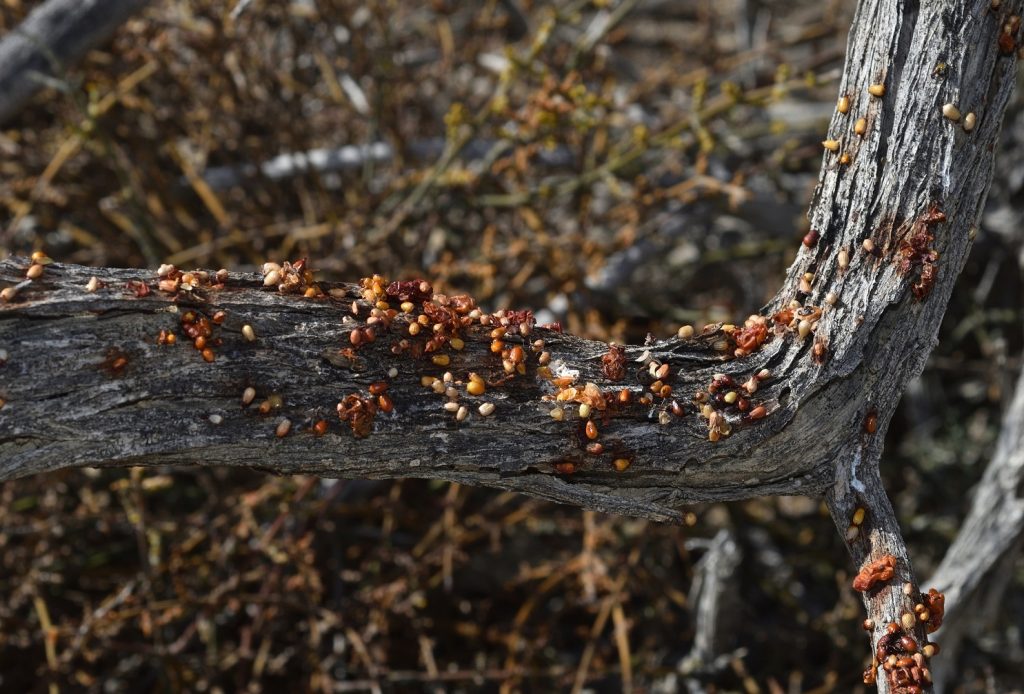
Phainopepla poop on a mesquite branch. It looks like it’s entirely mistletoe seeds.
Lyceum Wash in Anza Borrego State Park 03/24/19

The mistletoe that I see most commonly in southern California is desert mistletoe (Phoradendron californicum), also known as mesquite mistletoe. It’s found in the Sonoron and Mojave Deserts, where it grows as a stem parasite mostly on trees in the pea family, such as mesquite and catclaw. P. californicum extracts water and nutrients from its host plant through its haustoria, but it does its own photosynthesis. (This despite having no leaves — I guess it has enough chlorophyll in its stems.) Mistletoe is spread by birds that eat the berries and poop out the indigestible seeds. A song bird called the Phainopepla is the main disperser of mistletoe seeds in western North American. It’s not uncommon when hiking in the Sonoron Desert to see a limb of a mesquite tree covered in seed-ridden droppings from this bird.

Dodder (Cuscuta sp.) on California buckwheat
Cowles Mountain, San Diego County 05/31/19

Another common parasitic plant in southern California is dodder. Dodder is any member of the genus Cuscuta. The most common dodder in my area is Cuscuta californica, but there are a number of other species found here. All of them take the form of huge masses of stringy, orange-yellow tangles of thin stems and tendrils draping host plants such as buckwheat and laurel sumac. Dodders still retain traces of chlorophyll and may photosynthesize to varying degrees, so they should probably be classified as a hemiparasites. They are well on their way to being holoparasites, however, extracting water, nutrients, secondary metabolites, proteins, and even mRNAs54 from their hosts.

Update 8/25/19: Actually, the articles I’ve been reading can’t seem to agree on whether Cuscuta is a hemi- or holoparasite. Some of them say it’s totally parasitic, others say it still does a bit of photosynthesis. Maybe it varies according to the species. I would guess that most species are pretty close to being holoparasitic, but, hey, I’m not even a professional botanist.

Dodder (Cuscuta sp.)
Cowles Mountain, San Diego County 05/31/19

Dodders are stem parasites. When a dodder first germinates from a seed, it has a small, rudimentary root that serves to anchor it, but it absorbs no nutrients from the soil and this root starts to degenerate once the plant acquires a host. The plant soon becomes entirely rootless. Dodder produces tiny white or cream flowers in abundance, but they usually go unnoticed by the casual observer, since they are only a few millimeters wide.

A buckwheat stem completely swathed in dodder
Cowles Mountain, San Diego County 05/31/19

The broomrape family, Orobanchaceae, is a large family of mostly root parasites. It includes both hemi- and holoparasites. Of the hemiparasites, some are obligate parasites (i.e. they can’t survive without a host). Others are facultative parasites — they can get along on their own, if necessary.

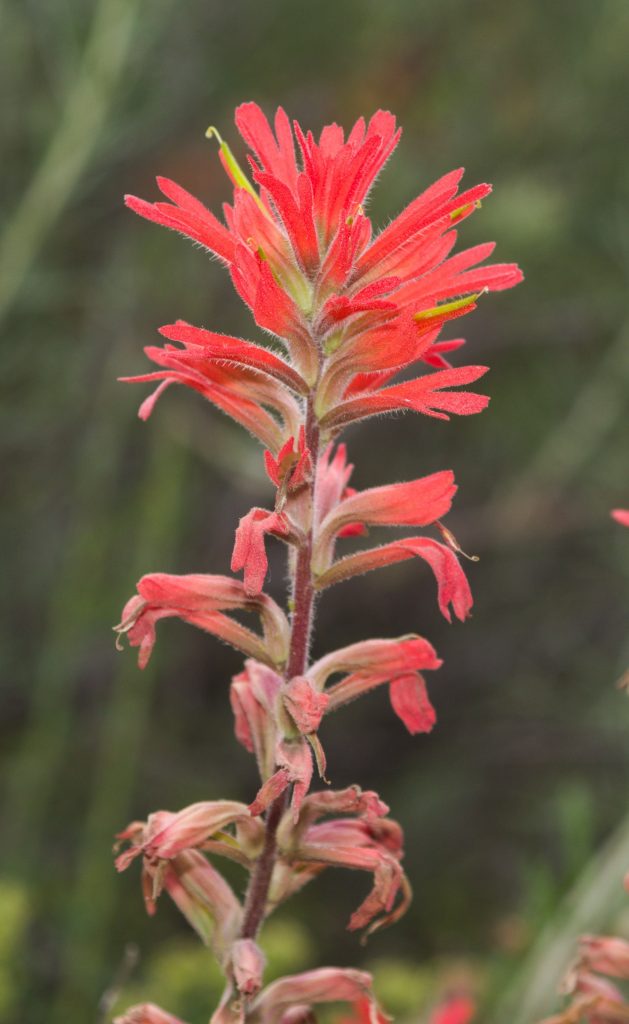
A common genus of broomrapes found in southern California is Castilleja. This includes coast Indian paintbrush (C. affinis), a perennial herb with beautiful red flowers that is well-known to hikers. Indian paintbrush is a hemiparasite. It can still photosynthesize, but its leaves are noticeably reduced. C. affinis is never found in nature without a host plant. It can survive and reproduce in a greenhouse without a host, but the plants will be less vigorous than they would be with a host. So does this make C. affinis an obligate or a facultative parasite? It’s not clear. This is another case where it’s just a matter of how you define your terms.

Coast Indian paintbrush (Castilleja affinis)
A root hemiparasite in the broomrape family
Mission Trails Regional Park, San Diego County 04/16/19

Another very common member of the genus Catilleja is the oddly named purple owl’s clover, Catilleja exserta. (Apparently, it’s also called exserted Indian paintbrush, although not by anyone I know.) C. exserta is also a hemiparasite. It’s somewhat similar in form to coast Indian paintbrush, growing in erect stems with small, thin leaves, but its flowers are a striking purple or lavender color with large spots of white. Purple owl’s clover is an annual plant. It seems to be much pickier about when it blooms than its relative, C. affinis, but, in the Spring, when the time is right, it can be seen blooming in profusion.

Purple owl’s clover (Castilleja exserta)
Other common names include escobita and exserted Indian paintbrush.
Mission Trails Regional Park, San Diego County 04/16/19

Yet another hemiparasitic broomrape in my area — one that I just recently learned about — is bird’s beak, specifically stiffbranch bird’s beak (Cordylanthus rigidus). It’s an odd-looking plant, again with small, much reduced leaves on thin stems. The flowers are strange white blossoms that apparently remind some people of bird’s beaks. The dark-tipped bracts55 that surround the blossoms are what really give the plant its weirdness.

Stiffbranch bird’s beak (Cordylanthus rigidus)
A root hemiparasite in the broomrape family
Otay Mountain, San Diego County 06/22/19

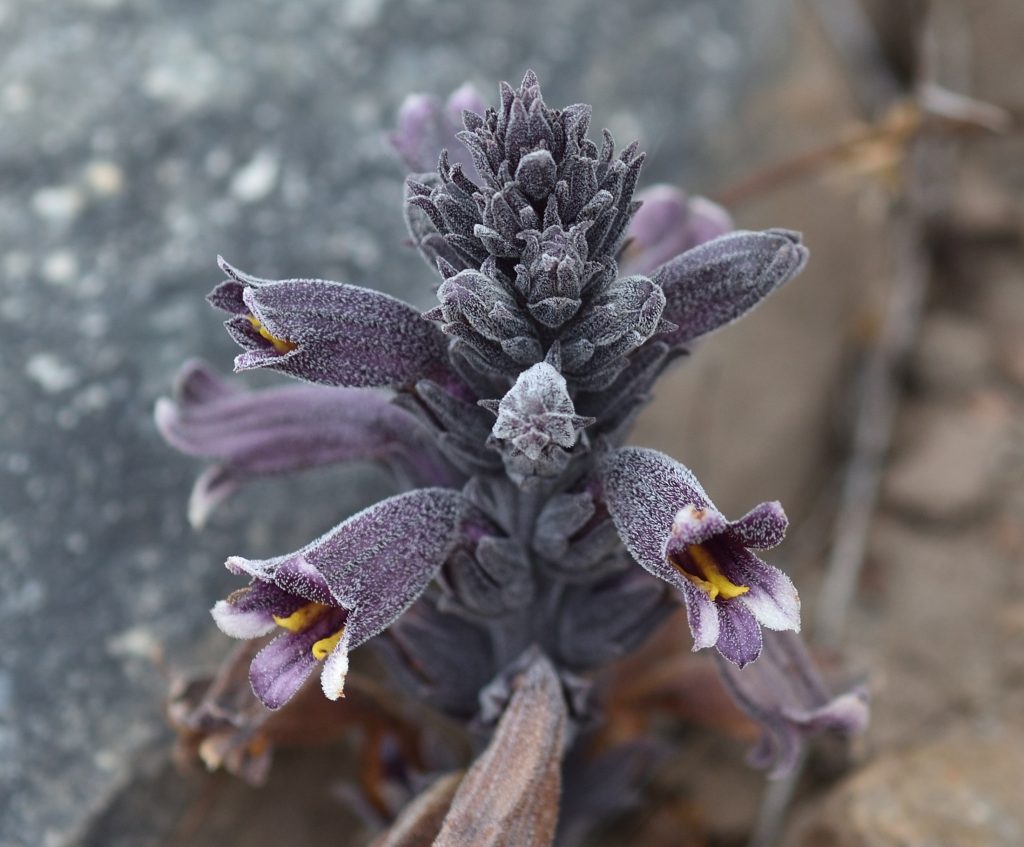
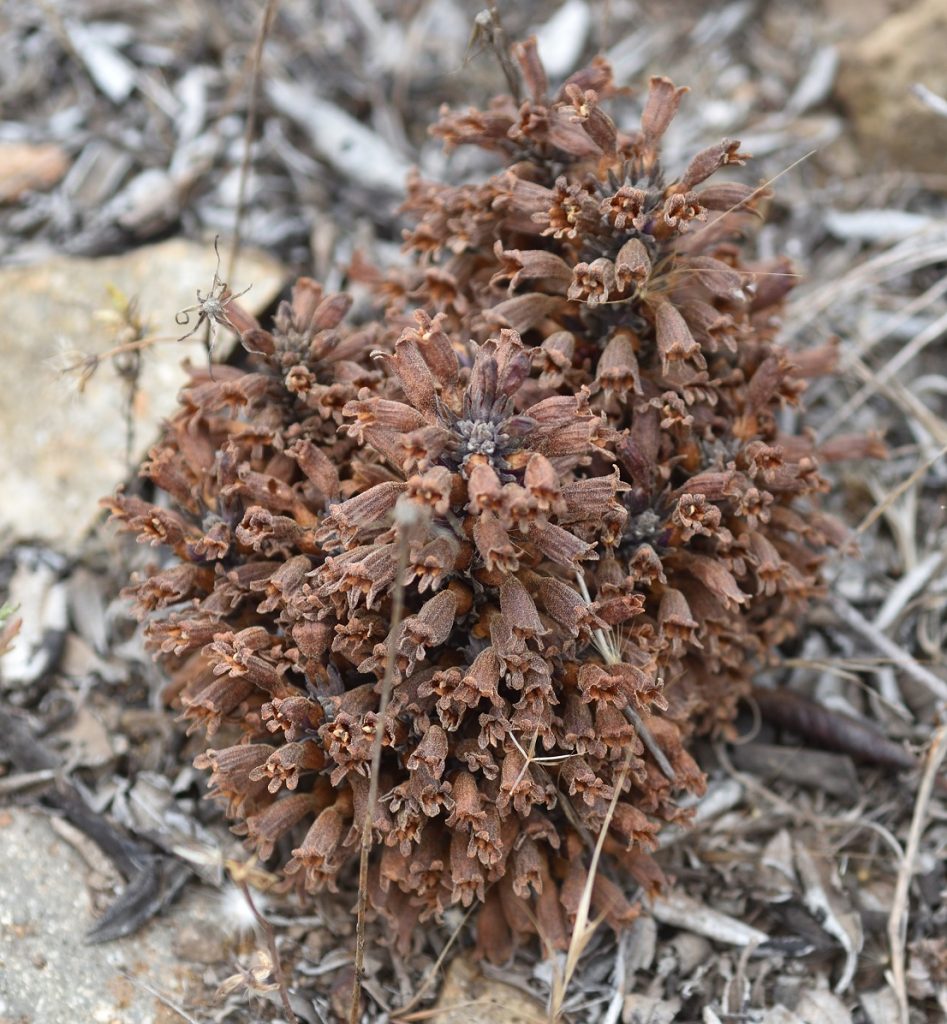
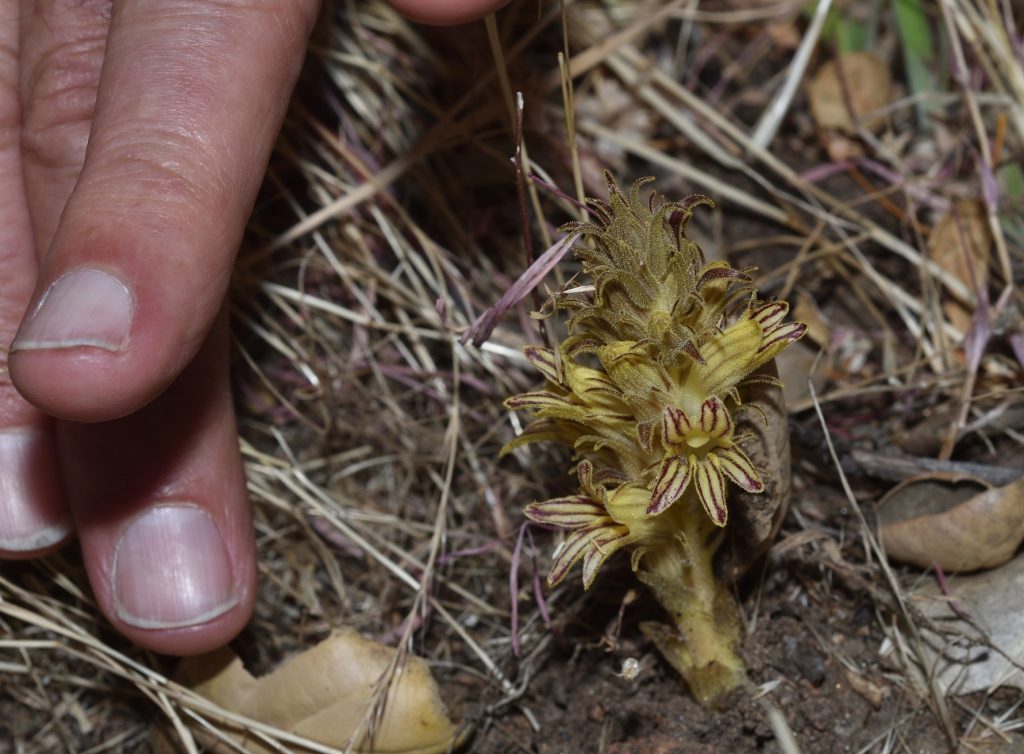
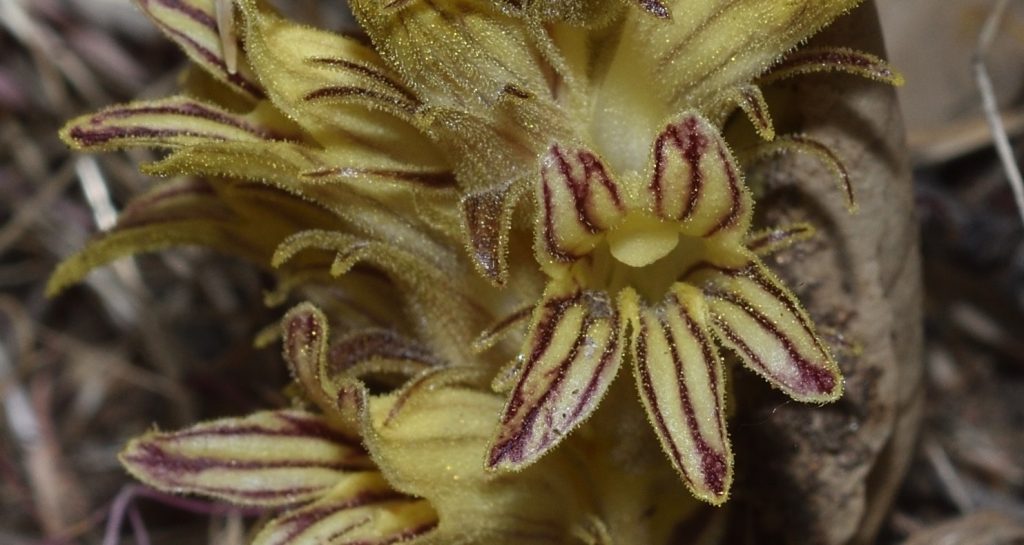
Two more species of broomrape found in southern California are chaparral broomrape (Orobranche bulbosa), which I saw on Otay Mountain near the Mexican border, and Parish’s broomrape (Orobanche parishii), which I encountered a bit farther North near Pine Valley, CA. Both are holoparasites, depending entirely on resources extracted from the roots of their host plants. Lacking both leaves and chlorophyll, the only parts of these plants visible above ground are the thick clusters of flowers growing from single stems.

Chaparral broomrape (Orobanche bulbosa)
A weird, root holoparasite in the broomrape family
Otay Mountain, San Diego County 06/22/19
More chaparral broomrape (Orobanche bulbosa)
Otay Mountain, San Diego County 06/22/19
Parish’s broomrape (Orobanche parishii)
Another weird, beautiful member of the genus Orobanche
Noble Canyon, Pine Valley, CA 07/07/19
Parish’s broomrape (Orobanche parishii)
Noble Canyon, Pine Valley, CA 07/07/19

That about covers the parasitic plants I’ve come across on my hikes, but there are a few others I want to mention. One plant that I’ve looked for unsuccessfully for years is Thurber’s stemsucker (Pilostyles thurberi). P. thurberi is only a few millimeters long. It has no roots or leaves and lives entirely inside the stem of its host plant. The only time the plant is visible is when it blooms, sending out a tiny flower that protrudes from the stem of the host.

P. thurberi parasitizes shrubs in the pea family, especially Emory’s indigo bush or dyebush (Psorothamnus emoryi). This plant is very common in parts of the Sonoran Desert. Every time I see dyebush, I look for the flowers of the parasite, but, so far, I haven’t had any luck.

I mentioned earlier that there was only one known species of parasitic conifer — Parasitaxus usta, which grows in New Caledonia. This plant always grows attached to the roots of another conifer, Falcatifolium taxoides. It has no roots of its own, but also, no haustoria, so it’s not entirely clear how it gets its sustenance. Scientists think P. usta is a myco-heterotrope — a parasite on the mycorrhizal fungi that form symbiotic relationships with many plants. Studies have shown that it gets carbohydrates from the fungus. However, it also appears to get nitrogen and water directly from the host tree. (I’m not sure how it does this without haustoria. None of the articles I read were clear about it.) Click here to read an interesting article about this unique parasite.

This would not be the first time a plant evolved to parasitize fungi. Ghost plant or ghost pipe (Monotropa uniflora), which grows in a small part of northern California (and other parts of the world), is a known parasite of mycorrhizal fungi. Lacking chlorophyll, it sprouts a single stem that looks like a frilly white candy cane without the stripes.

I hinted earlier that there may be one more example of a parasitic conifer. I say may be, because this one’s a little different. Ever heard of an albino redwood? I hadn’t either until I started researching this article. An albino redwood is a mutant coast redwood (Sequoia sempervirens) that grows from the base of a normal redwood and lives on sugars extracted (usually) from the parent tree. It has no chlorophyll and so, its needles are a ghostly white. It’s also much smaller than a normal redwood, which makes sense, considering that it has to live off what it can get from its parent. Although it’s usually regarded as a parasite, in 2016 one scientist suggested that normal redwoods may actually support the albinos because they store toxic heavy metals. The albinos have defective stomata (breathing pores) that cause them to accumulate the metals in their tissues. If this is the case, then, far from being a parasite, the albino redwood could be benefiting the surrounding trees by absorbing poisons from the soil. There are only around 400 albino redwoods known and their locations are secret.

I’ll end this post with another plant that I’ve never seen in the wild (and probably never will, since it’s native to Sumatra and, possibly, Borneo). The corpse lily or corpse flower (Rafflesia arnoldii) is a parasite of a few species of vines in Tetrastigma, a genus in the grape family. R. arnoldii is most famous for producing the largest single flower in the world. This flower grows to a diameter of around one meter (3.3 feet), which is even more remarkable considering that, as with Pilostyles thurberi, the rest of the plant grows entirely inside its host. The name corpse flower comes from its scent, which mimics the smell of rotting flesh to attract its pollinators, carrion flies.

The Stuff of Nightmares

There are a lot of tarantulas in Southern California. They’re big and hairy and they have very large fangs. This article is not, however, about tarantulas. It’s about a tarantula’s worst nightmare…

Milde’s tarantula hawk wasp (Pepsis mildei)56 is a beautiful insect. Its body is a deep blue-black, its eyes are pitch black, and its wings are reddish orange. The females can be up to two inches long. They’re fairly common in Southern California and are easy to spot.

Milde’s Tarantula Hawk Wasp (Pepsis mildei)
Sweetwater River Trail 9/8/17

The adult wasps feed off nectar, pollen, and fruit juice. (Sometimes they feed off fermented fruit and get so drunk they have trouble flying.) They frequent milkweed, western soapberry trees, and mesquite trees.

Male tarantula hawks don’t have stingers. Actually, no male insects have stingers. There’s a very good reason for this — stingers evolved from ovipositors. An ovipositor is a tubular organ through which an insect lays its eggs. Ovipositors come in a great variety of forms from short and thick to ridiculously long. Some insects totally lack ovipositors and just lay their eggs through an opening in their abdomens. Others have ovipositors with sawtoothed edges. They use these to saw into the stems or leaves of plants, so they can lay their eggs inside.

But in many insects, the ovipositor has lost its original function of laying eggs and, instead, is used to inject venom. In other words, it’s become a stinger. Obviously, a stinger is a pretty great form of self-defense. It can also be used to subdue prey. But, because stingers evolved from ovipositors, only the females have them. So the male tarantula hawk is totally harmless.

The female is another story. The sting of the female tarantula hawk is extremely painful. In fact, according to Justin Schmidt, who developed the Schmidt sting pain index, the tarantula hawk has the second most painful sting of any insect.57

Females are not aggressive toward humans and you’re unlikely to get stung unless you happen to step on one while barefoot. If you are unlucky enough to get stung, though, Dr. Schmidt’s advice is to immediately lay down (so that you don’t hurt yourself running around blind with pain) and begin screaming. (Actually, you won’t have any choice about the screaming part.) Fortunately, the worst of the pain only lasts about five minutes. Unless you happen to be allergic, the sting is not dangerous and, when the pain finally subsides, you’ll have a great story to tell.

The tarantula hawk wasp is a parasitoid. A parasitoid is a parasite that kills its host. In this case, the host is a tarantula. A female wasp will fly around close to the ground, searching for tarantulas. She may even crawl inside the burrow of a tarantula to attack it where it lives. When she finds one, she stings it to paralyze it, then she drags it to a burrow that she dug earlier (or if she stung it inside its own burrow, she may leave it there). She then lays a single egg on the spider’s abdomen and seals the burrow. When the egg hatches, the larva burrows into the tarantula’s abdomen and begins to feed. Note that the tarantula is still not dead. It’s still paralyzed from the sting and will remain so until it finally dies from the larva feeding on its insides. The most amazing part, though — the most horrifying, gruesome, yet amazing, part — is that the larva feeds on the non-vital parts of the spider first, in order to keep it alive and fresh for as long as possible!

Dragging a paralyzed tarantula

While hiking on the Sweetwater River Trail near Jamacha, CA, I chanced upon a tarantula hawk wasp that had just stung a tarantula and was dragging it along the hiking trail. The video and photos accompanying this article all came from that encounter. I must have spent around twenty minutes observing the wasp. I was hoping to get a video of it actually placing the spider in a burrow, but I think the light from my headlamp (this was around dusk) must have been confusing it. It seemed to be dragging the tarantula around at random. It was probably trying to get it out of the light. I was able to get quite close to the wasp — almost touching it. It never acted the least bit aggressive. I don’t think it felt threatened — just confused. Since tarantula hawks don’t have nests to defend and don’t have many natural enemies, they tend to be docile. I finally gave up and left it alone with its prize.