Category Archives: Plants

The Genera Formerly Known as Mimulus

If you hike in southern California, there’s a good chance you’re familiar with monkeyflowers. These plants generally have very attractive flowers, which makes them a popular choice with gardeners. I read one article that even referred to them as “garden porn”. (I was tempted to use that as the title of this post, but I decided that I’d just as soon not have my blog popping up on porn searches.)

Sticky monkeyflower (Diplacus aurantiacus)

They’re called monkeyflowers because supposedly some the species have flowers that look like the face of a monkey. I guess I haven’t seen those species yet.

In chaparral, the most common species seems to be sticky monkeyflower (Diplacus aurantiacus). The flower has a long, tubular base, ending in five lobes. The color varies from white to orange or red. The most common color is said to be a light orange, but most of the ones I see in my neighborhood are red with an orange center. They are pollinated by bees and hummingbirds. The plant grows as a low bush.

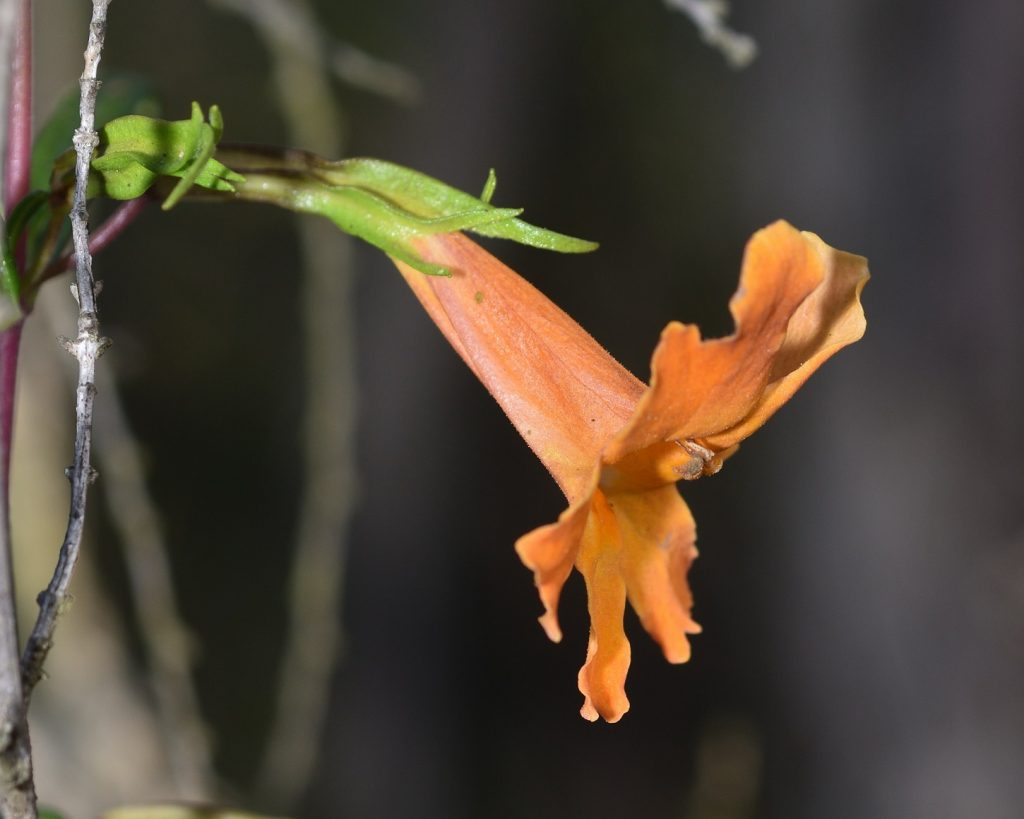
Sticky monkeyflower (Diplacus aurantiacus) — orange variety

Another monkeyflower I’ve encountered in chaparral is seep monkeyflower (Erythranthe guttata). I first saw this one growing in the middle of a small stream on Cowles Mountain in Mission Trails Regional Park. Most streams in southern California are dry for much of the year. We’d been having a lot of rain for several weeks prior to this, though, so the stream was flowing pretty well. The monkeyflower had just started flowering. Its flowers were bright yellow with the tubular bases of the flowers somewhat shorter than on the sticky monkeyflower. The leaves were much larger and the plant was growing as a small shrub.

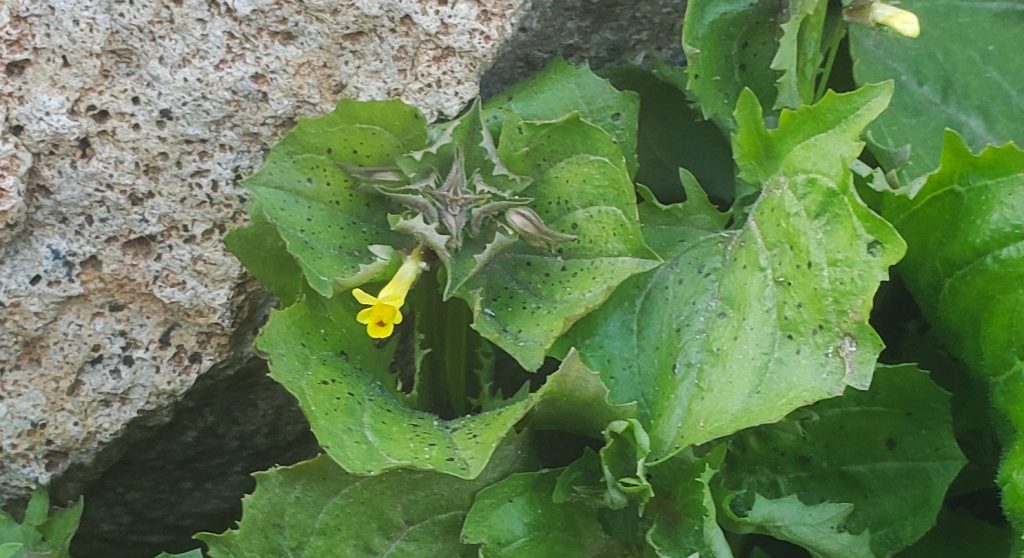
Seep Monkeyflower (Erythranthe guttata)

The last monkeyflower I want to mention is Bigelow’s monkeyflower (Diplacus bigelovii). This one grows in profusion in the Anza Borrego desert between February and June. It grows as an annual herb, rather than a bush, and its flowers are a beautiful magenta color. It’s definitely one of the most striking plants in Anza Borrego.
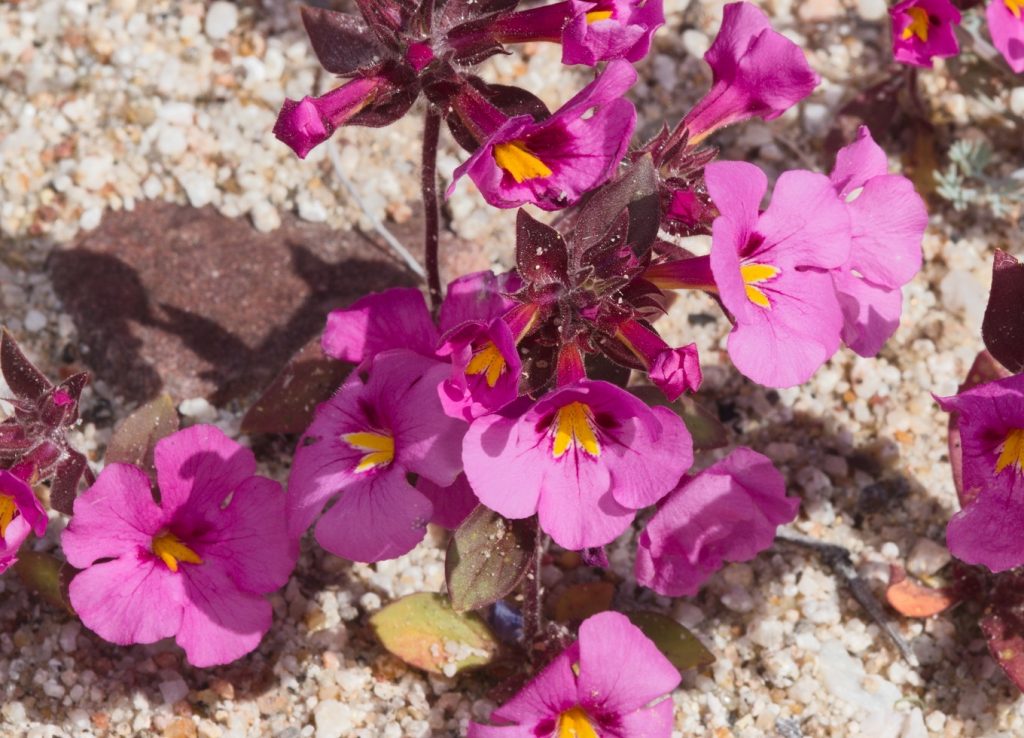
Bigelow's monkeyflower (Diplacus bigelovii)
Bigelow’s monkeyflower (Diplacus bigelovii)

So, why the odd title for this post? All monkeyflowers used to belong to the genus Mimulus and this genus was included in the figwort family (Scrophulariaceae) — nice and simple. Beginning in the 1990’s, though, things started to get a bit more complicated…

For most of the history of biology, the classification of organisms was based almost entirely on shared characteristics. The more characteristics two organisms shared, the more closely related they were presumed to be. This approach has some obvious problems. One problem is simply that an organism can change greatly over the course of millions of years. If we don’t have many intermediate fossils, it may not be at all clear that the early organism is related to the later one.

Another problem is that sometimes organisms that are not at all closely related will evolve similar traits simply because they are experiencing the same environmental pressures. This is called convergent evolution. For example, during the age of dinosaurs, there was a group of reptiles called Ichthyosaurs that was adapted to living in marine environments. These creatures looked and probably behaved remarkably like porpoises. But porpoises are mammals and Ichthyosaurs were reptiles — not very closely related at all. Apparently, the porpoise form is just a really good form for a large, aquatic, air-breathing creature.

With the cracking of the genetic code, scientists have developed tools that can give us a much better idea of the relationships between living things. As a result, many organisms are being reclassified as molecular studies provide us with more accurate information. In the mid-1990’s, studies of the DNA found in chloroplasts (the cell components in plants that contain the chlorophyll) showed that monkeyflowers are more closely related to lopseeds than figworts. As a result, the genus Mimulus was moved from the figwort family to the lopseed family (Phrynaceae).

It 2012, Mimulus itself was split up, also as a result of DNA studies. It was decided that the original genus should be broken up into three genera — Mimulus, Diplacus, and Erythranthe. Most of the monkeyflowers, in fact, have been moved to Diplacus or Erythranthe. The taxonomy of the monkeyflowers is still in flux. After the 2012 breakup, the seep monkeyflower remained in Mimulus, but later got moved to Erythranthe.

It can be hard for a biologist to get used to such name changes, especially if they happen to a group that he/she has been studying for decades. Nevertheless, most biologists support such changes, because they understand how important it is to come up with terminology that reflects the true relationships between organisms. As our understanding of these relationships are refined, our system of taxonomy must be updated accordingly.

Update 07/12/2019

Since posting this article, I’ve encountered several more species of monkeyflower. The first one is Cleveland’s bush monkeyflower (Diplacus clevelandii), which I saw on Otay Mountain in southern San Diego County, near the border with Mexico. It’s a fairly rare species, which grows in chaparral and oak woodland. It also likes disturbed habitats.
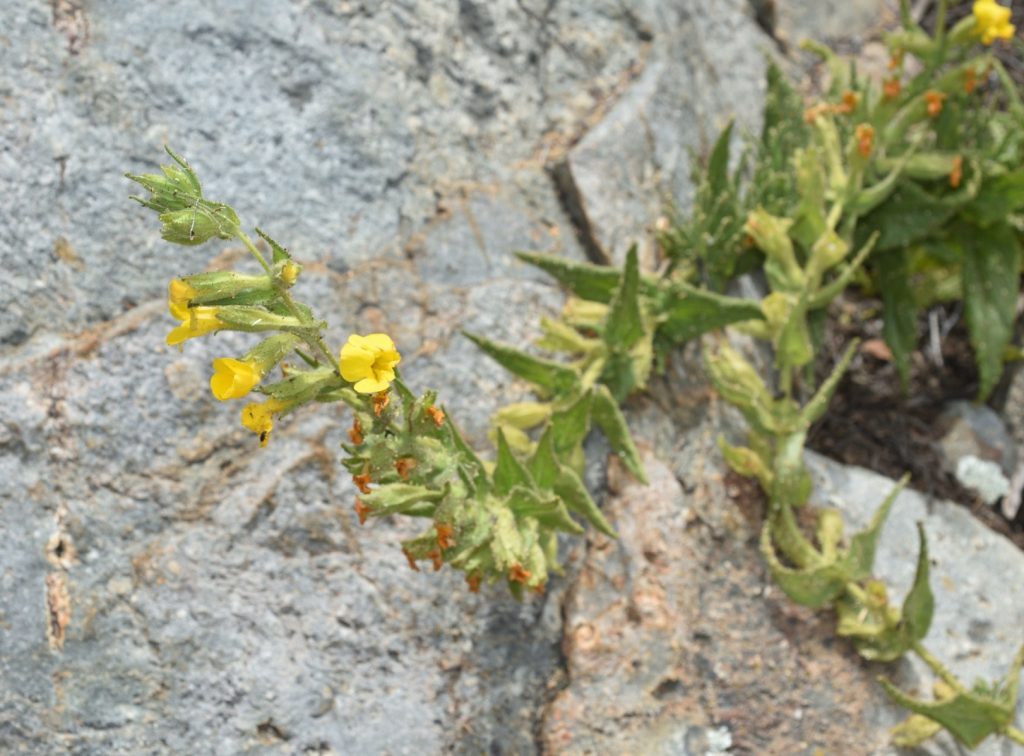
Cleveland’s bush monkeyflower (Diplacus clevelandii)
Otay Mountain, San Diego County. 06/22/19
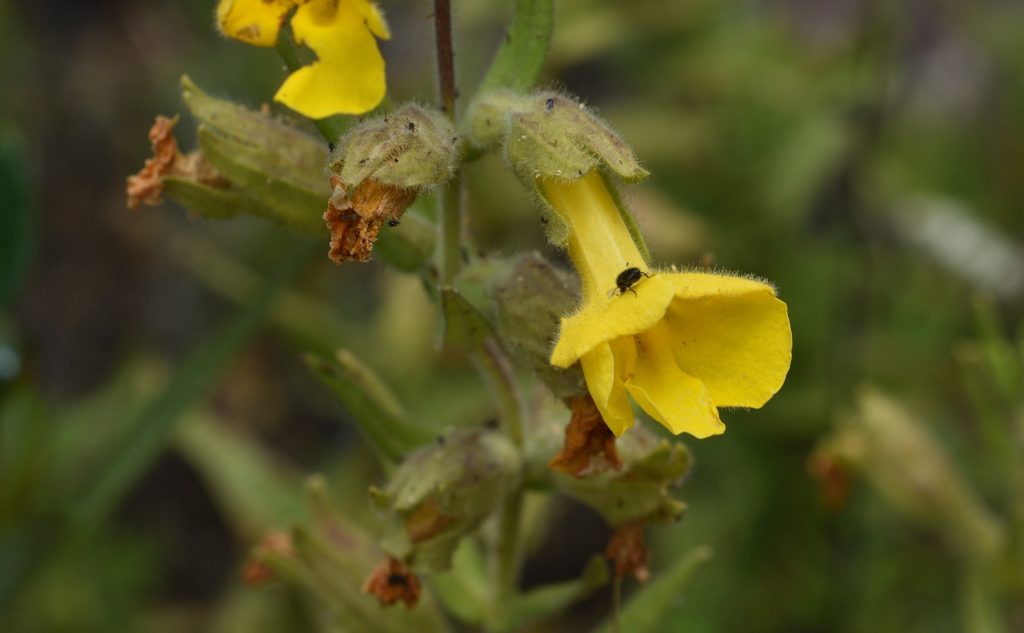
Cleveland’s bush monkeyflower (Diplacus clevelandii)
Otay Mountain, San Diego County. 06/22/19
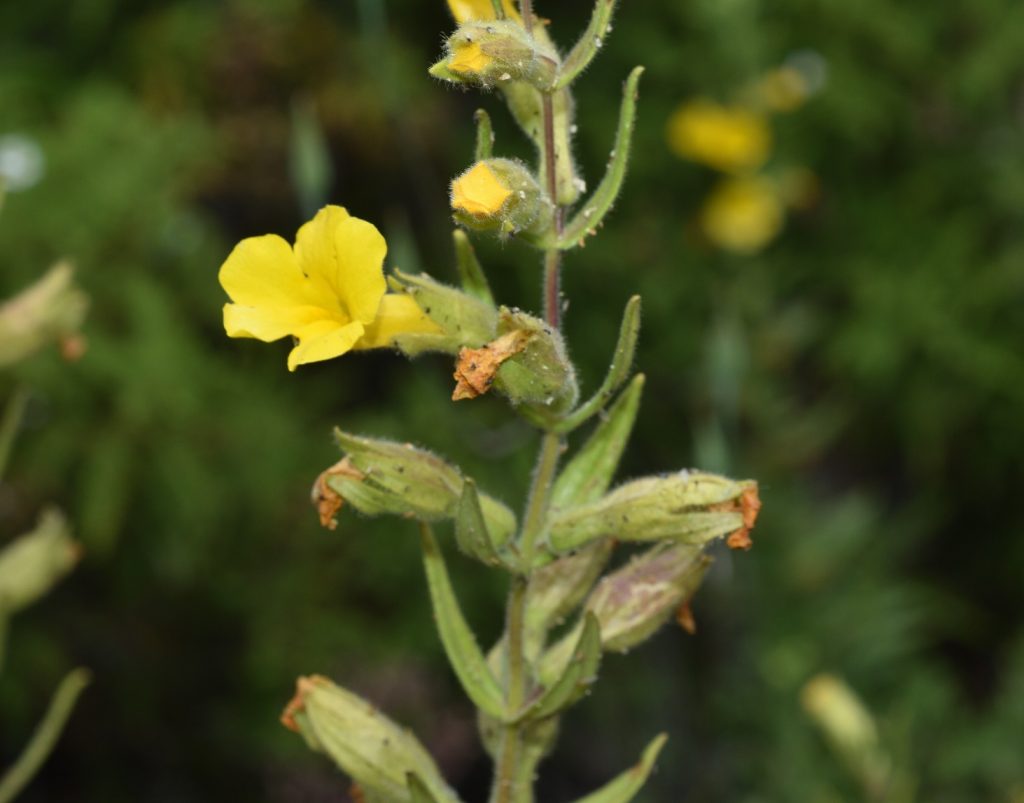
Cleveland’s bush monkeyflower (Diplacus clevelandii)
Otay Mountain, San Diego County. 06/22/19

While hiking in Noble Canyon in the Cleveland National Forest (San Diego County), I encountered a second new species called wide-throated yellow monkeyflower (Diplacus brevipes). At first sight, it could easily be confused with seep monkeyflower, but a closer examination will disclose some differences. Maybe the most obvious one is the pleat in the lower lip of the flower. The two plants also grow in very different environments. Seep monkey flower grows near water (sometimes even in water). D. brevipes grows in open chaparral.
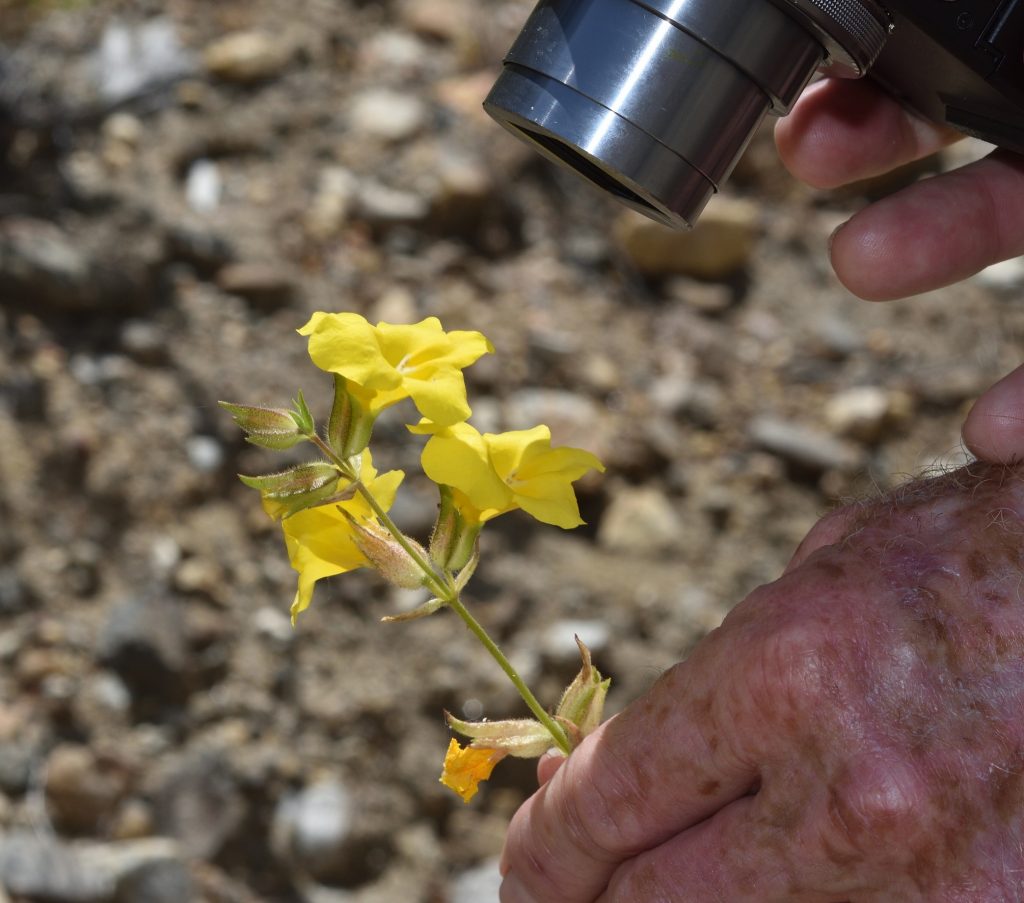
Wide-throated yellow monkeyflower (Diplacus brevipes)
Noble Canyon, San Diego County. 07/07/19
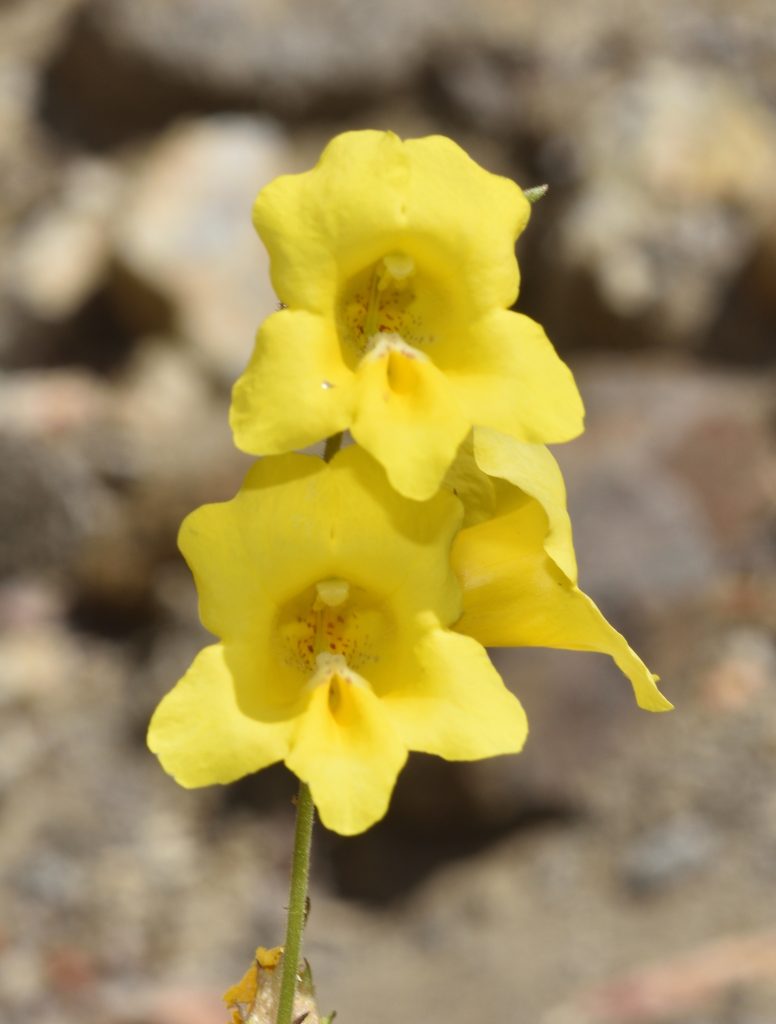
Wide-throated yellow monkeyflower (Diplacus brevipes)
Noble Canyon, San Diego County. 07/07/19

The third new monkeyflower I saw is called false monkeyflower. If you find that last sentence a bit confusing, that makes two of us. As far as I can tell, false monkeyflower is regarded as a true monkeyflower, despite the name. Of course, “monkeyflower” is itself a common name, so, from a scientific point of view, I guess it’s kind of a moot point.

False monkeyflower is quite a bit different from the other monkeyflowers we’ve seen here. The most striking difference is that the flowers are much smaller. I would guess that they are only about an eight of an inch across. (I should have included a coin in one of the photos for reference, but I didn’t think of it.)

False monkeyflower is sometimes classified in the genus Erythranthe, in which case, it’s called Erythranthe pilosus, but because it’s so different from other monkeyflowers, many botanists place it in its own genus, Mimitanthe. In that case, it’s called Mimitanthe pilosa.
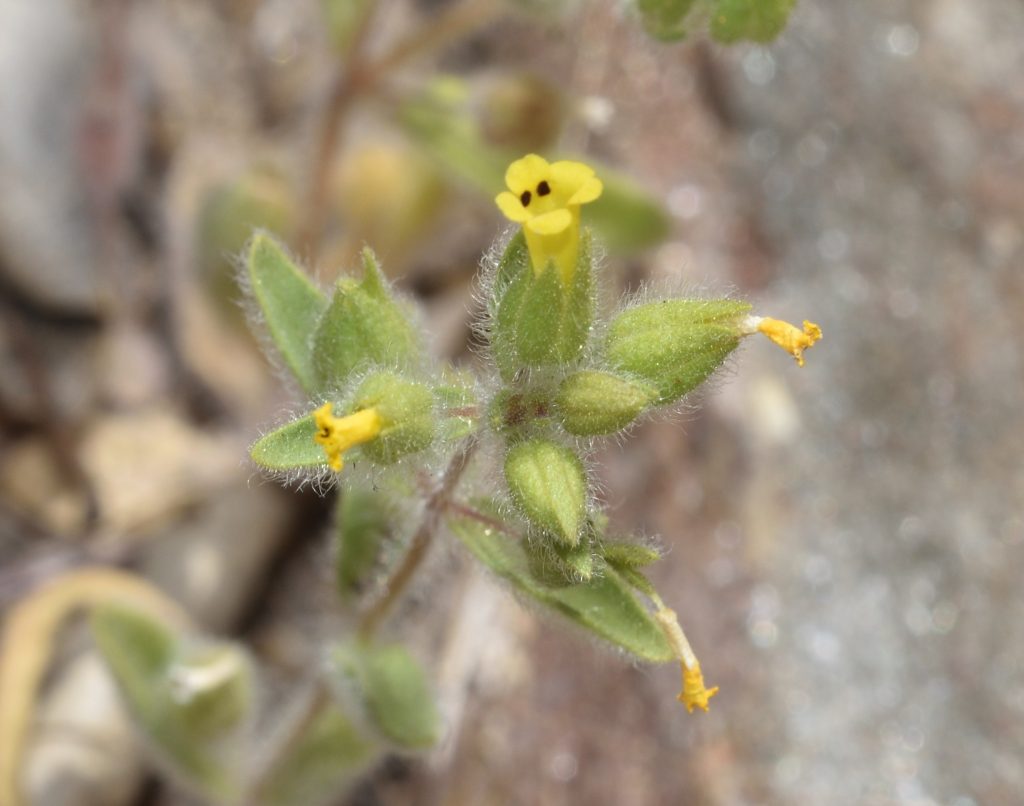
False monkeyflower (Mimitanthe pilosa)
Noble Canyon, San Diego County. 07/07/19
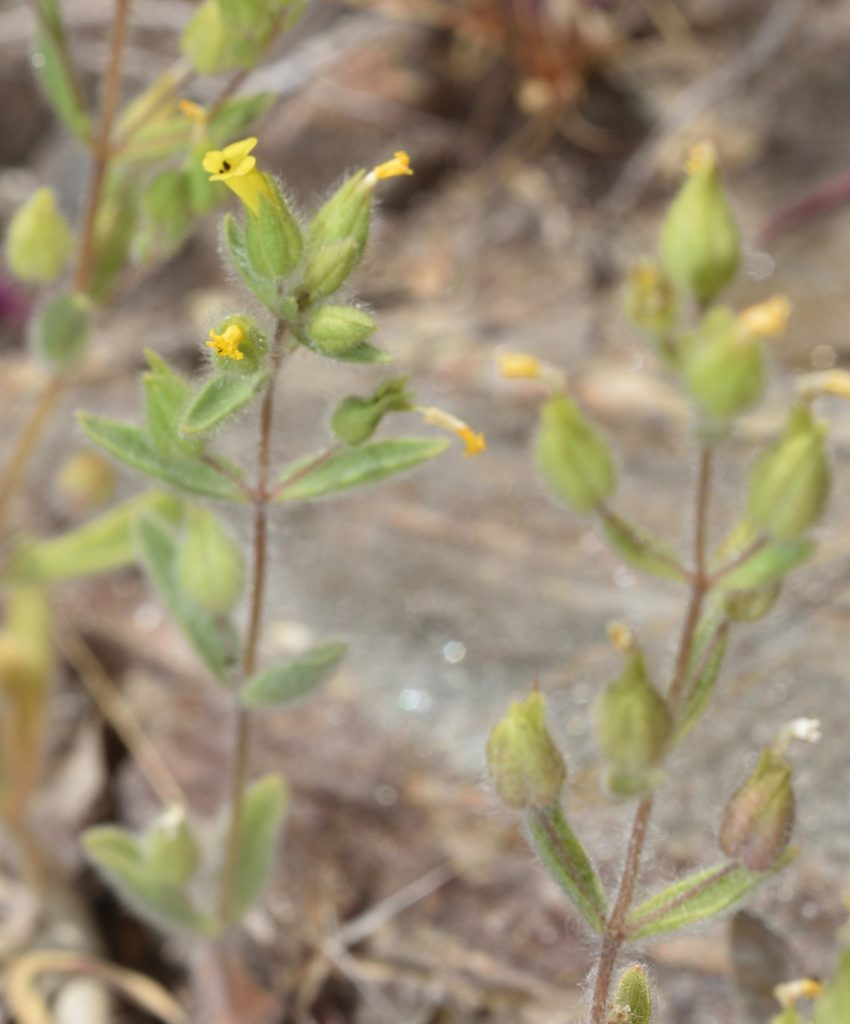
False monkeyflower (Mimitanthe pilosa)
Noble Canyon, San Diego County. 07/07/19
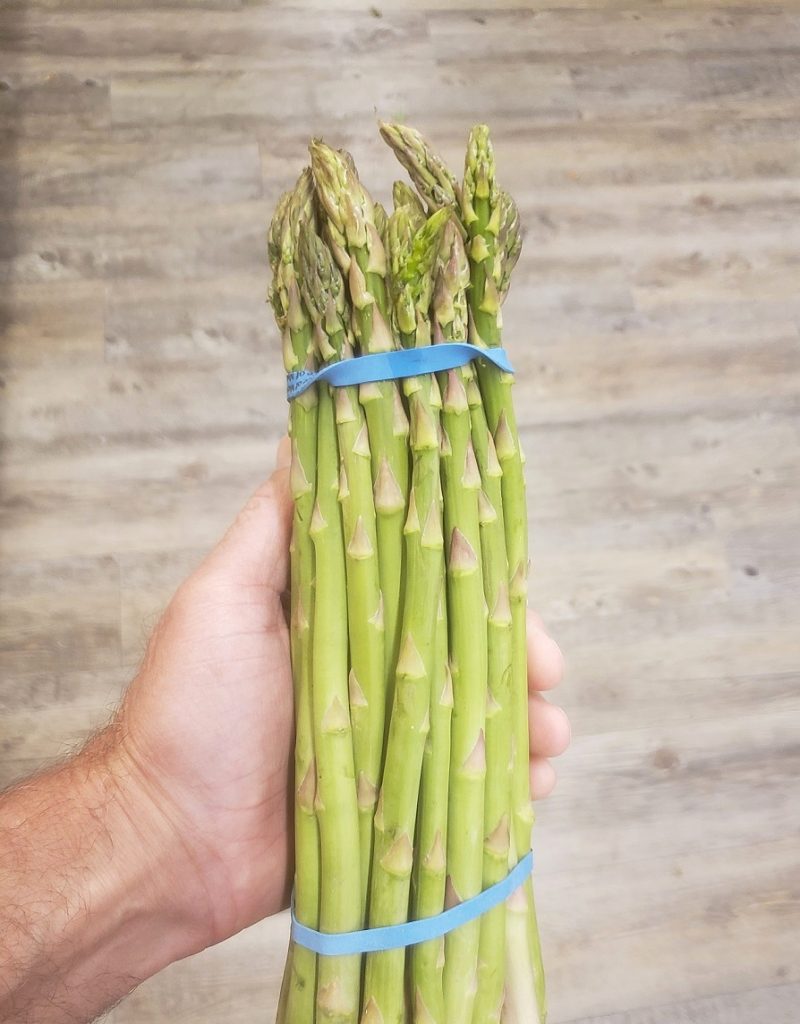
Asparagus & Co.

The vegetable asparagus comes from the plant Asparagus officinalis, which is a member of the family Asparagaceae. In botany, all family names end in -aceae, which is usually pronounced as if you were saying the letters A, C, E in quick succession. So, for example, grasses are in the family Poaceae; mustard plants are in the family Brassicaceae; and lilies are in Liliaceae. (For an introduction to the science of classification, see my previous post Taxonomy 101.)

Asparagus officinalis shoots

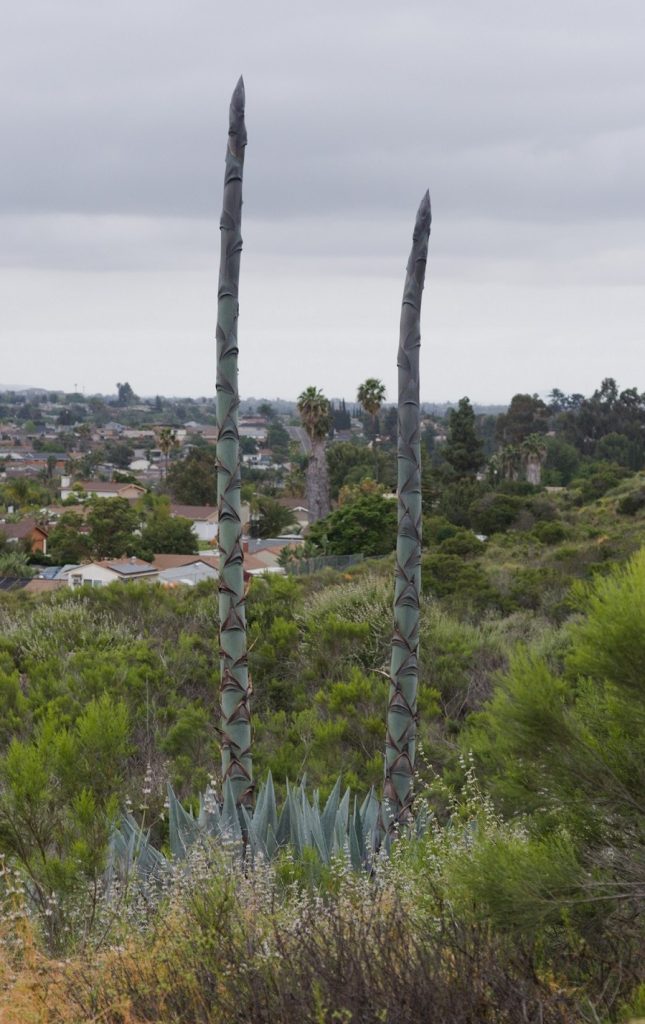
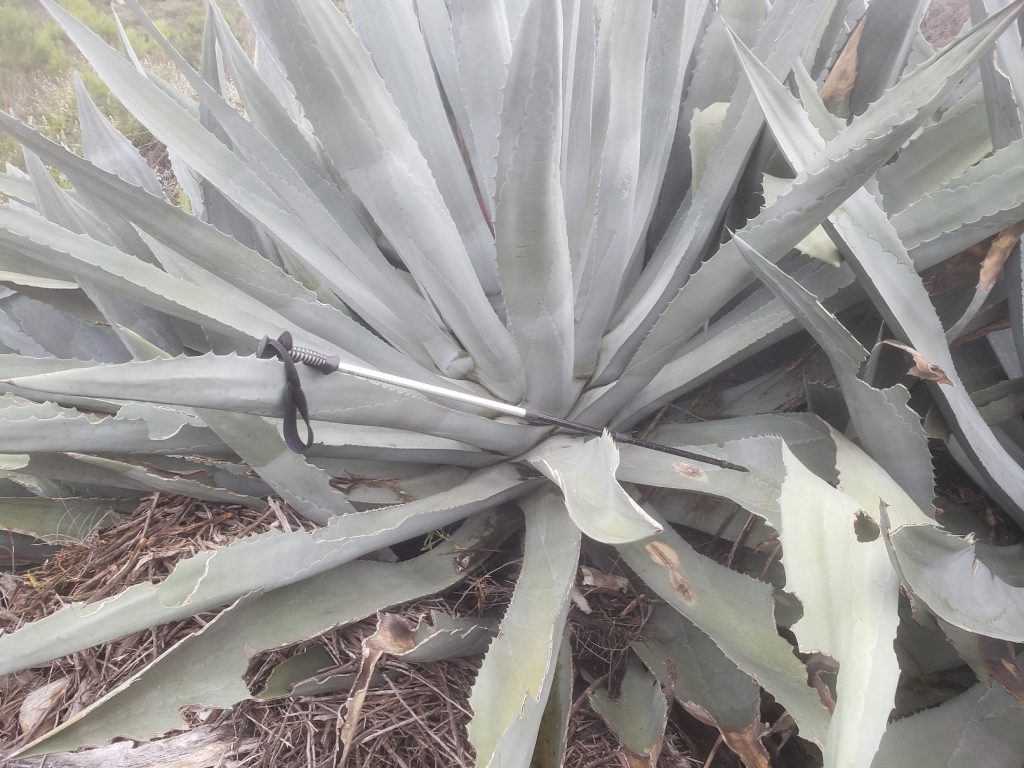
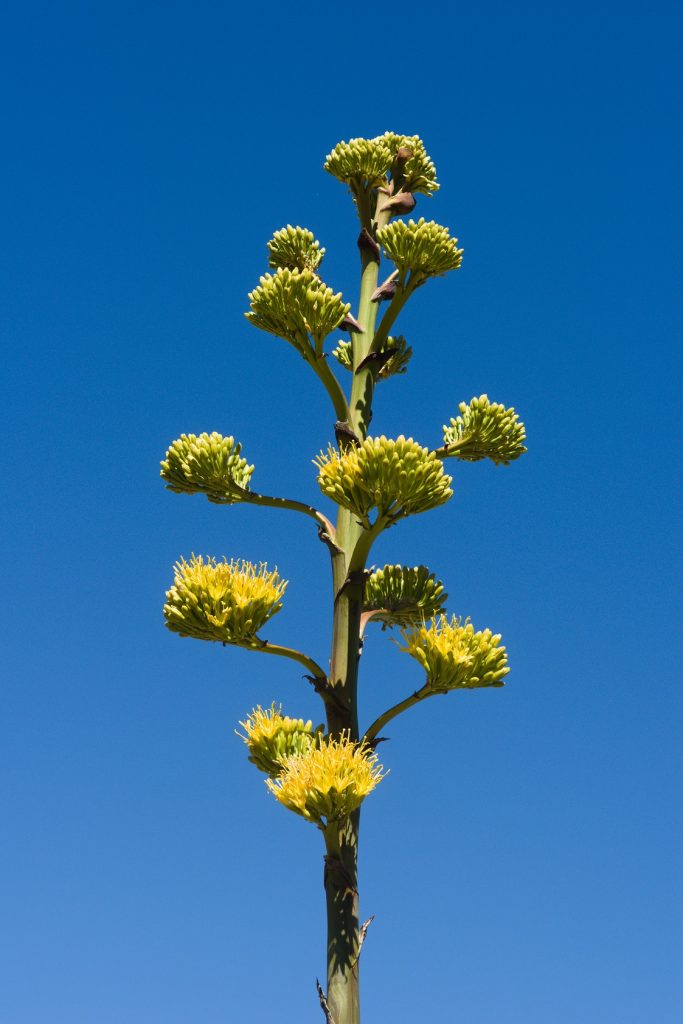
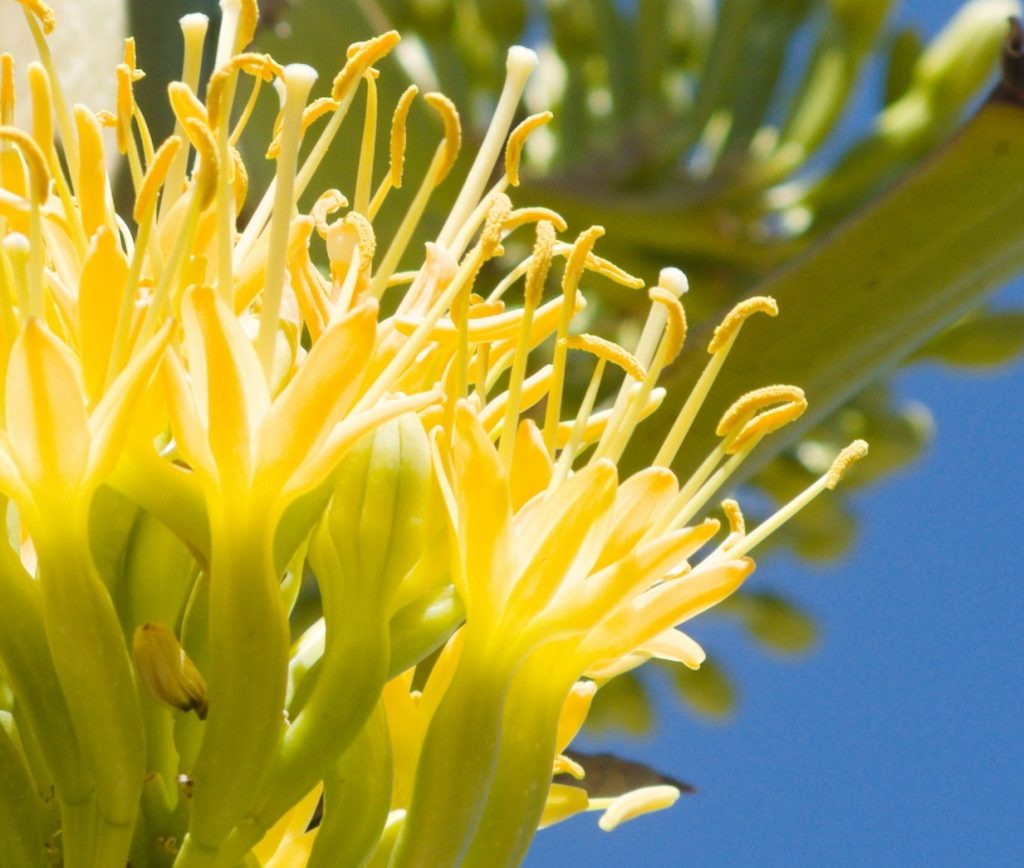
While hiking Cowles Mountain recently, I came across what for all the world looked like two giant stalks of asparagus twenty to thirty feet tall. They were actually Agave americana, a species of Agave that is native to Mexico, New Mexico, Arizona, and Texas. This plant lives for ten to thirty years. For most of its life, it consists of a rosette of sharply-spiked, succulent leaves. This rosette can reach a height of around six feet. Near the end of its life, Agave americana blooms for the first and last time. The plant shoots up a giant stalk, which eventually sprouts a huge inflorenscence of yellow flowers. The flowers are pollinated by bats and occasionally moths. Because of its long life, Agave americana is sometimes called a century plant; although, it never actually lives much past thirty years.

Century plant (Agave amercana)
At the base of Cowles Mountain, Mission Trails Regional Park 4/30/19
The rosette at the base of the plant with my hiking pole for reference

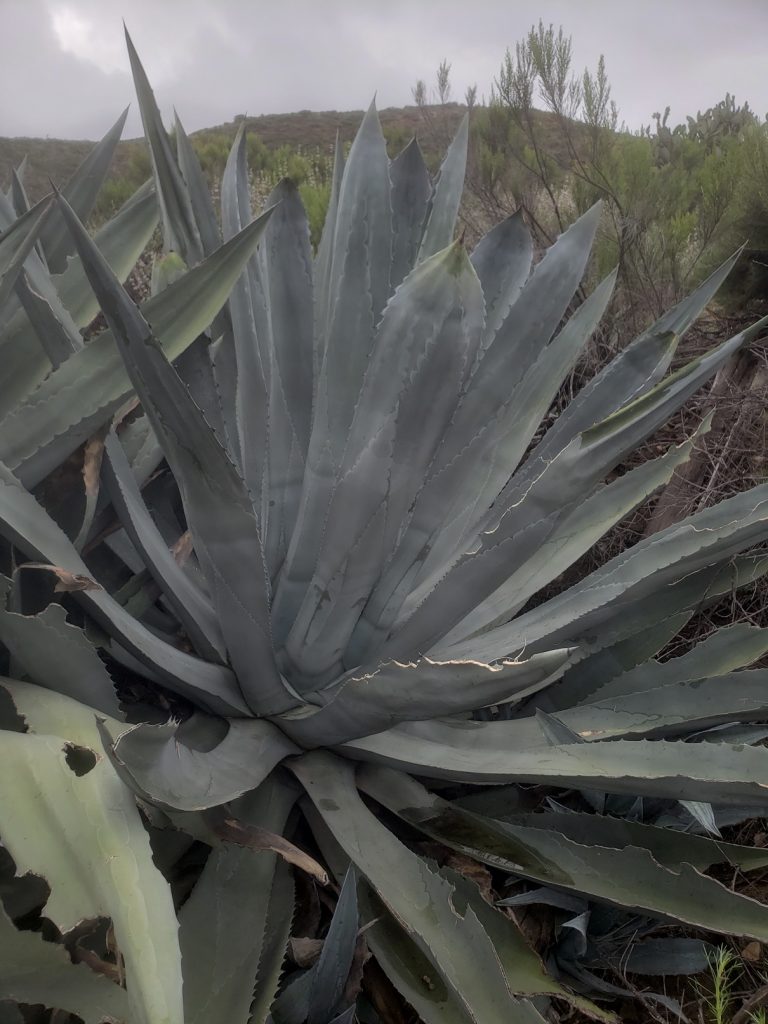
In addition to reproducing sexually through its flowers and seeds, Agave americana reproduces asexually by putting out suckers from its roots. These suckers are called puppies or pups. They form around the base of the rosette and are clones of the main plant. The main plant dies after flowering, but the puppies live on and eventually flower themselves.

One of the pups. This is a sucker sprouting from a root of the main plant. It will continue to live after the main plant flowers and dies.

As you may have guessed, Agave americana and agaves in general (of which there are many) are in the asparagus family. Like asparagus, agave is edible. Agave murpheyi, in particular, was an important food source for Native Americans. Most parts of the plant were eaten at some stage of its development.

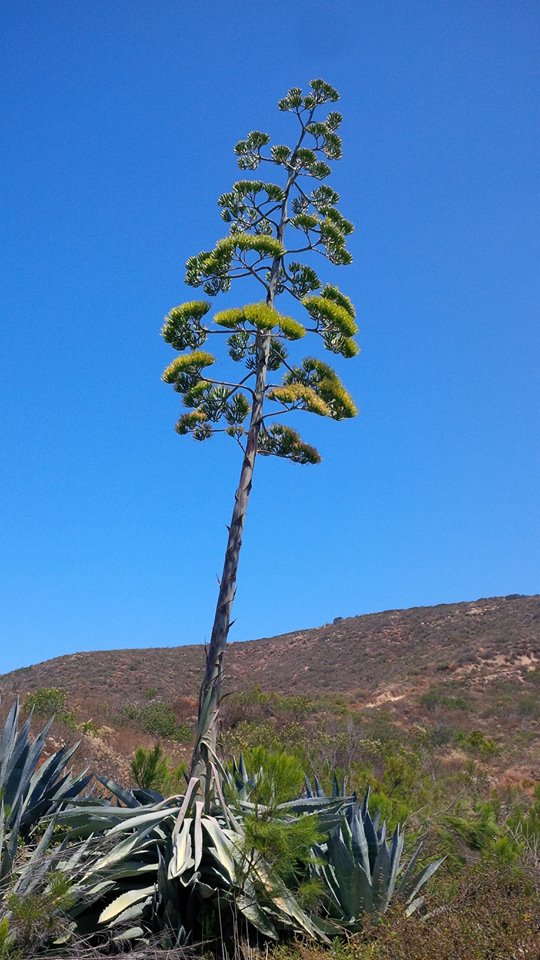
This is a century plant in bloom. I saw this one in 2016, also at the base of Cowles Mountain. The plant is probably close to 30 feet tall.

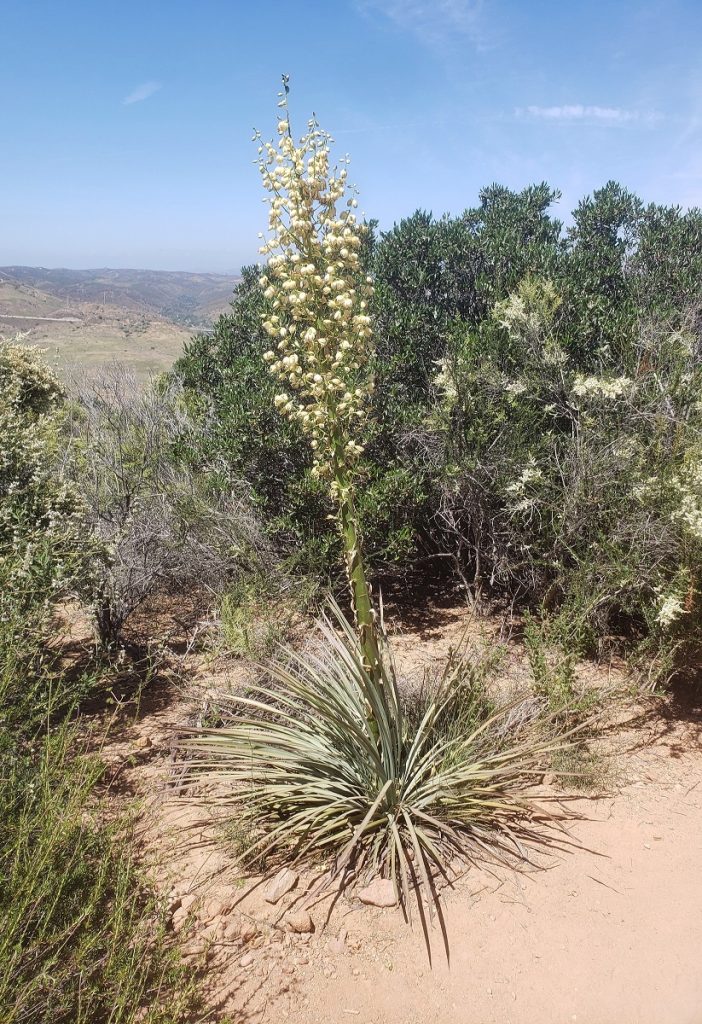
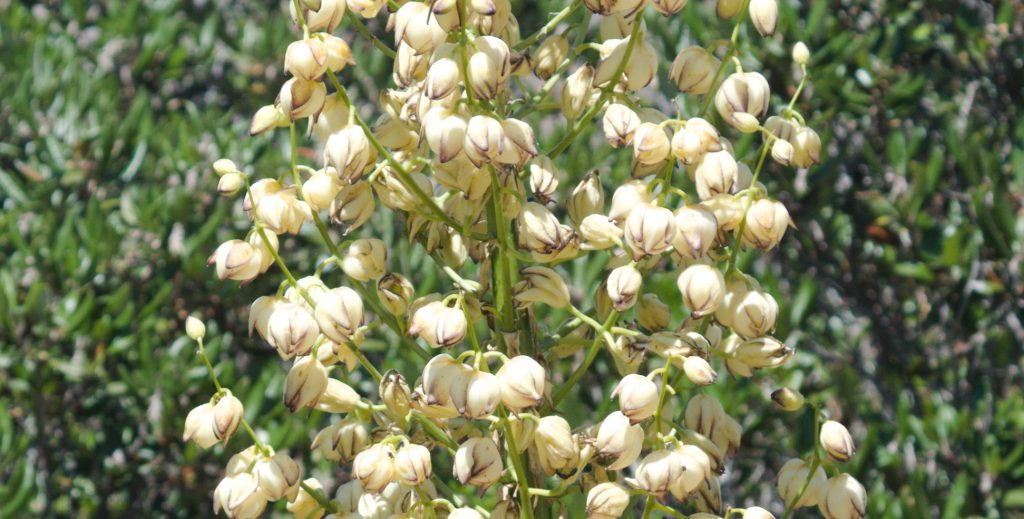
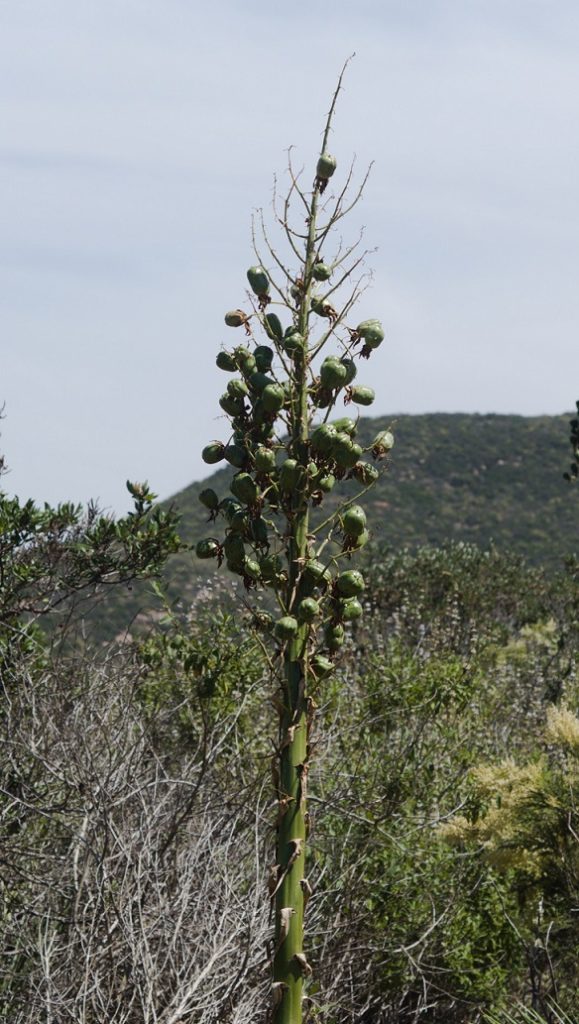
Another closely related member of Asparagaceae found in southern California is yucca. Yucca is the genus name. There are many individual species. They look very similar to the agaves, but the leaves tend to have smooth margins, instead of the spikes that are typically found on agave leaves. The most common yucca in my neighborhood (just east of San Diego) is Hesperoyucca whipplei 1, whose common names include chaparral yucca and Spanish bayonet. In form, it’s very similar to Agave americana, having a rosette of spiky leaves at the base and, when in bloom, a tall central stalk with a large inflorescence. The plant is much smaller than Agave americana, though, with the stalk rarely exceeding ten feet in height.

Hesperoyucca whipplei
Mission Trails Regional Park 5/5/19
Hesperoyucca whipplei flowers
Hesperoyucca whipplei fruiting

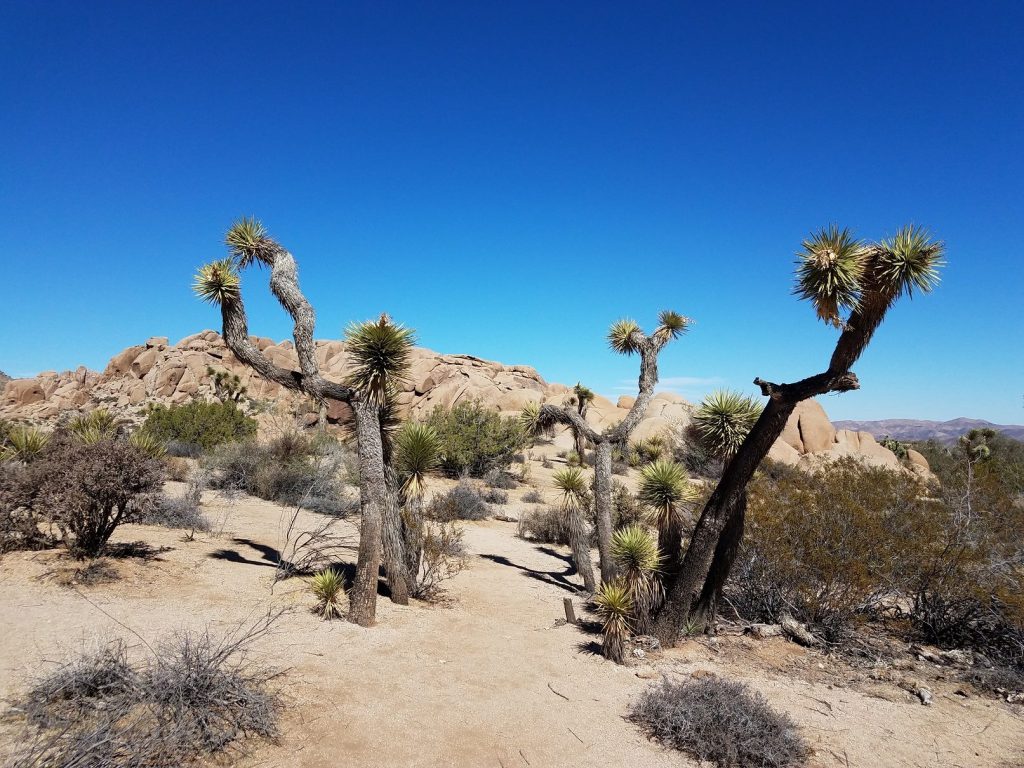
Probably the most striking of the yucca’s, at least in the United States, is the Joshua Tree (Yucca brevifolia). Joshua Trees are common in the Mohave Desert, especially in the part of the desert that extends into Joshua Tree National Park (roughly the northern half of the park). Joshua trees grow quite large — up to about 49 feet. Unlike Agave americana and Hesperoyucca whipplei, Yucca brevifolia has a weirdly branching central trunk and the leaves grow at the ends of the branches, instead of at the base of the plant.

Joshua Trees (Yucca brevifolia)
Joshua Tree National Park 10/18/16

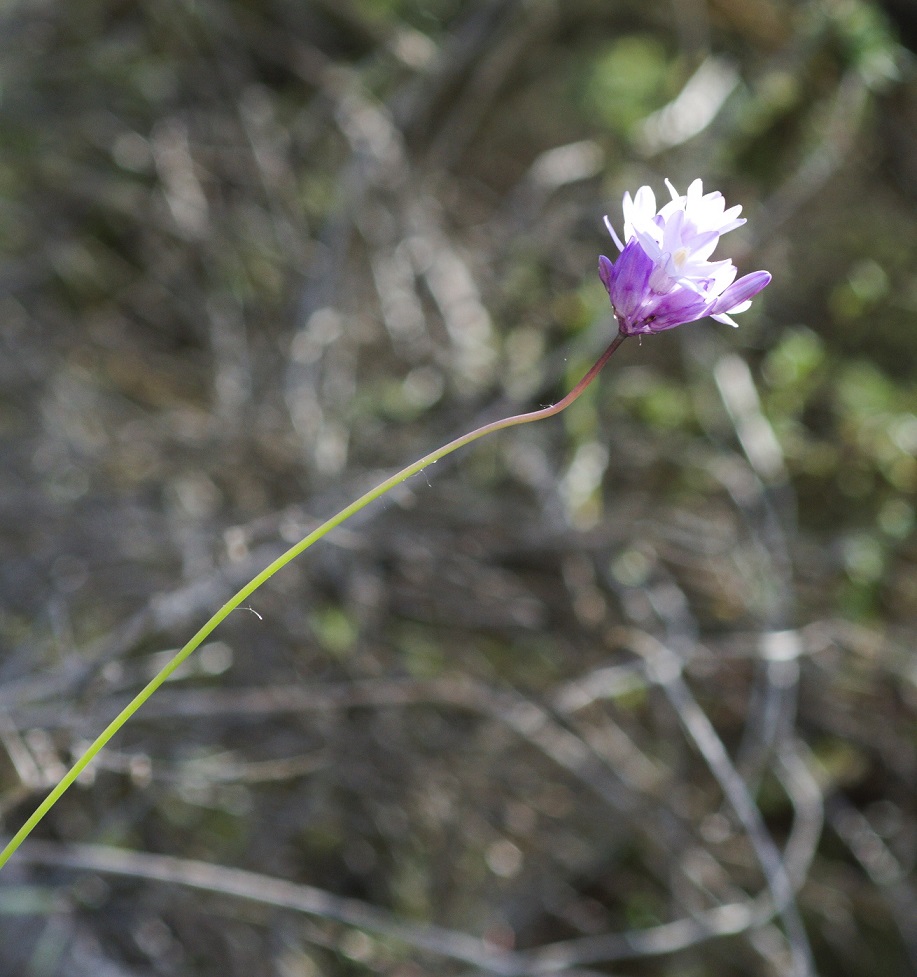
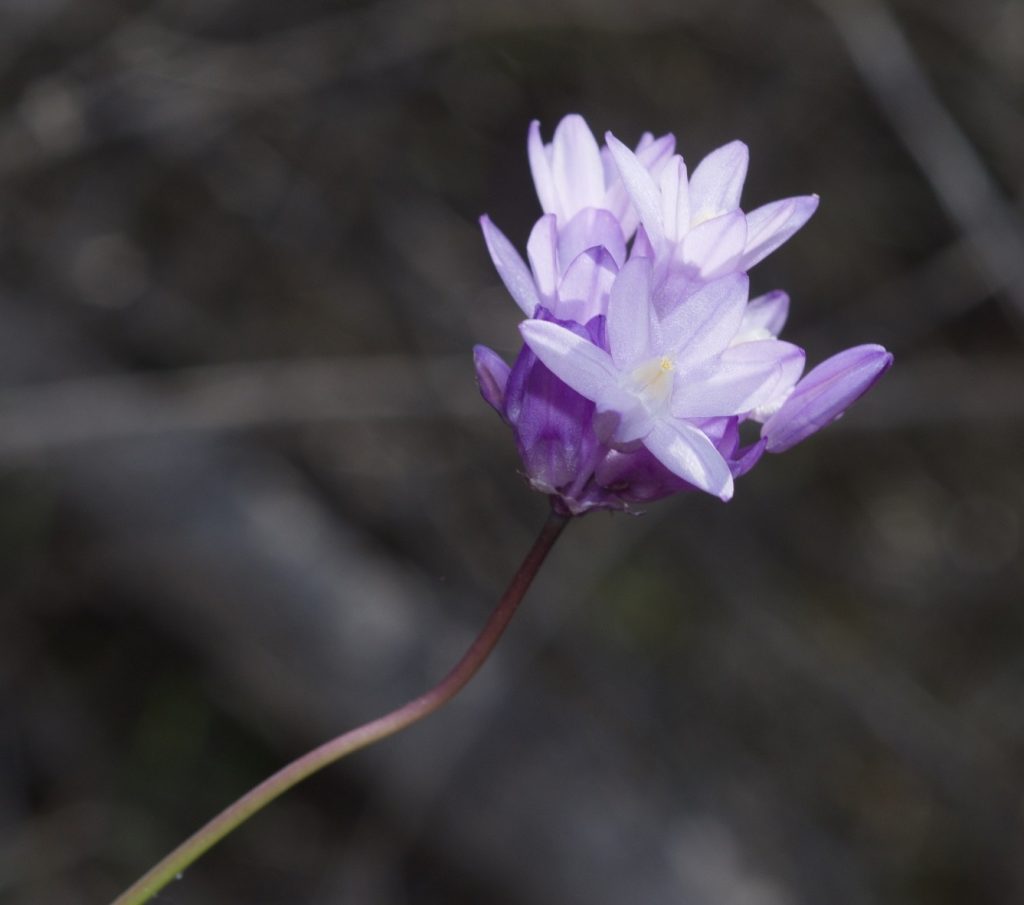
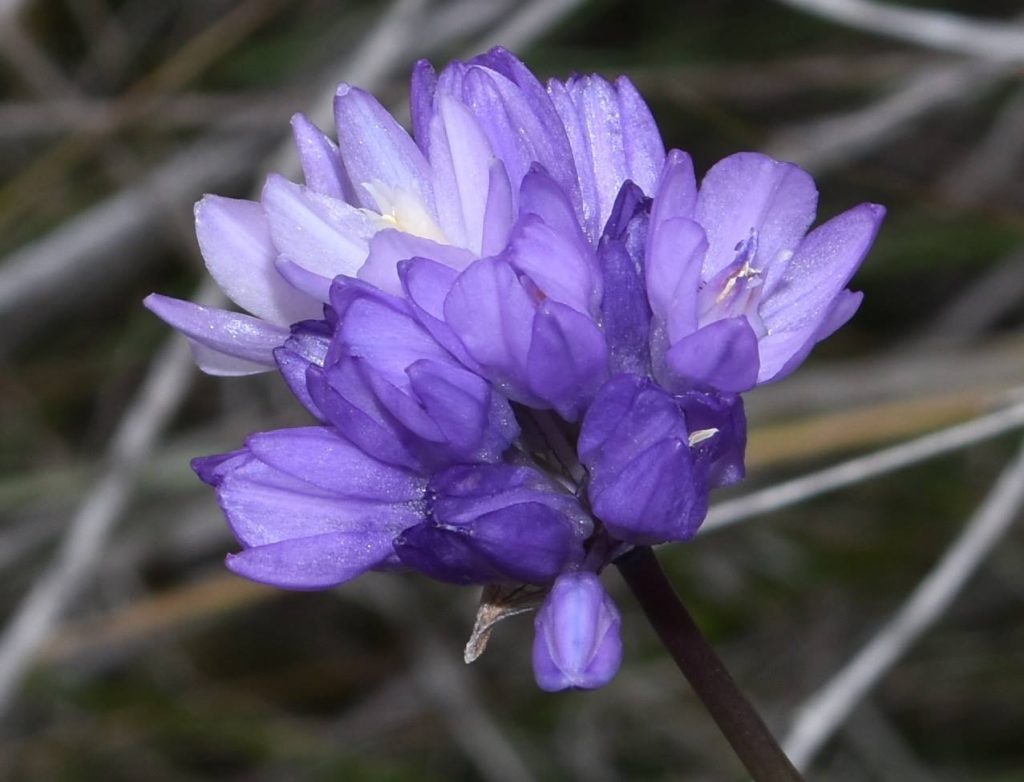
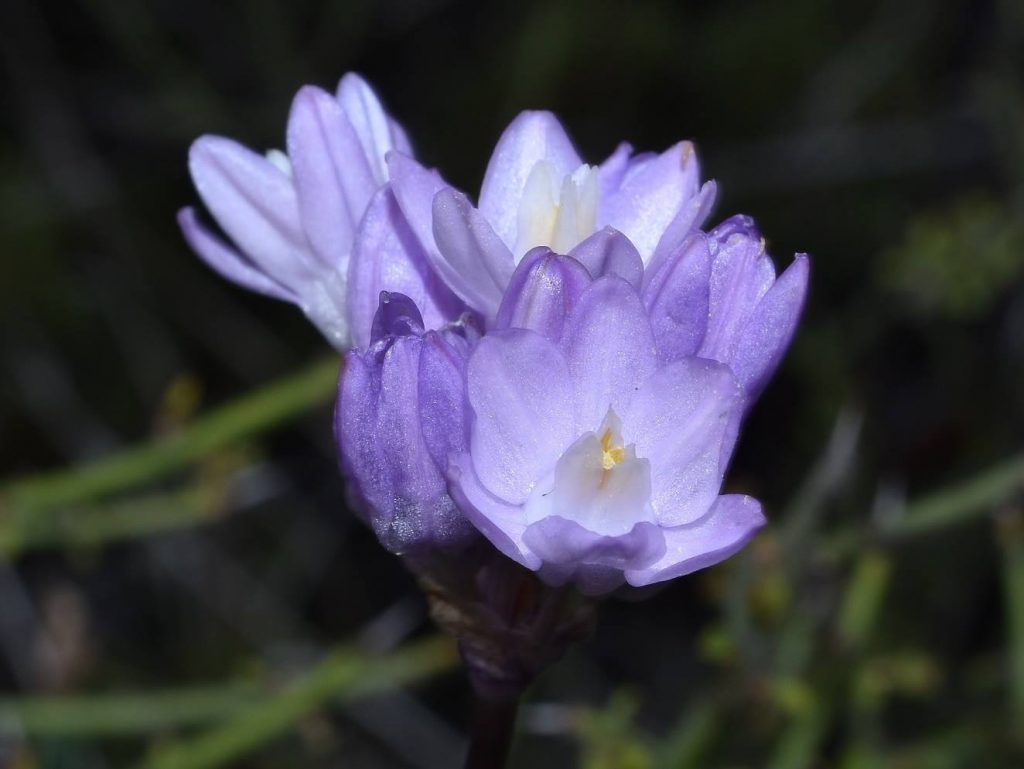
There is one other member of the Asparagaceae family that is very common here in southern California — blue dicks. (No, I’m not making up that up. The vulgar connotation associated with the word “dick” is of fairly recent origin, so the name was perfectly innocent when it was originally adopted.) The “blue” part of the name comes from the color of the flowers; although, they’re usually more purple than blue. “Dick” is probably just a shortening of the genus name, Dichelostemma, where the “ch” is pronounced as a “k”. The complete scientific name is Dichelostemma capitatum.

Blue Dick (Dichelostemma capitatum)
Mission Trails Regional Park, San Diego County 5/2/19

The blue dick does not look very much like asparagus, agave, or yucca. For one thing, it’s quite small — only growing a foot or so tall. It does, however, have a single thin stalk with a cluster of flowers at the top. It only has two or three leaves, but they grow from the base of the stalk like the basal rosettes of many agaves and yuccas.

Here are some more photos of this beautiful plant:

Mission Trails 5/2/19
Mission Trails 3/16/18

Here’s a couple more examples of plants in the asparagus family. First, here are some photos of the beautiful inflorescence of the desert agave (Agave deserti), which looks like a smaller version of Agave americana:

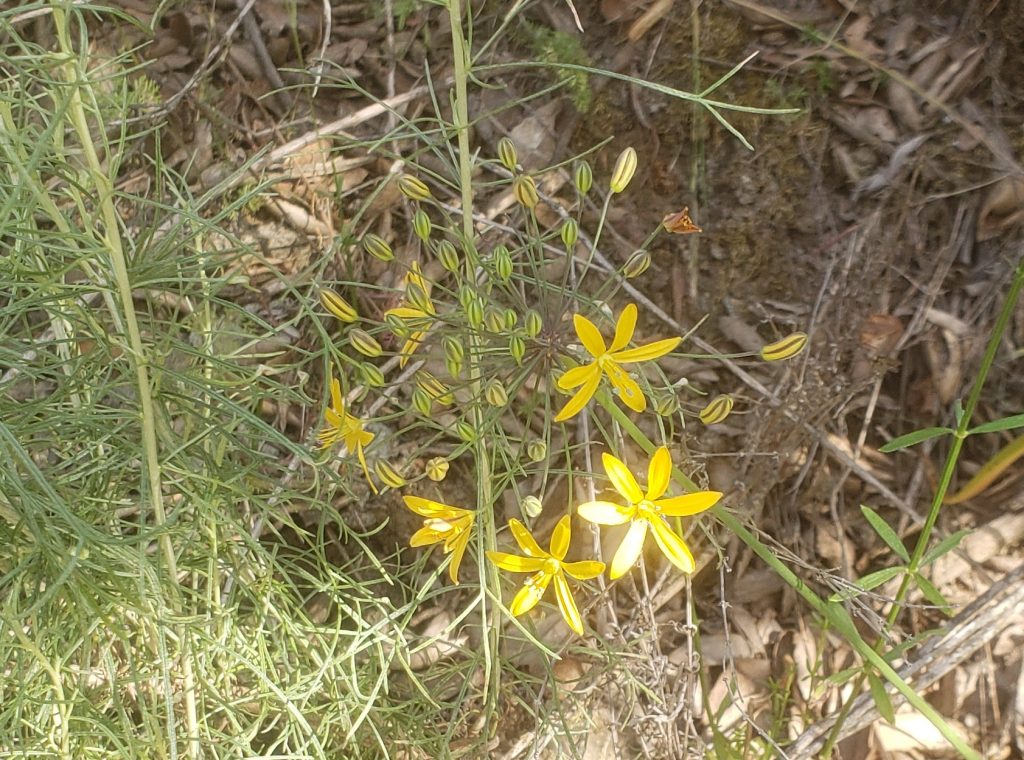
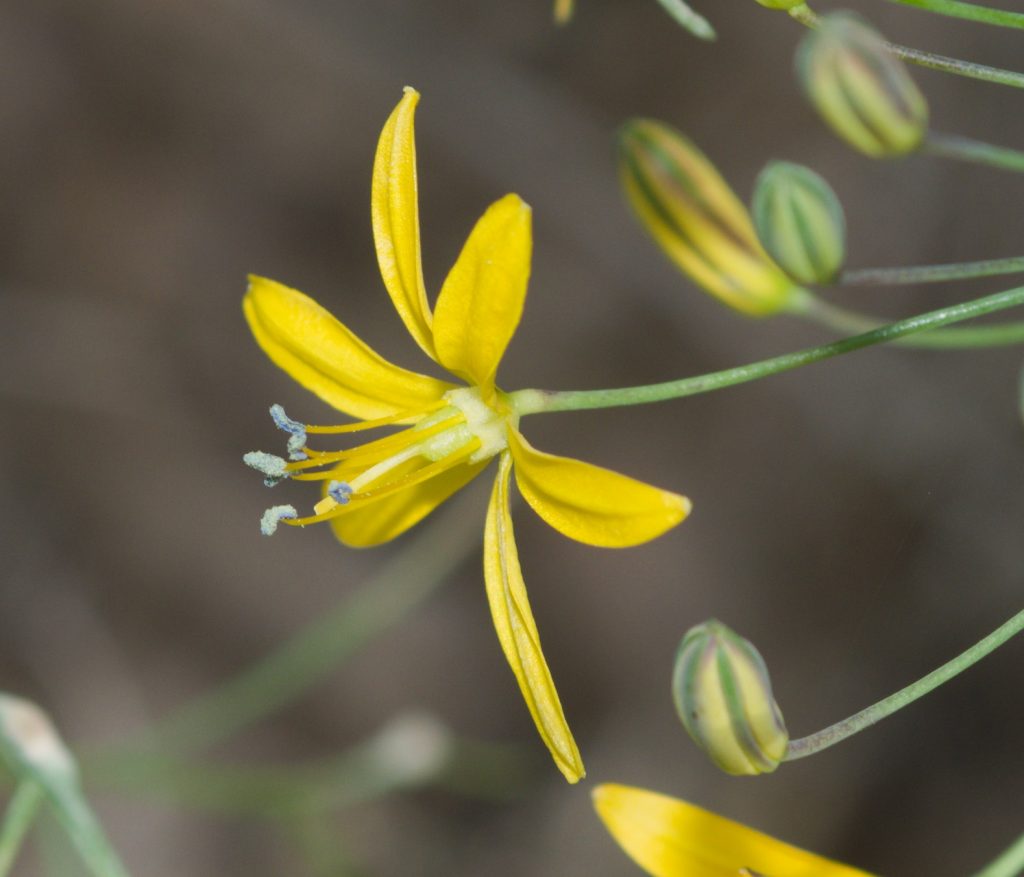
And here’s another of the smaller members of the family, Bloomeria crocea or goldenstar:

Goldenstar (Bloomeria crocea)
Mission Trails 5/2/19

Looking at all these different members of the Asparagaceae, you might be wondering why on Earth botanists would group them all together under one family. As I already mentioned, many of the plants share a basic form — a long, thin stalk with flowers at the top and leaves at the bottom. Often, especially in the case of the agaves and yuccas, the leaves are thick, fleshy, and succulent, with sharp tips.

Many of the members have corms. A corm is an underground swelling of the stem of the plant that is used for food storage. In the case of perennials, such as the blue dicks and goldenstars, the above ground part of the plant will die at the end of the growing season, but the corm will survive, so that the plant can grow again the following year. Yuccas are not perennials, but they still have underground tubers similar to corms that also act as storage organs.

There are some similarities in the inflorescences, too. The most important thing though, beyond all the similarities and differences, is that all the members of Asparagaceae share a common evolutionary origin. At some point long ago, one species of plant branched into multiple species, some of which branched in their turn, until, millions of years later, we ended up with a family of several hundred species of all shapes and sizes.

Extraordinary Variety

My purpose in writing about all these different members of Asparagaceae, beyond just exploring a very interesting plant family, was to introduce a topic that I’ll be coming back to in many future posts — namely, how organisms that are very closely related can, nevertheless, vary remarkably. On the one hand, you have two species of plant — Asparagus officinalis and Agave americana that are in the same family and do look very similar, except that one grows only a foot or so tall, while the other can be up to thirty feet! On the other hand, you have the Joshua Tree (Agave brevifolia), which is similar in many ways to chaparral yucca (similar leaves, similar inflorescences), but has the leaves in the “wrong” place and, moreover, has a branching trunk in place of a single stalk. And then you have the blue dick, which at first glance seems completely unrelated, but, on closer examination, has many features in common with other members of the family.

This observation is not limited to plants. Closely related animals, too, can vary to a remarkable degree. Perhaps there is no better example than the dog. Dogs evolved from wolves. In fact, wolves and dogs are in the same species, Canis lupus. If a dog mates with a wolf, the offspring will be viable. That is, the offspring will be able to mate with each other and, in their turn, produce offspring. This is one of the definitions of a species. So every kind of dog from a miniature chihuahua to a great dane is just a variation on the same basic model.

How is this possible? I like to look at it like this… suppose you want to build a robot dog and you want that robot dog to have all the behaviors of a real dog. How hard would that be? Pretty hard, obviously, but let’s suppose that, being the amazing robotics genius that you are, you somehow manage to pull it off. Now suppose you decide that one incredibly advanced robot dog is a bit boring. You’d like to have lots of different of robot dogs — big ones, small ones, cute robot Pomeranians, ugly robot Pugs 2, annoying little robot chihuahuas, and so on and so forth. How hard would it be to accomplish that? Well, compared to building the original model, it would probably be a piece of cake.

I think it’s much the same with nature. It took billions of years for the first dog to evolve from the primordial soup. But now that we’ve got the basic model, spinning off variations on it is a cinch.

Frankincense and Myrrh and Elephant Trees

“All you have to do is look at the plant to reliably identify it…”
-Tom Chester*

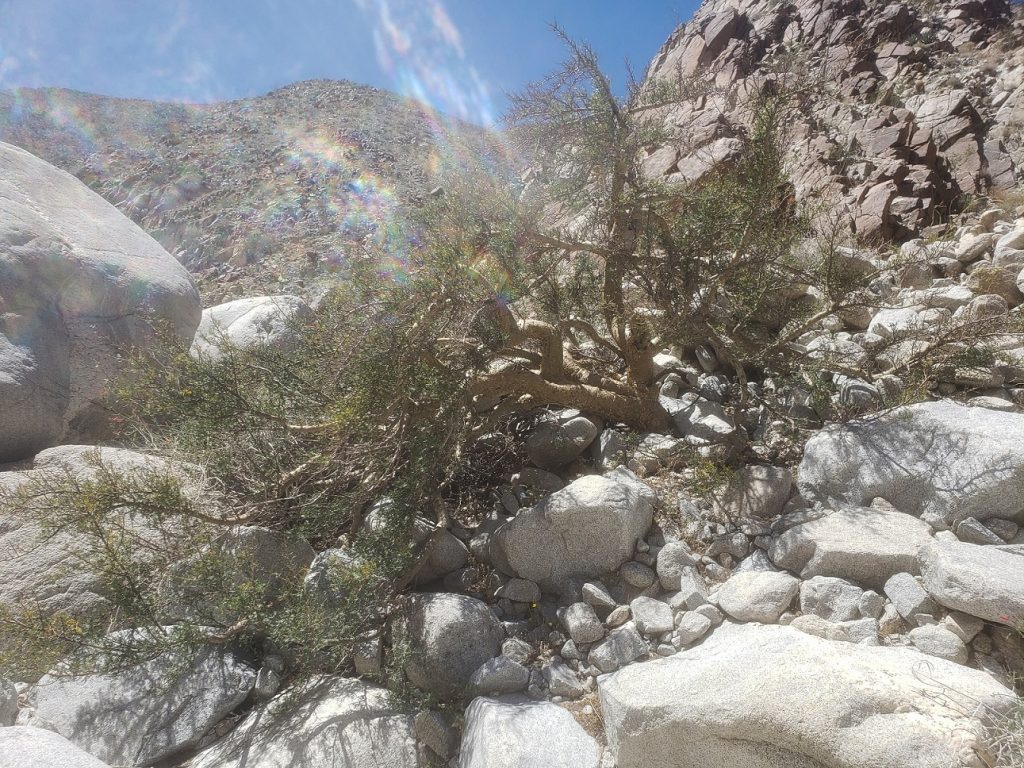
The above quote should give you some idea just how distinctive the elephant tree is. Elephant trees (Bursera microphylla) are fairly common in Mexico, especially in Baja California and the central Sonoran desert, but they’re not so easy to find north of the border. There are a few places in Anza Borrego State Park where you can see them, though. The largest collection is in Alma Wash and Alma Canyon, just south of Ocotillo Wells.**

It’s not an easy place to get to. From Ocotillo Wells, you take Split Mountain Road to the beginning of Elephant Trees Nature Trail. It’s not far to the trail head, but the road is a bit rough. My car is AWD with an 8.5 inch clearance — a bit higher than the average car. So you don’t need an off-road vehicle, but high-clearance is advised. Elephant Trees Nature Trail is a fairly short loop. Unfortunately, there’s only one elephant tree left on the trail, as of this writing, and it’s not a particularly impressive specimen.

If you want the full experience, keep going up the wash, turn into Alma Canyon, and follow it to Starfish Cove. The entire hike is around 11.3 miles, give or take. It’s a long, arduous slog, much of it over broken rock and small boulders. Make sure you go during cooler weather and bring plenty of water.

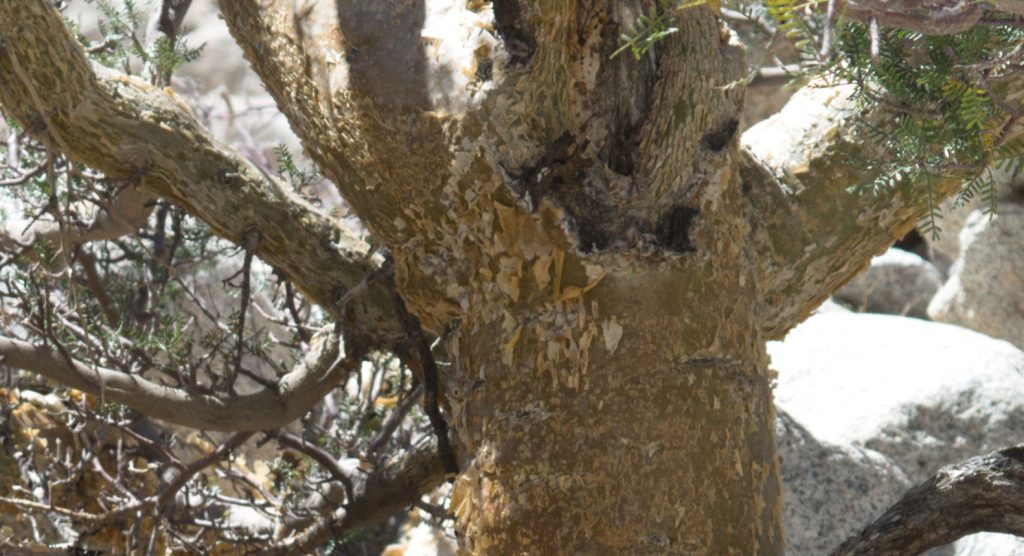
So what’s so special about an elephant tree? Elephant trees are not tall — usually no more than 6 feet — but they have massive trunks for their size. The trunks are often very gnarled. Supposedly, if a boulder rolls over a young tree, it will often just keep growing, now with a new twist in its trunk. But a lot of the trees have gnarled trunks, so I doubt that rolling boulders can account for all of it. It would be interesting to know what other sorts of things cause the trunks to grow like that.

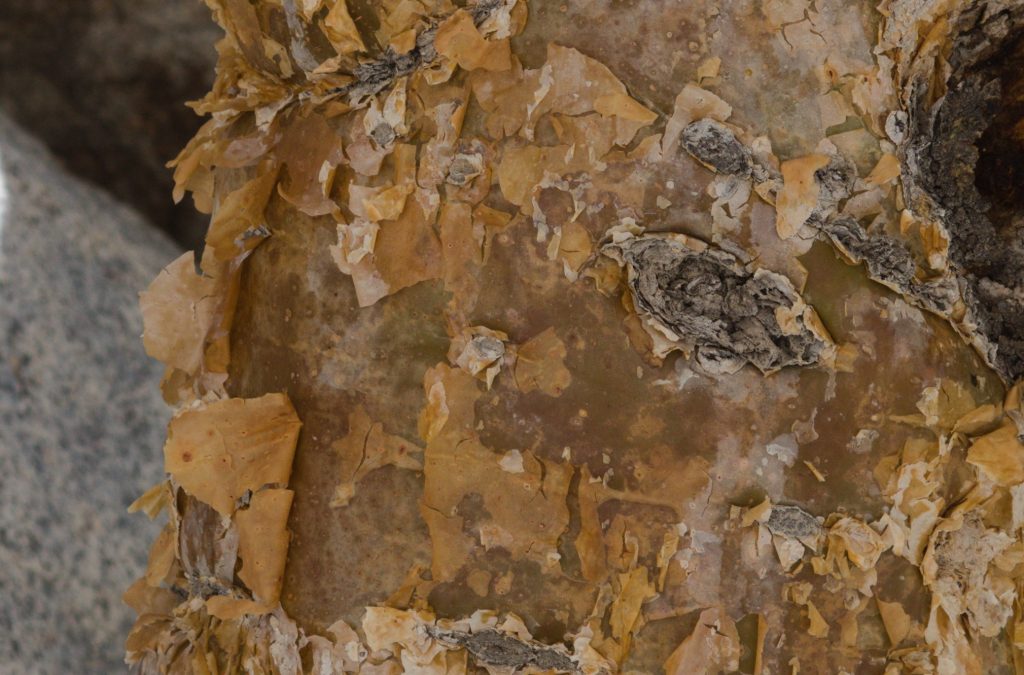
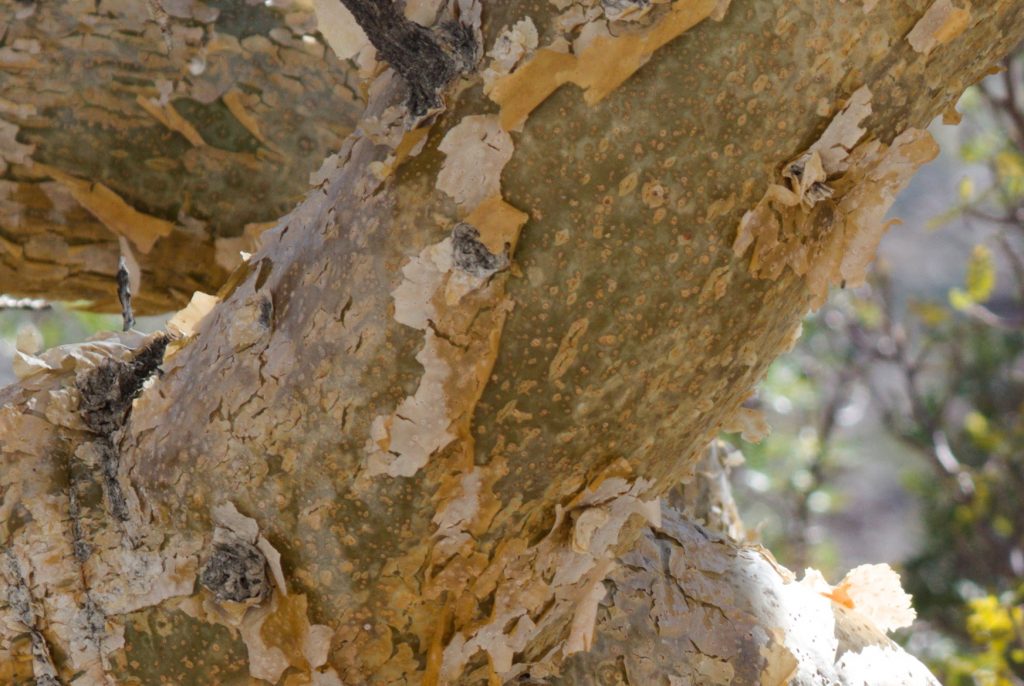
The branches and twigs tend to be of a more normal size for the height of the tree, so they kind of look like they’re too small for the trunk (or maybe it’s just that the trunk looks too large for the tree). But this just adds to the tree’s exotic look. Younger branches have a reddish color. The bark is very papery and peels away from the trunk. Some people have suggested that the rustle of this peeling bark in the wind attracts pollinating insects.

The elephant tree is a semi-succulent. It stores water in its thick trunk and lower limbs. The leaves are pinnate (compound with the leaflets arranged in a feather-like pattern) and rather small. They resemble the leaves of mesquite and cat-claw, which initially made me think they were in the pea family, but, as we’ll see in a minute, that turns out not to be the case.

The flowers are white or cream colored. They’re small, star-shaped, and not very showy, which is just as well, since the trees usually flower in June or July — not the best time to be hiking in Anza Borrego.

So how do frankincense and myrrh come into the picture? Frankincense and myrrh are aromatic resins extracted from trees in the Boswellia and Commiphora genera, respectively, which are both in the family Burseraceae. The elephant tree is also in this family. So perhaps it’s not too surprising that the sap of the elephant tree has a very pleasant aroma. In fact, the whole tree has a nice fragrance.

Frankincense and myrrh have been used for centuries in perfumes and incense. They’ve played an important role in religious ceremonies in the Middle East and Europe and they’ve been used for various medicinal purposes, as well.

Native Americans used the red sap of the elephant tree in much the same way as frankincense and myrrh were used in the Old World. The Cahuilla treated the sap as something of a panacea, using it to treat a wide variety of illnesses. In fact, it was believed to be so powerful that it was too dangerous for ordinary people to handle. It was kept hidden away and only used by the shamans.

*From his website: http://tchester.org/bd/species/burseraceae/bursera_microphylla.html

**I’ve been told that there are other places in Anza Borrego you can go to see elephant trees that are a lot easier to get to, but by far the largest collection is in this area.

In Among the Mosses – An Introduction to Liverworts

Liverworts are primitive, non-vascular plants in the division Marchantiophyta. Mosses, hornworts, and liverworts, collectively, are referred to as bryophytes. Like mosses, liverworts tend to be small and green. They also often grow alongside mosses, so many people who see liverworts assume they are mosses, although the two don’t really look much alike.

“Wort” is simply a Middle English word meaning plant. So the name liverwort means “liver plant”. It got this name because, in olden times, people thought that the main body of some types of liverworts were shaped like livers. And, believe it or not, they thought that meant that the plant would be good for treating liver diseases. This was based on the doctrine of signatures, which argued that God made plants for the benefit of people and so he provided clues to their uses by making them look kind of like the organs they could be used to treat.

The earliest known fossils of land plants, which are between 471 million and 473 million years old, are liverworts, so they’re probably closely related to the first plants to colonize the land. Non-vascular just means that they don’t have a vascular system consisting of xylem and phloem. These are highly specialized tissues used to transport water and nutrients. This is not to say that liverworts don’t have any kind of transport system at all — they have to have some way to get water and nutrients to their cells — but the lack of a vascular system means that they depend more on simple diffusion, which limits the size they can attain. As a result, all liverworts are quite small. Liverworts don’t have roots. Instead, they have single-celled rhyzoids (thin filaments) that anchor them to the substrate.

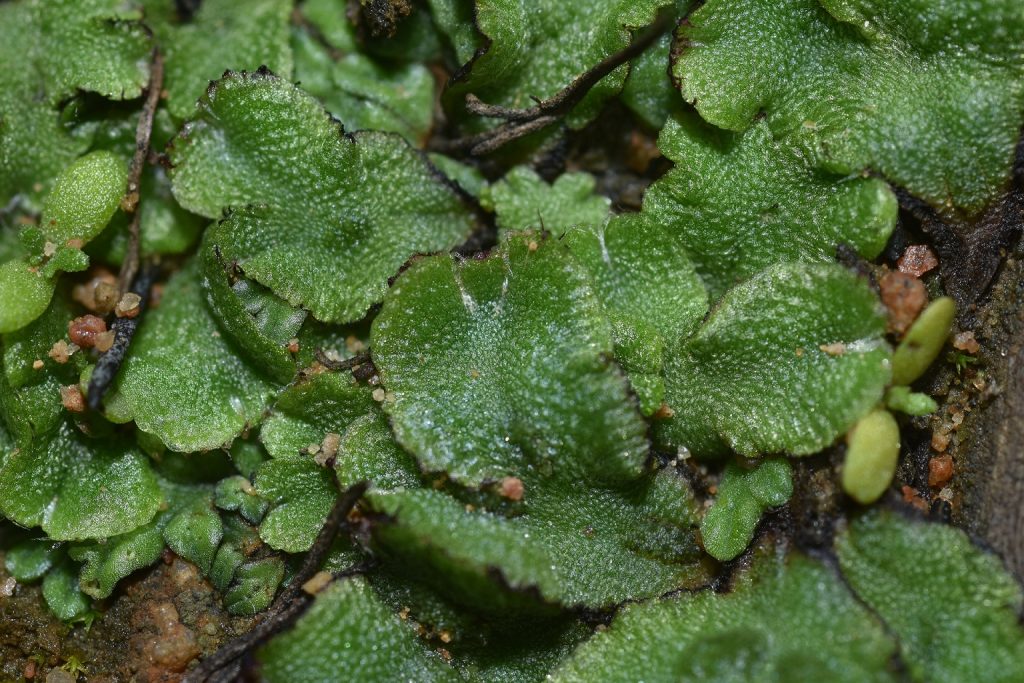
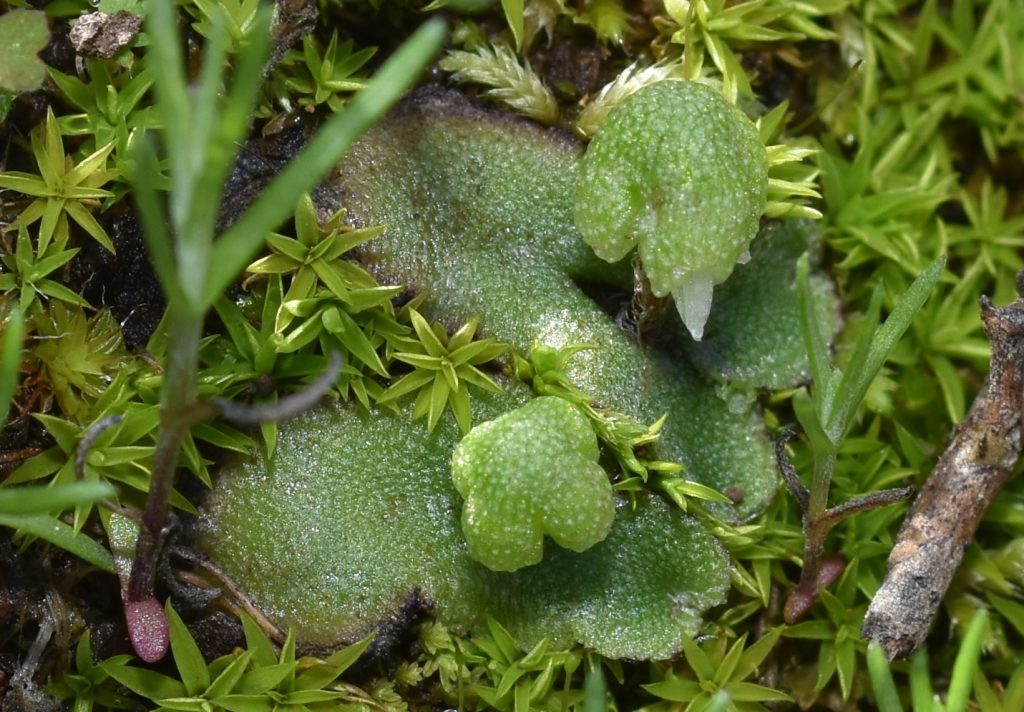
Here’s some photos of liverworts I’ve seen in San Diego County. Notice that in some of the photos, the liverworts consist of very flat, blob-shaped or leafy structures. These are thalli (singular thallus). They are the main body of the plant. In other photos, each thallus has a stalk rising up from it. This is called a gametangia and it’s the reproductive part of the plant.

Liverworts (Asterella bolanderi)
Gametangia sprouting from thalli
Liverwort (Asterella bolanderi)
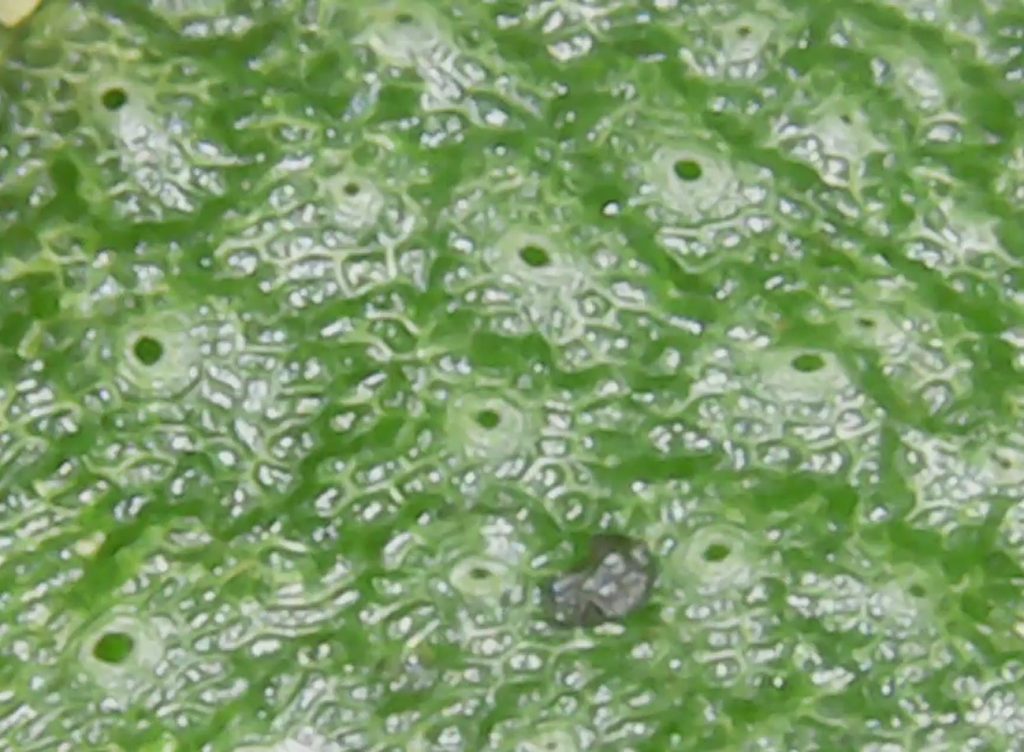
This is a microscope image of the pores on the thallus of one of the liverworts in the previous photo.
Liverwort (Asterella bolanderi)
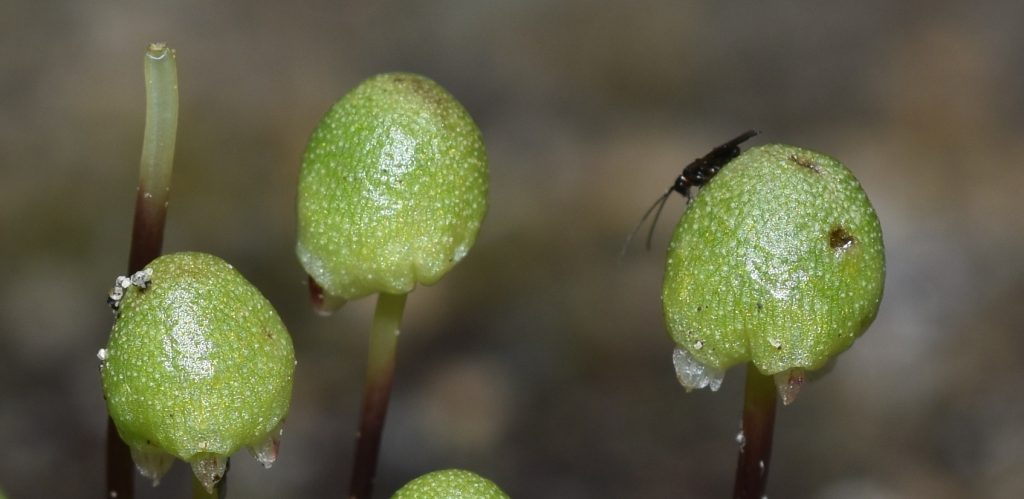
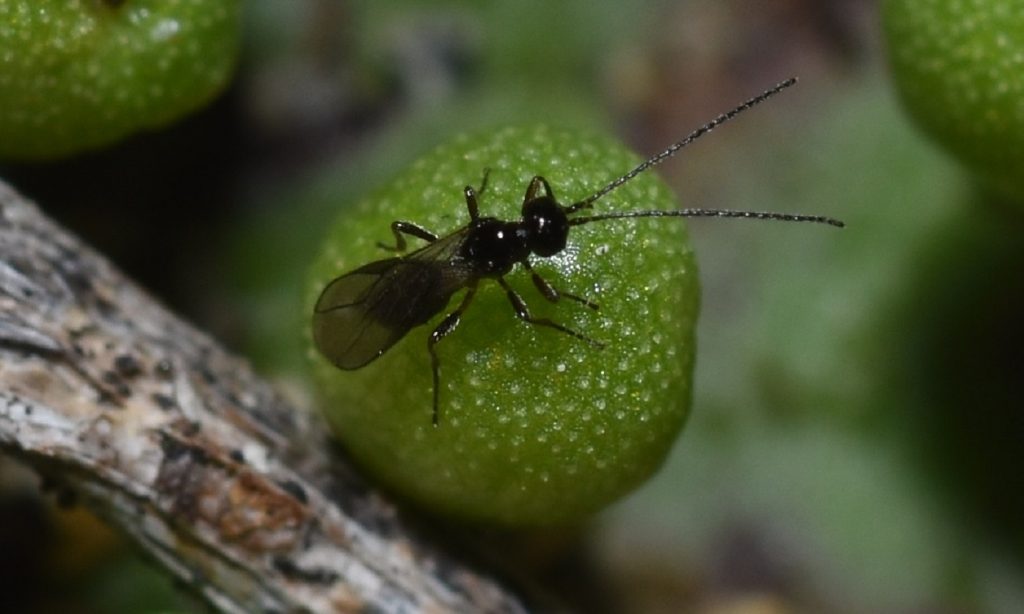
This photo shows gametangia sprouting from the thalli of some Asterella bolanderi liverworts. The tiny insect pictured is a jaw wasp — a type of Braconid wasp.
Jaw wasp (Subfamily Alysiinae)
A closeup of the wasp

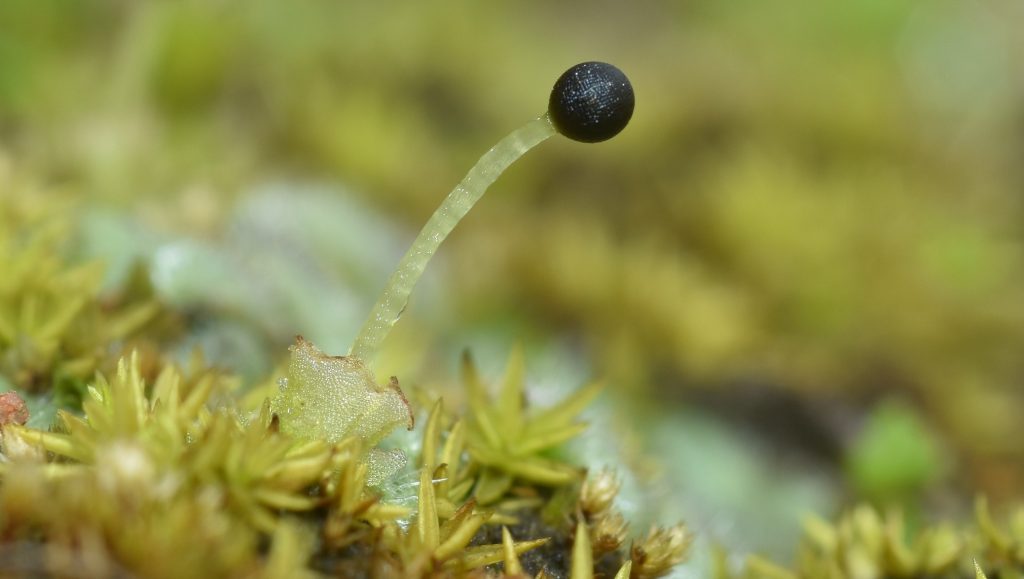
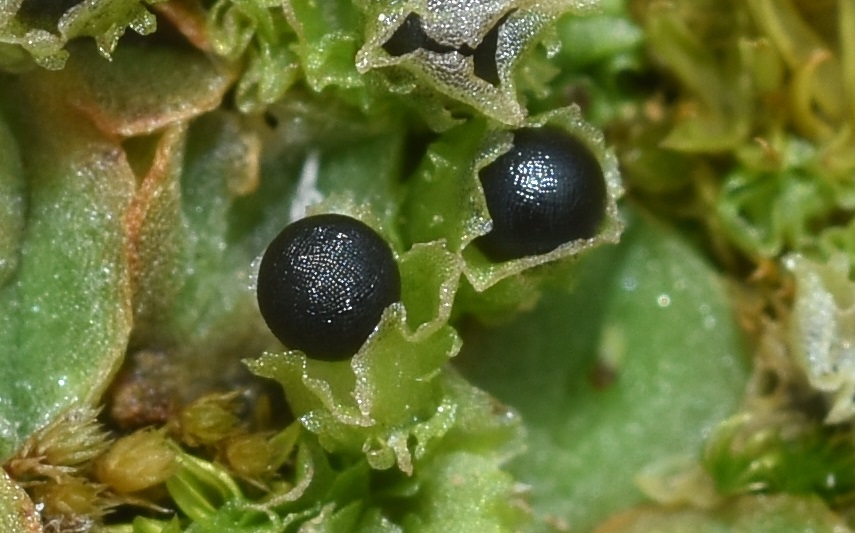
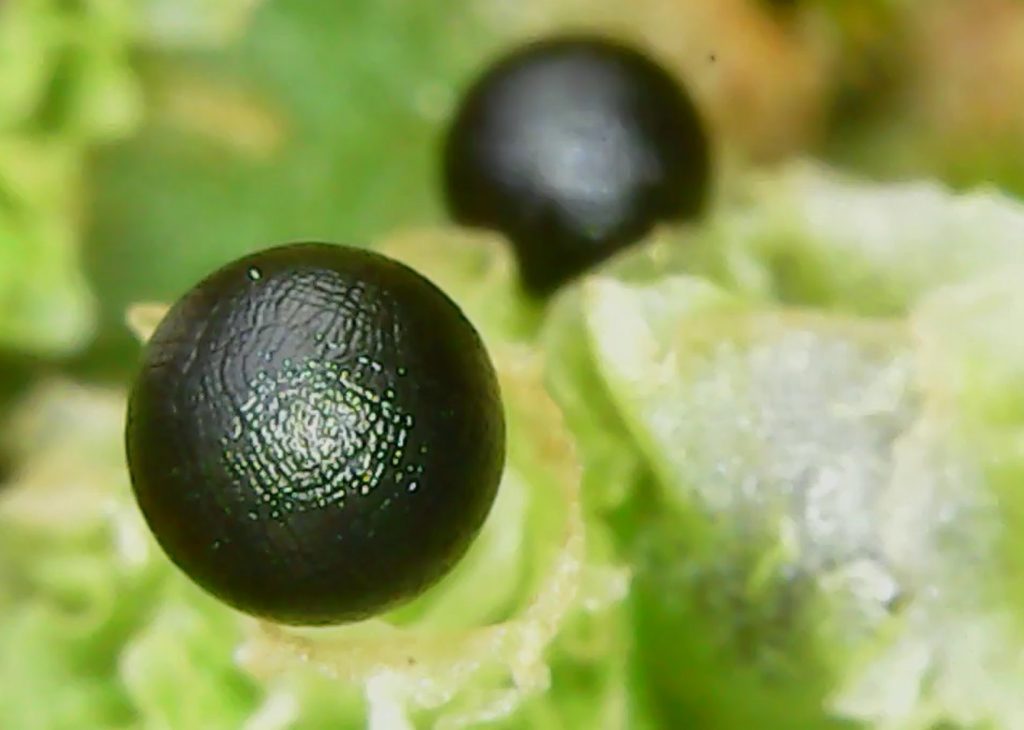
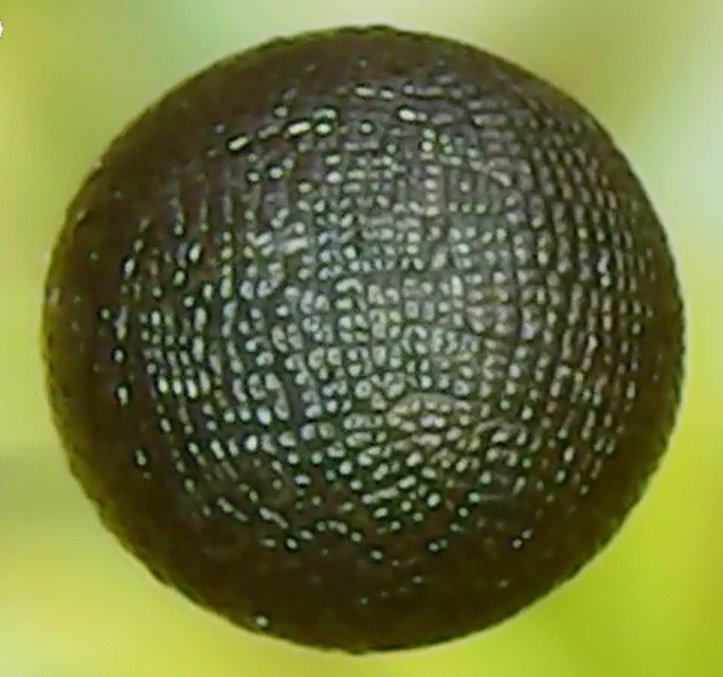
Next, we have some liverworts in the family Fossombroniaceae. The black capsules at the tops of the gametangia are smaller than the head of a pin.

Liverwort (Fossombroniaceae)
Liverwort in Fossombroniaceae family
Liverworts  (Fossombroniaceae)
Liverworts in Fossombroniaceae family
Liverwort  (Fossombroniaceae)
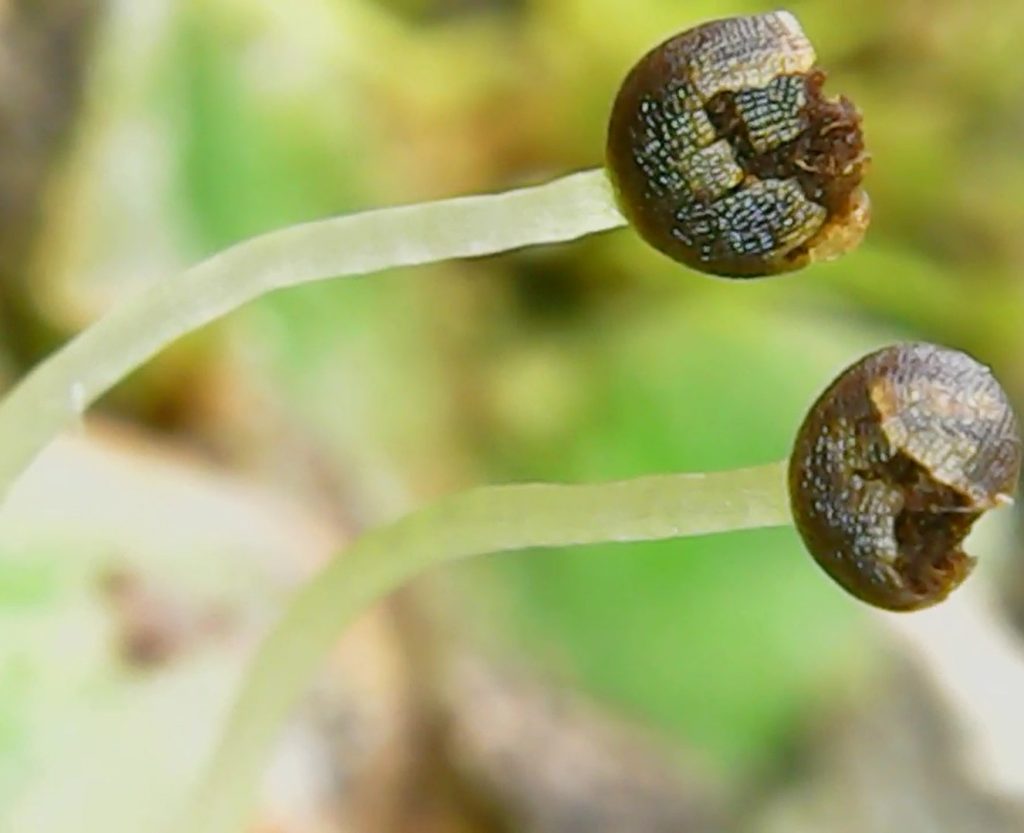
Here, the capsules of the gametangia have broken open to release the spores.
Liverwort  (Fossombroniaceae)
Liverwort (Fossombroniaceae)
Extreme closeup of one of the capsules

Finally, here are some bottle liverworts (Sphaerocarpos).

Bottle liverworts (Sphaerocarpos)

Most land plants breathe through stomata, which are openings, usually on the undersides of leaves, that can be closed if the plant needs to conserve water. Liverworts do not have stomata. They have pores that serve the same purpose, but which cannot be closed. So if a liverwort’s environment gets too dry, the liverwort just dries up. Like mosses, liverworts can withstand a great deal of drying. They just re-hydrate when the environment gets wet again.

Liverworts In Depth

The rest of this post gets into the life cycle of liverworts and it involves some fairly technical stuff, so I’ll forgive you if you want to skip it. But if you’re interested, we’ll start with some genetics. First, let’s talk about animals, specifically humans. A person’s appearance and, to some extent, their behavior, is determined by their genes. Most of the cells in a human body have two copies of each type of gene. One of the copies comes from the person’s mother and the other copy comes from their father. These two copies are called alleles. For example, a person’s cells may each have two alleles that code for eye color. Maybe both of them code for blue eyes. In that case, the person will actually have blue eyes. Or maybe one of the genes codes for blue eyes, but the other one codes for green eyes. In this case, one of the genes may be dominant. If the gene for green eyes is dominant, it will override the gene for blue eyes and the person’s eyes will be green. (I don’t actually know whether genes for green eyes are dominant or not, I’m just giving an example.) It gets way, way more complicated than this, but the point is that how the person turns out is determined by the interaction of the two sets of genes.

When a female human produces an egg cell, only one copy of each allele ends up in that cell. Likewise, when a male human produces a sperm cell, only one copy of each allele ends up in that sperm cell. When a sperm cell fertilizes an egg cell, it injects it’s genes into the egg cell where they combine with that cell’s genes. So the resulting fertilized egg ends up with two copies of each allele. Thus, the resulting embryo and the person it grows into will have two copies of each allele.

If you think of sperm cells and unfertilized egg cells as separate organisms from the humans that produce them (which they are), you could say that the human life cycle consists of an alternation of generations. You have a multi-cellular generation (the actual humans) consisting of cells with two copies of each allele and a single cell generation (the sperm and unfertilized eggs) in which each cell has only one copy. (Btw, a cell with two copies of each allele is called a diploid cell. A cell with only one copy is called a haploid cell. Try to remember that — it’s important.)

Now plants do things in similar, but different, ways and it varies a lot depending on what plant you’re talking about. Since we’re just concerned with liverworts here, I’ll stick to them. Liverworts that have thalli are called thallose liverworts and the following discussion applies specifically to them. Other types of liverwort probably do things in similar ways, but there’s no way I’m going to try to cover all the variations here.

The thallus and gametangia (the main body and the stalk) are together referred to as the gametophyte. They are analogous to the human body, except that they’re made up of haploid cells (i.e. each cell contains only one set of alleles). A specific gametophyte will be either male or female. If it’s female, then it will produce egg cells in the structure at the end of the gametangia. If it’s male, then the gametangia will produce sperm cells. The egg cells remain in their gametangia on the gametophyte that produced them. The sperm cells must leave their gametangia and make their way to a nearby female gametophyte. They do this by swimming, so there must be at least a film of water connecting the two gametophytes. So liverworts are limited to areas that are very wet for at least some of the time. Once the sperm cell reaches the neighboring gametophyte, it swims up the gametangia and finds an egg cell to fertilize.

The fertilized egg cell now contains two copies of each allele — the one that it started with and one from the sperm cell. So it’s a diploid cell. The egg cell divides and multiplies, forming an embryo. This embryo, which again, is made up of diploid cells, is called a sporophyte and is a separate organism from the gametophyte, even though it’s growing on it. So you have a diploid organism growing on (or in) a haploid organism. Again, alternation of generations, but this time both generations are multi-cellular.

Some of the diploid cells in the sporophyte divide in such a way as to produce haploid spores — the spores only get one copy of each allele. The spores are contained within capsules in the sporophyte. When the sporophyte matures, these capsules dry out, open up, and release the spores, which are dispersed by the wind. If a spore falls in a suitable area, it will germinate and grow into a new, haploid gametophyte, completing the cycle.

Now, will this new gametophyte be male or female? Obviously, it depends on whether the spore that produced it was male or female. But what does it mean for a spore to be male or female? Remember that a cell contains multiple chromosomes. In the case of humans, the presence or absence of a Y chromosome determines whether or not the fertilized egg will be male or female. Some such mechanism is also going on in liverworts. According to my reading, at least one liverwort — Marchantia polymorpha — does have something like a Y chromosome. I suspect that’s probably true of all liverworts, but I don’t know for sure. The point is that whether or not a liverwort gametophyte is male or female depends on what genes it ends up with and that’s determined mostly by chance.

Liverworts can also reproduce asexually. Thallose liverworts have structures called gamma cups that form on the thalli. Spores form in the gamma cups and, when it rains, water droplets splashing in the cups release the spores into the environment.