Category Archives: Arthropods

Big, Hairy Tarantulas

There are three animals that will forever be associated with the American Southwest in my mind: rattlesnakes, scorpions, and tarantulas. My home state, Virginia, doesn’t have scorpions or tarantulas. There are a few timber rattlers, but they live way up in the Blue Ridge Mountains and I’ve never run across one. In fact, until I moved to California, I’d never encountered any of the three in the wild. Because of this — and their dangerous reputations — these three creatures have always had an exotic appeal to me.

So, when I started this blog, I knew I’d have to write about all of them sooner or later. It didn’t take long for me to get around to posting about rattlesnakes (see Rattlesnake!) and I covered scorpions in my last post, Scorpions, Scorplings, and Scorpionism. In this article, we’ll take a look at the last of the “big three”: tarantulas.

Even if you’ve never seen a tarantula in real life, you’ve probably seen them in magazines or movies. So you should have some idea what a tarantula is supposed to look like — big and hairy. Sort of like this:

Tarantula (Aphonopelma sp.)
Anza Borrego Desert, San Diego County 10/23/16

The tarantula in the above photo is the first one I ever saw in the wild. I encountered it while camping in Anza Borrego State Park in the Sonoran Desert of California. It was about the size of my palm — far larger than any of our Virginia spiders and not at all bad for my first tarantula sighting.

Tarantulas actually come in a great variety of sizes. The largest is the Goliath birdeater (Theraphosa blondi), which is found in northern South America. It’s about the size of a dinner plate. True to its name, it has been known to eat small birds and even rodents, but it more commonly feasts on large bugs, worms, and amphibians.1

Giant birdeater tarantula (Theraphosa blondi)
Author: Www.universoaracnido.com
This file is licensed under the Creative Commons Attribution-Share Alike 2.5 Generic license.

Just to give you a better idea of the size:

Giant birdeater tarantula (Theraphosa blondi)
Author: Rjcastillo
This file is licensed under the Creative Commons Attribution-Share Alike 3.0 Unported license.

On the other end of the spectrum is the spruce-fir moss spider (Microhexura montivaga), which is about the size of a BB. It eats mites and springtails — tiny invertebrates that are barely visible to the naked eye. (See my earlier post, “Of Mites and Men… and Ticks” for a discussion of mites.) M. montivaga lives on the east coast of the United States in small, isolated pockets of the southern Appalachian Mountains — not the kind of place you would normally think of when you think of tarantulas. Unfortunately, its habitat is rapidly shrinking due to the warming climate and also due to an invasive insect that has killed off most of the Fraser firs in those mountains.2 3

Spruce Fir Moss Spider (Microhexura montivaga)
Author: U.S. Fish and Wildlife Service
his image or recording is the work of a U.S. Fish and Wildlife Service employee, taken or made as part of that person’s official duties. As a work of the U.S. federal government, the image is in the public domain

Just How Deadly Are They? 4

Despite the terror they often instill, tarantulas are not really very dangerous. They all have venom, but it’s not lethal to humans and, in fact, there has never been a documented case of a person dying from a tarantula bite. This makes them far less dangerous than even wasps and bees.

Before you go picking one up, though, I should mention that tarantulas — at least the ones in the Americas — have another defense mechanism that they can deploy against large, genuinely dangerous animals like us. On their abdomens, they have barbed, urticating hairs or bristles. “Urticating” basically means irritating and, if you get a tarantula irritated, it may return the favor by using its hind legs to flick a cloud of these bristles in your direction. These can embed themselves in your skin or, worse, in the corneas of your eyes, possibly causing permanent eye damage. So use caution if you plan on handling one of these spiders.

When a tarantula flicks off a cloud of urticating hairs, it often leaves a bald spot on its abdomen. The hairs will not grow back until its next molt.

. . .

Before we go any further, maybe I should take some time to explain just what makes a tarantula a tarantula. Obviously, a tarantula is a type of spider…

…Or Is It? 5 6

Spiders are members of the order Araneae. Everything that is a spider is in the order Araneae and everything in the order Araneae is a spider. Tarantulas are in this order. So far, so good.

Araneae is broken down into suborders and infraorders as follows:

Figure 1. How Araneae breaks down into suborders (Mesothelae and Opsthothelae) and infraorders (Arachnomorphae and Mygalomorphae)
Adapted from “Are Tarantulas Spiders? (Or Are They Different?)“

The vast majority of spiders are in the infraorder Arachnomorphae. These are referred to as the “true” spiders. Tarantulas are not in this group — they are in Mygalomorphae. So, if tarantulas are not true spiders, does that mean they are they false spiders? No, tarantulas are still considered spiders. You see, biologists have this annoying habit of deciding that, given a group of animals X, a certain subset of X will often be designated as true X, even though the general public knows the entire group as X. For instance, there are true bugs, true frogs, true toads, true salamanders, and so on, ad nauseum. So it is with spiders. So, tarantulas truly are spiders; they just aren’t true spiders.

Now That We’ve Cleared That Up…7

Let’s see if we can figure out how a tarantula differs from your “typical” spider. As mentioned in the last section, the vast majority of spiders are in the infraorder Arachnomorphae. Arachnomorphs have two main characteristics that differentiate them from the rest of the order. First, they have only one pair of book lungs. All other spiders have two pairs. The book lungs are usually visible on the underside of the abdomen as light-colored patches, so this is a good distinguishing feature. Second, their chelicerae — the appendages that end in the fangs — open and close from side to side. Other spiders have chelicerae that raise up and stab down. This means that an arachnomorph spider can rush up to a prey animal and immediately bite it. A tarantula, on the other hand, has to lift its chelicerae, unfold its fangs, and then stab down. This gives arachnomorphs an evolutionary advantage and helps to explain why there’s so many more of them.8

Within the Mygalomorphae, tarantulas form the family Theraphosidae. So another, slightly more technical, name for a tarantula is ‘theraphosid’. All tarantulas have either two or four spinnerets on the rear of their abdomens. Arachnomorphs usually have six. Like most spiders, tarantulas have eight eyes. Unlike most arachnomorphs, these eyes are crowded together on an ocular tubercle. (See the section on anatomy.)

So it’s pretty easy to distinguish tarantulas from arachnomorphs. Distinguishing them from other mygalomorphs is more of a challenge. The website The Natural History of Tarantulas lists a few characteristics that can be used. Check that site out if you’re interested. I usually just post photos of a specimen on BugGuide or iNaturalist and hope that someone more knowledgeable than me will tell me what it is.

As far as California goes, most of the tarantulas found here are in the genus Aphonopelma. All the sightings I’ve made have been in that genus. Unfortunately, it’s hard to identify them down to the species level.

Tarantula (Aphonopelma sp.)
Mission Trails Regional Park, San Diego County 9/28/18

Here’s a closeup of the spider in the above photo. Note the long spinnerets:

Closeup

Lifestyles 9

Tarantulas are found on all continents except Antarctica. Most species are tropical, but lots are found in arid environments, too. Here in Southern California, they are found in both chaparral and desert.

Habit-wise, tarantulas can be broadly divided into three types: terrestrial tarantulas that have permanent burrows, terrestrial tarantulas that don’t have permanent burrows, and tree-living or arboreal tarantulas. The vast majority of tarantulas are of the first type — they live on the ground and have burrows. They may dig these burrows themselves or they may commandeer the abandoned dens of mammals or reptiles. They often tend to hang out near their burrows. Here’s a video of one doing just that. You can see it quickly scramble inside when I get too close:

Tarantulas line their dens with silk. This provides structural support and also makes it easier for the spider to climb up and down. Many species will extend the bottom part of this silken tube outside the den as a kind of “welcome mat”. The spider senses the vibrations of a prey animal walking on the mat and rushes out to invite it in for dinner.

The second type — terrestrial tarantulas that don’t have permanent burrows — may not actually exist, as this lifestyle has not been verified by researchers in the field. Be that as it may, there are a few species, such as Cyriocosmus ritae and Lasiodora parahyban, that are suspected of falling into this category. This type wanders around at night and hides during the day in whatever shelter it can find.

Arboreal tarantulas inhabit trees. Some species construct silken tubes to live in. Others live in rot holes or hide behind loose bark or in epiphytic plants.

Tarantulas don’t spin what we usually think of as spider webs. They use their silk for other purposes, such as the aforementioned silken tubes.

One notable difference between New World and Old World tarantulas is that the Old World varieties don’t have urticating hairs. They compensate by having more potent venom and by being much quicker to bite people. For that reason, Old World species are less popular as pets.

Tarantulas tend to be nocturnal, although they do sometimes come out during the day. If you want to find one, your best bet is to look for them at night in the middle of summer. (That’s also the best time to find scorpions, so you could get a two-for-one.)

Here’s a couple of videos of a tarantula just walking around in the desert. (This one was, in fact, out in broad daylight.)

Tarantula
Pinyon Canyon, Anza Borrego State Park, San Diego County 11/20/16
Tarantula
Pinyon Canyon, Anza Borrego State Park, San Diego County 11/20/16

How Does a Tarantula Dig?

One thing that mystified me for a long time was how tarantulas are able to dig burrows. I mean, they don’t exactly look like they’re made for digging. I finally got around to googling it and it turned out to be pretty simple. The spider sprays some sticky silk on the ground and uses its legs to roll up the silk, along with the soil that’s stuck to it, into a ball, which it then pushes out of the way. Rest and repeat. A lot. In this way, a tarantula can slowly excavate quite an extensive burrow. It just takes time and lots of patience, of which a tarantula, with its tiny brain, has plenty. Click here to watch a video of someone’s pet spider digging a den.

What Do They Eat? 10

Tarantulas eat mostly large arthropods such as insects, centipedes, millipedes, and other spiders. The biggest species will sometimes kill larger prey such as lizards, birds, bats, mice, and small snakes. Mostly, they use ambush to capture prey — just sitting around and waiting for something tasty to wander by. As already mentioned, some burrowing species will extend the bottoms of the silken tubes that line their dens to form mats outside the entrance. Vibrations caused by a prey animal walking on this mat will alert the spider to its presence.

What Eats Them? 11

Lots of things, actually. Lizards, frogs, birds, scorpions, giant centipedes, and a few mammals (including even some humans) routinely dine on tarantulas. Some mammals, such as opossums, mongooses, and honey badgers, have evolved immunity to the venom.

The most interesting (and horrifying) predators of tarantulas are large members of the wasp family Pompilidae, collectively known as “tarantula hawks”. The females of these wasps hunt down tarantulas by smell, sting them, drag them back to a previously prepared burrow or sometimes leave them in their own burrows, lay a single egg on their abdomens, and seal the burrow. When the wasp larva hatches out, it begins eating the spider, which is still alive, but paralyzed. It starts with the non-vital organs in order to keep the tarantula alive and fresh for as long as possible.

I covered tarantula hawks in much more detail in an earlier blog post, The Stuff of Nighmares. I encourage you to read it or at least check out the photos and video. Tarantula hawks are surprisingly beautiful wasps and their relationship with tarantulas is as fascinating as it is gruesome.

‘Crispy Tarantulas Served With Lime and Pepper Sauce’ 12

Yes, people do eat tarantulas. Not so much in North America, but in some countries, like Venezuela and Cambodia, they are considered delicacies. The bristles are removed by roasting them over an open fire. Click here for an amusing article by a guy who tried them in Cambodia.

A Bit of Anatomy 13

Unlike insects, whose bodies are divided into three main parts (head, thorax, and abdomen), a spider’s body is divided into just two parts: the prosoma and opisthosoma. The prosoma, which is also called the cephalothorax, is basically a fusion of what was ancestrally the head and thorax. The opisthosoma is the abdomen. A narrow, flexible waste connects the two. This waste allows the spider to move the opisthosoma independently of the prosoma, which is important when weaving silken structures.

Tarantula (Aphonopelma sp.)
Anza Borrego State Park, San Diego County 1/12/17

The section of exoskeleton that forms the top or dorsal surface of the prosoma is called the carapace. Near the center of the carapace is a dimple called the fovea. This is where the exoskeleton has “enfolded” to form a reinforced area inside the exoskeleton and it is to this area that many of the spider’s muscles are attached.

Dead Tarantula (Aphonopelma sp.)
Canyon Sin Nombre, Anza Borrego State Park, San Diego County 12/2/18

All spiders have eight legs. At least, they should have. It’s actually remarkably common for a spider to lose one, two or even more of its legs. Often, this happens during a molt. One or more of the legs may get tangled up in the old exoskeleton and the spider will end up just biting them off. A spider may also lose a leg to a predator. Either way, it’s not a usually a big deal. A spider can get along just fine with seven or even six legs and the missing legs will grow back the next time it molts. (Assuming it has any molts left. If not, then it will have to get by with its remaining legs for the remainder of its life.) So the legs are kind of made to break off easily.

In one particularly amazing case, a pet tarantula named Bob escaped from its cage and crawled onto a sticky pad that was supposed to catch ants. Unfortunately, it was pretty good at catching tarantulas, too. Its owner rescued it, but it lost all but one of its legs in the ordeal. Remarkably, Bob survived and eventually all his legs grew back!14 If you’re on Facebook, you can check out his page: Bob the Former Disabled Tarantula.

This unfortunate ground spider (not a tarantula) only has 5 legs left.
La Mesa, CA 5/5/20
A closeup of the same spider. You can see that the missing leg broke off cleanly after the first segment (the coxa).

At the front of a spider’s prosoma is an additional pair of appendages, which look similar to legs, but are usually shorter. These are the pedipalps. They carry sense organs for taste and feel. On sexually mature males, the last segment of each pedipalp has a swelling called an embolus (pl. emboli) or palpal bulb. This is used to transfer sperm to the female. (See the section on reproduction.)

Between the pedipalps are the chelicerae or jaws, which end in an impressive pair of black fangs. As noted earlier, in tarantulas and other mygalomorphs, the chelicerae move vertically up and down. To envenomate prey, the spider lifts its chelicerae, unfolds its fangs, and stabs down.

Here’s a view of the ventral (bottom) surface of a tarantula:

Tarantula (Aphonopelma sp.)
Anza Borrego State Park, San Diego County 9/4/17

… and let’s have a closer look at those fangs:

Tarantula (Aphonopelma sp.)
Anza Borrego State Park, San Diego County 9/4/17

Note the pair of tiny claws on each leg:

Tarantula (Aphonopelma sp.)
Anza Borrego State Park, San Diego County 9/4/17

Near the end of its abdomen, a tarantula has two or four spinnerets. Often it has one long pair and one shorter pair. In this, they differ from most araneomorphs, which usually have six spinnerets.

I should probably mention that the bristles on a tarantula (urticating or otherwise) are not really hairs. Only mammals have true hairs. A tarantula’s bristles are actually made of a fine cuticle. The technical name for these bristles is “setae” (singular seta).

Mating 15 16

A male tarantula’s genitals are located on the underside of its abdomen between its book lungs. The sperm are secreted through an opening at this location. How the spider gets the sperm from this opening to the corresponding opening on the female’s abdomen is a bit complicated.

The male begins by spinning a “sperm web”. This is a mat of silk that is elevated just enough for the spider to fit underneath. The tarantula spins the web right-side up. When he’s finished, he turns upside-down and crawls underneath it. He then rubs his abdomen on the mat, releasing sperm onto it. When the web is loaded up with semen, he inserts the emboli on the ends of his pedipalps into the pool. (See the section on anatomy.) The emboli absorb the semen and keep it fresh until the spider locates a mate. By the way, tarantulas aren’t the only spiders that spin sperm webs. Similar webs are used by all spiders to charge their emboli.

Now that the male is “loaded for bear”, so to speak, he goes out hunting, not for bear, but for a female tarantula. He does this by following the scent of her pheromones. When he finds a prospective female, he taps his pedipalps on the ground or other surface in a behavior known as “courtship drumming”. If the female is interested, she will move closer and allow him to go through a series of courtship gestures that help to determine whether or not the two spiders are of the same species.

If all goes well, the male approaches the female and uses his front legs to lift her fangs safely out of the way. This also serves to expose her belly, where the genital opening is located. (In many species, the male has “tibial hooks” on the front pair of legs that help him keep a grip on those nasty fangs.) He then inserts the ends of his pedipalps into the female’s epigynum (her external genital structure) and begins transferring sperm.

Once the transfer is complete, the male does not hang around to smoke a cigarette. Instead, he prudently gets the heck out of Dodge before the female decides to make a meal of him. (This actually doesn’t happen very often with tarantulas, although how much this is due to the male’s quick retreat, I don’t know.)

After a male tarantula reaches sexual maturity, he doesn’t usually molt again. He also doesn’t have much longer to live — generally just one to one and a half years. Female tarantulas, on the other hand, go on to live quite a long time after reaching sexual maturity and continue to molt periodically. Females have been known to live for 30 to 40 years. (The record seems to be in some dispute. I’ve seen various figures. One or two sources even claimed over 50 years!) Males have much shorter lifespans and, for that reason, females are more popular as pets.

Eggs with Legs 17

When the female is ready to lay her eggs, she spins a silken bowl, lays the eggs in it, and wraps them up, forming a sac. A tarantula will lay anywhere from 50 to 2000 eggs, depending on the species. Usually, the female will turn the egg sac periodically to keep the eggs from deforming. It generally takes around 6 weeks before the eggs begin to hatch. At that point, the baby spiders, which are called spiderlings or slings, exit the egg sac.

When a sling first hatches, it is still attached to the embryo and looks kind of like an egg with eight legs sprouting from it. As a result, newly-hatched spiders are sometimes referred to as “eggs with legs”. After their first molt, the slings begin to look a bit more like proper spiders. A spiderling is considered a juvenile when it begins to look like an adult, i.e. when it begins to assume the adult coloration and patterning. This takes a number of molts, depending on the species. A tarantula’s growth rate also depends on the species, but environmental factors, such as temperature and availability of food, play a part, as well.

Molting 18 19

Like all spiders, tarantulas shed their exoskeletons periodically as they grow. You probably won’t be surprised to hear that the shed exoskeleton includes, not only the outer layers of the main body, but also the outer layers of the legs. What may surprise you is that it also includes the lining of the mouth, stomach, and lungs and even the corneas of the eyes! That’s right, a spider’s corneas are part of its exoskeleton! The outer layers of the fangs come off, as well, leaving them an unexpected milky white. (They’ll turn black again when the new exoskeleton hardens.)

The molting process for a tarantula is an awkward, stressful process lasting usually one to a few hours. Some older spiders may take as long as 24 hours. The spider begins by spinning a molting mat. This is, for all intents and purposes, a bed that the spider will lay on during its molt. When the tarantula is ready to begin the process, it will lay on its side and flip over onto its back on the mat. Tarantulas do sometimes molt right side up, but it’s rare.

The old exoskeleton will split open and the spider will begin to wiggle out. As you can imagine, getting all those parts out of their old coverings is not an easy process. As mentioned earlier, a spider may even have to abandon a leg that gets stuck and won’t come free. Once the molting process is finished, it takes several days for the new exoskeleton to harden. During that time, the tarantula is very vulnerable and will try to remain hidden. Some tarantulas will go through the entire molting process inside their dens.

The following series of photos shows a tarantula’s shed exoskeleton (called an exuvia). The oval piece is the old carapace. With that detached from the exoskeleton, you can see the leg holes on the inside.

Description (by author): The exuvia shed during ecdysis of an adult female specimen of the tarantula species Aphonopelma seemanni, native to Central America.
Author: MB299792458
This file is licensed under the Creative Commons Attribution-Share Alike 3.0 Unported license.

Hissing Tarantulas 20

Tarantulas do not have the ability to make vocalizations. Nevertheless, some species are able to “hiss”. The technical word for this is stridulation and it’s usually done by rubbing some of the setae (bristles) against each other. Typically, a tarantula stridulates as part of a threat display, but it may also be used in mating displays or territorial behavior. Not all species stridulate, but there are examples of both New and Old World species that do so. Click here for an excellent video of a tarantula stridulating.

How to Handle a Tarantula

Tarantulas don’t like to be handled. Ideally, you should just watch them, take a few photos, and let them go about their business. Ideally. Of course, some of us just can’t resist. So, let it be understood that I’m not advising you to handle a tarantula, but if you choose to take the risk (both to yourself and to the spider), here’s a few tips…

First, if you have the spider in the palm of your hand, don’t stand up with it. Keep your hand close to the ground, so that if the tarantula tries to run, it won’t have more than a few inches to fall. Tarantulas, as scary as they may look, are actually quite delicate creatures. They aren’t designed to survive falls.

Second, don’t get your eyes too close to it. As noted before, a frightened tarantula may kick urticating hairs from its abdomen and you really don’t want to get those in your eyes.

So how should you go about picking up a tarantula? There are two ways to do it. The first way is to grasp the spider around the waste using your thumb and index finger. Obviously, you should only try this if the tarantula is large enough for you to easily get your fingers between its legs and around its waste. The video below shows a spider that was the perfect size for this technique. The advantage to this method is that the spider shouldn’t be able to bite you from this position and it would probably be difficult for it to kick hairs at you, as well.

The second method is probably less stressful for the spider. Place your hand palm up on the ground directly in front of the tarantula. Give it a gentle push with your other hand to get it to crawl onto your open palm. It’s probably okay to lift your hand up a few inches to observe the spider, but don’t stand up with it.

Here’s a video of me demonstrating the wrong way to do this. (At the time, I didn’t realize how easily they could be injured.)

The Evolution of Tarantulas 21 22 23

Sadly, information about tarantula evolution is very sparse. Only two fossil specimens have been found that have been convincingly identified as belonging to the tarantula family. These were both found in amber and both date back about 16 million years. It’s likely that tarantulas go back much farther than that, however.

Fossils of other mygalomorph spiders have been found that date back to the Triassic, which ended about 203.1 mya, so it’s quite possible that tarantulas go back to that period, as well. We don’t know when they split off from the other mygalomorphs, though, so we can’t be certain.

Despite the shortage of fossils, scientists have been able to get some understanding of the evolutionary tree of tarantulas through phylogenetic studies — i.e. studying the genes of living tarantulas. This gives us some idea of the relationships of the different groups and the evolution of various features. For instance, one study concentrated just on the evolution of the urticating setae.24 I’ve only read a brief abstract of the study, so I don’t know the details, but it’s fascinating to think that researchers are able to use genetic analysis to follow the development of a specific feature.

In another interesting study,25 26 scientists found that tarantulas have evolved a blue coloration on at least eight separate occasions. Not all tarantulas exhibit the rather drab colors of the ones here in California. A number of species sport a bright, cobalt blue on much of their body.

Greenbottle blue tarantula (Chromatopelma cyaneopubescens), South America
Author: Luis José Quintero-Morillo
This file is licensed under the Creative Commons Attribution-Share Alike 3.0 Unported license.

In this study, scientists used previously published phylogenetic trees to create a “supertree” of 53 tarantula species. Then, with the help of digital images from Flikr and Google Images, the researchers mapped out where genera with one or more blue species appeared on the tree. From this, they were able to determine the lowest possible number of times the blue color could have evolved independently. The result was eight.

This is particularly surprising, given that all the different species exhibit almost exactly the same shade of blue. The wavelength of the blue color in the photos only varied within a 20 nm range around a central wavelength of 450 nm.

The researchers also used an electron microscope to examine blue hairs from eight different tarantula species. It turns out the color is not due to pigment, but to the nanostructure of the hairs. In other words, these super-fine structures produce color as a result of physical processes such as diffraction, interference, and coherent scattering. The researchers found that the shapes of these nanostructures varies between species, indicating that they are producing the blue color in different ways — more evidence that the coloration evolved independently in the different groups.

So what could cause different species of tarantula to all evolve almost the exact same shade of blue? We don’t know. In many animals, bright colors evolve as a result of sexual selection — they increase the animal’s chances of attracting a mate. This is unlikely to be the case with tarantulas, however, because they have very poor eyesight. They probably can’t even see the colors they produce. It’s possible that the blue color helps to conceal the spider when it hunts at night. Or perhaps it serves as a warning to predators that might want to eat it. It’s all just speculation at this point. The answer will have to wait on future studies by other clever scientists.

Silk Speculations 27 28 29 30

Most people know that spiders have spinnerets on their butts. What most people don’t know is that male spiders have additional spinnerets called epiandrous fusillae on the bottoms of their abdomens. They use these to spin their sperm webs. (See the section on mating.)

Even more weirdly, observations have suggested that the zebra tarantula (Aphonopelma seemanni) may have silk-producing organs on its feet! This has led to speculation that silk production in spiders may have evolved to aid in climbing and only later evolved to be used for web making.

Spiders, of course, aren’t the only arthropods that have the ability to produce silk. The larvae of many insects spin silken cocoons and some caterpillars spin entire shelters where they congregate en masse. Some adult insects also have spinnerets. Webspinners or footspinners (order Embioptera) have silk glands in their forelegs. Colonies of these insects live in silken galleries spun from these glands.

My one lucky observation of a webspinner, specifically a black webspinner (Oligotoma nigra). The swellings on the forelimbs contain the silk glands.
Mission Trails Regional Park, San Diego County 7/31/18

One thing that biologists have learned is the importance of control genes. The genes that are responsible for the development of a particular structure are present in the nucleus of all the cells. Control genes are responsible for turning these genes on or off in response to the cell’s environment (what other types of cells are around it, for example). By manipulating these control genes, a fruit fly, for instance, can be made to grow legs in place of antennae. Apparently, mutations in some such control genes can cause an arthropod to grow silk glands in almost any part of its body. If having the ability to produce silk in that part turns out to give the animal an evolutionary advantage, the animal’s descendants may retain the mutation and refine it.

Sorry, I’m getting off topic here. Please consider this a hint of a possible future post about silk.

Parting Shots

Here’s a few photos of a tarantula (Aphonopelma sp.) that I saw just last weekend during a night hike. Enjoy!

Tarantula (Aphonopelma sp.)
Mission Trails Regional Park, San Diego County 7/12/20
A closeup of the abdomen. I suspect those hairs are of the urticating variety.
A closeup of the ocular tubercle
Not the biggest tarantula I’ve ever seen, but a goodly size for a spider

Scorpions, Scorplings, and Scorpionism

Alongside rattlesnakes and tarantulas, scorpions are one of the most iconic animals of the American Southwest. That’s not to say they’re limited to that area — far from it — scorpions are found in tropical and temperate regions all over the globe and in just about every sort of terrestrial environment from deserts and high mountains to inter-tidal zones. They’ve also been around for a very long time. Scorpions date back at least as far as the Silurian period, around 435 million years ago.

California Common Scorpion (Paruroctonus silvestrii)
Mission Trails Regional Park, San Diego County, CA 7/1/17

Despite their long evolutionary history and wide distribution, their basic form hasn’t changed much. Like spiders, they have eight legs. At the front of the body are another pair of appendages called pedipalps, which end in large claws or pincers.

Perhaps their most distinctive feature is their long “tail” — really just a narrowing of the abdomen — ending in a large, bulbous stinger. The fact that this tail is really an extension of the abdomen can be seen by the location of the anus, which is on the last segment, just before the stinger. A scorpion will often hold its tail curved over its body with the stinger pointing forwards. It may forgo using its stinger on small prey, but when it needs to subdue a larger animal, the stinger stabs forward with blinding speed.

Although all scorpions are venomous, most are not dangerous to people. In some cases, the sting is said to be less painful than a bee sting. (This is not the case with the two most common scorpions in my area. More on that later.) Of the approximately 1750 described species of extant (living) scorpions, only around 25 have venom that is dangerous to humans. Most of these are in the family Buthidae. This includes the deadliest species in the United States, the Arizona bark scorpion (Centruroides sculpturatus). As you might expect, C. sculpturatus is found mostly in Arizona, but there’s also a small population in the southeastern corner of California.

The venom of the Arizona bark scorpion causes severe pain, usually lasting between 24 and 72 hours. If the sting is in a hand or arm, the victim may experience temporary loss of use of the appendage. In especially bad cases, the victim may experience numbness, paralysis, convulsions in the affected limb, and frothing at the mouth.

Despite the severity of these symptoms, death is extremely rare. Every year, thousands of people in Arizona are stung by C. sculpturatus, yet only 2 fatalities have been recorded in the state since 1968. This is not to say that stings should be treated lightly. Part of the reason for the low fatality rate has been the development of antivenin. If you think you’ve been stung by C. sculturatus, you should seek medical attention as soon as possible. Children, the elderly, and immuno-compromised people are most at risk.

While we’re on the subject of stings, I know you’ll want to see a scorpion in action, so here’s a video of a California common scorpion trying to sting my hiking pole. (No, I don’t regularly harass scorpions. I just wanted to see one in action, too.) 15 16

The general term for envenomation by scorpion, by the way, is ‘scorpionism’. Why we need a general term for this, I don’t know.

Milking Scorpions for Fun and Profit 20 21

No, scorpions do not produce milk. They are ‘milked’ for their venom. Why, you ask? Scorpion venom is a mixture of many different biochemical substances that have all sorts of physiological effects. It’s very possible that some of these substances will find a use in medicine. Researchers are actively exploring the use of scorpion venom for such things as treating multiple sclerosis and cancer and to help with heart transplants. It may also be useful in pain management.

One thing researchers are concerned about, though, is the possibility of addiction to scorpion venom. Yes, you read that right. It’s no secret that many of the medications currently used for pain management are extremely addictive. There’s no guarantee that medications derived from scorpion venom will be any different.

And there’s cause for concern. There is currently a craze in India of people deliberately letting themselves be stung by scorpions. Apparently, the pain is followed by a feeling of euphoria. There are even dealers on the side of the road between Delhi and Bombay that you can go to if you want to pay to be stung. Many clients seem to get addicted to the stings.

So, danger of addiction aside, how do you go about milking a scorpion? It’s actually not that hard. You cover the mouth of a container with some sort of membrane, position the membrane in front of the stinger, and give the scorpion a tap on the back. When the scorpion strikes, the stinger penetrates the membrane and leaves a tiny drop of venom clinging to the inside.

Of course, you’re not going to collect massive amounts of venom this way. Neither is it particularly safe. People who collect venom professionally (for sale or research) usually use electrical stimulation of the venom bulb to get it to release venom. Click here to watch a video of someone using this method. A robot has even been developed to speed up the process of collecting venom for cancer research.31

Despite the advent of scorpion-milking robots, scorpion venom is produced in such tiny quantities that it supposedly holds the record for being the most expensive liquid in world. A single liter will set you back over ten million dollars!32

A Very Laid-Back Predator 33 34 35

Scorpions are nocturnal predators. They usually hide in burrows during the day and come out at night to hunt. Their prey typically includes insects, spiders, and other arthropods. Some species also feed on grubs and earthworms. Really large scorpions have even been known to eat lizards and small rodents. Most species are generalists, feeding on many different things, but some specialize in one type of prey, such as burrowing spiders.

They will also eat each other. Because of this, it’s perhaps not surprising that the vast majority of scorpions are nonsocial. There are a few species that overwinter in groups, however. Presumably, those types are less inclined to cannibalism.

Scorpions are not active hunters. Mostly, they sit and wait. Their eyesight is poor, but the sensory hairs on their legs and pedipalps allow them to sense the vibrations of approaching prey.

No, Really, They Are Seriously Laid-back 36

Scorpions tend to be very abundant in arid regions — more so than is possible for most predators. They’re able to pull this off because they have unusually low metabolic rates. According to a study published in the “Journal of Experimental Biology”,37 the metabolic rates of scorpions from two genera were measured to be less than 24% that of typical terrestrial arthropods such as spiders and insects (measured at 25° C). This means they don’t require nearly as much energy and don’t have to eat as often. According to one website,38 scorpions can go up to a year without food and require less than a tenth as much oxygen as most insects.39

Another fascinating thing about scorpion metabolism is that they seem to have the ability to slow it down and quickly speed it back up when the situation demands. Click here to watch a “National Geographic” video that discusses this. While many animals slow their metabolism when hibernating or estivating, it typically takes a while for them to raise it back up to normal speed. A scorpion, however, can be resting in a lowered metabolic state and still be ready to strike at full speed if a tasty morsel wanders by.

This slow metabolism undoubtedly plays a part in their ability to survive in a wide range of environments. Although they usually live in hot, arid places, researchers have frozen scorpions overnight and then watched them thaw out and walk away!40

Where Baby Scorpions Come From 41 42

While most scorpions reproduce sexually, there are a few species that have decided to skip all the mess and fuss of exchanging genetic material. These species reproduce through a process called parthenogenesis in which embryos develop from unfertilized eggs. All the scorpions in these species are female and all the babies are clones of their mother.

In species that do reproduce sexually, the courtship starts with a dance. The male grasps the female’s claws in his own and starts leading her around. Depending on the species, the dance may involve other behaviors such as the male grasping the female’s chelicerae (mouth-parts) with his own — almost like a kiss. In fact, the behavior is sometimes called a cheliceral kiss. There may also be some juddering and, in some species, the male even injects a small amount of venom into the female to keep her calm.

The dance, which is called a “promenade à deux” (French for a “walk in twos”), is not particularly romantic. Its main purpose is probably to keep the male from being eaten while he searches for a nice, smooth place to deposit his spermatophore. This is just a capsule that contains his sperm. Once he finds a good place, he extrudes a glandular secretion that forms a stalk to which the spermatophore is attached. He then positions the female over it. Physical contact with the spermatophore causes the sperm to be ejected into her genital opening. (See the section on anatomy.) The sperm, of course, then make their way to the eggs and fertilize them.

Unusually for non-mammalian animals, scorpions give birth to live young. The eggs are retained inside the mother and the embryos are nourished in utero for a period of several months to a year, according to species. Litter sizes range from 1 to 100, but average about 25. Immediately after birth, the young scorpions (or scorplings) climb up onto their mother’s back, where they will remain for 1 to 50 days. During this time, they absorb water through their mother’s cuticle. At birth, the scorpling’s cuticle is soft. It won’t harden until after the first molt, at which time the scorpling will leave its mother and assume its mostly solitary life.

Scorpions I Have Known

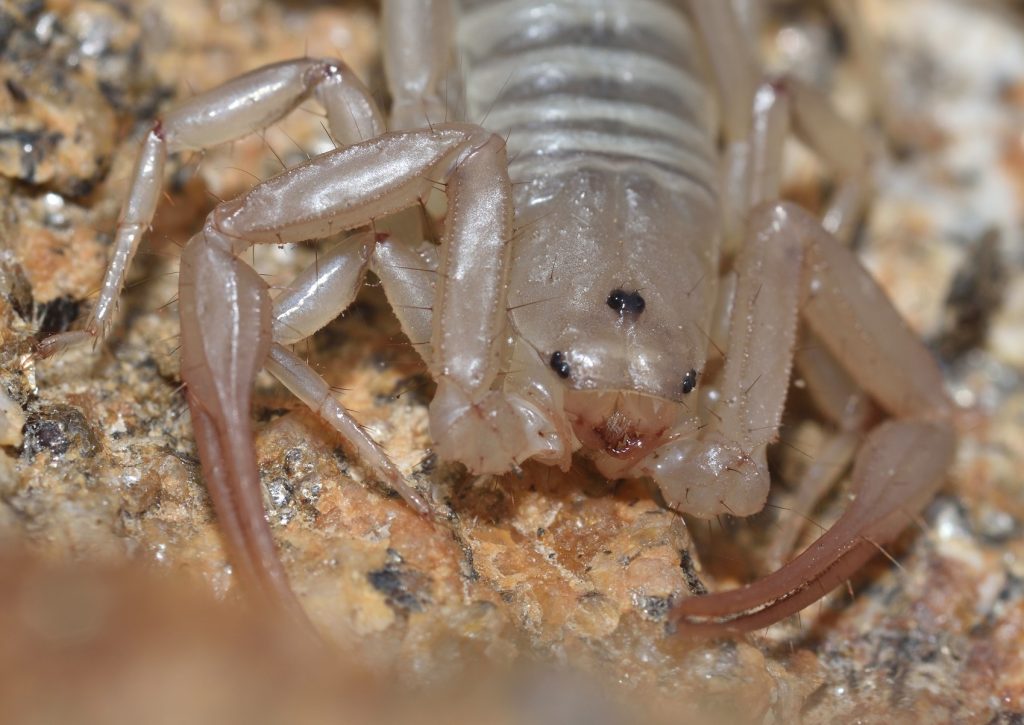
Here in Southern California, we have a number of species, but, so far, I’ve only encountered three of them. The most common one seems to be the California common scorpion (Paruroctonus silvestrii).43 The adults tend to be around 7 cm (2.5 inches) long. There’s a photo of one near the beginning of the article. Here’s another one:

California Common Scorpion (Paruroctonus silvestrii)
Mission Trails Regional Park, San Diego County, CA 8/13/18

The body of this individual appears to be a bit thicker than the one in the earlier photo. This may indicate that it’s a female, as they’re supposed to have thicker bodies. I’m not an expert, though, so I don’t know for sure. The scorpion in the next two photos, however, is almost certainly female. In fact, I wouldn’t be surprised if it was pregnant. (But again, I’m not an expert.)

California Common Scorpion (Paruroctonus silvestrii)
San Diego County, CA 7/18/17
California Common Scorpion (Paruroctonus silvestrii)
San Diego County, CA 7/18/17

P. silvestrii is found throughout California and in a great variety of habitats. I usually see them in chaparral country, but I’ve seen them in the desert, as well. They can even be found on sandy coastlines and forested mountains.44

As noted earlier, the newborn or young of scorpions are called scorplings. The next few photos show a very young scorpling of P. silvestrii. I don’t know how young, but it was tiny compared to the adults — maybe a quarter of an inch or around one centimeter.

Young California common scorpion (Paruroctonus silvestrii)
Mission Trails Regional Park, San Diego County, CA 8/21/17
Young California common scorpion (Paruroctonus silvestrii)
Mission Trails Regional Park, San Diego County, CA 8/21/17
Young California common scorpion (Paruroctonus silvestrii)
Mission Trails Regional Park, San Diego County, CA 8/21/17

The sting of P. silvestrii, by the way, is reportedly quite painful. According to enonumus, writing on the website “BugGuide” 45, when he got stung on the bottom of the foot by one of them, “It just felt like someone stuck an ice pick straight through my foot!!!”

The second most common scorpion I’ve seen in Southern California is the California swollen stinger scorpion (Anuroctonus pococki).46 Here’s a few pics.

California swollen stinger scorpion (Anuroctonus pococki)
San Diego County 8/11/17
California swollen stinger scorpion (Anuroctonus pococki)
San Diego County 8/11/17

This scorpion is about the same length as P. silvestrii, but its more robust body and much larger claws make it look a bit more fearsome. This may be misleading. As a general rule, the larger the claws, the less potent the venom. This is because having large claws is an indication that the scorpion relies more on its claws to subdue prey than on its sting.47 So, despite its appearance, A. pococki could have a less painful sting than P. silvestrii. This is not a hard and fast rule, however, and anecdotal evidence says that it’s sting is still plenty painful.48

The next photo shows a closeup of A. pococki’s stinger. Note the swelling just before the business end. This structure is what inspired the scorpion’s common name. The scorpion mating process can be hazardous to males, since females sometimes have difficulty distinguishing between a potential suitor and a potential meal. Males of some species get around this problem by stinging the female to calm her down. Of course, it wouldn’t do to inject a full load of venom into the female as killing her would tend to defeat the whole purpose of mating. Supposedly, the swelling is there to keep the male from overdoing things — maybe by preventing him from stabbing too deeply? I’m not quite sure how it’s supposed to work.49

Closeup of the stinger of a California swollen stinger scorpion (Anuroctonus pococki)
San Diego County 8/11/17

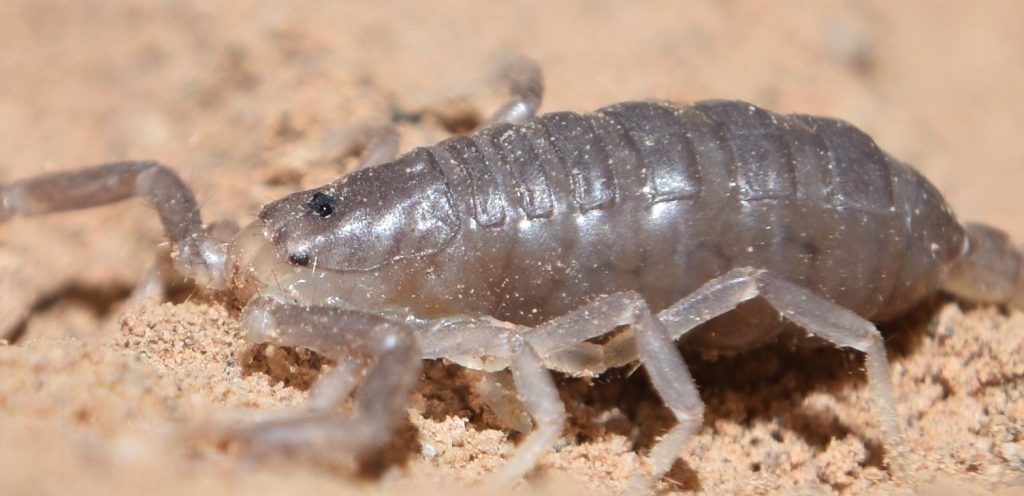
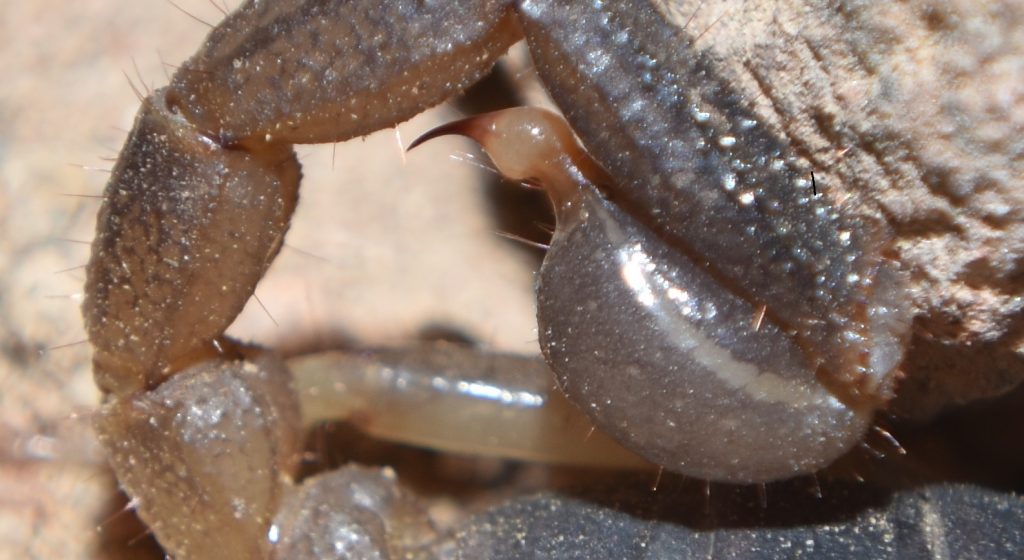
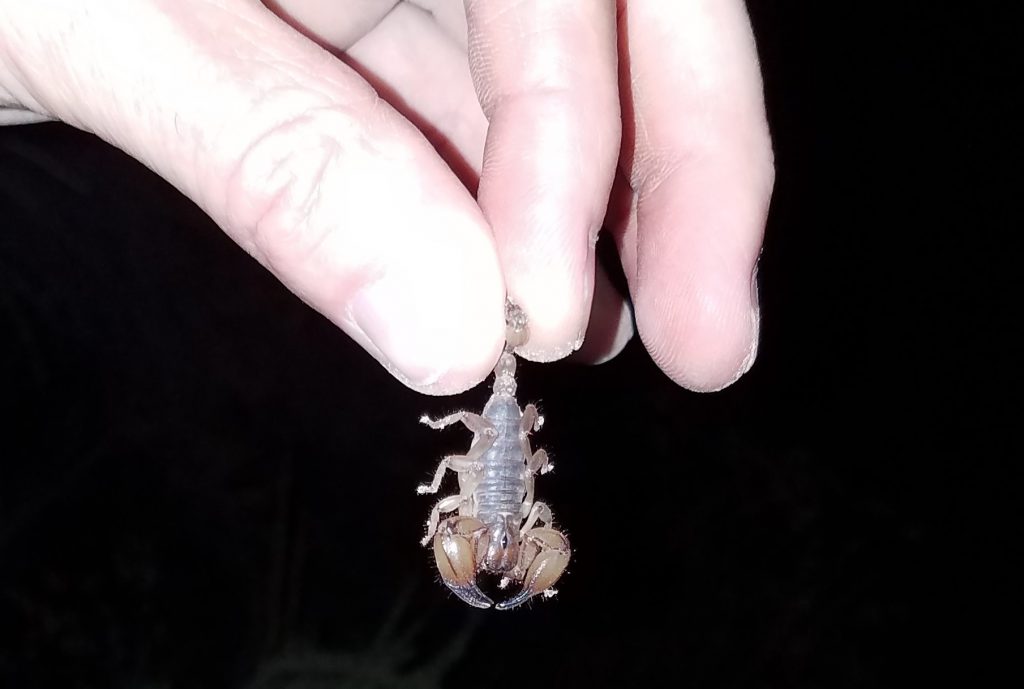
The third and final scorpion species that I’ve encountered in Southern California is Stahnkeus subtilimanus.50 51 If it has a common name, I haven’t been able to find it. I’ve only seen this scorpion once. I was hiking in the desert in winter and I turned over a rock, hoping to find something interesting to photograph. I was successful. It’s around the same length as the other two.

Stahnkeus subtilimanus
Jojoba Wash in Anza Borrego State Park, San Diego County, CA 1/19/20
A closer look

Lighting ‘Em Up 52 53

The easiest way to find a scorpion is: (a) look for them when they’re most likely to be out and about — namely, at night in the middle of summer — and: (b) use a black light. Black light or UV radiation makes scorpions glow a blue-green color.

Just in case you’re too young to remember all the black light paraphernalia of the 60’s and 70’s, a black light is just a light bulb (or, more likely these days, a grid of LEDs) that emits light in the ultraviolet or UV range of wavelengths, which is invisible to the human eye. When certain materials are exposed to UV light, they absorb some of it and re-emit it at lower wavelengths that are visible to us. Various creatures have bits that glow when exposed to UV light, but scorpions are unusual in that their entire bodies glow.

Black light flashlights are relatively cheap and can easily be ordered online. It’s worth the small investment if want to experience the thrill of seeing a scorpion in the wild. And they’re quite effective. It’s possible that you may find yourself standing around at night under the light of an ordinary flashlight with nary a scorpion in sight. You turn off your regular flashlight and turn on your black light and, suddenly, they’re all over the place! Scorpions are not uncommon in the American Southwest and they’re not hard to find if you know where (and when) to look for them. A black light certainly helps with that endeavor.

That said, it’s perfectly possible to spot a scorpion without using a UV flashlight. In fact, to be honest, I’ve never found one that way. I spotted my first scorpion while hiking at night with a regular headlight for illumination. After I saw my first one, I had no problem spotting more. Your eyes just learn what to look for. Note: Unless you’re willing to look under rocks for them, you will need to hike at night to find them. I have seen one or two in daylight, but it’s rare. And it has to be pretty warm. Scorpions, at least the ones in Southern California, only come out when it’s toasty.

California common scorpion (Paruroctonus silvestrii) glowing under a black light
Mission Trails Regional Park, San Diego County, CA 7/1/17
The same scorpion glowing a lot more brightly. (Either I replaced the batteries in my black light or I adjusted the aperture setting of my camera. Probably the latter.)

How and Why They Light Up 54 55

You may be wondering what causes a scorpion to glow under a black light. The exoskeleton or cuticle of a scorpion contains several chemicals that fluoresce when exposed to UV radiation. These chemicals are present in the hard, thin out layer of the cuticle called the hyalin layer. Interestingly, a scorpion is not able to fluoresce immediately after molting. It starts to fluoresce again only after the new cuticle hardens. This could mean that the substance that causes the glow is produced as a byproduct of the hardening or it could mean the substance is not secreted until shortly after the molt.

So what are these chemicals you ask? Well, if you really want to know, they are β-carboline, 7-hydroxy-4-methylcoumarin, and some kind of phthalate ester that was only recently isolated from scorpion cuticle. You probably know about as much about these chemicals as I do, but I can tell you that at least one of them must be powerful and long-lasting. When a scorpion is preserved in alcohol, the alcohol itself will eventually begin to fluoresce. More remarkably, cuticle preserved in fossil scorpions hundreds of millions of years old still fluoresces under UV light!

Perhaps more interesting than how a scorpion fluoresces is why do they bother? I mean, what’s the point of all that glowing? The answer to that is still up in the air. There are a number of theories, but the one that seems to be backed up by the most experimental evidence is that it helps them hide from the moon.

Perhaps I should explain. It turns out that some UV light is present in moonlight and scorpions glow dimly when exposed to it. The theory is that converting the UV light to visible light allows the scorpion to detect it. In other words, it’s able to tell when it’s being illuminated by the light of the moon. Since scorpions have many predators, they prefer to avoid this. So a scorpion may remain in its burrow or keep to the shadows when the moon is visible.

One really odd thing about scorpions is that they have photosensitive elements in their tails. These elements are most sensitive to green light. The theory seems to be that the tail is used to detect the blue-green glow emitted by the cuticle. The brighter the glow, the brighter the moon. So the hyalin layer in combination with the photosensitive elements in the tail form a whole-body UV detector that helps the scorpion hide more effectively.

The Various Parts and How They Work (Scorpion Anatomy) 56 57 58

The body of a scorpion is divided into three main parts — the prosoma, the mesosoma, and the metasoma. The prosoma (colored green in figure 1) is also called the cephalothorax. This term may be inappropriate, however, since in other arthropods it’s generally used for a body part that forms from a fusion of the head segment (the cephalon) with the following segment (the thorax) and there is no evidence that scorpions or their ancestors ever had a body part corresponding to a thorax. So prosoma may be the more correct term. The mesosoma and metasoma together are called the opisthosoma.

Figure 1. Unidentified Scorpion
This work has been released into the public domain by its author, Pearson Scott Foresman. This applies worldwide.
In some countries this may not be legally possible; if so:
Pearson Scott Foresman grants anyone the right to use this work for any purpose, without any conditions, unless such conditions are required by law.

Legend for Figure 1:

  • Cephalothorax or prosoma – The area in green
  • 1 to 7 – Segments of mesosoma (abdomen) in tan
  • M1 to M5 – Segments of metasoma (tail) in pink
  • Opisthosoma – The abdomen and tail together. Includes the mesosoma (in tan) and metasoma (in pink).
  • P – Pedipalps
  • T – Telson (venom bulb and stinger)
  • C – Chelicerae (mouthparts)
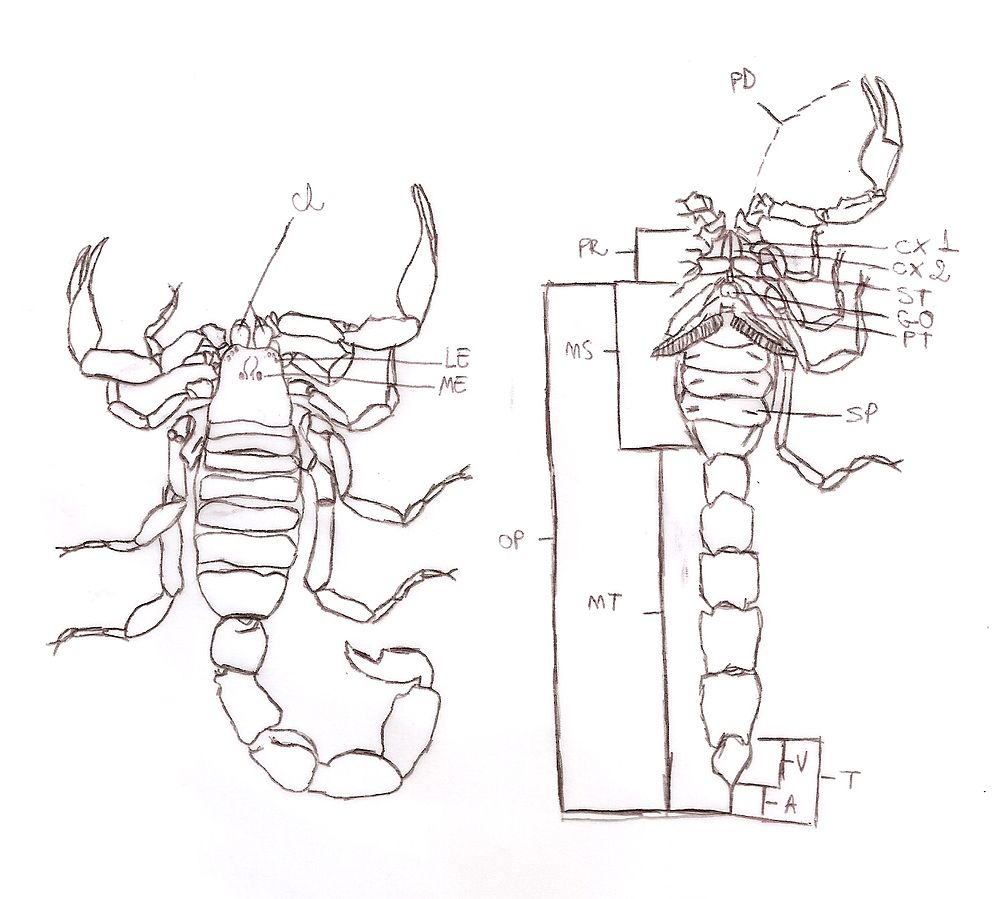
Figure 2. Dorsal (on left) and ventral (on right) anatomy of a generic scorpion
Author: Pietrovicari
This file is licensed under the Creative Commons Attribution-Share Alike 3.0 Unported license.

Legend for Figure 2:

  • Ch – Chelicerae (mouthparts)
  • LE – Left eyes
  • ME – Median eyes
  • PD – Pedipalps
  • PR – Prosoma or cephalothorax
  • MS – Mesosoma
  • MT- Metasoma
  • OP – Opisthosoma
  • GO – Genetal opercula (covers the gonopore or genital opening) 
  • PT – Pectins or pectines

The prosoma usually has one central pair of eyes on top. Often, there will also be two or three pairs of lateral eyes near the front edge. None of these eyes form sharp images, but the central pair is among the most light-sensitive of any animal. Scorpions are believed to use the shadows cast by starlight to navigate at night! The lateral eyes or ocelli are only used to detect changes in light intensity. They help the scorpion maintain its daily cycles.

In the photo below, you get a good view of the pair of central eyes. There is a cluster of lateral eyes visible, as well.

California common scorpion (Paruroctonus silvestrii)
San Diego County 8/12/18

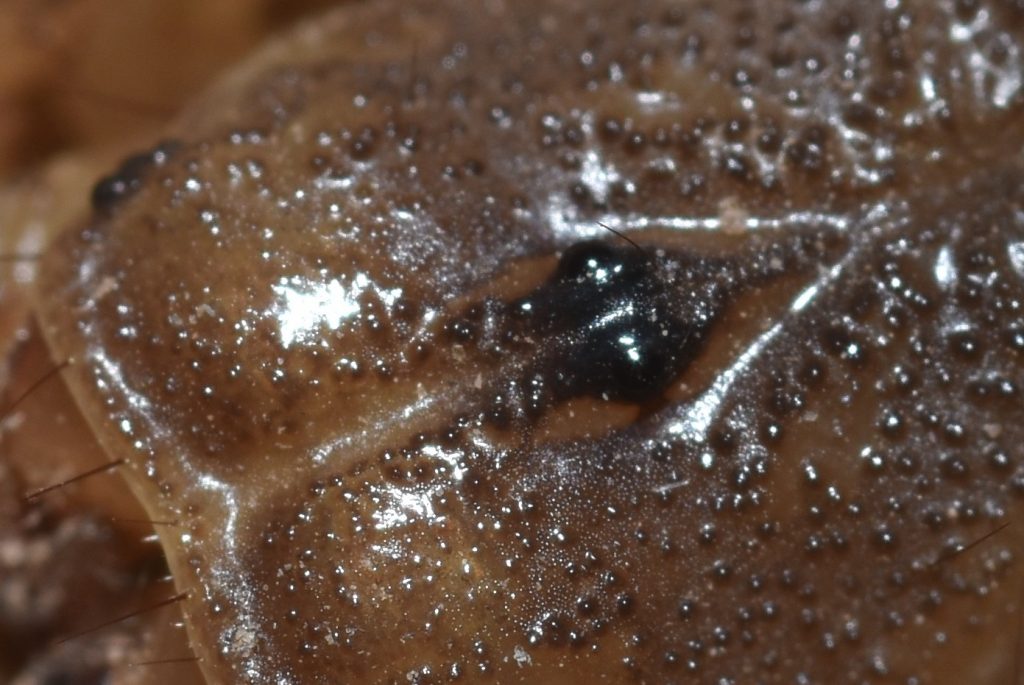
Here’s a better view of the lateral eyes. It looks like this species has three pairs grouped very closely together.

California common scorpion (Paruroctonus silvestrii)
San Diego County 8/12/18

Four pairs of walking legs are attached to the underside (or ventral surface) of the prosoma. Extending from the front of the prosoma are a pair of appendages called pedipalps, which end in large claws. And between the pedipalps are a pair of pincer-like appendages called chelicerae that function as mouthparts, tearing up food. Prey is caught with the claws, passed to the chelicerae, and, from there, the shredded parts are passed into the preoral cavity. Digestive juices secreted into the preoral cavity partially digest and liquefy the food. Only liquefied food is passed on to the rest of the digestive tract. Parts that cannot be liquefied are filtered out and expelled from the preoral cavity.

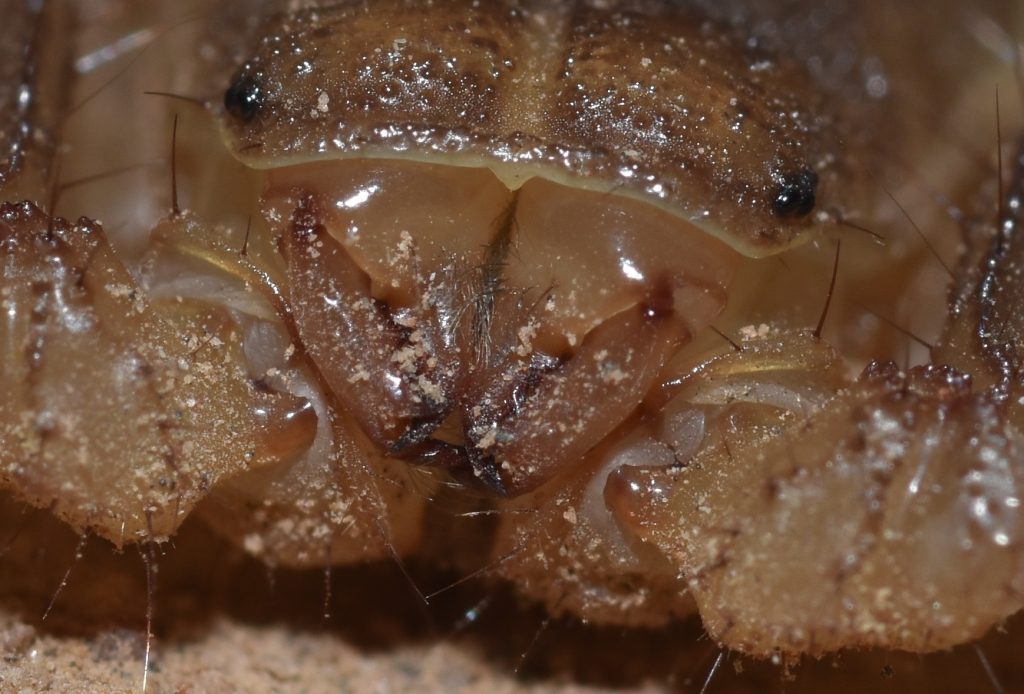
The next photo shows the chelicerae of a California common scorpion. Its lateral eyes are also visible.

California common scorpion (Paruroctonus silvestrii)
San Diego County 8/12/18

In the photo below, we can see the rather vicious-looking mouth-parts of a California swollen stinger scorpion. The central and lateral eyes are visible on the prosoma.

California swollen stinger scorpion (Anuroctonus pococki)
San Diego County 8/11/17

Behind the legs on the bottom of the prosoma are the genital opercula (GO in figure 2), which cover the openings to the genitals. Behind those are a pair of pectens (or pectines). These are comb-like appendages that serve as sense organs. Some species use them to locate prey. Males also use them to detect pheromones released by females. One way to tell males from females is that male pectines are larger and have more and larger teeth.

As noted earlier, the tail or metasoma is really an extension of the abdomen. The anus is located on the last segment of the metasoma, right before the telson. The telson is a venom bulb with a wicked stinger attached. This bulb contains two venom sacs which inject venom through a pair of openings on each side of the stinger, just before the tip.

On the ventral (bottom) side of mesosomal segments three through six are three pairs of book lungs. The ancestors of scorpions were aquatic and book lungs are evolved from gills. If you think of them as gills that have been enclosed inside the body to keep them from drying out, you probably won’t be far wrong.

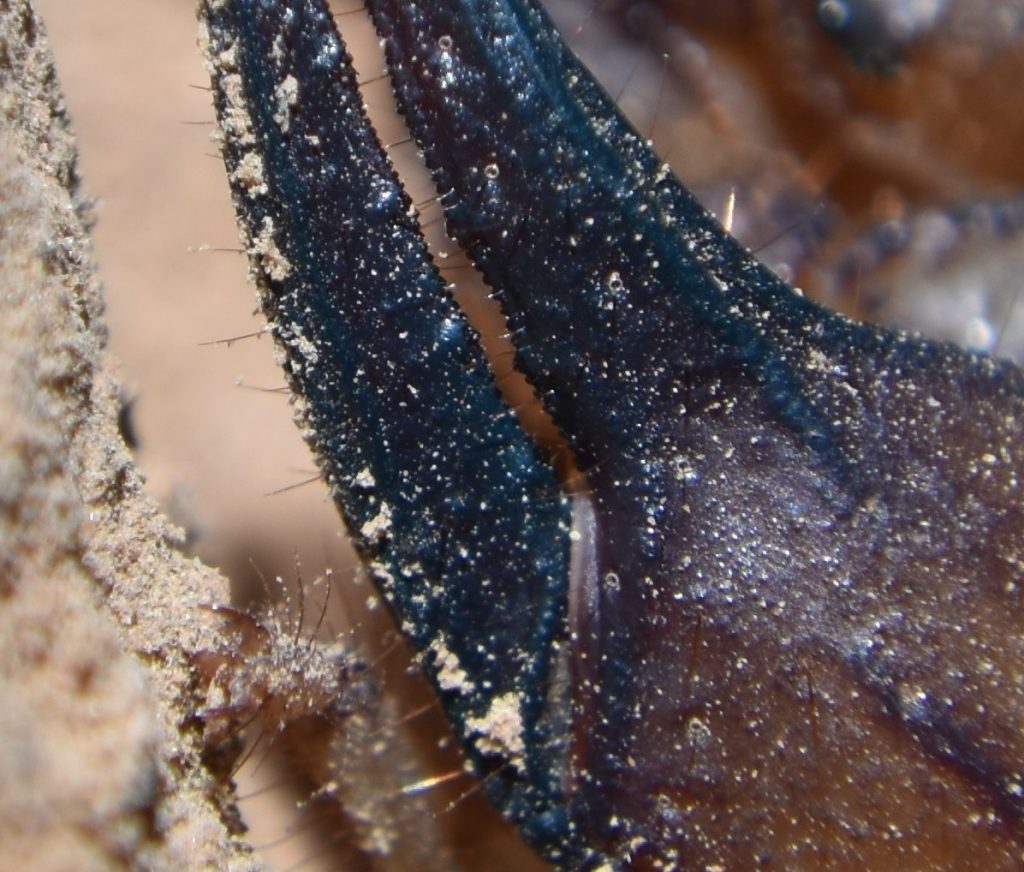
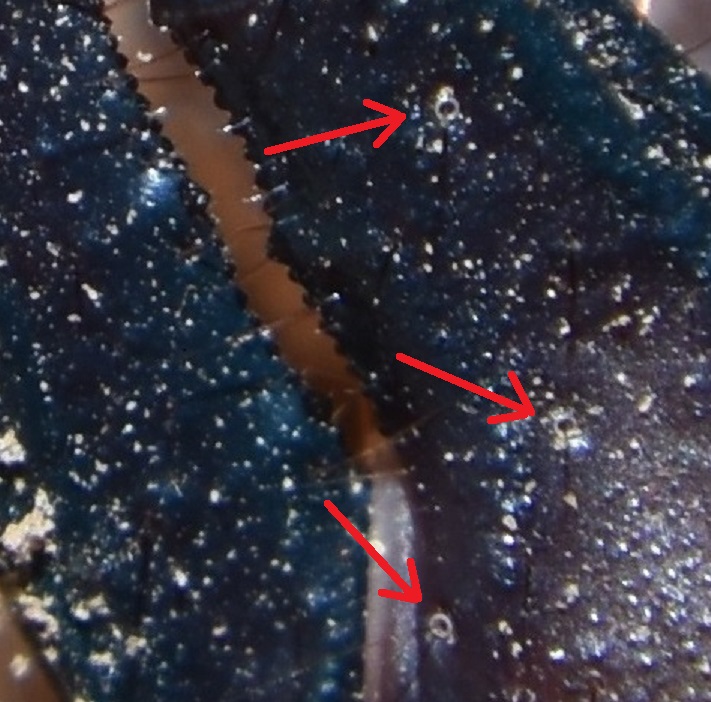
And finally, the following photo shows a claw of a California swollen stinger scorpion. You can see that there are a great many “hairs” or setae sprouting from it. Setae are sensory hairs. Most of them are probably used to feel things that come in contact with the claw, but some of them are a special type of setae called trichobothria. These sprout from the centers of tiny circular openings. The second photo below shows a blowup of a section of the claw with several trichobothria indicated with red arrows. The trichobothria are used to detect airborne vibrations and currents.59

Claw of a California swollen stinger scorpion (Anuroctonus pococki)
San Diego County 8/11/17
A closeup showing several tricobothria

The Grasshopper Mouse: A Mouse That Eats Scorpions 60 61 62

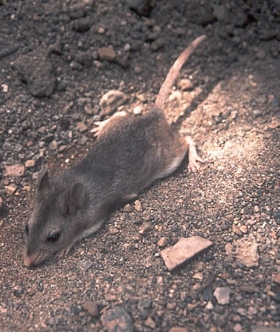
Most mice are vegetarians. Grasshopper mice in the genus Onychomys are an exception. They feed on a wide range of animals including insects (such as the eponymous grasshopper), spiders, snakes, centipedes, and even other species of mice. They also feed on scorpions. The southern grasshopper mouse (Onycomys torridus), in particular, routinely kills and eats Arizona bark scorpions (Centruroides sculpturatus). This is especially impressive given that, as already mentioned, this is the most venomous scorpion in the United States.

It looks so normal: Southern grasshopper mouse (Onychomys torridus)
Author: National Park Service
Source: Rodents – Tonto National Monument

So how does this rather unassuming-looking mouse manage this? A scorpion’s venom is a cocktail of chemicals that have various usually not very good effects on the animals it stings. One of these toxins has the job of causing intense pain. Researchers have found that the southern grasshopper mouse has a single mutation that changes the way this toxin interacts with pain neurons in such a way that, instead of exciting the neurons, it shuts them down, essentially anesthetizing the mouse. When it’s first stung, the mouse feels a quick stab of pain, but then it goes numb and is able to continue to feed with impunity.

Of course, this doesn’t explain how the mouse is able to handle all the other toxins in the venom. (There seems to be around 6 in total). Apparently, the grasshopper mouse has evolved resistance to those, as well, but researchers haven’t figured out the details yet.

There’s lots more I could write about this fascinating rodent, but this is a post about scorpions, so that will have to wait for a future article.

Scorpion Evolution 63 64 65 66 67

First, a quick bit of taxonomy. Scorpions are arthropods (phylum Arthropoda), which includes all animals with a segmented body, jointed legs, and an exoskeleton. Within Arthropoda, they are included in the subphylum Chelicerata, which groups together all animals that have chelicerae. Within Chelicerata, they are usually included in the class Arachnida, along with spiders, mites, ticks, and the like. (There is some debate about whether scorpions are really arachnids. We’ll get into that later.) Finally, scorpions themselves form the order Scorpiones.

To sum up, here’s the last paragraph in heirarchical form:

Arthropoda –> Chelicerata –> Arachnida –> Scorpiones

Arthropods were among the earliest animals and were part of the famous Cambrian explosion around 541 million years ago, which marks the beginning of the Cambrian period. All the major animal forms appear in the fossil record during this period. The last common ancestor of arthropods has not been found, but it’s been reconstructed as a modular organism in which each module or segment had a single pair of legs and an armor plate. It would have evolved during the period immediately preceding the Cambrian, the Ediacaran.

The Chelicerata evolved around 445 mya from marine arthropods. (All animal life was aquatic at this time.) Scorpions were among the earliest Chelicerata to evolve. Fossil scorpions as old as 430 million years have been found.

Scorpions are closely related to the extinct eurypterids (order Eurypterida) or sea scorpions, but the exact relationship is not known. Some scientists believe that scorpions evolved from eurypterids. Other scientists believe they both evolved from a common ancestor. Either way, the eurypterids are a fascinating group of animals and deserve a section of their own…

The Eurypterids

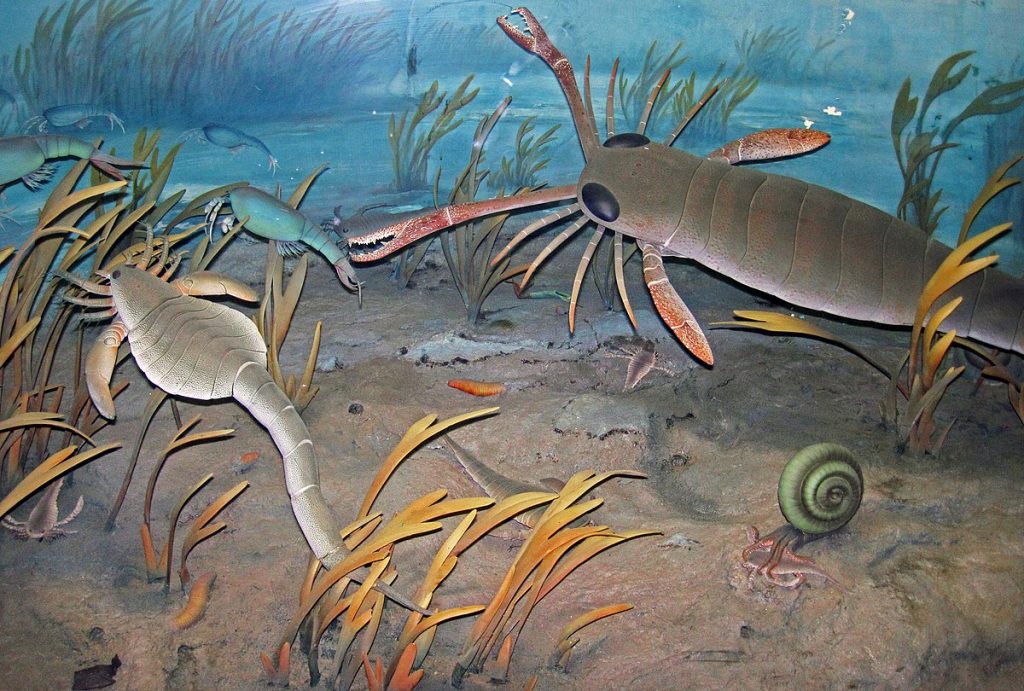
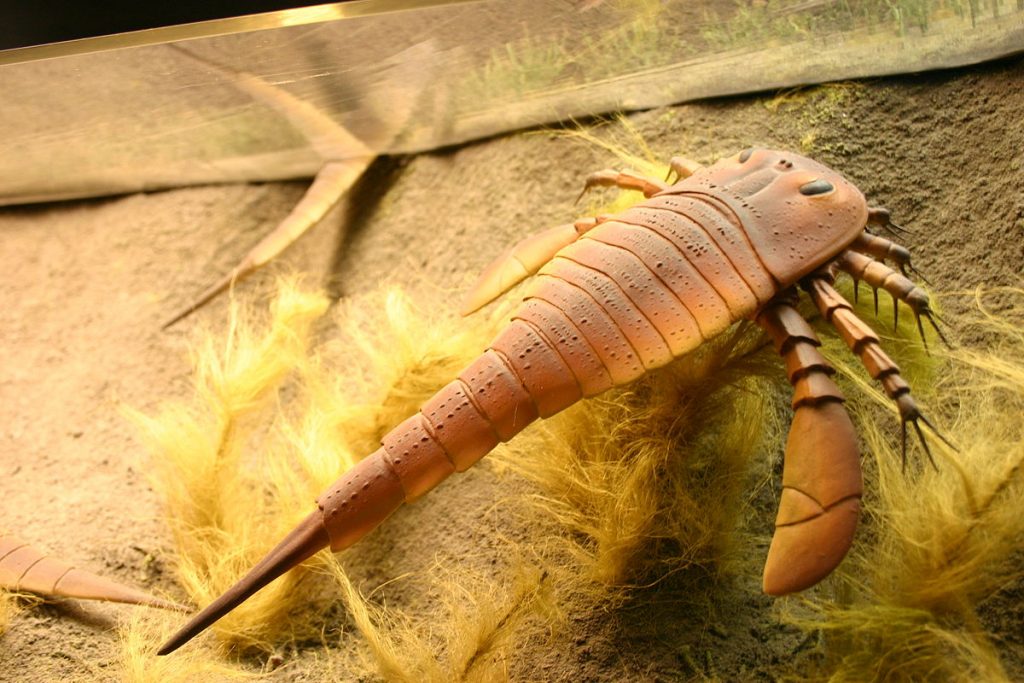
Sea scorpions go back at least to the Ordovician period around 467.3 mya. They may have evolved as early as the late Cambrian. The photos below attest to their obvious similarities to the true scorpions.

Reconstruction of a fossil sea scorpion making Palmichnium tracks.
Author: James St. John
This file is licensed under the Creative Commons Attribution 2.0 Generic license.
A reconstruction of life on an ancient seafloor during the Silurian, including two species of eurypterid
Author: James St. John
This file is licensed under the Creative Commons Attribution 2.0 Generic license.
Reconstruction of genus Eurypterus exhibited in Smithsonian National Museum of Natural History: Hall of Fossils
Author: Ryan Somma
This file is licensed under the Creative Commons Attribution-Share Alike 2.0 Generic license.

The earliest eurypterids lived in marine environments, but many later species inhabited brackish or fresh water. It’s possible they may have even invaded the land, although this is not known for certain. Some studies suggest that a dual respiratory system was present in some species, which would have allowed them to breathe both in water and air. But this, too, is not certain.

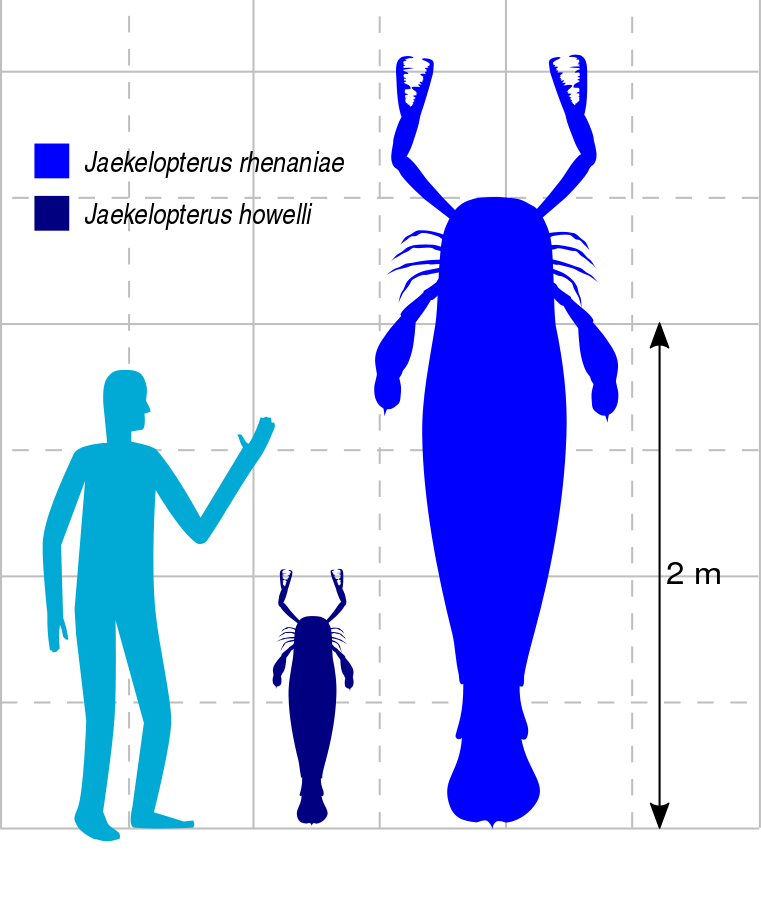
Eurypterids were very successful in their time and diversified to fill many niches. The smallest were less than an inch long. The largest known eurypterid, Jaekelopterus, may have reached 2.3–2.6 metres (7.5–8.5 ft)! It would have been the apex predator of the Early Devonian (roughly 419 to 393 mya).

Size of two species of Jaekelopterus
Author: User:Slate Weasel
This image is in the public domain.

Despite their similarities, it’s important to re-emphasize that scorpions may not have evolved from eurypterids. It’s quite possible that the two groups split from a common, unknown ancestor. There just isn’t enough fossil evidence to settle the matter one way or the other.

Scorpion Evolution Continued…68

The first scorpions were either marine or amphibious. The earliest fossils are associated with other marine organisms, so it’s likely they were entirely marine. They appear to have had gills and their legs appear to have been adapted to a bottom-dwelling lifestyle. The first fossils of scorpions that were definitely terrestrial are from the Upper Devonian or Lower Carboniferous between 370 and 323 mya. The transition from external book gills to internal book lungs is what made their colonization of land possible.

Early scorpions (as well as eurypterids) had compound eyes. These evolved into the simple eyes and ocelli of modern scorpions. (See my earlier blog post The Story of Eyes: Part 1.)

Ancient scorpions included some impressively large specimens. The current record holder, Brontoscorpio anglicus, apparently grew to around a meter long! (The only fossil we have of B. anglicus is an “incomplete single free finger of a pedipalp, almost 10 centimetres (3.9 in) long”,69 so this is necessarily an estimate.)

An artist impression of Brontoscorpio
Author: Tim Bertelink
This file is licensed under the Creative Commons Attribution-Share Alike 4.0 International license.

I mentioned earlier that there is some debate over whether or not scorpions should be classified as arachnids. The fossil record of scorpions is not terribly good and embryological and morphological studies have not been able to establish a clear relationship between the two groups. Some scientists believe that scorpions do belong in Arachnida and may even be the ancestors of other members of the group. Others believe that they don’t belong in Arachnida and instead are members of the class Merestomata. In this view, their closest living relatives would be the horseshoe crabs.

Living Fossils? Not So Much

It used to be very common for certain plants and animals to be described as “living fossils” — generally because their outward appearance hasn’t changed much from their distant ancestors. Although you’ll still hear the term used occasionally, modern scientists prefer to avoid it. The fact is, all organisms change over time, even if the changes aren’t immediately obvious.

Scorpions are a good example. A paper in “Nature” 70 describes a study of the genome of the scorpion Mesobuthus martensii. According to this paper, “Although M. martensii appears to evolve conservatively, it has a greater gene family turnover than the insects that have undergone diverse morphological and physiological changes, suggesting the decoupling of the molecular and morphological evolution in scorpions.” In other words, while the scorpion’s overall form has been conserved, physiological features, such as basic metabolic pathways, signalling pathways, and venom makeup, have evolved at a remarkable pace. So much for scorpions being living fossils!

It’s interesting to note that the concept of “decoupling” is also used in modern computer programming, especially object oriented programming. I won’t go into a lot of detail, but the idea is that programmers try to design the various “entities” — usually classes — in a program in such a way that any given entity can be redesigned without having to modify other entities that use it or depend on it. More and more, biologists are finding that evolution also uses decoupling to improve the “evolvability” of organisms. The decoupling of morphology and physiology in scorpions is a nice example. Evolvability is an important concept in modern evolutionary theory, but that’s a topic for another time.

Don’t try this at home.

Cheesy Bobs

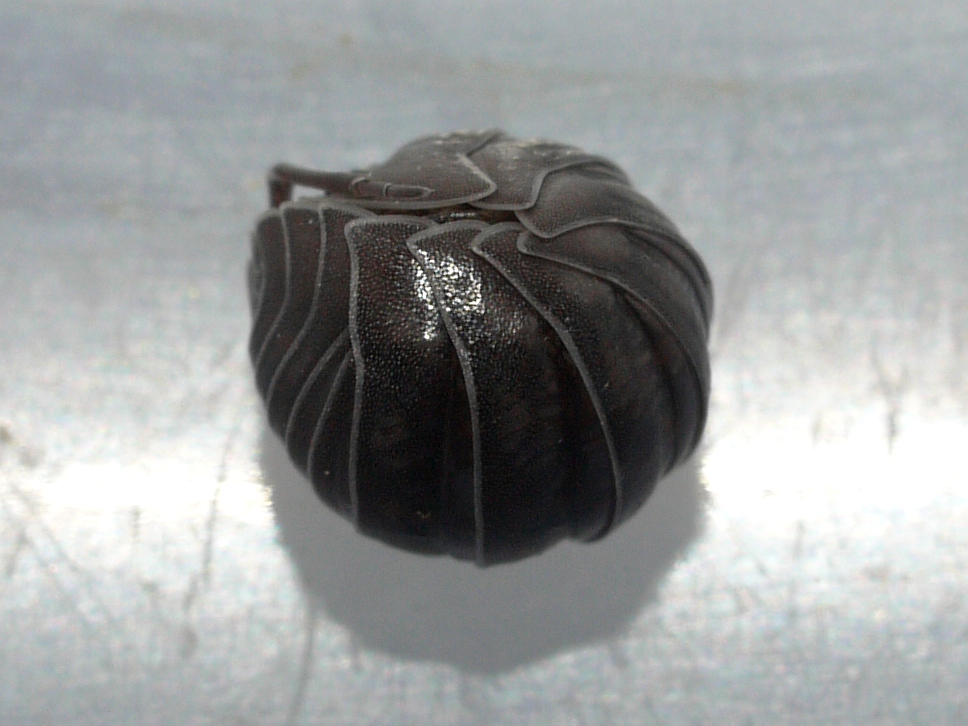
In Guildford, England, woodlice are known as ‘cheesy bobs’. I don’t live in Guildford — or in England, for that matter — but I love that name. Maybe I’ll start calling them that and see if it catches on. Anyway, here in Southern California, most people call them roly-polies or pillbugs, if they call them anything. (These names usually apply only to members of the genus Armadillidium, which can roll up into balls.)

Woodlice have a ridiculous number of common names. Wikipedia lists 25 different names and this is just a small sampling. I clicked at random on one of the footnotes in the list and it brought up a reference to a paper (yes, an actual scientific paper) entitled “Vernacular Names of Woodlice with Particular Reference to Devonshire”, which went on to list many more names. This is kind of surprising, given that most people know jack-all about woodlice. Many people don’t even know what they are, which brings me to my next topic: 38

What the Heck Are They? 40 71

Since there are so many great common names, I thought it would be fun to sprinkle some of them throughout this article. Just to anchor us, I’ll also frequently refer to them as ‘woodlice’ (singular ‘woodlouse’). Whenever I use one of the other common names, I’ll put it in single quotes and note the source in a footnote. For instance:

‘Chucky pigs’ 72 are crustaceans (like crabs, lobsters, shrimp, etc.) They form the suborder Oniscidea within the order Isopoda. One interesting thing about woodlice is that they’re the only terrestrial crustaceans. That is, they’re the only ones that have managed to adapt completely to living on land. Not all species live on land and not all of them live on land all the time, but most do.

Actually, there is some ambiguity in the literature about whether or not woodlice really are the only terrestrial crustaceans. Some articles state this as fact. Others point to a few other types of crustaceans, such as some species of amphipods, that may also qualify as fully terrestrial. This discrepancy may be due to the difficulty of defining ‘fully terrestrial’.

Common Pill Bugs or Roly-polies (Armadillidium vulgare)
San Diego County, CA 6/15/17

As I already mentioned, ‘hog-lice’ 73 are in the order Isopoda. Woodlice, and Isopods in general, have seven pairs of equal-sized legs. This is the reason for the name ‘Isopoda‘, which is Latin for ‘equal feet’. Isopods also have segmented exoskeletons, two pairs of antennae, and five pairs of appendages on the abdomen that are used for respiration. In woodlice, only one of the pairs of antennae is easily seen. The other pair are very small and may be vestigial (no longer used). (See figure 2.)

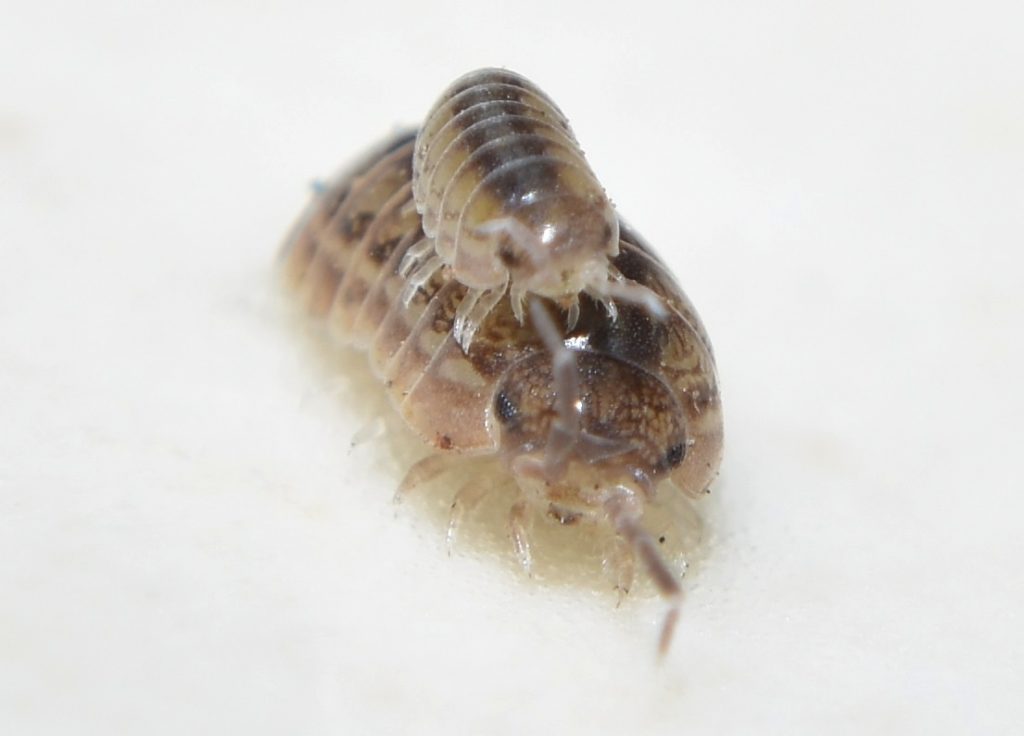
Common Pill Bugs (Armadillidium vulgare)
San Diego County, CA 6/15/17
The smaller woodlouse is not riding on the older one for any particular reason. It just happened to crawl on top of it.

Female isopods carry their young in a pouch underneath their bodies. This pouch is called a ‘marsupium’. The marsupium starts off full of water. After the young have developed to the point where they are capable of breathing outside water, air is injected into the marsupium and the young continue to develop for a time before leaving the brood pouch. This is one of the nice adaptions the woodlouse has made to living on land.

Armadillidium nasatum
Woodlice in the genus Armadillidium are famous for their ability to roll up into balls. They are often called pillbugs or roly-polies.
Author: Ilona Loser
This file is licensed under the Creative Commons Attribution-Share Alike 4.0 International license.

More on Anatomy

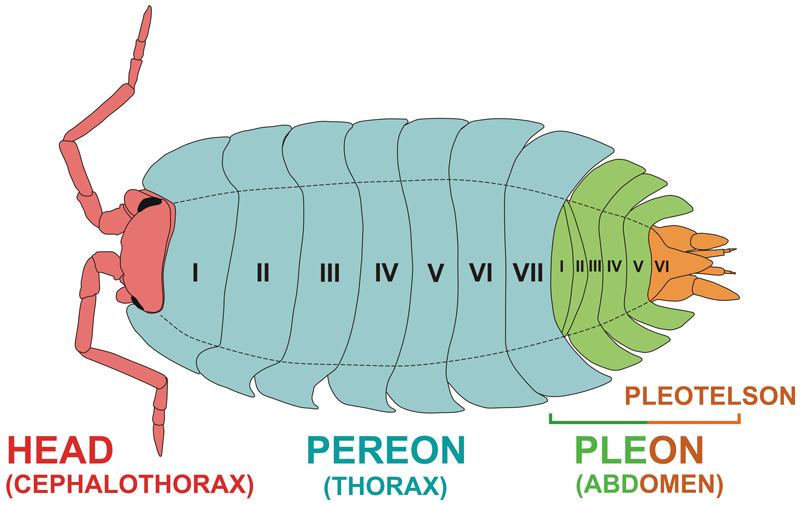
The ‘ sow bug’ 74 body is divided into three major parts: the cephalothorax (which is technically the head fused with the first segment of the thorax), the pereon (the remaining segments of the thorax), and the pleon (the abdomen). (See Figure 1.)

Figure 1 The main body regions of a woodlouse
Author: Darekk2
This file is licensed under the Creative Commons Attribution-Share Alike 4.0 International license.

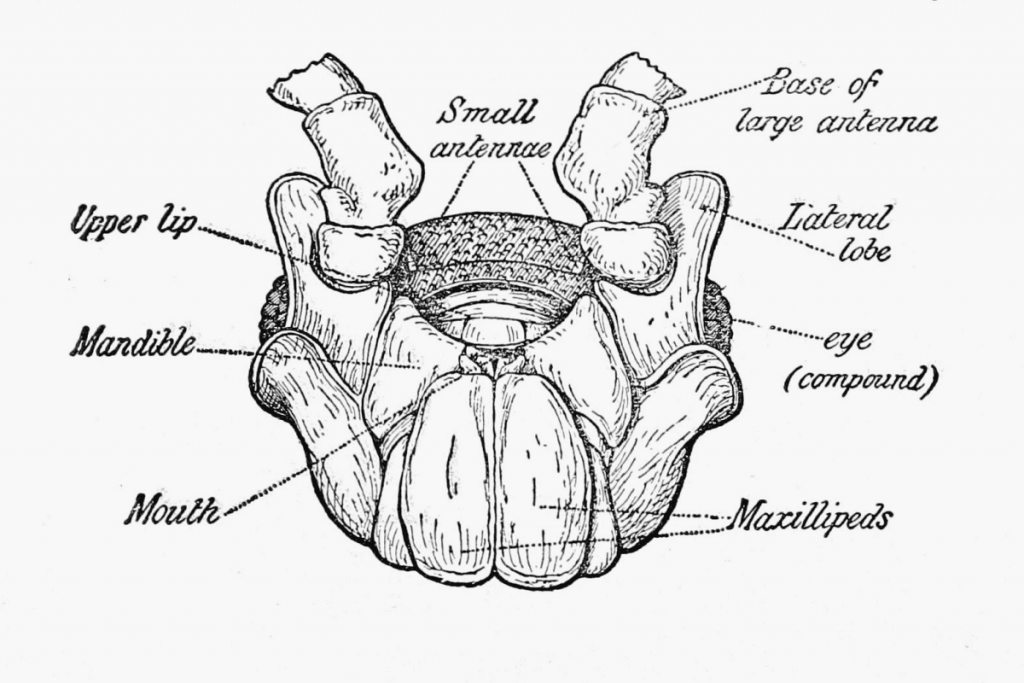
Figure 2 shows a ventral (bottom) view of the head of a woodlouse. A number of important features are visible in this figure. The maxillipeds were originally legs, but they have evolved to serve as sort of a lower lip. You can see how they’ve fused together. Above these, you can see the mandibles and, above them, the upper lip. Note the large main antennae and the very tiny pair of antennae between them. The eyes are also visible.

Figure 2 Illustration from the book “The British Woodlice” by Webb, Wilfred Mark and Sillem, Charles (1906)
This media file is in the public domain in the United States. This applies to U.S. works where the copyright has expired, often because its first publication occurred prior to January 1, 1925, and if not then due to lack of notice or renewal. See this page for further explanation.

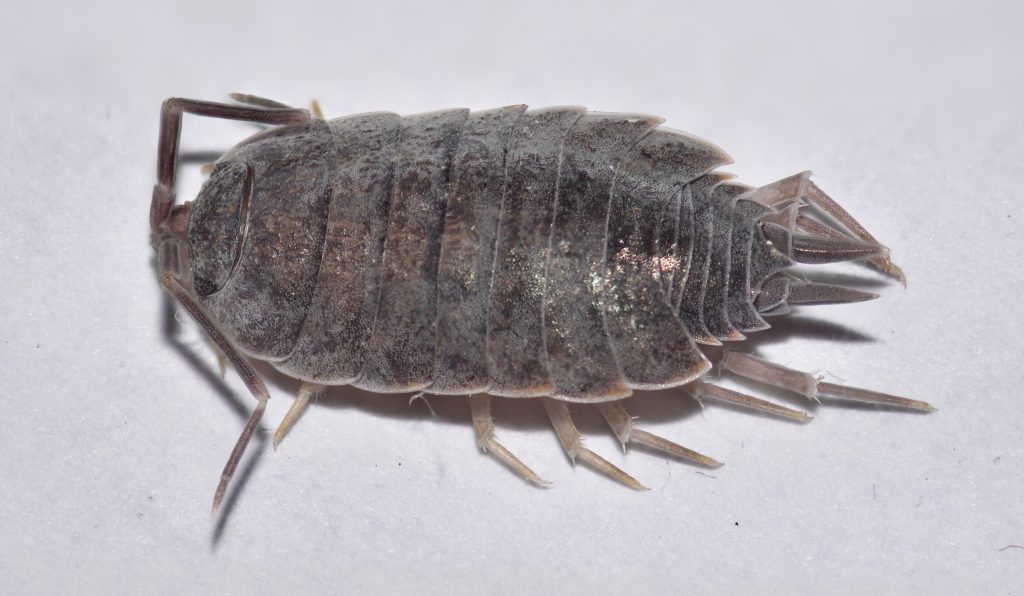
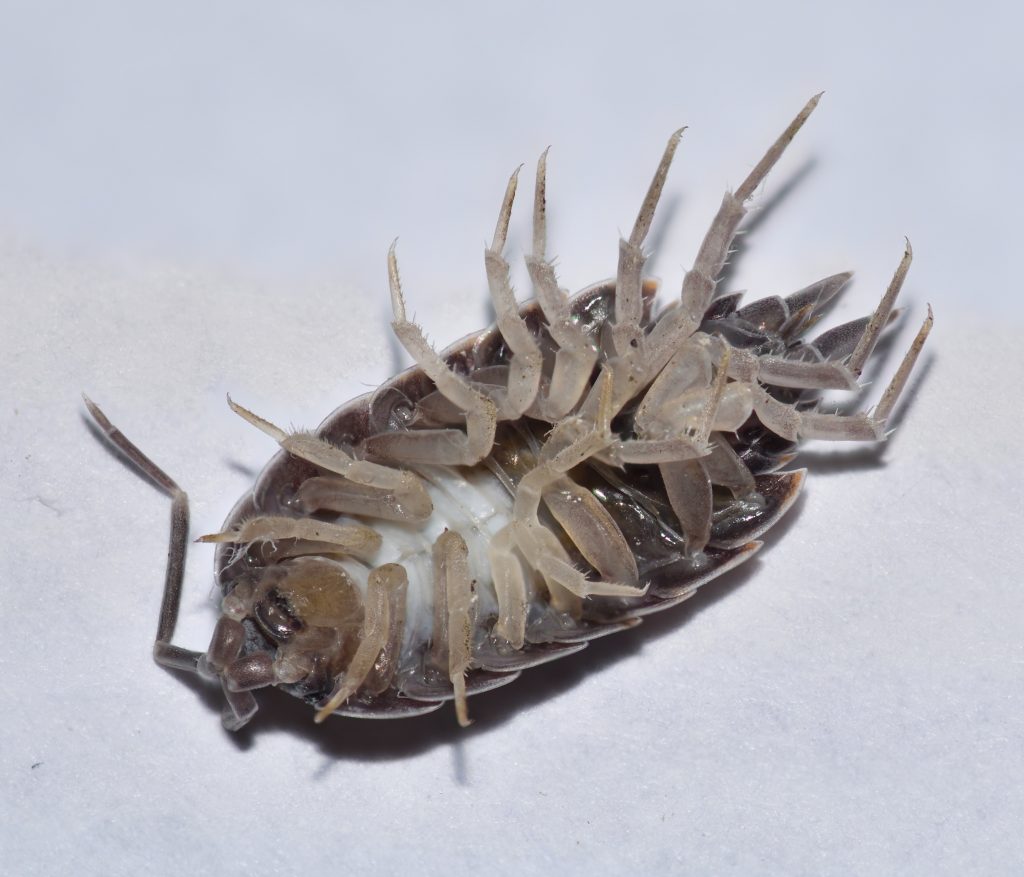
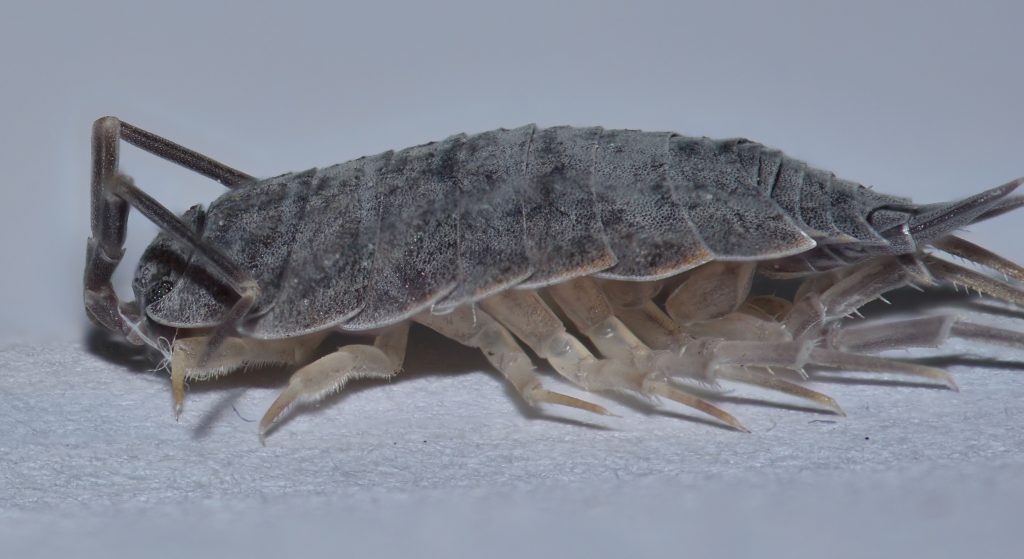
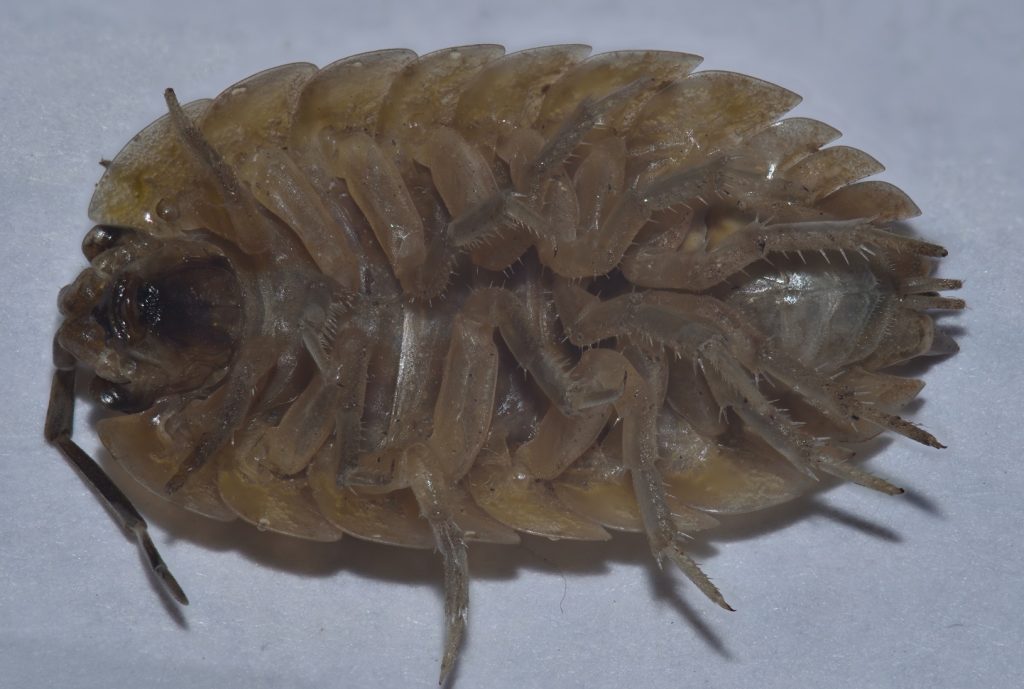
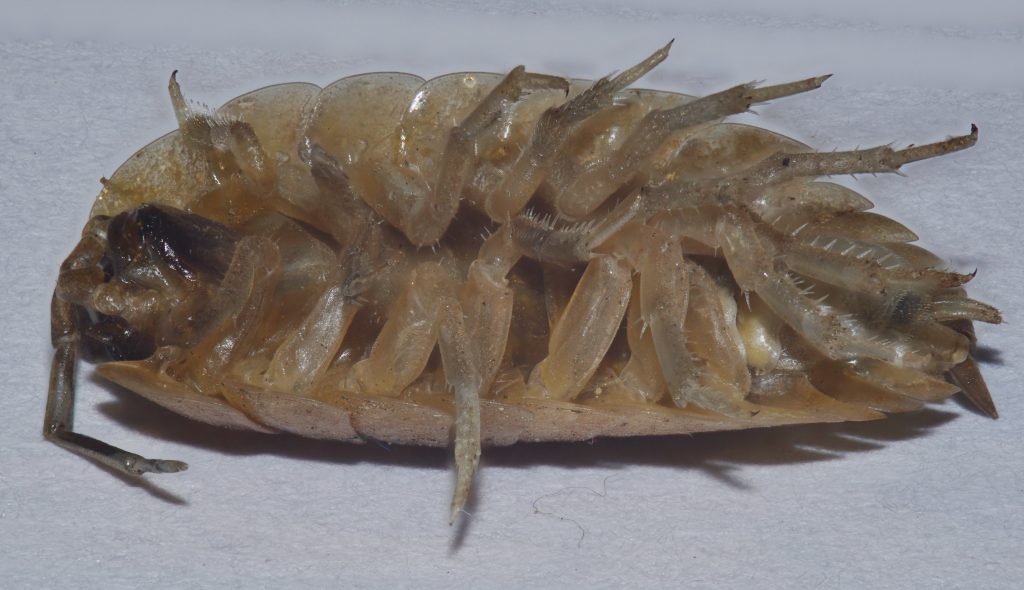
The following photos show a woodlouse in the genus Porcellionides (according to bugguide.net).

Porcellionides sp.
Ruffin Canyon, San Diego County 11/1/19
Porcellionides sp. – ventral surface

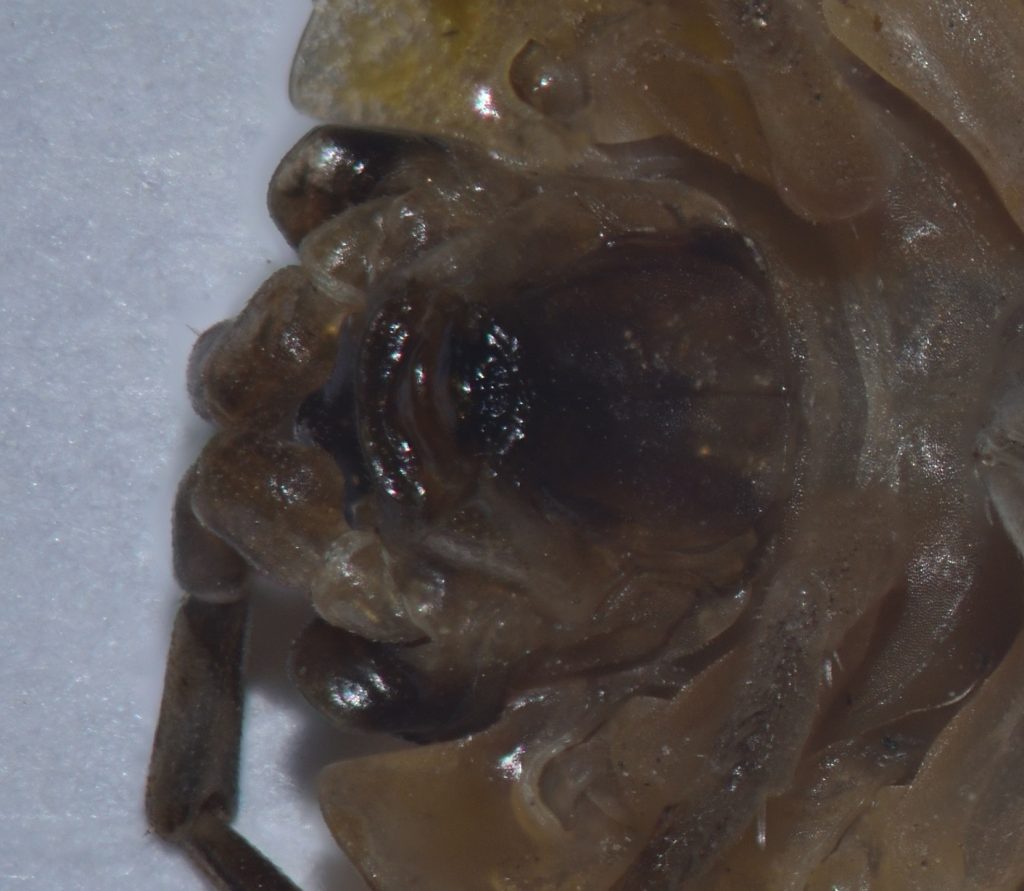
In the next photo, you get a pretty good view of one of the eyes. Although Figure 2 describes them as compound eyes, they may not technically fit that definition if they haven’t been integrated into a single organ. (See my previous article on millipedes.) However, according to one article,75 the eyes can vary from small groups of ocelli (simple eyes) to compound eyes, according to the species. So maybe some of them do have true compound eyes.

Porcellionides sp.

Here’s some photos of another species of ‘butcher boy’ 76 It’s been identified as two completely different genus/species on two different forums, so I’m not sure what it really is, other than some kind of woodlouse.

Woodlouse
San Diego County 12/14/19

See if you can match up the mouth-parts in the following photo with those in figure 2.

Closeup of the mouth-parts

At the beginning of this section, I referred to woodlice as ‘sow bugs’. This is actually one of the more common names. As a side note, someone on the Internet mentioned that she once met a kid who insisted on calling them ‘sour bugs’. When she tried to correct him, he said “Have you ever tasted them?”, which effectively ended the argument. (I wish I could give this person credit, but, unfortunately, I don’t remember where I read the story.)

Eating and Being Eaten

‘Boat-builders’ 77 eat mostly decomposing plant material (detritus). They love compost. As such, they are very beneficial bugs, helping to recycle organic material.78 Woodlice are not usually carnivorous, but they will occasionally eat dead and decaying animals. They are also cannibalistic — they will happily eat dead woodlice or even live woodlice that are vulnerable because they’re in the process of molting.79

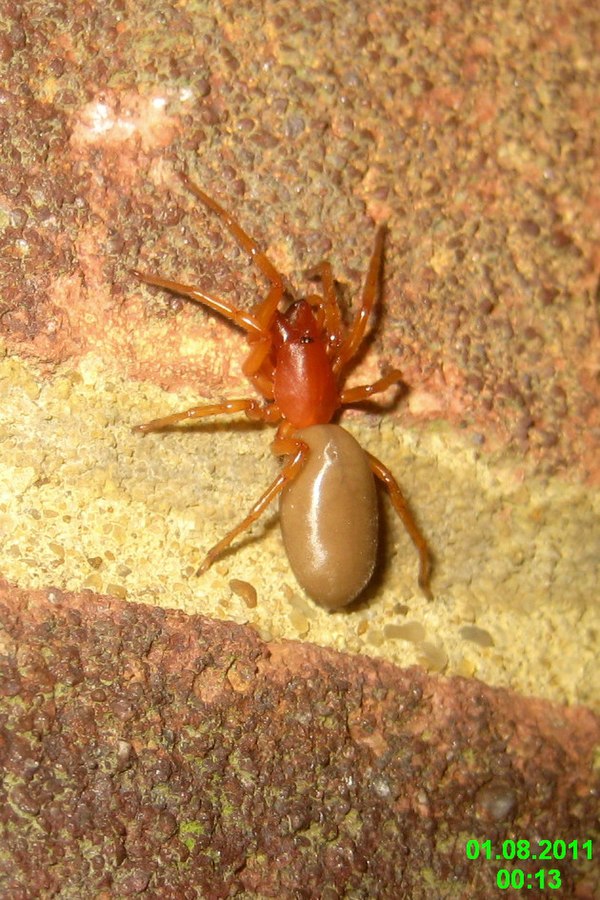
Of course, in addition to eating, they often get eaten. Some of their many predators include toads, lizards, snails, newts, foxes, and small owls.80 ‘Chucky pigs’ 81 also have to contend with the woodlouse spider (Dysdera crocata). This spider has large chelicerae (fangs) that are able to pierce the woodlouse’s exoskeleton. Laboratory studies have shown that D. crocata doesn’t actually have any preference for ‘monkey-peas’.82 — they just hang out in the same habitats (in leaf litter, under logs and rocks, etc.) 83

Woodlouse Spider
Author: David Short from Windsor, UK
This file is licensed under the Creative Commons Attribution 2.0 Generic license.

Woodlice are sometimes eaten by humans, although it’s probably not a widespread practice. According to one article, they taste a like shrimp. This isn’t too surprising — they are closely related, after all.84 Other authors are less complementary. Wikipedia references an article from Discover that describes them as tasting like “strong urine”.85 I’m not sure how the author knows what strong urine tastes like, but, there you go.

‘Cheese Log’ 86 Reproduction

Woodlouse genitalia are on their abdomens. Females have two genital openings, one on each side. When a male woodlouse finds a receptive female, he crawls onto her back and, according to the source referenced in the footnote for this section, “spends a few minutes licking her head and tapping on her back with his front legs”. (The source doesn’t bother explaining how he goes about licking her without the benefit of a tongue. Your guess is as good as mine.) The male then moves to one side, bends his body under the female, and inserts his genitalia into the genital opening on the opposite side. After transferring sperm, which takes about 5 minutes, he moves to the opposite side of the female and repeats the process with her other genital opening.

Gills or Lungs?

According to Wikipedia, ‘Grammersows’ 87 “breathe through trachea-like lungs in their paddle-shaped hind legs (pleopods), called pleopodal lungs.” 88 Other articles describe woodlice as breathing through gills. The confusion may be due to the difficulty of telling where gills leave off and lungs begin. Here’s a link to a very interesting video that refers to them as gills: Click here. The video goes on to explain that “folds in the pleopod gills developed into hollow, branched structures — almost like tiny lungs.”

Another source of confusion could be that different species of woodlouse vary in the extent to which the ancestral gills have been modified. In any case, woodlice and their relatives tell a fascinating story of how a group of aquatic animals evolved to conquer the land. As such, they’re of great interest to evolutionary biologists.

The Strange Case of Wolbachia 89 90

Wolbachia is a genus of bacteria that infects arthropods (including woodlice) and some nematodes. It’s remarkably widespread. One study estimated that 25 to 70 percent of all insect species were potential hosts for this microbe.91 In some arthropod species, the relationship has evolved to be mutualistic, so that the host actually benefits in some way from the infection. There are even examples of species that cannot reproduce, or even survive, without the bacteria.

The most remarkable thing, though, is what the bacteria does to its hosts. Wolbachia is passed from mother to offspring through the egg cells. It doesn’t pass from father to offspring, because the bacteria are too big for the sperm cells. What this means is that Wolbachia benefits if there are more female hosts than males. It also benefits if there are fewer uninfected hosts to compete with the infected ones. Various strains of Wolbachia have evolved different ways to take advantage of this:

1. The bacteria may kill the males during larval development, so that only infected females live to reproduce.

2. Feminization of the males. In some cases, Wolbachia actually overrules a host’s genes, causing genetic males to develop as functional females. In other cases, the males may develop as infertile ‘pseudofemales’, which, from the bacteria’s point of view, is just as good as killing them.

3. Parthenogenesis, a.k.a. asexual reproduction. The bacteria modifies the female host so that she is able to reproduce without the help of males. In other words, she lays unfertilized eggs that hatch into new females. Remarkably, some researchers have suggested that asexual reproduction is always due to Wolbachia.92

4. Cytoplasmic incompatibility. Wolbachia alters the chromosomes of the infected hosts in such a way that infected males can only successfully reproduce with infected females.

As far as I can tell, Wolbachia infection in woodlice hasn’t been widely studied. I did find one paper from 2001 that described a study done on the species Oniscus asellus.93 I won’t bore you with the details — you can check out the link in the footnote, if you’re interested — but, in general, Wolbachia seems to exhibit a wide variety of strategies in woodlice, just as it does in other arthropods.

‘Granny Grey’ Gets the Blues 94 95

Invertebrate iridescent virus 31 (IIV-31), a.k.a. ‘isopod iridescent virus’, is a virus that infects and eventually kills isopods. But before it kills them, it turns them blue. In the advanced stages of an infection, the crystalline arrangement of the virus particles that have built up in the bug’s exoskeleton cause it to turn a bright, iridescent blue or sometimes a bluish-purple. If you ever encounter a woodlouse of this color, you may be sure that it’s been infected with IIV-31 and, moreover, that it’s not long for this world.

A fossil isopod has been found preserved in Myanmar amber that actually displays iridescent blue patches, suggestive of an IIV-31 infection. While it’s not known for certain that this is a result of the virus, it seems likely. Here’s a photo:

A fossil isopod in early Cretaceous amber
Author: George Poinar Jr.
Source: George Poinar Jr., “Evolutionary History of Terrestrial Pathogens and Endoparasites as Revealed in Fossils and Subfossils,” Advances in Biology, vol. 2014, Article ID 181353, 29 pages, 2014. doi:10.1155/2014/181353
This file is licensed under the Creative Commons Attribution 3.0 Unported license.

More Random Weirdness

Honestly, there are so many weird facts about ‘chucky pigs’ 96 that it’s hard to figure out how to discuss them in any kind of logical order. So here’s a few of them listed at random: 97

Like all arthropods, a woodlouse has to periodically shed its exoskeleton as it grows. Unlike most arthropods, it does this in two stages. First, it molts the back half of the exoskeleton, then it molts the front half a few days later. If you see a woodlouse whose front and back halves are different colors, it’s probably in the process of molting. Molting in two stages may make the woodlouse less vulnerable to predators. It probably also reduces water loss.

‘Granfer-grigs’ 98 can drink water through their anus. Woodlice have tube-like structures called uropods on their back ends. They press the uropods together and touch them against a moist surface. Capillary action sucks water up through the uropods and into the anus. They can also drink water the usual way through their mouths and they even seem to be able to absorb water vapor directly through their exoskeletons when the humidity is high enough. If the humidity remains high for too long, they may become water-logged and have to seek out an area of lower humidity. In summary, woodlice are very well adapted to extracting water from the environment.

Building on that last point, a few species of woodlice have even managed to adapt to living in the desert. Hemilepistus reaumuri lives in the deserts of North Africa and the Middle East in what is probably the driest environment colonized by any species of crustacean. It occurs there in great numbers and is an important part of the desert ecosystem.99 100

Woodlice do not pee. The main purpose of urination is to get rid of nitrogenous waste. This usually occurs in the form of ammonia. Ammonia is too toxic for most animals to deal with directly, so they convert it into urea or uric acid before excreting it. Woodlice, however, have developed a high tolerance for ammonia and are able to excrete it directly as a gas. This means they don’t have to waste energy converting it to another form.

‘Grammer sows’ 101, like all crustaceans and many other arthropods, have blue blood. This is due to the presence of the compound hemocyanin102, which is copper-based and serves the same purpose as the iron-based hemoglobin in our blood. The blood is colorless when it’s not carrying oxygen, but turns pale blue in the presence of oxygen. Unfortunately, woodlouse blood only contains small amounts of hemocyanin, so the blue color is not visible to the unaided eye.

As a young child, the science fiction writer Isaac Asimov decided it would be a great idea to put a number of woodlice in his mouth. His reasoning was that the woodlice would “tickle his tongue” as they walked around on it. Apparently, he was right about this, but his mother noticed the strange expression on his face and asked him if everything was all right. He replied by spitting out a mouthful of woodlice.

Woodlouse Evolution 103

Fossils of aquatic isopods have been found from the Carboniferous, around 300 million years ago. All isopods that live in water are benthic — that is, they crawl around on the bottom — so it’s likely that woodlice evolved from such bottom-dwellers. Isopods would have begun the evolution into woodlice by developing forms that could survive outside water for longer and longer periods. Such intermediate forms still exist today. The sea slater (Ligia oceanica), for instance, lives on the seashore in rocky areas, coming out at night to dine on seaweed, diatoms and debris.104

The earliest fossils we have of actual woodlice only go back to the Eocene, about 50 million years ago. It’s likely that they evolved much earlier than that, though. ‘Tiddy-hogs’ 105 are widely distributed throughout the world and, since they don’t have any means of crossing the ocean, this implies that they must have evolved before the continents split up, around 160 million years ago.

Scientists used to believe that Oniscidea (the woodlouse suborder) was monophyletic; that is, they believed that all of them were descended from a common ancestor. This would have implied that they underwent a single transition from water to land. Molecular studies, however, have called this into question. One such study, published in Nature in 2019 106 suggests at least two, and possibly more, such transitions onto land.

Some Thoughts on All Those Names

You may have noticed that many of the common names for woodlice are related to pigs. In fact, an article on the “Country Life” website107 claims that 94% of the common names relate to pigs! The article goes on to explain that the reason for this is that “Woodlice look like feeding piglets or pigs huddled in a pen.” However, another website (which I haven’t been able to relocate) suggests that it’s just because they smell bad.

Either way, what interests me more is why there are so many common names. I mean, millipedes, by comparison, seem to have very few common names. Maybe it’s because woodlice look so different from other animals. Millipedes are worm-like, so people may just think of them as a kind of worm, despite all the legs. But woodlice are just plain weird. Also, you rarely see them unless you turn over a log or brick or move a bucket or something. Then, suddenly, there they are!

Another thing to keep in mind is that up until recent times, most people lived in the country. So, while they wouldn’t have been encountering woodlice on a daily basis, unexpected encounters with them would have been much more common than for the average person today. You see something weird; you have no idea what it’s related to; so you make up a weird name for it.

That’s the best explanation I can come up with. It does seem like it would be an interesting, if rather eclectic, research subject.

A Meandering of Millipedes

Southern California is not known for being wet and humid. Millipedes lose water easily, so those that live here spend most of their time hidden away in protected places. When they do come out, it’s usually at night. The one time you see a lot of them is after the first good rain of Autumn. Then they come out in droves. In one three-mile night hike in November, I counted over thirty.

The most common millipede in my neighborhood is in the genus Tylobolus. I’m not sure of the species. Tylobolus is in the family Spirobolidae and the order Spirobolida. Spirobolida are the round-backed millipedes. The reason for this moniker will be obvious from the photos below. Like all millipedes, Tylobolus adds segments with each molt, so the number of legs and segments depends on the millipede’s age, but the adults have around 40 to 54 segments.79 80

Tylobolus sp.
Mission Trails Regional Park, San Diego County 12/03/19
Tylobolus sp.
Mission Trails Regional Park, San Diego County 12/03/19
Tylobolus sp.
Same millipede as above perched on my thumb.

The one other species I’ve encountered here is in the genus Bollmaniulus. I don’t know the species name. The genus is in the family Parajulidae and the order Julida. As you can see from the following photo, they’re much skinnier than Tylobolus, but otherwise, the two are surprisingly similar, even though they’re in separate orders.86

I would love to know what different niches these two species occupy that would explain their extreme difference in width. Unfortunately, I haven’t been able to find much information on them. If anyone out there knows more about them, please enlighten me.

Bollmaniulus sp.
Mission Trails Regional Park, San Diego County 1/9/19
Bollmaniulus sp.
Mission Trails Regional Park, San Diego County 11/23/19
Bollmaniulus sp.
Mission Trails Regional Park, San Diego County 11/23/19

Here’s a video of Bollmaniulus in motion:

And here’s the same millipede in slow motion. This is a male — you can tell by the structure hanging down behind the fifth pair of legs, which is part of the genitalia. (Don’t worry, we’ll be covering their private parts in much greater detail later.)

Millipede or Centipede? 87 88

The first thing everyone wants to know is how to tell the difference between a millipede and a centipede. They both tend to be long and worm-like and have lots of legs, so it’s easy to confuse them. The resemblance is superficial, though. They’re actually quite easy to tell apart if you know what to look for.

First of all, Centipedes are all carnivores and they’re all venomous. What used to be their first pair of legs has evolved into fangs, which they use to inject venom into their prey. Millipedes, on the other hand, are almost all detritivores, which means they eat rotting plant or animal matter (detritus). Mostly, they eat rotting leaves. There is a small group of millipedes that are carnivorous, but even those are not venomous. So that’s the first way to tell a millipede from a centipede — pick it up and see if it bites you.

If you prefer a less potentially painful method, you can look at the legs. Millipedes have two pairs of legs on most of their segments. (See figure 1.) Centipedes have only one pair per segment. Because of this, millipedes usually have a lot more legs than centipedes. You can’t depend on this, however, because a long centipede could have more legs than a short millipede. The legs of millipedes are also held more underneath the body, whereas centipede legs splay out to the sides.

One other difference is that centipedes, being carnivores, tend to move faster than millipedes — they’re built for speed. Millipedes, on the other hand, are built for things like burrowing and pushing their way underneath rotting leaves. This explains the two pairs of legs per segment. What better way to increase your ability to bulldoze your way through stuff than by almost doubling the number of your legs?

But why two pairs of legs per segment? Why not just double the number of segments? Actually, each of the segments with two pairs of legs started out as two segments, which have become fused. And what is the point of fusing them? If you have two pairs of legs pushing on two unfused segments, the segments are going to move in relation to each other at the joint. Maybe not much, but any amount of movement at the joint is going to consume energy. If you fuse the segments, then all of the energy goes into pushing the fused segments forward. Obviously, even more energy would go into pushing the millipede forward if you fused all the segments, but then you would lose all flexibility. As with so many things in evolution, it’s a trade-off. By fusing the segments in pairs, you significantly increase the amount of energy that goes into moving the millipede forward without sacrificing much flexibility.

What Good Is a Millipede? 93

If you catch a millipede and keep it in a small container for a while, one of the first things you’ll notice is that it poops a lot. The leaves and other detritus that millipedes consume are broken down in their guts and excreted as pellets that are more easily decomposed by microorganisms. I kept a couple of millipedes in a Tupperware container with some dead vegetation for a week or two and I was amazed at the rate at which they converted the vegetation into poop. So millipedes are important in producing new soil. They also help to aerate the soil by burying through it. In this way, they serve much the same purpose as earthworms.

Back to the Basics 94 95 101

Millipedes are arthropods. This means they’re in the phylum Euarthropoda, which includes myriapods, insects, arachnids, and crustaceans. (The older term, Athropoda, is now used for a proposed grouping of Euarthropoda with the phylum Onychophora, the velvet worms.) Arthropods have jointed appendages, cuticle made of chitin, and segmented bodies. They also have exoskeletons, which must be shed periodically.102

Within Euarthropoda, millipedes belong to the subphylum Myriapoda (which also includes centipedes) and, within this, they form the class Diplopoda. This word comes from the Latin for “two feet” — a reference to the two pairs of legs per segment.

When it hatches, a millipede has just three pairs of legs. As it grows, it molts repeatedly, adding legs and segments with each molt. The first segment after the head is legless. The next three segments, called haplosegments, have only one pair of legs each. (These are the pairs it’s born with.) With its first molt, it adds its first diplosegment (i.e. a segment with two pairs of legs). As mentioned earlier, each diplosegment is actually two segments fused together.

Millipedes have a single pair of antennae with seven or eight segments. Each one has a group of sensory cones at the tip. As it walks, the millipede taps the tips of its antennae on the ground — first one and then the other — sensing what’s in front of it.103

Many types of millipede are blind. If they do have eyes, they consist of small groups of ocelli (simple eyes) that form a patch on each side of the head. The individual ocelli just detect the presence and intensity of light. The input from all the ocelli in a patch is integrated by the nervous system to form a crude image. These patches are not technically compound eyes, because the ocelli in a patch are not fused together into one organ. Given time, they could potentially evolve into such organs, so they probably represent an intermediate step in the evolution of compound eyes.

Figure 1 The front end of a typical millipede
Author: Janssen, Ralf; Prpic, Nikola-Michael; Damen, Wim G.M., modified by Animalparty
This file is licensed under the Creative Commons Attribution-Share Alike 3.0 Unported license.

Diplopoda is divided into two subclasses: Penicillata and Chilognatha. Penicillata consists of the tiny bristle millipedes and it’s the basal subclass. In other words, its members are more closely related to the earliest millipedes. They have soft exoskeletons and tufts of barbed bristles. When attacked by a predatory insect, these bristles come loose and become entangled in the legs and mouth-parts of the attacker.

Another characteristic of bristle millipedes is that sperm transfer is indirect. Males deposit a spermatophore (a capsule or mass containing sperm) on the ground, which the female picks up and inserts.

All other millipedes (and most of the ones you’re likely to encounter) are in the subclass Chilognatha. These millipedes have hard exoskeletons reinforced by calcium salts. Instead of bristles, members of Chilognatha have repugnatorial glands (a.k.a stink glands) that exude toxic chemicals when the animal is feeling threatened. The toxins are secreted through pores located on the sides of the animal. Some millipedes can even squirt these toxins in a stream.

Different species have different mixes of toxins. The members of the largest order of millipedes, Polydesmida, even include hydrogen cyanide as part of the mix. Fortunately, they don’t produce it in large enough quantities to be dangerous to people.108 In fact, no millipedes secrete toxins that are seriously dangerous to humans. Some of them may cause a burning sensation in people who are sensitive and they may cause stains on clothing, but, otherwise, they’re harmless. I often handle the millipedes I find and I’ve experienced no ill effects (although they do smell pretty awful).

The Chilognatha are further subdivided into pill millipedes and… well, the ones that aren’t pill millipedes. The main difference is that pill millipedes are short, with only a few segments, whereas the others are long and worm-like. Pill millipedes look a lot like pillbugs (a.k.a woodlice or roly polies), but they’re not closely related.

Spaced-out Lemurs and Other Tales of Self-Medication 109 110 111

Lemurs are a group of primates native to the island of Madagascar. Most of them are small animals with large eyes, a pointed snout, and a long tail. The group is very diverse, though. Up until shortly after humans reached the island around 2000 years ago, there were lemurs that were as large as an adult male gorilla!

Lemurs are fascinating in their own right, but I only mention them here because at least two species have a special relationship with millipedes. Red-fronted lemurs apparently self-medicate with giant millipedes (probably genus Sechelleptus). A lemur will chew on a millipede, stimulating it to secrete toxins from its stink glands. The lemur will then rub what appears to be a mixture of toxins and saliva on the fur around its genitals, anus, and tail. Often, the lemur will finish up by eating the millipede.

Scientists believe the lemurs do this because the secretions contain benzoquinone. This chemical acts as a mosquito repellent and it’s also believed to help the animals cleanse themselves of parasites in their digestive tracts. In particular, nematodes in the family Oxyuridae are known to cause irritation around the anus. Many of the lemurs have bald spots around the lower back that are probably caused by the lemurs rubbing the irritated areas. Researchers believe the lemurs may use millipede secretions both as a treatment and a preventative for this condition.112

The common black lemur also self-medicates using millipedes. Click here to watch a National Geographic video of some lemurs doing this. But in this case, the lemur doesn’t eat the millipede — it nips the millipede to get it to secrete its toxins, then it rubs the animal on its fur. Although the millipede is usually released unharmed, the lemur apparently does ingest some of the toxins, which have a soporific effect. In other words, the lemur gets high. The linked video has some amusing shots of a lemur spaced out on millipede juice.

Lemurs are not the only animals that practice self-medication. They’re not even the only ones who do it with millipedes. Some birds rub bugs — usually ants, but sometimes millipedes — on their bodies in a behavior called ‘anting’. Ants are usually used because they contain chemicals like formic acid, which probably serve purposes similar to the millipede secretions.


The Mouth-parts 113 114

The mouth-parts of millipedes are fairly simple compared to many other arthropods. They basically consist of a pair of very large mandibles and a gnathochilarium, which is kind of like a lower lip. The front legs may also be used to manipulate food.

The three major parts of the mandible are labeled in the photo below. The gnathal lobe has a couple of “teeth” and some grinding parts that are not visible in the photo.

Mouth-parts of Tylobolus sp.

The following video shows a millipede (Tylobolus sp.) eating the glue off a strip of duct tape. I filmed it using a USB microscope attached to my laptop. See if you can identify the mouth-parts in the video.

I suppose you might be wondering how I happen to have a video of a millipede eating duct tape glue. Well, I wanted to videotape the millipede’s underparts, so I took a strip of duct tape and stuck the ends together to form a loop with the sticky part on the outside. Then I stuck the loop flat on a surface. I took the millipede, stretched it out, and stuck it on its back on the sticky strip.

Unfortunately, I had underestimated how strong millipedes are. It was able to pull its front end loose from the tape and twist its body around so that the front half was right-side up. At that point, it stopped struggling and started eating the glue! I don’t know what duct tape glue is made of, but millipedes love it.

The Sexy Bits…115

Scientists who study bugs may seem to pay an inordinate amount of attention to their genitals. (The bugs’ genitals, that is — just to be clear.) They do this for a very practical reason. Mating is a complicated business. Because of this, bug genitalia is subject to a lot of evolutionary pressure. There is often great variation between the genitalia of two species, even when they appear almost identical in every other respect. So scientists often go straight to the genitals when they’re trying to identify a specimen. Sometimes it’s the only way, short of molecular analysis.

Millipedes are no exception. Their genitals vary greatly in the details. The overall layout is pretty consistent, though. Both males and females have their main genitals on the legs of the third segment. That is, on the second pair of legs. (I know, it gets confusing.) The males have a “penis” on the first segment of each of those legs, so they have a pair of penises (or penes, if you prefer). The females have a pair of vulvae in the same location.

...And How They’re Used 116 117

As I mentioned earlier, male bristle millipedes (subclass Penicillata) do not impregnate the females directly. They deposit a spermatophore, which the females pick up and insert into their vulvae.

Males in the subclass Chilognatha do impregnate the females directly, but they do so indirectly. Uh… I guess I should clarify that. In addition to the penises on his first pair of legs, the male millipede has a pair of “intromittent” organs, called gonopods, on his seventh or eighth segment. These are the organs that transfer sperm from the penises to the vulvae of the female. So the male does transfer sperm directly from his gonopods to the female, but the sperm first has to get from the penises to the gonopods and there’s no physical connection between the two.

Bollmaniulus sp.
In this photo, you can see the gonopods on the seventh segment.
A closeup of the gonopods in the previous photo. It’s a bit hard to see, but both pairs of legs on the seventh segment have been converted into gonopods. So the gonopods in this species consist of two pairs. The rear pair have a very different morphology from the front pair. Unfortunately, I wasn’t able to find any details about how these parts work together.

So how does that work? As you might expect, the details vary from species to species, but I found a website that gives a couple of examples. You can view the relevant page by clicking here. Both examples involved species in the order Polydesmida or flat-backed millipedes.

The first species studied was an Australian millipede, Cladethosoma clarum. Researcher Melissah Rowe observed 30 acts of copulation in 30 different pairs and offered the following description (which I’ve paraphrased).

The male lined up his ventral (bottom) surface with the female’s ventral surface so that his seventh segment (the one with the gonopods) was opposite the female’s third segment (the one with the vulvae). Holding the female’s head with his front legs, he arched his seventh segment away from the female. Presumably, this allowed sperm to be ejaculated from the penises onto the gonopods. The male then inserted his gonopods into the female’s vulvae. He partially withdrew them and inserted them several more times before letting them remain inserted for the duration of the copulation. The whole process lasted 2 to 17 minutes, averaging a little under 5.

The article goes on to describe copulation in another species, Parafontaria sp., observed by researchers in Japan. Copulation in this species was similar, but lasted a lot longer, ranging from 57 to 265 minutes.

That Certain Glow (of millipede genitalia) 118

As previously noted, one of the best ways to tell millipede species apart is to examine their private parts. Of course, this is easier said than done. Millipedes are not large animals and the anatomy of their genitals can be hard to discern. Researchers at the Chicago Field Museum have come up with a new imaging technique that can potentially make such identifications easier.

It turns out that some millipedes have genitals that glow under ultraviolet (UV) light. Stephanie Ware, one of the research assistants at the museum, rigged up UV flashlights on a camera. She then used a technique called focus stacking to create highly detailed images of the glowing gonopods. Usually, in a macro photo, only part of the subject will be in focus. In focus stacking, you take a series of photos of an object, changing the focus slightly each time. (The camera has to be on a tripod or similar device to keep it from moving and the subject has to be completely still.) The resulting images are run through a computer program that extracts just the parts that are in focus and stitches them together into a single image. (I used focus stacking to get the two photos of millipede genitalia in the last section.) Using this technique, the researchers were able to identify 8 species in the genus Pseudopolydesmus (order Polydesmida) that had previously been miscategorized as 12 species.

It’s not known if having genitals that glow under UV light provides any evolutionary advantage. The millipedes in this order are blind, so it could be that the glow is just an accidental byproduct of some chemical present in the tissues.

…And the Consequences 119 120
The consequences of all that millipede sex is, of course, a new generation of millipedes. The female lays from ten to three hundred eggs at a time, depending on the species. She fertilizes them in the process, using sperm that she’s kept in storage. Many species just lay the eggs on wet soil or detritus, but some actually construct nests. They bury into the soil and build nests, which they may line with their own feces. Most types of millipede abandon the eggs after they’re laid, but some hang around to care for them until they hatch. Some even provide parental care for the hatchlings until they’re ready to go it alone.

Millipede Evolution 121

Millipedes have a very long history, dating back to the Silurian period 443.8 to 419.2 million years ago. They were among the first animals to colonize the land.

Millipedes are slow-moving and they’re limited to wet, humid environments, so they’re not quick to spread. Nevertheless, 400 million years is a very long time. In their slow, plodding way, they’ve managed to make it to every continent except Antarctica. (They were probably there, too, before it got too cold for them.)

One consequence of being slow to spread is that it’s easy for a population to become isolated. Isolation leads to diversification. If a population is isolated long enough, it may form a new species. For this reason, millipedes have become greatly diversified. There are approximately 12,000 named species in 16 orders and around 140 families spread throughout the world.

I already mentioned that millipedes are in the phylum Euarthropoda. Within the arthropods, they belong to a subphylum called Myriapoda. This includes millipedes (Diplopoda), centipedes (Chilopoda), and a couple of less well-known classes, Pauropoda and Symphyla.

Symphyla are very small arthropods 2 to 10 mm long. They have a superficial resemblance to centipedes and are sometimes called garden centipedes or pseudocentipedes. They live in the soil, where they consume decaying vegetation. 122

An unknown species of Symphyla
Author: Soniamartinez
This file is licensed under the Creative Commons Attribution-Share Alike 4.0 International, 3.0 Unported, 2.5 Generic, 2.0 Generic and 1.0 Generic license.

Pauropoda are a class of even smaller Arthropods, measuring only 0.5 to 2 mm long. They also live in the soil. Pauropoda have been observed eating mold, fungal hyphae (the thin filaments that make up the underground part of soil fungi), and the root hairs of plants. One of their distinguishing characteristics is their antennae, which are branching, biramous (having two main branches), and segmented. You can see this most clearly in the top two figures of the following drawing. Note that each antennae forks into two branches (before one of the branches forks again).123

Figure 2 Pauropoda
Author: unknown
This image comes from the 12th edition of the Encyclopædia Britannica or earlier. The copyrights for that book have expired in the United States because the book was first published in the US with the publication occurring before January 1, 1924. As such, this image is in the public domain in the United States.
A pauropod in the family Pauropodidae
Author: Hideyuki Miyazawa
This file is licensed under the Creative Commons Attribution 3.0 Unported license.

Scientists used to think that insects were the sister group to millipedes, meaning they branched off from a common ancestor. More recent research has shown that insects probably evolved from crustaceans and that crustaceans and myriapods share a common ancestor.

The relationships between the classes in Myriapoda have been the subject of much research and debate over the years, but advances in molecular analysis are beginning to clear things up. According to the most recent paper I was able to find on the subject, which was published in 2014 and which you can read by clicking here, Symphyla is probably the basal class, branching off first from the common ancestor of the group. Pauropoda was the next group to branch off, followed by the millipedes (Diplopoda), and finally the centipedes (Chilopoda).

One of the figures in the referenced paper shows a cladogram (tree of relationships) that illustrates this. The figure also shows the relationships of the other arthropod groups to the Myriapoda. It’s worth checking out if you’re interested in arthropod evolution. Click here to go that figure.

Perhaps the most interesting finding in this study is that Symphyla appears to have branched off before the Myriapoda colonized the land. This implies that there wasn’t a single colonization event. In other words, the ancestors of the Symphyla colonized the land in one such event and the ancestors of the rest of the Myriapoda colonized it in one or more separate events.

A Sadly Extinct Millipede

The Carboniferous Period, which lasted from 358.9 to 298.9 million years ago, is famous for two things: the formation of the coal beds (which gave the period its name) and giant insects. The latter was at least partly the result of the very high oxygen levels at the time, which allowed arthropods in general, not just the insects, to grow to much larger sizes than would be possible today. (The lack of large vertebrate predators may have also played a part.) Not surprisingly, the largest known fossil millipede was found in Carboniferous deposits. This is Arthropleura armata and it grew to 2.5 meters long — over eight feet! 124 125

What do you call a group of millipedes?

A murder of crows, a parliament of owls, a crash of rhinos… I don’t know who comes up with these terms or how they become ‘official’, but I got to wondering what a group of millipedes would be called. Googling the matter didn’t give an answer, although I did find out that a group of centipedes is called a swarm (at least according to one person somewhere on the Internet). So maybe no one has come up with a name for a group of millipedes, in which case, I guess someone needs to.

As mentioned in the previous section, millipedes belong to the group Myriapoda, so how about a “myriad of millipedes”? That has a certain ring, but it’s a little boring. Millipedes are kind of slow, so what about a “moseying of millipedes”? Better, but maybe a little hokey. In addition to being slow, they often appear to wander around at random, so how about a “meandering of millipedes”? Yeah, I like that… a meandering of millipedes it is.

Update 01/16/2020 126

This just in… A week or two after publishing this article, I found a third species of millipede in my area. This one is in the order Polydesmida — the “flat-backed millipedes”. They are called this because most of the species, including this one, have wide lateral keels on their body segments called paranota. This gives them a more flattened appearance than the other two millipedes discussed here. Polydesmida is the largest order of millipedes, so it’s not surprising that they are found around here. They also hold the distinction of being the only millipedes that secrete hydrogen cyanide from their stink glands.

This millipede is much smaller than the other ones I’ve encountered, as you can see from the first photo below. One person online identified it as probably being in the family Macrosternodesmidae. I haven’t been able to confirm that, much less narrow it down to genus or species. I’ll update this post if more info becomes available.

Millipede in the order Polydesmida
San Diego County 1/14/20
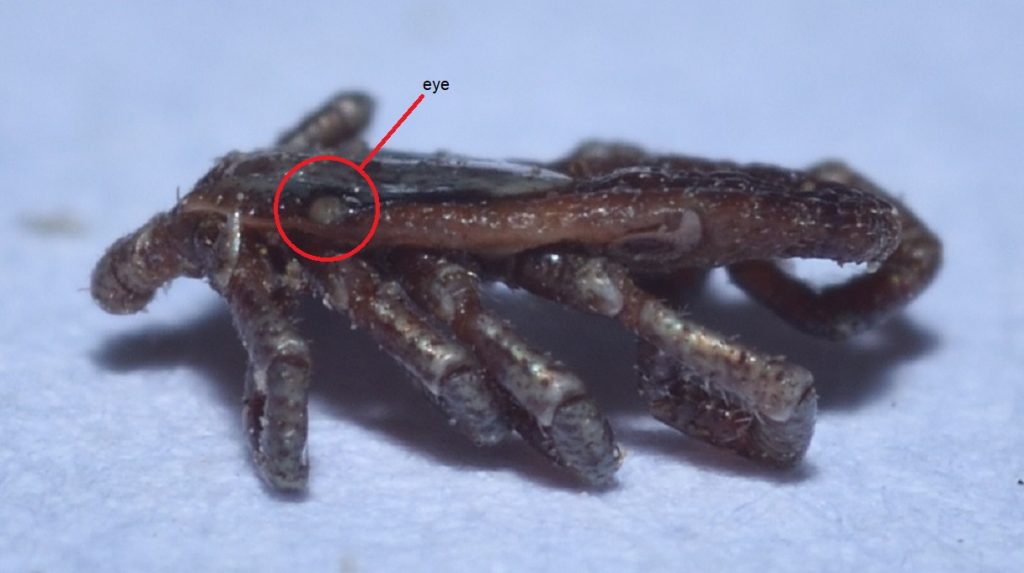
Millipede in the order Polydesmida
San Diego County 1/14/20
Millipede in the order Polydesmida
San Diego County 1/14/20
Millipede in the order Polydesmida
San Diego County 1/14/20

Vegan Wasps and Flying Mice


There is a family of wasps, the Sphecidae or thread-waisted wasps, that practice mass-provisioning. These wasps construct brood chambers which they fill with dead or paralysed insects or spiders. Different species of wasp specialize in different prey. Some collect mostly spiders, some collect mostly beetles, and so on. Once a chamber is fully-provisioned, the wasp lays a single egg in it, seals it, and begins work on the next chamber. Adult wasps feed on pollen and nectar from flowers, so it’s likely that pollen sometimes gets brushed off and falls into the brooding chamber. A lot would be stuck to the bodies of prey insects, as well. Pollen is an excellent source of protein, so it’s likely that the wasp larvae often eat the pollen.

At some point, around 130 million years ago, some unidentified species of Sphecid wasp must have started routinely supplementing its prey collection with pollen. Perhaps this came in handy when prey was in short supply. Over time, this wasp evolved to rely more and more on pollen and less and less on insects until, eventually, it was collecting only pollen. The first bee was born.

“[Bees] are simply wasps that have gone vegan” 117

Sphecid wasps are almost exclusively solitary, so the first bees would also have been solitary. Most of them still are. The average person can recognize only two types of bee — honey bees and bumblebees. This is a bit surprising, since there are about 20,000 bee species worldwide. Just in San Diego County, where I live, we have several hundred native species. To be honest, though, I’ve only seen a tiny fraction of those and I only recognize a few of them on sight. So maybe I’ll learn as much writing this post as you’ll learn reading it.

We may as well start with honey bees. Honey bees are members of the genus Apis. Currently, Apis includes seven species, only two of which — Apis mellifera and Apis cerana indica — have been domesticated. Apis mellifera, the western or European honey bee, is the only one of the two that has been spread widely beyond it’s native range. This is the honey bee most people are familiar with. Some people may be surprised to learn that honey bees are not native to North America. In fact, they’re believed to have originated in either Africa or Asia. It’s hard to tell for sure because humans have been spreading them around for thousands of years.

Honey bee (Apis mellifera) on nightshade blossom (Solanum umbelliferum)
Los Penasquitos Canyon, San Diego County. 06/09/19

Honey bees are famously social insects. Technically, they are eusocial. Eusociality is the highest level of sociality. To be classified as eusocial, a species must meet the following criteria:

  1. Cooperative brood care. Members of a colony care for offspring that are not their own.
  2. Overlapping of generations within colonies. Multiple generations live within a colony at the same time.
  3. Division of labor into reproductive and non-reproductive castes. Only one or a few individuals reproduce. The rest perform brood care and other tasks.
Honey bee (Apis Mellifera)
San Diego County. June 2017

Honey bees and other eusocial creatures are sometimes thought of as superorganisms. This is the idea that the entire colony functions as a single organism in which the individual members act more like cells than independent beings. Experiments have shown that in some ants — another eusocial organism — the colony as a whole exhibits more intelligence than the individual ants.

Honey bee (Apis Mellifera)
San Diego County. June 2017

An Very Close Look at a Honey Bee

I found this honey bee clinging to a rock. It was very sluggish and barely responded at all as I filmed it with my usb microscope. I’ve seen this sort of thing before in bees. Sometimes you’ll find one that’s so slow and unresponsive that you can pick it up in your hand without it reacting. Bees have very short lifespans. I suspect that bees get like this when they’re nearing the end of their days.

At any rate, this video gives us a chance to really examine the anatomy of the bee. Notice the “simple” eye on the top of the head between the two compound eyes. This is called an ocellus (plural ocelli). An ocellus has a single lens and just a few sensory cells. It’s used to detect movement.

I could easily devote the rest of this article to honey bees. (Heck, I could devote a whole blog to them.) But we’ve got a lot more bees I want to get to, so let’s move on to bumblebees…

Bumblebees are members of the genus Bombus. Prior to World War II, they were sometimes called “humblebees”, but that term has pretty much disappeared, except in some of the older literature. (Darwin called them that.) And, in times past, “dumbledor” was sometimes used to refer to bumblebees and other buzzing insects. (Now where have I heard that name before?)

A bumblebee (Bombus sp.) expelling waste
San Diego County
Do bumblebees really pee? Click here to learn the answer.

Most bumblebee species are also eusocial; however, they have not taken it quite as far as the honey bees. For one thing, bumblebee colonies are much smaller — usually between 50 and 400 bees. Honey bee colonies, by comparison, generally consist of around 50,000 individuals! Also, in temperate regions, bumblebee nests last for only one season. When the weather turns cold, they die off. The young queens go into hibernation for the winter and search for a place to start a new colony the following spring. Honey bee colonies, on the other hand, are perennial — they can last for many years.

There are many other ways in which bumblebees fall short of the level of social organization that honey bees have achieved. They don’t make combs of hexagonal cells — their brood cells are much more roughly made; they don’t make honey (honey bees make it to use during the winter when they can’t forage); their workers are not as specialized — a single bee will perform many different tasks; and they don’t do a “dance” to tell other bees where to find the good flowers.

One distinctive thing about bumblebees is that they do tend to be rather large insects. The largest is believed to be a South American species named Bombus dahlbomii. Adult queens of this species are about 1.6 inches (40 mm) long. They’re also quite fluffy, which has led to the popular name “flying mice”. Author Dave Goulson, perhaps most memorably, described the insect as “a monstrous fluffy ginger beast”. 119

A solitary bee that I often see in San Diego County is the mining bee or digger bee (genus Andrena). There are hundreds of species in the genus, but the ones I’ve seen are medium- sized, hairy bees with a tan or golden color. They’re called mining bees because the female digs a tunnel in the ground with branches leading off to individual brooding cells.

Mining bees (Andrena sp.) in hedgehog cactus bloom
Anza Borrego State Park, San Diego County. 03/30/19
Closeup
Well, I guess they’re not always solitary…
Note: This video is not sped up — it’s actual speed.
Mining bee (Andrena sp.) in four-o’clock blossom (Mirabilis sp.)

Another group of bees that are sometimes called mining bees are bees in the genus Perdita. These bees are small and often brightly colored. As you can see, the specimen in the photos below has a metallic sheen to the head and thorax. Perdita is one of the few types of bees that don’t have stingers.

Mining bee (Perdita sp.) in weed mariposa lily blossom
Mission Trails Regional Park, San Diego County. 06/04/19

Another group of solitary bees found in southern California is the long-horned bees (tribe Eucerini, family Apidae). These are small, hairy bees. The males in most species have unusually long antennae; hence, the “long-horned” in the common name. Presumably, this helps them locate potential mates. Although technically solitary, many of them nest in large groups and males are sometimes found in large aggregations. All long-horned bees nest in the ground.

Long-horned bees (tribe Eucerini) on splendid mariposa lily
Los Penansquitos Canyon, San Diego County. 06/09/19
Long-horned bee (tribe Eucerini)

I think the bee in the following photo may also be in Eucerini, but I haven’t been able to confirm that.

Bee in hooked pincushion plant (Navarretia hamata)
San Diego County. 06/04/19

The following series of photos are of an evening bee in the genus Hesperapis, family Mellitidae. I haven’t been able to find out much else about it. One of the species in this genus, H. regularis, which is native to California, constructs its brooding chambers underground. I would guess the other species in the genus do this, too, but I don’t know for sure. I saw this bee in the Sonoran Desert near East Butte.

Evening bee (Hesperapis sp.)
Sonoran Desert. 02/03/19
Evening bee (Hesperapis sp.)
Sonoran Desert. 02/03/19

Yet another solitary bee is the chimney bee or sunflower bee (genus Diadasia). Its host plants include asters, bindweeds, willowherbs, cacti, and mallows. Species that frequent cacti are sometimes called cactus bees. The most common host plants are mallows, which suggests that this was likely the ancestral host plant for the genus.

Diadasia constructs its brood chambers underground. The common name “chimney bee” comes from the fact that they built small turrets above the entrances to their tunnels. It’s not known what purpose these turrets serve. It’s been suggested that they help to prevent flooding, keep debris from falling into the tunnels, and/or protect the nest from predatory insects. At least sometimes, after egg-laying, a bee will disassemble the turret and use the mud to plug the tunnel entrance.

Chimney bee (Diadasia sp.) on a cholla cactus
Los Penasquitos Canyon, San Diego County. 06/09/19
Chimney bee (Diadasia sp.)

One last bee I want to talk about is the carpenter bee (genus Xylocopa). Unfortunately, I don’t have any good photos of them, but they’re so common and distinctive that I felt I should mention them anyway. These are large bees that look a lot like bumblebees, but they’re mostly black. Some species are entirely black. One way to tell for sure whether a bee is a bumblebee or a carpenter bee is to examine its abdomen. Carpenter bees generally have shiny abdomens; whereas, bumblebee abdomens are extremely hairy. They’re called carpenter bees because most species construct their nests by burrowing into wood or other hard plant material like bamboo.

Bee Impostors

Many harmless insects have evolved to resemble bees or other harmful insects (harmful as in stinging or biting or just tasting really bad), thus decreasing the chances that a predator will try to eat them. This is called Batesian mimicry. What looks like a bee in the following photos is actually a type of hoverfly or Syrphid fly.

Hoverfly (Eristalis sp.) in splendid mariposa lily
San Diego County. 06/02/19
A closer look…

Of Mites and Men… and Ticks

One of the frustrations of macro photography is that, no matter how powerful your lens, it’s never powerful enough. There’s always some tiny bug that you can almost make out, but not quite. Mites are a case in point. Some mites are completely invisible to the unaided eye. Many others are visible, but just barely. Mites are super common, so I’ve photographed a lot of them, but usually with very poor results.

So I bought a microscope. It’s not a great microscope. It was manufactured in China; as far as I can tell, it doesn’t have any brand name; and it took about a month for it to get here. On the other hand, it was cheap, it’s portable, and, because it plugs into the usb port of my smartphone or laptop, it doesn’t require batteries. It also magnifies up to 1000x, which is not bad. It can take both videos and still shots. Oddly enough, the videos have better resolution, so I always take videos and make screenshots of the frames that I like.

As soon as I began using my new microscope, I started seeing mites all over the place. They were in moss and lichens. They were crawling around on mushrooms. A strange new world was revealed. In this article, I’ll try to give you a quick introduction to that world.

So what are mites? Mites are arachnids, which means they’re related to spiders. Like spiders, they have eight legs in their adult form. They’re also related to ticks, although maybe not as closely related as their appearance would suggest. More on that later. Here’s a photo of a fairly typical mite:

Sidewalk mite (genus Balaustium)

The bodies of mites and ticks are divided into two segments — the cephalothorax and the opisthosoma. The cephalothorax is a fusion of the head and thorax. The opisthosoma is the rear part of the body. It’s similar to the abdomen of insects, but has a few different internal organs. Sometimes the division between the two segments is easily discernible. Most times, like in the above photo, there’s no clear separation.

Mites and ticks are grouped together for convenience into the suborder Acari. I say “for convenience” because this is not a natural grouping. Some types of mites are more closely related to other types of arachnids like Solifugidae (sun scorpions) than they are to other mites. Some research even suggests that ticks are more closely related to spiders than to mites. Nevertheless, historically, they’ve tended to get lumped together, so I’m going to follow that tradition by covering them both in this article.

Mites have a very long evolutionary history. The oldest fossil mite dates back to the early Ordovician about 480 million years ago. So they’ve had plenty of time to diversify and they haven’t wasted it. It’s a hugely diverse group.

Ticks are quite a bit younger, but they do go back at least 145 million years, which puts them right in the middle of the age of dinosaurs. Lumps of 99 million-year-old amber found at a fossil site in Myanmar contain material from a dinosaur nest, including a number of ticks, bits of beetles, and at least one feather from a dinosaur. (Yes, many dinosaurs did have feathers. See my earlier post The Coolest Thing about Birds.) The feather couldn’t have been from a bird because they hadn’t evolved yet. This is the strongest evidence we have to date that ticks parasitised dinosaurs. This isn’t surprising, but it’s always nice to have hard evidence.

Among he ticks preserved in this amber was a previously unknown species, which the researchers named Deinocroton draculi or “Dracula’s terrible tick”, because one of the ticks was still bloated with blood. You can check out an article about this discovery in The Guardian. It even includes a nice interactive 3D model of Deinocroton draculi.

Another bit of amber found in Myanmar, also from about 99 million years ago, contains a tick wrapped in spider silk. One paleontologist speculated that the tick may have been trying to feed on small, tree-climbing rapter dinosaurs when it got caught by the spider. You can read about this find on National Geographic‘s website.

While all ticks are parasitic, mites have a variety of lifestyles. Some eat plants; some are detrivores, living off decaying material; some are predators; and some are parasites. A mite might be parasitic as a larva or nymph and switch to another way of making a living as an adult. Or it might be parasitic as an adult, as well.

Some More Visuals

The following series of photos shows the nymphal form of a mite of the genus Leptus (family Erythaeidae) parasitizing a harvestman (aka daddy-long-legs). This is an unusually large mite, so I was able to get some pretty good photos with my macro lens.

Harvestman (genus Eurybunus) with a parasitic mite attached to its leg

Leptus uses its mouth-parts to pierce the skin. It then injects saliva into the opening. The saliva contains digestive juices which break down cells and cause the surrounding tissue to harden. The mite sucks up the digested cells. The saliva gradually seeps lower into the body of the host, breaking down cells and hardening the surrounding tissue as it goes. The resulting tube is called a stylosome and acts like a drinking straw for the mite. (Note: What looks like the head in the above photo is actually the mouth-parts. As noted earlier, the head and thorax in mites are fused together.) In its adult form, Leptus is predatory.

Speaking of predatory, the next series of photos shows a whirligig mite (family Anystidae) eating a thrips. Thrips are very tiny insects that are often found on flowers. (“Thrips” is both the singular and plural form.)

Whirligig mite eating a thrips

I collected this mite in a small plastic container. Later, I came across some thrips and caught a few of them, too. When I got home, I shook out the contents of the container onto a sheet of typing paper and started using my microscope to try to videotape the mite. I wasn’t having much luck because the mite was moving around too quickly. Then it suddenly stopped. When I finally got it in focus, I found out why. It had latched onto one of the thrips and was busily sucking it dry.

Here’s a couple of videos. Notice that you can see the mite’s internal organs working in the first video.

The next video is a little less violent. It shows a winter grain mite (Penthaleus major) crawling around on some lichen. I think I probably brushed it with the microscope, which is why it’s flailing around so much. I doubt that it’s that clumsy ordinarily.

One of the first things I looked at when I got my microscope was this huge mushroom:

Mushroom in Mission Trails Regional Park, San Diego County

And this is the mite I saw on it. It’s in the order Mesostigmata. I love the way it looks like it’s crawling around in a snowfield. Oh, and you get a couple of quick glimpses of an ant, which should give you some idea how of just how tiny this mite is.

The next video shows some mites on a lichen. It looks like there may be a couple of different species here. Notice that some of them appear to have glued bits of rock onto their backs as camouflage. (You can see it a lot better if you view the video full screen.) According to Matthew Shepherd (see comments), these mites are probably in the genus Bryobia, which is in the spider mite family Tetranychidae.121

Phoresis

I know this next part is going to gross some people out. I found this beetle under the bark of a rotting log (which is a great place to find beetles, btw). This is a clown beetle (Hololepta populnea). As you can see, it was covered in mites. In the original version of this article, I said that the larger mites were probably orbatid mites. This was incorrect. Matthew Shepherd (see the comments) correctly identified them as turtle mites (family Uropodidae). They are in the order Mesostigmata.

Mites in this order are free-living and predatory — they’re not parasitic.126 So what, you may ask, are they doing on this beetle if they aren’t parasitising it? This is an example of phoresis. Phoresis is when one organism hitches a ride on another organism. It’s a means of dispersal. The most obvious example is when a seed clings to the fur of an animal, but it’s common among other organisms, as well, including mites.

There are many advantages to phoresis. If an organism is limited to one small area and the environment in that area changes drastically, it could easily be wiped out. Dispersal over a wide area also helps to prevent inbreeding. Phoresis can even be used as a method of seasonal migration (although I doubt that’s relevant to mites).

According to Matthew, “The name ‘uropoda’ means tail-foot and relates to the unusual phoretic adaptations of the deutonymphs [second larval stage] in this family. When the nymphs crawl onto a beetle, they exude a tough stalk called an ‘anal pedicel’ out of their anus which they glue onto the beetle’s back, which then dries, sometimes lifting the animal up and holding it like a lollypop on a stick, while the beetle-transport heads off on its way to pastures new.”

More on Ticks

Getting back to ticks, most of them belong to one of two families — the hard ticks (Ixodidae) and the soft ticks (Argasidae). The hard ticks are so-called because they have a hard shield or scutum on the top of their cephalothorax. The mouth-parts project forward from the body and are easily visible from above. Soft ticks lack a scutum and their mouth-parts are underneath the body.

As noted earlier, all ticks are parasitic. Various species feed on the blood of mammals, birds, reptiles, and amphibians. Ticks go through a series of stages in their lifecyle from egg to larva to nymph to adult. Hard ticks feed from three different hosts during their lifetimes. Soft ticks may have as many as seven nymphal stages, each one requiring a blood meal.

Sadly, I don’t have any photos of ticks in my personal collection. Fortunately, my friend Meridith (of spittlebug fame) sent me this awesome photo of male and female American dog ticks (Dermacentor variabilis). The female is the one with the white patch at the front of the body:

American dog tick (Dermacentor variabilis)
© Meridith Erickson. 2019

Of Dust and Dander

We have mites in our homes and mites on our bodies. Most of you have probably heard of dust mites. Also called house dust mites (or HDM), dust mites include a number of different species commonly found in homes. They eat mostly dead skin shed by humans and their pets, which is known as dander. It’s been estimated that about 80 percent of the dust that you see floating in sunbeams consists of dander, so they find plenty to eat. Dust mites don’t carry diseases and they aren’t normally harmful to humans, but some people can have allergic reactions to their feces and shed exoskeletons.

Two species of mite are known to live on our bodies — Demodex folliculorum and Demodex brevis. D. folliculorum reproduces in hair follicles and D. brevis reproduces in the sebaceous glands near the base of hairs. Otherwise, the two species are very similar. Unlike typical mites, they are long and worm-like with very short legs. These mites are usually harmless; although, D. folliculorum can cause a disease called Demodicosis. It’s believed that all people have mites living on them, but, since it’s not easy to collect them, this hasn’t been confirmed. Click here to read an article about body mites that includes some interesting photos.

Update 07/03/2019

While hiking with a meetup group over the weekend, one of the people in the group found a tick crawling on her. Quickly admonishing her not to brush it off (and ignoring the exaggerated eye-rolls of my companions), I collected the tick in a small plastic container. So I was finally able to get some photos to supplement the one Meridith sent me.

It appears to be another female American dog tick. In the following photos, I’ve highlighted a bit of the anatomy. The first photo shows the scutum — the hard “shield” on the tick’s back. On the male, this would cover the entire back, but, on the female, it leaves room for the body to expand when the tick drinks blood.

American dog tick (Dermacentor variabilis) – female

It’s difficult to tell in these photos, but the hypostome is separate from the chelicerae on either side of it. The chelicerae are similar to jaws. The tick uses them to cut or scrape through the skin. The hypostome is a combination harpoon and drinking tube. If you’re interested, you can read a rather technical scientific article about these mouthparts here.

As noted previously, the tick doesn’t have a head separate from the rest of the body. The eyes are actually on the side of the body.

And just because you were wondering…

The Diabolical Ironclad Beetle

Sam Wells, in his blog post about the diabolical ironclad beetle, states: “How the species got its name is a mystery to me.” Personally, I don’t find it all that mysterious. To me, it looks exactly like it’s encased in cast iron. And, imho, any beetle that looks like it’s encased in cast iron also looks pretty friggin’ diabolical.

In any case, the diabolical ironclad beetle, Phloeodes diabolicus127 is very well-armored. Reportly, you can step on it and it will just get up and walk away. There have even been reports of them being run over by cars without incurring any damage. An insect collector, wanting to mount a specimen. will often resort to using a drill to make a hole in the beetle’s carapace for the pin. It’s just too hard to force a pin through manually. This is one tough bug.

An ironclad beetle is any member of the beetle subfamily Zopherinae, so there are lots of different kinds. P. diabolicus is the only one I’ve seen in San Diego County, though. I haven’t been able to dig up much information about the beetle. Supposedly, they are found in woodlands under the loose bark of oak trees or cottonwoods. According to Charles Hogue in Insects of the Los Angeles Basin, “They are thought to feed on punky fungus-ridden wood.” I can add to this that they also feed on large mushrooms, as evidenced by the following video and photo. The ironclad is, of course, the roughly textured one. The other beetle is a species of Eleodes — a desert stink beetle.

Diabolical ironclad beetle (Nosoderma diabolicum) in the front and a desert stink beetle (genus Eleodes) in back

What Makes a Beetle a Beetle?

Beetles are insects in the order Coleoptera. Coleoptera comes from the Greek words koleos, which means sheath, and pteron, which means wing. Most modern insects have two pairs of wings. In beetles, the front pair have evolved to form thickened, protective shields for the membraneous hind wings. Only the hind wings are actually used for flight. The protective front pair are called the elytra.

Having only one pair of functional wings, plus the extra weight of the elytra, makes beetles less efficient flyers than many other insects. As a result, beetles tend to fly less often and they’re generally slower to resort to flight to escape threats. On the other hand, a hardened elytra is excellent armor. Also, being able to tuck the delicate wings inside the elytra allows the beetle to crawl into narrow spaces or burrow into things without having to worry about damaging its wings.

The following photo shows a blister beetle with its elytra open, exposing the thin hind wings.

Gnathium sp.
Gnathium sp.
Anza Borrego State Park near East Butte 02/03/19

Update: 9/11/20

In the original version of this post, I gave Nosoderma diabolicum as the scientific name for this beetle and Phloeodes diabolicus as a former name. According to Hisserdude on BeetleForum.net, this is incorrect. Phloeodes diabolicus is the correct name. I’ve updated this post accordingly. I’ve also deleted a bit about the number of species in Nosoderma and replaced it with a blurb about the beetle subfamily that the ironclads make up. You can read Hisserdude‘s argument by clicking on this link: Diabolical Ironclad Beetle (Phloeodes diabolicus) PSA.

The Stuff of Nightmares

There are a lot of tarantulas in Southern California. They’re big and hairy and they have very large fangs. This article is not, however, about tarantulas. It’s about a tarantula’s worst nightmare…

Milde’s tarantula hawk wasp (Pepsis mildei)128 is a beautiful insect. Its body is a deep blue-black, its eyes are pitch black, and its wings are reddish orange. The females can be up to two inches long. They’re fairly common in Southern California and are easy to spot.

Milde’s Tarantula Hawk Wasp (Pepsis mildei)
Sweetwater River Trail 9/8/17

The adult wasps feed off nectar, pollen, and fruit juice. (Sometimes they feed off fermented fruit and get so drunk they have trouble flying.) They frequent milkweed, western soapberry trees, and mesquite trees.

Male tarantula hawks don’t have stingers. Actually, no male insects have stingers. There’s a very good reason for this — stingers evolved from ovipositors. An ovipositor is a tubular organ through which an insect lays its eggs. Ovipositors come in a great variety of forms from short and thick to ridiculously long. Some insects totally lack ovipositors and just lay their eggs through an opening in their abdomens. Others have ovipositors with sawtoothed edges. They use these to saw into the stems or leaves of plants, so they can lay their eggs inside.

But in many insects, the ovipositor has lost its original function of laying eggs and, instead, is used to inject venom. In other words, it’s become a stinger. Obviously, a stinger is a pretty great form of self-defense. It can also be used to subdue prey. But, because stingers evolved from ovipositors, only the females have them. So the male tarantula hawk is totally harmless.

The female is another story. The sting of the female tarantula hawk is extremely painful. In fact, according to Justin Schmidt, who developed the Schmidt sting pain index, the tarantula hawk has the second most painful sting of any insect.129

Females are not aggressive toward humans and you’re unlikely to get stung unless you happen to step on one while barefoot. If you are unlucky enough to get stung, though, Dr. Schmidt’s advice is to immediately lay down (so that you don’t hurt yourself running around blind with pain) and begin screaming. (Actually, you won’t have any choice about the screaming part.) Fortunately, the worst of the pain only lasts about five minutes. Unless you happen to be allergic, the sting is not dangerous and, when the pain finally subsides, you’ll have a great story to tell.

The tarantula hawk wasp is a parasitoid. A parasitoid is a parasite that kills its host. In this case, the host is a tarantula. A female wasp will fly around close to the ground, searching for tarantulas. She may even crawl inside the burrow of a tarantula to attack it where it lives. When she finds one, she stings it to paralyze it, then she drags it to a burrow that she dug earlier (or if she stung it inside its own burrow, she may leave it there). She then lays a single egg on the spider’s abdomen and seals the burrow. When the egg hatches, the larva burrows into the tarantula’s abdomen and begins to feed. Note that the tarantula is still not dead. It’s still paralyzed from the sting and will remain so until it finally dies from the larva feeding on its insides. The most amazing part, though — the most horrifying, gruesome, yet amazing, part — is that the larva feeds on the non-vital parts of the spider first, in order to keep it alive and fresh for as long as possible!

Dragging a paralyzed tarantula

While hiking on the Sweetwater River Trail near Jamacha, CA, I chanced upon a tarantula hawk wasp that had just stung a tarantula and was dragging it along the hiking trail. The video and photos accompanying this article all came from that encounter. I must have spent around twenty minutes observing the wasp. I was hoping to get a video of it actually placing the spider in a burrow, but I think the light from my headlamp (this was around dusk) must have been confusing it. It seemed to be dragging the tarantula around at random. It was probably trying to get it out of the light. I was able to get quite close to the wasp — almost touching it. It never acted the least bit aggressive. I don’t think it felt threatened — just confused. Since tarantula hawks don’t have nests to defend and don’t have many natural enemies, they tend to be docile. I finally gave up and left it alone with its prize.

The Bug That Blows Bubbles Out of Its Butt

Froghoppers are insects in the order Hemiptera — the true bugs. The main characteristic of a true bug is having piercing and sucking mouth-parts. Most hemipterans, including the froghoppers, use these mouth-parts to suck sap from plants.

Froghoppers are so named because of their jumping abilities. The adults of some species can jump up to 70 cm vertically — an amazing feat for a such a small insect. Relative to their body mass, they are better jumpers than fleas!

The most interesting thing about froghoppers, though, is that their larvae blow bubbles out of their butts! Like the adults, the larvae suck juices from plants. Unlike the adults, they excrete the excess sap from their rear ends as bubbles. The bubbles form a foam around them which looks like a gob of spit. This gives the larvae their common name of ‘spittlebugs’. The foam has a number of purposes. It hides the insect from potential predators. It has an acrid taste, which also helps to discourage predators. It insulates the larvae from heat and cold and it keeps them from drying out. Who knew that blowing bubbles out of your butt was such a useful skill?

I should mention that there’s one family of froghoppers, Machaerotidae, that doesn’t produce foam. They live in calcareous tubes, instead. The Machaerotidae are Old World insects, though, so you won’t find them in here in North America.

Spittlebugs are very common insects here in Southern California. In the warmer months, I see their gobs of foam on various bushes, usually several gobs per bush. You can brush the foam away to uncover the larva. It’s very small, so you’ll need a magnifying glass or similar device to get a good look. (Or you can just look at the photos and videos attached to this post.)

Many thanks to my friend, Meridith, for holding one of the larva while I photographed it. It’s her finger that’s prominently featured in a number of the photos.

Clastoptera juniperina blowing bubbles
Another Clastoptera juniperina blowing bubbles

A gob of spittlebug foam on a bladderpod plant
A closer look

Some more photos of Clastoptera juniperina, the most common spittlebug in my area…

Hilltopping Ants

In July of 2016, not too long after moving to California, I hiked to the top of a peak in the Colorado Desert. When I got close to the top, I witnessed an astounding sight — hundreds of thousands of ants flying in a vast swarm at the highest point of the peak. (Yes, you read that right — flying ants. More on that later.)

The phenomenon is called hilltopping and I’ve encountered it in ants a couple of times since then. The last time was on the top of Stonewall Peak near Julian, CA. My nephew, Derrick, was hiking with me. It was the first time he’d encountered hilltopping ants, so I got some great videos of him savoring the experience.

Ants hilltopping. Stonewall Peak near Julian, CA. July 2016.

Many people are surprised to learn there are flying ants. The majority of ants in a colony are workers. All the workers are female, but they’re sterile, so they don’t reproduce. All they do is work. An ant colony needs some way to start other colonies, though, so the colony also produces non-sterile ants. Naturally, these come in both the male and female variety and, when sexually mature, they have wings. (This is true for most types of ants. As with most things in nature, there are exceptions.)

At certain times during the year, typically in spring or summer, all the reproductive ants of a particular species in an area will leave their colonies and come together in a huge swarm to mate. How do these ants find each other? One solution is hilltopping. When a flying ant leaves its colony, it will head for the highest spot in its immediate vicinity. As a result, ants will congregate at the summit of the highest peak in the area.

Many hiking peaks have registers at the top. A register is just a notebook inside a can or jar, which is usually left wedged in between some rocks. Hikers will sign the register — writing their name, the date, and maybe a comment or two. So you end up with a record of the hikers that have visited a peak over the years. On that peak back in July 2016, the register was inside a large red can. The can was easily visible and the entire swarm of ants was centered directly on it! It’s hard for me to get across just how remarkable this was. The swarm covered a large area, but it was at its absolute densest right at that can. It was very obviously the center of the swarm.

Why were the ants targeting the can? Two possibilities come to mind. The top of the can could have been the absolute highest point of the peak — it did look pretty close. The other possibility is that the ants were attracted to the can because its bright red color made it stand out. I’m leaning towards the latter explanation. I’ve read that some types of ants will congregate around the shiniest object in a vicinity instead of the highest point. Maybe this particular species combines the two behaviors.

After mating, the male ant dies, his purpose in life fulfilled. Their bodies will collect in depressions in the ground where you can scoop them up by the handfuls! The female, meanwhile, flies off to find a place to start a new colony. Her chances are not good — ants are tasty snacks for a lot of animals — but if she survives long enough to find a suitable spot, she uses her legs to break off her wings, digs a chamber in the ground, and gets down to the business of laying eggs.

Many other types of insects hilltop. I often see butterflies hilltopping, for instance. Unfortunately, they don’t do it in vast swarms like the ants. (How cool would it be if they did?) The males of some butterfly species will actually establish a territory, chasing off intruding males. I’ve even seen a butterfly chasing off a small bird! Sometimes two male butterflies will fly around each other in a spiral, flying higher and higher, until one of them gives up. This establishes the dominance of the other male. I presume the loser will fly off, leaving the territory to the winner.